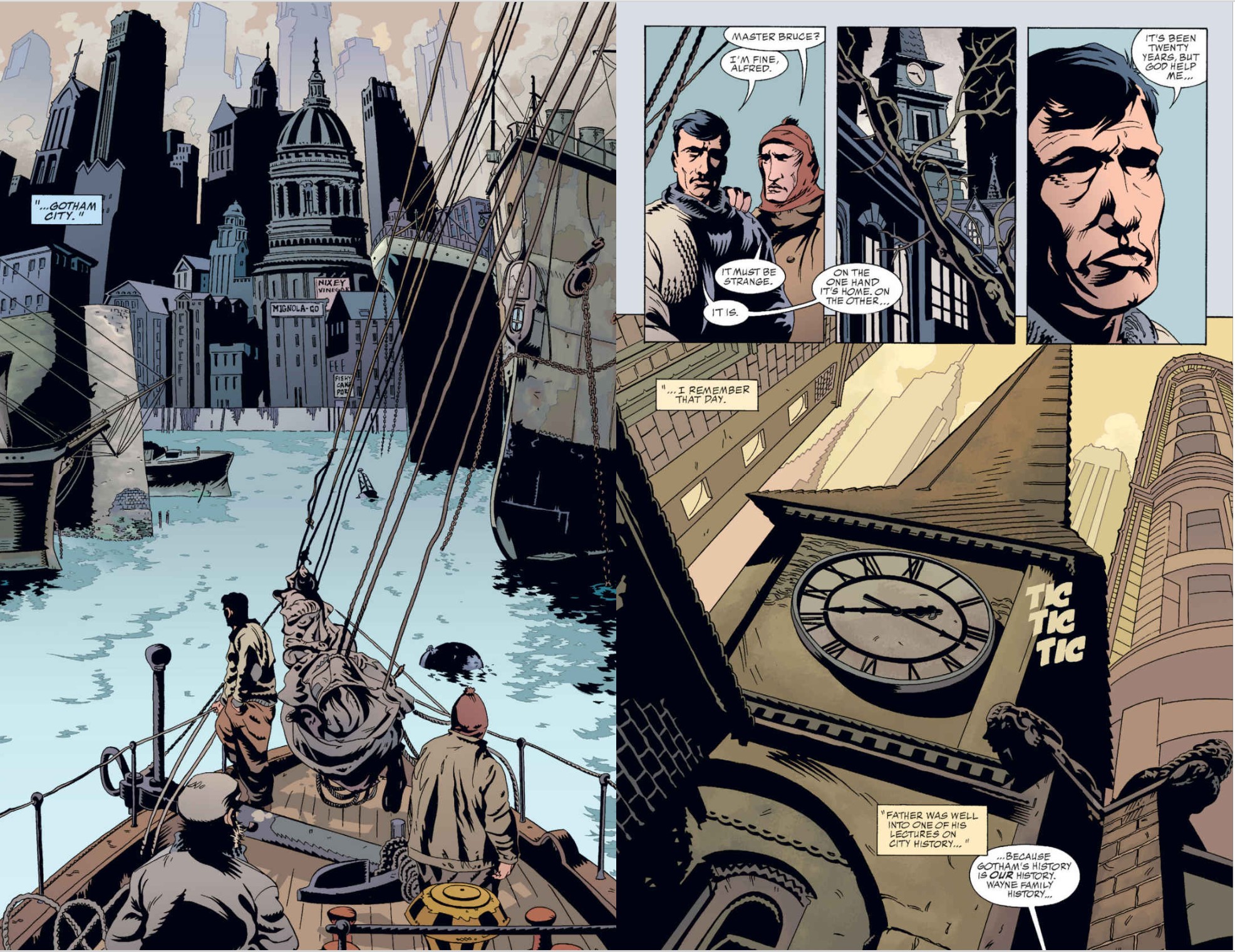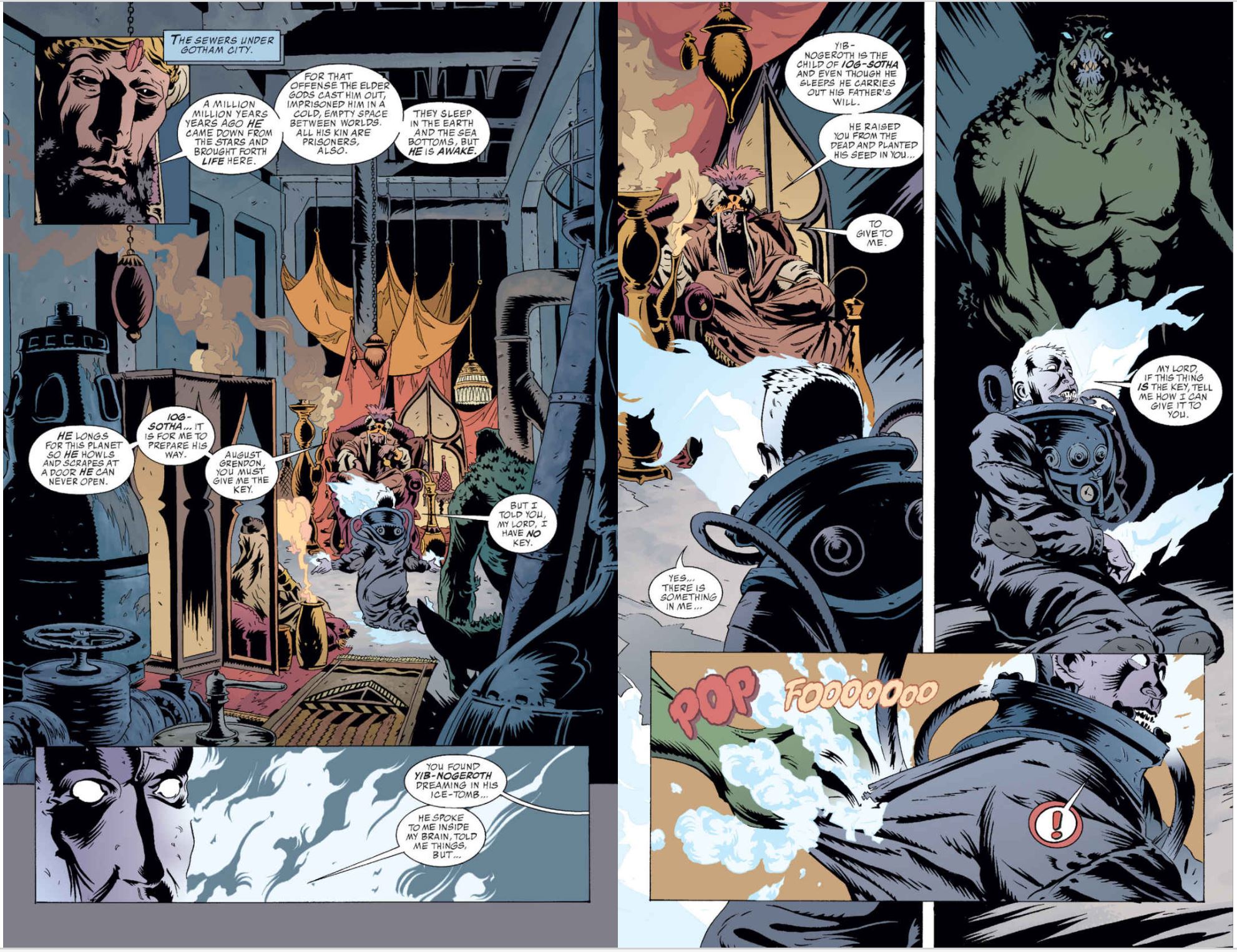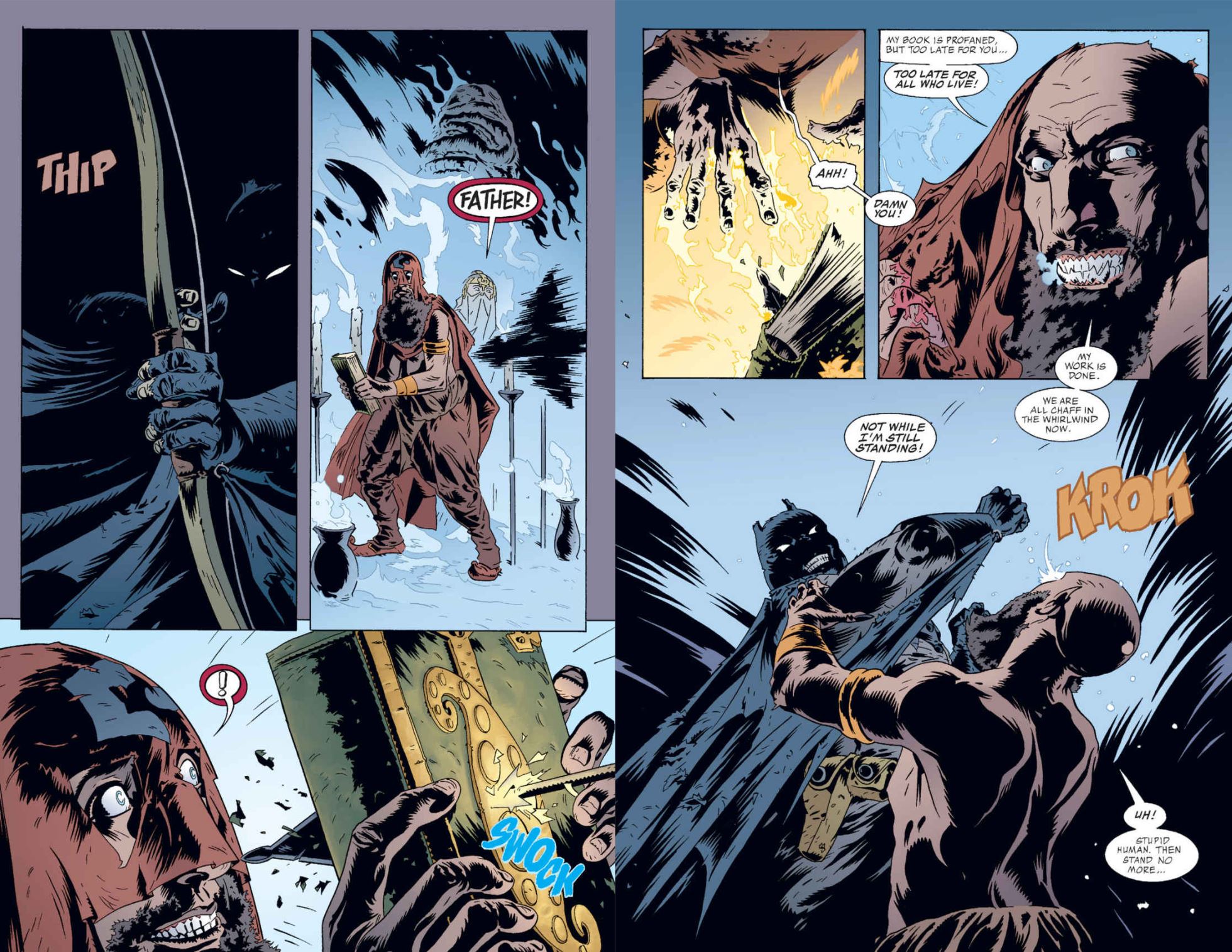
Alone volumes 1 and 2: The Vanishing and The Master of Knives


By Gazzotti & Vehlmann, translated by Jerome Saincantin (Cinebook)
ISBNs: 978-1-849181-96-9 (PB Album/Digital edition vol 1) 978-1-84918-206-5 (PB Album/Digital edition vol 2)

These books include potentially Discriminatory Content produced for dramatic effect.

Fabien Vehlmann was born in 1972 yet his prodigious canon of work (from 1998 to the present) has earned him the soubriquet of “the Goscinny of the 21st Century”. He entered the world in Mont-de-Marsan and grew up in Savoie, growing up to study business management before taking a job with a theatre group. In 1996, after entering a writing contest in Le Journal de Spirou, he caught the comics bug. Two years later with illustrative collaborator Denis Bodart he published a mordantly quirky, sophisticated portmanteau period crime comedy entitled Green Manor. From there on his triumphs grew to include – amongst many others – Célestin Speculoos for Circus, Nicotine Goudron for L’Écho des Savanes, The Marquis of Anaon and major-league property Spirou and Fantasio

Bruno Gazzotti is Belgian, born in 1970 and was a student of Institut Saint Luc in Liège. Another artist addicted to comics from his earliest years, he started being paid to draw them in 1988, after being hired by Le Journal de Spirou editor Patrick Pinchart on the strength of his portfolio alone. Before long he was illustrating Le Petit Spirou with Tome & Janry. In 1989, he and Tome created New York Cop Soda, which kept Gazzotti busy until 2005, when he resigned to co-create award-winning feature Seuls

Alone volume 1: The Vanishing

Released in January 2006, Seuls – La disparition is a superb example of a kids’ thriller suitable for all ages: evoking the eerie atmosphere of TV series Lost, with notes of modern phenomenon Stranger Things and the most disturbing elements of Philip Wylie’s novel The Disappearance and William Golding’s Lord of the Flies.

Translated as The Vanishing, the first chapter show glimpses of an ordinary bustling town, with simple folk going about their business. Our swift peeping settles on a cross section of kids: Ivan, an imaginative child of wealth who wants for nothing but never sees his dad anymore and Leila, a born engineer, inventor and tinkerer. Her poor but honest dad always has time to play and favourably critique her latest gadget…

Camille is studious and over-focussed on exams and achievement and Terry is pretty much still a baby. He certainly acts like one, trying to stay up late, binge watching TV and throwing tantrums if he doesn’t get his way. Sadly, not all the children in town have such typical lives. Dodzi has just been taken into the social care system. His early life has made him tough and resilient but won’t stop other young inmates handing him a beating on this ominous, odd-feeling portentous night…

Morning dawns overcast and forbidding. The city is quiet. Roaming empty streets, Dodzi calls out to anyone who can hear and is met – actually run over – by Leila and Terry on her bike. They are all pretty scared and have seen nobody else at all…

No one else is around. All the adults are gone, and every kid they know. The internet is down, television and radio only roar out static. Above, fearsome ponderous storm clouds gather. Within minutes fear turns to panic and violence before, eventually, Dodzi brutally enforces calm and leads them away, only to stumble into Camille being attacked by a dog. As the tough guy tries to fight it off, the rabid beast senses something in the shadows of an alley and bolts away…

As the youngsters wander, someone watches the shocked, scared waifs, and after they joyously blow off steam in a fountain, they meet final lost boy Ivan. He invites them back to his mansion at the edge of town where they find food while being subjected to his theories on what’s happened… everything from a shared dream to an extinction event to the possibility that they’re dead and in hell…

Needing more information, Dodzi and Leila try to drive one of many cars on the estate while the smaller kids sort out a proper meal. Neither task goes well. The cooking is a disaster while the near-lethal reconnaissance only reveals more empty streets, wrecked shop fronts and wild animals roaming the avenues and alleys. While the motoring minors seek to evade two rhinos, Terry and Camille are nearly eaten by a white tiger that’s got through the estate gates! When Dodzi and Leila return – and following a burst of viciously released tensions – the kids modify and weaponize a 4-by-4 and head back into town. Ivan’s dad owns the tallest building in the city: somewhere stuffed with crucial resources and a place easily fortified and defended…
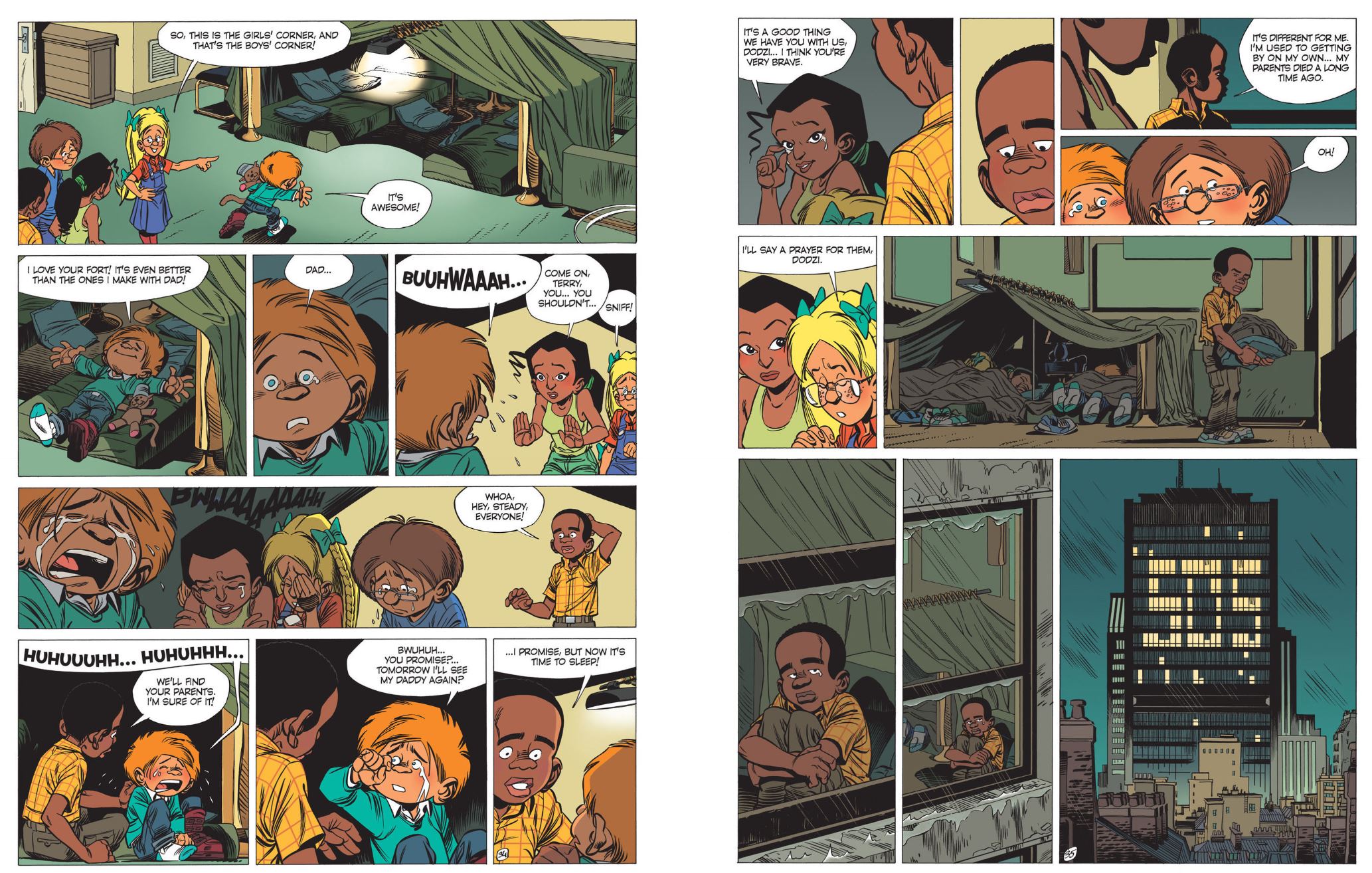
As the first day alone ends, the kids are bloated with vending machine snacks and playing in the vast office block’s upper reaches, but de facto leader Dodzi is still uneasy. When Leila reports tiny Terry is missing, the notional “man-in-charge” heads out to search, finding to his horror where all those animals came from: a scene of destruction that distracts Dodzi enough that a hidden stalker almost takes him. Naturally, the others have completely ignored his orders and followed, so it isn’t Dodzi who dies…

Thus begins a spooky, powerful and often shocking tale of mystery and imagination with bereft children facing increasingly daunting physical hazards and an escalating series of events which can have no logical or rational explanation…

To Be Continued…

Alone volume 2: The Master of Knives

Debut volume The Vanishing showed an ordinary bustling town rendered an empty mausoleum overnight, with a small cross-section of kids left to survive or die. When it happened, the mystified minors wandered a terrifyingly quiet, suddenly unfamiliar environment until finding each other and the relief of “bad kid” Dodzi who reluctantly took responsibility for their staying alive. Adults were gone, all outside contact severed and wild beasts stalked them so Dodzi brutally enforced calm and lead them away to find a succession of temporary – albeit palatial – refuges to regroup and think. Encounters with escaped circus animals resulted in the little band settling in the towering Majestic Hotel to await whatever came next…

Originally released as Seuls: Le Maître des couteaux in 2007, The Master of Knives opens with Dodzi scouting the vacant metropolis and helping Leila consolidate supplies for a long stay in the lap of luxury. His nervousness remains high as close calls with the liberated beasts in the streets come continually, but the younger children seem to be adapting well. It certainly helps that they are hoarding every toy and treat they find in abandoned shops and houses. Ivan has a plan to occupy him too: systematically calling every telephone number in the phone book. No luck yet, though…

Things start to go south swiftly after he finds his father’s pistol and tempts Leila into a spot of rooftop target practice. When Dodzi furiously confiscates the lethal plaything, he has no idea that he has now become the preferred prey of a mystery stalker. As this masked pursuer enacts a chilling campaign of terror, stressed-out Dodzi agonisingly learns that he is not the only obsession of the terrifying, nebulous cloaked figure draped in blades and daggers…
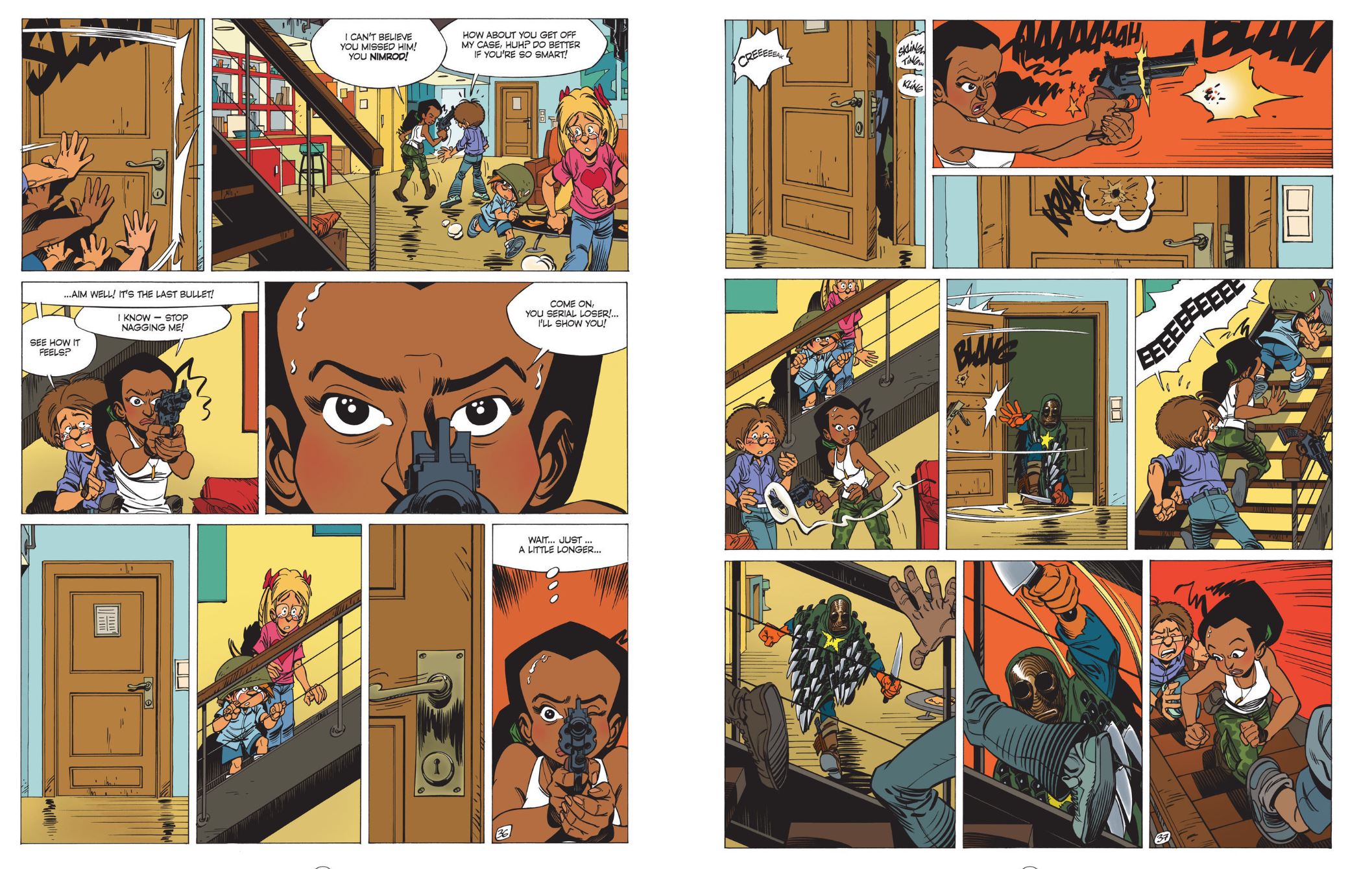
While the others obliviously fritter away the day, pressure-laden Dodzi is remorselessly hunted over rooftops by the manic killer. When he briefly eludes the hunter, the Master simply doubles back to menace the children in the hotel. Ultimately a shocking confrontation ensues, with the tables turned… but only at the cost of Dodzi’s closely withheld shameful secrets being exposed to all…

In the painful aftermath, the days of innocence are discarded and the orphan family prepares to hit the open road to see if other cities have been emptied too…

To Be Continued…

This spooky, powerful, frequently shocking tale of mystery and imagination sees bereft children facing increasingly daunting physical hazards and an escalating series of events which apparently have no logical or rational explanation. Tension and terror inexorably amplifies with every instalment – just like the real world at the moment.

Alone – running to 12 translated volumes thus far of a projected 14 – was one of the biggest critical and commercial comics hits of the last decade (more than 2 million copies sold!). Seuls even made it to the big screen in 2017, so if you love eerie enigmas and powerful tale-telling, you’ll soon be buying this, you’ll buy these and successive releases to know why…
© Dupuis 2006 and 2007 by Gazzotti & Vehlmann. All rights reserved. English translation © 2014 Cinebook Ltd.

Today in 1912, Terry and the Pirates crafter George Wunder (officially in charge from December 30, 1946 to 1973) was born, followed in 1930 by filmmaker and occasional Superman comics scripter Richard Donner. That same year cartoonist/children’s book illustrator Howie (Eek & Meek) Schneider arrived. In Canada in 1957, small press maven John McLeod (Dishman, Space Kid) joined the party, as did superhero/cover star J.G. Jones in 1962.

This date in 1981 we lost the great Howard Purcell (Sargon the Sorcerer, Green Lantern, Gay Ghost, Mister District Attorney, Enchantress, Sea Devils, Nick Fury, Black Knight, DC mystery and Sci Fi anthologies) and in 2004 comics author and scripter Nat Gertler initiated the first 24-hour comics day.
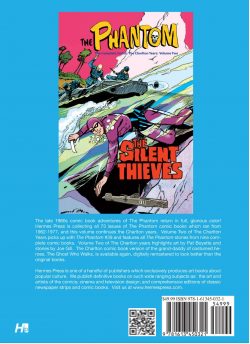
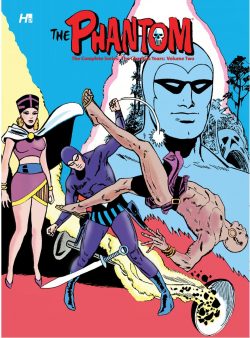
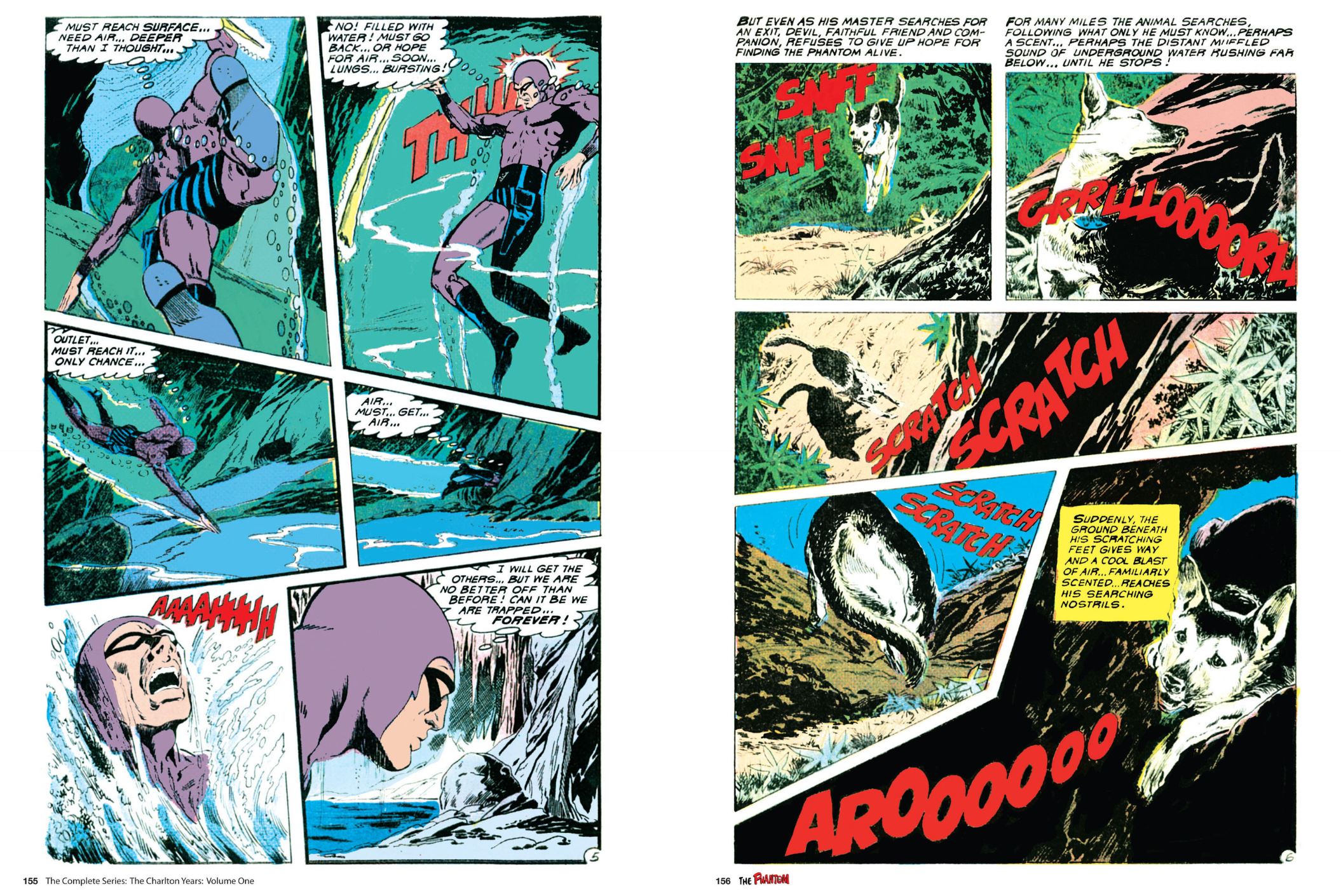
The Phantom – The Complete Series: The Charlton Years Volume Two


By Pat Boyette, Joe Gill, D. J. Arn
eson
& various (Hermes Press)
ISBN: 978-1-61345-032-1 (HB/Digital edition)

This book includes Discriminatory Content produced in less enlightened times.

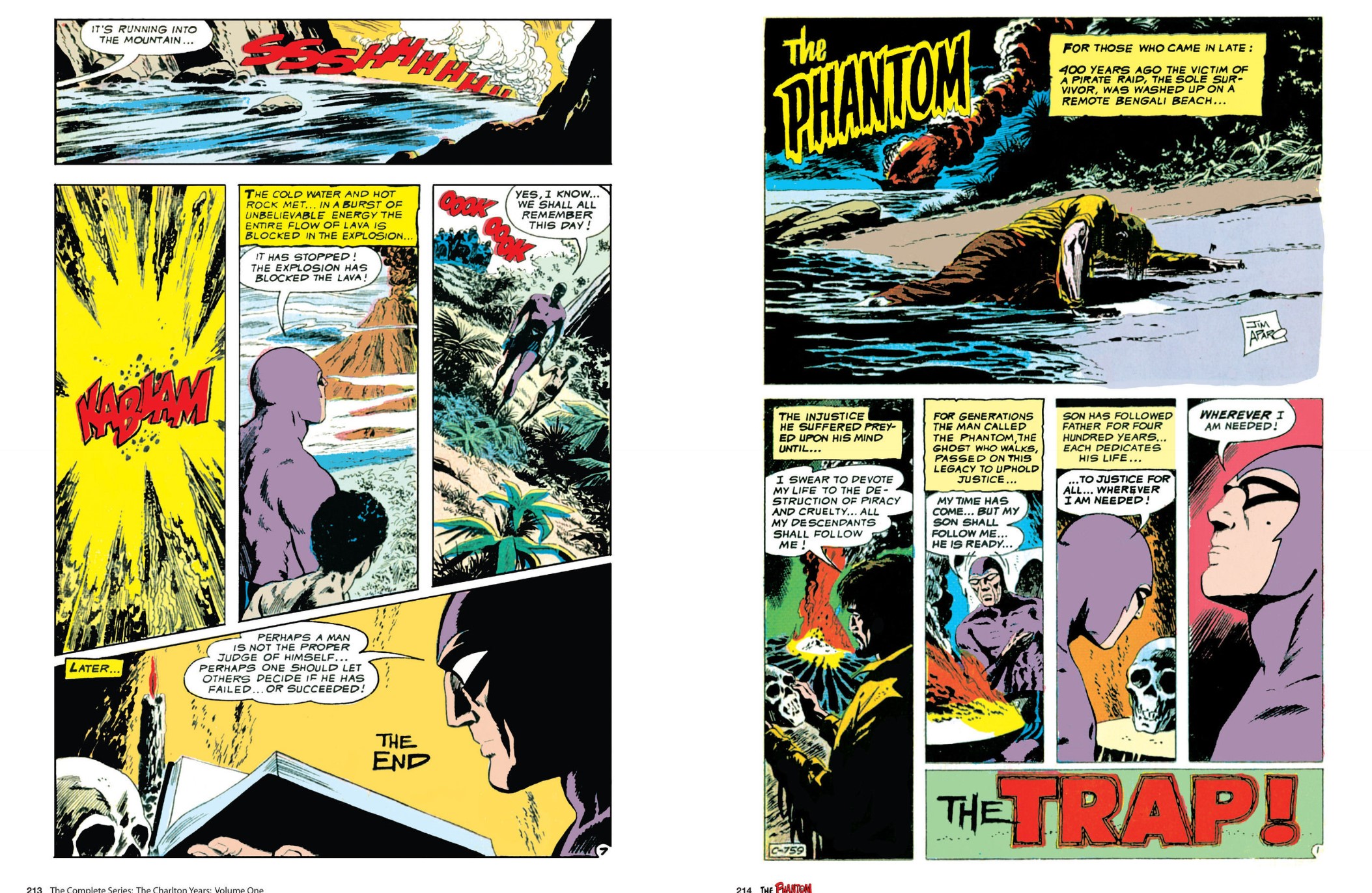
In the 17th century a British sailor survived an attack by pirates, and, washing ashore on the African coast, swore on the skull of his murdered father to dedicate his life and that of all his descendants to destroying all pirates and criminals. The Phantom fights crime and injustice from a base deep in the jungles of Bengali, and throughout Africa is known as the “Ghost Who Walks”…

His unchanging appearance and unswerving war against injustice have led to him being considered an immortal avenger by the credulous and the wicked. Down the decades one hero after another has fought and died in an unbroken family line, and the latest wearer of the mask, indistinguishable from the first, continues the never-ending battle.

Lee Falk created the Jungle Justice dealer at the request of his syndicate employers who were already making history, public headway and loads of money with his first strip sensation Mandrake the Magician, and although technically not the first ever costumed hero in comics, The Phantom’s astounding popularity made him the prototype paladin: wearing the later demi-compulsory skintight bodystocking and mask with opaque eye-slits.

He debuted on February 17th 1936 (Yep! Ninety nonstop years!!) in an extended sequence pitting him against a global confederation of pirates called the Singh Brotherhood. Falk wrote and drew the daily strip for the first two weeks before handing over the illustration side to artist Ray Moore. A hugely successful Sunday feature began in May 1939. However, for such a long-lived and influential series, in terms of compendia or graphic collections, The Phantom has been very poorly served by the English language market – except in Australia where he has always been accorded the status of a pop culture god.

Numerous companies had begun releasing books of the strips – one of the longest continually running adventure serials in publishing history – but in no systematic or chronological order and never with any sustained success, but, even if only of historical value (or just printed for Australians), surely the mysterious Mr. Kit Walker was worthy of a definitive chronological compendium series?

Happily, and perhaps because of the tights and mask, his comic book adventures have fared slightly better – especially in recent times. From November 1962 through July 1966, all new adventures were published by West Coast giant Gold Key Comics after which King Features Syndicate dabbled with a comic book line of their biggest stars – including Popeye, Blondie, Flash Gordon, Mandrake and The Phantom – between 1966 and 1967. When they gave up the ghost (see what I did there?), plucky dependable, cheap Charlton Comics were there to pick up the slack…

The Phantom was no stranger to funnybooks, having appeared since the Golden Age in titles like Feature Book and Harvey Hits, albeit only as reformatted newspaper strip reprints. Gold Key’s efforts were tailored to a big page and a young readership, a model King Features maintained for their own run, but which was carefully tweaked when Charlton acquired the license. This splendid full-colour tome gathers the contents of The Phantom #39-47 (originally released between August 1970 and December 1971) and opens with an erudite Introduction and appreciation from Don Mangus who reveals everything of the history and involvement of a much-sidelined star in ‘Sworn to the Oath of the Skull – Pat Boyette’.

San Antonio born on 27th July 1923, Aaron P. Boyette was pure mythical Texan: self-taught in everything that mattered and unstoppably confident. A true and tireless entrepreneur, he was a key component of the development of commercial radio in Texas: a journalist who researched, wrote, broadcast, managed, and presented shows. If you’ve read Golden Age Green Lantern, everyman hero Alan Scott – who did all the jobs – could have been patterned on Pat…

Boyette forsook burgeoning stardom to become a cryptographer during WWII. Coming out, he performed the same do-it-all trick with early television and later moved into making movies. After anchoring TV news, he abruptly moved sideways again, and took to comics: writing, editing, lettering, painting and illustrating as Pat Boyette, Sam Swell, Alexander Barnes & Bruce Lovelace.

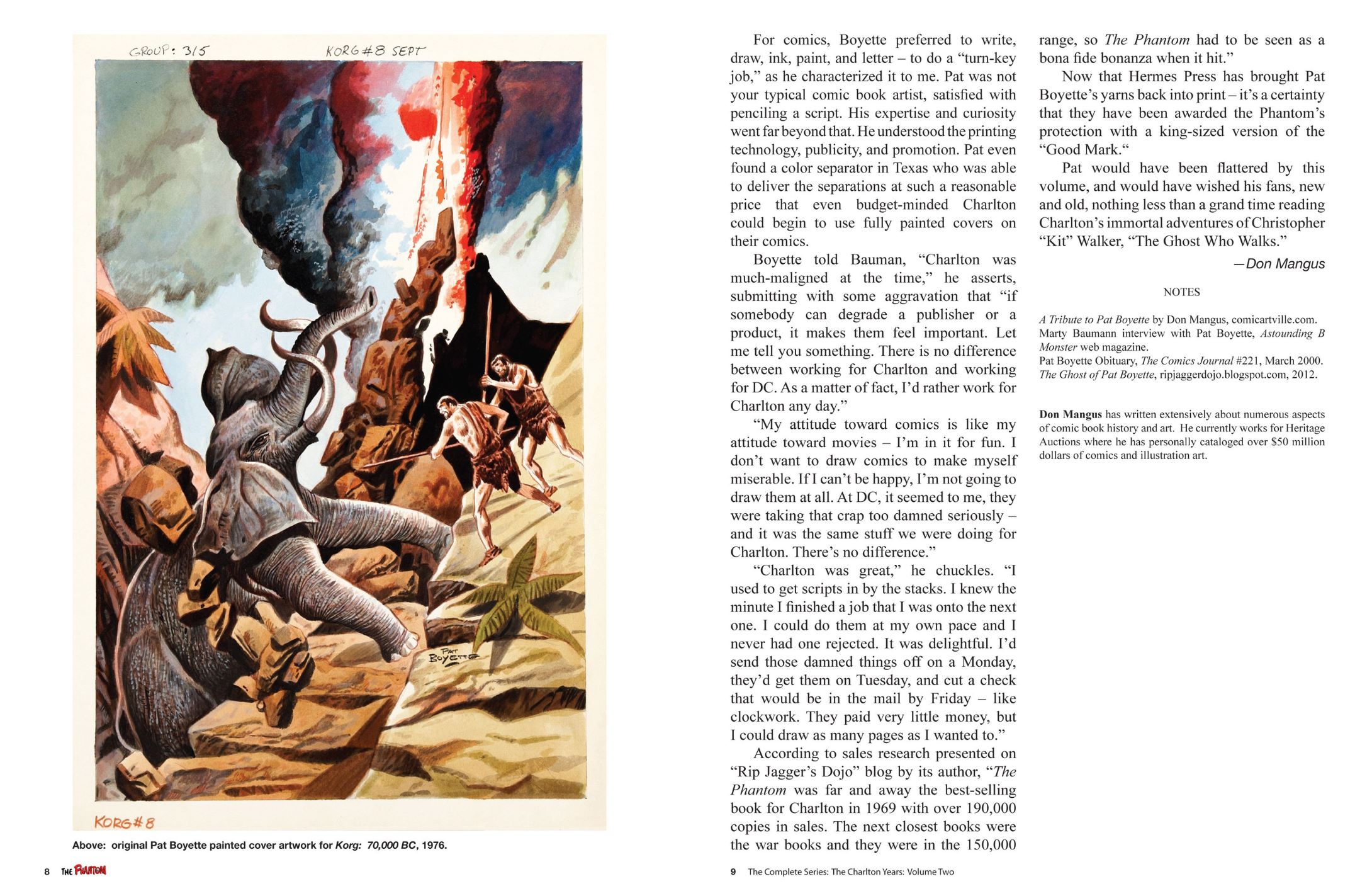
Working for Charlton, DC, Warren, Archie, Acclaim; a host of eighties indie outfits and as a self-publisher, he produced newspaper strip Captain Flame; drew prestigious DC title Blackhawk; and found a lasting home at Charlton Comics. Here Boyette co-created The Peacemaker and assumed creative duties on Pete (“PAM”) Morisi’s Peter Cannon: Thunderbolt. As the superhero boom faded he increasingly output on their anthological lines, crafting hundreds of genre short stories for romance, war, western horror, science fiction, fantasy and other titles. Boyette also handled Charlton’s biggest and most high-profile licensed features including The Six Million Dollar Man; Space: 1999; Korg: 70,000 B.C; Flash Gordon; Jungle Jim and the company’s runaway top seller: The Phantom. Boyette’s work was continually published at Charlton until at least 1986 when the outfit was being wrapped up. He readily adapted to the growing indie market, with his last work appearing in DC/Paradox Press’s The Big Book of the Weird Wild West in 1998.

Pat Boyette died of oesophageal cancer on January 14th, 2000 in Fort Worth, Texas.

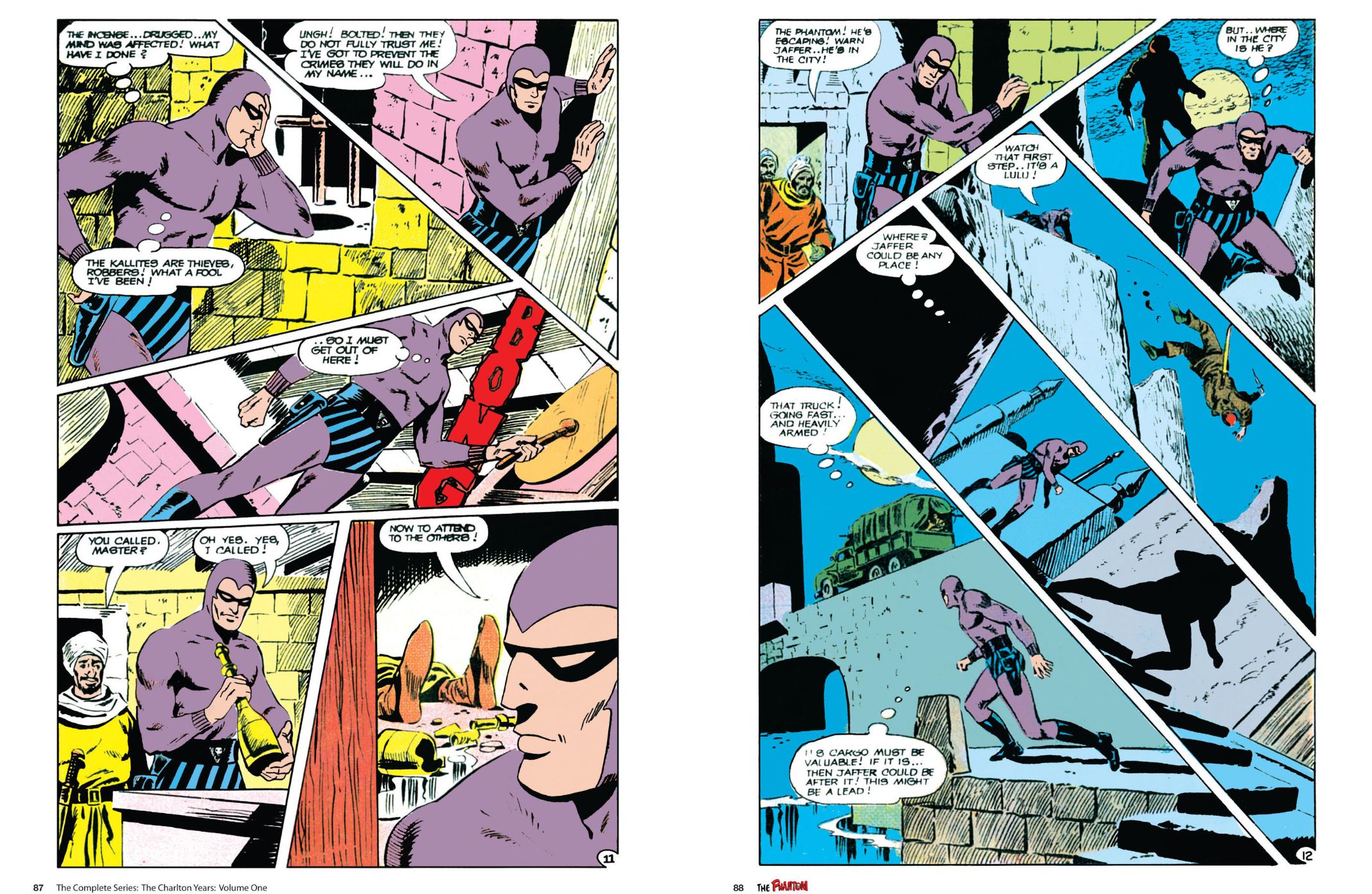
The majority of the bi-monthly yarns here are scripted by Boyette, backed up by Joe Gill in #40, 41 & 45 (and also perhaps occasionally by predecessor scripter D.J. Arneson?): utterly workmanlike and hitting all the expected bases, with each issue offering a pictorial Contents Page teaser and terse, spartan, stripped-back action; mystery yarns with themes and plots that readers of newspapers and dyed-in-the-wool superhero fans could appreciate equally. There are plenty of mad scientists, aliens, monsters, war criminals, brutal beasts, sadistic potentates, thieves & pirates and many admiring women, but no costumed villains…

We open with The Phantom #39 as ‘A Small War!’ sees a ruthless filmmaker provoke conflict between old tribal friends until the Ghost-Who-Walks steps in, after which the hero foils thinly-disguised Nazis seeking to recover lost gold from the ‘Canyon of Death!’, and scuppers ‘The Silent Thieves!’ using their U-Boat to raid a river-adjacent diamond mine…

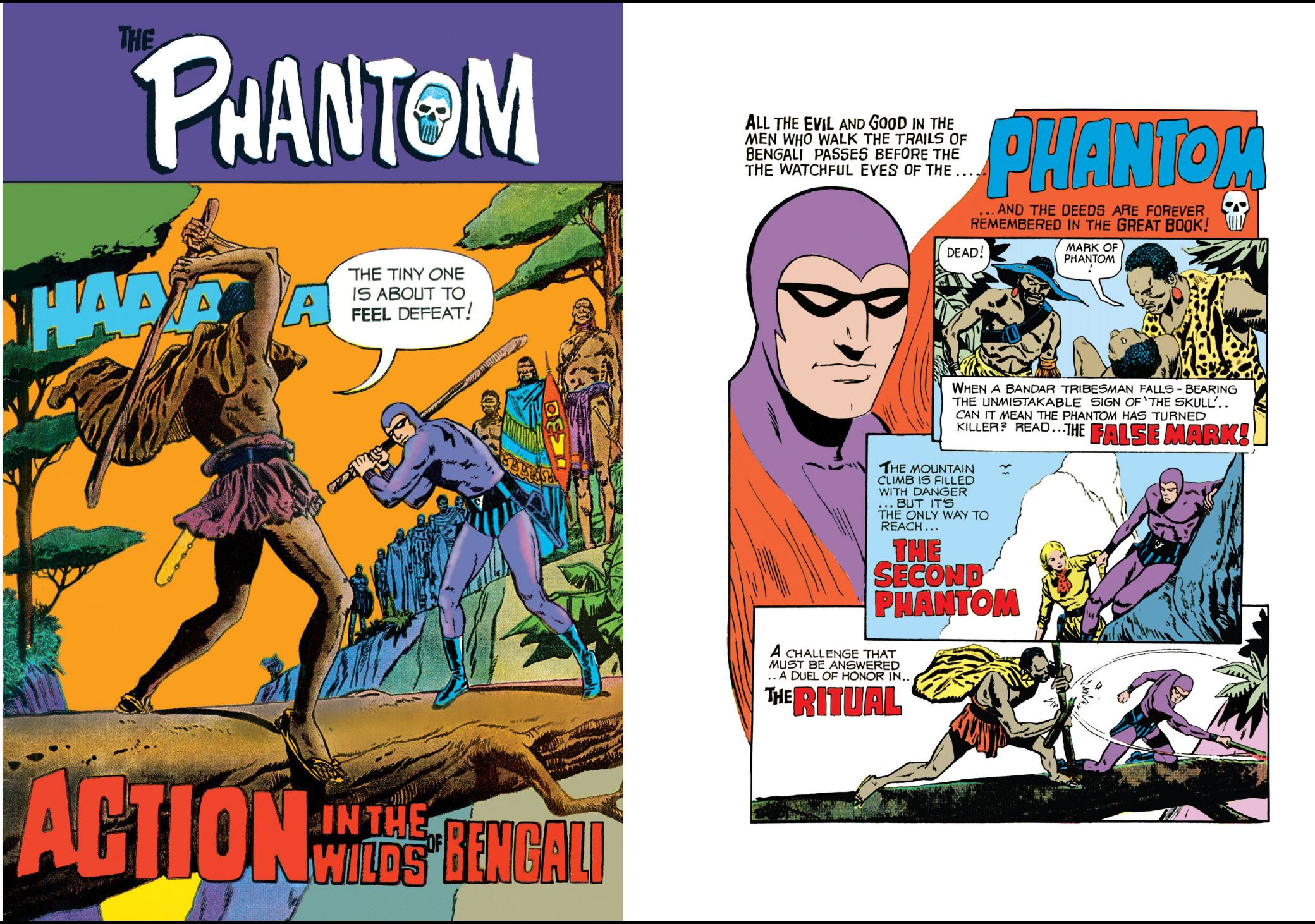
Boyette and his associates often sagely left their time period vague and unconfirmed, allowing creative anachronism to play out in tales that could often be starring earlier Phantoms of the undying dynasty. In #40, following a sample of original art pages, a wryly fond homage to earlier legends sees the masked marvel battle once again a giant warrior with quarterstaffs over a river crossing in ‘The Ritual’, before a vengeful criminal frames the Phantom for multiple murders with a diabolical device leaving his death’s head signature – ‘The False Mark’ – on native victims. The issue closes with a distraught heiress seeking her long-missing father and momentarily gulled by ‘The Second Phantom’ until the true titan turns up…

Scripted by Joe Gill, #41’s opener ‘Slave of Beauty’ sees our hero captured by an immortal queen resurrecting her fallen desert empire through slavery. However, Hegara is not all she seems and the Jungle Juggernaut readily crushes her dream before chasing a stolen Bandar treasure across the world. Savagely seized by murderous white hunter Waldo Brunn, ‘The Idol’ is only ultimately recovered after a bizarre alliance, and is followed by a devious clash with a ‘Deadly Foe’ developing viruses in the wilderness who proves to be anything but…

The Phantom #42 opens with a cruel high-tech attack on elephants perpetrated by plutocratic monster Rama Jahn and requiring all the ingenuity of the Ghost-Who-Walks to save the ‘Keeper of the Herd!’, before a simple good deed generates chaos in ‘Who Needs Enemies?’ Seeking to repay his debt, multi-millionaire E.R. Randall bombards the Bengali villagers with gifts and money that disrupt their lives. Moreover, he’s extremely unhappy when they begin to reject his unwanted largesse…

‘Prey of the Hunter’ then reveals what must be done when hunter Hugo Lusk becomes addicted to killing and the Judge of the Jungle must stop the slaughter, Sadly, that involves first becoming Lusk’s latest trophy…

Up front in #43 ‘Test of an Idol!’, finds fabulously attractive, utterly spoiled screen star Iris Benton attempting – and initially succeeding – in beguiling the hero and making The Phantom her latest conquest. Thus he permits a movie of his exploits and even participates but is tragically unprepared when her allure crosses the species barrier and leads to her abduction by apes!

A clever use of the hero’s historical longevity drives ‘Paid in Full’ when the descendent of a long-dead British victim of jungle larceny (saved by a Ghost who Walked in 1653) demands reparations – and compound interest – on a sum of money that went missing at the time. Happily Edward Cowper-Smythe is reasonable man…

The issue closed with a clash against most modern witchdoctor Medugli, who refused to follow the Phantom’s Peace and returned to torment the Bandari with a technological terror-weapon provided by colonising secret allies. Happily, ‘The Rain Stopper!’ was no mystery to the hero and ecological catastrophe was averted in the nick of time

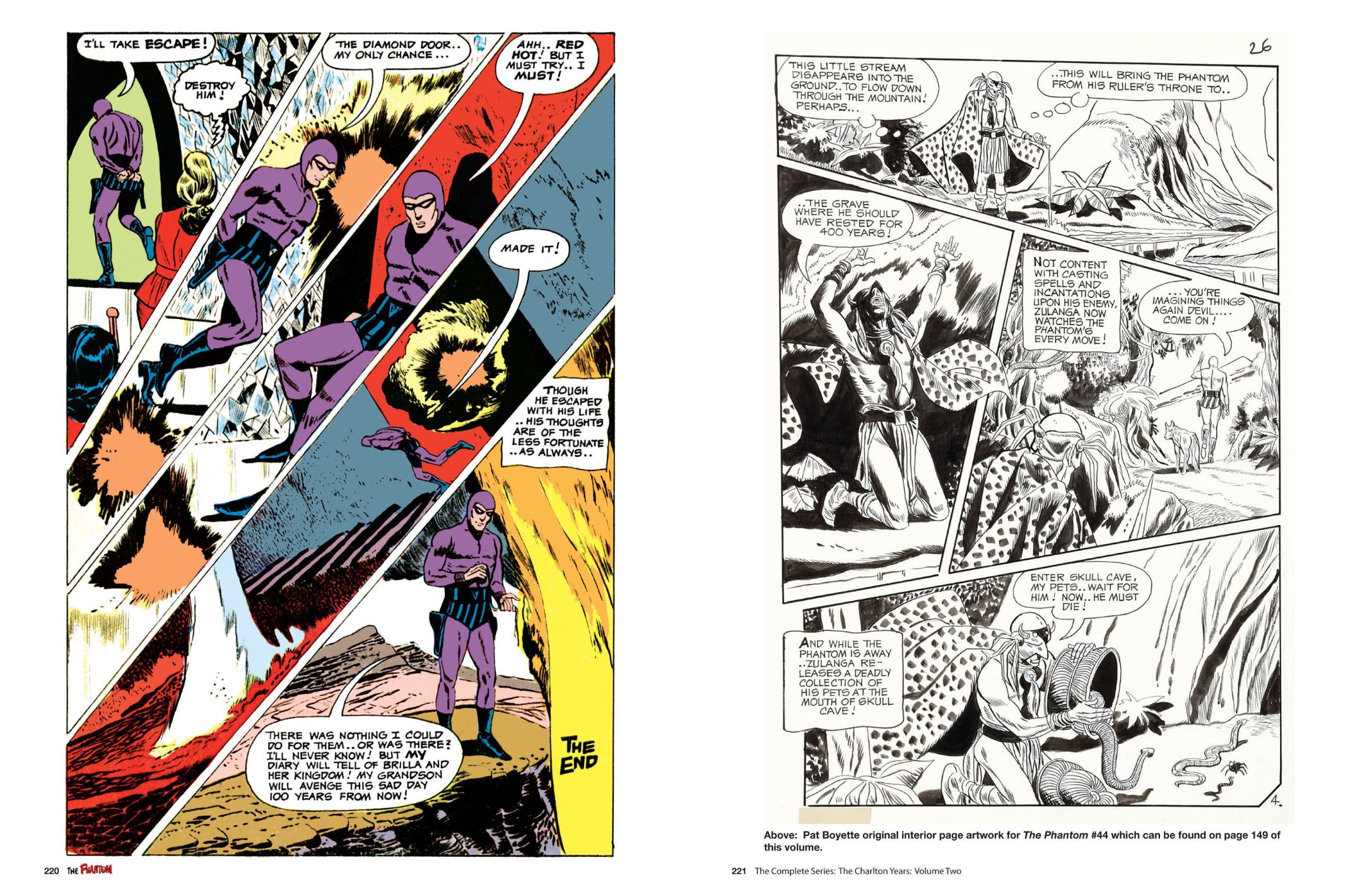
In #44, ‘To Right a Wrong!’ sees marauding Achmid Raj successfully plunder the fabled Skull Cave only to be hunted down by the Ghost Who Walks, after which ‘Danger in Bengali’ reintroduces the contemporary hero’s true love Diana Palmer who regrettably arrives at the Cave just as a diabolical, piratical impostor is plundering it. Taken hostage she soon learns that her man – and his wolf Devil – are not dead, but in hot pursuit and really, really angry…

When replacement Bandari witch-man Zulanga proves just as nefarious as his predecessor, The Phantom again exiles him, and almost pays a fatal price as the wily rogue covertly returns with serpents and poisons to inflict ‘Death from Far Away!’ Almost…

A rare Phantom failure is rectified after 105 years in #45’s opening saga ‘Return of the Ruby!’ as the descendent of the hero who lost an unparalleled gem to bandits locates the precious prize. Now he must solve the moral dilemma of depriving its current – honest and innocent – owner to restore it to the family of the original ones…

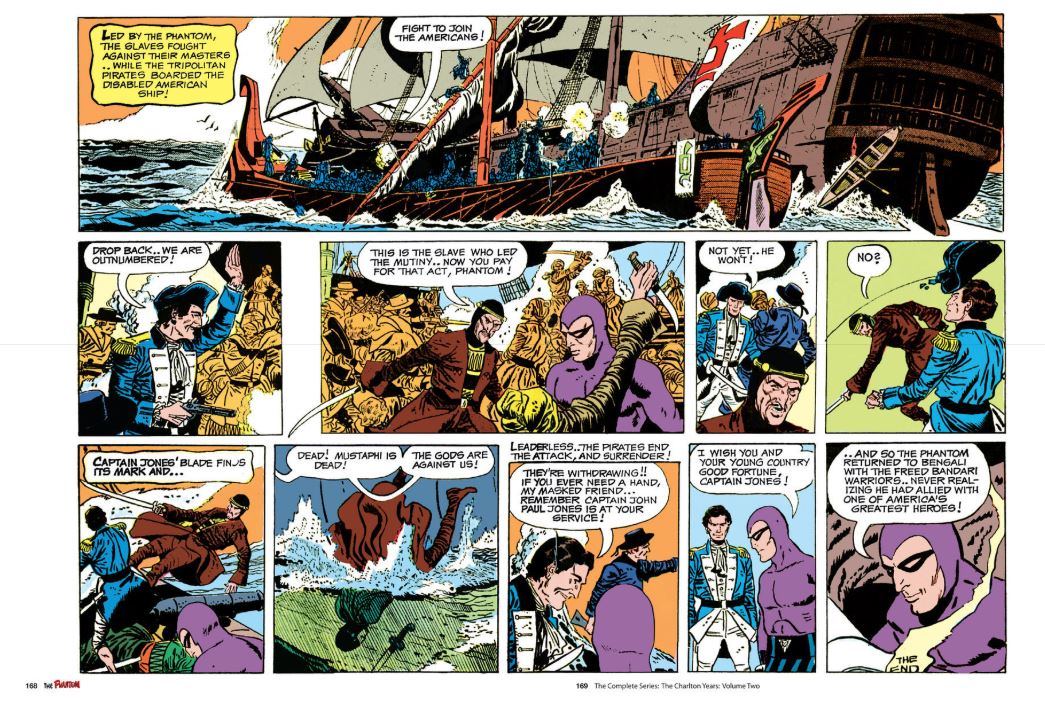
In 1777, as tyrannical Captain Mustaphi ravaged the seas around Tripoli, an alliance to scuttle the slavers’ schemes paired an earlier Ghost Guardian with a Revolutionary War icon in ‘Phantom and John Paul Jones’ before a return to the present sees the death of the Bandar monarch and a vigil in the ‘Cave of Kings’. Happily The Phantom is paying his respects when hostile blood-enemies the Yumyu attempt to slaughter the grieving subjects and steal the incomparable grave goods…

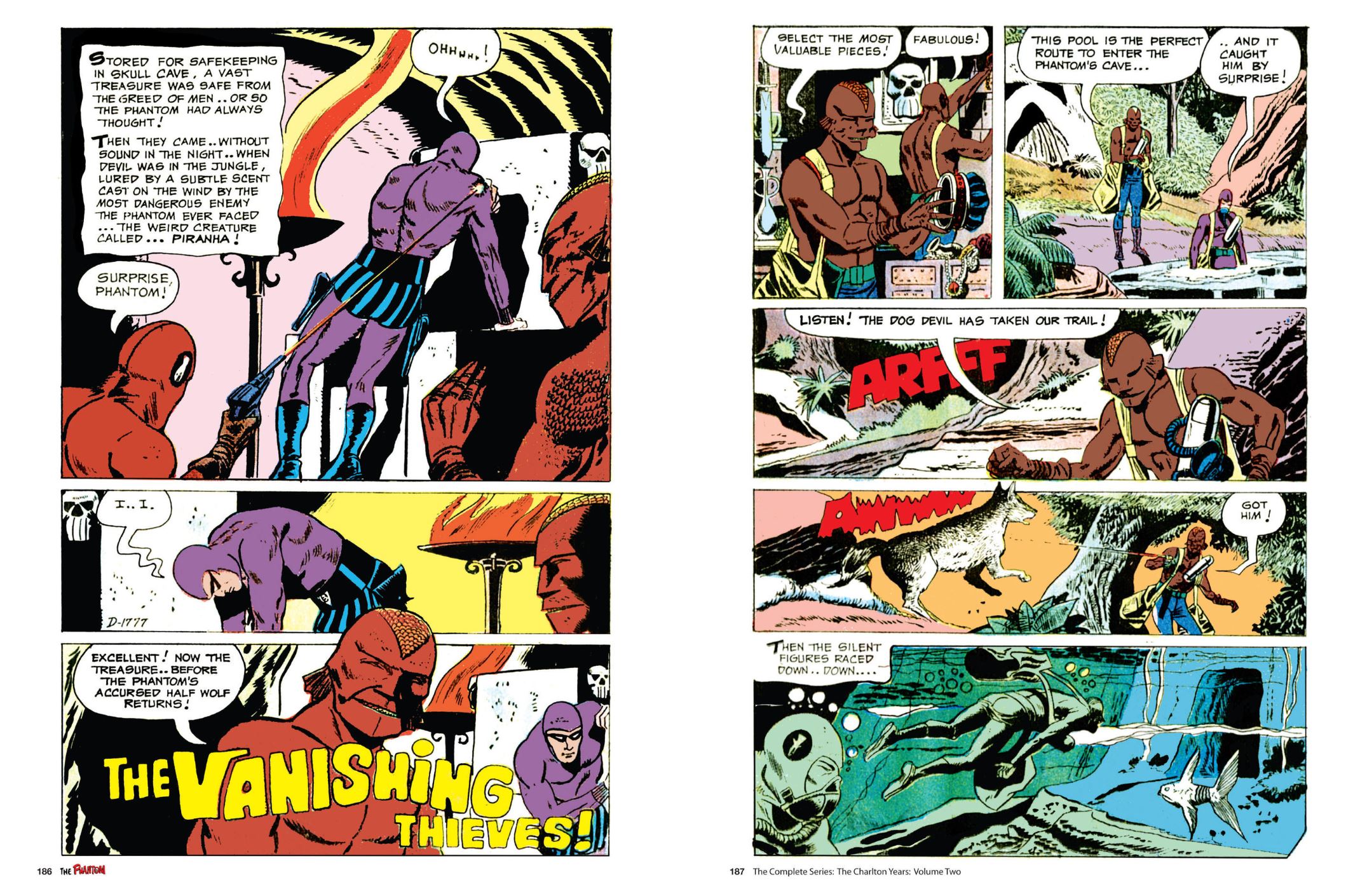
The Phantom and Diana face devilish duplicates and legendary cult terrors the Leopardmen in #46’s lead yarn ‘Last of the Cat’, only to learn that vengeful old enemy Felix Cattmann is out of jail and behind all the Leopard-y jeopardy (sorry not sorry!) after which fantasy blends with larceny as Piranha Men raid the Skull Cave from the lakes and rivers beneath it. Of course, ‘The Vanishing Thieves!’ grievously underestimated the hero’s lung capacity and resolve, and their defeat lonely led to the Ghost Who Walks daring a deadly mountain peak to rescue abducted princess Inja from slave-raider Kruug and the eagles defending the ‘Nest of the Man-Eaters’

Last issue in this tome of thrills and terrors, The Phantom #47 offered another trio of wild adventures beginning with entry into ‘The False Skull Cave’ constructed after avaricious Busas used government spy-plane systems to map vast “undiscovered” Bengali and ferret out the location of the world’s greatest treasure store. Of course, finding either cave or escaping alive were entirely different matters…

In ‘Soundless Voices!’ another cunning attempt to replace the Ghost with a diabolical doppelganger is foiled by the hero’s ferocious will to live and the long-range communications net of whale song, before the episodes pause after exposure to ‘The Vapors of Vulcan’. When Morpheus Negri, the mostly-dormant volcano in a remote corner of Bengali erupts again, the incredible immortals who live within it again plunder and ravage the land, seeking slave-prospects from the fittest of surface dwellers Who could they possibly pick this millennium?

Undying ruler Brilla has faced a Phantom long before and this one also rejects her offer of eternal “companionship” and escapes her alternate tactic of being consumed to sustain her energies for another century…

Packed and peppered throughout with pages of Boyette original art, this is another riveting, nostalgia-drenched triumph: straightforward, stripped down, nonstop rollicking action-adventure that has always been the staple of comics fiction and the Ghost Who Walks. If that sounds like a good time to you, this is a traditional action-fest you must not miss…
The Phantom® © 1970-1971 and 2013 King Features Syndicate, Inc. ® Hearst Holdings, Inc. Reprinted with permission. All rights reserved.

Today in 1946 horror story mangaka Hideshi Hino (Hell Baby, Hino Horrors, Panorama of Hell) was born, whilst strip debuts include Russell MyersBroom Hilda in 1970 and Aaron McGruder’s The Boondocks in 2006. We lost crucial Disney animator Milt Kahl in 1987, DC cartoonist Henry Boltinoff in 2001 and Mexican creator/founder of their Academy of Arts Alberto Beltrán a year later.

Ant Wars


By Gerry Finley-Day, José Luis Ferrer, Alfonso Azpiri, Luis Bermejo, Lozano, Peña, Simon Spurrier & Cam Kennedy & various (Rebellion/REBCA)
ISBN: 978-1-78108-622-3 (HB/Digital edition)

This book includes Discriminatory Content produced in less enlightened times.

The sun’s out and the sarnies are packed so let’s shamble down memory lane with a bug-beguiling packed lunch for all us oldsters which might, perhaps, offer a fresh, untrodden path for younger fans of the fantastic in search of a typically quirky British comics experience.

This stunning paperback/eBook package provides another knockout nostalgia-punch from Rebellion Studios’ scintillating 2000 A.D. treasure-trove, gathering the 15 weekly episodes of seminal shocker Ant Wars as first seen in Progs #71-85 (July 1st – 7th October 1978). There’s also a later resurgence of creepy creatures, which initially infested The Judge Dredd Megazine (#231-233, May to July 2005).

The strip debuted with ferociously prolific writer Scots Gerry Finley-Day (Ella on Easy Street, The Camp on Candy Island, Rat Pack, The Bootneck Boy, D-Day Dawson, The Sarge, One-Eyed Jack, Hellman of Hammer Force, Sgt. Streetwise, Dredger, Dan Dare, Invasion, Judge Dredd, Harry 20 on the High Rock, The V.C.s, Rogue Trooper, Fiends of the Eastern Front and dozens more) establishing a contemporary scenario to explore human greed and venality against a setting of increased pollution and eco-barbarism in the heart of the Amazon basin. The creepily compelling visuals came via an international tag team of illustrators – beginning with co-creator José Luis Ferrer, and followed by Alfonso Azpiri, Luis Bermejo, Lozano and Peña -who skilfully combined local knowledge of Central/South American locales with old fashioned monster movie riffs to deliver a wicked and wild cautionary tale.

In an era of burgeoning eco-politics, increasing environmental awareness and growing advocacy for Indigenous rights, the saga confronted entrenched corporate greed, Military-Industrial Complex arrogance and political complacency in a rip-roaring, grossly anarchic Doomwatch scenario that revelled in an innate love of irony married to macabre and bloody carnage. It was also pretty cool to see an utter absence of Yanks or Brits casually saving the day…

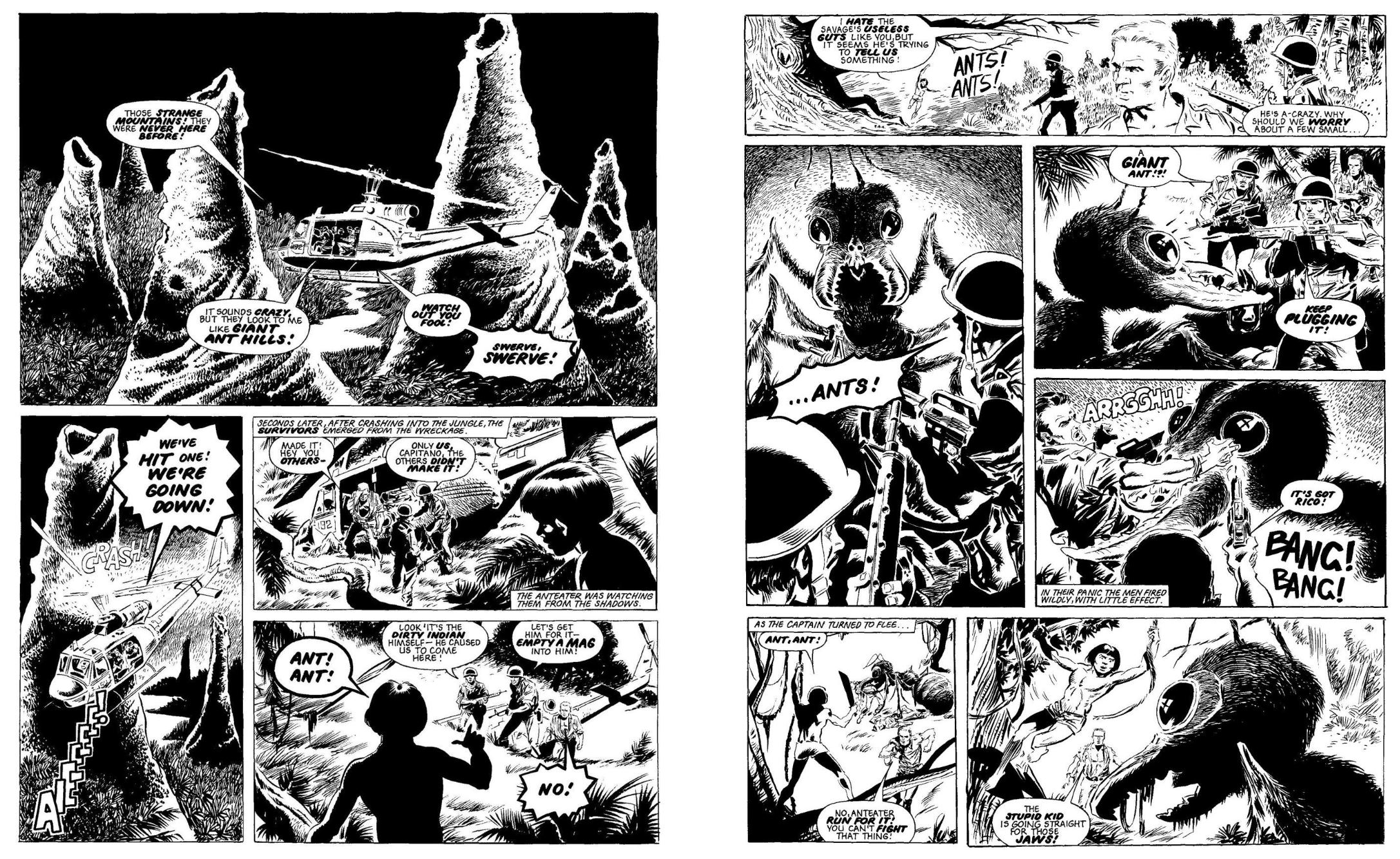
It begins in the depths of the Brazilian rain forest as helicopter-borne soldiers descend on “wild Indians” they find eating ants. After despatching the disgustingly primitive indigenes, the troops complete their mission, expediting a test of GGS: a new super-insecticide created by a multinational corporation which needs testing without too much oversight…

Some months later captive natives are being forcibly “civilised” by those soldiers in a Reservation Camp. The captives (grudgingly) wear clothes and can speak to their “benefactors” now, but recidivism remains stubbornly high. When one youngster is caught eating ants again, he endures another punishment beating before escaping. Delighted to have something to do, the soldiers board their copters and track him into the verdant hell all around them. That’s when they discover skyscraper-sized anthills and are ambushed by hungry Formicidae the size of buses and far smarter than they are or, indeed, most humans…

The squad are wiped out, but Captain Villa survives, aided by the Indian boy they had disparagingly dubbed “Anteater”. His speed, agility and dexterity with a machete are the only counter to the big bugs – which readily dismember troops and destroy aircraft – so the enemies form a reluctant partnership to escape the ant-controlled jungles and alert humanity to the imminent peril they all face. The boy understands bugs implicitly and his knowledge saves them over and again as they struggle through green hells barely ahead of an endless army of colossal soldier ants apparently intent on eradicating humankind.

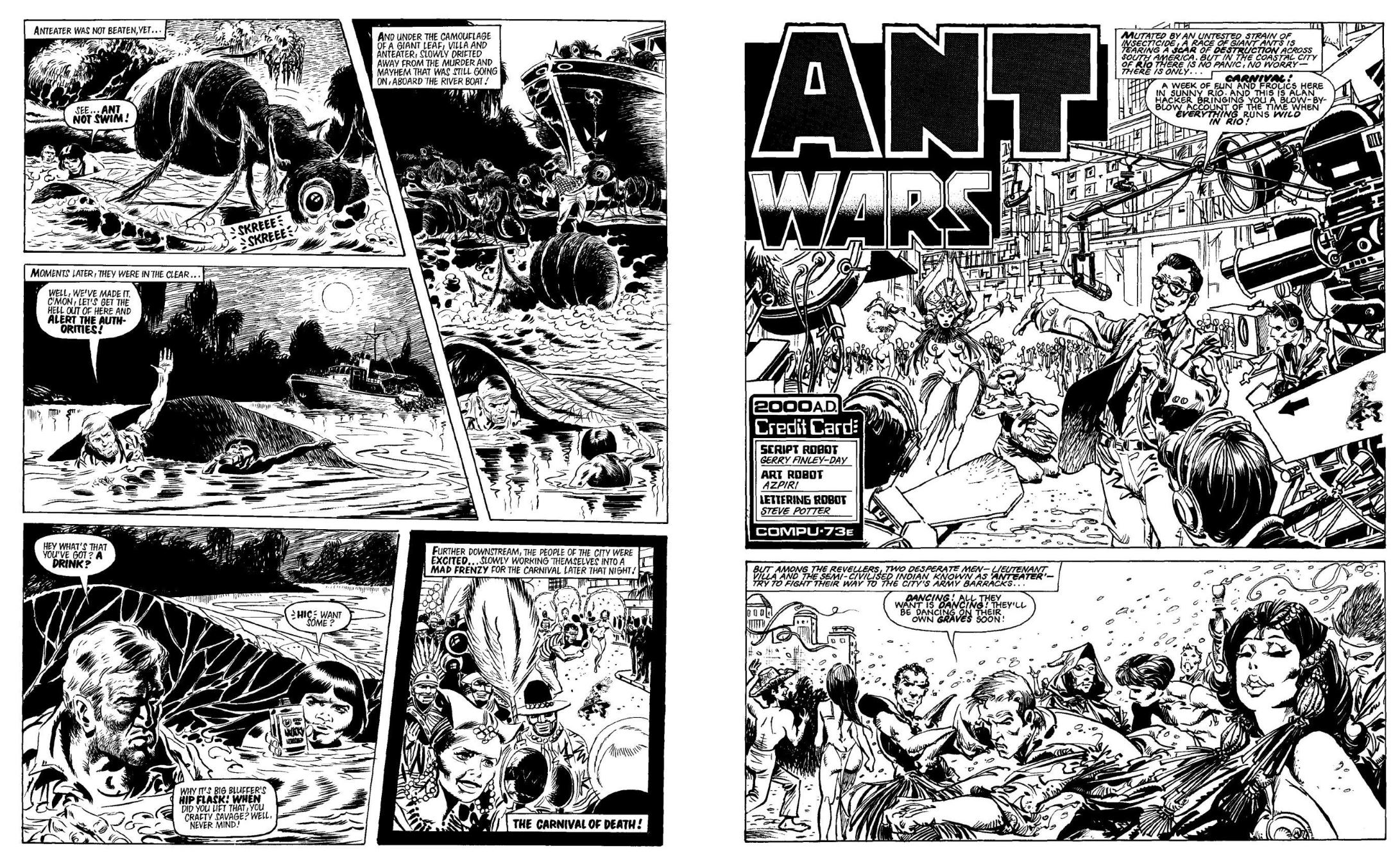
After many close calls and stomach-churning hairsbreadth escapes – avoiding the plantation-consuming, outpost-conquering, riverboat-confiscating bugs, Villa and Anteater reach Rio de Janeiro, and at last convince people with actual power and authority of the existential threat, but it is far too late. Ant queens have already established forward bases there and as the humans waste time and resources partying at Carnival, a horrific battle for control of the continent and ultimately the planet begins.

Soon ant colonies are found in Argentina, Bolivia and beyond and the struggle must be decided by humanity’s most unforgivable armaments…

And in the aftermath, there are many profitable opportunities to test even better bug sprays and formulations…

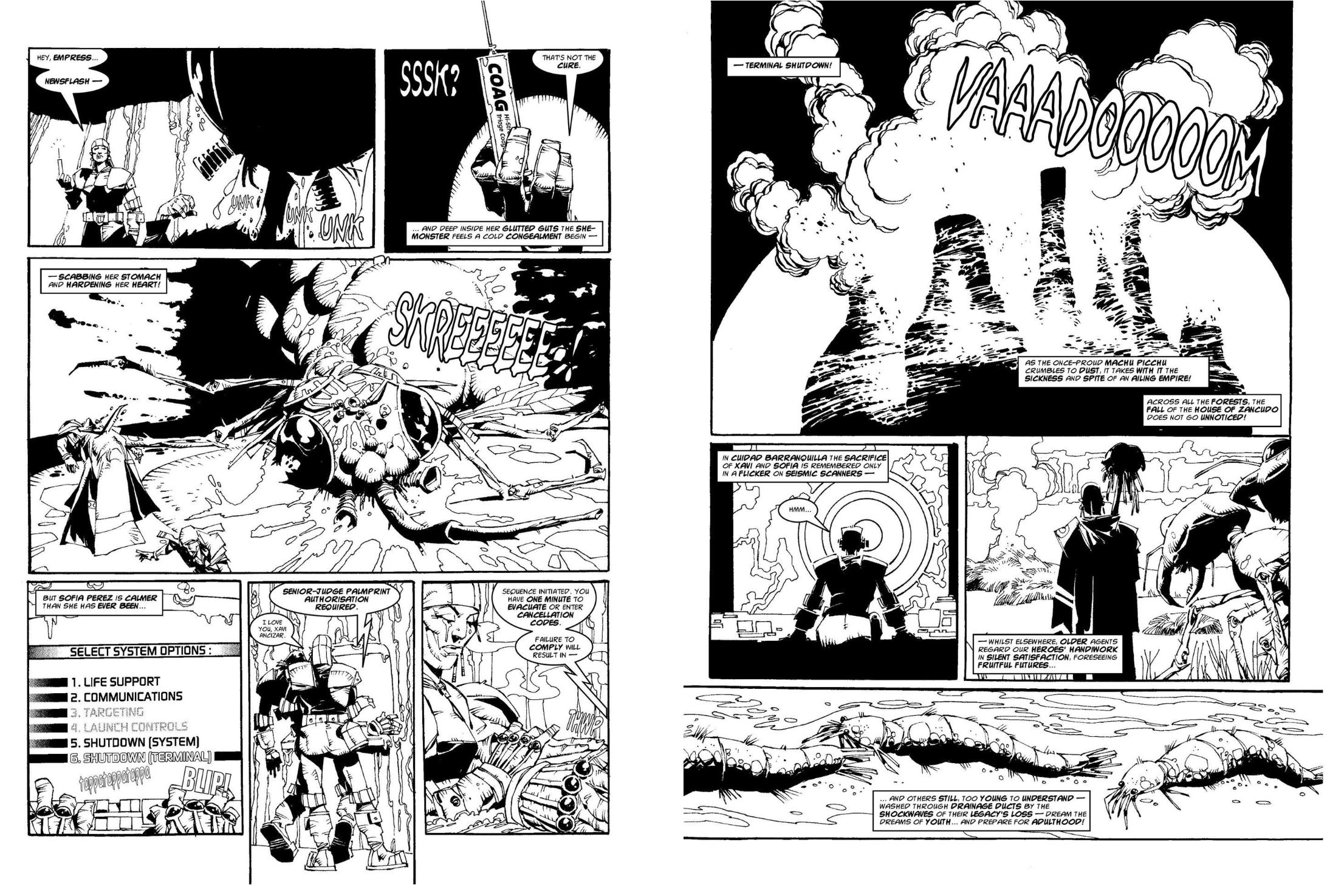
In 2005 the concept was retooled, crafted in tribute to the original by Simon Spurrier & Cam Kennedy. A notional sequel set in the future world of Mega-cities and mass madness where Judges like Joe Dredd were sworn to curtail and control Zancudo was a short serial running across 2000 A.D. spin-off title The Judge Dredd Megazine (issues #231-233). It focused on less-than-upstanding Judges Xavi Ancizar and Sofia Perez as they escort sociopathic “mutie” telepath Fendito “El Bandito” in a medical-supply flyer bound for the penal facility in La Paz. It’s 2171 and they have left sprawling metropolis Cuidad Barranquilla to risk the perils of the Peruvian rainforest, but don’t get far. When the ship is brought down, and even after surviving the crash, their chances diminish every second as they are attacked by giant intelligent mosquitos. They are also blithely unaware that the device neutralising El Bandito’s psionic powers has malfunctioned…

Although Judges are trained to resist, smart giant bugs are easier to handle, and it might have all worked out differently for the mind-thief if they hadn’t stopped to save a little girl and stumbled into Los Zancudo Pichu. This bizarre embattled colony is home to human natives enslaved to Mosquito queens and where all inhabitants – even the big bugs – are slowly expiring of a malarial infection they call The Blight…

Those downed Judge medical supplies promise a cure for the dying city and all its inhabitants, and Fendito is delighted to betray his own (more or less) kind to save his skin, but even corrupted, debased Judges have standards, so their discovery of the original purpose of Zancudo prior to the insects’ triumphal takeover offers a slim chance of atonement if not personal survival…

A grand, old fashioned Mankind vs Monsters yarn dripping with wit and edgy social commentary, Ant Wars is an unreconstructed romp to while away a little time with and a splendid way to prepare for the long hot and possibly few days ahead.
© 1978, 2005 & 2018 Rebellion A/S. All Rights Reserved.

Today in 1828 trailblazing cartoonist, caricaturist and author Frank Bellew was born, with Marvel bulwark Carl (Human Torch) Burgos coming along in 1916 and – in 1986 – mainly-Marvel comic book illustrator Paulo Siqueira.

Ken Reid’s Roger the Dodger debuted in The Beano this date in 1953, but we lost British underground star and newspaper cartoonist Edward Barker (International Times, The Largactilites, The Galactilites) in 1997 and Steve Canyon artist Dick Rockwell in 2006.

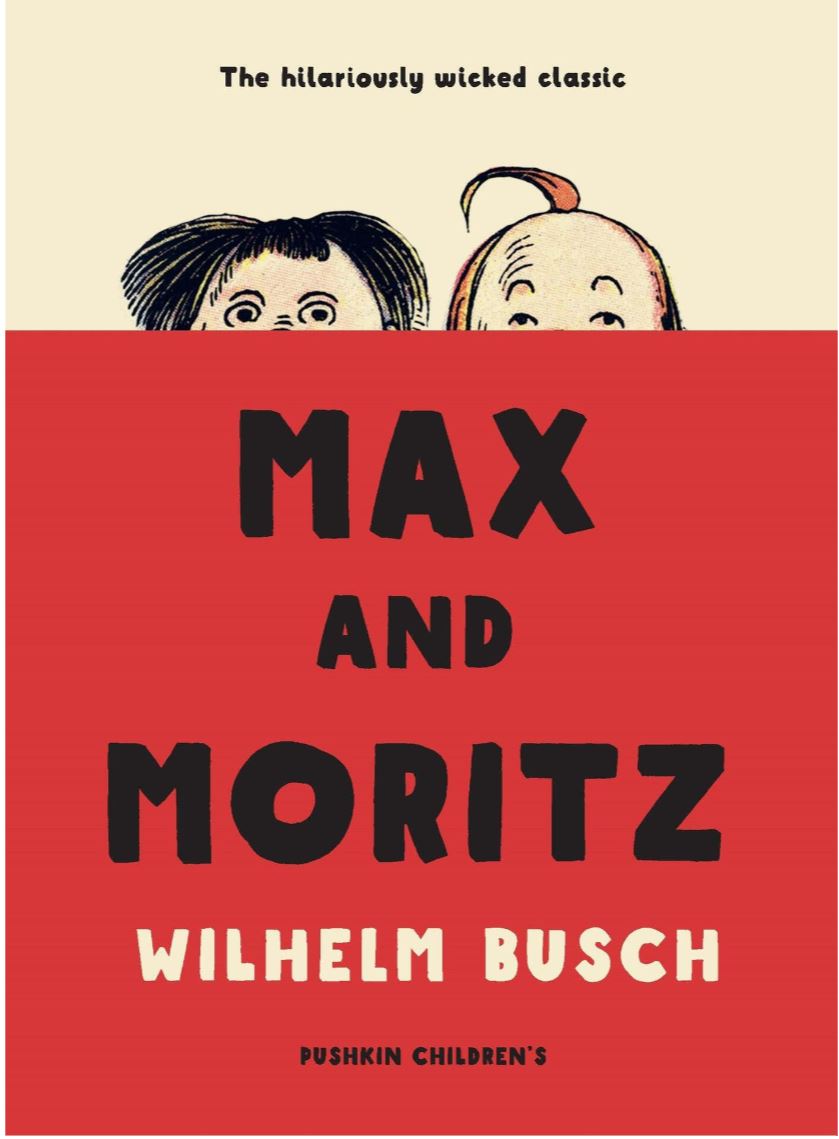
Max and Moritz – translated from the German by Mark Ledsom


By Heinrich Christian Wilhelm Busch translated /adapted by Mark Ledsom (Puskin Children’s)
ISBN: 978-1-78269-254-6 (HB/Digital edition)

This book includes Discriminatory Content produced in less enlightened times.

Do you remember when exhausted adults would say something – such as a favoured book – was just “for the children”?

For over a century today’s subject was the quintessential tome those grownups were talking about, but just like so many beloved bygone fairy tales, it probably should not have been. Its well-meaning creator was a gentle, witty family guy whose carefully crafted child’s amusement (along with successive pictorial essays and yarns) become a cornerstone of comics development, as well as one of the earliest and most popular graphic narratives of all time…

Naturally, as child-rearing fashions and notions evolved over decades, so too did the go-to exemplars and visually-aided fairy tale-fuelled social primers that helped form succeeding generation. Nevertheless, when you go back and actually read those old reliable kindergarten standbys, you might be able to grasp why so much of our history turned out the way it did…

Joking aside, so much of traditional western childhood behaviour-shaping salutary fare is Germanic in origins but creepy as £@$#!*! As a staunch pedagogue (no, go look that up before you make a fool of yourself) of Teutonic origins I cannot express how inversely proud that makes me feel…

Heinrich Christian Wilhelm Busch was born in Wiedensahl, Germany today in 1832. The eldest of seven surviving children, he led a remarkable, eventful but ultimately tragic life. At his prime, despite poor health he became a successful and acclaimed artist and writer, professional painter and poet, sought after humourist and pioneer of comic strips and children’s publishing…

In an era of burgeoning literacy and ironclad views on morality and propriety, books made to traumatise kids into being good began with Heinrich Hoffman’s 1845 release Struwwelpeter and could be found in most middle class homes across the western world. Thus as part of a welter of articles and commentaries churned out at a time of financial need, jobbing writer/artist Busch added his own with the October 1865 launch of Max und Moritz – Eine Bubengeschichte in sieben Streichen.

It should have been released through Ludwig Richter Press – a producer of children’s books and “Christian Devotional Literature” – but when they rejected it, the manuscript passed to the artist’s previous publisher Kaspar Braun. A slow seller, Max and Moritz – A Story of Seven Boyish Pranks picked up traction in 1868 with a second edition, and by Busch’s death in 1908 had sold nearly 450,000 copies. It wasn’t hurt by teachers attacking it, declaring it “frivolous and an undesirable influence on the moral development of young people.”

None of his later comics prototypes were as successful. At the time of Busch’s death it was translated into English, Danish, Hebrew, Japanese, Polish, Hungarian, Portuguese, Russian, Swedish, Latin and Walloonian, but also banned in many countries or barred to readers under 18. By 1997, there were another 281 dialect and language translations available.

Beautifully illustrated and a hugely popular yet controversial addition to the genre of cautionary tales for the instruction and correction of wayward youth, this edition enjoys a careful and liberal re-translation by Mark Ledsom. However, like most kids’ stories from the latter centuries of the last millennium it comes with terrifying warnings, admonitory notes and a moral message baked in (on this occasion, quite literally).

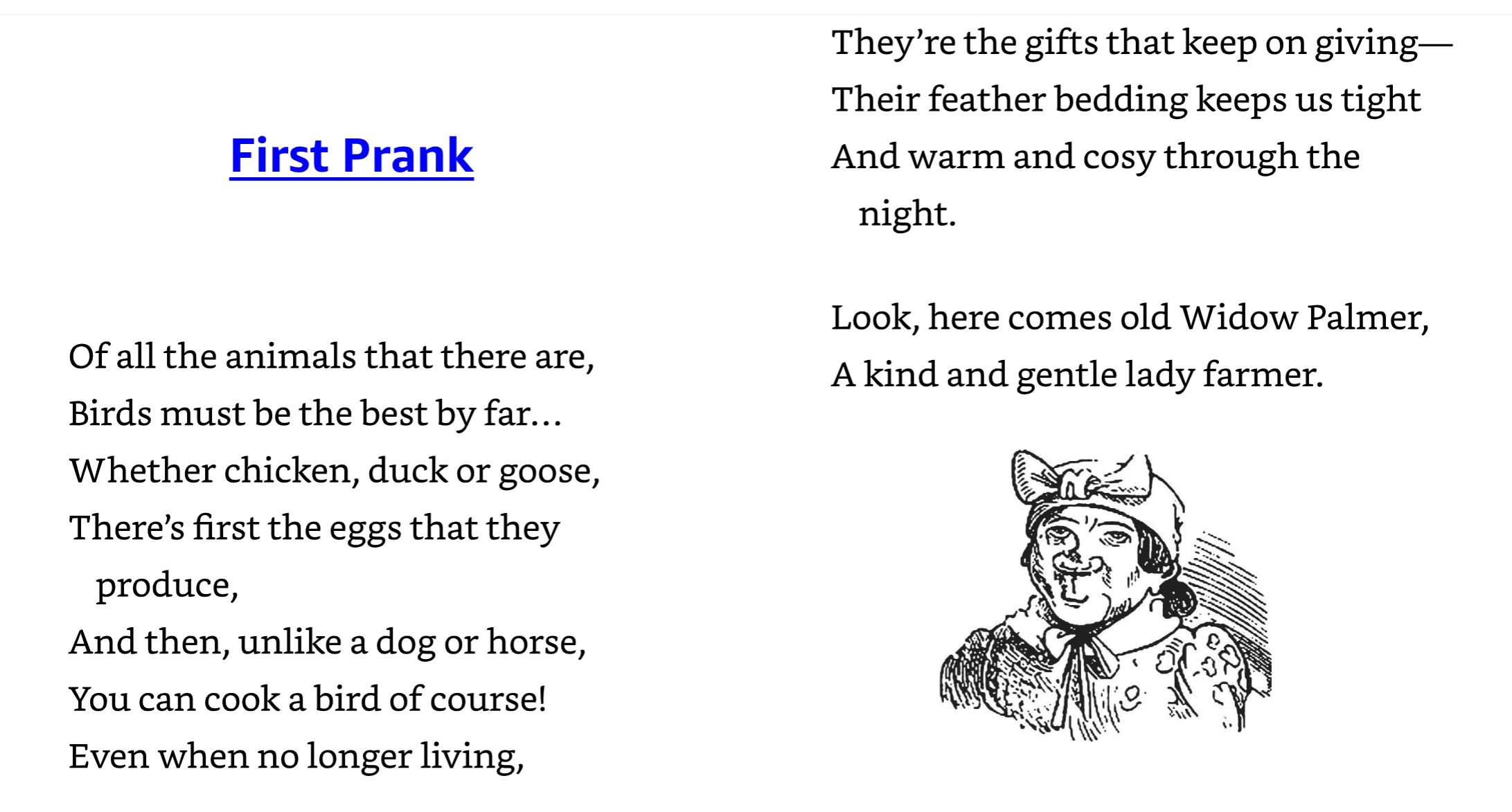
Rendered in stunning pen-& ink linework and described in snappy rhyming couplets we meet a pair of ghastly oiks very reminiscent of Young Tory hopefuls in the ‘Introduction’ prior to the jolly japesters launching their ‘First Prank’ against Old Widow Palmer and her poor poultry…

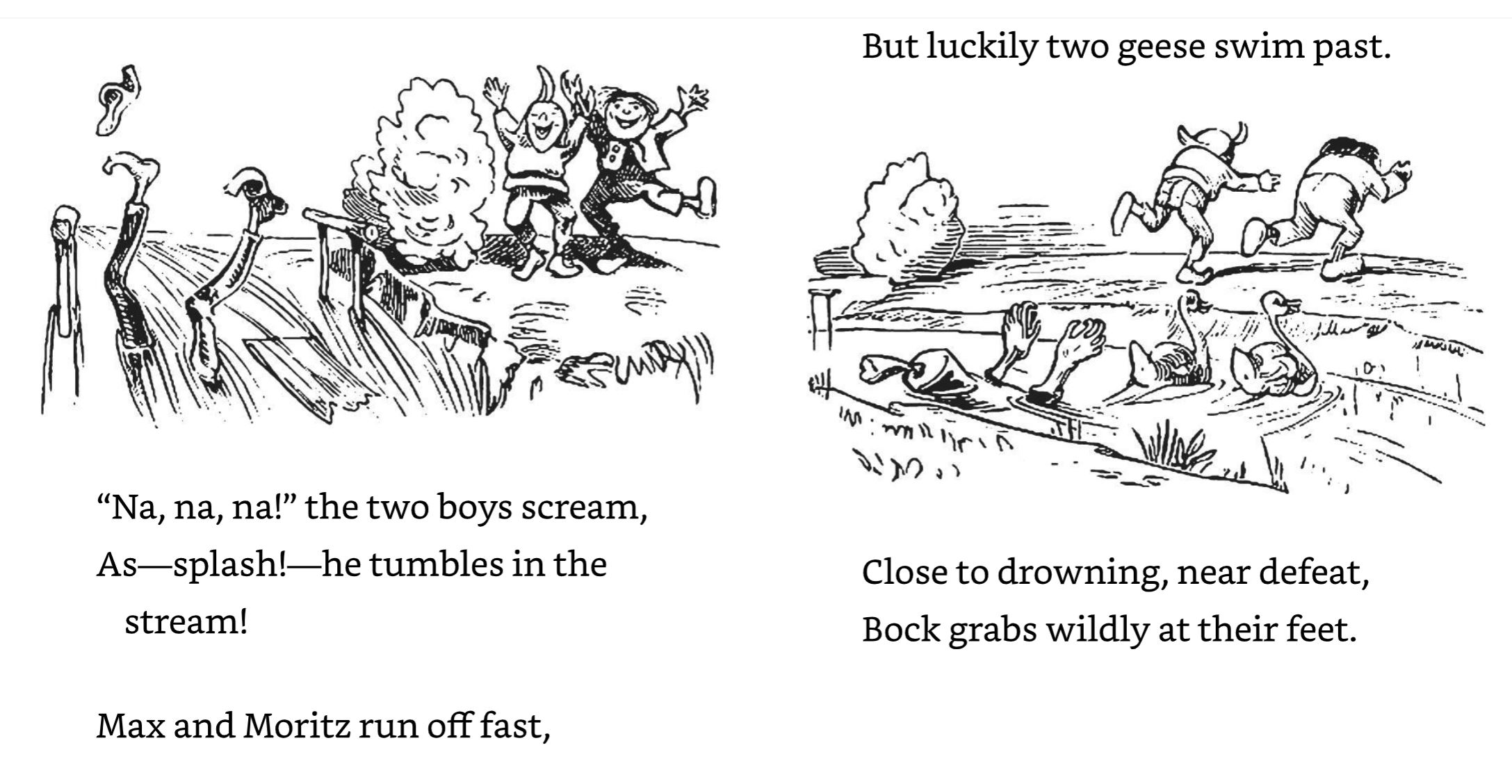
The ‘Second Prank’ expands the lads’ animal cruelty into framing the widow’s dog for theft before a ‘Third Prank’ targets and endangers harmless tailor Mr. Bock whilst teacher Lampel is nigh assassinated in the ‘Fourth Prank’

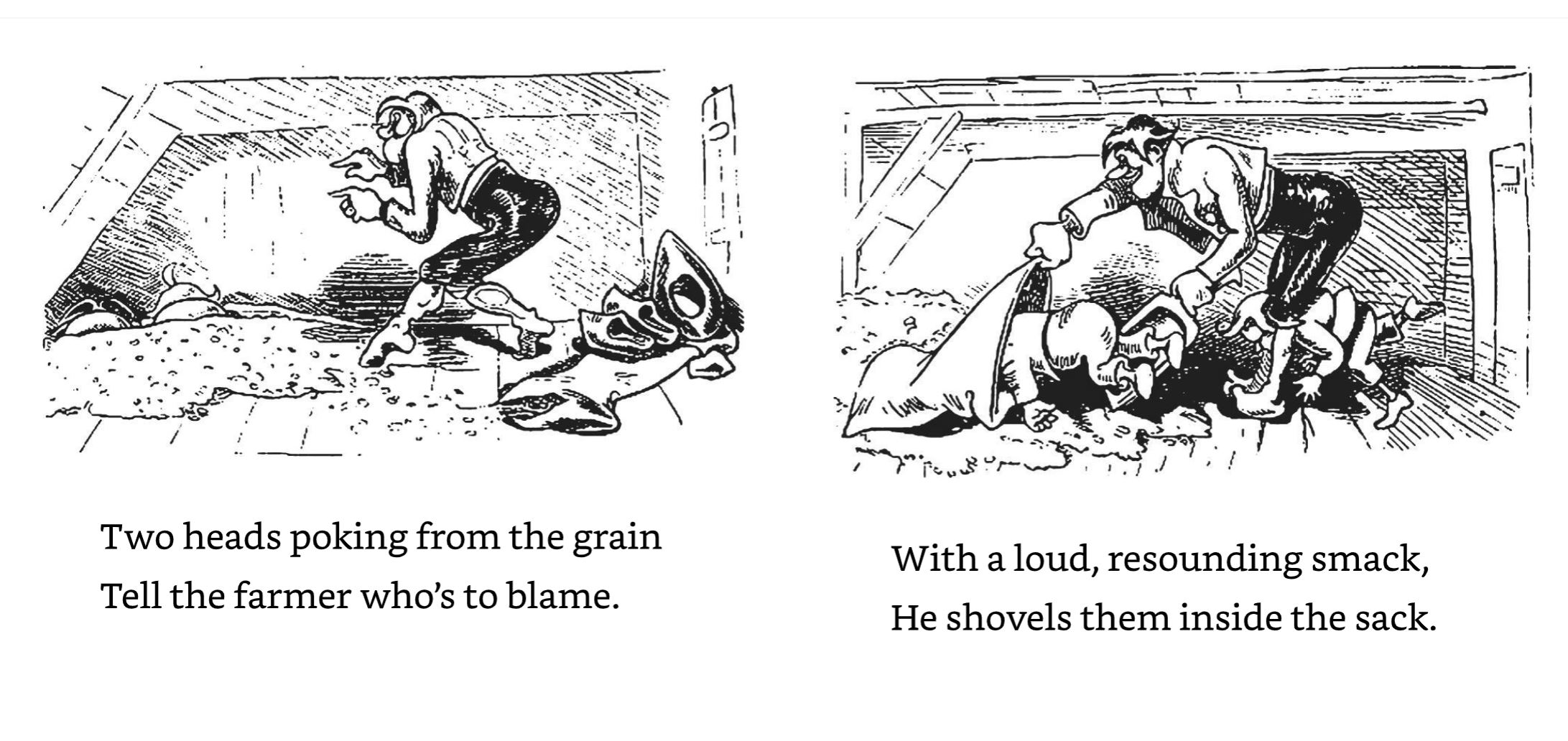
The terrorism encompasses Grandpa Fritz in the ‘Fifth Prank’ as the twisted tots unleash insect hell, after which the ‘Sixth Prank’ sees them burgle, vandalise and pay a stiff price for breaking into the Bakery, before reaping what they sowed after targeting a farmer in their ‘Final Prank’. With justice ferociously served, all that’s left is a sinister summing up, courtesy of a relatively recondite ‘Conclusion’

Also included here for scholars and show-offs is a foreign language addition of ‘Max und Moritz (Original German Text)’ as well as a fulsome ‘Translator’s Note’ from Ledsom. Noteworthy, remarkable, influential and rather hard to take for many modern readers, Max and Moritz marked a key point in the development of comics… and quite possibly passed a minor Rubicon in human taste. If you need to see how we got here, this is definitely the place to start…

Although the book is in public domain now this version enjoys some proprietary rights.
English translation © 2019 Mark Ledson. All rights reserved.

Today in 1832, German picture story pioneer Wilhelm Busch was born, as was cartoonist Billy De Beck (Barney Google) in 1890; David Breger (Mr Breger, Private Breger, G.I. Joe) in 1908; and Britain’s legendary Denis McLoughin (Roy Carson, Swift Morgan, Buffalo Bill) in 1918 and Argentine line wizard Alberto Breccia (Mort Cinder) one year later.

Good penmanship is crucial in our game but isn’t always apparent, which is why we’re wishing all-star Jerry Grandenetti a posthumous “happy birthday” for today in either 1925 or 1927. Ten years later, unsung giant Tom Sutton (Vampirella, Captain Marvel, Not Brand Echh, Werewolf by Night, Planet of the Apes, The Hacker Files) arrived, complemented by Sara Pichelli (Spider-Man, X-Men, Girl Comics) in 1983.

Ed Dodd’s Mark Trail launched today in 1946, as did UK comic Terrific in 1967 but the date also marks the loss of internationally-acclaimed illustrator Alberto Giolitti (Star Trek, Turok, King Kong, Tarzan, Cisco Kid, Lone Ranger, Cinque anni dopo, Tex Willer ) in 1993; Brant (Wizard of Id) Parker in 2007 and Marty Greim (Thunderbunny, The Shield, Black Terror, Atomic Mouse, Disney characters) in 2017.

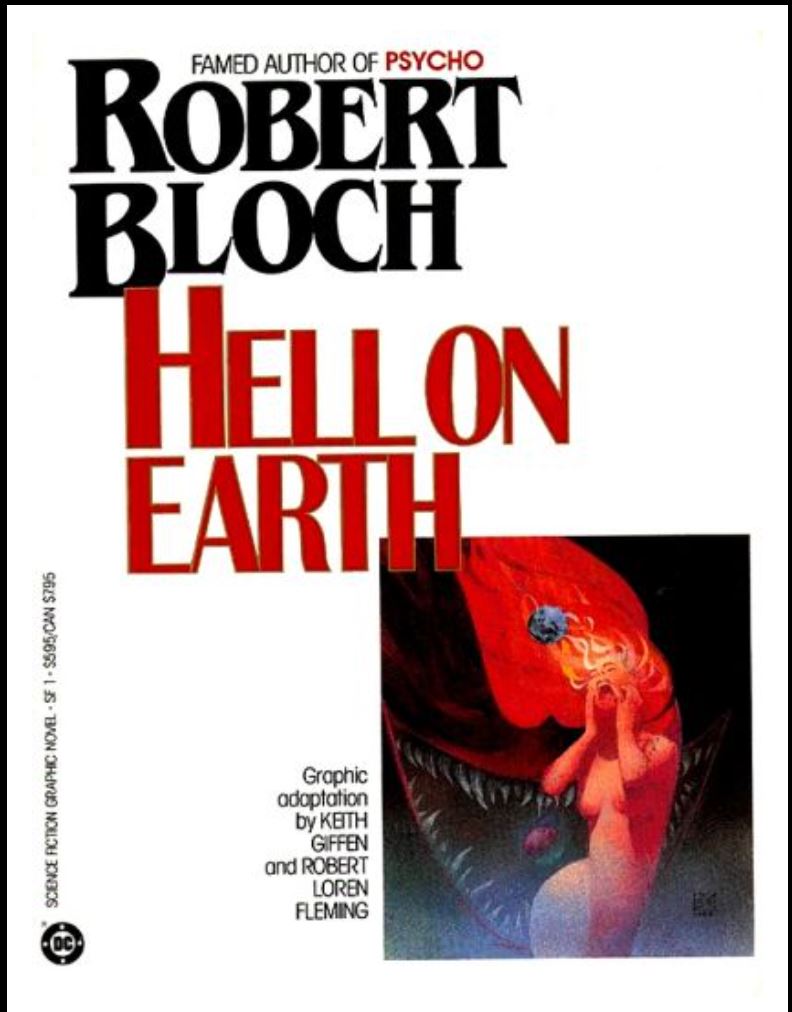
Hell on Earth – A DC Science Fiction Graphic Novel


By Robert Bloch, adapted by Keith Giffen & Robert Loren Fleming with Greg Theakston, Bill Wray, Gaspar Saladino & various (DC Comics)
ISBN 978-0-93028-905-8 (Album TPB)

During the 1980s DC, on a creative roll like many publishers large and small, attempted to free comics narrative from previous constraints of size and format as well as content. To this end, legendary editor Julie Schwartz called upon his old contacts from his youthful days as a Literary Agent to inveigle major names from the book world to have their early Sci-Fi and fantasy classics adapted into a line of Science Fiction Graphic Novels.

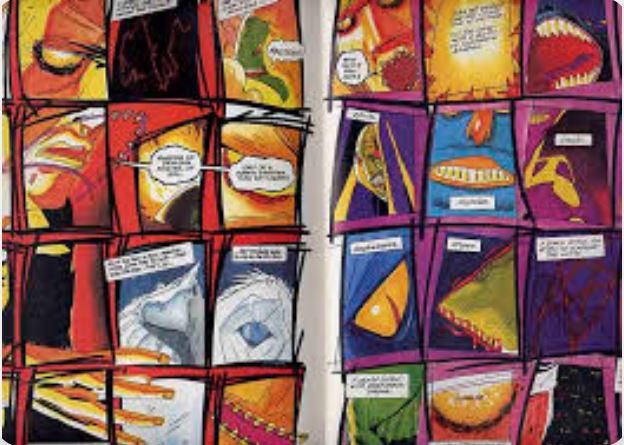
One of the most radical interpretations came courtesy of celebrated comedy wise-guys Keith Giffen & Robert Loren Fleming, with inks and colours from Greg Theakston & Bill Wray, not to mention phenomenal lettering and calligraphic effects from Gaspar Saladino.

Revered horror fantasist Robert Bloch developed out of the Lovecraftian tradition of the early pulps to become a household name for books such as Psycho and I Am Legend, which replaced unspeakable elder gods with just-as-nasty yet smaller-scaled devils like Jack the Ripper or that strange guy in the next apartment. In 1943 he scripted a blackly ironic tale of three ordinary people, researcher Professor Phillips Keith, his assistant Lily Ross and the reporter/pulp horror writer they hire to document their great experiment.

The tense interplay of this claustrophobic chiller is effectively captured by illustrator Giffen in his multi-panelled homage/distillation of José Muñoz’s stark art style as the experiment proceeds and the parapsychologists proceed to bring the Devil to Earth and trap him in a glass cage. Of course, as the lives of the trio spiral down into a miasma of darkness, guilt and regret, we have to ask: “Is he really trapped?”

Although a wordy, moody text, the interpreters have crafted a visual analogue that is just as tense and stifling as the original (which, if Satan is on your side, you might find in even rarer compilation Hell on Earth: the Lost Bloch volume two), so if you like daring art and classic spookiness you should track down this album. And while you’re at it why not grab the prose piece as well and see how it works sans graphic narrative?
© 1942 Weird Tales. Text and illustrations © 1985 DC Comics Inc. All Rights Reserved.

Today in 1927 George Storm’s venerable adventure strip Bobby Thatcher began, as did our entire hobby in a way, since in 1970 Minicon (precursor to Comic Con International) opened in San Diego’s U.S. Grant Hotel.

In 1929 Zagor cocreator Gallieno Ferri was born, just like Al Williamson in 1931, Mark Waid in 1962 and Jeff Lemire in 1976. In 1959 we lost jobbing artist Edwin Balmer of Speed Spaulding fame.

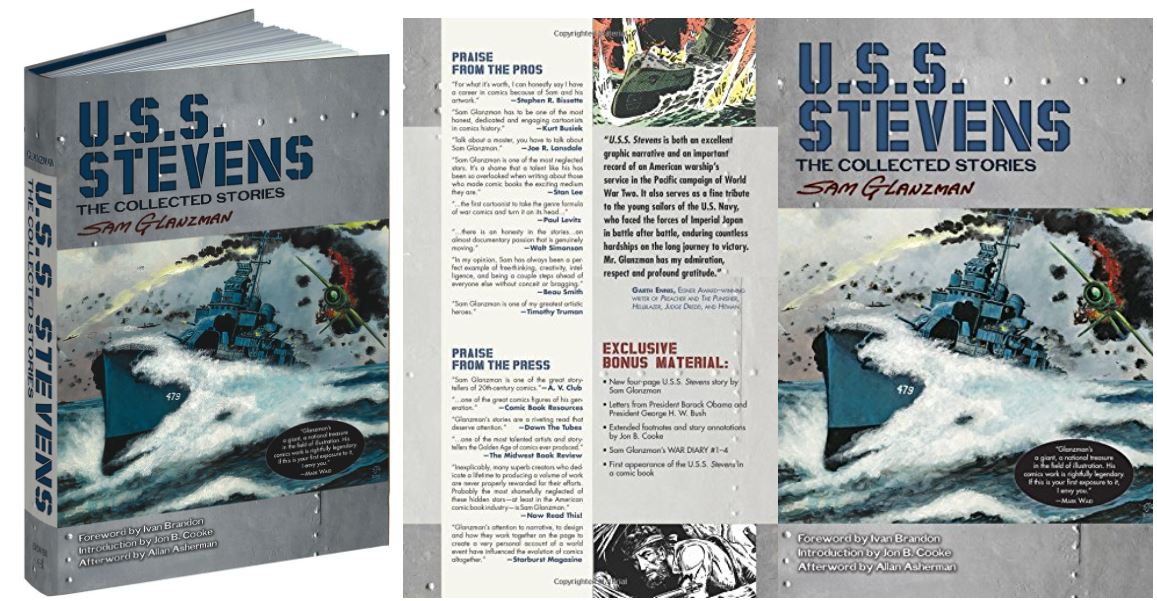
U.S.S. Stevens – The Collected Stories


By Sam Glanzman (Dover Comics & Graphic Novels)
ISBN: 978-0-486-80158-2 (HB/Digital edition)kuno

This book includes Discriminatory Content produced for dramatic and comedic effect.

To the shame and detriment of the entire comics industry, for most of his career Sam Glanzman was one of the least-renowned creators in American comic books. Despite having one of the longest careers, most unique illustration styles and the respect of his creative peers, he just never got the public acclaim his work deserved. Thankfully that all changed in recent years and he lived long enough to enjoy the belated spotlight and bask in some well-deserved adulation.

Glanzman drew and wrote comics since the Golden Age, most commonly in classic genres ranging from war to mystery to fantasy, where his work was – as always – raw, powerful, subtly engaging and irresistibly compelling. On titles such as Kona, Monarch of Monster Island, Voyage to the Deep, Combat, Jungle Tales of Tarzan, Hercules, The Haunted Tank, The Green Berets, The Private War of Willie Schultz, and especially 1980s graphic novels A Sailor’s Story and Wind, Dreams and Dragons – which you should buy in a single volume from Dover – Glanzman produced magnificent action-adventure tales which fired the imagination and stirred the blood. His stuff always sold and at least won him a legion of fans amongst fellow artists, if not from the small, insular and over-vocal fan-press.

In later years, Glanzman worked with Tim Truman’s 4Winds outfit on high-profile projects like The Lone Ranger, Jonah Hex and barbarian fantasy Attu. Moreover, as the sublime work gathered here attests, he was also one of the earliest pioneers of graphic autobiography; translating personal WWII experiences as a sailor in the Pacific into one of the very best things to come out of DC’s 1970s war comics line.

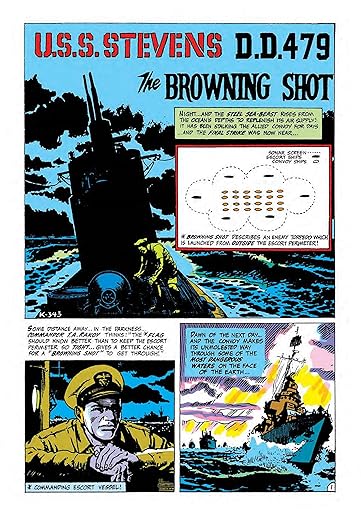
U.S.S. Stevens, DD479 was a peripatetic filler-feature bobbing about between Our Army at War, Our Fighting Forces, G.I. Combat, Star Spangled War Stories and the other anthological battle books; quietly backing-up the cover-hogging, star-attraction glory-boys. It provided wry, witty, shocking, informative and immensely human vignettes of shipboard life, starring the fictionalised crew of the destroyer Glanzman had served on. It was, in most ways, a love story and tribute to the vessel which had been their only home and refuge under fire. In 4- or 5-page episodes, the auteur recaptured and shared a kind of comradeship we peace-timers can only imagine and, despite the pulse-pounding drama of the lead features, us fans all knew these little snippets were what really happened when the Boys went “over there”. Just like now…

A maritime epic to rank with Melville or Forester – and with stunning pictures too – every episode of this astounding unsung masterpiece is housed in one stunning hardback compilation (also available digitally for limp-wristed old coots like me) and if you love the medium of comics, or history, or just a damn fine tale well-told, you must have it.

That’s really all you need to know, but if you’re one of the regular crowd needful of more of my bombastic blather, a much fuller description follows.

As I’ve already stated, Glanzman belatedly enjoyed some well-earned attention, and this tome opens by sharing Presidential Letters from Barack Obama and George Herbert Walker Bush for his service and achievements. Then follows a Foreword from Ivan Brandon and a copious and informative Introduction by Jon B. Cooke detailing ‘A Sailor’s History: The Life and Art of Sam J. Glanzman’. Next comes a brace of prototypical treats; the initial comic book appearance of U.S.S. Stevens from Dell Comics’ Combat #16 (cover-dated April-June 1965) and the valiant vessel’s first cover spot from Combat #24, April 1967.

The first official U.S.S. Stevens, DD479 appeared after Glanzman approached Joe Kubert, who had recently become Group Editor for DC’s war titles. He commissioned ‘Frightened Boys… or Fighting Men’ (appearing in Our Army at War #218, April 1970), depicting a moment in 1942 as boredom and tension were replaced by frantic action when a suicide plane targeted the ship…

A semi-regular cast was introduced slowly throughout 1970; fictionalised incarnations of old shipmates including skipper Commander T. A. Rakov, who ominously pondered his Task Force’s dispersal, moments before a pot-luck attack known as ‘The Browning Shot’ (Our Fighting Forces #125, May/June) proved his fears justified…

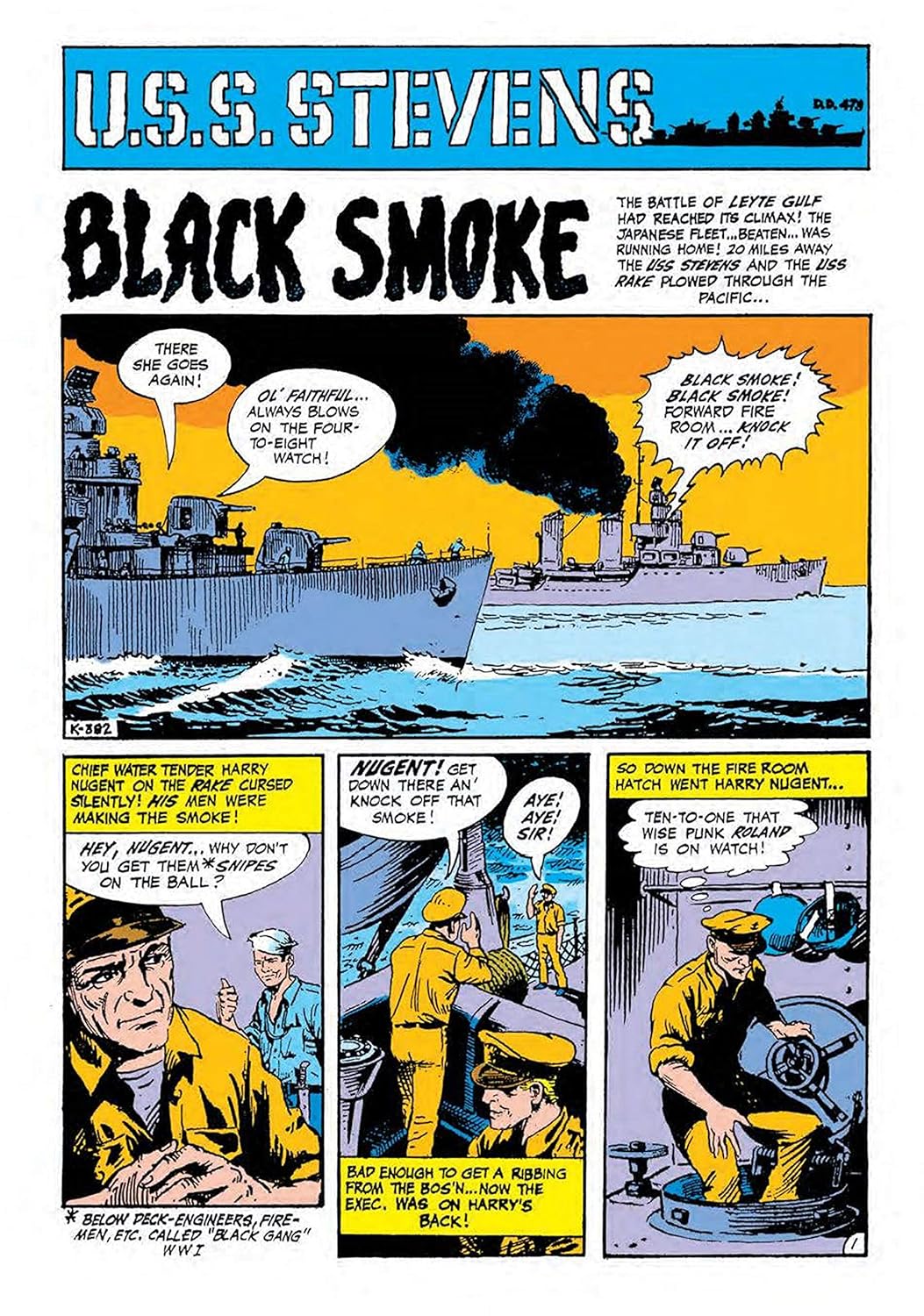
Glanzman’s pocket-sized tales always delivered a mountain of information, mood and impact and ‘The Idiot!’ (OAaW#220, June) is one of his most effective, detailing in 4 mesmerising pages not only the variety of suicidal flying bombs the Allies faced, but also how appalled American sailors reacted to them. Sudden death was everywhere. ‘1-2-3’ (OFF #126, July/August) details how quick action and intuitive thinking saves the ship from a hidden gun emplacement whilst ‘Black Smoke’ (Our Army at War #222, from the same month) shows how a know-it-all engineer causes the sinking of the Stevens’ sister-ship by not believing an old salt’s frequent, frantic warnings. All aboard ship were regularly shaken by the variety of Japanese aircraft and skill of the pilots. ‘Dragonfly’ (OFF #127, September/October) shows exactly why, whilst an insightful glimpse of the enemy’s psychological other-ness is tragically, graphically depicted in the tale of ‘The Kunkō Warrior’ (OAaW #223, September).

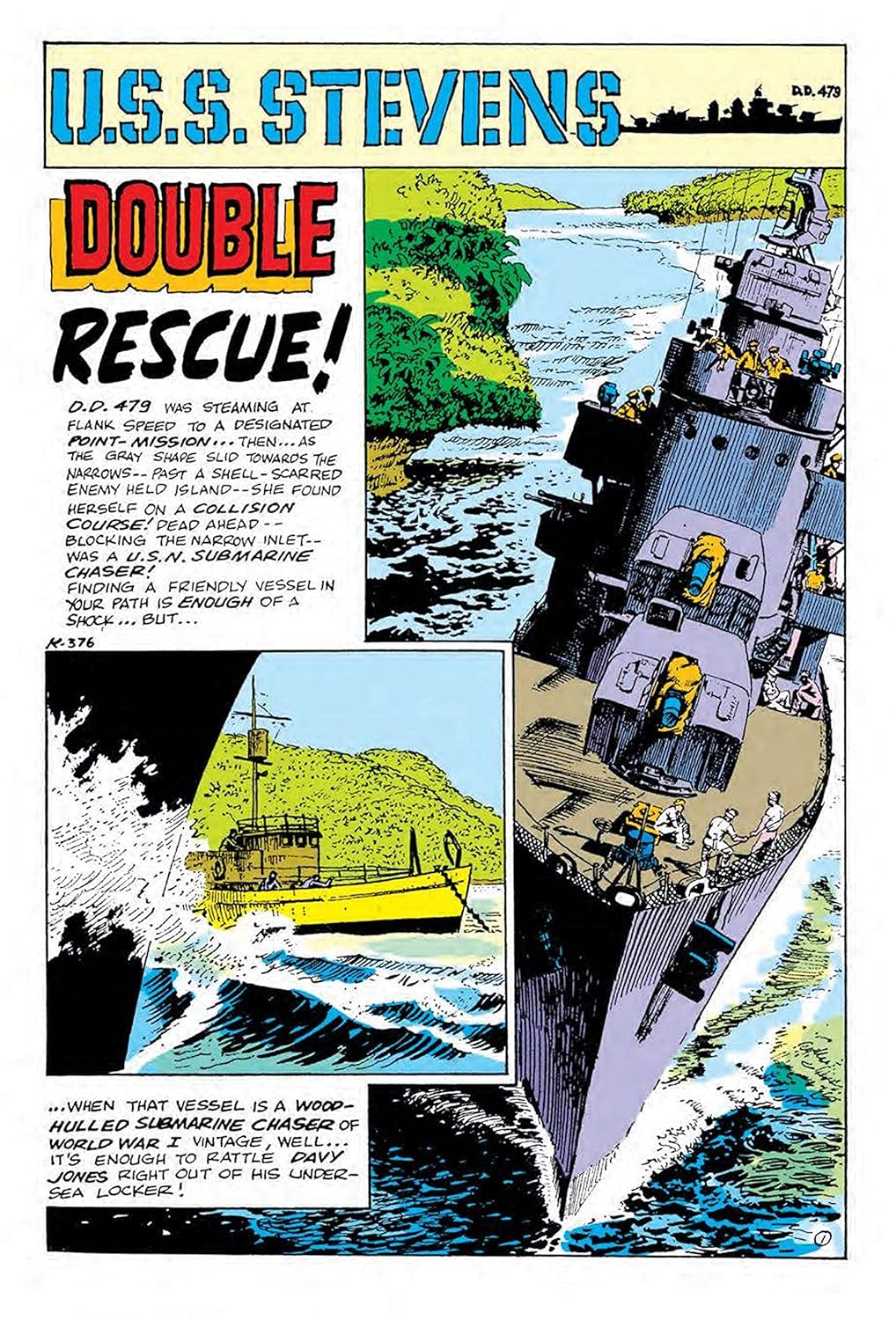
A weird encounter with a wooden WWI vessel forces a ‘Double Rescue!’ (Star Spangled War Stories #153, October/November) before OFF #128’s (November/December) ‘How Many Fathoms?’ again counts the human cost of bravery with devastating, understated impact. ‘Buckethead’ (OAaW #225, November) then relates one swabbie’s unique reaction to constant bombardment before ‘Missing: 320 Men!’ (G.I. Combat #145, December 1970-January 1971) debuted Glanzman-avatar Jerry Boyle, who whiled away helpless moments during a shattering battle by sketching cartoons of his astonished shipmates.

‘Death of a Ship!’ (OAaW #227, January 1971) deals with classic war fodder as submarine and ship hunt each other in a deadly duel. A military maritime mystery was solved by Commander Rakov in ‘Cause and Cure!’ Our Army at War #230, March) whilst next issue (April 1971) posed a different conundrum as the ship lost all power and was stuck ‘In the Frying Pan!’

The vignettes were always less about warfare than its effect – immediate or cumulative – on ordinary guys. ‘Buck Taylor, You Can’t Fool Me!’ (OAaW #232) catalogues his increasingly aberrant behaviour but posits some less likely reasons, after which old school hero Bos’n Egloff saves the day during the worst typhoon of the war in ‘Cabbages and Kings’ (OFF #131, July/August) whilst ‘Kamikaze’ (OAa #235 August) boldly and provocatively tells a poignant life-story from the point of view of the pilot inside a flying bomb.

An informative peek at the crew of a torpedo launch station in ‘Hip Shot’ (G.I. Combat #150 October/November) segues seamlessly into the dangers of shore leave ‘In Tsingtao’ (OFF #134, November/December) whilst ‘XDD479’ (OAaW #238 November) reveals a lost landmark of military history. The real DD479 was one of three destroyers test-trialling ship-mounted spotter planes. This little gem explains why that experiment was dropped…

Buck bounces back in ‘Red Ribbon’ (G.I.C #151 December 1971-January 1972), sharing a personal coping mechanism for making shipboard chores less “exhilarating”, whilst ‘Vela Lavella’ (OAaW #240, January 1972) captures the claustrophobic horror of nighttime naval engagement before ‘Dreams’ (G.I.C #152 February/March) peeps inside various heads to see what the ship’s company would rather be doing. ‘Batmen’ (OAaW #241, February) uses a lecture on radar to recount one of the most astounding exploits of the war…

Every episode was packed with fascinating fact and detail, culled from the artist’s letters home and service-time sketchbooks, but those invaluable memento belligeri also served double duty as the basis for a secondary feature. The debut ‘Sam Glanzman’s War Diary’ appeared in Our Army at War #242 (March 1972): a compendium of pictorial snapshots sharing quieter moments, such as the first passage through the Panama Canal, sleeping arrangements or K.P. duties peeling spuds, and precedes an hilarious record of the freshmen sailors’ endurance of an ancient naval hazing tradition inflicted upon every “pollywog” crossing the equator for the first time in ‘Imperivm Neptivm Regis’ (OFF #136 (March/April 1972).

A second ‘Sam Glanzman’s War Diary’ (OAaW #244, April) reveals the mixed joys of ‘Liberty in the Philippines’ after which a suitably foreboding ‘Prelude’ (Weird War Tales #4 (March/April 1972) captures the passive-panicked tension of daily routine whilst a potentially morale-shattering close shave is shared during an all-too-infrequent ‘Mail Call!’ (G.I. Combat #155, April/May)…

A thoughtful man of keen empathy and insight, Glanzman often offered readers a look at the real victims. ‘What Do They Know About War?’ (OAaW #244, April) sees peasant islanders trying to eke out a living, only to discover far too many similarities between Occupiers and Liberators, whilst the next issue focussed on sailors’ jangling nerves and stomachs. ‘A Funny Thing Happened on the Way to the War!’ (#245, May) reveals what happened when DD479 was mistakenly declared destroyed and, thanks to an administrative iron curtain, found it impossible to refuel or take on food stores. Cartoonist Jerry Boyle resurfaced in a ‘Comic Strip’ (OFF #138, July/August) after which Glanzman produced one of the most powerful social statements in an era of tumultuous change.

Our Army at War #247 (July 1972) featured a tale based on decorated Pearl Harbor hero Doner Miller who saved lives, killed the enemy and won medals, but was not allowed to progress beyond the rank of shipboard domestic because of his skin. ‘Color Me Brave!’ was an excoriating attack on the U.S. Navy’s segregation policies and is as breathtaking and rousing now as it was then.

‘Ride the Baka’ (OAaW #248 August) revisits constant near-miss moments sparked by suicide pilots after which Glanzman shares broken sleep in ‘A Nightmare from the Beginning’ (OFF #139, September/October) whilst ‘Another Kunkō Warrior’ (OFF #140, November/December) sees marines taking an island and encountering warfare beyond their comprehension…

1973 began with a death-dipped nursery rhyme detailing ‘This is the Ship that War Built!’ (G.I.C #157 December 1972-January 1973) before ‘Buck Taylor’ (OFF #141 January/February) delivers an impromptu lecture on maritime military history. Glanzman struck an impassioned note for war-brides and lonely ships passing in the night with ‘The Islands Were Meant for Love!’ (Star Spangled War Stories #167 February). Terror turns to wonder when sailors encounter the ‘Portuguese Man of War’ (OAaW #256 August), a shore leave mugging is thwarted thanks to ‘Tailor-Mades’ (OFF #143 June/July) and letters home are necessarily self-censored in ‘The Sea is Calm… The Sky is Bright…’ (OAaW #257 June), but shipboard relationships remain complex and bewildering, as proved in ‘Who to Believe!’ (SSWS #171, July).

The strife of constant struggle comes to the fore in ‘The Kiyi’ (OAaW #258 July) and is seen from both sides when souvenir hunters try to take ‘The Thousand-Stitch-Belt’ (SSWS #172 August), but, as always, it’s noncombatants who truly pay the price, just like the native fishermen in ‘Accident…’ (OAaW #259, August). Even the quietest, happiest moments can turn instantly fatal as good-natured pilferers swiping fruit at a refuelling station discover in ‘King of the Hill’ (SSWS #174, October). An unlikely tale of a kamikaze who survives his final flight but not his final fate, ‘Today is Tomorrow’ (OAaW #261, October) precedes a strident, wordless plea for understanding in ‘Where…?’ (OAaW #262 November 1973) before our sombre mood is briefly lifted with a tale of selfishness and sacrifice in ‘Rocco’s Roost’ from OAaW #265, February 1974.

The following issue provided both a gentle ‘Sam Glanzman’s War Diary’ covering down-time in “The Islands” and a brutal tale of mentorship and torches passed seen in ‘The Sorcerer’s Apprentice’, after which a truly disturbing tale of what we now call gender identity and post-traumatic stress disorder is recounted in the tragedy of ‘Toro’ ( April/May Our Fighting Forces #148)…

‘Moonglow’ from OAaW #267 (April 1974) reveals how quickly placid contemplation can turn to blazing conflagration, whilst – after a chilling, evocative ‘Sam Glanzman’s War Diary’ (OAaW #269 June) – ‘Lucky… Save Me!’ (OAaW #275, December 1974) shows how memories of unconditional love can offset the cruellest of injuries. ‘Heads I Win, Tails You Lose!’ (OAaW #281, June 1975) explores how both friend and foe alike can be addicted to risk, after which the next issue’s ‘I Am Old Glory…’ sardonically transposes a thoughtful veneration with the actualities of combat before ‘A Glance into Glanzman’ by Allan Asherman (Our Army at War #284, September 1975) takes a look at the author’s creative process.

Then it’s back to those sketchbooks and another peep ‘Between the Pages’ (OAaW #293, June 1976) before ‘Not Granted!’ (OAaW #298, November 1976) discloses every seaman’s most fervent wish…

Stories were coming at greater intervals at this time and it was clear that – editorially at least – the company was moving on to fresher and more fantastical fields. Glanzman, however, had saved his best till last as a stomach-churning visual essay displayed the force of tension sustained over months in ‘…And Fear Crippled Andy Payne’ (Sgt. Rock #304, May 1977) before an elegy to bravery and stupidity asked ‘Why?’ in Sgt. Rock #308 (September 1977).

And that was it for nearly a decade. Glanzman – a consummate professional – moved on to other ventures. He was, however, constantly asked about U.S.S. Stevens and eventually returned to his spiritual stomping grounds in expanded tales of DD479: both in his graphic novel memoirs and comic strips. The latter appeared in anthological monochrome Marvel magazine Savage Tales (#6-8, spanning August-December 1986) under the umbrella title ‘Of War and Peace – Tales by Mas’.

First up was ‘The Trinity’ blending present with past to detail a shocking incident of a good man’s breaking point, whilst a lighter tone informed ‘In a Gentlemanly Way’, as Glanzman recalled different means by which officers and swabbies showed pride for their ships. ‘Rescued by Luck’ than concentrated on a saga of island survival for sailors whose ship had sunk. Next comes a hauntingly powerful black-&-white tale of then and now entitled ‘Even Dead Birds Have Wings’ (created for the Dover Edition of A Sailor’s Story from 2015), after which a chronologically adrift yarn (from Sgt. Rock Special #1, October 1992) evokes potently elegiac feelings, describing an uncanny act of gallantry under fire and the ultimate fate of old heroes in ‘Home of the Brave’

Some years ago, by popular – and editorial – demand, Glanzman returned to the U.S.S. Stevens for an old friend’s swan song series; providing new tales for each issue of DC’s anthological 6-issue miniseries Joe Kubert Presents (December 2012 – May 2013). More scattershot reminiscences than structured stories, ‘I REMEMBER: Dreams’ and ‘I REMEMBER: Squish Squash’ recapitulate unforgettable moments seen through eyes at the sunset end of life; recalling giant storms and lost friends, imagining how distant families endured war and absence and, as always, balancing funny memories with tragic, like that time when the stiff-necked new commander…

‘Snapshots’ continues the reverie, blending a veteran’s war stories with cherished times as a kid on the farm whilst ‘The Figurehead’ delves deeper into the character of Buck Taylor and his esoteric quest for seaborne nirvana…

Closing that last hurrah were ‘Back and Forth 1941-1944’ and ‘Back and Forth 1941-1945’: an encapsulating catalogue of war service as experienced by the creator, mixing facts, figures, memories and reactions to form a quiet tribute to all who served and all who never returned…

With the stories mostly told, ‘Afterword’ by Allan Asherman details those heady days when he worked in DC Editorial, and Glanzman would unfailingly light up the offices by delivering his latest strips, after which this monolithic milestone offers a vast and stunningly detailed appendix of ‘Story Annotations’ by Jon B. Cooke.

This is a magnificent collection of comic stories based on real life and what is more fitting than to end it with ‘U.S.S. Stevens DD479’ (coloured by Frank M. Cuonzo & lettered by Thomas Mauer): one final, lyrical farewell from Glanzman to his comrades and the ship which still holds his heart after all these years?

This is an extraordinary work. In unobtrusive little snippets, Glanzman challenged myths, prejudices and stereotypes – of morality, manhood, race, sexuality and gender – decades before anybody else in comics even thought to try. He also brought an aura of authenticity to war stories which has never been equalled: eschewing melodrama, faux heroism, trumped-up angst and eye-catching glory-hounding to instead depict how brothers-in-arms really felt and acted and suffered and died.

Shockingly funny, painfully realistic and visually captivating, U.S.S. Stevens is phenomenal and magnificent: a masterpiece by one of the very best of “The Greatest Generation”. I waited over 40 years for this and I couldn’t be happier that ten years later this is one comics classic that is still available to all: a sublimely insightful, affecting and rewarding graphic memoir every home, school and library should have and one every reader will return to over and over.
Artwork and text © 2015 Sam Glanzman. All other material © 2015 its respective creators.

Today in 1920. US Dennis the Menace originator Hank Ketcham was born as was Funky Winkerbean cartoonist Tom Batiuk in 1947, and comics horror god Stephen R. Bissette in 1955. In 1973 we mourned Blondie creator Chic Young.

Mandrake the Magician: The Hidden Kingdom of Murderers – Sundays 1935-1937


By Lee Falk & Phil Davis (Titan Books)
ISBN: 978-0-85768-572-8 (HB)

This book includes Discriminatory Content produced in less enlightened times.

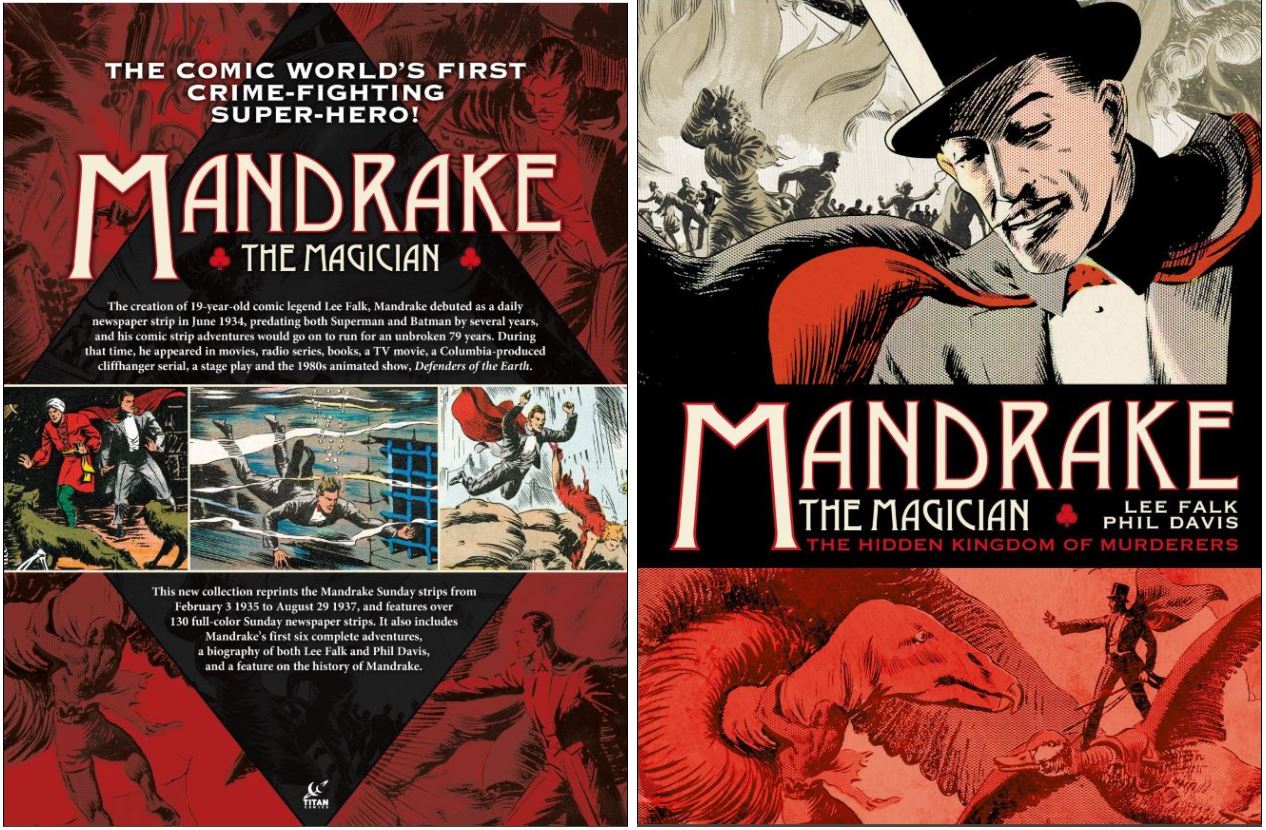
Regarded by many as comics’ first superhero, Mandrake the Magician debuted as a daily newspaper strip on June 11th 1934, although creator Lee Falk had sold the strip almost a decade previously. Initially drawing it too, Falk replaced himself as soon as feasible, allowing the early wonderment to materialise through the effective understatement of sublimely solid draughtsman Phil Davis. An instant hit, Mandrake was quickly supplemented by a full-colour Sunday companion page from February 3rd 1935.

Falk – as 19-year-old college student Leon Harrison Gross – had sold the strip to King Features Syndicate years earlier, but asked the monolithic company to let him finish his studies before dedicating himself to it full time. Schooling done, the 23-year-old born raconteur settled into his life’s work, entertaining millions with astounding tales. Falk also created the first costumed superhero in moodily magnificent generational manhunter The Phantom, going on to spawn an entire comic book subgenre with his first creation.

Most Golden Age publishers boasted at least one (and usually many) nattily attired wizards in their gaudily-garbed pantheons: all roaming the world(s) making miracles and crushing injustice with varying degrees of stage legerdemain or actual sorcery – characters like Mr. Mystic, Ibis the Invincible, Sargon the Sorcerer, and an assortment of the Magician”’s like Zatara, Zanzibar and Kardak. In the Antipodes, Mandrake was a suave, stalwart of Australian Women’s Weekly and a cherished icon of adventure in the UK, Australia, Italy, Brazil, Germany, Spain, France, Turkey and across Scandinavia: a major star of page and screen, pervading every aspect of global consciousness.

Over many decades he has been a star of radio, movie chapter-serials, a theatrical play, television and animation (as part of series Defenders of the Earth). With all that came the usual merchandising bonanza – games, toys (including magic trick kits), books, comics and more…

Falk worked on Mandrake and “The Ghost who Walks” until his death in 1999 (even on his deathbed, he was laying out one last story), but also found a few quiet moments to become a renowned playwright, theatre producer and impresario, as well as an inveterate world-traveller. A man of many talents, Falk drew the first few weeks himself before uniting with sublimely imaginative cartoonist Phil Davis, whose sleekly understated renditions took the daily strip – and especially these expansive full-page Sunday offerings – to unparalleled heights of sophistication: his steady assured realism the perfect tool to render the Magician’s mounting catalogue of wondrous miracles…

Those in the know are well aware that Mandrake was educated at the fabled College of Magic in Tibet, thereafter becoming a suave globe-trotting troubleshooter, always accompanied by his faithful African partner Lothar and beautiful, feisty companion (and eventually, in 1997 (!), bride) Princess Narda of Cockaigne, solving crimes and fighting evil. Those days, however, are still to come as the comics section opens in this splendidly oversized (315 x 236 mm) full-colour luxury hardback – and digital equivalents – with ‘The Hidden Kingdom of Murderers’ (running from February 3rd to June 2nd 1935) as the eccentrically urbane Prince of Prestidigitation and his herculean companion are approached by members of the international police to help expose a secret society of criminals and killers acting against the civilised world from their own hidden country.

After officer Duval is assassinated, Mandrake and Lothar – accompanied by panther woman Rheeta and surviving cop Pierce – embark upon a multi-continental search which, after many adventures, eventually brings them to a desolate desert region where they are confronted by bloody-handed Bull Ganton, King of Killers. With the master murderer distracted by Rheeta, Mandrake easily infiltrates the odious organisation and quickly begins dismantling a secret society of two million murderers. By the time Ganton wises up and begins a succession of schemes to end Mandrake, it’s far too late…

That deadly drama concluded, Mandrake & Lothar head to India to revisit old haunts and end up playing both peacemaker and cupid in the ‘Land of the Fakirs’ (June 9th – October 6th). When Princess Jana, daughter of Mandrake’s old acquaintance Jehol Khan, is abducted by rival ruler Rajah Indus of Lapore, the Magician ends his mischievous baiting of the street fakirs to intervene. In the meantime, Captain Jorga – who loves Jana despite being of a lower caste – sets off from the Khan’s palace to save her or die in the trying…

After many terrific and protracted struggles, Mandrake, Lothar & Jorga finally unite to defeat the devious duplicitous Rajah before the westerners set about their most difficult and important feat – overturning centuries of tradition so that Jorga and Jana might marry…

Heading north, the peripatetic performers stumble into amazing fantasy after entering the ‘Land of the Little People’ (13th October 1935 – March 1st 1936), encountering a lost race of tiny people embroiled in centuries-long war with brutal cannibalistic adversaries. After saving the proud warriors from obliteration, Mandrake again plays matchmaker, allowing valiant Prince Dano to wed brave and formidable commoner Derina who fought so bravely beside them. With this sequence, illustrator Davis seemed to shake off all prior influences and truly blossomed into an artist with a unique and mesmerising style all his own.

That is perfectly showcased in the loosely knit sequence (8th March to 23rd August 1936) which follows, as Mandrake & Lothar return to civilisation only to narrowly escape death in an horrific train wreck. Crawling from the wreckage, our heroes help ‘The Circus People’ recapture and calm the animals freed by the crash, subsequently sticking around as the close-knit family of nomadic outcasts rebuild. Mighty Lothar has many clashes with jealous bully Zaro the Strongman, culminating in thwarting attempted murder, whilst Mandrake uses his hypnotic hoodoo to teach sadistic animal trainer Almado lessons in how to behave, but primarily the newcomers act as a catalyst, making three slow-burning romances finally burst into roaring passionate life…

Absolutely the best tale in this tome and an imaginative tour de force that inspired many soon-to-be legendary comic book stars, ‘The Chamber into the X Dimension’ (30th August 1936 to March 7th 1937) is a breathtaking, mindbending saga starting when Mandrake & Lothar seek the missing daughter of a scientist whose experiments have sent her literally out of this world. Professor Theobold has discovered a way to pierce the walls between worlds but his beloved Fran never returned from the first live test. Eager to help – and addicted to adventure – Mandrake & Lothar volunteer to go in search of her and find themselves in a bizarre timeless world where the rules of science are warped and races of sentient vegetation, living metal, crystal and even flame war with fleshly humanoids for dominance and survival.

After months of captivity, slavery, exploration and struggle our human heroes finally lead a rebellion of the downtrodden fleshlings and bring the professor the happiest news of his long-missing child…

Concluding this initial conjuror’s compilation is a whimsical tale of judgement and redemption as Mandrake uses his gifts to challenge the mad antics of ‘Prince Paulo the Tyrant’ 14th (March 14th – 29th August 1937). The unhappy usurper had stolen the throne of Ruritanian Dementor and promptly turned the idyllic kingdom into a scientifically created madhouse. Sadly, Paulo had no conception of what true chaos and terror were until the magician exercised his mesmeric talents…

This epic celebration also offers a fulsome, picture-packed and informative introduction to the character – thanks to Magnus Magnuson’s compelling essay ‘Mandrake the Magician Wonder of a Generation’ – plus details on the lives of the creators (‘Lee Falk’ and ‘Phil Davis Biography’ features) plus a marvellous Davis pin-up of the cast to complete an immaculate confection of nostalgic strip wonderment for young and old alike.
Mandrake the Magician © 2016 King Features Syndicate. All Rights Reserved. “Mandrake the Magician Wonder of a Generation” © 2016 by Magnus Magnuson.

MAD day today. Al Jaffee was born in 1921 and Sam Viviano turned up in 1953. In between, Italian creator of Zagor Franco Donatelli was born in 1924 and Spain’s Superlópez creator Jan (Juan López Fernández) arrived in 1939.
As you are already aware today was the Day Lee Falk embarked on his final voyage.

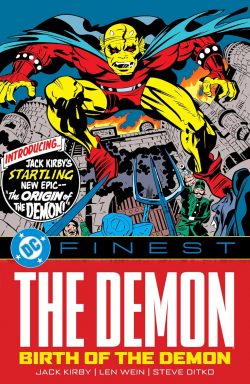
DC Finest: The Demon – Birth of the Demon


By Jack Kirby with Mike Royer, Bob Haney, Bob Rozakis, Len Wein, Gerry Conway, Jim Aparo, John Calnan, Mike Golden, Steve Ditko, José Delbo, Bob McLeod, Dick Giordano, Dave Hunt & various (DC Comics)
ISBN: 978-1799507437 (HB/Digital edition)

This book includes Discriminatory Content produced in less enlightened times.

Jack “King” Kirby shaped the very nature of comics narrative. A compulsive storyteller, Jack was an astute, spiritual man who had lived through poverty, gangsterism, the Depression and World War II. He had seen Post-War optimism, Cold War paranoia, political cynicism and the birth and death of peace-seeking counter-cultures. He was open-minded and utterly wedded to the making of comics stories on every imaginable subject. He began at the top of his game, galvanising the comic book scene from its earliest days with long-term creative partner Joe Simon: creating Blue Bolt, drawing Captain Marvel and adding lustre to Timely comics with creations such as Red Raven, Hurricane, Captain America and The Young Allies.

In 1942 Simon & Kirby moved to National/DC and hit even more stellar highs with The Boy Commandos, Newsboy Legion, Manhunter and The Sandman before the call of duty saw them inducted into the American military.

On returning from World War II, they reunited, forming a studio working primarily for the Crestwood/Prize publishing outfit. Here they invented the entire genre of Romance comics. Amongst that dynamic duo’s other concoctions for Prize was a noir-ish, psychologically underpinned supernatural anthology Black Magic and its short-lived but fascinating companion title Strange World of Your Dreams. All their titles eschewed traditional gory, heavy-handed morality plays and simplistic cautionary tales for deeper, stranger fare. Until the EC comics line hit their peak, S&K’s were far and away the best and most mature titles on the market.

Kirby understood the fundamentals of pleasing his audience and always strived diligently to combat the appalling state of prejudice about the comics medium – especially from industry insiders and professionals who despised the “kiddies world” they felt trapped in. When the 1950s anti-comics comics witch hunt devastated the industry, Simon & Kirby parted ways. Jack went back to DC briefly and created newspaper strip Sky Masters of the Space Force before partnering with Stan Lee at what remained of Timely Comics to create the monolith of stars we know as Marvel. After more than a decade there he felt increasingly stifled and side-lined and in 1970 accepted an offer of complete creative freedom at DC. The jump resulted in a root and branch redefinition of superheroes in his quartet of interlinked Fourth World series.

When those controversial, grandiose, groundbreaking titles were cancelled, Kirby looked for other concepts to stimulate his vast creativity and still appeal to an increasingly fickle and divided market. General interest in the Supernatural was peaking, with books and movies exploring the unknown in gripping and stylish new ways, and the Comics Code Authority had already released its censorious choke-hold on mystery and horror titles, thereby saving the entire industry from implosion when the superhero boom of the 1960s fizzled away.
At DC’s suggestion, Kirby had already briefly returned to his supernatural experimentation in a superb but poorly received and largely undistributed monochrome magazine. Spirit World launched in the summer of 1971, but as before, editorial cowardice and back-sliding scuppered the project before it could get going. You can see what might have been in a collected edition re-presenting the sole published issue and material from a second, unreleased sequel in Jack Kirby’s Spirit World

With most of his ideas misunderstood, ignored or side-lined by the company, Kirby opted for more traditional fare. Never truly defeated though, he cannily blended his belief in the marketability of the mystic unknown with flamboyant super-heroics to create another unique and lasting mainstay for the DC universe: one whom lesser talents would make a pivotal figure of the company’s continuity.
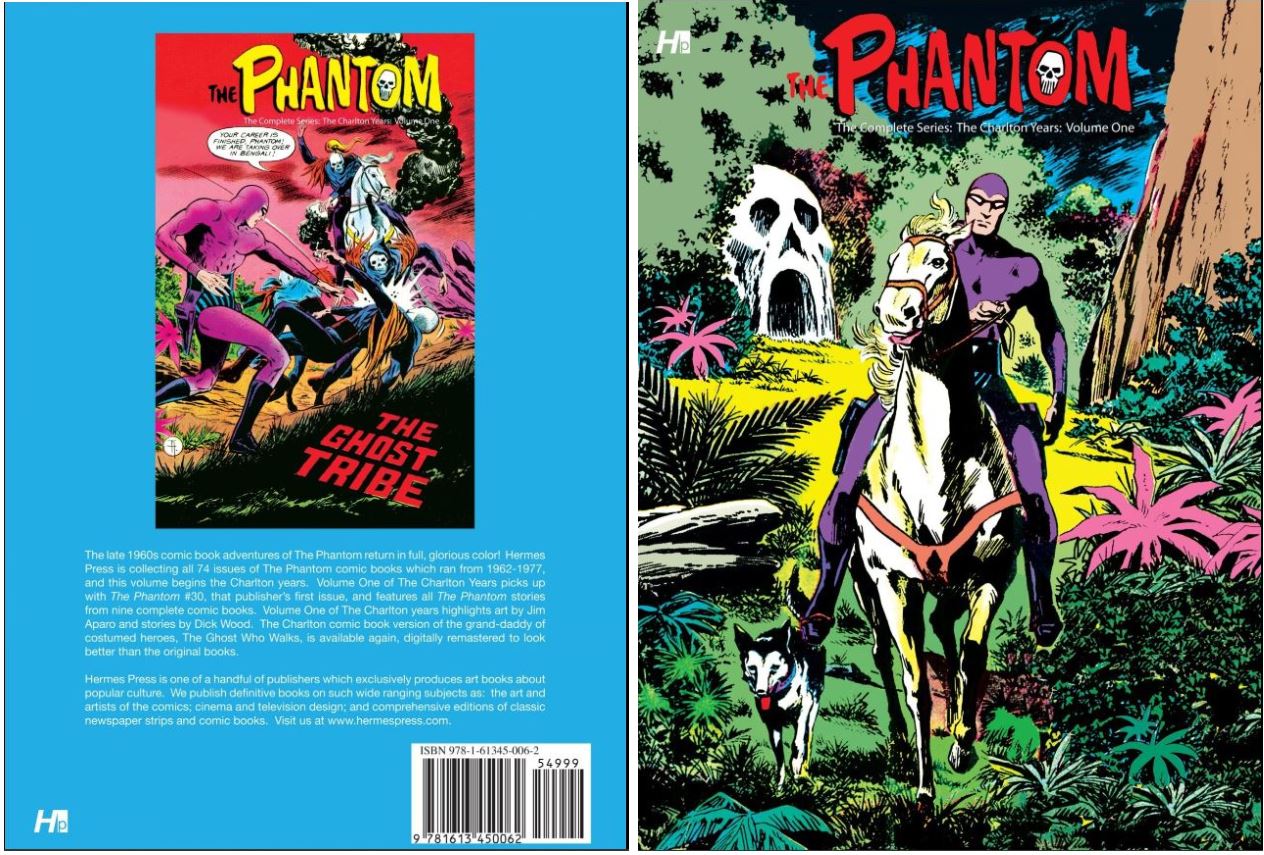
This compilation collects The Demon #1-16 (1972-1973), classic team-ups from The Brave and the Bold #109 & 137 and key appearances from Batman Family #17, Detective Comics #482-485 and Wonder Woman volume 1 #280-282, cumulatively spanning cover dates August/September 1972 through August 1981, providing a comprehensive introduction to one of Kirby’s most broadly reinterpreted and reimagined characters.
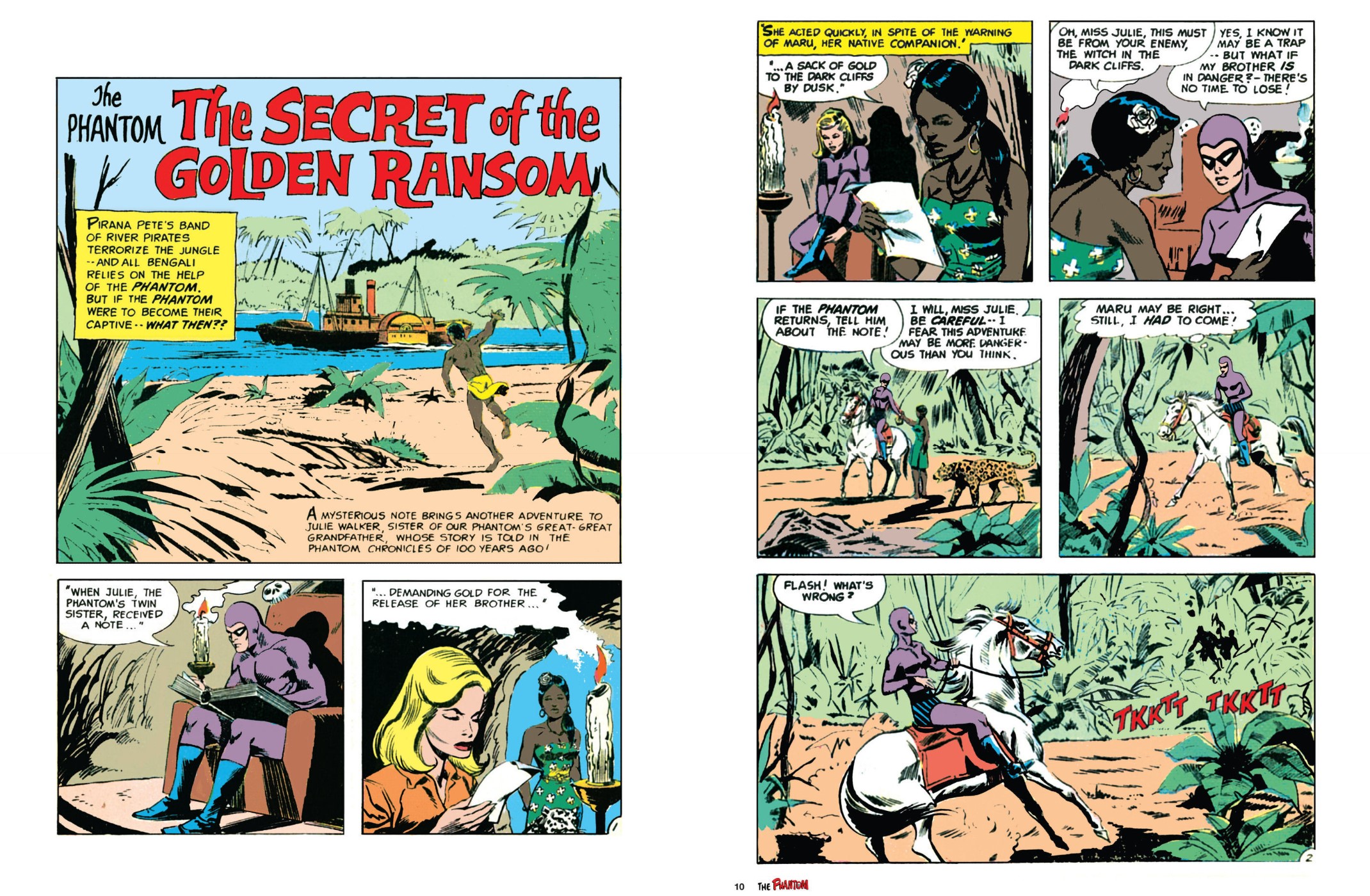
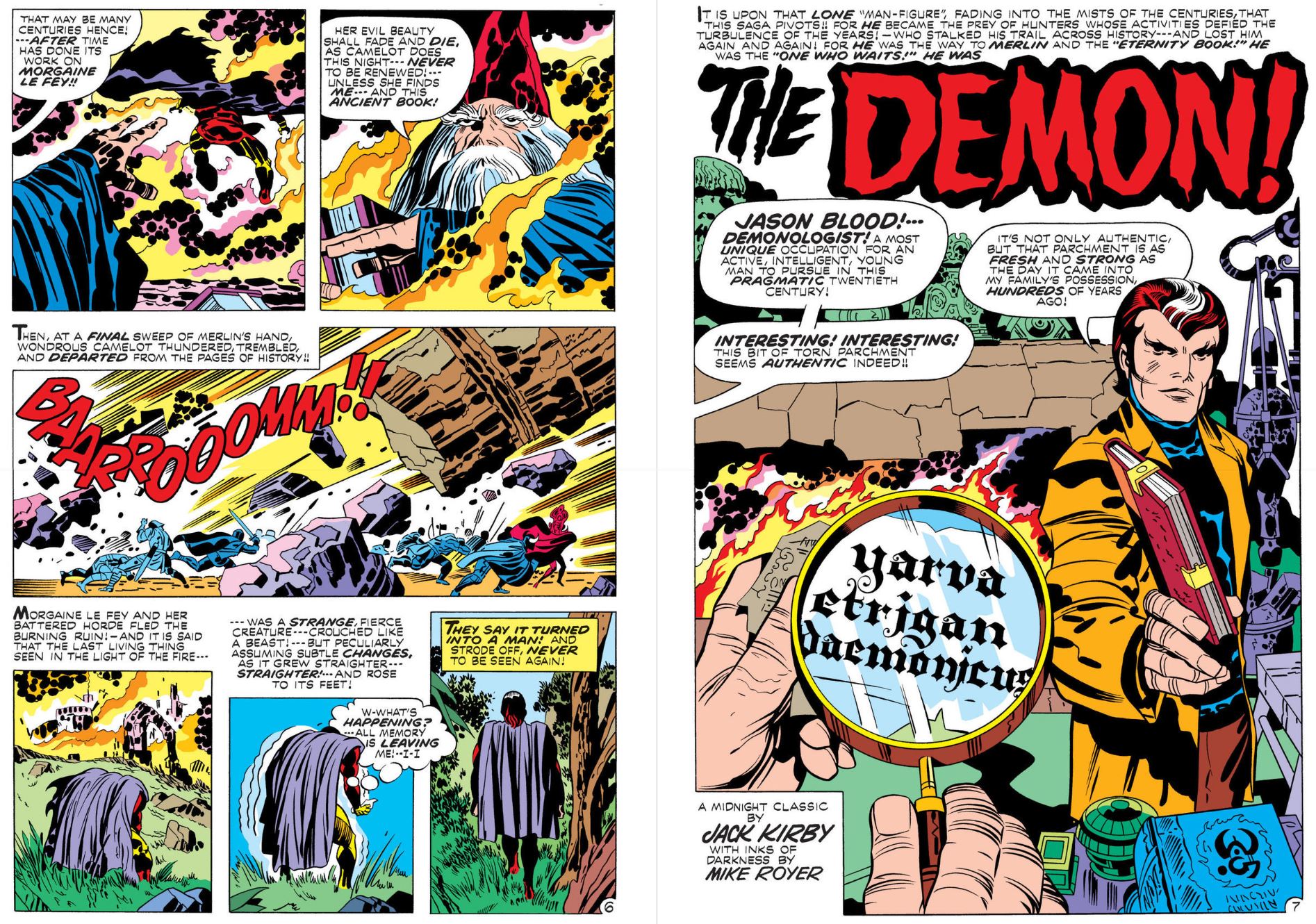
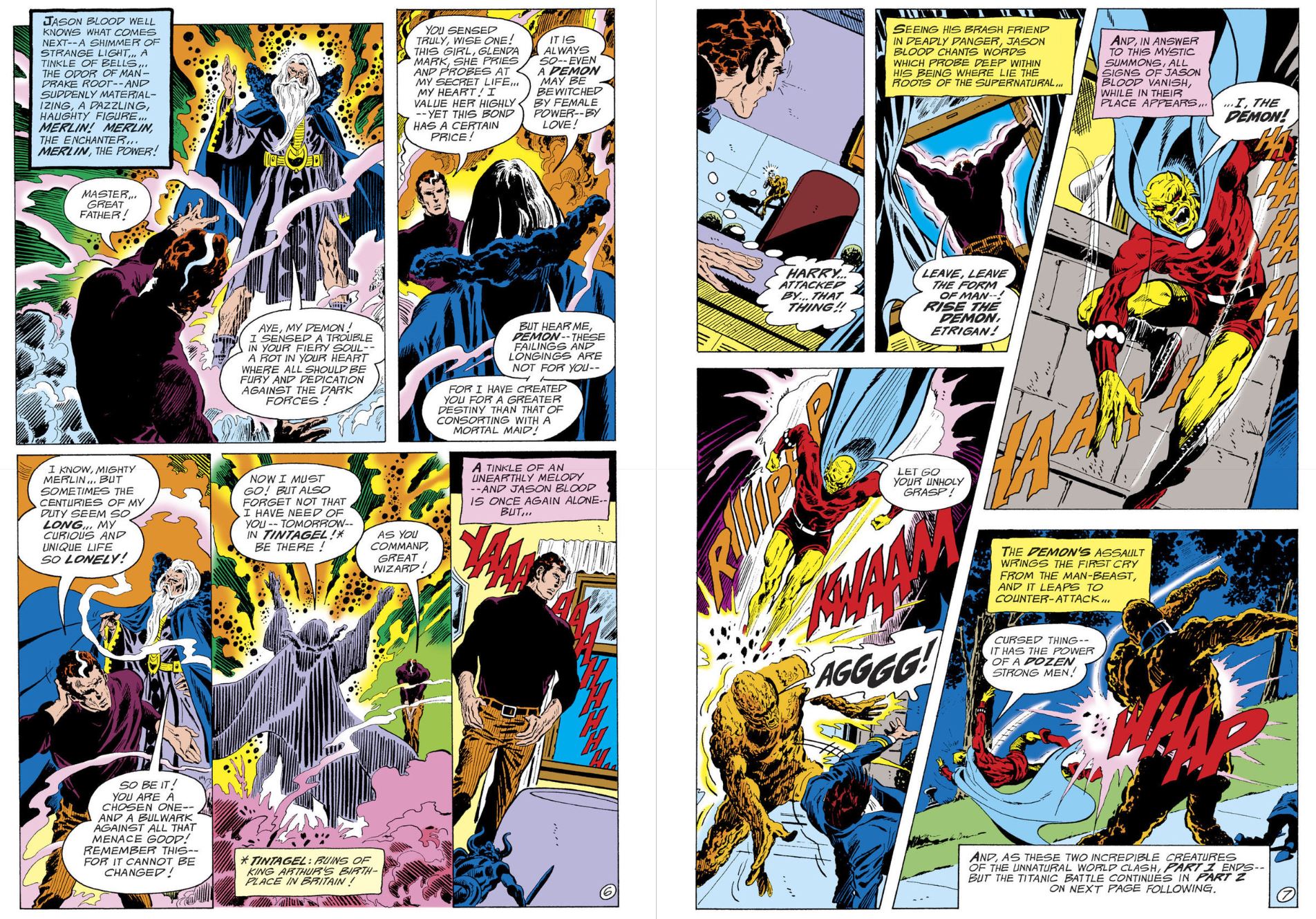
Inked by Mike Royer, The Demon #1 introduces a howling, leaping monstrosity (modelled after a 1939 sequence from Hal Foster’s Arthurian epic Prince Valiant) in ‘Unleash the One Who Waits’. This shocking force of un-nature battles beside its master Merlin as Camelot dies in flames, a cataclysmic casualty of the rapacious greed of sorceress Morgaine Le Fey. Out of that apocalyptic destruction, a man arises and wanders off into the mists of history…

In our contemporary world (or at least the last quarter of the 20th century) demonologist and paranormal investigator Jason Blood has a near-death experience with an aged collector of illicit arcana. This culminates in a hideous nightmare about a demonic being and the last stand of Camelot. He has no idea that Le Fey is still alive and has sinister plans for him…

And in distant Moldavia, strange things are stirring in crumbling Castle Branek, wherein lies hidden the lost Tomb of Merlin…

Blood is wealthy, reclusive and partially amnesiac, but one night he agrees to host a small dinner party, entertaining acquaintances Harry Mathews, psychic UN diplomat Randu Singh and his wife Gomali plus their flighty young friend Glenda Mark.

The soiree does not go well. Firstly, there is the painful small talk, and the sorcerous surveillance of Le Fey, but the real problems start when an animated stone giant arrives to “invite” Blood to visit Castle Branek. This shattering voyage leads to Merlin’s last resting place but just as Blood thinks he may find some answers to his enigmatic past, Le Fey pounces. Suddenly he starts to change, transforming into the horrific beast of his dreams…

Issue #2 – ‘My Tomb in Castle Branek!’ – opens with wary villagers observing a terrific battle between a yellow monster and Le Fey’s forces, but when the Demon is defeated and Blood arrested, only the telepathic influence of Randu back in America can help him. Le Fey is old, dying, and needs Merlin’s grimoire, the Eternity Book, to extend her life.

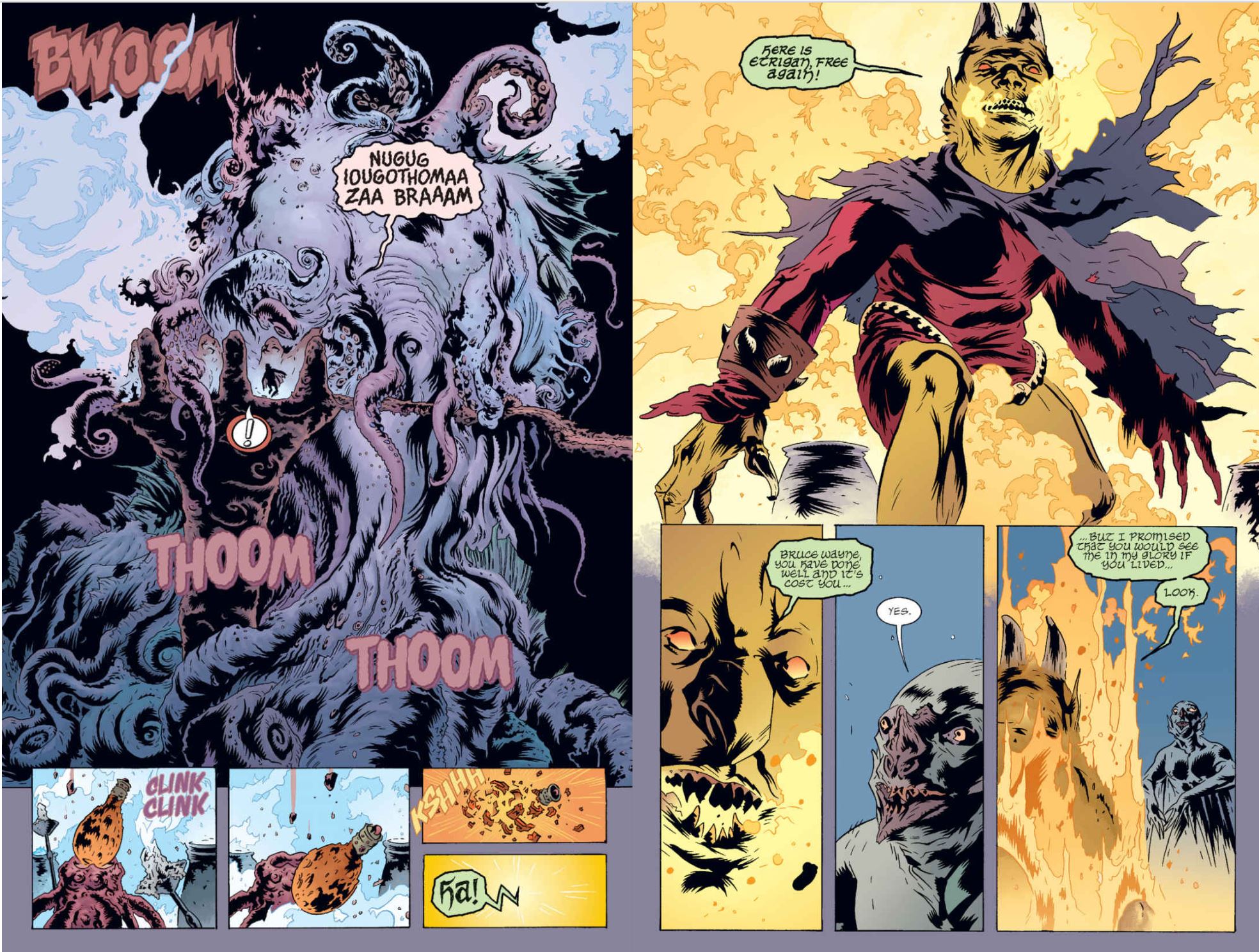
Thus, she manipulates Blood – who has existed for centuries, completely unaware that Merlin’s hellish attack dog the Demon Etrigan is chained inside him – to regain his memories and awaken the slumbering master mage. It looks like the last mistake she will ever make…

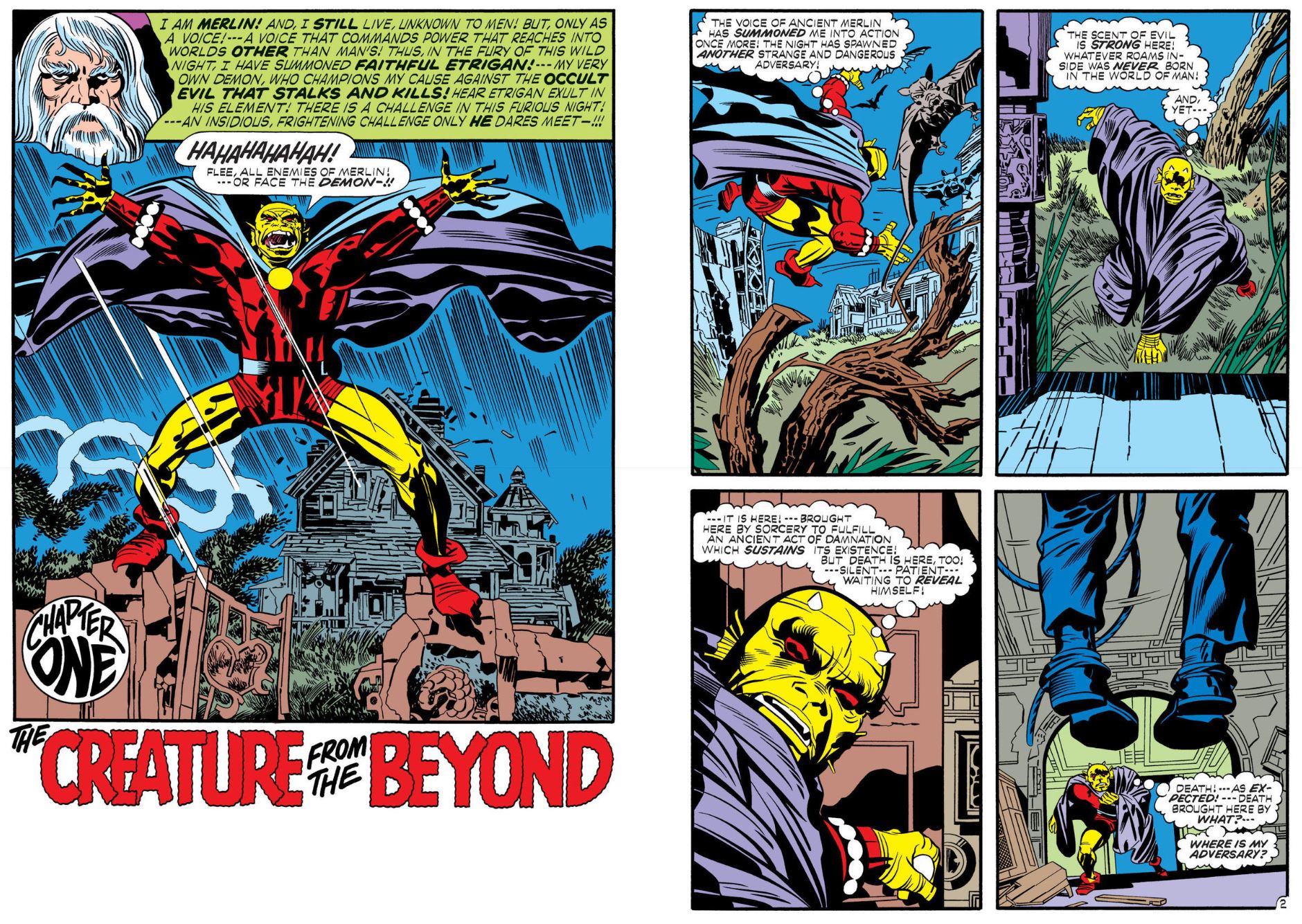
Kirby’s tried-&-trusted approach was always to pepper high concepts throughout blazing, breakneck action, and #3 was one of the most imaginative yet. ‘Reincarnators’ finds Blood back in the USA, aware at last of his tormented history, and with a small but devoted circle of friends. Adapting to a less lonely life, he soon encounters a cult able to physically regress people to a prior life… and use those time-lost beings to commit murder. The Demon #4-5 comprise one single exploit, wherein a simple witch and her macabre patron capture the reawakened, semi-divine Merlin. ‘The Creature from Beyond’ and ‘Merlin’s Word’s …Demon’s Wrath!’ introduce cute little monkey Kamara the Fear-Monster (later used with devastating effect by Alan Moore in Saga of the Swamp Thing #26-27) and features another startling “Kirby-Kritter”: Somnambula, the Dream-Beast

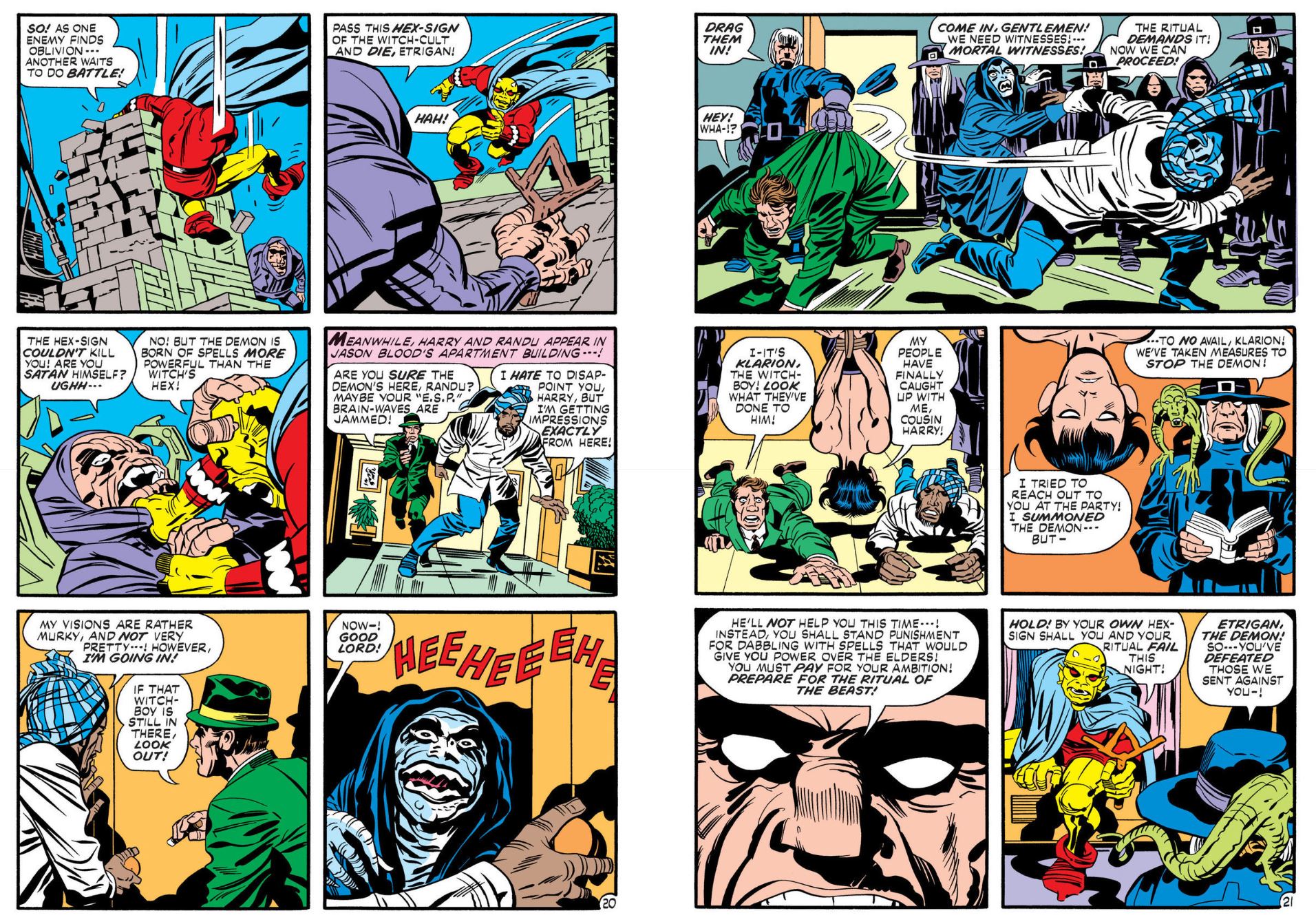
It seems odd in these blasé, anything goes modern times but The Demon was a deeply controversial book in its day – cited as providing the first post-Comics Code depiction of Hell, and one where problems were regularly solved with sudden, extreme violence. ‘The Howler!’ in issue #6 is a truly spooky yarn with Blood hunting a primal entity of rage and brutal terror that transforms victims into murderous lycanthropic killers, whilst #7 debuts a spiteful, malevolent young fugitive from a mystical otherplace.

‘A Witchboy!!’’ introduces Klarion and his cat-familiar Teekl – utterly evil little sociopaths in a time where all comic book politicians were honest, cops only shot to wound and “bad” kids were only misunderstood: thus, another Kirby first…

An extended epic, ‘Phantom of the Sewers’ skilfully combines movie and late-night TV horror motifs in the dark and tragic tale of actor Farley Fairfax, cursed by the witch he once spurned. Unfortunately, Glenda is the spitting image of the departed Galatea, and when, decades later, the demented thespian kidnaps her (in ‘Whatever Happened to Farley Fairfax?!!’) to raise the curse, it could only end in a flurry of destruction, death, consumed souls and ‘The Thing That Screams’…

In case you were wondering: the first musical adaption of The Phantom of the Opera (by Ken Hill) was in 1976, and the one you’re thinking of launched in 1986. The King was always ahead of the curve and subtly influential…

This 3-part thriller is followed by another moody, multi-part masterpiece (The Demon #11-13). ‘Baron von Evilstein’, ‘Rebirth of Evil!’ and ‘The Night of the Demon!’ comprise a powerful parable about worth and appearance, featuring the ultimate mad scientist and the tragic, misunderstood monster he so casually builds. It’s a truth that bears repeating: ugly doesn’t equal bad…

An opportunity to widen the horror-hero’s appeal came next in The Brave and the Bold #109: as Bob Haney & Jim Aparo unship superb supernatural thriller ‘Gotham Bay, Be My Grave!’ wherein the Caped Crusader and Kirby’s Kritter Etrigan the Demon fractiously unite to battle an unquiet spirit determined to avenge his own execution after nearly a century…

Despite the King’s best efforts The Demon was not a monster hit – unlike his science-fiction disaster drama Kamandi – and by #14 it’s clear the book was in its last days. Not because the sheer pace of imagination, excitement and passion diminished – far from it – but because the well-considered, mood-drenched stories were suddenly replaced by rocket-fast, eldritch romps populated with returning villains. First back was Klarion in ‘Return of the Witchboy!’ who creates a deadly doppelganger to replace Jason Blood and kill his friends in ‘The One Who Vanished!!’ (#14-15) before the series succumbed to irresistible economic forces with #16 (cover dated January 1974) in a climactic if hasty showdown with ‘Immortal Enemy’ Morgaine Le Fey…

Etrigan and cohort resurfaced in 1977 and B&B #137 (October) as Haney, John Calnan & Bob McLeod subjected Batman, Jason Blood’s friends and The Demon to war with resurrected Chinese wizard Shahn-Zi at ‘The Hour of the Serpent!’ before in a guest shot led to short revival. In Batman Family #17 (cover-dated April/May 1978), the Man-Bat serial saw Bob Rozakis & Mike Golden celebrate a happy event as the Chiropteran Crusader awaited the natal event of his firstborn child only to learn ‘There’s a Demon Born Every Minute!’ with devil babies infesting the maternity ward the hero welcomes the arrival of Etrigan (eventually) before teaming up to again thwart the diabolical schemes of malign Morgaine Le Fey.

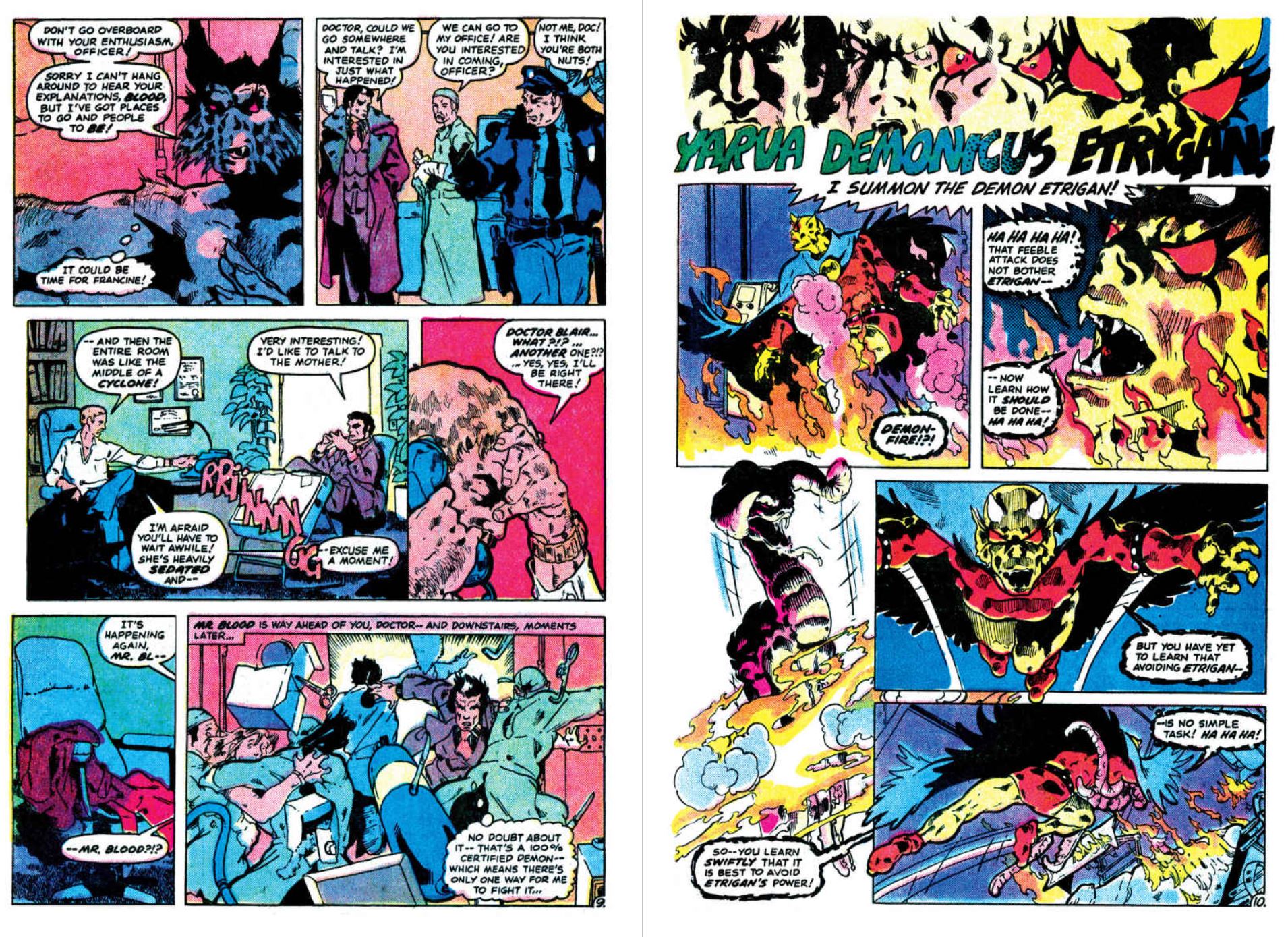
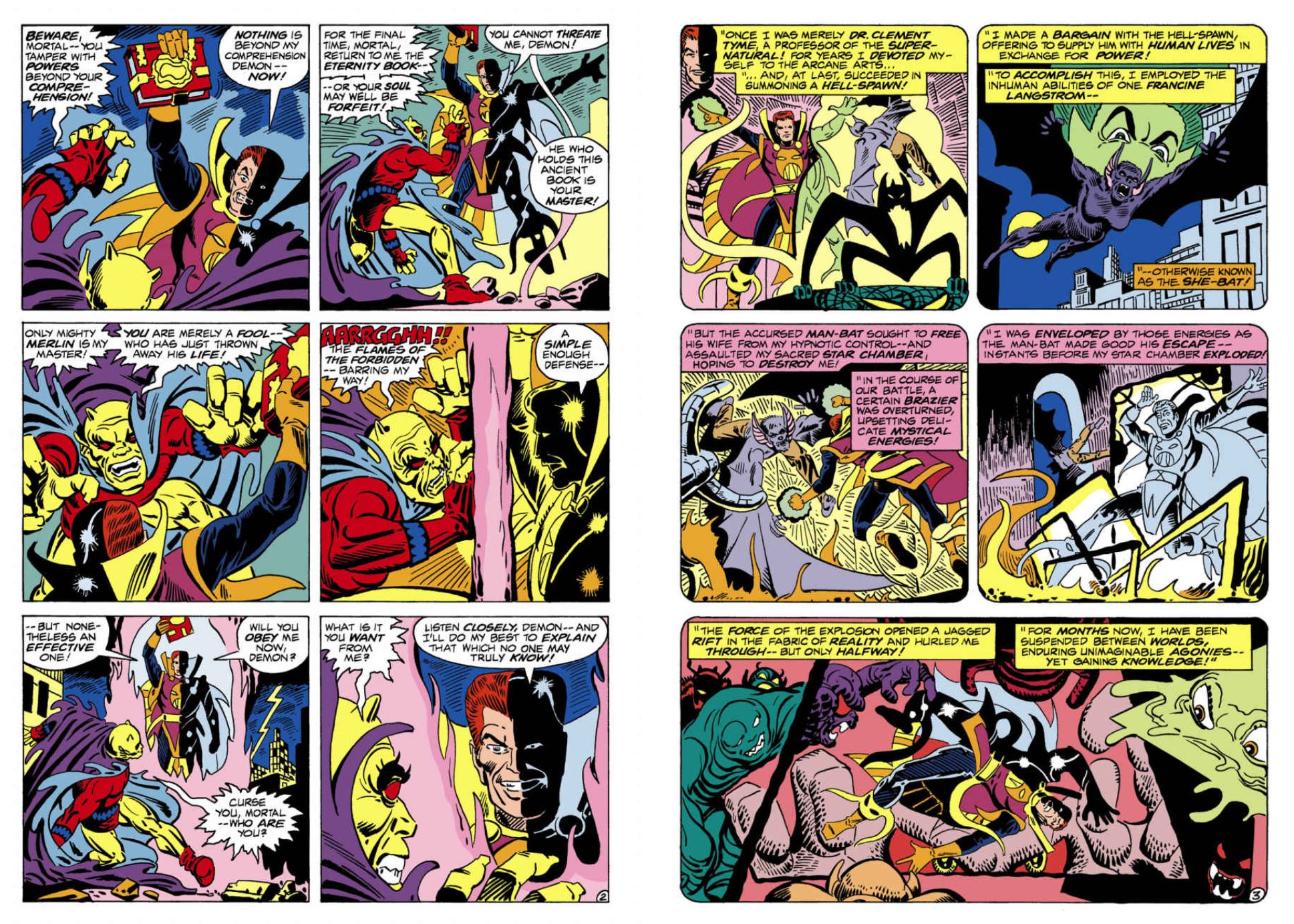
Implicit invite accepted, Gotham resident The Demon took up residence in anthological blockbuster Detective Comics beginning with #482 (February/March 1979). Here Len Wein, Golden & Dick Giordano opened a tense quest for ‘The Eternity Book’ of Merlin. As Steve Ditko added his unique vision to the optics, the chase caught Etrigan clashing with mad mystic academic Baron Tyme in DC #483’s ‘Return to Castle Branek!’ before hurtling to a chaotic, cataclysmic conclusion in #484’s ‘Tyme Has No Secrets!’ and furious finish in #485’s ‘The Fatal Finale!’

The riotous revelries conclude with an often overlooked team-up. For Wonder Woman #280 (volume 1, June 1981), Gerry Conway, José Delbo & Dave Hunt detail how Air Force officers Diana Prince and Steve Trevor investigate the prestigious Delphi Foundation after demon Baal-Satyr abducts their friend Etta Candy. They uncover senatorial corruption and insidious infiltration by witchboy Klarion and use arcane connections to link up with Randu Singh, Blood and his infernal alter ego prior to a rescue raid on ‘The Castle Outside Time!’ (WW #281), enduring more hellish treatment prior to #282’s triumphant, resurgent ‘Return and Redemption’

With covers by Kirby, Royer, Tatjana Wood, Aparo, Rich Buckler, Ross Andru & Dick Giordano, this is a sublime slice of Right Place, Wrong Time entertainment: a wondrously economical collection every comics fan of today should have and cannot help but enjoy.
© 1972, 1973, 1977, 1978, 1979, 1981, 2026 DC Comics. All Rights Reserved.

Today comic strip master Sy Barry arrived in 1928, whilst Graham Nolan didn’t turn up until 1962 and much-missed Italian artist Massimiliano Frezzato (I custodi del Maser, Margot) in 1967.

We lost Barney Baxter cartoonist Frank Miller in 1949, and the amazing Arnold (Deadman, Doom Patrol, Guardians of the Galaxy) Drake in 2007 but could enjoy Treasure Chest comics from 1946 and Hank Ketchum’s (US) Dennis the Menace from 1951.

Batman: The Doom That Came to Gotham


By Mike Mignola, Richard Pace, Troy Nixey, Dennis Janke & Dave Stewart (DC Comics) ISBN: 978-1-4012-5806-1 (TPB/Digital edition)
This book includes Discriminatory Content produced for dramatic effect.

The origins of the Dark Knight are so well-known now that it’s simple to twist and tweak them to suit almost any tale. It doesn’t hurt that the character has a universal recognition factor that holds up in almost any imaginary scenario…

Released in 2015, available in trade paperback and digital formats and collecting a 3-issue Elseworlds miniseries (from November 2000 – January 2001), The Doom That Came to Gotham was written by horror mood-meister Mike Mignola (Hellboy; duh!) and Richard Pace (Negative Burn; Ashes; Starman; Terror Inc.; Imaginary Fiends), limned by Troy Nixey (Harley Quinn; Trout; Only the End of the World Again; The Matrix Comics), inker Dennis Janke & colourist Dave Stewart.

In case you came in late: During the 1990s, DC regrouped to rebrand its frequent dalliances with alternate reality scenarios under the copious and broad umbrella of a separate imprint. The Elseworlds banner and credo declared heroes would be taken out of their usual settings and put into strange places and times – some that have existed, or might have existed, and others that can’t, couldn’t or shouldn’t exist…

No doubts here, however, as the tale deftly takes us back to Roaring Twenties America, dishing out a daring dose of pulp fiction plumb centre of the ghastly spine-chilling mythos of Clark Ashton Smith, H.P. Lovecraft and their darkly-dementing contemporaries…

It’s 1928 and orphaned Bruce Wayne returns to Gotham City two decades after his parents were murdered by a maniac. He’s been roving the world, and recently uncovered the fate of long-lost Professor Cobblepot’s fabled Antarctic expedition. That jaunt resulted in a clash with a naked madman who talked to penguins and a large slab of ice with a creature inside it: a thing that never evolved on this world…

By the time he and his close associates Alfred, Dick, Jason and the rest have docked in his bleakly daunting home town, they have all had more than enough of the vile dreams the thing in the hold has generated…

There are more surprises when he reaches his long-shuttered mansion: a dead man who somehow speaks and a mysterious stranger named Jason Blood who claims he’s been sent to deliver a dire warning. Turning into an actual demon, the visitor warns that to save Gotham, Bruce must cut out its heart. Although shocked, Bruce is ready to act, and dons the bizarre outfit that makes him look like a human bat…

…And thus begins a skilful, macabre pastiche of classic noir horror traditions, as the desperate, driven mystery man haunts the alleys and byways of the city, testing corrupt cops, self-serving officials and outright villains – all with names most comics fans will recognise – uncovering a long-suppressed, centuries-old secret, even as literal Things From Beyond Human Comprehension and the borders of time and space congregate.

Can even a heroic Bat Man triumph against such odds and if so, at what cost…

Taking its title from H.P. Lovecraft’s 1920 novella The Doom That Came to Sarnath and inspired by August Derleth’s 1945 novel The Lurker at the Threshold (written from Lovecraft’s unfinished plot notes), the eldritch epic is complemented by a full cover gallery by Mignola and a hefty sketches & design section featuring pencilled pages by Pace (originally slated to illustrate the tale) and layouts by Nixey.

Bold, compelling, potently stylish and chilling in all the right places, The Doom That Came to Gotham is a supernatural romp to delight and impress: once read and never forgotten. Yes there’s an animated movie released in 2023, but truly that’s just gilding. This dark lily is what you must have…
2000, 2001, 2015 DC Comics. All Rights Reserved.

Today in 1920 Belgian wonder Eddy Paape (Emmanuel, Valhardi, Luc Orient, Johnny Congo) was born, with Gray Morrow (Man-Thing, Tarzan, Buck Rogers, Flash Gordon) arriving in 1934 and Alan Weiss (Warlock, Batman: the Blue, the Grey and the Bat, Steelgrip Starkey) in 1948. In 1949 Godfather of British Comics Pat Mills was born and in 1967 mangaka marvel Ai Yazaw, (Nana, I’m No Angel, Neighborhood Story, Paradise Kiss) arrived. Two years later Cully Hamner (Down, Green Lantern: Mosaic, Blue Beetle, Red) came along, but it was 1978 before Australian horror star Ben Templesmith (30 Days of Night) turned up.

The Phantom – The Complete Series: The Charlton Years volume one


By Dick Wood, Steve Skeates, Bill Harris, D. J. Arneson, Jim Aparo, Frank McLaughlin, Pat Boyette, Bill Lignante, Nick Alascia & various (Hermes Press)
ISBN: 978-1-61345-006-2 (HB/Digital edition)

This book includes Discriminatory Content produced in less enlightened times.

In the 17th century a British sailor survived an attack by pirates, and, washing ashore on the African coast, swore on the skull of his murdered father to dedicate his life and that of all his descendants to destroying all pirates and criminals. The Phantom fights crime and injustice from a base deep in the jungles of Bengali, and throughout Africa is known as the “Ghost Who Walks”…

His unchanging appearance and unswerving war against injustice have led to him being considered an immortal avenger by the credulous and the wicked. Down the decades one hero after another has fought and died in an unbroken family line, and the latest wearer of the mask, indistinguishable from the first, continues the never-ending battle.

Lee Falk created the Jungle Justice dealer at the request of his syndicate employers who were already making history, public headway and loads of money with his first strip sensation Mandrake the Magician, and although technically not the first ever costumed hero in comics, The Phantom’s astounding popularity made him the prototype paladin: wearing the later demi-compulsory skintight bodystocking and mask with opaque eye-slits.

He debuted on February 17th 1936 in an extended sequence pitting him against a global confederation of pirates called the Singh Brotherhood. Falk wrote and drew the daily strip for the first two weeks before handing over the illustration side to artist Ray Moore. A hugely successful Sunday feature began in May 1939. However, for such a long-lived and influential series, in terms of compendia or graphic novel collections, The Phantom has been very poorly served by the English language market (except in Australia where he has always been accorded the status of a pop culture god).

Various companies have tried to collect the strips – one of the longest continually running adventure serials in publishing history – but in no systematic or chronological order and never with any sustained success. But, even if only of historical value (or just printed for Australians), surely Kit Walker is worthy of a definitive chronological compendium series?

Happily, his comic book adventures have fared slightly better – at least in recent times…

From November 1962 through July 1966 all new adventures were published by West Coast giant Gold Key Comics after which King Features Syndicate dabbled with a comic book line of their biggest stars – including Popeye, Blondie, Flash Gordon, Mandrake and The Phantom – between 1966 and 1967. When they gave up the ghost (see what I did there?), plucky dependable, cheap Charlton Comics were there to pick up the slack…

The Phantom was no stranger to funnybooks, having appeared since the Golden Age in titles like Feature Book and Harvey Hits, but only as reformatted newspaper strip reprints. The Gold Key exploits were tailored to a big page and a young readership, a model King maintained for their own run but which was tweaked when Charlton took on the license.

This splendid full-colour hardcover and/or eBook gathers the contents of The Phantom #30-38 (originally released between February 1969 and June 1970) and opens with an erudite Introduction from Christopher Irving relating all you need to know about ‘The Phantom and Charlton Comics’, compellingly augmented by the first of many pages of original art by Jim Aparo.

As with previous publishers, the majority of the stories are scripted by Dick Wood (with some contributions from Bill Harris and Charlton mainstay Steve Skeates) but the big attraction here is a large body of illustration by then up-&-coming superstar Jim Aparo in his last work for CC before moving to DC.

Opening the Charlton archive are a brace of thrilling escapades by Dick Wood & Frank McLaughlin (with possibly some inking assistance from Sal Trapani?) beginning with ‘The Secret of the Golden Ransom’ as Julie – sister of the Ghost Who Walks – again dons purple long johns to secretly save her brother from a devilish trap, after which the ‘The Living Legend’ sees the jungle juggernaut put the fear of god into a western-educated tribesman who no longer believes in ghosts…

Issue #31 sees an epic full-length tale by Wood & Aparo as ‘The Phantom of Shang-Ri-La’ finds the hero on a rescue mission to the fabled Valley of the Sun to save his best friend from devious crooks masquerading as benevolent immortals. After more original art, #32’s ‘The Pharaoh Phantom’ takes the masked marvel to Egypt and an impossible confrontation with a freshly-revived mummy who claims to be the original and genuine Ghost Who Walks.

Pat Boyette & Nick Alascia limn Wood’s lead story in The Phantom #33 as ‘The Curse of Kallai’ exposes an ancient mystery wherein an Indian death cult returns to plunder Africa, claiming an earlier Phantom was their bound and sworn ally, after which Steve Skeates & Aparo detail how a young native boy is pivotal in reversing ‘The Phantom’s Death’

Using the nom de plume Norm Dipluhm, D. J. Arneson scripts a brace of tales for Aparo in #34 beginning with ‘The Cliff Kingdom’ as the Phantom destroys a tribe hunting low flying aircraft before going on to defeat far-from supernatural menace ‘The Giant Ape of Tawth’

Veteran team Bill Harris & Bill Lignante return in #35 to reveal the sinister secret of ‘The Ghost Tribe’ plundering and slave-taking in Bengali, but not before the Phantom infiltrates the marauders’ inner circle and is ‘Trapped’ in an almost inescapable situation. Almost…

Dipluhm & Aparo open #36 with ‘The River That Never Ends’ as the Phantom is drawn into  a subterranean underworld whilst battling merciless modern pirates, and close with a pithy smuggling yarn as the spectral avenger intercepts some ‘Very Special Timber’ to punish a very ingenious evildoer…

In #37 the format changes to shorter stories beginning with ‘Bandar Betrayers’ as a strange blossom warps the minds of the Phantom’s greatest friends and allies whilst ‘Skyjack’ sees him undercover as Kit Walker, flying to America when his plane is attacked by a fanatic, and a last exploit sees him back in Africa as a new commander for the private jungle police force is almost compelled to ‘Disband the Patrol’

Wrapping up these volatile verdant voyages, #38 starts on ‘The Dying Ground’ as rogue hunters trap the hero in hopes of learning the location of the fable Elephant’s Graveyard before a crisis of conscience and capability is countered by uncanny natural phenomena in ‘The Phantom’s New Faith’ after which Jungle Patrol intel allows The Phantom to save his ever-so-patient intended bride Diana Palmer from murderous art-thieves setting ‘The Trap’

Packed with original art by Aparo, this is another riveting, nostalgia-drenched triumph: straightforward, captivating rollicking action-adventure that has always been the staple of comics fiction.

If that sounds like a good time to you, this is a traditional action-fest you must not miss…
The Phantom® © 1969-1970 and 2012 King Features Syndicate, Inc. ® Hearst Holdings, Inc. Reprinted with permission. All rights reserved.

Today in 1922, comics visionary Bill Gaines (EC Comics, Mad) was born, followed two years later by master scripter/screenwriter Arnold (Deadman, Doom Patrol, Guardians of the Galaxy) Drake. Writer/editor/documentarian Joyce (Brought to Light, Real War Stories, American Splendor) Braner came long in 1952, letterer Tom Orzechowski in 1953 and Uruguayan artist Eduardo Barreto (AKA Luis Eduardo Barreto Ferreyra and illustrator of everything from Steel Sterling to Superman) in 1954, with Ed (Deadpool) McGuinness arriving in 1974.

In 1980 we lost the astoundingly diligent Dick Dillin (Blackhawk, Justice League of America, Superman, World’s Finest) and in 1998 the forever-irreplaceable Archie Goodwin. In 2024 Dragon Ball creator Akira Toriyama died.