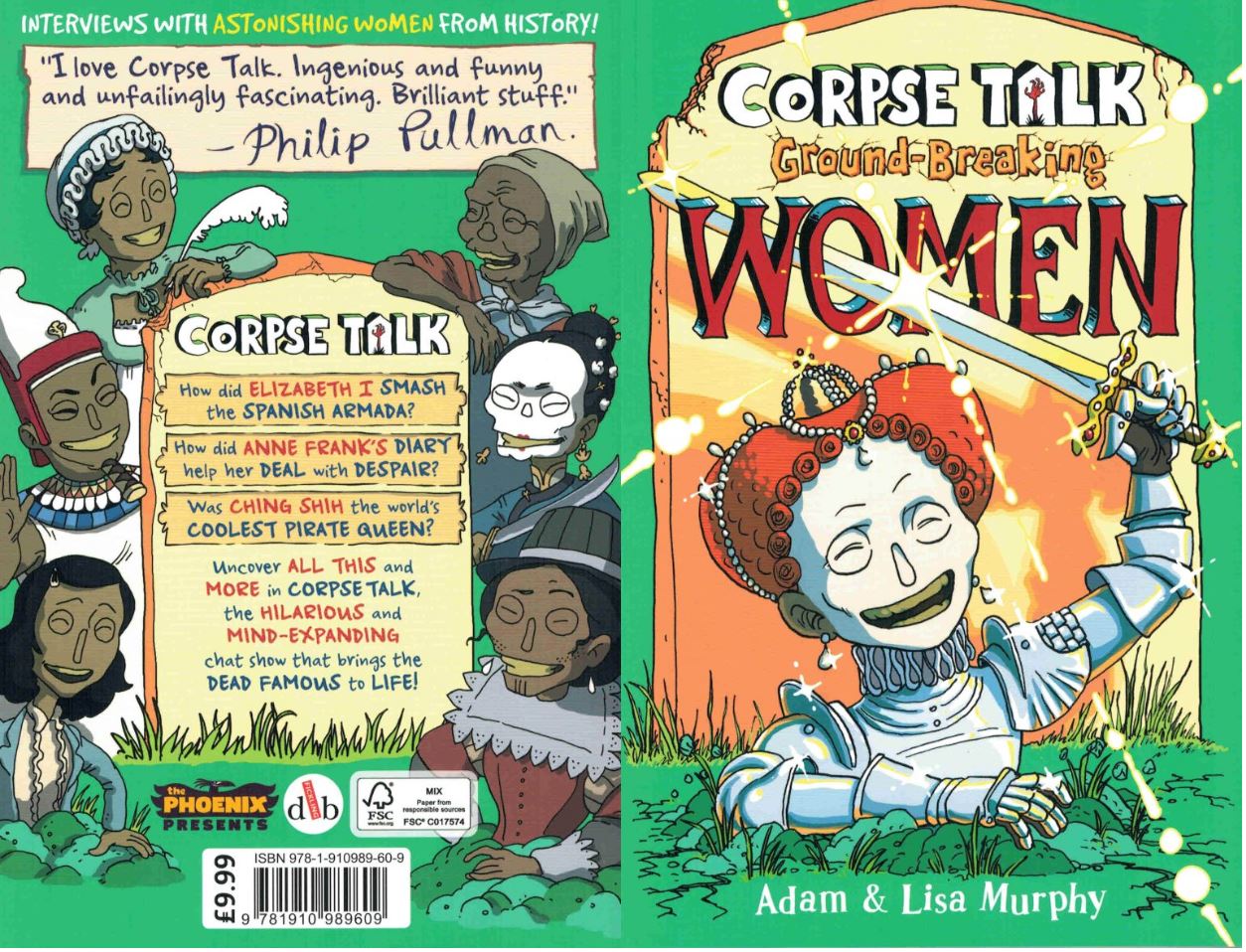
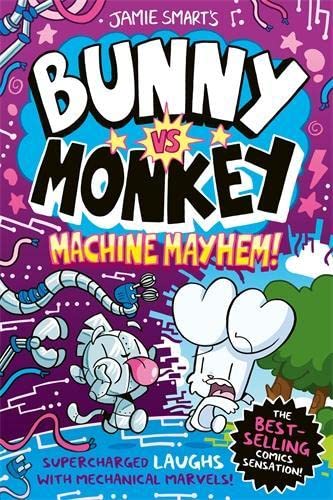
Bunny vs Monkey: Machine Mayhem!


By Jamie Smart, with Sammy Borras (David Fickling Books)
ISBN: 978-1-78845-297-7 (TPB)

Bunny vs. Monkey has been a staple of The Phoenix since the very first issue in 2012: recounting a madcap vendetta gripping animal arch-enemies set amidst an idyllic arcadia masquerading as more-or-less mundane but critically endangered English woodlands.

Concocted with gleefully gentle mania by cartoonist, comics artist and novelist Jamie Smart (Fish Head Steve!; Looshkin; Flember), these trendsetting, mind-bending yarns have been wisely retooled as graphic albums available in remastered, double-length digest editions such as this one. Now brilliantly beach-ready comes a handy pocket paperback edition to consult when the surf’s all unsanitary and there’s sand or sandwiches in the Gameboy…

The tail-biting tension and animal argy-bargy began yonks ago after an obnoxious little anthropoid plopped down after a disastrous British space shot. Crashlanding in Crinkle Woods – scant miles from his launch site – lab specimen Monkey believed himself the rightful owner of his strange new world, despite all efforts from reasonable, sensible, contemplative resident Bunny to dissuade him. For all his patience, propriety and genteel good breeding, the laid-back lepine just could not contain the incorrigible idiot ape, who was – and still is – a rude, noise-loving, chaos-creating troublemaker…

Problems are exacerbated by other unconventional Crinkle creatures, particularly a skunk called Skunky who has a mad scientist’s attitude to life and a gift for building robots and super-weapons…

With artistic assistance from design deputy Sammy Borras, the saga resumes with the war of nerves and mega-ordnances apparently over. The unruly assortment of critters cluttering up the bucolic paradise had finally picked sides and the battles at last ended. They even seemingly forgot the ever-encroaching Hyoomanz…

Following a double-page pin-up of the ever-expanding cast, this archive of anarchic insanity opens in the traditional manner: divided into seasonal outbursts, and starting with a querulous teaser tale as Spring begins in ‘D.I.Whyyyy?’

As the animals gather to help Bunny repair his much-abused house, universal innocents Pig Piggerton and Weenie squirrel – more keen than skilled – realise that cheese is not a suitable substitute for wallpaper paste, plaster or cement…

Despite the subsequent collapse, times are good and very peaceful since the awful ape went away and Ai (an Aye-aye) acts quickly to keep it that way when Bunny feels nostalgic for the old days. Sadly, somebody’s listening and brings in a ‘Makeshift Monkey!’ – until the real deal returns in ‘The Little Monkey Who Cried…’

Before long Skunky is back too and everyone’s fleeing for their lives from deadly underground tentacles, but life quickly slips into its old pattern… until obsolescence rears its ugly head and cyborg gator Metal Steve is pronounced ‘Out of Warranty’: left to wither on Skunky’s scrapheap…

Back and still bad, Monkey briefly inflicts himself on Bunny and wrecks the joint again in ‘The Housemate’ after which our mercurial monochrome megamind constructs a replacement for the gone gator: triggering ‘Robot Rampage’ when infinitely superior mechanoid Metal E.V.E. lay down her own law…

Falling foul of another near-lethal prank the silly simian is scientifically resurrected and evolved in ‘Curse of the Monkey’ only to trip on his own incompetence and barely escape a fishy final fate in ‘Toilet Run!’

A close call with humans in ‘Bunny vs Monkey Jellybeans!’ precedes piratical pretenders Weenie and Pig’s ‘A Dangerous Voyage’, before Monkey endures his own Journey into the Unknown. As “The Most Brilliant Animal in the Woods” Skunky convinces his erstwhile ally to shrink down and explore the inner cerebellum of brain-battered, bewildered ex-stuntman Action Beaver for ‘The Lost Memory’ of a misplaced ultimate weapon, which is what probably inspires him to make his own, after entering a competition and prematurely unleashing his ‘Winning Entry’…

Metal E.V.E. is forming her own plans but they have to wait a bit as she’s ‘Keepin’ Busy’ with some domestic chores in Skunky’s lab, but it’s not long until Summer begins and the woods are imperilled by subterranean invasion from new menace ‘Roland T. Mole’…

Hijinks in parallel dimensions herald the arrival of doomsayer ‘Skunky?’ as the forgotten stuntman stumbles with catastrophic consequences into his ancestral homeland in ‘Beaverville’. Monkey meanwhile creates unexpected carnage but precious little terror with super-cute kaiju ‘Rofl Axolotl’ before being painfully reminded how dangerous the woods can be in ‘So Beautiful’…

After a brief and deceptive flirtation with ‘The Dark Arts’, the hairy halfwit returns to science by creating little golden minions, but his ‘Gloobs’ prove too smart for servitude, so instead embraces high fashion in ‘C’est Chic!’ Utterly uncaring, Weenie and Pig go about their business until a ‘A New Friend’ almost breaks up the partnership. The swiftly-developing relationship of ‘Weenie and Winnie’ seems set to end the good old days, but another robotic invasion sets the world to rights in ‘Just Checking’…

A reality-altering beast threatens in ‘Wishful Thinking’ and the entire woods go all French just as aliens invade in ‘L’Honk Honk’ before Monkey & Skunky explore artisanal dining in ‘Eat Up!’, with appalling consequences for their customers, after which Ai and Monkey discover uncanny ‘Night Lights’ in the deep dark woods…

The season concludes with Metal E.V.E. getting ahead by installing crucial ‘Upgrades’ and inadvertently making contact with an unsuspected predecessor just as Autumn opens with ‘Bumblesnatch’ and pig & squirrel enjoying super-powers-inducing chewing gum whilst Crinkle Woods is catapulted into a different kind of chaos when broached by pet pooch ‘Fluffy’…

When ‘The Summoning’ invokes some pretty indifferent forest gods, Skunky lodges with over-accommodating Bunny, who is soon sucked into unwanted adventure ‘Down Below’ and unearths E.V.E.’s brave new world. Hopeless old ally Metal Steve then runs amok with nano-bots and spawns unlikely armageddon beast ‘Pig-Kira!’

Once that menace vanishes into vapour, the mostly organic animals unite to formulate ‘Some Kind of Plan’ for fighting E.V.E. – all except ‘Nurse Monkey’ who’s keen to explore other lifestyles – before reenlisting in ‘Roll Up! Roll Up!’ with a barmy spinning machine. It has no chance of easing their plight but will probably end their lives before she does…

The crusade pauses for Weenie’s birthday and the hunt for ‘The Best Present in the World’, but restarts again when E.V.E. crashes the party with ‘Something to Say’ about the “rise of the machines” and end of all flesh…

Skunky’s response is yet another monster, but giant mecha-hedgehog ‘Thunderball!’ is easily overcome, and as so-distractable Monkey goes wild among the fallen leaves in ‘Leaf it Alone’, the machine rise begins in ‘Nahhhhh!’…

Sadly, Metal E.V.E. makes a big mistake then, spilling Monkey’s drink and kicking the conflict to an unprecedented new level…

Pausing for Weenie, Pig, Ai and Bunny to share some ‘Scary Stories’ around a nighttime campfire, the constant crisis enters a new phase when the ghost of local legend Fantastic Le Fox manifests, even as our ape oaf is transformed into E.V.E.’s ‘Metal Monkey’…

Le Fox is ‘An Old Friend’ resolved to help the animals survive and his strategic advice is welcome, but the turning point comes in ‘Clash of the Robots’ as Metal Monkey and Steve duel, even as their mecha-mistress takes full charge, unleashing DNA-altering microbots that put the fleshy freedom fighters to flight in ‘Uh-Oh-Nano!’

Winter sets in and hostilities suddenly cease as all concerned succumb to the temptation of chucking ‘Snowballs’ and the end gets nigher in a wave of robotic attacks triggered by ‘Metal Mania’. Yet again, everything pauses as Christmas provides a moment to unwrap ‘Presents’ but – drenched in seasonal spirit – ‘An Unlikely Hero’ dares to bring the message of the moment right to the robot queen. The act unwittingly changes the course of history in the woods, leaving only some ‘Tidying Up’ to restore everything to what passes for normal…

The animal anarchy might have ended for now, but there’s more secrets to share thanks to detailed instructions on ‘How to Draw Metal Steve’ and ‘How to Draw Metal E.V.E.’ to wind down from all that angsty furore…

The zany zenith of absurdist adventure, Bunny vs Monkey is weird wit, brilliant invention, potent sentiment and superb cartooning all crammed into one eccentrically excellent package. These tails never fail to deliver jubilant joy for grown-ups of every vintage, even those who claim they only get it for their kids. This is the kind of comic parents beg kids to read to them. Shouldn’t that be you?
Text and illustrations © Jamie Smart 2022. All rights reserved.
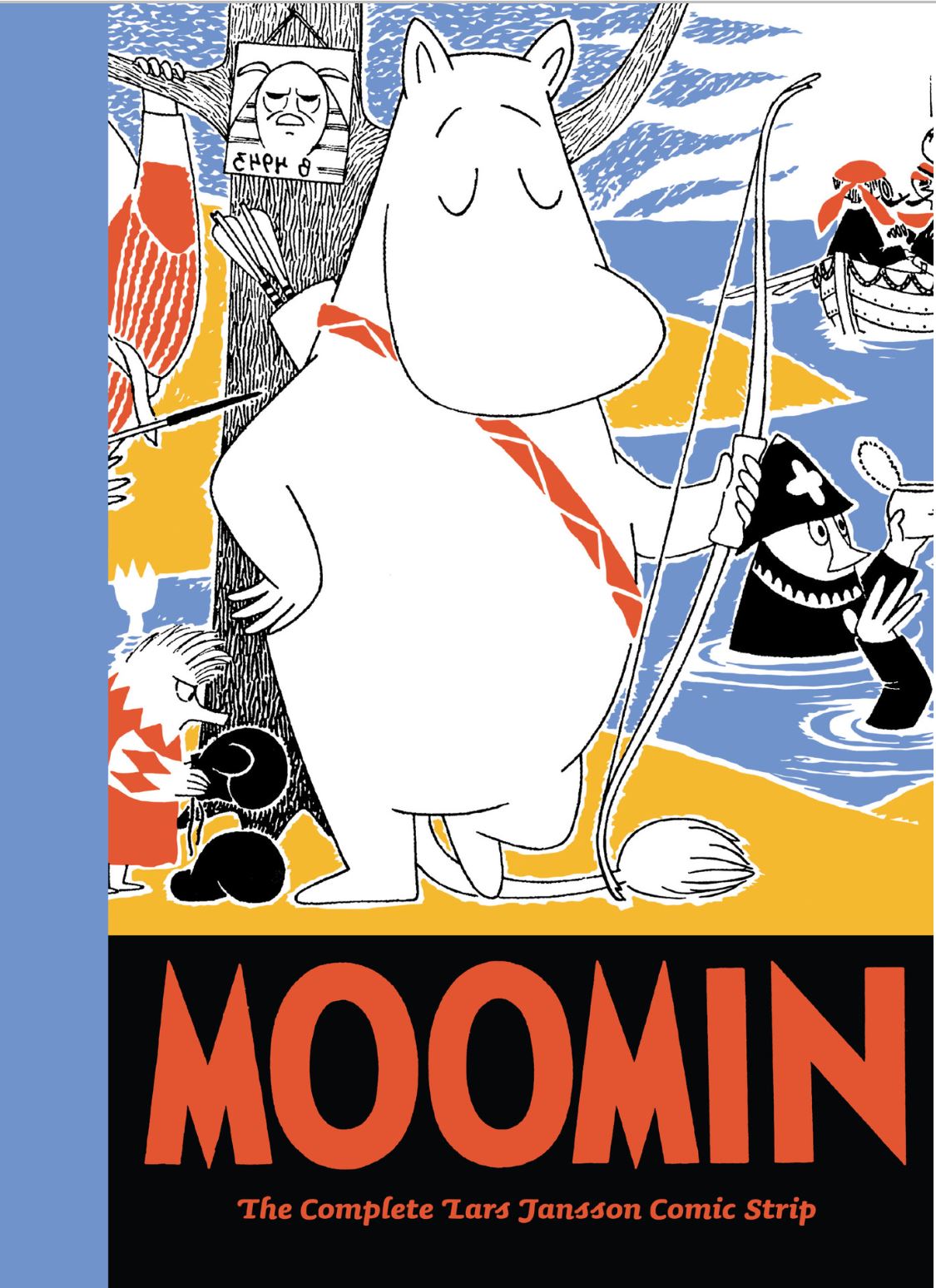
Moomin volume 7 – The Complete Lars Jansson Comic Strip


By Lars Jansson (Drawn & Quarterly)
ISBN: 978-1-77046-062-1 (HB) eISBN: 978-1-77046-554-1

Tove Jansson was one of the greatest literary innovators and narrative pioneers of the 20th century: equally adept at shaping words and images to create worlds of wonder. She was especially expressive with basic components like pen and ink, manipulating slim economical lines and patterns to realise sublime realms of fascination, whilst her dexterity made simple forms into incredibly expressive and potent symbols and, as this collection shows, so was her brother…

Tove Marika Jansson was born into an artistic, intellectual, basically bohemian Swedish family in Helsinki, Finland on August 9th 1914. Father Viktor was a sculptor and mother Signe Hammarsten-Jansson a successful illustrator, graphic designer and commercial artist. Tove’s brothers Lars – AKA “Lasse” – and Per Olov became respectively an author/cartoonist and art photographer. The family and its close intellectual, eccentric circle of friends seems to have been cast rather than born, with a witty play or challenging sitcom as the piece they were all destined to inhabit.

After extensive and intensive study (from 1930-1938 at the University College of Arts, Crafts and Design, Stockholm, the Graphic School of the Finnish Academy of Fine Arts and L’Ecole d’Adrien Holy and L’Ecole des Beaux-Arts, Paris), Tove became a successful exhibiting artist through the troubled period of the Second World War.

Brilliantly creative across many fields, she published the first fantastic Moomins adventure in 1945. Småtrollen och den stora översvämningen (The Little Trolls and the Great Flood or latterly and more euphoniously The Moomins and the Great Flood) was a whimsical epic of gentle, inclusive, accepting, understanding, bohemian misfit trolls and their strange friends…

A youthful over-achiever, from 1930 to 1953 Tove worked as an illustrator and cartoonist for Swedish satirical magazine Garm: achieving some measure of notoriety with an infamous political sketch lampooning the Appeasement policies of European leaders by depicting Hitler in nappies. She was also highly in-demand for many magazines and children’s books, and had started selling comic strips as early as 1929.

Moomintroll was her signature character. Literally.

The lumpy, big-eyed, gently adventurous romantic goof began life as a spindly sigil next to her name in her political works. She called him “Snork” and claimed she had designed him in a fit of pique as a child – the ugliest thing a precocious little girl could imagine – as a response to losing an argument with her brother about Immanuel Kant.

The term “Moomin” came from her maternal uncle Einar Hammarsten who attempted to stop her pilfering food when she visited, warning her that a Moomintroll guarded the kitchen, creeping up on trespassers and breathing cold air down their necks. Snork/Moomin filled out, became timidly nicer – if a little clingy and insecure – acting as a placid therapy-tool to counteract the grimness of the post-war world.

Initially The Moomins and the Great Flood made little impact, but Jansson persisted – as much for her own edification as any other reason – and in 1946 Kometjakten (Comet in Moominland) was published. Many commentators regard the terrifying tale a skilfully compelling allegory of Nuclear Armageddon. You should read it now… while you still can…

When it and third illustrated novel Trollkarlens hatt (1948, Finn Family Moomintroll or occasionally The Happy Moomins) were translated into English in 1952, their instant success prompted British publishing giant Associated Press to commission a newspaper strip about her seductively sweet and sensibly surreal creations.

Jansson had no misgivings or prejudices regarding strip cartoons and had already adapted Comet in Moominland for Swedish/Finnish paper Ny Tid. Mumintrollet och jordens undergäng – Moomintrolls and the End of the World – was a popular feature, so she readily accepted the chance to extend her eclectic family across the world. In 1953, The London Evening News began the first of 21 Moomin strip serials to captivate readers of all ages.

Jansson’s involvement in the cartoon feature ended in 1959, a casualty of its own success and a punishing publication schedule. So great was the strain that towards the end she recruited brother Lars to help. He then took over, continuing the strip until 1975. His tenure as sole creator continues here…

Liberated from the strip’s pressures, Tove returned to painting, writing and other creative pursuits: making plays, murals, public art, stage designs, costumes for dramas and ballets, a Moomin opera and 9 more Moomin-related picture-books and novels, as well as 13 books and short-story collections strictly for grown-ups.

Tove Jansson died on June 27th 2001. Her awards are too numerous to mention, but just consider: how many modern artists get their faces on the national currency?

Lars Fredrik Jansson (October 8th 1926 – July 31st 2000) was just as amazing as his sister. Born into that astounding clan twelve years after Tove, at 16 he started writing – and selling – novels (nine in total). He also taught himself English because there weren’t enough Swedish-language translations of books available for his voracious reading appetite.

In 1956, he began co-scripting the Moomin newspaper strip at his sister’s request: injecting his own brand of witty whimsicality to ‘Moomin Goes Wild West’. He had been Tove’s translator from the start, seamlessly converting her Swedish text into English. When her contract with The London Evening News expired in 1959, Lars Jansson officially took over the feature, having spent the interim period learning to draw and perfectly mimic his sister’s cartooning style. He had done so in secret, with the assistance and tutelage of their mother Signe. From 1961 to the strip’s end in 1974, he was sole steersman of the newspaper iteration of trollish tails.

Lasse was a man of many parts: other careers including writer, translator, aerial photographer and professional gold miner. He was the basis and model for the cast’s cool kid Snufkin…

Lars’ Moomins was subtly sharper than his sister’s version and he was far more in tune with the quirky British sense of humour, but his whimsy and wry sense of wonder was every bit as compelling. In 1990, long after the original series, he began a new career, working with Dennis Livson (designer of Finland’s acclaimed theme park Moomin World) as producers of Japanese anime series The Moomins and – in 1993 with daughter Sophia – on new Moomin strips…

Moomintrolls are easy-going free spirits: natural bohemians untroubled by hidebound domestic mores and most societal pressures. Moominmama is warm, kindly tolerant and capable but perhaps overly concerned with propriety and appearances, whilst devoted spouse Moominpappa spends most of his time trying to rekindle his adventurous youth or dreaming of fantastic exploits.

Their son Moomin is a meek, dreamy boy with confusing ambitions. He adores their permanent houseguest the Snorkmaiden – although that impressionable, flighty gamin much prefers to play things slowly whilst hoping for somebody potentially better to come along…

The seventh oversized (310 x 221 mm) monochrome hardback compilation gathers serial strip sagas #26-29, and opens with Lars firmly in charge and puckishly re-exploring human frailties and foibles via a sophisticate poke at the shifting political climate…

Craftily casting cats among pigeons, 26th escapade ‘Moomin the Colonist’ finds armchair adventurer Moominpappa resenting the advent of the annual hibernation and rashly listening to his bookish boy, who has been reading about colonisation…

Soon he has packed up the family and a few close friends and set out to conquer fresh fields and pastures new. With Mymble and Little My, Mrs Fillyjonk, her daughters and a cow in tow, the eager expansionists head off across the frozen land and don’t stop until they reach a tropical desert island where they start setting up a new civilisation combining the best of the old world with lots of fresh ideas on how society should be run…

Sadly, their neighbours from back home have sneakily copied the Moomin movement and before long the new continent is embroiled in a passive-aggressive, slyly competitive struggle for control, with scurrilous reprobate Stinky and his pals playing the bad guys behind the Palm Tree Curtain…

Following the mutual collapse of colonialism, outrageous satire gives way to wicked sarcasm as ‘Moomin and the Scouts’ recounts how energetic Mr Brisk’s passion for the outdoor life, badges and bossing children envelopes the instinctively sedentary Moomins and unleashes all kinds of disruptive chaos. With scouts running wild amongst the trees it just seems easier to join them rather than seek to beat them and let nature disrupt the movement from within…especially after Moomin starts hanging around with Miss Brisk’s Girl Guides and the generally dismissive Snorkmaiden feels oddly conflicted…

The perils of property and stain of status upsets the orderly life of the clan when Moominpappa unexpectedly comes into a major inheritance in ‘Moomin and the Farm’. Grievously afflicted by a terrible case of noblesse oblige, the family uproot themselves and retire to stately Gobble Manor to perpetuate the line of landed gentry on a modern working arable and pastoral estate.

Adapting to wealth and property is one thing and even accommodating the legion of ancestral ghosts is but another strand of Duty, but the effort of taking on and even perpetuating centuries of unearned privilege proves far too weighty a burden for all concerned… before the increasingly untenable situation typically corrects itself…

Back in their beloved house and rearranging furniture, a dropped chest disgorges an ancient map and triggers another wild dreamers’ quest in ‘Moomin and the Gold-fields’…

Unable to refuse adventure when it’s dangled in front of their exuberant noses, father and son are soon trekking the wilds and digging random holes thanks to the supremely unclear chart, and before long the entire valley is afflicted with gold rush fever.

With law, common decency and even good manners abandoned to greed as the sedate dell becomes a boisterous and sordid boom town, all Moominmama can do is maintain her dignity and wait for the madness to pass…

This deceptively barbed and edgy compilation closes with ‘Lars Jansson: Roll Up Your Sleeves and Get to Work’ by family biographer Juhani Tolvanen, extolling his many worthy attributes and more besides…

These are truly magical tales for the young, laced with the devastating observation and razor-sharp mature wit which enhances and elevates only the greatest kids’ stories into classics of literature. These volumes – both Tove and Lars’ – comprise an international treasure trove no fan of the medium – or carbon-based lifeform with even a hint of heart and soul – can afford to be without.
© 2012 Solo/Bulls except “Lars Jansson: Roll Up Your Sleeves and Get to Work” © 2011, 2012 Juhani Tolvanen. All rights reserved.

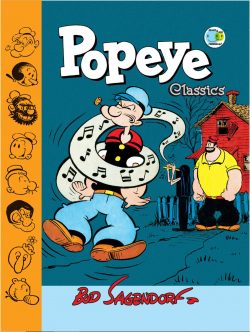
Popeye Classics volume 9: The Sea Hag’s ‘Magic Flute’ and More!


By Bud Sagendorf, edited and designed by Craig Yoe (Yoe Books/IDW Publishing)
ISBN: 978-1-63140-772-7 (HB) eISBN: 978-1-68406-092-4

How many cartoon classics can you think of still going after a century? Here’s one…

There are a few fictional personages to enter communal world consciousness – and fewer still from comics – but this grizzled, bluff, uneducated, visually impaired old tar with a speech impediment is possibly the most well-known of that august bunch.

Elzie Crisler Segar was born in Chester, Illinois on 8th December 1894. His father was a general handyman, and the boy’s early life was filled with the solid, dependable blue-collar jobs that typified the formative years of his generation of cartoonists. Segar worked as a decorator, house-painter and also played drums; accompanying vaudeville acts at the local theatre.

When the town got a movie-house, Elzie played silent films, absorbing all the staging, timing and narrative tricks from keen observation of the screen. Those lessons would become his greatest assets as a cartoonist. It was while working as the film projectionist, at age 18, that he decided to become a cartoonist and tell his own stories.

Like so many others in those hard times, he studied art via mail, specifically W.L. Evans’ cartooning correspondence course out of Cleveland, Ohio, before gravitating to Chicago where he was “discovered” by Richard F. Outcault – regarded as the inventor of modern newspaper comic strips with The Yellow Kid and Buster Brown. The celebrated pioneer introduced Segar around at the prestigious Chicago Herald. Still wet behind the ears, the kid’s first strip, Charley Chaplin’s Comedy Capers, debuted on 12th March 1916.

In 1918, Segar married Myrtle Johnson and moved to William Randolph Hearst’s Chicago Evening American to create Looping the Loop, where Managing Editor William Curley foresaw a big future for Segar and promptly packed the newlyweds off to New York: HQ of the mighty King Features Syndicate. Within a year Segar was producing Thimble Theatre, (launching December 19th 1919) in the New York Journal: a smart pastiche of cinema and knock-off of movie-inspired features like Hairbreadth Harry and Midget Movies, with a repertory of stock players acting out comedies, melodramas, comedies, crime-stories, chases and especially comedies for vast daily audiences. It didn’t stay that way for long…

The core cartoon cast included parental pillars Nana & Cole Oyl; their lanky, cranky, highly-strung daughter Olive; diminutive-but-pushy son Castor and the homely ingenue’s plain and (so very) simple occasional boyfriend Horace Hamgravy (latterly, plain Ham Gravy).

Thimble Theatre had already run for a decade when, on January 17th 1929, a brusque, vulgar “sailor man” shambled into the daily ongoing saga of hapless halfwits. Nobody dreamed the giddy heights that stubbornly cantankerous walk-on would reach…

In 1924, Segar created a second daily strip. Surreal domestic comedy The 5:15 featured weedy commuter/aspiring inventor John Sappo and his formidable spouse Myrtle. It endured – in one form or another – as a topper/footer-feature accompanying the main Sunday page throughout Segar’s career, survived his untimely death, and eventually became the trainee-playground of Popeye’s second great humour stylist – Bud Sagendorf.

After Segar’s premature passing in 1938, Doc Winner, Tom Sims, Ralph Stein and Bela Zambouly all took on the strip as the Fleischer Studio’s animated features brought Popeye to the entire world, albeit a slightly variant vision of the old salt of the funny pages. Sadly, none had the eccentric flair and raw inventiveness that had put Thimble Theatre at the forefront of cartoon entertainments. And then, finally, Bud arrived…

Born in 1915, Forrest “Bud” Sagendorf was barely 17 when his sister – who worked in the Santa Monica art store where Segar bought his drawing supplies – introduced the kid to the master cartoonist who became his teacher and employer as well as a father-figure. In 1958, after years on the periphery, Sagendorf finally took over the strip and all the merchandise design, becoming Popeye’s prime originator…

With Sagendorf as main man, his loose, rangy style and breezy scripts brought the strip itself back to the forefront of popularity and made reading it cool and fun all over again. Bud wrote and drew Popeye in every graphic arena for 24 years. When he died in 1994, his successor was controversial “Underground” cartoonist Bobby London.

Bud had been Segar’s assistant and apprentice, and in 1948 became exclusive writer/artist of Popeye’s comic book exploits. That venture launched in February of that year: a regular title published by America’s unassailable king of periodical licensing, Dell Comics.

On his debut, Popeye was a rude, crude brawler: a gambling, cheating, uncivilised ne’er-do-well, but was soon revered as the ultimate working-class hero. Raw and rough-hewn, he was also practical, with an innate, unshakable sense of what’s fair and what’s not: a joker who wanted kids to be themselves – but not necessarily “good”. Above all else he was someone who took no guff from anyone…

Naturally, as his popularity grew, Popeye mellowed somewhat. He was still ready to defend the weak and had absolutely no pretensions or aspirations to rise above his fellows, but the shocking sense of dangerous unpredictability and comedic anarchy he initially provided was sorely missed… except in Sagendorf’s sagas…

Collected here are Popeye #40-44, crafted by irrepressible “Bud” and collectively spanning April-June 1957 to April-June 1958. The stunning, nigh stream-of-consciousness slapstick sagas and nautical nuttiness are preceded by a treasure-stuffed treatise on ‘The Big Guy who Hates Popeye!’, as Fred M. Grandinetti details all you need to know about archetypal “heavy” Bluto. The lecture on the thug of many names is backed up by character and model sheets from animated appearances, comic book covers, and numerous comic excepts. Also emergent are strip precursors and alternate big bullies, original strip art from Sagendorf and London, plus a kind-of guest shot from Jackson Beck – the meaty matelot’s on-screen voice…

Sadly missing the usual ‘Society of Sagendorks’ briefing by inspired aficionado, historian and publisher Craig Yoe, and the ever-tantalising teasers of ephemera and merchandise of ‘Bud Sagendorf Scrapbooks’, we instead plunge straight back into ceaseless sea-savoured voyages of laughter, surreal imagination and explosive thrills with quarterly comic book #40, opening with a monochrome inside front cover gag concerning the sailor’s ward Swee’Pea and his fondness for digging in the dirt, before ‘Thimble Theatre presents Popeye the Sailor in The Mystery of the “Magic Flute!”’ once more pits the mariner marvel against the ghastly and nefarious Sea Hag.

Here she unleashes an army of agents to locate and secure a mystic talisman safeguarded by Popeye. With it, she can rid the world of her great enemy…

With the family house overrun, impetuous elder Poopdeck Pappy unthinkingly hands over the wishing whistle and instantly Popeye is whisked into a pit with lions, thugs and Bluto all lined up to kill him. It doesn’t work out well for any of them…

‘Popeye the Sailor and Eugene the Jeep’ then reintroduces another of Segar’s uniquely wonderful cartoon cryptids. The little marvel had originally debuted on March 20th 1936: a fantastic 4th dimensional beast with incredible powers whom Olive and Wimpy use to get very rich, very quickly. Of course, they quickly lost it all betting on the wrong guy in another of Segar’s classic and hilarious set-piece boxing matches between Popeye and yet another barely-human pugilist…

This time he pops up after Olive and the old salt clash over setting an engagement date, and Wimpey suggests asking the Jeep’s advice. Instantly he materialises, and the question is nervously asked. The response is ambiguous and draws nothing but trouble…

Prose filler ‘Ol’ Blabber Mouth’ tells how a parrot accidentally causes all his friends to be captured by pet trade hunters before we arrive at the ever-changing back-up feature. Sappo – now reduced to gullible foil and hapless landlord to the world’s worst lodger – endured the ethics-free experiments of Professor O.G. Wotasnozzle “The Professor with the Atomic Brain”.

Callously and constantly inflicting the brunt of his genius on the poor schmuck, here the boffin seizes top billing with The Brain of O.G. Wotasnozzle, building a robot replica of his landlord and running rings around the sap in ‘Double Double Who’s Got Trouble’…

The issue ends with an endpaper monochrome gag with Popeye and the precious “infink” disputing bedtimes and a colour back cover jape with them disastrously fishing…

Issue #41 (July-September) opens with ‘Popeye the Sailor in Spinach Soap!’ as the sailor battles Olive’s new beau. He looks just like Bluto, but has one advantage the sailor cannot match …a steady job!

In response, the money-disdaining matelot calls his secret weapon and Wimpey takes charge of Popeye’s savings – a million bucks – all so that he can set up a business to employ the sailor man…

An engaging Micawber-like coward, cad and conman, the insatiably ravenous J. Wellington Wimpy debuted in the newspaper strip on May 3rd 1931 as an unnamed, decidedly partisan referee in one of Popeye’s pugilistic bouts. Scurrilous, aggressively humble and scrupulously polite, the devious oaf struck a chord and Segar made him a fixture. Preternaturally hungry, ever-keen to solicit bribes and a cunning coiner of many immortal catchphrases – such as “I would gladly pay you Tuesday for a hamburger today” and “Let’s you and him fight” – Wimpy was the perfect foil for our straight-shooting action hero and increasingly stole the entire show… and anything else unless it was very heavy or extremely well nailed down.

Full of good intentions but unable to control himself, Wimpey naturally embezzles it all and fobs off his pal with a get-rich-scheme. However when Popeye starts selling his vegetable-based cleanser door to door he soon finds his old tactics are enough to wash that man out of Olive’s hair…

Co-starring Popeye, Swee’Pea and the Jeep!, ‘Sucker Gold!’ sees the cowboy-obsessed kid head for the desert and perilous Apache Mountain to be a prospector. Happily, with Eugene along for the ride his safety and prosperity are assured…

The story of Bradley fills the prose section this revealing how the ‘Horse Student’ was kicked out of human high school, after which O.G. Wotasnozzle! thinks himself into an invulnerable, inert state and the authorities resort to explosives to wake him up, before the back cover finds Popeye giving his kid a (kind-of) haircut…

Cover-dated October-December, Popeye #42 opens with the main event as the entire cast is caught on ‘Trap Island!’ as The Sea Hag and her hefty hench-lout target them from her mobile mechanised islet, before using doppelgangers to lure the sailor into ultimately useless death traps. Even her monster spinach-fuelled gorilla Smash is helpless before the power of spinach inside Popeye…

Popeye then discovers Swee’Pea can get into trouble anywhere, anytime when he sends him to fetch ‘Today’s Paper!’ Through no fault of his own the mighty mite ends up trapped in a weather balloon, a target of the air force, 2300 miles from home in Harbor City, a blood enemy of angry Indian Chief Rock’n’roll and locked in a missile, before dutifully bringing back that pesky periodical…

A duck with a speech impediment finds his purpose in prose yarn ‘Big Toot’ prior to Sappo giving O.G. Wotasnozzle the push. Typically, the toxic tenant terrorises every prospective replacement for his lodgings and the status quo is reluctantly re-established…

Another endpaper monochrome gag sees Popeye and Olive experiencing a little car trouble before Popeye #43 (cover-dated January-March 1958) opens in mono with another dig at Swee’Pea and his shovel whilst main event ‘Mind over Muscles!’ finds Popeye in high spirits and utterly oblivious to Sea Hag’s sinister surveillance. As the sailor eagerly anticipates his annual physical exam, she sends in her Sonny Boy – AKA Bluto disguised as a physician – to undermine his confidence and poison his mind with the notion that spinach is killing him. However, even doctor’s orders can’t make him give up his green cuisine and everyone gets what they deserve in the end…

‘Popeye and Swee’Pea in “The Voyage!”’ finds the sailor man sent on a dangerous mission to an island of “wild savages” with his boy outrageously left behind and babysat by Poopdeck Pappy. The infernal infink’s unhappy state is swiftly shifted by capricious fate though, and his soapbox boat is caught by wind, tide and a welcoming whale. When Popeye finally arrives, there’s a big little surprise awaiting him…

Prose parable ‘Diet!’ reveals what happens when Mrs. Smith declares the family is going vegetarian and pet dog Winky disagrees, after which O.G. Wotasnozzle apparently mends his ways and declares himself ‘“A Friend to Man” or “Be Kind to Sappo Week!”’ Sadly, even his best intentions and domestic inventions are severely hazardous to his landlord’s health – and the town’s wellbeing…

Concluding with an endpaper monochrome gag seeing Popeye severely tested by the kid’s bath time and a spot of gardening brings us to the last happy hurrah as Popeye #44 (April-June 1958) opens with black & white wisdom and Wimpy showing Olive the only way to Popeye’s heart…

Full-colour feature ‘Popeye meets “Orbert”’ embraces a wider-screened, more dynamic illustration style for Sagendorf as occasional amorous arch rival Bluto makes another play for Olive. Whilst he and Popeye enjoy their violent clash, Swee’Pea opens the box Bluto brought and unleashes a strangely alien flying beast. When its odd orbits kayo the blustering brute, Swee’Pea christens it Orbert. Soon they are inseparable and its ability to grant wishes have turned the kid into a bully and tyrant, and it’s time for some stern parenting …and spinach…

Sappo’s détente with O.G. Wotasnozzle is still in play but comes under extreme pressure when the Prof joins a quiet day’s fishing, and starts devising ways to make the pastime more efficient…

‘Specks’ reflects in prose upon the life of short-sighted fish George, before Popeye and Swee’Pea star in self-proclaimed “horrible story” ‘Follow the Leader!’ as spies kidnap the kid and try to make him tell where Popeye’s pirate gold is stashed. The map he eventually draws them only leads to trouble and the issue and this volume wrap up on a monochrome end gag proving Swee’Pea’s punch is a powerful as his wits…

Outrageous and side-splitting, these universally appealing yarns are evergreen examples of narrative cartooning at its most absurd and inspirational. Over the last nine decades Thimble Theatre’s most successful son and his family have delighted readers and viewers around the world. This book is simply one of many, but each is sure-fire, top-tier entertainment for all those who love lunacy, laughter, frantic fantasy and rollicking adventure. If that’s you, add this compendium of wonder to your collection.
Popeye Classics volume 9 © 2016 Gussoni-Yoe Studio, Inc. All Rights Reserved. Popeye © 2016 King Features Syndicate. ™ Heart Holdings Inc.

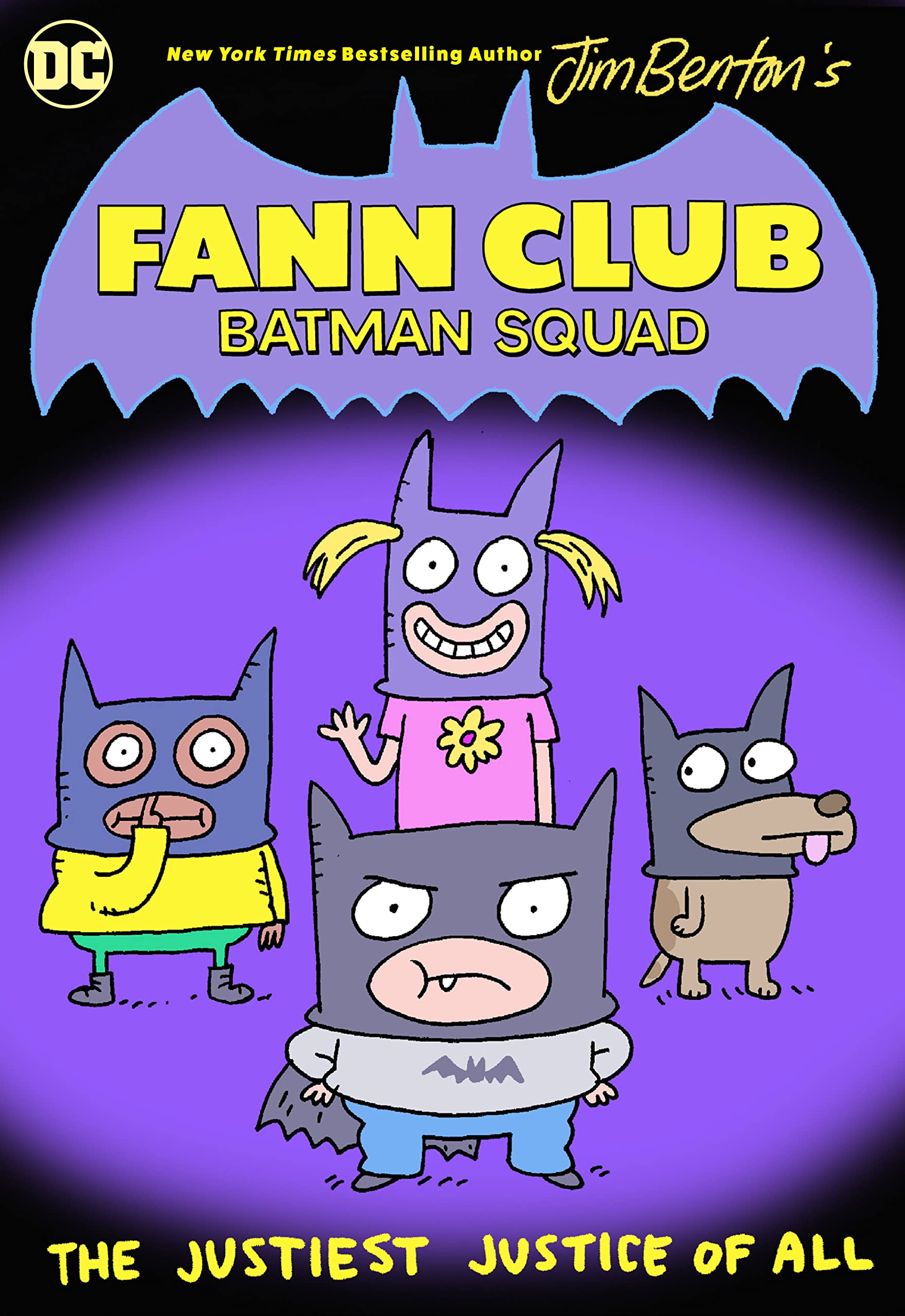
Fann Club: Batman Squad – the Justiest Justice of All


By Jim Benton (DC Comics)
ISBN: 978-1-7795-0889-8 (PB/Digital edition)

In recent years DC has opened up its vast and comprehensive shared superhero universe: generating Original Graphic Novels featuring its many stars in stand-alone adventures specifically tailored for kids and also that tricky demographic so sadly misnamed Young Adult. To date, results have been rather hit or miss, but when they’re good, they are very good indeed…

Another sublime example of the process at its best is this cheery elegy to the joys of crimefighting as channelled through the pristine but so-blinkered purview and perceptions of a youngster who believes in the process with all he’s got…

Ernest Fann is a little kid with a big imagination and a colossal passion. This drive has made him an absolute expert on Superheroes, Vengeance, Justice and The Batman, and that status comes with a necessary burden.

There is anxiety, impatience and even a motivating tragic loss – when something chewed his precious collectors’ item socks. His life is troubled by flashbacks and his sleep by the oddest dreams. It’s a mystery even his dog Westy can’t explain, whilst the neighbours’ kid and babysitter Harriet are completely oblivious to his inner life and secret…

Aware at he is probably the World’s Second Greatest Detective, he swears to share his gifts and the way of the Batman by founding… a fan club.

When willing recruits drawn by his cunning outreach arrive, he clothes them in the costumes he made and code names the (completely anonymous) strangers Night Terrier, Nightstand and Eyeshadow. He, of course, is the mighty Gerbilwing and Evil has never been more scared…

With his Batman Squad equipped it’s ‘Time to Begin: Fanning the Flames’ as their training montage shares secrets – like learning how to scowl and stand mysteriously – before going ‘On Patrol’ to note all the wickedness and mystery besetting the neighbourhood. All those little clues add up to trouble and before long Gerbilwing & Co. are unleashed when they intercept a bank robbery and uncover the true source of all the strange events…

Jim Benton began his illustration work making up crazy characters in a T-Shirt shop and designing greetings cards. Born in 1960, he’d grown up in Birmingham, Michigan before studying Fine Arts at Western Michigan University.

Tirelessly earning a living exercising his creativity, he started self-promoting those weird funny things he’d dreamed up and soon was raking in the dosh from properties such as Dear Dumb Diary, Dog of Glee, Franny K. Stein, Just Jimmy, Just Plain Mean, Sweetypuss, The Misters, Meany Doodles, Vampy Doodles, Kissy Doodles, jOkObo and It’s Happy Bunny via a variety of magazines and other venue…

His gags, jests and japes are delivered in a huge variety of styles and manners: each perfectly in accord with whatever sick, sweet, clever, sentimental, whimsical or just plain strange content each idea demanded, and his SpyDogs effortlessly made the jump to kids’ animated TV success.

He seamlessly segued into best-selling cartoon books (those are the best kind) such as Man, I Hate Cursive, Clyde, Catwad, Jop and Blip Wanna Know, Dog Butts and Love. And Stuff Like That. (And Cats) and Attack of the Stuff. It’ been 10 minutes since I started typing this, so there might be a few more published since then…

Perfectly capturing the wonder of childhood and sheer force of a kid’s unbridled imagination, Fann Club: Batman Squad is hilarious with a huge amount of heart and empathy and literally cloaked in the moody charisma of Frank Miller’s Dark Knight. The combination is utterly irresistible.

Also include is a teaser preview of ‘Young Alfred: Pain in the Butler’, but that’s not the point and can wait for its own review. Here you just need to swear your oath, kit up in your own justice gear and join The Bat Squad ASAP.

Tell them Gerbilwing said it was okay and Eyeshadow would be there to keep things safe…
© 20223 DC Comics. All Rights Reserved.

Fann Club: Batman Squad will be published on June 6th 2023 and is available for pre-order now.

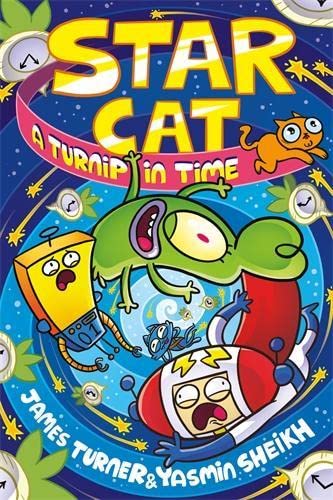
Star Cat – A Turnip in Time


By James Turner & Yasmin Sheikh (David Fickling Books)
ISBN: 978-1-78845-256-4 (TPB)

Never forget: all the best cats are ginger, and especially so if they come from space…

Way back in January 2012, Oxford-based David Fickling Books made a rather radical move by launching a traditional anthology comics weekly aimed at under-12s. It revelled in reviving the good old days of picture-story entertainment intent whilst embracing the full force of modernity in style and content.

Each issue still features humour, adventure, quizzes, puzzles and educational material in a joyous parade of cartoon fun and fantasy. Since then The Phoenix has established itself a potent source of children’s entertainment as, like the golden age of The Beano and The Dandy, it is equally at home to boys and girls, and has mastered the magical trick of mixing amazingly action-packed adventure series with hilarious humour strip serials such as this one.

One of the wildest rides of the early days was Space Cat by the astoundingly clever James Turner (Super Animal Adventure Squad, Mameshiba, The Unfeasible Adventures of Beaver and Steve). The strip began in issue #0 and some of those first forays appear here completely remastered and fully redrawn by Yasmin Sheikh (Luna the Vampire), jostling against stuff not collected before…

The premise is timeless and instantly engaging, focussing on the far-out endeavours of a band of spacefaring nincompoops in the classic mock-heroic manner. There’s so very far-from-dauntless Captain Spaceington, extremely dim amoeboid Science Officer Plixx, inarticulate, barely housebroken beastie The Pilot, and Robot One, who quite arrogantly and erroneously believes itself at the forefront of the cosmos’ smartest thinkers.

The colossal void-busting vessel the Captain and his substandard star warriors traverse the universe in looks like a gigantic ginger tom, because that is what it is: half cat, half spaceship. What more do you need to know?

We reconnect with the crew after ‘Prologue: Pilot’ sees the sorry stalwarts are almost exposed and fired by a highly critical Space Inspector. Just in time, another cosmic cock-up saves their bacon and a cross-chronal warning rocks Plixx’s world view and faith in science…

Nevertheless, duty always calls and when the voyagers arrive above Porcelainia, they are plunged into a ‘Spin Cycle of Terror’. Plixx is ready and willing – if not actually able – to help save the “most fragile planet in the universe” from deplorably deranged ultimate enemy Dark Rectangle. The terrifying two-dimensional tyrant has constructed a colossal bull-motifed super-washing machine to shatter the world and its so breakable denizens.

Thankfully, the villain had underestimated the crew’s sheer dumb luck and the forces of the universal principles governing laundry…

Dark Rectangle flees with the Star Cat in pursuit, and the chase allows Plixx and Robot One an opportunity to fiddle with cosmic constants. The resultant wave of disproportional maladjustment (to Spaceington, Pilot, mecha-robo Hamster suits, hench-being Murky Hexagon and more) in ‘Size Matters’ is almost the end…

The discovery of a new world and its superior inhabitants proves daunting and diminishing, but even the astounding ultra-intellects of Brainulon 7 pale before the sheer inanity of Plixx’s ‘Brain Drain’, and it’s not long until the far-our feline conveyor reaches Wetterania VII, just as rash of space fleas infest the ship-beast and leave all aboard ‘Itching for Trouble’…

The sinister shape of Dark Rectangle is next seen plundering the spaceways with our heroes desperately seeking new weapons and tactics. Nothing helpful comes from Plixx, whose latest innovation erases DNA sequences and delivers ‘The De-Evolution Dilemma’. With everyone aboard Star Cat affected, the Rhomboid Rogue attacks and encounters far less than he bargained for, but still too much to handle…

Chicken-with-a-mission The Space Mayor then tasks the solar swashbucklers with joining the extremely hazardous Great ‘Space Race’, where Dark Rectangle’s dire depredations in sabotaging the many entrants only leads to entirely the wrong Entity winning the prize of a Wish Granted…

Flushed with failure, the crew answers a distress call and is deposited on unsanitary orb Pootopia, charged with blocking an incipient civil war. Their ‘Mission Impoossible’ soon descends into scatological silliness after Dark (brown) God Bowlthulu manifests, and they’re quite happy to pass on to an undercover espionage mission against the bellicose Garflaxians. Sadly, Plixx’s  notions of disguise and camouflage are no help at all when ‘Spying High’…

‘Cryptid Calamities’ details a far too close encounter with the Space Ness Monster before the crew are asked to judge a flower show. It all leads to shame and ‘Herbaceous Horror’ when Dark Rectangle recklessly unleashes his merciless Mecha Slugs on the Star Cat crew.

The mis-educated Science Officer’s notorious addiction to cake then sparks the devastation of the Spacetime Continuum and really, REALLY ticks off God after fumbling a chronal experiment in ‘The Time Turnip’…

After experiencing Primal Revelation and witnessing the rebirth of Reality, Plixx resolves to become Space Scientist of the Year, but the competition at the ‘Science Fair’ is fierce, weird and really keen on not breaking any rules, once more leading to confrontation with sentient forces beyond the ken of sentient, sapient beings …and Plixx…

Wrapping up the sidereal silliness are Fact Files on ‘Brainulonians’, ‘Garflaxians’, ‘The Pootopians’, ‘Porcelainians’, and an activity section detailing ‘How to Draw’ and thereafter ‘How to Draw Pilot’, ‘Dark Rectangle’ and ‘Murky Hexagon’…

Star Cat is a spectacularly hilarious comic treasure: surreal, ingenious, wildly infectious, and fabulously fun. No pet owner, comedy connoisseur or lover of the Wild Black Yonder should miss this brilliant cartoon cat treat.

Text and illustrations © The Phoenix Comic 2023. All rights reserved.

Star Cat – A Turnip in Time will be published on June 1st 2023 and is available for pre-order now.


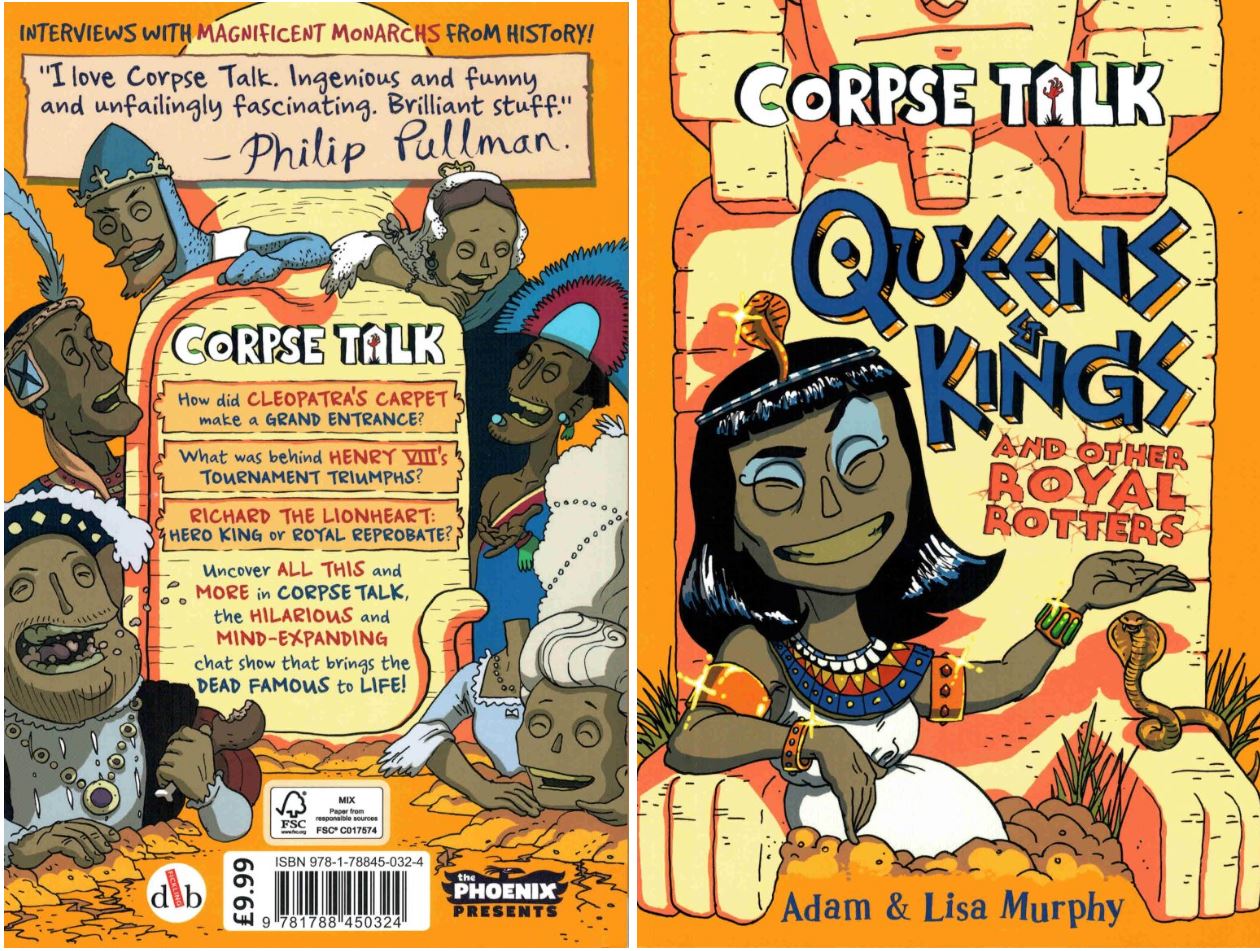
Corpse Talk: Queens & Kings and Other Royal Rotters


By Adam & Lisa Murphy (David Fickling Books)
ISBN: 978-1-78845-032-4 (PB)

The educational power of comic strips has been long understood and acknowledged: if you can make material memorably enjoyable, there’s nothing that can’t be better taught with pictures. The obverse is also true: comics can make any topic or subject come alive… or at least – as here – outrageously, informatively undead…

The fabulously effective conceit of Corpse Talk is that your cartooning host Adam Murphy (ably abetted off-camera by Lisa Murphy) tracks down (digs up?) famous personages from the past: serially exhumed for a chatty, cheeky This Was Your Life talk-show interview. It also often grosses one out, which is no bad thing for either a kids’ comic or learning experience.

Culled from the annals of The Phoenix, this regally-themed recollection is dedicated to not-so-private audiences with a succession of famous, infamous and utterly unforgettable royal rogues and rapscallions in what would almost certainly not be their own words…

Catching up in date of demise succession, our fact-loving host begins the candid cartoon conferences by digging the dirt with Ramesses II: Pharaoh of Egypt 1303 BCE – 1213 BCE. He preferred to be called ‘Ramesses the Great’ and our intrepid interviewer incisively traces the “accomplishments” and gift for self-promotion of the dusty legend.

As always, each balmy biography is supplemented by a sidebar feature examining a key aspect of their lives, such as here with ‘How to Make a Mummy’, scrupulously and systematically sharing the secrets of interring the definitely departed, after which we refocus on the ancient orient to quiz Qin Shi Huang Di: Chinese Emperor 259 BCE 210 BCE on his reign and once more sifting truth from centuries of post-mortem PR briefings.

Backing up the inquiry ‘The Emperor’s Tomb’ details the layout of the vast City of Death Qin was buried in, as well as the Palace of Shadows, its terracotta army and the treasures it guarded.

Cleopatra: Pharaoh of Egypt 69 BCE – 30 BCE outlines her incredible life, whilst ‘Barging In’ examines her astounding gold sea-craft – and how it brought her to the attention of back-up lover/sponsor Mark Anthony.

A thankfully thoroughly sanitised account of the sordid exploits of Nero: Roman Emperor 37-68 is supported up by a deconstruction of one of his feasts in ‘Cafe Nero’, after which Justinian II: Byzantine Emperor 669-711 personally explains how his determination and guile enabled him to rule, lose, recapture and retake control of the mighty Late Roman Empire. The impenetrable defences of 8th century Constantinople are then dissected in ‘The Walled City’…

As well as a bit about burned cakes, Alfred the Great: King of Wessex 849-689 reveals remarkable military and civilising feats of the learning-obsessed ruler whilst expanding the knowledge base and defining the fractured kingdoms of ‘The Dark Island’ of Britain.

The Norman conquest is unpicked from the (one-eyed) view of the losing contender in Harold Godwinson: English King 1022-1066. The account is accompanied by an extended look at the historical source document in ‘Born on the Bayeaux’ before the first English civil war is remembered by formable Angevin matriarch Empress Matilda: English Queen 1102-1167. This is followed by a detailed deconstruction of the sturdy castle defensive system in ‘The Old Bailey’.

The Crusades are represented by rival legends made real. First up is admirable and noble Saladin: Sultan of Egypt and Syria 1137-1193, bolstered by a catalogue of Moslem contributions to global civilisation in ‘Gifts of Genius’, after which the unhappy truth about Richard the Lionheart: English King 1157-1199 is laid bare. After debunking centuries of self-aggrandising myths, ‘The Siege of Acre’ traces one of the crusaders’ few actual heroic exploits…

Moctezuma II: Aztec Emperor 1456-1520 relates how his timidity and sense of self-preservation led to the destruction of his dominions at the hands of conquistadores before ‘Temple of Doom’ takes us into the deepest inner workings of the bloodstained ziggurats dedicated to human sacrifice on an industrial scale…

The most complex and contentious period in British history is taken apart by those royals at the heart of it all when Henry VIII: English King 1491-1547 tries to give us his spin on events leading to the reformation. Following ‘Full Tilt – a History of Jousting’ – come ‘The Six Wives of Henry VIII’ – consecutively Catherine of Aragon (1485-1536), Anne Boleyn (1507-1536), Jane Seymour (1508-1537), Anne of Cleves (1525-1557), Catherine Howard (1523-1542 and Catherine Parr (1512-1548) – offering their side of the arguments and events.

Their raucous riotous revelations are augmented by a breakdown of the duties of a Queen’s faithful attendants in ‘The Waiting Game’.

Charles II: English King 1630-1685 relates how he came to power following the Second Civil War, backing up personal reveries with ‘A Memoir on Monarchy’ running down the changing role of rulers, after which we cross the channel to hear how it all went wrong for France’s final female autocrat in Marie Antoinette: French Queen 1755-1793. Her fall from grace is abutted by a chilling lesson on guillotine mechanics in ‘Decapitation Stations’.

Contemporary cousin Catherine the Great: Russian Empress 1729-1796 managed to run things largely her own way, but as back-up ‘Tsars in their Eyes’ shows, she was plagued by a constant stream of pretenders, all claiming to be true, proper, better qualified and, yes, male contenders for her throne.

South African rebel and strategic genius Shaka Zulu: Zulu King 1787-1828, recounts how he literally created a mighty nation from nothing whilst ‘The Battle of Isandlwana’ covers how his innovations were used to humiliate the overwhelmingly powerful British Army before the procession of pomp and circumstance closes with Queen Victoria: English Queen 1819-1901, accompanied by a phenomenally absorbing family tree, branching out and into every royal bloodline in Europe: a true ‘Game of Thrones’…

Clever, cheeky, outrageously funny and formidably factual throughout, Corpse Talk unyieldingly tackles history’s more tendentious moments whilst personalising the great, the grim and the good for coming generations.

It is also a fabulously fun read no parent or kid could possibly resist. Don’t take my word for it though, just ask any reader, royal-watcher or republican in waiting…
Text and illustrations © Adam & Lisa Murphy 2018. All rights reserved.

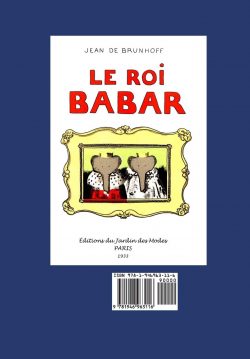
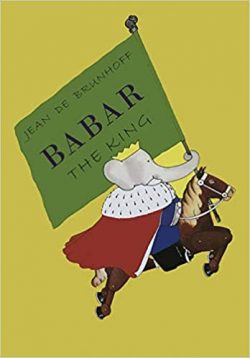
Babar the King


By Jean de Brunhoff (Egmont/Albatross)
ISBN: 978-702375-705-0 (HB) 978-1-4052-3819-9 (2008 Album PB) 978-1-94696-311-6 (2018 facsimile edition)

Since 1931 Babar the Elephant has charmed (and on occasion outraged and incensed) generations of readers. Jean de Brunhoff’s L’Histoire de Babar was first published in France and was an instant hit. The English language version was released in 1933, complete with introduction by A. A. Milne, bringing the forthright and capable elephantine hero across the channel and thence onwards across the Oceans to America and the Colonies.

Apparently, the tale was a bedtime story the author’s wife Cecile created for their own children. De Brunhoff co-opted, scripted and painted seven adventures before his death in 1937, two of them published posthumously. After World War II his son Laurent continued the franchise producing ten more adventures between 1946 and 1966. To date that’s at least another 37 books supplementing the original magnificent seven…

The tales in those tomes have in their time been controversial. Many critics have seen them as being pro-colonialism, and as products of a more robust time, they could never be regarded as anodyne or saccharine, but they are sweet, alluring and irresistibly captivating.

When baby Babar was growing up in the jungle, his mother was killed by white hunters. Terrified and sad the baby fled in panic, eventually coming to a very un-African provincial city. There he met a kind old lady who supported him as he adapted to city life. Babar moved into her very large house and was educated in modern, civilised ways. But still, occasionally, he felt homesick and missed his jungle home…

After a few years he encountered cousins Celeste and young Arthur and the Old Lady adopted and supported them too. Soon, though, their mothers come to fetch them and Babar returns with them to show the other elephants all the wonderful things he has learned and experienced. Buying a motor-car and filling it with clothes and presents he returns just in time, because the King of all the Elephants has eaten a bad mushroom and is dying…

Babar The King is the third volume, published in 1933 as Le Roi Babar. Here – after a long time travelling, voyaging and getting the perfect wife – a youthful vigorous forward-looking monarch and his bride Celeste start civilising and modernising the Kingdom of the Elephants. With them is that wonderfully helpful and dedicated Old Lady…

In a wave of rapid modernisation, the inspirational city of Celesteville is completed. It has broad streets, magnificent civic buildings, parks, gardens, theatres, ports and every amenity to delight and edify the populace. There is even a brand-new school, but that is not so popular with every citizen! Now every elephant has a job and vocation, but even such a paradise is capable of misfortune. They must all pull together when a great fire ravages the house of King Babar’s great friend and advisor Cornelius…

Charming and seductive, this venerable yarn – and the others – can still set pulses racing. In a crowded market it’s grand to see books that are both fresh and yet comfortingly pedigreed. Political assumptions of adults are one thing, but the most valid truth is that these are magical books for the young, illustrated in a style that is fluid, humorously detailed and splendidly memorable. Even after 90 years they retain the power to enthral and captivate with a charm leavened by underlying realism that is still worthy of note.

In 2018, a facsimile edition was released (170 x 250 mm), but the Egmont edition is also readily available. As far as I know the stories are still not found digitally.
2008 Edition. All Rights Reserved.

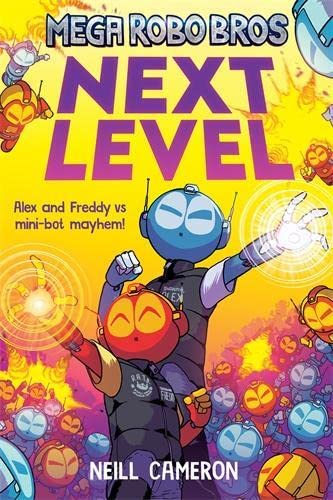
Mega Robo Bros: Next Level


By Neill Cameron, with Abby Bulmer (David Fickling Books)
ISBN: 978-1-78845-294-6 (TPB)

Mighty in metal and potent in plastic, here’s another solid gold all-ages outing from Neill (Tamsin of the Deep, Pirates of Pangea, How to Make Awesome Comics, Freddy) Cameron’s marvellous purpose-built paladins. However, the rambunctious Mega Robo Bros find that even they can’t fight progress adventures and growing pains – in more adventures balancing frantic fun with portents of darker, far more violent days to come…

It’s still the Future!

In a London far cooler than ours, Alex and his younger brother Freddie Sharma are generally typical kids: boisterous, fractious, eternally argumentative yet devoted to each other, and not too bothered that they’re adopted. It’s really no big deal for them that they were meticulously and covertly constructed by the mysterious Dr. Roboticus – before he vanished – and are considered by those in the know as the most powerful – and only fully SENTIENT – robots on Earth.

Dad is just your average old guy who makes lunch and does a bit of writing, but when not being a housewife, Mum is a bit extraordinary, herself – surprisingly famous and renowned robotics boffin Dr. Nita Sharma harbours some shocking secrets of her own…

Life in the Sharma household tries to be pretty normal. Freddie is insufferably exuberant and over-confident, whilst Alex is at the age when self-doubt and anxiety hit hard. Moreover, the household’s other robot rescues can also be problematic…

Programmed as a dog, baby triceratops Trikey is ok, but French-speaking deranged ape Monsieur Gorilla can be mighty confusing, whilst gloomily annoying, existentialist aquatic fowl Stupid Philosophy Penguin hangs around ambushing everyone with quotes from dead philosophers…

The boys have part-time but increasing insistent jobs as super-secret agents, although because they weren’t very good at the clandestine part, almost the entire world knows of them. Generally, however, it’s enough for the digital duo that their parents love them, even though they are a bit more of a handful than most kids. They all live as normal a life as possible: going to human school, playing with human friends and hating homework. It’s all part of their “Mega Robo Routine”, combining dull human activities, actual but rare fun, games-playing, watching TV and constant training in the combat caverns under R.A.I.D. HQ.

Usually, when a situation demands, the boys carry out missions for bossy Baroness Farooq: head of government agency Robotics Analysis Intelligence and Defence. They still believe it’s because they are infinitely smarter and more powerful than the Destroyer Mechs and other man-made minions she usually utilises.

Originally published in UK weekly comic The Phoenix, this revised, retooled and remastered saga opens with the lads feted as global heroes.

After defeating a reject robot rebellion sparked by artificial life activist The Caretaker, the Bros battled monstrous, deadly damaged droid Wolfram and learned that he might be their older brother…

Over the course of that case they learned that fifteen years previously Mum was a young, pretty and brilliant roboticist working under incomparable (but weird) pioneering genius Dr. Leon Robertus. whose astounding advances had earned him the unwelcome nickname Dr. Roboticus. Maybe that was what started pushing him away from humanity…

After months, Robertus to let her repurpose his individually superpowered prototypes into a rapid-response team for global emergencies. Mum used to be a superhero, leading manmade Rapid Response team The Super Robo Six!

While saving lives with them she first met crusading journalist/future husband Michael Mokeme who proudly took her name when they eventually wed…

Robertus was utterly devoid of human empathy but – intrigued by the team’s acclaim and global acceptance – created a new kind of autonomous robot. Wolfram was more powerful than any other construct, and was equipped with certain foundational directives allowing him to make choices and develop his own systems. He could think, just like Alex and Freddy can! Only, as it transpired, not quite…

When Robertus demoted Nita and made Wolfram leader of a new Super Robo Seven, the result was an even more effective unit, until the day Wolfram’s Three Directives clashed during a time-critical mission. Millions of humans paid the price for his confusion and hesitation…

In the aftermath, R.A.I.D. was formed. They tried to shut down Robertus and decommission Wolfram, but the superbot rejected their judgement, leading to a brutal battle, the robot’s apparent destruction and Roboticus escaping…

As the boys absorbed their “Secret Origins”, Wolfram returned attacking polar restoration project Jötunn Base. It covered many miles and was carefully rebalancing the world’s climate, when Wolfram took it over: reversing the chilling process to burn the Earth and drown humanity…

Alex and Freddy were ordered to stay put and not help by Baroness Farooq, but rebelled. By the time the Bros reached Jötunn Base, Wolfram has already ruthlessly crushed a RAID force led by their friend Agent Susie Nichols. After also failing to stop their determined and utterly unreasonable brother, thoughtful, kind contemplative Alex found a way to defeat – and perhaps, destroy – his wayward older brother and save the world…

Here, the boys are seen adapting to a new normal. Their exploit has made them global superstars and whilst immature Freddy is revelling in all the attention Alex is having trouble adjusting: not just to the notoriety and acclaim, but also the horrifying new power levels he achieved to succeed and also the apparent onset of robot puberty…

A collection of shorter, interlinked exploits, Next Level opens with the turbocharged lads attending another Royal Garden Party at Buckingham Palace. Mum has cleverly dodged the affair, leaving Dad and Grandma policing Stupid Philosophy Penguin and Freddy’s increasingly outrageous behaviour in front of the Queen. Anxious and upset, Alex hides in a spectacularly-appointed toilet and finds the Crown Prince doing likewise. Before long, he’s comparing notes on duty and expectation: sharing his feelings of guilt and grief to perhaps the only other kid on Earth who could be expected to comprehend…

Chapter 2 finds the Bros back at R.A.I.D. HQ, breezing through the usual training programs. To stop Wolfram, the boys had to be upgraded with safety protocols rescinded and they are now almost too powerful. That’s proved the moment they let go against the latest droid weapon and reduce it to more budget-busting spare parts in seconds. That’s when Dr. Sharma’s assistant Zahra Abdikarim has a rather brilliant idea, involving force fields and holograms…

Freddy’s dangerous boredom levels are soon decreased via a training regime that resembles a giant video game…

Another day and another first as Freddy foils an actual bank robbery by an actual exo-suited supervillain and stumbles into an even more insidious crime scheme: copyright infringement!

Whilst grandstanding for the crowds after the bust, the little lout sees a street seller hawking extremely sophisticated robot toy knock-offs of him and his brother. Suspicious and worried, Alex and still-recuperating Agent Susie (working from her hospital bed by telemetric tech) trace the toys to Toymakr Industries and clash with a ruthless narcissistic entrepreneur with no respect for law and life. Not only has he stolen their images and reputations, but also weaponised the little dolls and constructed “upgraded” doppelgangers of the real deal…

Cue huge robot-on-robot carnage…

Chapter 4 takes a more introspective tone as Alex’s PTSD trauma manifests as horrific bad dreams and his parents look into therapy and quickly hit a huge biological snag. Although the boys have literally grown from babies and physically change like humans, they are still mechanical not organic and most counselling strategies just won’t work on them. Thankfully Mum is a genius and finds another way to get Alex the help he so badly needs…

Introspection turns to action when the Bros are called in by the Metropolitan Police to help solve a string of impossible robotics/computer company robberies. With Susie in a tricked-out wheelchair, the boys rapidly uncover a cunning, ludicrous yet deadly scheme by an old foe…

A different kind of crisis manifests next as the Mega Robo Bros experience the dubious joys of camping, on and organised kids-only Outbound Adventure trip. It’s the first time away from home – other than for Earth-saving – for both boys and neither is keen to spend time in a strange camp with boys they don’t know. It’s a life-changing experience for all concerned…

After many close calls, Chapter 7 finally hosts the wedding of Susie Nichols and Zahra Abdikarim, but of course the brides’ big day acts as a magnet for chaos and one particular old enemy. Happily, Baroness Farooq is astoundingly adept at anticipating any possible contingency and the Bros are delighted to hand out a hearty hammering to the party crasher in the bombastic feelgood final chapter…

Crafted by Cameron and colouring assistant Abby Bulmer, this rip-roaring riot isn’t quite over yet: offering charming activity pages on ‘How To Draw Cuddle-Bots!’ and ‘How To Panda’ (both Cute and Angry!), as well as delivering a whacky brace of Bonus Comic! capers with ‘Monsieur Gorilla in Les Vacances de M. Gorilla’ before Alex & Freddy play ‘Legend of Heroes’ with catastrophic results…

Exceedingly engaging excitement and hearty hilarity is balanced here with poignant moments of insecurity and introspection, affording g thrills, chills, warmth, wit and incredible verve. Alex and Freddy are utterly authentic kids, irrespective of their origins, and their antics strike exactly the right balance of future shock, family fun and superhero action to capture readers’ hearts and minds. What movies these tales would make!

Text and illustrations © Neill Cameron 2023. All rights reserved.
Mega Robo Bros Next Level will be released on May 4th 2023 and is available for pre-order now.

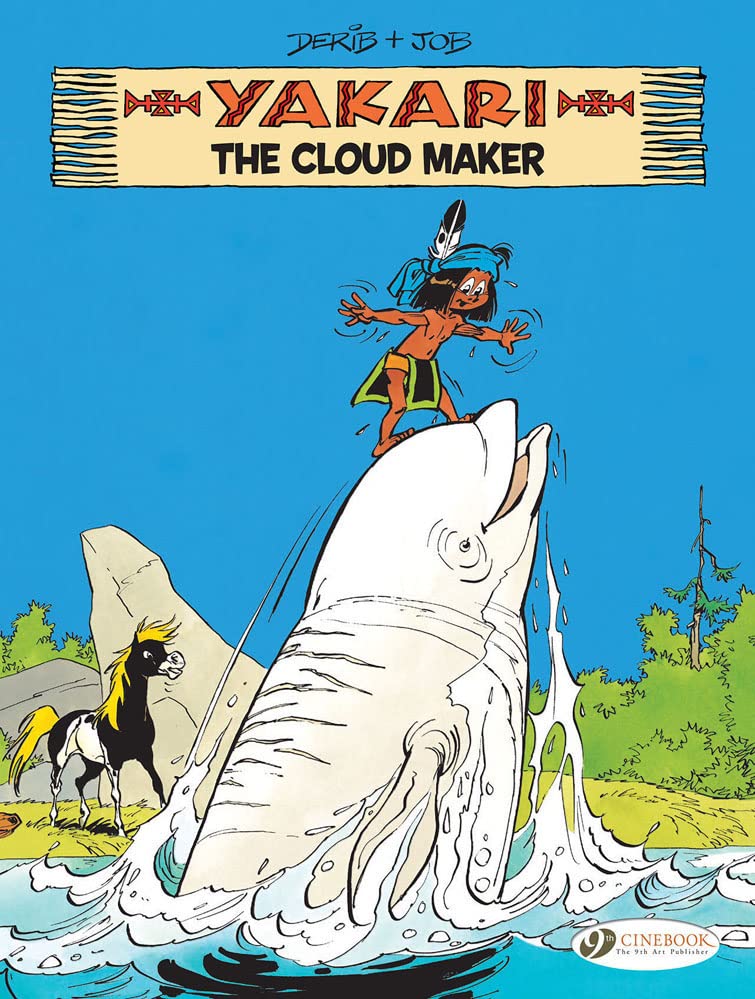
Yakari volume 20: The Cloud Maker


By Derib & Job, coloured by Dominique and translated by Jerome Saincantin (Cinebook)
ISBN: 978-1-80044-074-6 (Album PB/Digital edition)

In 1964 children’s magazine Le Crapaud à lunettes was founded by Swiss journalist André Jobin, who then wrote for it under the pseudonym Job. Three years later he hired fellow French-Swiss artist Claude de Ribaupierre AKA “Derib”. The illustrator had launched his own career as an assistant at Studio Peyo (home of Les Schtroumpfs): working on The Smurfs strips for venerable weekly Le Journal de Spirou.

Thereafter, together they created the splendid Adventures of the Owl Pythagore before striking pure comics gold a few years later with their next collaboration. Derib – equally au fait with enticing, comically dynamic “Marcinelle” cartoon style yarns and devastatingly compelling meta-realistic action illustrated action epics – went on to become one of the Continent’s most prolific and revered creators. It’s a crime that groundbreaking strips such as Buddy Longway, Celui-qui-est-nà-deux-fois, Jo (first comic to deal with AIDS), Pour toi, Sandra and La Grande Saga Indienne) haven’t been translated into English yet, but we still patiently wait in hope and anticipation…

Over the decades, much of Derib’s stunning works have featured his beloved Western themes: magnificent geographical backdrops and epic landscapes. Yakari is considered by fans and critics to be the strip which led him to his deserved mega-stardom.

Debuting in 1969, it traces the eventful, nomadic life of a young Oglala Lakota boy on the Great Plains – according to this tale, in the vicinity of the Great Lakes Basin. The stories are set sometime after the introduction of horses by the Conquistadores, but before the coming of modern Europeans.

The series – which also generated two separate animated TV series and a movie – is up to 42 albums thus far: a testament to its evergreen vitality and brilliance of its creators, even though originator Job moved on and Frenchman Joris Chamblain took on the writing in 2016.

Overflowing with gentle whimsy and heady compassion, little Yakari enjoys a largely bucolic existence: at one with nature and generally free from privation or strife. For the sake of our delectation, however, the ever-changing seasons are punctuated with the odd crisis, generally resolved without fuss, fame or fanfare by a little lad who is smart and brave – and can, thanks to a boon of his totem guide the Great Eagle, converse with all animals…

In 1995, Le souffleur de nuages was the 21st European album, but – as always with the best books – the content and set-up are both stunningly simple and sublimely accessible, affording new readers total enjoyment with a minimum of familiarity or foreknowledge required…

Here and now it is painfully topical as Yakari’s wandering people are stranded as springtime rains inundate the entire region. When the downpour finally stops, the land is devasted by flooding and the little wonder and his valiant pony decide to check on all their animal pals. Happily, Little Thunder is an excellent swimmer…

They don’t go far before meeting beaver patriarch Thousand-Mouths, whose frantic efforts to rally the clan for a major repair job to the lodge and dams is being hampered by bone idle slacker Wooden Bed. Just like any teenager, he just wants to sleep…

Water is everywhere, and the landscape is a sea broken by tiny islands. The prairie dog colony are marooned on one, waiting until it all recedes so they can clear out their great burrow. They are also nervously contemplating the ominously cloud-filled sky…

Pressing on, the horse and his boy reach a flooded forest and find raccoon Black Mask and his kin fractiously sharing a tree with grumpy owl. Nobody is happy, but all are resigned to waiting out the weather…

That night, back in camp and very much appreciating being warm and dry, Yakari has one of his special, prophetic dreams. It shows him more rains washing away his tipi (tent) until it is washed up onto a big white cloud…

Happily, morning brings better news. The waters have clearly receded, but – still perplexed by his vision – Yakari rides Little Thunder back along yesterday’s route just to check. Everywhere, industrious animals are clearing up and making good, and with so much to see and beasts to check on, the pair are far from home when the sun sets.

Bedding down under a large rock, they are later awakened by an odd cry coming from the river. Closer examination in the morning reveals the disturbance came from a pond linked to the swiftly flowing waters. Oddly, a small cloud is escaping from the turbulence. When Yakari dives in for a closer look, he is abruptly raised up into the air by a giant white fish surfacing under him!

The incredible snow-white monster turns out to be a chatty and gregarious beast calling itself a “white whale”. The curious Beluga had travelled along the swollen river from the “Great Water” Yakari had seen when travelling with spirit creature Nanabozho. Soon they are all trading life stories…

The boy names his new chum Peeleepee because of the cry it constantly utters, and discovers that despite living in the ocean, the newcomer needs air to live, water to support his weight and makes clouds from the top of his head…

In a remarkably short time they are all great friends and have learned lots of each other’s worlds. The boy and the beluga even trade tricks and acrobatic games, but the idyl is rudely shattered when a passing toad points out that, while they’ve been romping, the waters have further evaporated. The great white wonder is now trapped in an isolated pond far from the river it needs to live or get home by…

Snotty but smart, the amphibian then suggests a possible solution, but it takes all of Yakari’s friends working together, sheer luck, applied physics and the boy’s considerable negotiating skills to ensure the safety of the stranded newcomer before this ending turns out happy…

Yakari is one of the most unfailingly absorbing all-ages strips ever conceived and should be in every home, right beside Tintin, Uncle Scrooge, Asterix and The Moomins. It’s never too late to start reading something wonderful, so why not get back to nature as soon as you can?
Original edition © Derib + Job – Editions du Lombard (Dargaud – Lombard s. a.) – 2000. All rights reserved. English translation 2022 © Cinebook Ltd.

Corpse Talk: Groundbreaking Women


By Adam & Lisa Murphy (David Fickling Books)
ISBN: 978-1-910989-60-9(Digest PB)

The educational power of comic strips has been long understood and acknowledged: if you can make the material memorably enjoyable, there is nothing that can’t be better taught with pictures. The obverse is also true: comics can make any topic or subject come alive… or at least – as in this delightful almanac of inspiration – outrageously, informatively undead…

The comical conceit at play in Corpse Talk is that your scribbling, cartooning host Adam Murphy (ably abetted off-camera by Lisa Murphy) digs up famous personages from the past: all serially exhumed for a chatty, cheeky This Was Your Life talk-show interview that – in Reithian terms – simultaneously “elucidates, educates and entertains”. It also often grosses one out, which is no bad thing for either a kids’ comic or a learning experience…

Another splendid release culled from the annals of British modern wonder The Phoenix (courtesy of those fine saviours of weekly comics at David Fickling Books) this collection -regrettably still unavailable in digital editions – quizzes a selection of famous, infamous and “why-aren’t-they-household names?” women from history, in what would probably be their own – post-mortem – words…

Be warned, as you absorb these hysterical histories, you may say to yourself again and again “but… that’s not FAIR…” over and over again.

Catching up in order of date of demise, our fact-loving host opens these candid cartoon conferences by digging the dirt with ‘Hatshepsut: Pharaoh 1507-1458 BCE’, tracing her reign and achievements …and why her name and face were literally erased from history for millennia.

As ever, each balmy biography is accompanied by a side feature examining some crucial aspect of their lives, such as here where ‘Temple Complex’ diligently details the controversial pharaoh’s astounding and colossal “Holy of Holies”: the Djeser-Djeseru Mortuary Temple of Hatshepsut.

‘Hypatia of Alexandria: Mathematician & Philosopher 360s-415’ sketches out the incredible accomplishments, appalling treatment and tragic fate of a brilliant teacher and number-cruncher, supplemented here by a smart lesson in the almost-mystical concept of ‘The Golden Ratio’.

Throughout all civilisations, (mostly male) historians have painted powerful women with extremely unsavoury reputations and nasty natures. Just this once, however, the facts seem to confirm that ‘Irene of Athens: Empress of Byzantium 752-803’ was every bit as bad as detractors described her. Her atrocious acts against friends, foes and her own son Constantine are offset in the attendant fact-feature ‘Spin Class’, revealing how Irene employed religious industrial espionage to break China’s millennial monopoly on silk production, and comes complete with a detailed breakdown of how the Byzantine silk trade worked…

Every comic reader or fantasy fan is familiar with the idea of women warriors, but a real-life prototype for them all was the great-granddaughter of Genghis Khan. ‘Khutulun: Wrestling Princess 1260-1300s’ refused to be married off unless a suitor could defeat her in the Mongolian grappling martial art Bökh. So effective a fighter, archer and strategist was she, that the Khan appointed her his Chief Military Advisor and even nominated her his successor on his deathbed – an honour and can of worms she wisely sidestepped to become a power behind the throne.

Her incredible account is backed-up by an in-depth peek into the ferocious wrestling style she dominated in ‘Mongolian Moves’, after which ‘Joan of Arc: Saint 1412-1431’ explains how it all went wrong for her in asks-&-answers feature ‘How Do You Become a Saint?’

On more traditional and familiar ground, ‘Elizabeth I: Queen of England 1533-1603’ recounts her glorious reign and explains the how and why of her power dressing signature appearance in ‘A Killer Look!’ whilst transplanted near-contemporary ‘Pocahontas: Powhattan Princess 1596-1617’ shares the true story of her life before ‘Sad Ending, Continued…’ discloses the ultimate fate of her tribe at the hands of English Settlers.

Another astonishing character you’ve presumably never heard of is ‘Julie D’Aubigny: Swashbuckler 1670-1707’. She was a hell-raising social misfit who scandalised and terrorised the hidebound French Aristocracy. Daughter of a fencing teacher, she fought duels, broke laws, travelled wherever she wanted to, enjoyed many lovers – male and female – and even sang with the Paris Opera (now that’s a movie biopic I want to see!). What else could she offer as a sidebar but a lesson on duelling for beginners in ‘Question of Honour’?

‘Granny Nanny: Resistance Fighter 1686-1755’ started life as an Ashanti Princess, taken to Jamaica as a slave. However, once there she organised the ragtag runaways known as Maroons into an army of liberation. The workings of her rainforest citadel Nanny Town (now Moore Town) are explored in ‘Fortresses of Freedom’ after which a more sedate battle against oppression is undertaken with the interrogation of ‘Jane Austen: Novelist 1775-1817’, complete with cartoon precis of her subversive masterpiece ‘Pride & Prejudice (The Corpse Talk Version)’…

‘Ching Shih: Pirate Queen 1775-1844’ tells of another woman who beat all the odds but has since faded from male memory: a young girl kidnapped by China Seas pirates who rose to become their leader. Ravaging the Imperial coast, the corsair created an unshakable pirate code that benefitted the poor, outsmarted the Chinese Emperor and ultimately negotiated a pardon for herself and all her men to live happily ever after!

That salty sea saga is accompanied by the lowdown and technical specs on ‘Punks in Junks’ and followed by another bad girl with a good reputation.

‘Princess Caraboo: Con-Artist 1791-1864’ was never the Malayan royal refugee British High Society was captivated by, but rather a Devonshire serving maid who made the most of outrageous fortune via her quick wits. Her story is backed up by a delightful opportunity to forge your own faux identity with ‘Caraboo’s Character Creation Course!’…

Far more potent and worthy exemplars, ‘Harriet Tubman: Abolitionist 1822-1913’ ferried more than 300 of her fellow slaves from Southern oppression to freedom in northern American states and what we now call Canada: supplemented here by a detailed breakdown of ‘The Underground Railway’ before emancipation martyr ‘Emily Wilding Davison: Suffragette 1872-1913’ shares her brief, troubled life and struggle to win women the right to vote and participatory roles in society. The history is backed up by an absolutely unmissable graphic synopsis of the long struggle in ‘A Brief History of Women’s Rights’…

Someone who made every use of those hard-won concessions was ‘Nellie Bly: Journalist 1864-1922’, whose sensational journalistic feats and headline-grabbing stunts made her as newsworthy as her many, many scoops. One of the most impressive was beating Jules Verne’s fictional miracle of modernity by voyaging for ‘72 Days Around the World’ – as seen in the gripping sidebar spread – whereas the career of ‘Amy Johnston: Aviator 1903-1941’ was cut tragically short by bad luck and male intractability. Her flying triumphs are celebrated through a fascinating tutorial on her preferred sky-chariot. The ‘De Havilland Gypsy Moth’.

The short, tragic life of ‘Anne Frank: Journalist 1864-1922’ follows, accompanied by a detailed breakdown of the secret hideout and necessary tactics employed to conceal Anne, her family and friends in ‘The Secret Annex’.

Closing on an emotional high note, the rags to riches/riches to rags to riches account of dancer, comedian, freedom fighter and social activist ‘Josephine Baker: Entertainer 1906-1975’ details the double rollercoaster life of a true star and ends this book on a big finish with her teaching the secrets of how to ‘Dance the Charleston’.

Clever, moving, irreverently funny and formidably factual throughout, Corpse Talk: Ground-Breaking Women cleverly yet unflinchingly handles history’s more tendentious moments: personalising the great, the grim and the good in ways certain to be unforgettable. It is also a fabulously fun read no parent or kid could possibly resist.

Don’t take my word for it though, just ask any reader, spiritualist or dearly departed go-getter…
Text and illustrations © Adam & Lisa Murphy 2018. All rights reserved.