DC’s Greatest Imaginary Stories


By Otto Binder, Bill Finger, Jerry Siegel, John Broome, Leo Dorfman, Edmond Hamilton, Jim Shooter, C.C. Beck, Dick Sprang, Kurt Schaffenberger, Curt Swan, Carmine Infantino, Bob Kane & various (DC Comics)
ISBN: 978-1-4012-0534-8 (TPB)

This book includes Discriminatory Content produced in less enlightened times.

Win’s Christmas Gift Recommendation: Purely Addictive Comics Madness… 9/10

Alan Moore’s infamous epigram notwithstanding, not all comics tales are “Imaginary Stories”.

When DC Editor Mort Weisinger was expanding the Superman continuity and building the legend, he realised that each new tale was an event that added to a nigh-sacred canon: that what was written and drawn mattered to the readers. But, as a big concept guy, he wasn’t going to let that aggregated “history” stifle a good idea, nor would he allow his eager yet sophisticated audience to endure clichéd deus ex machina cop-outs to mar the sheer enjoyment of a captivating concept. The mantra known to every baby-boomer fan was “Not a Dream! Not a Hoax! Not a Robot!” boldly emblazoned on covers depicting scenes that couldn’t possibly be true… as a way of exploring non-continuity deviations, plots and scenarios devised at a time when editors believed entertainment trumped consistency and knew that every comic read was somebody’s first… or potentially last.

This jolly little compilation – long overdue for revival and expansion – celebrates the time when whimsy and imagination were king but somewhat stretches the point by leading with a fanciful tale of the World’s Mightiest Mortal. Courtesy of Otto Binder & CC Beck, ‘Captain Marvel and the Atomic War’ (Captain Marvel Adventures #66, October 1946) actually hoaxes the public through a demonstration of how the world might end in the new era of Nuclear Proliferation.

‘The Second Life of Batman’ (Bill Finger, Dick Sprang & Charles Paris in Batman #127, October 1959) doesn’t really fit the strict definition either, but the tale of a device that predicts how Bruce Wayne’s life would have run if his parents had not been killed is superb and engaging all the same. In contrast, ‘Mr. and Mrs. Clark (Superman) Kent!’ (Jerry Siegel & brilliant Kurt Schaffenberger) was the first of an occasional series that began in Superman’s Girlfriend Lois Lane #19 (August 1960). Far more apropos, it depicts the laughter and tears that might result if the plucky news-hen secretly marries the Man of Steel.

From an era uncomfortably parochial and patronising to women, there’s actually plenty of genuine heart and understanding in this tale and a minimum of snide sniping about “silly, empty-headed girls”…

Eventually the concepts became so bold that Imaginary Stories could command book-length status. ‘Lex Luthor, Hero!’ (Superman #149, November 1961) by Siegel, Curt Swan & Sheldon Moldoff details the mad scientist’s greatest master-plan and ultimate victory in a tale as powerful now as it ever was. In many ways this is what the whole concept was made for! No prizes for guessing what ‘Jimmy Olsen Marries Supergirl!’ (Superman’s Pal Jimmy Olsen #57, December 1961) is about, but the story is truly a charming delight, beautifully realized by Siegel, Swan & Stan Kaye.

Once more stretching a point ‘The Origin of Flash’s Masked Identity!’ (John Broome, Carmine Infantino & Joe Giella in The Flash# 128, May 1962) although highly entertaining, is more an enthusiastic day-dream than alternate reality and, I suspect, is added to bring variety to the mix – as is the intriguing ‘Batman’s New Secret Identity’ (Batman #151, November 1961, by Finger, Bob Kane & Paris).

‘The Amazing Story of Superman-Red and Superman-Blue!’ (Superman #162, July 1963) is possibly the most influential tale of this entire subgenre. Written by Leo Dorfman with art from Swan & George Klein, this startling utopian classic was so well-received that decades later it still influences and flavours Superman continuity. The plot involves the Action Ace being divided into two equal wonder men who promptly solve all universal problems and even the love rivalry between Lois Lane and Lana Lang!

Siegel & Schaffenberger’s ‘The Three Wives of Superman!’ is an enchanting tragedy of missed chances from SGLL #51 (August 1964) clearing the palate for ‘The Fantastic Story of Superman’s Sons’ (by Edmond Hamilton, Swan & Klein in Superman #166, November 1964): a solid thriller built on a tragic premise (what if only one of Superman’s children inherited his powers?), and this bright and breezy book closes with the stirring, hard-hitting ‘Superman and Batman… Brothers!’, wherein orphaned Bruce Wayne is adopted by the Kents, but cannot escape a destiny of tragedy and darkness. Written by Jim Shooter, with art from Swan & Klein for World’s Finest Comics #172 (cover-dated December 1967) this moody thriller in many ways signalled the end of carefree days and the beginning of a grittier, more cohesive DC universe for a less whimsical, fan-based audience.

This collection is a glorious slice of fancy, augmented by an informative introduction from columnist Craig Shutt, bolstered with mini-cover reproductions of many tales that tragically never made it into the collection, but I do have one minor quibble: No other type of tale was more dependent on an eye-catching, conceptually intriguing cover, so why couldn’t those belonging to these collected classics have been included here, too?

Surely, it’s time for a re-issue in either print or digital format with all those arresting covers included. Yes, it is… and don’t call me Shirley.
© 1946, 1959-1964, 1967, 2005 DC Comics. All Rights Reserved.

Today in 1900 Chester Gould was born. No help from me here, deduct who he was.

Happy birthday British arts icon Rian Hughes, arrived today in 1963, joined three years after by Jill Thompson and Guy Davis. Them also you should seek out here or in their own books…

Incredible Hulk Epic Collection volume 1: Man or Monster? (1962-1964)


By Stan Lee, Jack Kirby, Steve Ditko, Paul Reinman, Dick Ayers, George Roussos, Chic Stone & various (MARVEL)
ISBN: 978-0-7851-9600-6 (TPB/Digital edition)

This book includes Discriminatory Content produced in less enlightened times.

Win’s Christmas Gift Recommendation: Timeless Monster Madness Masterpieces… 10/10

We all still like superheroes right? Here’s a bunch of yarns thou shouldst not miss…

Chronologically collecting the Jade Juggernaut’s earliest appearances, this titanic tome (available as a hefty paperback and relatively weightless digital edition) gathers Incredible Hulk #1-6; Fantastic Four #2 & 25-26; Avengers #1-3 & 5, Amazing Spider-Man #14; Tales to Astonish #59 and an unforgettable clash with Thor from Journey into Mystery #112: cumulatively spanning early 1962 to the end of 1964.

The Incredible Hulk was new-born Marvel’s second new superhero title, despite Henry Pym technically debuting earlier in a one-off yarn from Tales to Astonish #27 (January 1962). However, Hank didn’t become a costumed hero until the autumn, by which time Ol’ Greenskin was not-so-firmly established.

The Hulk smashed right into his own bi-monthly comic and, after some classic romps by Young Marvel’s finest creators, crashed right out again. After six issues the series was cancelled and Lee retrenched, making the Gruff Green Giant a perennial guest-star in other titles until such time as they could restart the drama in their new “Split-Book” format in TtA where Ant/Giant-Man was rapidly proving to be a character who had outlived his time.

Cover-dated May 1962, Incredible Hulk #1 finds puny atomic scientist Bruce Banner sequestered on a secret military base in the desert, perpetually bullied by bombastic boss General “Thunderbolt” Ross, even as the clock counts down to the World’s first Gamma Bomb test.

Besotted with Ross’s daughter Betty, Banner endures the General’s constant jibes as the timer ticks on and tension increases, but at the final moment the boffin sees a teenager lollygagging at Ground Zero. As he frantically rushes to the site to drag the boy away, unknown to all, the assistant he’s entrusted to delay the countdown has an agenda of his own…

Rick Jones is a wayward but good-hearted kid. After initial resistance he lets himself be pushed into a safety trench, but just as Banner prepares to join him The Bomb detonates…

Somehow surviving the blast, Banner and the boy are secured by soldiers, but that evening as the sun sets the scientist undergoes a monstrous transformation. He grows larger; his skin turns a stony grey…

In six simple pages that’s how it all starts, and no matter what any number of TV or movie reworkings or comicbook retcons and psycho-babble re-evaluations would have you believe that’s still the best and most primal take on the origin. A good man, an unobtainable girl, a foolish kid, an unknown enemy and the horrible power of destructive science unchecked…

Written by Stan Lee, drawn by Jack Kirby with inking by Paul Reinman, ‘The Coming of the Hulk’ barrels along as the man-monster & Jones are kidnapped by Banner’s Soviet counterpart The Gargoyle for a rousing round of espionage and Commie-busting. He soon sees the (green) light, though…

In the second issue the plot concerns invading aliens, and the Banner/Jones relationship settles into a traumatic nightly ordeal where the good doctor transforms and is locked into an escape-proof cell whilst the boy stands watch helplessly. Neither ever considers telling the government of their predicament…

‘The Terror of the Toad Men’ is formulaic but viscerally, visually captivating as Steve Ditko inks Kirby; imparting a genuinely eerie sense of unease to the artwork. Incidentally, this is the story where the Hulk inexplicably changed to his more accustomed Green persona…

Although back-written years later as a continuing mutation, the plain truth is that grey tones caused all manner of problems for production colourists so it was arbitrarily changed to the simple and more traditional colour of monsters.

The third issue presented a departure in format as chaptered epics gave way to complete short stories. Dick Ayers inked Kirby in the transitional ‘Banished to Outer Space’ which radically altered the relationship of Jones and the rage-beast, with the story thus far reprised in 3-page vignette ‘The Origin of the Hulk’. Marvel mainstay of villainy the Circus of Crime debuts at the end in ‘The Ringmaster’ whilst in #4 The Hulk goes on an urban rampage for first tale ‘The Monster and the Machine’ prior to aliens and Commies combining in second escapade ‘The Gladiator from Outer Space!’

The Incredible Hulk #5 is a joyous classic of Kirby action, introducing immortal despot Tyrannus and his underworld empire in ‘The Beauty and the Beast!’, after which those pesky Commies came in for another pasting when the Jolly Green freedom-fighter crushes the invasion of Lhasa in ‘The Hordes of General Fang!’

Lee grasped early on the commercial impact of cross-pollination and – presumably aware of disappointing sales – inserted the Green Gargantuan into his top selling title next. Fantastic Four #12 (March 1963) featured an early crossover as the team were asked to help the US army capture ‘The Incredible Hulk’: a tale from Lee, Kirby & Ayers packed with intrigue, action and bitter irony. It begins with a series of spectacularly destructive sabotage incidents putting the heroes on the trail of a monster when they should have been looking at spies… Despite the sheer verve and bravura of these simplistic classics – some of the greatest, most rewarding comics nonsense ever produced – the Hulk series was not doing well. Kirby moved on to more appreciated arenas and Steve Ditko stepped up to handle art chores for #6: another full-length epic and an extremely engaging one.

‘The Incredible Hulk Vs the Metal Master’ has astounding action, slyly subtle sub-plots and a thinking man’s resolution, but nonetheless the title died with the issue, also dated March. Another comic debuted that month and offered a lifeline to the floundering Emerald Outcast. ‘The Coming of the Avengers’ offers one of the cannier origin tales in comics. Instead of starting at a zero point and acting as if the reader knew nothing, creators Lee, Kirby & Ayers assumed interested parties had at least a passing familiarity with Marvel’s other titles, and wasted little time or energy on introductions in the premiere issue.

In Asgard Loki, god of evil, is imprisoned on a dank islet but still craves vengeance on his step-brother Thor. Observing Earth, the villain sees the monstrous Hulk and engineers a situation wherein the man-brute goes on a rampage, hoping to trick the Thunder God into battling the bludgeoning brute. When sidekick Rick Jones radios the Fantastic Four for assistance, Loki diverts the transmission so they cannot hear it and expects his mischief to quickly blossom. However, other heroes pick up the SOS – namely Iron Man, Ant-Man & the Wasp – and as the costumed champions converge on the desert in search of the Hulk, they realize something’s amiss…

This terse and compelling yarn is Lee & Kirby at their absolute best, and one of the greatest stories of the Silver Age, here promptly followed by ‘The Space Phantom’ (Lee, Kirby & Reinman): another unforgettable epic, in which an alien shape-stealer almost destroys the group from within. The tale ends with the volatile Hulk quitting the team only to return in #3 as a villain in partnership with ‘Sub-Mariner!’: a globetrotting romp delivering high energy thrills and one of the best battle scenes in comics history.

Three months later, Fantastic Four #25 featured a cataclysmic clash that had young heads spinning in 1964… and pretty much ever since. Inked by George Roussos, ‘The Hulk Vs The Thing’ and concluding saga ‘The Avengers Take Over!’ in FF #26 offered a fast-paced, all-out Battle Royale as the disgruntled man-monster comes to New York in search of sidekick Rick, with only an injury-wracked FF in the way of his destructive rampage.

A definitive moment in the character development of The Thing, the action accelerates and amplifies when a rather stiff-necked, officious Avengers team horns in claiming jurisdictional rights on “Bob” Banner and his Jaded Alter Ego. This tale is plagued with pesky continuity errors which would haunt Lee for decades, but notwithstanding the bloopers, this is one of Marvel’s key moments and still a vivid, vital read.

Over in Avengers #5, ‘The Invasion of the Lava Men!’ (Lee, Kirby & Reinman) resulted in another incredible romp as Earth’s Mightiest battled superheated, superhuman subterraneans and a lethally radioactive mutating mountain with the unwilling assistance of the Hulk. It would be his last appearance there for many months…

However, the next cameo came in Amazing Spider-Man #14 (July 1964): an absolute milestone as a hidden criminal mastermind debuted; manipulating a Hollywood studio into making a movie about the wall-crawler. Even with guest-star opponents such as the Enforcers the Incredible Hulk steals all the limelight in ‘The Grotesque Adventure of the Green Goblin’ (Lee & Ditko) which is only otherwise notable for introducing Spider-Man’s most perfidious and flamboyant enemy (sarcasm alert!).

The second stage of the man-brute’s career was about to take off and Tales to Astonish #59 (September) offered a pulse-pounding prologue as ‘Enter: The Hulk!’ (Lee, Ayers & Reinman) sees the Avengers inadvertently provoking Giant-Man to hunt down the Green Goliath. Although The Human Top devilishly engineered that blockbusting battle, Lee was the real mastermind, as with the next issue The Hulk debuted in his own series – and on the covers – whilst Giant-Man’s adventures shrank back to a dozen or so pages.

This wonderfully economical compendium of classic wonders closes with the lead story from Journey into Mystery #112 (January 1965). ‘The Mighty Thor Battles the Incredible Hulk!’ is a glorious gift to all those fans who can’t help but ask “Who’s stronger?”

Arguably Kirby & Chic Stone’s finest artistic moment together, it details the private duel between these two super-humans that occurred during the free-for-all between Earth’s Mightiest, Sub-Mariner and Ol’ Greenskin back in Avengers #3. The sheer raw power of that tale is a perfect exemplar of what makes the Hulk work (and one that inspired that fight in the Thor: Ragnarok movie) and would be an ideal place to close proceedings.

Happily, however, fans and art lovers can enjoy further treats in the form of assorted House Ads; original artwork by Kirby & Ditko; a gallery of classic Kirby covers modified by painter Dean White (originally seen on assorted Marvel Masterworks editions) plus reproduced Essentials collection and Omnibus covers by Bruce Timm and Alex Ross…

Hulk Smash! He always was and with material like this he always will be.
© 1962, 1963, 1964, 1965, 2016 Marvel Characters, Inc. All rights reserved.

Today in 1923 the magnificently quirky Mike Sekowsky was born. We all know about his Justice League, Adam Strange, Metal Men and Inhumans stuff but have you seen Diana Prince, Wonder Woman volume 1?

Yoko Tsuno volume 7 – The Curious Trio


By Roger Leloup (Cinebook)
ISBN: 978-1-84918-127-3 (PB Album)

This book includes Discriminatory Content produced in less enlightened times.

Win’s Christmas Gift Recommendation: Rollercoaster, Role Model Wonderment for All… 8/10

Today in 1933 master craftsman and raconteur Roger Leloup was born. Bon anniversaire and many more, mate…

On September 24th 1970, “electronics engineer” Yoko Tsuno began her troubleshooting career as an indomitable intellectual adventurer. Her debut in Le Journal de Spirou came in “Marcinelle style” 8 page short ‘Hold-up en hi-fi’, and although she is still delighting readers and making new fans today, for a while it looked as if she wasn’t going anywhere soon. Thankfully, her astonishing, astoundingly accessible exploits were revised as she quickly evolved into a paragon of peril: helming pseudo-realistic fantasies numbering amongst the most intoxicating, absorbing and broad-ranging comics thrillers ever created. Her globe-girdling mystery cases and space-&-time-spanning epics are the brainchild of Belgian maestro Roger Leloup. He launched his own solo career in 1953 whilst working as studio assistant and technical artist on Hergé’s Adventures of Tintin.

Compellingly told, sublimely imaginative and – no matter how implausible the premise of any individual yarn – always firmly grounded in hyper-authentic settings underpinned by solidly constructed, unshakably believable technology and unswerving scientific principles, Leloup’s illustrated escapades were at the vanguard of a wave of strips revolutionising European comics. Early in the journey, he switched from loose cartooning to mesmerising, nigh-photo realistic illustration that has become a series signature. The long-overdue sea-change in gender roles and stereotyping he led heralded a torrent of clever, competent, brave, formidable women taking their rightful places as heroic protagonists, not romantic lures. That consequently elevated Continental comics in the process. Such endeavours are as engaging and empowering now as they ever were, none more so than the travails of masterful Miss Tsuno.

Her first outings (oft-aforementioned, STILL unavailable Hold-up en hi-fi, and co-sequels La belle et la bête and Cap 351) were mere introductory vignettes prior to epic authenticity taking a grip in 1971 when the unflappable problem solver met valiant but lesser (male) pals Pol and Vic. Instantly hitting her stride in premier full-length saga Le trio de l’étrange (LJdS’s May 13th edition), from then on, Yoko’s efforts encompassed explosive exploits in exotic corners of our world, spy and crime capers, time-travelling jaunts and sinister deep-space sagas such as this one. There are 31 bande dessinée albums to date, with 21 translated into English thus far, albeit – and ironically – none available as digital books…

The series has a complex history in English. Comcat previously released a few adventures – sadly, poorly translated and adapted – before British-based Cinebook acquired the franchise and opened a comprehensive and entrancing sequence in 2007 with 1976’s (seventh) saga On the Edge of Life.

Translated as The Curious Trio, Le trio de l’étrange was actually the 7th chronicle released by Cinebook and opens in a busy TV studio at midnight (back when actual humans pushed, pulled and focussed the clunky paraphernalia). Young Director Vic Van Steen loses his rag with best pal Pol Paris for falling asleep on his camera. Later, still smarting from another fractious tiff, the pair walk home past a deserted construction site and witness what looks like an elegantly brilliant burglary…

The quietly flamboyant break-in is, in fact, a pre-arranged test by sleekly capable freelance Japanese electrical engineer Yoko Tsuno. She’s been hired by a major company to test their new security. After apologising for nearly ruining her trial with well-intentioned interference, the lads invite the enigmatic tech-bod to join their film crew as sound engineer on a proposed outside shoot.

The gig is to explore flooded caves for a documentary and before the week ends the new friends are hauling equipment to a spectacular cavern, keen to work out the technical details. No sooner do they begin, however, than something goes terribly wrong and the trio are dragged deep underground by irresistible, swirling waters…

From here the achingly realistic, rationalist strip takes a huge leap into the uncanny as their subterranean submersion dumps them into a huge metal-shod vault where they are seized by blue-skinned humanoids. The colossal complex is of incredible size, and the captives are bundled into a fantastic vessel which runs on rails via magnetic levitation. Driven even deeper underground, a handy translation helmet enables the only friendly-seeming stranger to explain. She is Khany and her race, the Vineans, have been sleeping deep beneath the Earth for almost half a million years.

However, since recently awakening, internecine strife has disrupted the colonists’ lives. Ambitious militaristic martinet Karpan constantly manoeuvres to seize power from vast electronic complex The Centre, which regulates the lives of the awakened colonists. The humans’ first meeting with the blustering bully does not go well. When he attempts to beat Khany, martial artist Yoko delivers a humiliating and well-deserved thrashing…

Infuriated, Karpan tries to disintegrate them but is pulled away by security forces. As the newcomers resume their voyage to The Centre, he secretly follows their magneto-carrier, resolved to destroy them. With the maglev ship hurtling to unimaginable depths, Khany introduces the humans to a stowaway – her young daughter Poky – while relating the astounding tale of the Vinean escape from planetary doom and two-million-light-year trip to Earth. Accustomed to subterranean living, on arrival the Vineans hollowed out a mountain and dug down even further.

The history lesson is interrupted by Karpan’s murderous attack, which is thwarted by Yoko’s quick thinking and her companions’ near-insane bravery…

Eventually, after another, far subtler murder attempt, the damaged magneto-carrier reaches its destination and the astonished visitors are brought before a stupendous computer to plead their case and expose Karpan’s indiscretions. The vast calculator controls every aspect of the colony’s life and will deliver judgement on the human invaders’ ultimate fate. After mind-scanning Yoko The Centre’s pronouncement is dire: the strangers must be placed in eternal hibernation…

When Pol plays his long-hidden trump card and threatens to destroy the machine with a stolen disintegrator, diplomatic Khany proposes a solution; suggesting simply waiting until they can all confront still-absent Karpan. Yoko is still deeply suspicious and not convinced Karpan is responsible for every attempt on their lives. That “night”, while Yoko rests, Poky sneaks into her habitation chamber and takes her on an illicit tour of the underside and innards of the impossibly huge complex. The jaunt verifies the engineer’s suspicions with a ghastly revelation. What they expose is a horrific threat not just to the Vineans – Karpan included – but to every human on the surface of Earth…

The eerie mystery then explodes into spectacular action and a third act finale worthy of any  Bond blockbuster as Tsuno’s dramatic duel with an incredible malign menace settles the fate of two species…

Absorbing, rocket-paced and captivatingly combining tense suspense with bombastic thrills, spills & chills, this is a terrific introduction to a world of rationalist mystery and humanist imagination with one of the most unsung female action heroes of all… and one you’ve waited far too long to meet…
Original edition © Dupuis, 1979 by Roger Leloup. All rights reserved. English translation 2012 © Cinebook Ltd.

Today in 1916 DC Golden/Silver age and newspaper strip scripter Alvin Schwartz was born, followed 11 years later by Belgian author Maurice Rosy, whose art direction made Spirou what it is.

In 1928 Don Lawrence was born. You can go look back at his Trigan Empire stuff, but why not also enjoy Maroc the Mighty like we just did…

Robot Archie and the World of the Future


By E. George Cowan, Ernest “Ted” Kearon, Davis Harwood, with Garry Leach, Geoff Campion & various (Rebellion Studios)
ISBN: 978-1-83786-554-3 (HB/Digital edition), 978-1-83786-626-7 (Webshop HB)

This book includes Discriminatory Content produced in less enlightened times.

Win’s Christmas Gift Recommendation: Timeless Fantasy Masterpiece for Young and Old Alike… 9/10

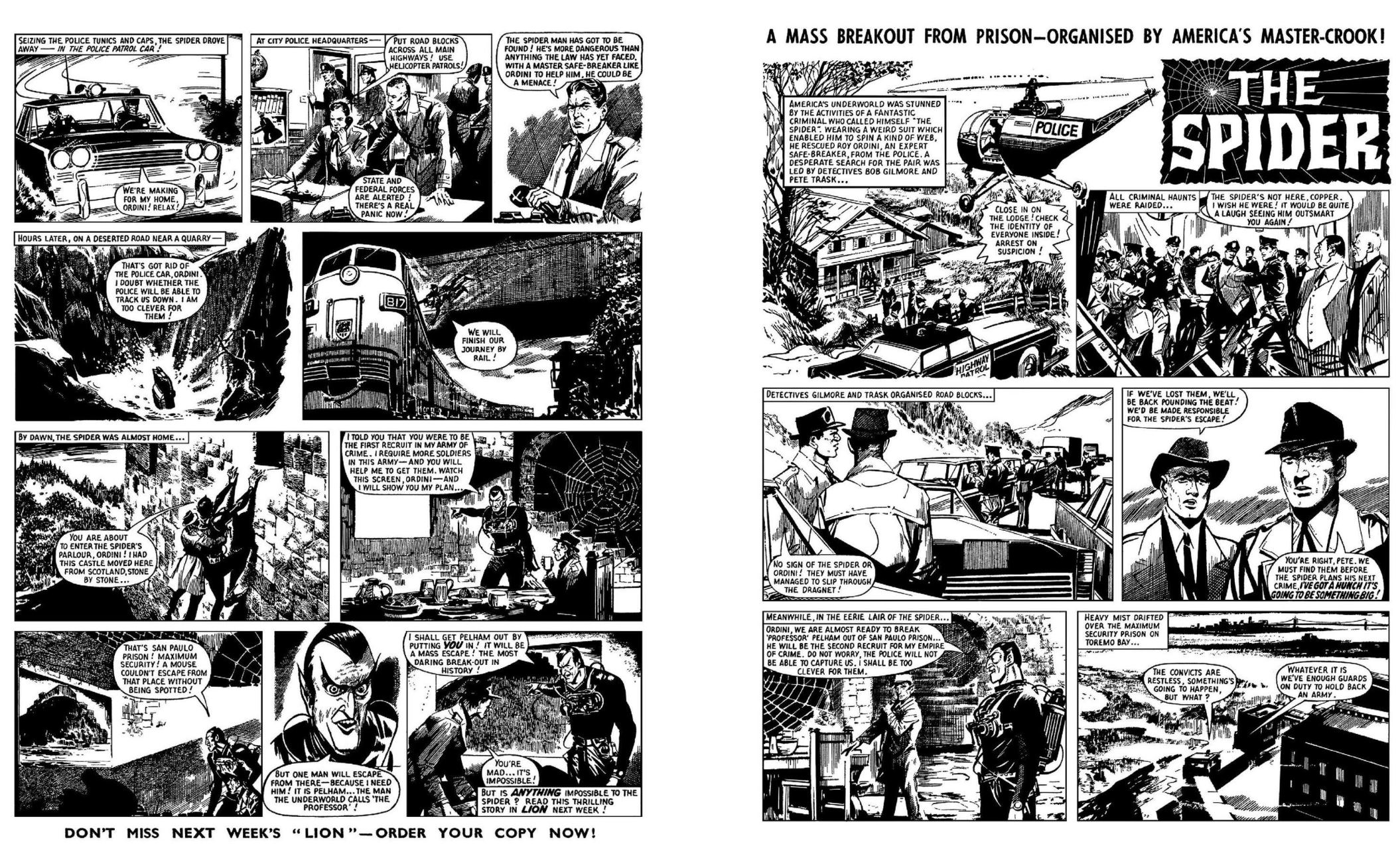
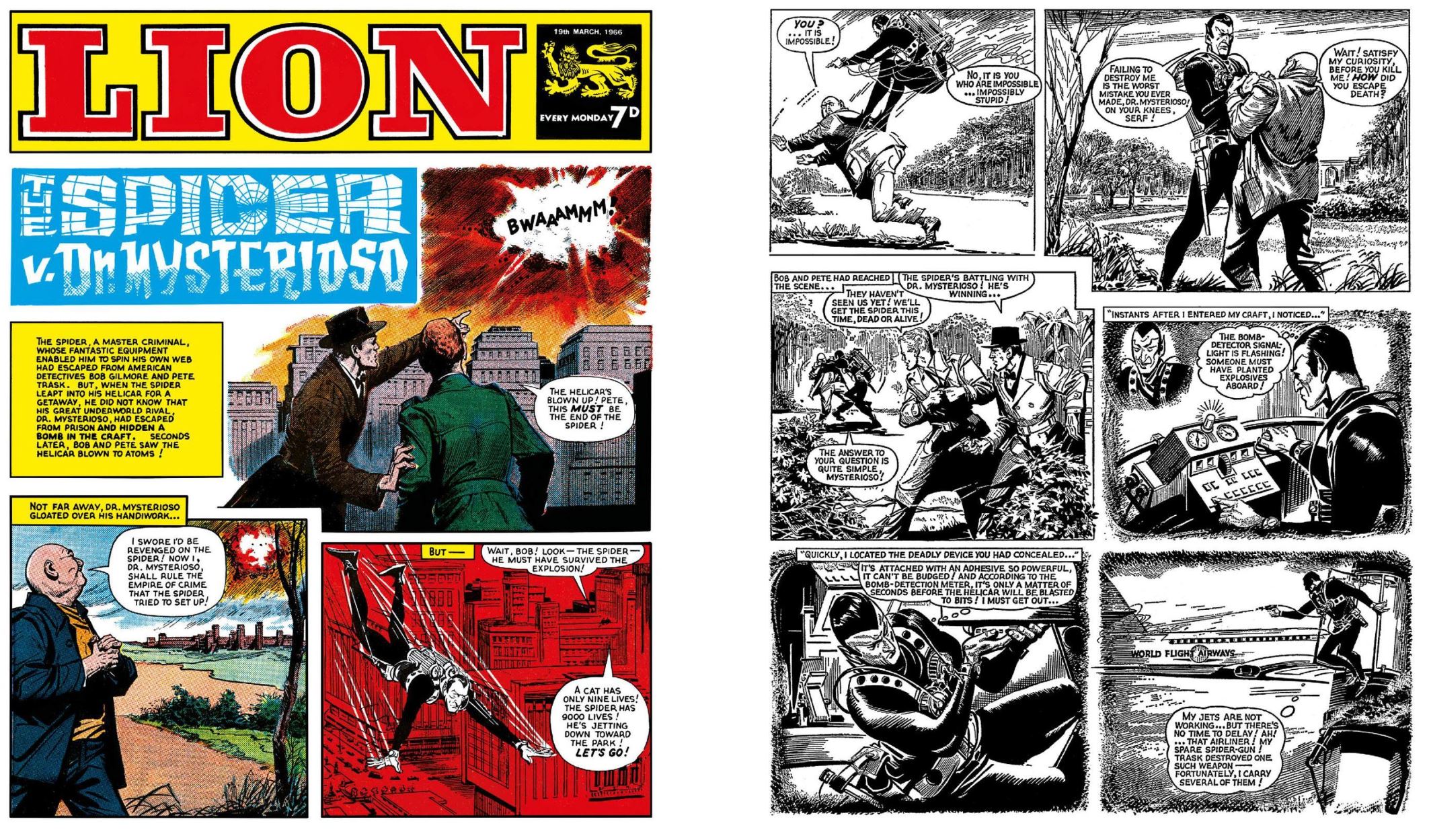
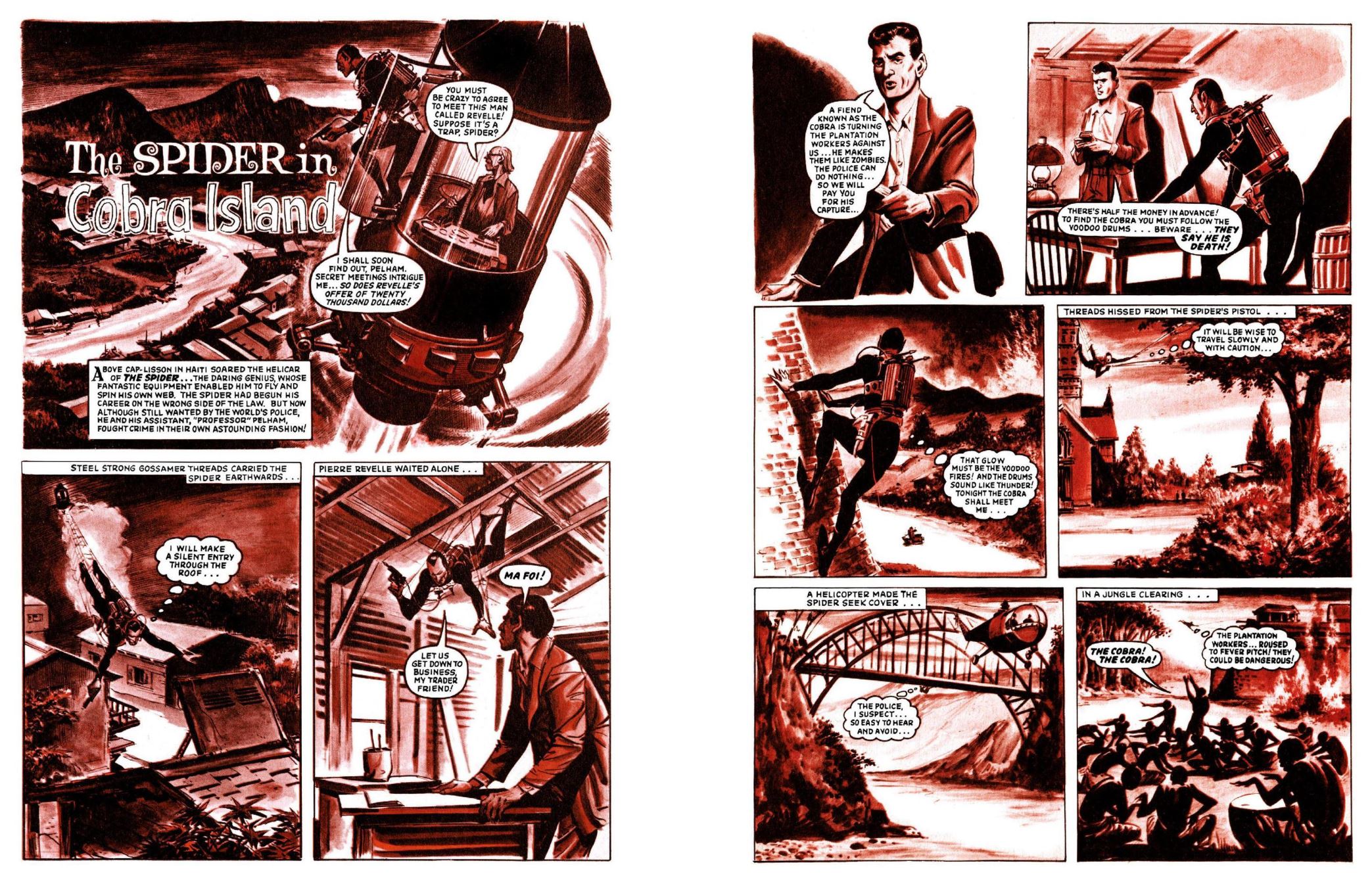
British comics have always enjoyed an extended love affair with what can only be described as “unconventional” (for which feel free to substitute “weird” or “creepy”) heroes. So many stars and notional role models of our serials and strips have been outrageous or just plain “off”: self-righteous voyeur/vigilantes like Jason Hyde, sinister masterminds in the manner of The Dwarf or Black Max, arrogant former criminals like The Spider or outright racist overmen such as fearsome white ideologue Captain Hurricane

Joking aside, British comics are unlike any other kind: having to be seen to be believed and always enjoying – especially when “homaging” such uniquely American fare as costumed crimefighters – a touch of insouciant rebelliousness…

Until the 1980s, UK periodicals employed an anthological model, offering variety of genre, theme and character on a weekly (sometimes fortnightly) basis. Humour comics like The Beano were leavened by action-heroes like The Q-Bikes or General Jumbo whilst adventure papers like Smash, The Eagle, Hotspur or Valiant offered palate-cleansers The Cloak, Grimly Feendish, Mowser and sundry other titter-treats.

Prior to the advent of game changers Action, Misty and 2000AD, British comics seemingly fell into fairly ironclad categories. Back then, you had genial and/or fantastic preschool fantasy; licensed entertainment properties; action; adventure; war; school dramas; sports and straight comedy strands. Closer examination would confirm there was always a subversive merging, mixing undertone, especially in such antihero series as Dennis the Menace or our rather strained interpretation of superheroes. Just check out The Phantom Viking, Kelly’s Eye or early Steel Claw stories…

After post-war austerity, the 1950s ushered in revolution. With printing and paper restrictions gone, a steady stream of titles emerged from companies new and old, aimed at the many different levels of childish attainment from pre-school to young adult. When Hulton Press launched Eagle in April 1950, the very concept of what weeklies could be changed forever. That oversized prestige package with photogravure colour was exorbitantly expensive, however, and when venerable London-based publishing powerhouse Amalgamated Press retaliated, it was a far more economical affair. I’m assuming AP only waited so long before the first issue of Lion launched (cover-dated February 23rd 1952) to see if their flashy rival was going to last.

Just like Eagle, Lion mixed prose stories, features and comic strips. It even offered its own cover-featured space-farer in Captain Condor – Space Ship Pilot. Initially edited by Reg Eves, the title ran 1156 weekly issues until 18th May 1974 when it merged with sister-title Valiant. Along the way, in the tradition of Darwinian British publishing – which subsumed weaker-selling titles to keep popular strips going – in 1959 Lion absorbed Sun then Champion (1966) before swallowing Eagle in April 1969, before merging with Thunder in 1971. One of the country’s most popular and enduring adventure comics, the last vestiges of Lion only vanished in 1976 after Valiant’s amalgamation with Battle Picture Weekly.

Despite that demise, there were 30 Lion Annuals between 1953 & 1982, all benefitting from the UK’s lucrative Christmas market, combining a variety of original strips with topical and historical prose adventures; sports, science/general interest features; short humour strips and – increasingly from the 1970s – reformatted reprints from IPC/Fleetway’s back catalogue.

The Jungle Robot debuted in Lion’s first issue, created by incredibly prolific E. George Cowan (Ginger Nutt, The Spider, Saber, King of the Jungle, Smokeman/UFO Agent, Nick Jolly the Flying Highwayman, Paddy Payne, Girls’ Crystal Libraries) and drawn by Alan Philpott (The Deathless Men/V for Vengeance, Look-In, Klanky). It enthralled readers for a couple of months before abruptly vanishing with the August 9th issue.

Other than an appearance in the 1955 Lion Annual, that was it until January 19th 1957 when the mechanical marvel was revived and revised by Cowan & A. Forbes prior to veteran artist Ernest “Ted” Kearon (Spot the Clue with Zip Nolan, The Day the World Drowned, Steel Commando and DC Thomson’s Morgyn the Mighty). He signed on in 1958 and soldiered on for most of the next 17-ish years. This time the mighty mouthed mechanoid became one of the most popular and well-remembered heroes of the British scene, successfully syndicated all across Europe and around the world. Hopefully this second compilation of later material will be soon supplemented by earlier annals …

Reprinting stories from 18th January 1969 to 18th October 1969, plus yarns from Lion Annual 1971 and Lion Holiday Special 1980 these latterday adventures of explorer/ troubleshooters Ted Ritchie, Ken Dale and arrogant, smug, self-absorbed yet paternally benevolent super-robot Robot Archie resume and take an even more outrageous turn here.

The former Jungle Robot was for a very long time the greatest achievement of Ted’s inventor uncle Professor C. R. Ritchie. Partnered with him/it the lads battled monsters & aliens, foiled crooks and faced disasters. Then the Prof left them The Castle. This inhabitable two-storey faux chess piece could take them anywhere in history and even into the future… and inevitably the boastful ‘bot commandeers it and discovers the wonders and perils of all spacetime…

After joining a peasant’s revolt in the 14th century, and ending an alien invasion in the 21st, they fetched up fully lost and out of control in 18th century England to face Highwaymen and corrupt judges, pirates and more. Now at the mercy of raging chronal currents, the wanderers arrive thousands of years into Earth’s menacing tomorrows to find a paradise run by genetically pacifistic humans who look like wise children. This promised land is serviced by billions of mechanical servants but ‘Robot Archie in the World of the Future’ (by Cowan & Kearon for Lion 18th January to 26th April 1969) coincides with another extraterrestrial landgrab.

With barbarous conquerors the Krull resolved to possess and use up the world, it falls to Ted, Ken and especially super-general Archie to protect what humanity has become, retrain billions of robots into an army and repel the invaders. Of course, with no organised military or armaments, their arsenal of liberty must come from museums… as do the hands-on tactics the metal commander-in-chief inflicts on the aliens. These sorties have never been seen before and the Krull have no idea how to counter then…

After a ferocious struggle Earth is safe and free again, albeit forever changed, and the time trio take off on the hope of finding their home era again. The next landing initially seems to satisfy them – a lush island with recognisable architecture and normal looking people. Sadly, a series of unexplained events soon show otherwise…

Running from May 3rd to August 2nd, ‘Robot Archie and the Island of 1,000 Secrets’ pits the lads against ghostly phenomena, animated machinery, possessed animals and “hostile natives”, before a succession of hairsbreadth escapes expose the whole locale as a testing ground for some scurrilous aliens formerly beaten but now ready for a second round of malice and mayhem. Bombastic, bellicose Archie is more than happy to supply it…

After a protracted struggle that slips from mystery to sci fi fantasy, the intruders are defeated and humans liberated, with the restless nomads taking off again and landing in a pit of genuine horror…

Concluding around that year’s Remembrance Sunday commemorations ‘Robot Archie in No-Man’s Land’ ran from 9th August – 18th November 1969 and dropped the pals in the middle of a mud-drenched clash for a few feet of trench. In the clash Archie was damaged and went berserk whilst ununiformed Ted and Ken are instantly assessed as spies and arrested. In an age of technological breakthroughs the Germans, after being pounded and petrified by “the Steel Man”, concentrate all their efforts on capturing it, leading to massive and cathartic comics Hun-bashing (with Archie excelling on land at sea and in the air) before finally rescuing his human companions, un-impounding the Time Castle and taking off for fresh pastures and fewer explosions…

To Be Continued…

With epic covers by Geoff Campion & Garry Leach, the ‘Extras’ section of this mighty monument to weird fun begins with a brace of short complete tales from Lion Annual 1971 Special 1969 and Lion Holiday Special 1980 respectively. ‘Robot Archie – The Steel Giant’ by Kearon and an uncredited author finds the time-tossed trio in ancient Rome just as a usurper awaits three gladiator/assassins he’s hired sight unseen to kill Caesar. He can’t miss them, one of them is a veritable colossus who always wears full armour…

The general is cautious however and sets them tasks to prove their merit, but while they are acing those, the real hitmen arrive. Whoops!

Only a decade later, and three years into Fleetways’ revolution of UK comics, Archie was long gone and a figure of fond nostalgia. Thus he was cheekily revived for a team/up clash with a fellow veteran. Delivered by an unknown writer and Dave Harwood, ‘Robot Archie vs the Spider’ gave everybody what they wanted as the icons tried to beat the stuffings out of each other in a two-part saga that delivered on action but promised a continuation that never came…

The memory storm concludes with a too-short Covers Gallery and biographies.

Now part of Rebellion Publishing’s line of British Comics Classics, Robot Archie is a landmark of UK fantasy long overdue for revival. I hope not much time passes before we see all the old stories back again…
© 1969, 1970. 1980 & 2025 Rebellion Publishing IP Ltd. All Rights Reserved.

Today in 1887, British cartoonist George William Wakefield was born. You’ve never heard of him but he delighted your great grandparents with his Laurel and Hardy comics. In 1947, Doug Murray was born, whom we probably know best for writing The ‘Nam.

Today in 1977 saw the last published episode of Li’l Abner and in 1997, master Archie artist Samm Schwartz prat-falled (pratfell?) his way offstage for the last time.

In 2003, Flash co-creator and Golden Age stalwart Harry Lampert died. You don’t have to follow Now Read This, but you really, REALLY should read the comics we’re plugging here.

DC Finest: Super Friends – The Fury of the Super Foes


By E. Nelson Bridwell, Denny O’Neil, Ramona Fradon, Kurt Schaffenberger, Ric Estrada, Alex Toth, Joe Orlando, Bob Smith, Vince Colletta with Dick Giordano, Curt Swan & Geoge Klein & various (DC Comics)
ISBN: 978-1-79950-316-3 (TPB)

This book contains Discriminatory Content produced during less enlightened times.

Win’s Christmas Gift Recommendation: Evergreen Superhero Sagas For All… 9/10

Once upon a time comics were primarily created with kids in mind. Whilst I’d never advocate exclusively going back to those days, the modern industry has for the longest time sinned by not fully addressing the needs and tastes of younger fans these days. By that I mean less tie-ns and more accessible standard stoires like Marvel Adventures material or this stuff here.

Happily, DC has latterly been rectifying the situation with new and – most importantly for old geeks like me – remastered, repackaged age-appropriate gems from their vast back catalogue.

A superb case in point of all-ages comics done right is this tome celebrating the joys of childhood when comics and TV shows were interchangeable in kids’ head. It was all one great big dangerous fun world to save or conquer…

DC Finest: Super Friends:- The Fury of the Super Foes gathers comic book tales spun off from a hugely popular Saturday Morning TV Cartoon show: one that, thanks to the canny craftsmanship and loving invention of lead scripter E. Nelson Bridwell, became an integral and unmissable component of the greater pre Crisis on Infinite Earths DC Universe.

It was also one of the most universally thrilling and satisfying superhero titles of the period: featuring the smart, witty, straightforward adventures people my age grew up with, produced during a period when the entire industry was increasingly losing itself in colossal continued storylines and bombastic, convoluted, soap opera melodrama.It’s something all creators should have tattooed on their foreheads: sometimes all you really want is a smart plot well illustrated, sinister villains well-smacked, a solid resolution and early bed…

TV show Super Friends ran (under various iterations) from 1973 to 1986; starring primarily Superman, Batman and Robin, Wonder Woman, Aquaman and a brace of studio-originated kids as student crimebusters. The cast was supplemented by guest stars from the DCU on a case by case basis. The animated series made the transition to print as part of the publisher’s 1976 foray into “boutiqued” comics which saw titles with a television connection cross-marketed as DC TV Comics.

Child-friendly Golden Age comic book revival Shazam!- the Original Captain Marvel had been adapted into a successful live action series and its Saturday Morning silver screen stablemate The Secrets of Isis consequently reversed the process to become a comic book. With the additions of hit comedy show Welcome Back Kotter and animated blockbuster Super Friends four-colour format, DC had a neat outreach imprimatur tailor-made to draw viewers into the magic word of funnybooks.

At least that was the plan: with the exception of Super Friends none of the titles lasted more than ten issues beyond their launch…

This massive mega-extravaganza collects Super Friends #1-26 (spanning November 1976 to November 1979), includes promo comic Aquateers Meet the Super Friends and reprints material from Limited Collectors’ Edition #C-41 and C-46.

The fun begins a crafty 2-part caper by the wondrous E. Nelson Bridwell and illustrators Ric Estrada, Vince Colletta & Joe Orlando. ‘The Fury of the Super Foes’ finds heroes-in-training Wendy & Marvin – and their incredibly astute mutt Wonderdog – studying at the palatial Hall of Justice, even as elsewhere, a confederation of villains prove imitation is the sincerest form of flattery… if not outright intellectual theft. Having auditioned a host of young criminals, The Penguin, Cheetah, Flying Fish, Poison Ivy and Toyman are creating a squad of sidekicks and protégés to follow in their felonious footsteps. Now Chick, Kitten, Sardine, Honeysuckle and Toyboy are all ready and willing to carry out their first caper…

When the giant “Troubalert” screen informs our heroes of a 3-pronged attack on S.T.A.R. Labs’ latest inventions, the team split up to tackle the crises, but are thoroughly trounced until Wendy & Marvin break curfew to help them. As a result of the clash, Chick and Kitten are brought back to the Hall of Justice, but their talk of repentance is a rascally ruse and they secretly sabotage vital equipment. Thankfully, Wonderdog has seen everything and quickly finds a way to inform the still-oblivious good guys in issue #2, but too late to prevent the Super Friends being briefly ‘Trapped by the Super Foes’

Aided and abetted by inker Bob Smith, the incomparable Ramona Fradon (Aquaman; Metamorpho the Element Man; Brenda Starr, Reporter) became penciller with #3, as ‘The Cosmic Hit Man?’ sees 50 intergalactic super-villains murdered by infernal Dr. Ihdrom, who then blends their harvested essences to create an apparently unbeatable hyper-horror to utterly overwhelm Earth’s heroic defenders. However, he falls victim to his own arrogance and Wendy & Marvin’s logical deductions…

‘Riddles and Rockets!’ sees the Super Friends overmatched by new ne’er-do-well Skyrocket whilst simultaneously seeking to cope with a rash of crimes contrived by King of Conundra The Riddler. Soon a pattern emerges and a criminal connection is confirmed…

Author Bridwell (Secret Six; Inferior Five; Batman; Superman; The Flash; Legion of Super-Heroes; Captain Marvel/Shazam!) was justly famed as DC’s Keeper of Lore and top Continuity Cop thanks to his astoundingly encyclopaedic knowledge of its publishing minutiae and ability to instantly recall every damn thing! ‘Telethon Treachery!’ gave him plenty of scope to display it with a horde of near-forgotten guest-stars joining the heroes as they host a televised charity event. Sadly, money-mad menace Greenback lurks in the wings, awaiting his moment to grab the loot and kidnap the wealthiest donors. Then The Atom (Ray Palmer) plays a crucial role in stopping the depredations of an animal trainer using beasts as bandits in ‘The Menace of the Menagerie Man!’ before a huge cast change is unveiled in #7 (October 1977) with ‘The Warning of the Wondertwins’

You all know TV is very different from comics. When the next season of Super Friends aired, Wendy, Marvin & Wonderdog were abruptly gone, replaced without explanation by alien kids Zan & Jayna and their elastic-tailed space monkey Gleek. With room to extrapolate and in consideration of fans, Bridwell explained the sudden change via a battle to save Earth from annihilation whilst introducing the newest student heroes in memorable style. At the Hall of Justice Wendy & Marvin spot a spaceship hurtling to Earth on the Troubalert monitor and dash off to intercept it. Aboard are two siblings from distant planet Exor: a girl able to transform into animals and a boy who can become any form of water, from steam to ice. They have come carrying an urgent warning…

Superman’s alien enemy Grax has resolved to eradicate humanity and devised a dozen different superbombs and attendant weird-science traps to ensure his victory. These are scattered all over Earth and even the entire Justice League cannot stretch its resources to cover every angle and threat. To Wendy & Marvin the answer is obvious: call upon the help and knowledge of hyper-powered local heroes…

Soon Superman and Israel’s champion The Seraph are dismantling a black hole bomb whilst Elongated Man and titan-tressed Godiva perform similar service on a life-eradicator in England. Flash (Barry Allen) and mighty-leaping Impala dismantle uncatchable ordnance in South Africa before Hawkman & Hawkwoman join Native American avenger Owlwoman to crush darkness-breeding monsters in Oklahoma, whilst from the Hall of Justice Wendy, Marvin and the Wonder Twins monitor the crisis with a modicum of mounting hope…

The cataclysmic epic continues in #8 with ‘The Mind Killers!’ as Atom and Rising Son tackle a device designed to decimate Japan, and in Ireland Green Lantern Hal Jordan and Jack O’Lantern battle multi-hued monstrosities before switching off their technological terror.

In New Zealand, time-scanning Tuatara tips off Red Tornado to the position of a bomb cached in the distant past whilst Venezuela’s doom is diverted through a team-up of Batman, Robin and reptile-themed champion Bushmaster. And in Taiwan a melding of sonic superpowers possessed by Black Canary and the astounding Thunderlord harmoniously saves the day…

The saga soars to a classic climax with ‘Three Ways to Kill a World!’ in which the final phases of Grax’s scheme fail thanks to Green Arrow & Tasmanian Devil in Australia, with Aquaman & Little Mermaid sorting out the embattled seas off Denmark and Wonder Woman & The Olympian preserving modern Greece.

Or at least, they would have if the Hellenic heroes had found the right foe. Sadly, their triumph against Wrong-Place, Right-Time terrorist Colonel Conquest almost upsets everything. Thankfully, the quick thinking hero-students send an army of defenders to Antarctica where Norwegian novice Icemaiden dismantles the ultimate booby-trap bomb.  However, whilst the adult champions are engaged, Grax invades the Hall of Justice seeking revenge on the pesky whistleblowing Exorian kids. He’s completely unprepared for and overwhelmed by Wendy, Marvin & Wonderdog, who categorically prove they’re ready to graduate to the big leagues…

Thus with Zan & Jayna enrolled as latest heroes-in-training, Super Friends #10 details their adoption by Batman’s old associate – and eccentric time travel theoretician – Professor Carter Nichols, just before a legion of alien horrors arrive on Earth to teach the kids that appearances can be lethally deceiving in ‘The Monster Menace!’ In #11, ‘Kingslayer’ pits the heroes against criminal mastermind Overlord who has contracted the world’s greatest hitman to murder more than one hundred leaders at one sitting…

Another deep dive into DC’s past resurrected Golden Age titans T.N.T and Dan, the Dyna-Mite in ‘The Atomic Twosome!’ These 1940s mystery men had been under government wraps ever since their radioactive powers began to melt down, but when an underground catastrophe ruptures their individual lead-lined vaults, the Super Friends are called in to prevent potential nuclear nightmare. Then the subterranean reason for the near tragedy is tracked to a monstrous mole creature, and leads to the introduction of eternal mystic Doctor Mist, who reveals the secret history of civilisation and begs help to halt ‘The Mindless Immortal!’ before its random burrowing shatters mankind’s cities. From here, Bridwell would build a fascinating new team concept that would support decades of future continuity…

Super Friends #14 opens with ‘Elementary!’; introducing four ordinary mortals forever changed when possessed by ancient sprits. Tasked by Overlord with plundering the world, Undine, Salamander, Sylph & Gnome are defeated by our heroes yet retain their powers and so become crimefighting team The Elementals. Also on view is a short back-up illustrated by Kurt Schaffenberger & Bob Smith. ‘The Origin of the Wondertwins’ at last reveals they are Exorian genetic throwbacks (despised outcasts on their homeworld) who fled from a circus of freaks and uncovered Grax’s plot before taking that fateful voyage to Earth.

Big surprises come in ‘The Overlord Goes Under!’ (Fradon & Smith) as the Elementals begin battling evil by joining the Super Friends in crushing the crook. All those superheroes are blithely unaware that they are merely clearing the way for a far more cunning and subtle mastermind to take Overlord’s place…

‘The People Who Stole the Sky!’ in SF #16 is a grand, old-fashioned alien invasion yarn, foiled by the team and the increasingly adept Wonder Twins whilst ‘Trapped in Two Times!’ has Zan & Jayna used by the insidious Time Trapper to lure their adult mentors into deadly peril on Krypton in the days before it detonated, and future water world Neryla in the hours before it’s swallowed by its critically expanding red sun. After rescuing the kids – thanks largely to Superman’s legendary lost love Lyla Ler-Rol – the Super Friends employ Tuatara’s temporal insight and Professor Nichol’s obscure chronal methodologies to hunt the Trapper in a riotous yet educational ‘Manhunt in Time!’ (art by Schaffenberger & Smith), by way of Atlantis before it sank, medieval Spain and Michigan in 1860CE: all to thwart a triple-strength scheme to derail history and end Earth civilisation…

SF #19 sees an encore for Menagerie Man in ‘The Mystery of the Missing Monkey!’ (Fradon & Smith) as the animal exploiter appropriates Gleek: intent on turning his elastic-tailed talents into a perfect pickpocketing tool, before Denny O’Neil (as Sergius O’Shaugnessy) teams with Schaffenberger & Smith for a more jocular turn. Here, chaos and comedy ensue when the team tackles vegetable monsters unleashed after self-obsessed shlock-movie director Frownin’ Fritz Frazzle uses Merlin’s actually magical Magic Lantern to make a “masterpiece” on the cheap in ‘Revenge of the Leafy Monsters!’

Bridwell & Fradon bounce back in #21 where ‘Battle Against the Super Fiends!’ has the heroes travelling to Exor to combat super-criminals who can duplicate their power-sets, after which ‘It’s Never Too Late!’ (#22, O’Shaugnessy, Fradon & Smith) reveals how time bandit Chronos subjects the Super Friends to a chronal-delay treatment rendering them perennially too late to stop him… but only until Batman and the Wonder Twins out-think him.

The Mirror Master divides and banishes teachers from students in #23 but is ultimately unable to prevent an ‘SOS from Nowhere!’ (Bridwell, Fradon & Smith) to the Flash. This episode also spends time fleshing out the Wonder Twins’ earthly alter egos as Gotham Central highschoolers John & Joanna Fleming

With O’Shaugnessy scripting, ‘Past, Present and Danger!’ sees Zan & Jayna’s faces found engraved on a recently-unearthed Egyptian pyramid. Upon investigation inside the edifice, the heroes awaken two ancient exiles who resemble the kids, but who are in truth criminals who fled Exorian justice thousands of years previously. How lucky, then, that the kids are perfect doubles that the villains can send back with the robot cops surrounding the pyramid – once they’ve got rid of all those busybody Earthling heroes…

Enjoying promotion through treachery, habitually harassed Underling has seized power at last in Bridwell’s ‘Puppets of the Overlord’, and then employs forbidden technology to mind-control adult and junior heroes. Happily, international champions Green Fury (later Fire), Wonder Woman’s sister Nubia, Tasmanian Devil and Seraph can join Green Lantern and Queen Mera of Atlantis in delivering a liberating solution, after which this splendid selection of super thrills pauses with SF #26 as Bridwell, Fradon & Smith bring back some old friends and enemies for ‘The Wondertwins’ Battle of Wits!’ when a scheming former Bat-foe enacts an infallibly murderous plot…

Rounding out the frenetic fun is a features section that includes the Alex Toth cover from Limited Collectors’ Edition #C-41  and new material from sequel C-46. These include a comic strip collaboration with Bridwell on introductory tale ‘Super Friends’ which was a star-studded framing sequence for a big reprint issue of Justice League classics. The wonders are further augmented by Toth’s comprehensive pictorial essay on creating ‘TV Cartoons’ (with contributions from Bob Foster), plus his ‘The JLA on TV’ model sheets, and designs of ‘The Hall of Justice’ by Terry Austin. As you of course know, comics legend Toth was lead designer on the characters’ transition to TV animation…

The extras include mini-comic Aquateers Meet the Super Friends – a 1979 promotional giveaway included with every purchase of Super Friends Swim Goggles. An uncredited framing sequence (which looks like a Continuity Associates project that Dick Giordano & Frank McLoughlin had a hand in) segues into ‘The Greatest Show on Water’ – an Aquaman short by Fradon originally published in Adventure Comics #219, (December 1955).

The bumper fun wraps with Alex Ross’ painted cover from 2001 book collection Super Friends!

With covers by Fradon, Smith, Schaffenberger, Colletta, Ernie Chan and more, this hopefully initial compendium is superbly entertaining, masterfully crafted and utterly engaging. It offers stories of pure comics gold to delight children and adults in equal proportion. Truly generational in appeal, they are probably the closest thing to an American answer to the magic of Tintin or Asterix and no family home should be without this tome.

Sadly, this masterful mystery megamix is not yet available digitally, but we live in hope. In the meantime, if you prefer your cartoon crimebustng computer collated you could access 2020’s Super-Friends: Saturday Morning Comics volume 1.
© 1976, 1977, 1978, 1979, 2001, 2025 DC Comics, Inc. All Rights Reserved.

Today in 1697, Willam Hogarth was born. Notionally adding to the comics lustre and significance, in 1918, Howard Purcell was also added to the planet’s roster, as was Neil Gaiman in 1960. In the exit column for today, in 1993 we lost astounding illustrator Alberto Breccia, and in 2006 immortal sci fi writer Jack Williamson. All those other guys you can find in old posts here, but I particularly recommend Beyond Mars – The Complete Series 1952-1955.

Fantastic Four Epic Collection volume 12: The Possession of Franklin Richards


By Marv Wolfman, Bill Mantlo, John Byrne, Ed Hannigan, George Pérez, Peter B. Gillis, Roger Stern, Doug Moench & Bill Sienkiewicz, Steve Ditko, Tom Sutton, Keith Pollard, Al Milgrom, Joe Sinnott, Pablo Marcos, Bruce Patterson, Chic Stone, Jon D’Agostino, Mike Esposito, Jerome Moore, Frank Giacoia & various (MARVEL)
ISBN: 978-1-3029-6056-8 (TPB/Digital edition)

This book includes Discriminatory Content produced in less enlightened times.

Win’s Christmas Gift Recommendation: Fantastic Fun for Comics Addicts… 8/10

It’s a been a big year for the fabulous FF. Here’s another titanic tome to add to your seasonal swag list…

For Marvel everything started with The Fantastic Four.

Monolithic modern Marvel truly began with eccentric monster ‘n’ alien filled adventures of a compact superteam as much squabbling family as coolly capable costumed champions. All that Modern Marvel is, company and brand, stems from that quirky quartet and the inspired, inspirational, groundbreaking efforts of Stan Lee & Jack Kirby…

Cautiously bi-monthly and cover-dated November 1961, Fantastic Four #1 – by Stan, Jack, George Klein and/or Christopher Rule – was raw and crude even by its ailing publisher’s steadily plunging standards. However, it seethed with rough, passionate, uncontrolled excitement and thrill-hungry kids pounced on its dynamic storytelling. The series caught a wave of change beginning to build in America, and every succeeding issue changed comics a little bit more… and forever. Revealed in that premier, maverick scientist Reed Richards, fiancée Sue Storm, close friend Ben Grimm and Sue’s bratty teenaged brother survived an ill-starred private spaceshot after cosmic rays penetrated their ship’s inadequate shielding.

All permanently mutated: Richards’ body became elastic, diffident Sue became (even more) invisible, Johnny Storm burst into living flame and tragic Ben shockingly devolved into a shambling, rocky freak. After the initial revulsion and trauma passed, they solemnly agreed to use their abilities to benefit mankind. Thus was born The Fantastic Four – you can add your own fanfare and timpani here if you wish…

Throughout the 1960s it was the key title and most consistently groundbreaking series of Marvel’s ever-unfolding web of cosmic creation: a forge for new concepts and characters. Jack Kirby was approaching his creative peak: unleashing his vast imagination on plot after spectacular plot, and intense, incredible new characters whilst Lee scripted some of the most passionate superhero sagas ever seen. Both were on an unstoppable roll, at the height of their powers and full of the confidence only success brings, with The King particularly eager to see how far the genre and the medium could be pushed… which is rather ironic since it was the company’s reticence to give the artist more creative freedom that led to Kirby’s moving to National/DC in the 1970s.

Without Kirby’s soaring imagination the rollercoaster of mindbending High Concepts lost out to traditional tales of characters in conflict, with soap opera leanings and supervillain-heavy Fights ‘n’ Tights forays abounding. With Lee & Kirby long gone but their mark very much still stamped onto every page of the still-prestigious title, this full-colour compendium represents Fantastic Four #215-231 and Annuals #14-16, spanning Fall 1979 to June 1981.

What You Should Know: After being rejuvenated and repowered in an extended space-spanning saga, the Family FF are getting used to being back on Earth even with supervillains all over the place. Now Read On…

The revived, excessively rejuvenated team are in full fine fettle for Fantastic Four Annual #14 wherin Marv Wolfman, George Pérez & Pablo Marcos put firstborn Franklin Richards and his sorcerous nanny Agatha Harkness in the spotlight for ‘Cats-Paw!’ When magical cult Salem’s Seven abduct and brainwash the adult FF in hopes of resurrecting their macabre master Nicholas Scratch, even the Avengers are helpless to stop the carnage unleashed. Thankfully, the extra-dimensional voyage of the kid and the crone is enough to set everything right…

The arcane account is augmented by ‘A Gallery of the Fantastic Four’s Most Famous Foes!’ by Keith Pollard & Marcos, giving the lowdown on late-debuting villains and ne’er-do-wells including Invincible Man, Attuma, Gideon, Dragon Man, The Frightful Four and Quasimodo. Monthly FF #215 then finds Wolfman, John Byrne & Joe Sinnott reintroducing Negative Zone terror tyrant ‘Blastaar!’ who somehow escapes the antimatter universe to take over the Baxter Building just as a reinvigorated Reed Richards is distracted by former colleague Professor Randolph James who has hyper-evolved himself to offset an otherwise fatal beating by street thugs. Sadly, his accelerator device has not advanced James’ ethical outlook, and after taking vengeance on his attackers, the future man proves that ‘Where There Be Gods!’ there be trouble too, as the mental marvel aligns with Blastaar only to fall before a far greater power… angry cosmic child Franklin…

Bill Mantlo scripts #217 for Byrne & Sinnott, as ‘Masquerade!’ at last exposes the viper in the team’s midst: an inimical force responsible for most of the recent setbacks and accidents, and almost the deaths of the heroes and Johnny’s new intended girlfriend Dazzler

No spoilers here this time, but back then we all just knew who the hidden villain actually was… that acursed robot!

Infernal gadget H.E.R.B.I.E. was imposed on the series due to concerns by producers of the current Fantasic Four cartoon show. Rejecting fire hazard Johnny for a cutely telegenic robot, Wolfman cheekily made that commercial compromise in-world canon, dividing fans forever after. The bleeping bot – a Humanoid Experimental Robot, B-type, Integrated Electronics (latterly, Highly Engineered Robot Built for Interdimensional Exploration; don’cha just love nominative deterministic acronymics?) – is pure Marmite in most readers eyes…

Next is the last half of an old-school saga that, for completeness, means you need to read Peter Parker, the Sensational Spider-Man #42 before enjoying the contents of FF #218. What’s not here is how ESU student Peter Parker goes on a class jaunt and is lured into a trap by the Frightful Four (in ‘Give Me Liberty or Give Me Death’ by Mantlo, Mike Zeck & Jim Mooney if you were wondering). The villains broadsided the wallcrawler after new recruit Electro impersonated the Human Torch there…

Now for ‘When a Spider-Man Comes Calling!’ (cover-dated May 1980 by Mantlo, Byrne & Sinnott), Trapster repeats the tactic to ambush the comfortably at home quartet, allowing his comrades The Wizard and Sandman to take over the heroes’ Baxter Building citadel… at least until a fighting-mad webspinner breaks free for an unstoppable counterattack…

Penciller John Byrne, having served out his first term on the series he was to soon make his alone, was officially only temporarily replaced for FF #219. Ably augmented by Sinnott, stalwart “Guest-Team” Doug Moench & Bill Sienkiewicz were parachuted in for monster mash-up ‘Leviathans’ due to the huge success and acclaim generated by their vigilante thriller Moon Knight. They brought with them a whole new look and sensibility, as well as far faster pace to the stories. Here, modern day pirate Cap’n Barracuda steals the fabled Horn of Proteus from Atlantis to unleash a wave of giant monsters on New York City. Thankfully, this is a subject the mighty Sub-Mariner and Mr. Fantastic can agree on, and their combined forces soon stomp the beasties to stop a piratical plunder ploy without peer…

Byrne bounced back writing & pencilling in #220 as ‘…And the Lights Went Out All Over the World!’ sees the Avengers call Reed and Co. when all Earth suffers a catastrophic power-outage. Science! sends the explorers to the arctic to encounter an astounding and unbelievable obelisk being constructed by beings of utterly alien appearance…

The story includes an updated origin for the quartet and guest shot for Canada’s finest (that’s Vindicator of Alpha Flight in case you were wondering) as the tale halts for a pinup by inker Sinnott (the Torch battling a flaming Skrull) prior to #221’s concluding chapter ‘Tower of Glass… Dreams of Glass!’ Following the usual misconceptions and rash clashes it is revealed that three aliens shipwrecked for half a million years just need their myriad mobile mechanisms to reverse the planet’s magnetic poles so they can return home at last. Happily, Reed has a less end-of-human-civilisation-y solution leaving everyone involved happy and safe; and back where they belong…

Now officially the regular creative team, Moench & Sienkiewicz prep for Halloween in FF #222’s ‘The Possession of Franklin Richards!’ as the cosmic ray kid is again targeted from beyond the unknown by exiled soul Nicholas Scratch. The son of Agatha Harkness is the kind of warlock who gives witchcraft a bad name. and, having made the boy his conduit back to reality, Scratch goes on to terrorise and torture his hated enemies. With Doctor Strange unavailable, they enlist the dubious gifts of self-doubting failed horror hero Gabriel the Devil Hunter and his morally ambiguous familiar Desadia (from Marvel’s monochrome magazine line titles Haunt of Horror and Monsters Unleashed)…

Apparently acquiescing, the team agree to liberate the dead diabolist’s minions of magical mayhem and Salem’s Seven toil ‘That a Child May Live…’ Of course, their instant assaults on humanity are an acceptable risk and consequence in Reed’s plan: setting the worlds to rights for all but the defeated devil…

Fantastic Four Annual #15 swiftly follows, wherein Moench & Pérez, abetted by Chic Stone, Jon D’Agostino & Mike Esposito, renew hostilities between the FF and Skrull empire as the shapeshifters target the supergenius’ latest energy-casting breakthrough in ‘Time for the Prime Ten!’ Infiltrating the Baxter Building, negating his valiant teammates and almost banishing Mr. Fantastic to the tender mercies of Annihilus in the Negative Zone, the sneaky killers are actually seeking to end their millennial war against stellar rivals The Kree, but have underestimated Reed’s brilliance, his family’s tenacity and the cosmic awareness of Earth-loving Kree Exile Captain Mar-Vell

A back-up tale by Moench & Tom Sutton takes us to recently liberated Latveria for the opening of proposed series ‘The Return of Doctor Doom!’ Only episode ‘The Power of the People!’ shows how restored monarch King Zorba fails to live up to his democratic promises and discover how excessive taxation really upsets voters, at around the same moment crazed, catatonic Victor von Doom goes missing from the most secure dungeon in Doomstadt…

Sadly, the impending crisis never materialised and was only addressed by Byrne in Fantastic Four #247…

Over in FF #224 & 225, fresh calamity unfolds in ‘The Darkfield Illumination’ (Moench, Sienkiewicz & Pablo Marcos) as radioactive red mist blankets Manhattan and plays hob with the team’s powers. Tracing the cloud’s origin point to an icy dome in the Arctic, the FF find a lost colony of technologically advanced Vikings utterly dependent upon a mutated immortal giant. ‘The Blind God’s Tears’ supply heat, light, food materials from the outside world and immortality, but now Korgon is dying and demands the explorers save him and the people who worship him. Always eager to help, the FF strive and succeed in saving the God, only to see him betrayed by his most trusted ally. As Korgon rages madly in response, the crisis escalates as Mighty Thor arrives to investigate worshippers who have abandoned their true god for a false one…

Bruce Patterson joins Marcos inking Sienkiewicz when Moench next brings closure to fans of his Shogun Warriors series. In their own title the former pilots of monster-fighting mega-mecha Dangard Ace, Raydeen and Combatra had been recruited by an ancient order to defend humanity, but retired when their machines were destroyed. That epic sacrifice had come when evil enemy Maur-Kon targeted the Fantastic Four and attempted to kill Reed. Now a new giant mecha rampages and robs, so the teams reunite with Ilongo Savage, Richard Carson and Genji Odashu aiding the fight against ‘The Samurai Destroyer’ and the unworthy soul exploiting its power for profit….

Movie-toned terror in the heartland follows as a meteor crashes in rural Pennsylvania resort Lost Lake just as the FF head out to the Boonies for a break. Their encounter with ‘The Brain Parasites’ reverting hosts to earlier evolutionary forms is by-the-books horror fun from Moench, Sienkiewicz & Patterson, and readily fixed by little Franklin’s increasingly unreliable powers. This sets the scene for the next – Sinnott inked – issue where further tests by professional head shrinkers and brain benders unleash uncontrollable chaos, possessed bystanders and an adult super-powered version of the lad. Thankfully, loving parents and uncles allow Franklin to exorcise his deadly ‘Ego-Spawn’.

The experiment in alternative tale-telling ends with a 3-part saga opening on #229’s ‘The Thing From the Black Hole’. When it homes in on Reed’s latest invention, Earth totters on the edge of destruction as a sentient singularity made of antimatter disrupts physical laws. Desperate Richards makes contact with its cosmic equivalent and uncovers a tale of love lost in service to scientific exploration. The wandering extinction event was once a living being whose love for a fellow astronaut turned them both into creatures of uncanny forces. Thankfully, ‘Firefrost and the Ebon Seeker’ now reach an understanding that saves Earth, but as a consequence a section of Manhattan – including the Baxter Building – is left inside the Negative Zone.

With panic amongst the abducted New Yorkers barely suppressed, the FF seek a solution ‘In All the Gathered Gloom!’ (Moench & Roger Stern, Sienkienwisz, Jerome Moore, Sinnott, & Frank Giacoia) even as new antimatter menace Stygorr zeroes in on the intruding enclave. The last thing the FF need is bullying big business plutocrat Lew Shiner telling everyone his money puts him in charge. After his posturing triggers a riot, tragedy is guaranteed, and the heroes barely beat the alien invader in time to return everyone surviving back home…

This foray into the fantastic finishes on a “soft pilot episode” as Fantastic Four Annual #16 embraces the contemporary fantasy market with ‘The Coming of… Dragon Lord!’ by Ed Hannigan & Steve Ditko. When trainee Ral Dorn is framed for killing a sacred beast and hunted by former fellows in the puissant extradimensional Dragon Rider organisation, the chase ends up with him wounded. His flight, employing a multi-powered Dragon Staff, leads to a collision with an off-duty quirky quartet, celebrating a reunion on the college campus where they first encountered astouding android Dragon Man,. but the coincidence escapes everybody and the heroes leave the mystery man to the medics.

Days later the fugitive breaks into their skyscraper home and with the Staff holding the FF at bay explains his predicament. A novice lawkeeper, his dream of bonding with a dragon has been shattered by the death of his destined beast-partner, and accusations that he’s responsible. The wild story is inadvertantly backed up by a posse of Dragon Riders seeking to stop him and the intervention of Ral’s bizarre former ally Lalique. When they are driven away, it is clear to the human heroes that something is not kosher and they determine to help him. It’s obvious to Ral that his boss Dragon Lord Skagerackäkor is behind the plot but without a bonded beast what can he do? That’s why he was on campus. He had learned of former FF foe Dragon Man and decided that needs must when the devil drives…

The classic plot left all the goodies rewarded amd baddies punished and was claearly an attempt to launch a series, but…

With covers by Sinnott, Ron Wilson, Josef Rubinstein, Rich Buckler, Al Milgrom, Byrne, Pollard, Sienkienwicz, Bob McLeod & Ditko the extras here include Sinnott pinups of the whole team and Thing pinup from FF #218 & 219: Sienkievich’s rejected cover-turned-pinup as printed in #224; the entries for January in the Marvel Comics 20th Anniversary Calandar 1981 (Sienkienwicz & Sinnott) plus original art pages/covers from Byrne, Sinnott, Sienkienwicz, Marcos and Patterson, as well as original colour-guides painted by George Roussos.

Although never quite returning to the stratospheric heights of the Kirby era, this truly different collection represents a closing of the First Act for the “World’s Greatest Comics Magazine”, and palate-cleansing preparation for the second groundbreaking run by John Byrne. These extremely capable efforts are probably most welcome to dedicated superhero fans and continuity freaks like me, but will still thrill and delight casual browsers looking for an undemanding slice of graphic narrative excitement.
© 2025 MARVEL.

Today in 1858, French cartoonist Emmanuel Poiré was born. He annoyed all the right people as Caran d’Ache… and plenty of the wrong ones too. Far less controversial were Fred Harmon and screenwriter/ scripter Stephen Slesinger who launched epic cowboy strip Red Ryder this day in 1938.

Osama Tezuka’s Astro Boy volume 10


By Osamu Tezuka, translated by Frederik L. Schodt (Dark Horse Manga)
ISBN: 978-1-56971-793-1 (tank?bon PB/Digital edition)

This book contains Discriminatory Content produced during less enlightened times.

From beginning his professional career in the late 1940s until his death in 1989, Osamu Tezuka generated an incomprehensible volume of quality work which transformed the world of manga and how it was perceived in his own country and, ultimately, across the globe. Devoted to Walt Disney’s creations, he also performed similar sterling service with Japan’s fledgling animation industry. Look what that led to…

The earliest stories were intended for children but right from the start Tezuka’s expansive fairy tale stylisations harboured more mature themes, holding hidden pleasures for older readers and the legion of fans growing up with the Mankaga’s manga masterworks…

The “God of Comics” was born in Osaka Prefecture on November 3rd 1928, and as a child suffered from severe illness. The doctor who cured him inspired the lad to study medicine, and although Osamu began drawing professionally whilst at university in 1946, he persevered with college and qualified as a medical practitioner too. Then, as he faced a career crossroads, his mother advised him to do the thing which made him happiest.

He never practiced as a healer but the world was gifted such masterpieces as Kimba the White Lion, Buddha, Black Jack and so many other graphic narratives. Working ceaselessly over decades, Tezuka and his creations inevitably matured, but he was always able to speak to the hearts and minds of young and old equally. His creations ranged from the childishly charming to the distinctly disturbing such as The Book of Human Insects or Tomorrow the Birds.

Tezuka died on February 9th 1989, having produced more than 150,000 pages of timeless comics; reinvented the Japanese anime industry and popularised a uniquely Japanese graphic narrative style which has become a fixture of global culture.

These monochrome digest volumes (173 x 113 mm in the physical world and any size you like if you read them digitally) present – in non-linear order – early exploits of his signature character, with the emphasis firmly on fantastic fun and family entertainment…

Tetsuwan Atomu (literally “Mighty Atom” but known universally as Astro Boy due to its dissemination around the world as an animated TV cartoon and one of post-war Japan’s better exports) is a spectacular, riotous, rollicking sci fi action-adventure starring a young boy who also happens to be one of the mightiest robots on Earth.

The series began in 1952 in Sh?nen Kobunsha and ran until March 12th 1968 – although Tezuka often added to the canon in later years, both in comics but in also in other media such as newspaper strips and in magazines. Throughout that period, the plucky robot lad spawned the aforementioned global TV cartoon boom, starred in comic book specials and featured in games, toys, collectibles, movies and the undying devotion of generations of ardent fans.

Tezuka frequently drew himself into his tales as a commentator, and in his later revisions and introductions often mentioned how he found the restrictions of Sh?nen comics stifling; specifically, having to periodically pause a plot to placate the demands of his audience by providing a blockbusting fight every episode. That’s his prerogative: most of us avid aficionados have no complaints and one upheld in abundance in the early tales included here…

Tezuka and his production team were never as wedded to close continuity as fans are. They constantly revised stories and artwork for later collections, so if you’re a purist you are just plain out of luck. Such tweaking and modifying is the reason these editions seemingly skip up and down publishing chronology. The intent is to entertain at all times so stories aren’t treated as gospel and order is not immutable or inviolate. It’s just comics, guys, and in case you came in late, here’s a little background to set you up.

In a forthcoming world where robots are ubiquitous and have won (limited) human rights, brilliant Dr. Tenma lost his son Tobio in a traffic accident. Grief-stricken, the tormented genius used his position as head of Japan’s Ministry of Science to have his team build a replacement. The android created was one of the most groundbreaking constructs in history, and for a while Tenma was content. However, as his mind re-stabilised, Tenma realised this unchanging humanoid was not Tobio and, with cruel clarity, no longer accepted a substitute. Ultimately, the savant removed the insult to his real boy by selling the robot to a shady dealer…

One day, independent researcher Professor Ochanomizu was in the audience at a robot circus and realised diminutive performer Astro was unlike the other acts – or indeed, any artificial being he’d ever encountered. Convincing the circus owners to part with the little robot, the boffin closely studied the unique creation and realised just what a miracle had come into his hands…

Part of Ochanomizu’s socialization process for Astro included placing him in a family environment and having him attend school just like a real boy. As well as providing friends and admirers the familiar environment turned up other foils and occasional assistants such as the bellicose Elementary School teacher Higeoyaji (AKA Mr. Mustachio) and a robot little sister dubbed Uran

The wiry, widgety wonder’s astonishing exploits resume here after the now traditional ‘A Note to Readers’ – explaining why one thing that hasn’t been altered is the depictions of various racial types in the stories. Since the author was keen to combine all aspects of his creation into one overarching continuity, this volume (at last) incorporates classic 1950s material as well as the masterful Sixties sagas and following an intimate chat with the cartoonist opens with masterful monster mash -up ‘Astro vs Garon’ which was originally serialised in Sh?nen Magazine from October 1962 to February 1963. Here a sequence of wild weather events precedes the arrival of a bizarre object from space. As scientists gather, prod and poke about, they determine the package is some sort of cosmic flat-pack parcel. Sadly, once they put all the pieces together, what they have is a planet-restructuring autonomous entity…

Thanks to Ochanomizu and his little robot companion, a packing note is translated, revealing the power and purpose of the construct, and – crucially – that it has arrived on the WRONG PLANET!

Sent to the Superintendent of Megalopa by the King of Planet Yura, the package has been despatched to “kill Plasta” and “modify” planets, so the sagacious observers are perfectly happy to leave it alone from now on if they can’t find a way to destroy it. Sadly, they aren’t quick enough and lightning awakens “the Garon”, which goes on a catastrophic rampage that all Earth’s military might and valiant Astro Boy can barely handle.

Thinking the crisis over, the handmade hero is called back into action when inert Garon is stolen by sleazy Professor Amagawa and a conglomerate of greedy capitalists and gangsters, Transported to the South Pacific the monster is then deliberately unleashed and all hell inevitably breaks loose. Able to convert the atmosphere and alter gravity, Garon goes wild and the astonishingly outpowered robot kid seems unable to pull off a second miracle.

Thankful for an old fable he once heard, Astro Boy devises a way to outsmart and banish the beast he cannot kill…

Japanese kids were editorially and parentally sheltered in different ways to us in the West, and second saga ‘Yellow Horse’ (Sh?nen, October 1955 – February 1956) might be a little shocking to some. It deals with diabolical drug dealers and sees Astro seconded by Police Inspector Nakamura to crack a ruthless smuggling gang with a hideout that is literally out of this world. To defeat them, the boy ‘bot goes undercover posing as a young user and eventually junkie/recruit, having to allow his hero Mr. Mustachio to be attacked and nearly killed and Professor Ochanomizu to be tortured and turned into an addict…

Eventually however, the plan gels and a calamitous battle reveals another shocking secret before the case can be closed…

Next, from Sh?nen magazine March to April 1967, ‘The 100 Million Year Old Crime’ sees a gang of French mutant juvenile delinquents run amok, endangering all of society with their unchecked mental powers. Called in to help, Professor O and Astro are crushed and defeated by the teens after they steal unstoppable robot superweapon Karabusu

As the professor is cruelly enslaved by the mutant kids, the wrecked scraps of Astro are found by ancient aliens. These “water ghosts” have been on/in Earth for 100,000,000 years and the father one is mired in guilt for committing an utterly unpardonable act. His daughter Parma is, however, enchanted by the robot remains and rebuilds him, triggering a cycle of redemption. Repaired and curious, Astro learns that heinous antediluvian crime was meddling with earth creatures’ genetic and creating humanity. All their historical atrocities and planetary harms are the alien’s fault and now he will wipe out his mistake. Desperate, Astro debates with the despondent progenitor and a deadly deal is struck, one involving reforming those mutant kids who seem to be the very worst the species can offer…

Sadly, the morbid maker has no intention of honouring it and Astro has to resort to the kind of tactics he despises for the good of all…

This outing to the orient of cartoon yore ends with a cunning crime caper and contemporary spoof saga as ‘Astro’s Been Stolen!’ (June to September in Tetsuwan Atom Kurabu AKA Mighty Atom Club) sees the mecha mite and his loving (equally mechanical) family distraught following a message from Professor O. This explains that the boy, his sister and they all need to grow for their mental health. That means transferring their processors and personalities into new, appropriately aged bodies every ten years…

Tragically, Ochanomizu has been targeted by diabolical twinned Doctors Rukarike. He’s actually a singular supervillain called Gettrich who cons the well-meaning savant into switching Astro Boy’s electro-brain into an adult replacement frame just so he can steal the junior version and place a hench-minion’s mind in it. The purpose is to gain admittance to the top-secret base containing super artefact the Neo-pyramid, but the fiend has not reckoned with Astro’s resilience and determination, nor the timely interference of British agent James Itch Dnob…

Breathtaking pace, outrageous invention, slapstick comedy, heart-wrenching sentiment and frenetic action are hallmarks of these captivating comics constructions: all ideal examples of Tezuka’s uncanny storytelling gifts. These still deliver a potent punch and instil wide-eyed wonder on a variety of intellectual levels and our melange of mecha-marvels is further enhanced an older, more sophisticated tone via the material’s constant revision, confirming Astro Boy as a genuine delight for all ages.
Tetsuwan Atom by Osama Tezuka © 2002 by Tezuka Productions. All rights reserved. Astro Boy is a registered trademark of Tezuka Productions Co., Ltd., Tokyo Japan. Unedited translation © 2002 Frederik L. Schodt.

Today in 1998 Batman co-creator Bob Kane died. Coincidentally, way back in 1927 letterer Milt Snappin was born on this same date. Milt put the words in Batman & Robin’s bubbles – as well as Superman, Superboy and other DC World’s Finest stars throughout the post Golden and Silver Age period.

The Creeper by Steve Ditko


By Ditko, Don Segall, Denny O’Neil, Michael Fleisher, Mike Peppe, Jack Sparling & various (DC Comics)
ISBN: 978-1-4012-2592-6 (HB)

This book includes Discriminatory Content produced in less enlightened times.

It’s Steve Ditko’s 99th birthday today and I’m not letting the fact that he’s no longer with us stop us enjoying his wonders and celebrating his unique storytelling mastery…

Steve Ditko was one of our industry’s greatest and most influential talents and, during his lifetime, amongst America’s least lauded. Always reclusive and reticent by inclination, his fervent desire was always just to get on with his job, tell stories the best way he can and let his work speak for him.

Whilst the noblest of aspirations, that attitude was usually a minor consideration – and even an actual stumbling block – for the commercial interests which for so long controlled all comics production and still exert an overwhelming influence upon the mainstream bulk of the comic industry’s output. After Ditko’s legendary disagreements with Stan Lee led to his quitting Marvel – where his groundbreaking efforts made the reclusive genius (at least in comicbook terms) a household name – he found work at Warren Comics and resumed his long association with Charlton Comics.

That company’s laissez faire editorial attitudes had always offered him the most creative freedom, if not greatest financial reward, but in 1968 their wünderkind editor Dick Giordano was poached by the rapidly-slipping industry leader and he took some of his bullpen of key creators with him to DC Comics. Whilst Jim Aparo, Steve Skeates, Frank McLaughlin and Denny O’Neil found a new and regular home, Ditko began only a sporadic – if phenomenally productive – association with DC.

It was during this heady if unsettled period that the first strips derived from Ditko’s interpretation of the Objectivist philosophy of novelist Ayn Rand began appearing in fanzines and independent press publications like Witzend and The Collector, whilst for the “over-ground” publishing colossus he devised a brace of cult classics with The Hawk and the Dove and the superbly captivating concept re-presented here: Beware The Creeper. Later efforts would include Shade, the Changing Man, Stalker and The Odd Man, plus truly unique interpretations of Man-Bat, the Legion of Super-Heroes and many more… including a wealth of horror, mystery and sci fi shorts reminiscent of his Charlton glory days.

The auteur’s comings and goings also allowed him to revisit past triumphs and none more so than with The Creeper – who kept periodically popping up like a mad, bad penny. This superb hardcover compilation – still tragically and inexplicably languishing with other classics DC hasn’t got around to making available in digital formats – gathers every Ditko-drafted/delineated Creeper classic from a delirious decade for your delight, and the spooky superhero spectacle kicks off with an effusive Introduction from appreciative fan Steve (30 Days of Night) Niles.

This collation curates tales from Showcase #73; Beware the Creeper #1-6; 1st Issue Special #7; World’s Finest Comics #249-255 and Cancelled Comics Cavalcade #2/Showcase #106 (collectively spanning March/April 1968 to February/March 1979), so settle in for a long ride…

Like so many brilliant ideas before it, Ditko’s bizarre DC visions first exploded off the newsstands in try-out title Showcase. Issue #73 heralded ‘The Coming of the Creeper!!’ with veteran comics & TV scripter Don Segall putting the words to Ditko’s plot and illustrations. The moodily macabre tale introduces suicidally-outspoken TV host Jack Ryder, whose attitude to his show’s sponsors and cronies loses him his cushy job. His brazen attitude does, however, impress network security chief Bill Brane and the gruff oldster offers him a job as an investigator and occasional bodyguard.

Jack’s first case involves tracking down recent Soviet defector Professor Yatz who has gone missing. The CIA suspect has been abducted by gangster Angel Devilin and sold to Red agent Major Smej. Displaying a natural affinity for detective work, Ryder tracks a lead to Devilin’s grand house and interrupts a costume party designed as a cover to make the trade. Promptly kicked out by thugs, Ryder heads for a costume shop but can only find a box of garish odds and ends… and lots of makeup.

Kitted out in a strange melange of psychedelic attire and accoutrements, he breaks back in but is caught and stabbed before being thrown into a cell with the missing Yatz. The scientist – also grievously wounded – is determined to keep his inventions out of the hands of evil men. These creations comprise an instant-healing serum and a Molecular Transmuter, able to shunt whatever a person is wearing or carrying into and out of our universe. A fully equipped army could enter a country as harmless tourists and materialise a complete armoury before launching sneak attacks…

To preserve them, Yatz lodges the Transmuter inside Ryder’s knife wound before injecting him with the untested serum. The effect is instantaneous and doesn’t even leave a scar. The investigator is also suddenly faster, stronger and more agile…

When Jack presses a handheld activator, he is instantly naked, and experimentation shows that he can make his motley costume appear and disappear just by touching a button. Of course, now, whenever it is activated, neither makeup nor wig, bodystocking, boots or gloves will come off. It’s like the crazy outfit has become his second skin…

When the gangsters come for their captives, Yatz is burning his notes. In the fracas that follows he catches a fatal bullet and, furious, guilt-ridden and strangely euphoric, Ryder goes after the thugs and spies. By the time the cops arrive he finds himself (or at least his canary yellow alter ego) blamed by Devilin for the chaos and even a burglary. The mobster has even given him a name – The Creeper

As soon as the furore dies down vengeful Ryder returns to exact justice for the professor and discovers his uncanny physical prowess and macabre, incessant unnerving laughter give him an unbeatable edge whilst winning him a supernatural reputation…

After that single yarn the haunting hero hurtled straight into his own bimonthly series. Beware the Creeper #1 debuted with a May/June cover-date. Behind one of the most evocative covers of the decade – or indeed, ever – ‘Where Lurks the Menace?’ (scripted by Denny O’Neil under his occasional pen-name Sergius O’Shaughnessy) finds Ryder and the Creeper hunting an acrobatic killer beating to death numerous shady types in a savage effort to take over the city’s gangs. Sadly, Jack’s relentless pursuit of “the Terror” and careful piecing together of many disparate clues to his identity is hindered by the introduction of publicity-hungry, obnoxious glamour-puss ‘Vera Sweet’. The TV weathergirl thinks she has the right to monopolise Ryder’s time and attention, even when he’s ducking fists and bullets…

The remainder of the far-too-brief run featured a classic duel of opposites as a chameleonic criminal mastermind insinuated himself into the lives of Jack and the Brane bunch. It all began with ‘The Many Faces of Proteus!’ in BtC #2 (by Ditko & O’Shaughnessy) wherein a pompous do-gooder’s TV campaign against The Creeper is abruptly curtailed after the Golden Grotesque shows up at the studio and throws bombs.

Caught in the blast is baffled and battered Jack Ryder, and he’s even more bewildered when Brane informs him that a tip has come in confirming the Creeper is working for gambler gangboss Legs Larsen

Dodging Vera, whose latest scheme involves a fake engagement, the real Creeper reaches Larsen’s gaming house in time to see a faceless man put a bullet into the prime suspect. In the ensuing panic the Laughing Terror transforms back into Ryder and strolls out with Larsen’s files, unaware that the faceless man is watching him leave and putting a few clues together himself…

The documents reveal a lone player slowly consolidating a grip on the city’s underworld but discloses no concrete information, so the Creeper goes on a very public rampage against all criminals in hopes of drawing Proteus out. The gambit works perfectly as a number of close friends try to kill Ryder, but only after frantically fending off flamethrower-wielding Vera in his own apartment does the Creeper realise that Proteus is far more than a madman with a makeup kit. A spectacular rooftop duel ends in a collapsed building and apparent end of the protean plunderer… but there’s no body to be found in the rubble…

Beware the Creeper #3 has our outré hero tearing the city’s thugs apart looking for Proteus, but his one-man spook-show is curtailed when Brane sends Ryder to find Vera. Little Miss Wonderful is determined to be the first to interview an island society cut off from the world for over a century, but all contact has been lost since she arrived. Tracking her to ‘The Isle of Fear’ Jack finds her in the hands of a death cult. More important to Ryder, however, is the fact that the Supreme One leading the maniacs is actually a top criminal offering sanctuary to Proteus flunkies he’s been scouring the city for…

Back in civilisation again, ‘Which Face Hides My Enemy?’ sees Ryder expose High Society guru and criminal mesmerist Yogi Birzerk’s unsuspected connection to Proteus. The cops drive The Creeper away before he can get anything from the charlatan, and when he dejectedly returns home Jack walks into an explosive booby trap in his new apartment. The “warning” from Proteus heralds the arrival of Asian troubleshooters Bulldog Bird and Sumo who claim to be also pursuing the faceless villain. They reveal he was a high-ranking member of the government of Offalia who stole a chemical which alters the molecular composition of flesh, before suggesting they all team up. Heading back to Bizerk’s place, it soon becomes clear that they are actually working for Proteus and that the faceless fiend knows Ryder’s other identity…

With #5, inker Mike Peppe joined Ditko & O’Neil as the epic swung into high gear with ‘The Color of Rain is Death!’ Proteus makes his closing moves, attacking Jack’s associates and framing him again whilst preparing for a criminal masterstroke which will win him much of the city’s wealth. Luring the Creeper into the sewers as a major storm threatens to deluge the city, the face-shifter reveals a scheme to blow up the drainage system and cause catastrophic flooding. After a brutal battle, he also leaves The Creeper tied to a grating to drown…

The stunning saga closed with final issue Beware the Creeper #6 (March/April 1969), by which time Ditko had all but abandoned his creation. ‘A Time to Die’ saw tireless, reliable everyman artist Jack Sparling pencil most of the story as the Howling Hero escapes his death-trap, deciphers the wily villain’s true gameplan and delivers a crushing final defeat. It was fun and thrilling and – unlike many series which folded at that troubled time – even provided an actual conclusion, but it somehow it wasn’t satisfactory and it wasn’t what we wanted.

This was a time when superheroes went into another steep decline with supernatural and genre material rapidly gaining prominence throughout the industry. With Fights ‘n’ Tights comics folding all over, Ditko concentrated again on Charlton’s mystery line, an occasional horror piece for Warren and his own projects…

In the years his own title was dormant, the Creeper enjoyed many guest shots in other comics and it was established that the city he prowled was in fact Gotham. When Ditko returned to DC in the mid-1970s, try-out series 1st Issue Special was alternating new concepts with revivals of old characters. Issue #7 (October 1975) gave the quirky crusader another shot at stardom in ‘Menace of the Human Firefly’ – written by Michael Fleisher & inked by Mike Royer. Here restored TV journalist Jack Ryder is inspecting the fantastic felons in Gotham Penitentiary just as manic lifer Garfield Lynns breaks jail to resume his interrupted costumed career as the master of lighting effects. By the time the rogue’s brief but brilliant rampage is over, the Creeper has discovered something extremely disturbing about his own ever-evolving abilities…

The story wasn’t enough to restart the rollercoaster, but some years later DC instituted a policy of giant-sized anthologies, and the extra page counts allowed a number of lesser lights to secure back-up slots and shine again. For World’s Finest Comics #249-255 (cover-dated February/March 1978 to February/March 1979) Ditko was invited to produce a series of 8-page vignettes starring his most iconic DC creation. This time he wrote as well as illustrated and the results are pure eccentric excellence. The sequence begins with ‘Moon Lady and the Monster’ as Ryder – once again a security operative for Cosmic Broadcasting Network – must ferret out a grotesque brute stalking a late-night horror-movie hostess, after which #250’s ‘Return of the Past’ reprises the origin as Angel Devilin gets out of jail and goes looking for revenge…

In WFC #251, ‘The Disruptor’ proves to be a blackmailer attempting to extort CBN by sabotaging programmes whilst ‘The Keeper of Secrets is Death!’ in #252 follows the tragic murder of Dr. Joanne Russell who was accused on a sensationalistic TV show of knowing the Creeper’s secret identity. Next issue ‘The Wrecker’ offers an actual grudge-bearing mad scientist who has built a most unconventional robot, whilst ‘Beware Mr. Wrinkles!’ in #254 debuts a villain with the power to age his victims. Neither, however, are a match for the tireless, spring-heeled Technicolor Tornado, whose too-short return culminates in a lethal duel with a knife-throwing jewel thief in #255’s ‘Furious Fran and the Dagger Lady’

Until this volume, that was it for Ditko devotees and Creeper collectors, but as the final delight in this splendid compendium reveals, there was more. An ill-considered expansion was followed by 1978’s infamous “DC Implosion”, when a number of titles were shut down or cancelled before release. One of those was Showcase #106 which would have featured a new all-Ditko Creeper tale.

It was collected – with sundry other lost treasures – in a copyright-securing, monochrome, minimum print-run internal publication entitled Cancelled Comics Cavalcade. Here, from CCC #2 (1978) and presented in stark black & white, fans can see the Garish Gallant’s last Ditko-devised hurrah as ‘Enter Dr. Storme’ pits the Creeper (and cameo crimebuster The Odd Man) against a deranged weatherman turned climatic conqueror able to manipulate the elements.

Fast, fight-filled, furiously fun and devastatingly dynamic, Beware the Creeper was a high-point in skewed superhero sagas and this is a compendium no lovers of the genre can do without.
© 1968, 1969, 1975, 1978, 1979, 2010 DC Comics. All Rights Reserved.

Today in 1926 Harvey Comics star and Anthro originator Howie Post was born, followed a year later by the mighty Steve Ditko. Just scroll back up or look anywhere on this blog, dude!

Sadly, it’s also the anniversary of Wally Wood’s death in 1981. We last looked closely at Ditko’s frequent collaborator in Cannon.

DC Finest Horror – The Devil’s Doorway


By Alex Toth, Gil Kane, Mike Friedrich, Gerry Conway, Sergio Aragonés, Dave Wood, Joe Orlando, Marv Wolfman, Len Wein, Steve Skeates, John Costanza, Otto Binder, D.J. Arneson, John Albano, Julius Schwartz, E. Nelson Bridwell, Joe Gill, Robert Kanigher, Jack Oleck, Cliff Rhodes, Bob Haney, George Kashdan, Jack Miller, Carl Wessler, Dennis O’Neil, Alan Riefe, Dave Kaler, Jack Phillips, Murray Boltinoff, Curt Swan, Jerry Grandenetti, Bill Draut, Werner Roth, Jack Sparling, Morris Waldinger, Tom Nicolosi, Bernard Baily, Jack Abel, George Roussos, Eddie Robbins, Wayne Howard, Stanley Pitt, Bruno Premiani, Dick Giordano, Dick Dillin, Murphy Anderson, Pat Boyette, Neal Adams, Nick Cardy, Mike Sekowsky, Sid Greene, Mike Roy, Mike Peppe, Don Heck, Wally Wood, Ralph Reese, George Tuska, Gray Morrow, John Celardo, Art Saaf, José Delbo, Vince Colletta, Frank Giacoia, Al Williamson & many & various (DC Comics)
ISBN: 978-1-79950-280-7 (TPB)

Sadly this masterful mystery megamix is not yet available digitally, but we live in hope…

This book includes Discriminatory Content produced in less enlightened times.

Win’s Christmas Gift Recommendation: Splendid Slice of Spectral Shock & Awe… 9/10

It’s the time for sweet indulgence, shocking over-eating and spooky stories, so let’s pay a visit to a much-neglected old favourite in a fresh new costume…

US comic books started slowly until the coming of superheroes unleashed a torrent of creative imitation and sparked a new genre. Implacably vested in World War II, the Overman swept all before him (and very occasionally her or it) until the troops came home and the more traditional genres resurfaced and eventually supplanted the Fights ‘n’ Tights crowd. Although new kids kept on buying, much of the previous generation of consumers also retained their four-colour habit but increasingly sought older themes in the reading matter. The war years altered global psychological landscapes and as a more world-weary, cynical young public came to see that all the fighting and dying hadn’t really changed anything, their chosen forms of entertainment (film and prose as well as comics) reflected this.

As well as Westerns, War and Crime comics, celebrity tie-ins, madcap escapist comedy and anthropomorphic funny animal features were immediately resurgent, but gradually another of the cyclical revivals of spiritualism and public fascination with all things occult, eldritch and arcane led to them being outshone and outsold by a wave of increasingly impressive, evocative and shocking horror comics.

There had been grisly, gory and supernatural stars before, including a pantheon of ghosts, monsters and wizards draped in mystery-man garb and trappings (The Spectre, Mr. Justice, Sgt. Spook, Frankenstein, The Heap, Sargon the Sorcerer, Zatara, Monako, Zambini the Miracle Man, Kardak the Mystic, Dr. Fate and dozens more), but these had been victims of circumstance: The Unknown as a “narrativium” power source for super-heroics.

Now the focus shifted to ordinary mortals thrown into a world beyond their ken with the intention of unsettling, not vicariously empowering, the reader. Almost every publisher jumped on the increasingly popular bandwagon, with B & I (which became magical one-man-band Richard E. Hughes’ American Comics Group) launching the first regularly published horror comic in the Autumn of 1948. Technically, though, Adventures Into the Unknown was actually pipped by Avon who had released an impressive single issue entitled Eerie in January 1947 before finally committing to a regular series in 1951. By this time, and following the filmic horror heyday of Universal Pictures’ fright films franchises, worthy comic book monolith Classics Illustrated had already long milked the literary end of the medium with adaptations of The Headless Horseman, Dr. Jekyll and Mr. Hyde (both 1943), The Hunchback of Notre Dame (1944) and Frankenstein (1945) among others.

If we’re keeping score, this was also the period in which Joe Simon & Jack Kirby identified another “mature market” gap by inventing the Romance comic (Young Romance #1, cover-dated September 1947) but they too saw sales potential in macabre mood material, resulting in seminal anthologies Black Magic (launched in 1950) and boldly obscure psychological drama vehicle Strange World of Your Dreams (1952). Around that time the staid cautious company that would become DC Comics bowed to the commercial inevitable and launched a comparatively straightlaced anthology that became one of their longest-running and most influential titles with the December 1951/January 1952 opening of The House of Mystery.

When the hysterical censorship scandal which led to witch-hunting hearings was at its height, the mobs with pitchforks furore was adroitly curtailed by the industry adopting a castrating straitjacket of self-regulatory rules. Horror titles produced under the aegis of the Comics Code Authority were sanitised, anodyne affairs in terms of Shock ‘n’ Gore.

However, since appetite for suspenseful short stories remained high, in 1956 National DC introduced sister title House of Secrets (a November/December cover-date). Plots were dialled back into superbly illustrated, rationalistic, fantasy-adventure vehicles which would dominate the market until the 1960s when superheroes (which began sneaking back in 1956 after Julius Schwartz reintroduced The Flash in Showcase #4), finally overtook them.

Green Lantern, Hawkman, The Atom and a slew of other costumed cavorters generated a gaudy global bubble of masked mavens which even forced the dedicated anthology suspense titles to transform into super-character split-books, with Martian Manhunter and Dial H for Hero monopolising House of Mystery whilst Mark Merlin – later Prince Ra-Man – sharing space with Eclipso in House of Secrets. When caped crusader craziness peaked and popped, HoS was one of the first casualties, folding with #80, the September/October 1966 issue.

However, nothing combats censorship better than falling profits and by the end of the 1960s the Silver Age superhero boom was over, with many titles gone and some of the industry’s most prestigious series circling the drain. This real-world Crisis prompted surviving publishers to loosen self-imposed restraints against crime and horror comics. Nobody much cared about gangster titles at that juncture, but liberalisation coincided with another bump in public interest for all things Worlds Beyond-ey, so resurrection of scary stories was a foregone conclusion and obvious no-brainer…

Even ultra-wholesome Archie Comics re-entered the field with a rather tasty line of Red Circle Chillers: a minor substrate they regularly return to with style and potency to this day.

Thus, with absolutely no fanfare at all House of Mystery #174 (cover dated May/June 1968), confirmed the downturn in superhero stories eveywhere as it hit newstands everywhere presenting a bold banner asking Do You Dare Enter The House of Mystery? Inside it reprinted admittedly excellent short fantastic thrillers originally seen in House of Secrets from those heady days when it was okay to scare kids…

It was a slow but unstoppable hit which just kept spreading…

This DC Finest collection gathers a year’s worth of scary stuff snapshotted from House of Secrets #81-85; House of Mystery #180-185; The Witching Hour #3-7; The Unexpected #113-117 and includes a short back-up yarn from Phantom Stranger volume 2 #5, which cumulatively filled dank evenings from May 1969-April 1970. It all starts – with absolutely no fanfare at all – in HoM #180…

Going from strength to strength, the fear flagship was increasingly drawing on DC’s major artistic resources. Astounding opener ‘Comes a Warrior’ is a chilling faux Sword & Sorcery classic written and drawn by da Vinci of Dynamism Gil Kane, and inked by incomparable Wally Wood, before they illustrate Mike Friedrich’s fourth-wall-demolishing ‘His Name is Cain Kane!’

A Sergio Aragonés gag page in the long-running ‘Cain’s Game Room’ roaming sequence then cleanses palates for Cliff Rhodes & Joe Orlando’s text-terror ‘Oscar Horns In!’ before Marv Wolfman & Bernie Wrightson proffer prophetic vignette ‘Scared to Life’. A double-page ‘Cain’s Game Room’ precedes an uncredited forensic history lesson drawn by Morris Waldinger and recycled as‘Cain’s True Case Files’ to close proceedings for that title. Meanwhile over in long-running, recently remodelled fantasy anthology The Unexpected, the former sci fi vehicle was retooling as a gritty, weird thriller venue with George Kashdan, Jack Sparling & Vince Colletta detailing ‘The Shriek of Vengeance’. Here, Golden Age troubleshooter Johnny Peril is accused of heinous crimes and then abducted by maniac justice dispenser The Executioner. His gladiatorial tests are no problem for an ordinary guy who’d been facing the incomprehensible unknown since Comics Cavalcade #19 (February 1947) and soon the true motive is exposed and the scheme crushed…

Dave Wood & recent Charlton Comics émigré Pat Boyette then glare into ‘The Eyes of Death’, revealing the fate of an actual criminal who gains the power to see iminent fatalities before Wood, Curt Swan & Mike Esposito ride ‘The Tunnel of Love Fear!’ to introduce potential host narrator Judge Gallows, discussing one of his stranger cases…

With Tales of the Unexpected #105 and House of Mystery #174, National/DC had gambled heavily that anthology horror material was back and wouldn’t call the wrath of the gods – and parents – down upon them. Now that they had a boutique mystery stable, they put lots of thought and effort into creating an all-new title to further exploit our morbid fascination with all thingies fearsome and spooky. They would also resurrect House of Secrets (cancelled in late 1969. Apparently in those heady days it was okay – and profitable – to scare the heck out of little kids if you also made them laugh.

Edited until #14 by Dick Giordano, The Witching Hour first struck with a February/March 1969 cover-date (actually on-sale from December 19th 1968). From the outset it was an extremely experimental and intriguing beast. Here however we begin with #3 (cover-dated July 1969). In this graphic grimoire, cool & creepy horror-hosts traditionally introducing the entertainments are replaced by three witches. Based as much on a common American misapprehension of Macbeth as the ancient concept of Maiden, Mother & Crone, this torrid trio constantly strove to outdo (and outgross) each other in telling of terror tales.

Crucially, Cynthia, Mildred & Mordred – as well as shy monster man-servant minion Egor – were designed by and initially delineated by master illustrator Alex Toth, making framing sequences between yarns as good as and frequently more enthralling than the stories they brazenly bracketed. Following intro ‘You Be Our Judge’ from Toth & Giordano, the graphic genius & Colletta illustrate Don Arneson’s medieval mood masterpiece ‘The Turn of the Wheel!’ before Alan Riefe & Sparling tell a decidedly different ghost-story in ‘The Death Watch’. Steve Skeates & Bernie Wrightson then debut a decidedly alterative fantasy hero in ‘…And in a Far-Off Land!’, followed by the first in a series of short prose vignettes: anonymous fright-comedy ‘Potion of Love’ and Mike Sekowsky & Giordano deliver the sisters’ farewell epilogue…

Back at House of Mystery #181, scripted by Otto Binder and drawn by quirkily capable Sparling, ‘Sir Greeley’s Revenge!’ offers a heart-warmingly genteel spook story, albeit jump-cut interrupted by new comedy featire Page 13 (from Aragonés) after which Wrightson’s first long tale is fantastical reincarnation saga ‘The Siren of Satan’ (scripted by Bob Kanigher) before we get to the next big thing – and an actual resurrection…

House of Secrets returned with #81 (August/September 1969) just as big sister HoM had done a year previously. Under a bold banner declaiming “There’s No Escape From… The House of Secrets”, Mike Friedrich, Jerry Grandenetti & George Roussos introduced a ramshackle, sentient old pile in ‘Don’t Move It!’, after which Bill Draut limned the introduction of bumbling caretaker Abel (with a guest-shot by his murderous older brother Cain) in eponymous intro set-up fable ‘House of Secrets’. A prose yarn by Gerry Conway ‘Burn this House!’ gave the portly porter a pause before he kicked off his storytelling career with Conway & Sparling’s‘Aaron Philip’s Photo Finish!’ before the inaugural issue is put to bed with a Draut limned ‘Epilogue’

The Unexpected #114 led with Kashdan, Ed Robbins & Colletta’s ‘Johnny Peril – My Self… My Enemy!’ as a modern day alchemist unleashes a lifeforce-stealing golem on the doughty P.I., after Dave Wood & Art Saaf premier a new host regaling readers with ‘Tales of the Mad, Mod Witch’ and opening with a warning about magic fountains and poorly aimed coins in ‘The Well of Second Chances’. Thematically on safe ground, we switch to Witching Hour #4 as Toth renders a ‘Witching Hour Welcome Wagon’ after which Conway scripts spectral saga ‘A Matter of Conscience’ for Sparling & George Roussos. Anonymous prose piece ‘If You Have Ghosts?’ then segues into smashing yarn ‘Disaster in a Jar’ (Riefe & Boyette) before Conway turns in period witchfinder thriller ‘A Fistful of Fire’ for José Delbo – a vastly underrated artist who was on the best form of his career at this time.

Toth’s Weird Sisters close out that issue as we move on to HoM #182 which opens with one of the most impressive tales of the entire decade. Jack Oleck’s take on the old cursed mirror plot is elevated to high art with his script for ‘The Devil’s Doorway’ illustrated by incredible Alex Toth. Marv Wolfman & Wayne Howard follow with ‘Cain’s True Case Files: Grave Results!’, and an expose of the Barbadian sugar trade, after which an Aragonés Game Room break leads to nightmarish Gothic revenge tale ‘The Hound of Night!’ from Kanigher & Grandenetti. HoS #82 was a largely Conway scripted affair with Draut drawing both ‘Welcome to the House of Secrets’ and ‘Epilogue’, whilst cinema shocker ‘Realer Than Real’ was illustrated by Werner Roth & Vince Colletta. Prose poser ‘His Last Resting Place!’ leads to Wolfman & Giordano’s short sci fi saga ‘Sudden Madness’ prior to Conway & Sparling regaling us with salutary tale of murder and revenge ‘The Little Old Winemaker’. Finally, as realised by Dick Dillin & Neal Adams ‘The One and Only, Fully-Guaranteed, Super-Permanent, 100%’ presents a darkly comedic eerily unsettling tale of domestic bliss and how to get it…

Carl Wessler & Ed Robbins open Unexpected #115 with Blitz- survivor Maude Waltham unwisely accessing the ‘Diary of a Madman’ and being drawn into a world she could not comprehend or cope with, after which Dave Wood, Swan & Jack Abel reveal how an opportunistic showman appropriates an old abndined house and discovers ‘Abrakadabra – You’re Dead!’ A classic plot gets a sixties makeover as ‘The Day Nobody Died!’ (by Wood as D.W. Holz, Werner Roth & Frank Giacoia) details the repercussions of a wise man unwisely caging the angel of death…

In Witching Hour #5 the sisters are at their most outrageously, eerily hilarious introducing an anonymous yarn lavishly embellished by Wrightson – a nifty nautical nightmare of loneliness and ‘The Sole Survivor!’, before text-teaser ‘The Non-Believer! and Boyette’s stunning, clownish creep-feature ‘A Guy Can Die Laughing!’ set the scene for Steve Skeates, Stanley Pitt & Giordano’s dating dilemma ‘The Computer Game’ I think this was one of the first to explore that now-hoary plot, and it neatly anticipates Toth’s sign off for the witches and added single-page black-comedy bonus ‘My! How You’ve Grown!’ from Sid Greene…

For #183, Joe Orlando offers Cain introductory chuckle ‘Welcome to the House of Mystery’ before, in collaboration with Oleck, Grandenetti reveals the misery of ‘The Haunting!’ Following more mirth in Cain’s Game Room (by John Albano) and vintage Bernard Baily ‘Odds and Ends from Cain’s Cellar’, ‘Curse of the Blankenship’s’ and ‘Superstitions About Spiders’, Wolfman & Wrightson contribute ‘Cain’s True Case Files: The Dead Can Kill!’ A bonanza of Aragonés comprising a comedic horroscope on Page 13 and two pages of Cain’s Game Room precedes a canny teaming of Kanigher with Grandenetti & Wally Wood that results in the truly bizarre ‘Secret of the Whale’s Vengeance’

After Draut & Giordano’s ‘Welcome to the House of Secrets’ piece, superstar Toth made his modern HoS debut with Wolfman-written fantasy ‘The Stuff That Dreams are Made Of’, before Mikes Royer & Peppe visualise sinister love-story ‘Bigger Than a Breadbox’, bookended by anonymous text teaser ‘Once Upon a Time in Mystery Book…’ Wrapping up, Conway & Draut revive gothic menace for chilling fable ‘The House of Endless Years’.

Modernity is briefly embraced in Unexpected #116 as thanks to Dave Wood & Art Saaf, The Mad Mod Witch escorts a group of strangers on an ‘Express Train to Nowhere!’ after which author unknown & Boyette describe a doomed Dutch peddlar’s brush with legend and ‘Steps to Disaster’, before Murphy Anderson picks out apparel ‘Mad to Order’ as Wrightson details the problems wrapped up in a ‘Ball of String!’ ‘Ashes to Ashes, Dustin to Dust?’ then closes the issue with a spectral tale of love & death from Murray “Al Case” Boltinoff & Sid Greene…

Sekowsky & Giordano limn Dave Kaler’s take on the sinister sisters’ intro for Witching Hour #6, after which far darker horror debuts as ‘A Face in the Crowd!’ (Conway, Mike Roy & Mike Peppe), wherein a Nazi war-criminal and concentration camp survivor meet in an American street. Wolfman & Delbo depict a tale of neighbourly intolerance in ‘The Doll Man!’ and ‘Treasure Hunt’ (Skeates, John Celardo & Giordano) shows why greed isn’t always good. Also included were Conway’s prose tale ‘Train to Doom’, ‘Mad Menace’ – a ½-page gag strip by John Costanza – and ‘Distortion!’: another Greene-limned one-pager.

HoM #184 features the triumphant return of Oleck & Toth for captivating Egyptian tomb raider epic ‘Turner’s Treasure’ before cartoon pauses for Page 13 (a diploma fron Aragonés & Orlando) and Orlando gag ‘The Fly’ deftly segues into epic barbarian blockbuster ‘The Eyes of the Basilisk!’ by Bridwell, Gil Kane & Wally Wood…

Closing with more Albano Cain’s Game Room giggles, next comes info short ‘The Devil’s Footprints!’ by Kanigher, Swan & Nick Cardy from The Phantom Stranger #5 (cover-dated January/February 1970) before in House of Secrets #84, Conway & Draut maintain the light-hearted bracketing of stories prior to properly beginning with ‘If I Had but World Enough and Time’ (Wein, Dillin & Peppe): a cautionary tale about too much TV. Tensions grow with Wolfman & Greene’s warning against wagering in ‘Double or Nothing!’ and Skeates, Sparling & Abel’s utterly manic parable of greed ‘The Unbelievable! The Unexplained!’, before Wein & Sparling mess with our dreams in ‘If I Should Die before I Wake…’

Johnny Peril leads in Unexpected #117, as Kashdan & Greene reveal how he becomes the patsy for a clan seeking to avoid a hereditary curse in ‘Midnight Summons the Executioner!’, after which Case, Grandenetti & Draut see a woman trick fate by accepting ‘Hands of Death’ whilst Wessler & Tuska detail the downfall of a money-mad beast in ‘The House that Hate Built!’ Wessler & Bruno Premiani then detail the uncanny ‘Death of the Man Who Never Lived!’ in a spy yarn unlike any other…

In Witching Hour #7, Toth & Mike Friedrich show spectacular form for the intro and bridging sequences, whilst Draut is compulsively effective in prison manhunt saga ‘The Big Break!’, with scripter Skeates also writing modern-art murder-mystery ‘The Captive!’ for Roussos. Friedrich & Abel advise a most individual baby to ‘Look Homeward, Angelo!’, whilst text piece ‘Who Believes Ouija?’ and Jack Miller & Michael Wm. Kaluta’s Gothically delicious ‘Trick or Treat’ round out the sinister sights in this issue. Then, House of Mystery #185 sees Cain take a more active role in all-Grandenetti yarn ‘Boom!’, with Albano, Aragones & Orlando Page13 and Cain’s Game Room, prior to Wayne Howard illustrating the sinister ‘Voice from the Dead!’ Following more Orlando Game-iness prolific Charlton scribe Joe Gill debuts with ‘The Beautiful Beast’: a lost world romance perfectly pictured by EC alumnus Al Williamson.

This monolitic montage of macabre mirth and scary sagas ceases with House of Secrets #85. Here, Cain & Abel acrimoniously open, after which Wein & Don Heck disclose what can happen to ‘People Who Live in Glass Houses…’ whilst graphic legend Ralph Reese limns Wein’s daftly ironic ‘Reggie Rabbit, Heathcliffe Hog, Archibald Aardvark, J. Benson Baboon and Bertram the Dancing Frog’, ere John Costanza contributes comedy page ‘House of Wacks’ and Conway, Kane & Adams herald the upcoming age of slickly seductive barbarian fantasy with gloriously vivid and vital ‘Second Chance’.

With iconic covers from Neal Adams, Jack Adler, Toth, Sekowsky, Cardy and Gray Morrow this (hopefully first of many) moody mystery compilations is a perfect accompaniment to dark nights in, and one you can depend on to astound and amaze in equal amounts.
© 2025 DC Comics. All Rights Reserved.

Today – or maybe even tonight – in 1939 underground cartoonist Frank Stack was born. His blasphemous antics have made us laugh for decades. Why not check out The New Adventures of Jesus: The Second Coming.

In 2011 today UK icon Mick Anglo died. He’s all over this blog if you want to see something very special but I’d advise scoping out one of his unique Annual creations, such as Batman Story Book Annual 1967 (with Robin the Boy Wonder).

Glacial Period


By Nicolas de Crécy, translated by Joe Johnson (NBM ComicsLit/Louvre: Musée du Louvre Éditions)
ISBN: 978-1-56163-855-0 (Album HB/Digital edition) 978-1-56163-483-5 (TPB)

I’m feeling waggishly topical today. Mayhap I might be getting better…

In 2005 one of the greatest museums in the world began an intriguing ongoing project with the upstart art form of comics; inviting some of the world’s most accomplished masters of graphic narrative to create new works in response to the centuries of acquired treasures residing within the grand repository of arts, history and culture.

The tales are produced in close collaboration with the forward-looking (if not security-conscious) authorities of the Louvre, and always push the envelope of what can be accomplished by master craftsman inspired by their creative antecedents and forebears. These are no thinly-concealed catalogues of exhibition contents gift-wrapped in cartoon terms to gull potential visitors off their couches and into a stuffy edifice of public culture, but vibrant and challenging comics events calculated to make you think again about what creativity and history mean…

The first of those stellar tomes, originally released as Période glaciaire, is a deluxe, lavish, oversized (286 x 222mm) hardback edition by NBM – well worth nicking but perhaps best purchased – granting readers that rarest of things… a second bite of the cherry.

Born in Lyon in September 1966 into a large family of artistic overachievers, Nicolas de Crécy was, in 1987, part of the first graduating class of students from de l’école de Bande dessinée des Beaux-Arts d’Angoulême.

After working for Studios Disney at Montreuil, he published first album Foligatto in 1991. Since then he has produced more than thirty albums; both one-off books such as Journal d’un fantôme, Escales, Plaisir de myope and La Nuit du grand méchant loup and series/serials such as Léon la came, Monsieur Fruit and Salvatore.

He is justly considered a wünderkind of French comics and his unique take on the role of the Louvre was – typically – boldly off-kilter, ingeniously amusing and fantastically sardonic…

Thousands of years from now Earth is a frozen dustheap. Scrabbling through its barren remains one day comes a turbulent group of scientists and archaeologists. The humans are a tendentious bunch, constantly bickering and pontificating on what the civilisation they are obsessed with understanding was actually like. Most have their own theories and perhaps only look now for finds to validate their views. Far more open and philosophical are the tubby talking dogs who act as frontrunners; their hyper-keen noses sniffing out areas where potential finds are buried. Especially sensitive – in every meaning of the term – is Hulk.

The rotund canine rogue can feel the tension in the party and when he sleeps (as often as possible) he has strange dreams and visions of beautiful old things. When he and official expedition leader Juliette are briefly separated from the group by a storm, the ensuing calm reveals an ancient structure freshly uncovered. Soon the humans are all over the “temple” and making grand plans. Nevertheless, the irascible mutt knows this find is mere dross and rubbish…

Another angry discussion results in top historian Paul being left behind to research/catalogue the temple whilst the others press on to uncover the fabled lost metropolis buried somewhere in this desolate region…

Hulk isn’t fooled. He sees that imperious alpha male Gregor has designs on Juliette and is slowly isolating her from the others. After she ignores the canny canine’s warnings, Hulk wanders off into the cold night and next morning impatient Gregor convinces the party to go on without him. Alone and no longer distracted, Hulk’s incredible faculties detect a faint scent and he begins to dig down.

Before long he has broken into a stone vault filled with fascinating artefacts and, as ever following his nose, the mighty mutt discovers a mesmerising maze of corridors, revealing incredible facts about the lost civilisation. Under the cold light skies above, Juliette & Gregor clash over who is truly in charge and poor studious Joseph intervenes, suffering for his chivalry. Further interpersonal violence is only prevented when the treacherously unstable landscape shifts and from the icy crust an ancient structure begins to inexorably rise…

Hysterically elated, Gregor drags stunned archaeologists into the fabled metropolis and all are astounded by the images and artefacts they find. Soon, they’re frantically hypothesising, guessing and just plain spit-balling as they plunge deeper and deeper into a still shaky, shifting edifice. Entranced and intoxicated by the panoply of pictures and statues, the humans’ imaginations are running amok.

And, from outside, Esteban calls out to them: he has spotted another glistening building forcing its way out of the snows…

The treasure trove seems unending: a final repository of ancient magnificence that leads them ever inward as the monumental mausoleum inexorably pushes upwards into dying sunlight.

Elsewhere, deep below them, Hulk is making his own explorations and encounters something uncanny and bizarre. Before long he’s conversing with the oldest statues and objets d’art in the vaults of history. The relics know the Louvre is in tectonic death throes and need his help to save all the wonderful “living” treasures that have waited here for patient millennia…

Sharing with him the true stories, mistakes and triumphs of the past races of man, dog and anxious, animated exhibits unite in a desperate attempt to save their quintessentially timeless splendours from final obliteration…

Accompanied by a formidable and informative List of Works which feature most prominently in this captivating yarn, Glacial Period is a bemusing, wide-eyed, light-hearted epic as well as an utterly engrossing, darkly charming graphic discussion on the nature and value of art and our eternal ever-changing relationship with it. It is also an entrancing, witty literal shaggy dog story in comics form that reads superbly even if you wouldn’t be caught dead in a museum, French or otherwise.

Why not give it a go and see if your cool attitude thaws after all?
© 2005 Futuropolis/Musée du Louvre Éditions. English Edition © 2006 NBM.

Today in 1920 Archie Comics artist Bob Montanna was born, and in 1958 Earth reeled from the first appearance of the Smurfs as walk-on in a Johan and Peewit strip by Peyo in Le Journal de Spirou. We covered all that in The Smurfs Anthology volume 1.