Death: At Death’s Door


By Jill Thompson (DC/Vertigo)
ISBN: 978-1-56389-938-6 (PB)

In 2003, multi-talented Jill Thompson crafted a canny alternative look to the overwhelmingly successful (and imminently televisual) Sandman as reimagined by Neil Gaiman, giving the esoteric eidolon a radical manga treatment for an intriguing reinterpretation of pivotal events from the landmark fantasy series.

During Sandman: Season of Mists Dream Lord Morpheus sought to liberate an old lover from Hell, whence he banished her ten thousand years previously. His confrontation with Lucifer took an unexpected turn when the Lord of the Damned promptly abdicated. Shutting Hell down, he liberated all the demons and souls in punishing bondage, gifting the infernal realm place and the responsibility of it all to the Sandman.

Repercussions of those events resounded for years through the Vertigo corners of the DC Universe – and ultimately onto our TV screens – and here Thompson’s sharp, light tale details background events that might have happened “off-camera” during those tumultuous times.

As Morpheus entertains embassies from gods and devils all eager to obtain the supernatural lebensraum of the Underworld, his sister Death has a couple of problems of her own.

Primarily, deprived of an abode, the damned dead souls from Hell are all turning up on her doorstep, but almost as troubling is the fact that her untrustworthy sisters Desire and Delirium have decided to turn the whole mess into an excuse for the wildest party in the Universe…

Cutesy comedy hi-jinks coupled with chilling suspense and fantasy make for an uncomfortable mix but Thompson makes it work, although the end result might not be to every modern fan’s taste.

Available in monochrome paperback and digital formats, later editions also offer a text afterword/Introduction ‘Death’, samples from Thompson’s sketchbook and a folksy recommended reading list of other books starring Dream, Death and the other Endless.
© 2003 DC Comics. All Rights Reserved.

Sorry for the excessive delay between posts. Long story short is that I was hospitalised – again! – and we ran out of stored reviews while I was recuperating. I’m back now and never more glad that I live in a country where medical treatment is considered a right and not a privileged commodity. Now, lets read some comics…

A Slug Story


By Mandi & Hana Kujawa, Claude St. Aubin, Lovern Kindzierski, Taylor Esposito & various (Renegade Arts Entertainment)

ISBN: -978-1-98890-376-7 (TPB) eISBN: 978-1-98890-378-1

It’s not often that I get to identify with people in the books I review, but I can fully attest that – just like the mother and son in this fictionalised account of actual events – when you’re rushed into hospital and doctors don’t know what’s wrong, it hits really hard.

What mother and daughter Mandi & Hana Kujawa did was translate those tense times into a stunning and comforting graphic novel for kids, with youthful patient Hana morphed into thoughtful, slug-appreciating class outsider Marcus, whose early efforts to convert his elementary school circle into slime appreciators fell on deaf ears, blind eyes and grossed-out sensibilities. Marcus crystalized those days in a comic strip starring philosophical slug Sad Sid…

The response was crucial to his big realisation: despite all the adult platitudes about doing your best and daring to dream big, not everybody will or even can succeed. Most people only do what’s feasible with what fate deals them and have to adjust their hopes and dreams accordingly…

That comes terrifyingly true years later in high school after Marcus contracts a mystery virus that shreds his memory and generates seizures demanding hospitalization for months and extreme experimental treatments. Despite the attentions of his mom and clique of close school friends, prospects seem bleak and daunting, but thankfully, he befriends a girl in equally dire circumstances.

It appears that Marcus and Emily share a rather uncanny ability and together they revive Sad Sid for some artistically therapeutic self-help treatment…

Addressing important issues of health, opportunity and personal autonomy in a deliciously accessible yet sensible manner, this tale – available in paperback and digital editions – is delivered with joyous elan by celebrated illustrator Claude St Aubin, colourist Lovern Kindzierski and letterer Taylor Esposito, and provides a photo-feature Afterword documenting Hana Kujawa’s treatment and recovery thus far.

A deeply thoughtful tract on health and circumstance, A Slug Story is something every parent and kid should peruse in these uncertain times.

The story, characters and world of A Slug Story are copyright Mandi & Hana Kujawa © 2020.

The Marvel Art of Savage Sword of Conan the Barbarian


By John Rhett Thomas, Roy Thomas, P. Craig Russell, Barry Windsor-Smith, John Buscema, Gil Kane, Neal Adams, Alex Toth, Walter Simonson, M.W. Kaluta, Tony DeZuñiga, Richard Corben, Boris Vallejo, Earl Norem, Joe Jusko, Michael Golden & many & various (Marvel)
ISBN: 978-1-3029-2382-2 (HB)

During the 1970’s the American comic book industry opened up after more than 15 years of cautious and calcified publishing practises that had come about as a reaction to the censorious oversight of the self- inflicted Comics Code Authority. This body was created to keep the publishers’ product wholesome after the industry suffered their very own McCarthy-style Witch-hunt during the 1950s.

One of the first genres revisited was Horror/Mystery comics and from that sprang pulp icon Conan the Barbarian, via a little tale in anthology Chamber of Darkness #4, whose hero bore no little thematic resemblance to the Cimmerian. It was written by Roy Thomas and drawn by Barry (now Windsor-) Smith: a recent Marvel find, and one who was gradually breaking out of the company’s all-encompassing Jack Kirby house-style.

Despite some early teething problems – including being cancelled and reinstated in the same month – the comic book adventures of Robert E. Howard’s brawny warrior soon became as big a success as the revived prose paperbacks which had heralded a world boom in tales of fantasy and the supernatural.

After decades away, and despite being fully owned by CPI (Conan Properties International), the brawny brute returned to the aegis of Marvel in 2019 and made himself fully at home. As well as his own title and in-world spin-offs, many collections celebrating “the Original Marvel Years” – due to the character’s sojourn with other publishers – have been released. This one is indubitably the most pretty to look upon.

The first time around, Conan broke many moulds, including being able to sustain not just his general audience boutique of titles and a newspaper strip, but also easily fitting Marvel’s black & white magazine division, offering more explicitly violent and risqué fare for supposedly more mature readers. For this market he debuted in Savage Tales #1 (1971) before winning his own monochrome title. Savage Sword of Conan launched in August 1974, running 235 issues until its cancellation in July 1995.

Throughout its life SSoC offered powerful stories, features on all things Robert E Howard and some of the most incredible artwork ever to grace comics pages.

All of that is covered by legendary Hyborian Scribe Roy Thomas in his Introduction and the page-by-page annotations of compiler John Rhett Thomas, but what’s really of interest is the painted covers, pin-ups, portfolios and extracts of story sequences by a stunning pantheon of internationally acclaimed artists which include John Buscema, Barry Windsor-Smith, Alex Toth, Neal Adams, Tony DeZuñiga, Jim Starlin, Frank Brunner, Alfredo Alcala, Alex Niño, Mike Zeck, Walter Simonson, Tim Conrad, Val Mayerik, Richard Corben, Steve Leialoha, Vicente Alcazar, Dick Giordano, Gene Colan, Pablo Marcos, E.R. Cruz, Rudy Nebres, Kerry Gammil, Nestor Redondo, Ernie Chan, Gene Day, Pat Broderick, Bill Sienkiewicz, Armando Gil, Gary Kwapisz, Adam Kubert, Dale Eaglesham, Dave Simons, Mike Docherty, Rafael Kayanan, Andrew Currie and P. Craig Russell, who also provides a picture-packed Afterword and appreciation of the mighty magazine and it’s star. I’m sure there are plenty more artists I’ve missed here, but you get the picture. Everyone and his granny wanted a shot at Conan…

Cover artists providing pulse-pounding paintings include Buscema, Adams, Starlin, Conrad, Sienkiewicz, Mayerik, Boris Vallejo, Earl Norem, Bob Larkin, Joe Jusko, Joe Chiodo, Michael Golden, Steve Hickman, Doug Beekman, David Mattingly, Dorian Vallejo, Nick Jainschigg, Ovi Hondru, Michael William Kaluta, George Pratt, Julie Bell and more, making this bombastic compilation a must-have bestiary of how to have cathartic fun and get paid too…

Groundbreaking, gripping, graphic wonderment, this astounding hardback and digital delight is every fantasy fan’s dream come true – and you know gift-giving season is just around the corner, right?
Conan the Barbarian published monthly by MARVEL WORLDWIDE INC., a subsidiary of MARVEL ENTERTAINMENT LLC. Conan © 2020 Conan Properties International LLC.

Black Widow: Marvel Team-Up


By Chris Claremont, Tom DeFalco, Marv Wolfman, Roger McKenzie, Bill Mantlo, Priest, Fabian Nicieza, Robert Campanella, Dan Slott, Bob Brown, Sal Buscema, Will Meugniot, Ron Frenz & Greg LaRocque, Rob Liefeld, Larry Alexander & Dwayne Turner & various (DC Comics)
ISBN: 978-1-3029- (TPB)

The concept of team-ups – an established star pairing or battling (usually both) with new or less well-selling company characters – has been with us since the earliest days of comics, but making the temporary alliance a key selling point really took hold with DC’s The Brave and the Bold before being taken up by their biggest competitor.

Marvel Team-Up was the second regular Spider-Man title, launching at the end of 1971. It went from strength to strength, heralding expansion and spawning a second collaborative vehicle in Marvel Two-In-One (with the Fantastic Four‘s strong man The Thing), both offering regular venues for uncomplicated action romps in addition to the House of Ideas’ complex sub-plot fare.

However, even in the infinite Marvel Multiverse, certain stars shine more brightly than others and some characters turn up in team-ups more often than others…

In recent years, carefully curated themed collections from the back-catalogue have served to initiate new readers intrigued by Marvel’s Movie and TV endeavours, and this engaging trade paperback/eBook compilation gathers a selection of potent pairings starring superspy The Black Widow, taken from MTIO #10; Marvel Team-Up #57, 82-85, 98, 140-141 and short tales from fortnightly anthology Marvel Comics Presents #53, 70 and 93: collectively spanning July 1975 – January 1992.

Natasha Romanoff (sometimes Natalia Romanova) is a Soviet Russian spy who came in from the cold and stuck around to become one of Marvel’s major female stars. She started life as a svelte, sultry honey-trap during the early “Commie-busting” days, targeting Tony Stark and battling Iron Man in her debut (Tales of Suspense #52, April, 1964).

She was subsequently redesigned as a torrid tights-&-tech super-villain before defecting to the USA, falling for an assortment of superheroes – including Hawkeye and Daredevil – before finally enlisting as an agent of S.H.I.E.L.D., setting up as a freelance do-gooder and joining/occasionally leading the Avengers.

Throughout her career she was always ultra-efficient, coldly competent, deadly dangerous and yet somehow cursed to bring doom and disaster to her paramours. As her backstory evolved, it was revealed Natasha had undergone experimental processes which enhanced her physical capabilities and lengthened her lifespan, as well as assorted psychological procedures which had messed up her mind and memories…

Traditionally a minor fan favourite, the Widow only really hit the big time after the Marvel Movie franchise was established, but for us unregenerate comics-addicts her print escapades have always offered a cool, sinister frisson of delight.

The multi-player mayhem opens with Marvel Two-In-One #10 by Chris Claremont, Bob Brown & Klaus Janson: a slice of inspired espionage action-intrigue with Ben Grimm joining the Widow’s war against suicidal terrorist Agamemnon who plans to detonate the planet’s biggest nuke at the bottom of the ocean in a blockbuster 007-styled thriller ‘Is This the Way the World Ends?’.

With artists Sal Buscema & Dave Hunt, Claremont continues defining the Widow’s ways in Marvel Team-Up #57 (May 1977) starting a complex extended thriller embroiling Spider-Man in a devious and deadly espionage plot which begins ‘When Slays the Silver Samurai!’ After being saved from a lethal ambush by Natasha and implausibly holding up a collapsing building, Spidey takes reluctant possession of a strange statuette but soon forgets all about it

The scheme comes to fruition in MTU #82 (June 1979) when Claremont, Sal B & Steve Leialoha craft a 4-part, multi-operative conclusion starting with Spider-Man saving Natasha from street thugs. In ‘No Way to Treat a Lady’ the lethal superspy has escaped capture and torture by retreating into a timid, ineffectual cover personality, and the Arachnid must keep “Nancy Rushman” alive until he learns how and why. The job gets even harder after S.H.E.I.L.D.’s Strike Forcecome mercilessly gunning for her…

The first (white) Nick Fury joins the fray in ‘Slaughter on 10th Avenue!’ capturing Nancy before discovering – when Spidey steals her back – that his entire organisation has been taken over by hidden mastermind Viper and her super hench-thugs Silver Samurai and Boomerang…

‘Catch a Falling Hero’ (MTU #84) reveals the purpose of that long-forgotten statuette, as Viper targets Washington DC and President Jimmy Carter. Meanwhile Spider-Man and the slowly recovering Nancy infiltrate the compromised flying fortress Helicarrier and Fury calls in British operative Shang Chi, Master of Kung Fu for a distracting frontal assault, culminating in all-out war above the Capitol and the closest of close shave conclusions for all concerned in ‘The Woman Who Never Was!’

A far simpler motive reunited the widow and the webspinner when separate cases overlapped in MTU #98 (October 1980, in an untitled tale by Marv Wolfman, Roger McKenzie, Will Meugniot & Bruce Patterson). Here dockside gunrunners and ambitious mobsters draw the heroes into a clash with The Owl, after which we jump to April 1983 and MTU #140 for the first part of a morally trying dilemma posed by Bill Mantlo, Tom DeFalco, Ron Frenz & Mike Esposito with ‘Where Were You …When the Lights Went Out?’

A city-wide blackout provokes riots and looting and Spider-Man is on scene when a skeevy pawnshop owner is shot dead. The next day, lawyer Matt Murdock is appointed to defend gangbanger teen Juan Santiago who is indicted for the murder. Press photographer Peter Parker is also in attendance, and both know the kid is not guilty. As Spider-Man resolves to investigate further, Daredevil‘s old flame Natasha Romanoff volunteers to fact-find for the overworked attorney. When investigations overlap a street gang are exposed as behind the incident, but the new murder suspect triggers a deadly car chase and hostage situation before being apprehended.

Frustratingly, although responsible for much of the tragedy on that night, he quickly proves to also be innocent of the pawnbrokers’ death…

This yarn takes place at the beginning of Marvel’s Secret Wars event and pauses for Spidey to go to The Beyonder‘s Battleworld; fight lots and come back with his all-black Symbiote uniform, so it’s a much-altered Spider-Man who joins Daredevil and the Widow in obtaining ‘Blind Justice’ in #141 (DeFalco, Jim Owsley AKA Priest, Greg LaRoque & Esposito) as the heroes uncover mob connections and a trail to Kingpin Wilson Fisk, the real killer and the true nature of the kid they’ve been defending…

The team-ups conclude with a selection from twice monthly rotating anthology Marvel Comics Presents, starting with ‘Heads I Win, Tails You Lose’: a jurisdictional clash between Natasha and mercenary antihero Silver Sable from #53 (July 1990) by Fabian Nicieza, Rob Liefeld & Bob Wiacek, and continuing with ‘One into Three Won’t Go!’ (#70, February 1991 by Robert Campanella, Larry Alexander, Jack Abel & Al Milgrom) as the Widow and fellow former Champion Darkstar battle the hyper-irradiated Red Guardian when her master The Presence orders her to capture them for his harem.

Their valiant resistance inspires Tania Belinskaya to overthrow her own mental shackles and transform into new hero Starlight before this collection closes with an early outing for superstar scripter Dan Slott & artist Dwayne Turner who end the ultra-espionage alliances with a ‘Split Seconds’ reunion for the Widow and Daredevil from MCP #93, battling Hydra goons and deactivating deadly booby traps in a midtown building.

The book’s bonus section offers original art from Meugniot & Patterson; Frenz & Esposito and cover-art by Ed Hannigan & Klaus Janson, plus data pages of Black Widow and her weapons and gear from the Official Handbook of the Marvel Universe and a painted cover by Al Milgrom.

These stories may vary in quality, but all stem from an honest drive to entertain and most fans will find little to complain about. Although primarily a tome for casual or new readers – who will have a blast – there’s also a ton of nostalgic delights and patented Marvel mayhem to be had by veteran viewers, and surely that’s reason enough to add this titanic tome to your secret stash of great reads…
© 2020 MARVEL

Showcase Presents Showcase


By Many and various (DC Comics)
ISBN: 978-1-78116-364-1 (TPB)

If you’re a book reviewer, Christmas often comes incredibly early. We received lots and lots of lovely new tomes in the last week and I’ve still not caught up yet, so in the meantime, I’m fobbing you all off with a reworked recommendation I was saving for our actual Christmas promotion season. It’s still a wonderful read criminally in need of re-release and a digital edition, but readily available – for now…

The review is incredibly long. If you want to skip it and just buy the book – because it’s truly brilliant – then please do. I won’t mind and you won’t regret it at all…

In almost every conceivable way, DC’s original “try-out title” Showcase created and dictated the form of the Silver Age of American comic books and is responsible for the multi-billion-dollar industry and art form we all enjoy today.

For many of us old lags, the Silver Age is the ideal era and a still-calling Promised Land of fun and thrills. Varnished by nostalgia (because it’s the era when most of us caught this crazy childhood bug), the clean-cut, unsophisticated optimism of the late 1950s and early 1960s produced captivating heroes and compelling villains who were still far less terrifying than the Cold War baddies then troubling the grown-ups. The sheer talent and unbridled professionalism of the creators working in that too-briefly revitalised comics world resulted in triumph after triumph and even inspired competitors to step up and excel: all of which brightened our young lives and still glow today with quality and achievement.

The principle was a sound one and graphically depicted in the very first issue: the Editors at National/DC were apparently bombarded with readers’ suggestions for new titles and concepts and the only possible way to feasibly prove which would be popular was to offer test runs and assess fan reactions – for which read Sales…

Firmly ensconced in the age of genre thrillers and human adventurers, this magnificent, monolithic monochrome tome covers the first 21 issues from that historic series, spanning March/April 1956 to July/August 1959, and starts the ball rolling with the first and last appearances of Fireman Farrell in a proposed series dubbed Fire Fighters.

Following the aforementioned short ‘The Story Behind Showcase’ by Jack Schiff & Win Mortimer, the human-scaled dramas begin in ‘The School for Smoke-Eaters’ by Schiff and the superb John Prentice (Rip Kirby), introducing trainee fireman Mike Farrell during the last days of his training and desperate to simultaneously live up to and escape his father’s fabulous record as a legendary “smoke-eater”.

The remaining stories, both scripted by Arnold Drake, deal with the job’s daily dilemmas: firstly in ‘Fire under the Big Top’ wherein an unscrupulous showman ignored Farrell’s Fire Inspection findings with tragic consequences, and in‘Fourth Alarm’ mixing an industrial dispute over fireman’s pay, a crooked factory owner and a waterfront blaze captured on live TV in a blisteringly authentic tale of human heroism.

Showcase #2 featured Kings of the Wild: tales of animal valour imaginatively related in three tales scripted by Robert Kanigher – who had thrived after the demise of superheroes with a range of fantastical genre adventures covering western, war, espionage and straight adventure. Stunningly illustrated by Joe Kubert, ‘Rider of the Winds’ tells of a Native American lad’s relationship with his totem spirit Eagle; ‘Outcast Heroes’ (Ross Andru & Mike Esposito) relates how an orphan boy’s loneliness ends after befriending a runaway mutt who eventually saves the town’s kids from a flood before ‘Runaway Bear’ – drawn by Russ Heath – uses broad comedy to describe how an escaped circus bruin battles all the horrors of the wilderness to get return to his comfortable, safe life under the Big Top.

Issue #3 debuted Kanigher & Heath’s The Frogmen in an extended single tale following candidates for a US Underwater Demolitions Team as they move from students to successful undersea warriors. Beginning with ‘The Making of a Frogman’ as the smallest diver – mocked and chided as a ‘Sardine’ by his fellows (especially ‘Shark’ and ‘Whale’) – perseveres and forges bonds until the trio are dumped into blazing Pacific action in ‘Flying Frogmen’, learning the worth of teamwork and sacrifice by destroying a Japanese Sub base in ‘Silent War’…

The feature returned as a semi-regular strip in All-American Men of War #44 (April #1957) amongst other Kanigher-edited war comics: making Frogmen the first but certainly not the last graduate of the try-out system. The next debut was to be the most successful but the cautious publishers took a long, long time to make it so…

No matter which way you look at it, the Silver Age officially arrived began with The Flash. It’s an unjust but true fact that being first is not enough; it also helps to be best and people have to notice. The Shield beat Captain America to the news-stands by over a year yet the former is all but forgotten today.

The industry had never really stopped trying to revive superheroes when Showcase #4 was released in late summer of 1956, with such precursors as The Avenger (February-September 1955); Captain Flash (November 1954-July 1955); Marvel’s Human Torch, Sub-Mariner and aforementioned Sentinel of Liberty (December 1953-October 1955) and even DC’s own Captain Comet (December 1953-October 1955) and Manhunter from Mars (November 1955 until the close of the 1960’s and almost the end of superheroes again!) still turning up in second-hand-stores and “Five-and-Dime” bargain bins. What made the new Fastest Man Alive stand out and stick was … well, everything!

Once DC’s powers-that-be decided to try superheroes once more, they moved pretty fast themselves. Editor Julie Schwartz asked office partner and Golden-Age Flash scripter Kanigher to recreate a speedster for the Space Age, aided and abetted by Carmine Infantino & Joe Kubert, who had also worked on the previous incarnation.

The new Flash was Barry Allen, a forensic scientist simultaneously struck by lightning and bathed in the exploding chemicals of his lab. Supercharged by the accident, Barry took his superhero identity from a comic book featuring his predecessor (scientist Jay Garrick, who was exposed to the mutagenic fumes of “Hard Water”). Designing a sleek, streamlined bodysuit (courtesy of Infantino – a major talent rapidly approaching his artistic and creative pinnacle), Barry Allen became the point man for the spectacular revival of a genre and the entire industry.

‘Mystery of the Human Thunderbolt’ (Kanigher) and ‘The Man Who Broke the Time Barrier’ (written by the superb John Broome) are polished, coolly sophisticated stories introducing the comfortingly suburban superhero and establishing the broad parameters of his universe. Whether defeating bizarre criminal masterminds such as The Turtle or returning criminal exile Mazdan to his own century, the new Flash was a protagonist of keen insight and sharp wits as well as overwhelming power. Nonetheless the concept was so controversial that despite phenomenal sales, rather than his own series the Fastest Man Alive was given a Showcase encore almost a year later…

Showcase #5 featured the last comics concept in years that didn’t actually develop into an ongoing series, but that’s certainly due to changing fashions of the times and not the quality of the work. The three crime yarns comprising cops-&-robbers anthology Manhunters, begin with ‘The Greatest Villain of all Time’ by Jack Miller & Mort Meskin, revealing how Hollywood screenwriter-turned-police detective Lt. Fowler is dogged by a madman playing for real all the fantastic bad guys the mystery author had once created, whilst ‘The Two Faces of Mr. X’ (Miller, Curt Swan & Sy Barry) finds a male model drafted by the FBI to replace a prominent mob-boss. Unfortunately, it’s the day before the gangster is scheduled for face-changing plastic surgery…

‘The Human Eel’ (Miller & Bill Ely) then pits a cop unable to endure heights against an international high-tech rogue who thinks he hold all the winning cards…

The next try-out was on far firmer fashion grounds and was the first feature to win two issues in a row.

The Challengers of the Unknown were a bridging concept. As the superhero genre was ever so cautiously alpha-tested in 1956 here was a super-team – the first new group-entry of this still-to-be codified era – but with no uncanny abilities or masks, the most basic and utilitarian of costumes, and the most dubious of motives: Suicide by Mystery…

If you wanted to play editorially safe you could argue that were simply another para-military band of adventurers like the long running Blackhawks… but they weren’t.

A huge early hit – winning their own title before The Flash (March 1959) and just two months after Lois Lane (March 1958, although she had been a star in comics since 1938 and even had TV, radio and movie recognition on her side) – the Challs struck a chord resonating for more than a decade before they finally died… only to rise again and yet again. The idea of them was stirring enough, but their initial execution made their success all but inevitable.

Jack Kirby was – and remains – the most important single influence in the history of American comics. There are quite rightly millions of words written about what the man has done and meant, and you should read those if you are at all interested in our medium. When the comic industry suffered a collapse in the mid 1950’s, Kirby briefly returned to DC, crafting genre mystery tales and revitalising the Green Arrow back-up strip whilst creating newspaper strip Sky Masters of the Space Force. He also re-packaged for Showcase an original super-team concept that had been kicking around in his head since he and long-time collaborator Joe Simon had closed their innovative but unfortunate Mainline Comics.

The Challengers of the Unknown were four extraordinary mortals; heroic adventurers and explorers brought together for a radio show who walked away unscathed from a terrible plane crash. Already obviously what we now call “adrenaline junkies”, they decided that since they were all living on borrowed time, they would dedicate what remained of their lives to testing themselves and fate. They would risk their lives for Knowledge and, of course, Justice.

Showcase #6, dated January/February 1957 – which meant it came out in time for Christmas 1956 – introduced pilot Ace Morgan, wrestler Rocky Davis, acrobat Red Ryan and scholarly marine explorer “Prof” Haley in a no-nonsense romp by Kirby, scripter Dave Wood, inkers Marvin Stein and Jack’s wife Roz, before devoting the rest of the issue to a spectacular epic with the doom-chasers hired by duplicitous magician Morelian to open an ancient casque holding otherworldly secrets and powers in ‘The Secrets of the Sorcerer’s Box!’

This story roars along with all the tension and wonder of the B-movie thrillers it emulates, and Kirby’s awesome drawing resonates with power and dynamism as the heroes tackle ancient horrors such as ‘Dragon Seed!’, ‘The Freezing Sun!’ and ‘The Whirling Weaver!’

The fantasy magic continued in the sequel: a science fiction crisis caused when an alliance of Nazi technologies with American criminality unleashes a robotic monster. Scripted by Kirby, ‘Ultivac is Loose!’ (Showcase #7, March/April 1957) introduces quietly capable boffin Dr. June Robbins, who becomes the fifth Challenger at a time when most comic females had returned to a subsidiary status in that so-conservative era.

As her computers predict ‘A Challenger Must Die!’, the lads nevertheless continue to hunt a telepathic, sentient super-robot who inadvertently terrorises ‘The Fearful Millions’ but soon find their sympathies with the tragic artificial intelligence after ‘The Fateful Prediction!’ is fulfilled…

Showcase #8 (June 1957) again featured the Flash, leading with another Kanigher tale – ‘The Secret of the Empty Box’. This perplexing but pedestrian mystery sees Frank Giacoia debut as inker, but the real landmark is Broome’s thriller ‘The Coldest Man on Earth’. With this yarn the author confirmed and consolidated the new phenomenon by introducing the first of a Rogues Gallery of outlandish super-villains. Unlike Golden Age stalwarts, new super-heroes would face predominantly costumed foes rather than thugs and spies. Henceforth, Bad Guys would be as visually arresting and memorable as the champions of justice. Captain Cold would return time and again as pre-eminent Flash Foe and Broome would go on to create every single member of Flash’s classic pantheon of super-villains.

Also included is filler reprint ‘The Race of Wheel and Keel’ by Gardner Fox, Gil Kane & Harry Lazarus, from All-Star Comics #53 (June/July 1950): a true story of how in 1858 a shipping magnate and stagecoach tycoon competed to prove which method of transportation was fastest…

When Lois Lane – arguably the oldest supporting character/star in the Superman mythology if not DC universe – finally received her own shot at a solo title, it was very much on the terms of the times.

I must shamefacedly admit to a deep, nostalgic affection for her bright, breezy, fantastically fun adventures, but as a free-thinking, (nominally) adult liberal of the 21st century I’m astounded now at the jolly, patronising, patriarchally misogynistic attitudes underpinning so many of the stories.

Yes, I’m fully aware that the series was intended for young readers at a time when “dizzy dames” like Lucille Ball or Doris Day played to a popular American stereotype of Woman as jealous minx, silly goose, diffident wife and brood-hungry nester, but asking kids to seriously accept that intelligent, courageous, ambitious, ethical and highly capable females would drop everything they’d worked hard for to lie, cheat, inveigle, manipulate and entrap a man just so that they could cook pot-roast and change super-diapers is just plain crazy and tantamount to child abuse.

I’m just saying…

Showcase #9 (cover-dated July/August 1957) featured Superman’s Girl Friend Lois Lane in three tales by Jerry Coleman, Ruben Moreira & Al Plastino; opening with seminal yarn ‘The Girl in Superman’s Past’ wherein Lois first meets red-headed hussy Lana Lang. The childhood sweetheart of Superboy seems to be a pushy conniving go-getter out to win Lois’ intended at all costs. Naturally Miss Lane invites Miss Lang to stay at her apartment and the grand rivalry is off and running…

‘The New Lois Lane’ aggravatingly saw Lois turn over a new leaf and stop attempting to uncover his secret identity just when Superman actually needs her to do so, and the premier concludes with concussion-induced day-dream ‘Mrs. Superman’ with Lois imagining a life of domestic super-bliss…

The next issue (September/October 1957) offered three more of the same, all illustrated by Wayne Boring & Stan Kaye, beginning with ‘The Jilting of Superman’ – scripted by Otto Binder – wherein the Man of Tomorrow almost falls for an ancient ploy as Lois pretends to marry another man to make the Kryptonian clod realise what she means to him…

‘The Sightless Lois Lane’ by Coleman reveals how a nuclear accident temporarily blinds the journalist, before her unexpected recovery almost exposes Clark Kent‘s secret when he callously changes to Superman in front of the blind girl. Binder delightfully closes the issue with ‘The Forbidden Box from Krypton’: a cache of devices dug up by a Smallville archaeologist originally packed by Jor-El to aid the infant superbaby on Earth. Of course, when Lois opens the chest all she sees is a way to become as powerful as the Man of Steel before becoming addicted to being a super-champion in her own right…

Superman’s Girlfriend Lois Lane launched into her own title scant months later, clearly exactly what the readers wanted…

Showcase #11 (November/December 1957) saw the Challengers return to combat an alien invasion on ‘The Day the Earth Blew Up’, with unique realist Bruno Premiani inking a taut doomsday chiller that keeps readers on the edge of their seats even today. Whilst searching for missing Antarctic explorers the Challs discover an under-ice base where double-brained aliens prepare to explosively alter the mass and gravity of Earth. Although intellectually superior, ‘The Tyrans’are no match for the indomitable human heroes and with their Plan A scotched, resort to brute force and ‘The Thing That Came out of the Sea’, even as Prof scuttles their aquatic ace in the hole with ‘One Minute to Doom’…

By the time of their final Showcase cases (#12, January/February 1958) they had already secured their own title. Here, though, ‘The Menace of the Ancient Vials’ is defused by the usual blend of daredevil heroics and ingenuity (with the wonderful inking of George Klein, not Wally Wood as credited here) as international spy and criminal Karnak steals a clutch of ancient chemical weapons which create giants and ‘The Fire Being!’, summon ‘The Demon from the Depths’and materialise ‘The Deadly Duplicates!’ before the pre-fantastic four put their enemy down.

Flash zipped back in Showcase #13 (March/April 1958) in a brace of tales pencilled by Infantino and inked by Joe Giella. Written by Kanigher, ‘Around the World in 80 Minutes’ follows the Scarlet Speedster as he tackles atomic blackmail in Paris, foils kidnappers and rebuilds a pyramid in Egypt; dismantles an avalanche in Tibet and scuttles a pirate submarine in the Pacific, before Broome’s ‘Master of the Elements’ introduces outlandish chemical criminal Al Desmond who ravages Central City as Mr. Element until the Flash outwits him.

One last try-out issue – inked by Giacoia – cemented the Flash’s future: Showcase #14 (May/June 1958) opens with Kanigher’s eerie ‘Giants of the Time-World!’ as the Fastest Man Alive smashes dimensional barriers to rescue his girlfriend Iris West from uncanny cosmic colossi and stamp out an alien invasion plan, after which Al Desmond returns with an altered M.O. and new identity. Doctor Alchemy‘s discovery of the mystic Philosopher’s Stone makes him ‘The Man who Changed the Earth!’: a stunning yarn and worthy effort to bow out on, but it was still nearly a year until the first issue of The Flash finally hit the stands.

To reiterate: Showcase was a try-out comic designed to launch new series and concepts with minimal commitment of publishing resources. If a new character sold well initially, a regular series would follow. The process had been proved with Frogmen, Lois Lane, Challengers of the Unknown and Flash, so Editorial Director Irwin Donenfeld now urged his two Showcase editors to create science fiction heroes to capitalise on the twin zeitgeists of the Space Race and the popular fascination with movie monsters and aliens. Jack Schiff came up with a “masked” crimefighter of the future – who featured in issues #15 and 16 – whilst Julie Schwartz concentrated on the now in the saga of a contemporary Earth explorer catapulted into the most uncharted territory yet imagined.

Showcase #15 (September/October 1958) commenced without fanfare – or origin – the ongoing adventures of Space Ranger – beginning in ‘The Great Plutonium Plot’ (plotted by Gardner Fox, scripted by pulp veteran Edmond Hamilton and illustrated by Bob Brown).

Their hero was in actuality Rick Starr, son of a wealthy interplanetary businessman who – thanks to incredible gadgets and the assistance of shape-shifting alien pal Cryll and capable Girl Friday Myra Mason – spent his free time battling evil and injustice. When Jarko the Jovian space pirate targets only ships carrying the trans-uranic element, Rick suspects a hidden motive. Donning his guise of the Space Ranger, he lays a cunning trap, exposing a hidden mastermind and a deadly ancient device endangering the entire solar system…

From his base in a hollow asteroid, Space Ranger ranges the universe and ‘The Robot Planet’ brings him and his team to Sirius after discovering a diabolical device designed to rip Sol’s planets out of their orbits. At the end of his voyage, Starr discovers a sublime civilisation reduced to cave-dwelling and a mighty computer intelligence intent on controlling the entire universe unless he can stop it…

Issue #16 opened with ‘The Secret of the Space Monster’ (plot by John Forte, scripted by Hamilton, illustrated by Brown) with Rick, Myra and Cryll investigating an impossible void creature and uncovering a band of alien revolutionaries testing novel super-weapons. ‘The Riddle of the Lost Race’ (Fox, Hamilton & Brown) then takes the team on a whistle-stop tour of the Solar system in pursuit of a vicious criminal and hidden treasures of a long-vanished civilisation.

A few months later Space Ranger was transported to science fiction anthology Tales of the Unexpected, beginning with issue #40 (August 1959) to hold the lead and cover spot for a 6-year run…

One of the most compelling and revered stars of those halcyon days was an ordinary Earthman who regularly travelled to another world for spectacular adventures, armed with nothing more than a ray-gun, a jetpack and his own ingenuity. His name was Adam Strange, and like so many of that era’s triumphs, he was the brainchild of Julius Schwartz and his close team of creative stars.

Showcase #17 (November/December 1958) proclaimed Adventures on Other Worlds, courtesy of Gardner Fox, Mike Sekowsky & Bernard Sachs, telling of an archaeologist who, whilst fleeing from enraged natives in Peru, jumps a 25-foot chasm only to be hit by a stray teleport beam from a planet orbiting Alpha Centauri. Rematerialising on another planet filled with giant plants and monsters, he is rescued by a beautiful woman named Alanna who teaches him her language via a cunning contrivance. ‘Secret of the Eternal City!’ reveals Rann is a world recovering from atomic war, and the beam Adam intercepted was in fact a simple flare, one of many sent in an attempt to communicate with other races.

In the four years (Speed of Light, right? As You Know, Bob – Alpha Centauri is about 4.3 light-years from Sol) the Zeta-Flare travelled through space, cosmic radiation converted it into a teleportation beam. Until the radiation drains from his body Strange is a most willing prisoner on a fantastic world of mystery, adventure and romance…

And an incredibly unlucky one apparently, as no sooner has Adam started acclimatising than an alien race The Eternalsinvades, seeking a mineral that grants them immortality. Strange’s courage and sharp wits enable him to defeat the invaders only to have the Zeta radiation finally fade, drawing him home before his adoring Alanna can administer a hero’s reward. Thus was established the principles of this beguiling series. Adam would intercept a Zeta-beam hoping for some time with his alien sweetheart, only to be confronted with a planet-menacing crisis.

The very next of these, ‘The Planet and the Pendulum’ sees him obtain the crimson-and-white spacesuit and weaponry that became his distinctive trademark in a tale of alien invaders attacking a lost colony of Rannians. They reside on planetary neighbour Anthorann – a fact that also introduces the major subplot of Rann’s still-warring city-states, all desperate to progress and all at different stages of recovery and development….

The next issue featured the self-explanatory ‘Invaders from the Atom Universe’ – with sub-atomic marauders displacing the native races until Adam unravels their nefarious plans – and ‘The Dozen Dooms of Adam Strange’, wherein our hero outfoxes the dictator of Dys who plans to invade Alanna’s home-city Rannagar.

With this last story, Sachs was replaced by Joe Giella as inker, although the former did ink Showcase #19’s stunning Gil Kane cover, (March/April 1959) which saw the unwieldy Adventures on Other Worlds title replaced with eponymous logo Adam Strange.

‘Challenge of the Star-Hunter’ and ‘Mystery of the Mental Menace’ are classic puzzle tales wherein the Earthman must outwit a shape-changing alien and an all-powerful energy-being. After so doing, Adam Strange took over the lead spot and cover of anthology comic Mystery in Space with the August issue.

Clearly on a creative high and riding a building wave, Showcase #20 (May/June 1959) introduced Rip Hunter… Time Master and his dauntless crew as Prisoners of 100 Million BC’ (by Jack Miller & Ruben Moreira) in a novel-length introductory escapade seeing the daredevil physicist, his engineer friend Jeff Smith, girlfriend Bonnie Baxter and her little brother Corky travel to the Mesozoic era, unaware they are carrying two criminal stowaways.

Once there, the thugs hi-jack the Time Sphere, holding it hostage until the explorers help them stock up with rare and precious minerals. Reduced to the status of castaways, Rip and his team become ‘The Modern-Day Cavemen’, but when an erupting volcano provokes ‘The Great Beast Stampede’, our dauntless chrononauts finally turn the tables on their abductors…

Miller was always careful to use the best research available, but never afraid to blend historical fact with bold fantasy for Hunter’s escapades, and this volume concludes with an epic follow-up. Illustrated by Sekowsky & Joe Giella, ‘The Secret of the Lost Continent’ (Showcase #21, July/August, 1959,) has the Time Masters jump progressively further back in time in search of Atlantis. Starting with a dramatic meeting with Alexander the Great in 331 BCE, the explorers follow the trail back centuries to ‘The Forbidden Island’ of Aeaea in 700 BCE and uncover the secret of the witch Circe before finally reaching 14,000 BCE and ‘The Doomed Continent’ only to find the legendary pinnacle of early human achievement to be a colony of stranded extraterrestrial refugees…

Rip Hunter would appear twice more in Showcase before winning his own comic. The succeeding months would see the Silver Age truly kick into High Gear with classic launches coming thick and fast…

These stories from a uniquely influential comic book determined the course of the entire American strip culture and for that alone they should be cherished, but the fact they are still some of the most timeless, accessible and entertaining graphic adventures ever produced is a gift that should be celebrated by every fan and casual reader.

Buy this for yourself, get it for your friends and get a spare just because you can…
© 1956, 1957, 1958, 1959, 2012 DC Comics. All Rights Reserved.

Avengers Marvel Masterworks volume 18


By David Michelinie, Roger Slifer, Steve Gerber, Tom DeFalco, Mark Gruenwald, Steven Grant, Bill Mantlo, Jim Shooter, Scott Edelman, Mark Evanier, John Byrne, George Pérez, Carmine Infantino, Jim Mooney, Don Newton, Michael Netzer, Sal Buscema & various (Marvel)
ISBN: 978-1-3029-0960-4 (HB)

The Avengers have always proved that putting all one’s star eggs in a single basket pays off big-time: even when all Marvel’s classic all-stars such as Thor, Captain America and Iron Man are absent, it merely allows the team’s lesser lights to shine more brightly.

Of course, all the founding stars were regularly featured due to the rotating, open door policy, which means that every issue includes somebody’s fave-rave – and the boldly grand-scale impressive stories and artwork are no hindrance either. With the team now global icons, let’s look again at the stories which form the foundation of that pre-eminence.

Re-presenting Avengers #178-188, Avengers Annual #8-9, plus Marvel Premier #49 and material from Marvel Tales #100 (cumulatively spanning December 1978 to October 1979), these stories again see the team in transition.

Jim Shooter, having galvanised and steadied the company’s notional flagship, moved on, leaving David Michelinie to impress his own ideas and personality upon the team, but such transitions are always tricky and a few water-treading fill-ins were necessary before progress resumed. For behind the scenes details you can read Michelinie’s fascinating Introduction before diving in to the fabulous action and drama…

After the death and resurrection of the heroes in the previous volume, Korvac‘s defeat leads seamlessly into Avengers Annual #8, getting back to business with a monolithic Fights ‘n’ Tights melee in ‘Spectrums of Deceit!’, courtesy of Roger Slifer, George Pérez, Pablo Marcos & Ricardo Villamonte. It sees the sentient power-prism of archvillain Doctor Spectrum systematically possessing Earth’s Mightiest Heroes. The upshot is another blockbusting battle against the Squadron Sinister and ethically ambivalent Femizon Thundra and another guest shot for mighty Ms. Marvel…

A subtle change of pace and tone came in Avengers #178. ‘The Martyr Perplex!’ – by Steve Gerber, Carmine Infantino & Rudy Nebres – sees mutant Hank McCoy/The Beast targeted by master brainwasher The Manipulator in a tense psycho-thriller teeming with shady crooks and government spooks, after which Tom DeFalco, Jim Mooney, Al Gordon & Mike Esposito deliver a 2-part yarn introducing tragic mutant Bloodhawk and an ambitious human hitman in ‘Slowly Slays the Stinger!’

Whilst Stinger cautiously executes his commission, another cohort of champions accompany Bloodhawk to his desolate island home of Maura for a ‘Berserkers’ Holiday’, just in time to battle an animated and agitated stone idol. When they return victorious, Stinger is waiting and the assemblage loses its newest ally forever…

Finally getting back on track, Avengers #181 introduces new regular creative team David Michelinie & John Byrne – augmented by inker Gene Day – as ‘On the Matter of Heroes!’ sees intrusive and obsessive Government Agent Henry Peter Gyrich lay down the law and winnow the army of heroes down to a federally acceptable seven.

As the Guardians of the Galaxy headed back to their future, Iron Man, the Vision, Captain America, Scarlet Witch, Beast and Wasp must placate Hawkeye after he is rejected in favour of new member The Falcon – reluctantly parachuted in to conform to government affirmative action quotas…

Almost immediately, Gyrich’s methodically calculated plans are in tatters as an elderly Romani sorcerer attacks. He claims mutants Wanda and Pietro Frank as his long-lost children and traps their souls inside little wooden dolls, and the resultant clash in #182’s ‘Honor Thy Father’ (inked by Klaus Janson) creates even more questions, as overwhelming evidence seems to confirm Django Maximoff‘s story. The upshot sees the Scarlet Witch and Quicksilver leave with him on a quest for answers…

Michelinie, Byrne, Janson & D(iverse). Hands provide a breathtaking all-action extravaganza in #183-184 as ‘The Redoubtable Return of Crusher Creel!’ finds Carol Danvers/Ms. Marvel cleared by Gyrich to replace the Witch…

Elsewhere in the Big Apple, the formidable Absorbing Man has decided to leave the country and quit being thrashed by heroes. Unfortunately, his departure plans include kidnapping a young woman “for company”, leading to a cataclysmic showdown with the heroes and Hawkeye (still determined to win back his place on the team) and resulting in carnage, chaos and a ‘Death on the Hudson!’…

Historical continuity addicts Mark Gruenwald & Steven Grant plot #185’s ‘The Yesterday Quest!’ for Michelinie, Byrne & Dan Green to execute as, in America, new robotic ally Jocasta strives to entice the Vision even as his wife and brother-in-law arrive in Balkan Transia. In the shadow of mystic Mount Wundagore Wanda is beguiled by Modred the Mystic, leaving Quicksilver to perish if not for the ministrations of talking humanoid cow Bova.

The wetnurse once employed by the High Evolutionary doesn’t mind, after all she was his mother’s midwife years ago…

‘Nights of Wundagore!’ then unpicks years of mystery with secrets of the mutants’ origins; how she passed them off as the stillborn children of American superhero Bob Frank and offers big hints as to their true father. Wanda meanwhile has lost a magic duel with Modred and is possessed by ancient demon Chthon. Pietro barely survives his clash with her/it, and calls for help, but thanks to more pointless bureaucracy from Gyrich, its hours before the Avengers – missing Iron Man but including Wonder Man – arrive to face the world rending

‘Call of the Mountain Thing!’ Although they ultimately triumph, not every participant makes it out alive…

The way home is just as momentous as #188’s ‘Elementary, Dear Avengers’ (by Bill Mantlo, Byrne, Green & Frank Springer) begins with a side trip to Inhuman City Attilan and news that Quicksilver is about to become a dad, and ends with the team causing an international incident by diverting over Russian airspace. Thankfully, the incident overlaps with a secret Soviet science experiment going badly wrong, compelling the heroes to tackle sentient elements with a taste for death and destruction

Avengers Annual #9 then introduces a lethal secret from the past as Mantlo, Don Newton, Jack Abel & Joe Rubinstein reveal a deadly robotic sleeper locked beneath Avengers Mansion. ‘…Today the Avengers Die!’ reprises Iron Man’s battle against deadly vintage mechanoid Arsenal and reveals that the Howard Stark-built weapon was cached in his old townhouse. Now ‘Something Deadly Lurks Below!’ proves that they should have let sleeping bots lie…

Rounding out the chronologically completist action is a snippet from Marvel Tales #100 (February 1979) and a solo yarn from Marvel Premier #49 (August 1979). The first finds time-displaced Two-Gun Kid and Hawkeye battle Killgrave the Controller in ‘Killers of a Purple Rage!’ by Scott Edelman, Michael Netzer & Terry Austin, after which Mark Evanier, Sal Buscema & Dave Simons craft a try-out mission for The Falcon who faces the sinister ‘Sound of the Silencer’: finding profit not patriotism motivates his string of assassination attempts

Available in hardback and digital iterations, and supplemented by original art from Pérez, Dave Cockrum, Byrne, Gene Day & Green; previous collection covers by Steve Epting & Tom Palmer and letters columns debating the new origins for Pietro and Wanda, this archival tome and this type of heroic adventure might not be to every reader’s taste but these – and the epic yarns that followed – set the tone for decades to come and informed all those movies everybody loves.
© 2018 Marvel Characters, Inc. All rights reserved.

Yakari and the Beavers


By Derib & Job, translated by Erica Jeffrey (Cinebook)
ISBN: 978-1-905460-09-0 (Album PB)

Children’s magazine Le Crapaud à lunettes was founded in 1964 by Swiss journalist André Jobin who then wrote for it under the pseudonym Job. Three years later he hired fellow French-Swiss artist Claude de Ribaupierre AKA “Derib”. The illustrator had launched his own career as an assistant at Studio Peyo (home of Les Schtroumpfs/The Smurfs), working on strips for venerable weekly Le Journal de Spirou.

Together at Le Crapaud à lunettes, Derib & Job created the splendid Adventures of the Owl Pythagore before striking pure comics gold a few years later with their follow-up collaboration.

Derib – equally au fait with enticing, comically dynamic “Marcinelle” cartoon style yarns and devastatingly compelling meta-realistic action illustrated action epics – went on to become one of the Continent’s most prolific and revered creators. It’s a crime that groundbreaking strips such as Celui-qui-est-né-deux-fois; Jo (the first comic ever published dealing with AIDS); Pour toi, Sandra and La Grande Saga Indienne) haven’t been translated into English yet, but we still patiently wait in hope and anticipation…

Many of Derib’s stunning works over the decades feature his cherished Western themes; magnificent geographical backdrops and epic landscapes. Yakari is considered by fans and critics to be the strip which first led him to deserved mega-stardom.

Debuting in 1969, Yakari follows the life of a young Oglala Lakota boy on the Great Plains; set sometime after the introduction of horses by the Conquistadores but before the coming of modern Europeans.

The series – which has generated two separate TV cartoon series and a movie release – has achieved 40 albums: a testament to the strip’s evergreen vitality and brilliance of its creators, even though originator Job has moved on and Frenchman Joris Chamblain assumed the writer’s role in 2016.

Overflowing with gentle whimsy and heady compassion, young Yakari enjoys a largely bucolic existence: at one with nature and generally free from privation or strife. For the sake of our delectation, however, the ever-changing seasons are punctuated with the odd crisis, generally resolved without fuss, fame or fanfare by a little lad who is smart, brave… and can – thanks to the boon of his totem guide the Great Eagle – converse with all animals…

Published in 1977, Yakari chez les castors became the third European album, released as the strip grew in prominence and popularity. A year after, the feature began running in Le Journal de Tintin, subsequently spawning two animated TV series (1983 and 2005), all the usual merchandising spin-offs and achieving monumental global sales in 17 languages to date.

Yakari and the Beavers opens in summer as the nomadic Sioux make camp at a confluence of rivers. The children are playing, testing their strength, speed and archery skills, but with burly Buffalo Seed winning most of the honours – and the fascinated attention of pretty Rainbow – physically less-developed Yakari soon slopes off to cavort with his faithful and forthright pony Little Thunder.

As they romp and swim in the river, they encounter a strange wooden construction ranging from bank to bank and unexpectedly arouse the ire of an excitable beaver named Thousand Mouths. He is the impatient and irascible foreman of a band of buck-toothed brethren, determined to finish the family home in record time, but his fellows are far less enthusiastic…

When one – Linden Tree – spots the palomino, it starts a stampede of rodents who would all rather ride horses than chew timber and move mud. Soon, while they’re all goofing around, their boss is going ballistic and a wise old beaver is teaching a rapt Yakari everything he needs to know about dam-building…

After more idle days in camp, Yakari’s thoughts return to the beavers. Before long he and Little Thunder are heading back to the dam, but are distracted by an astonishing noise. Tracing it, they discover extremely ambitious beaver Double-Toothfar from the river, attempting to chew down a colossal tree all alone…

This eager beaver confides his dreams of being a sculptor, but their conversation is curtailed when a bad-tempered grizzly bear wanders up, menacing little straggler Wild Rose. With the ursine interloper clearly not amenable to reason, Yakari drives the surly brute off with a rough-hewn jousting lance rapidly gnawed into shape by Double-Tooth’s flashing gnashers…

On escorting the kits back to the river, Yakari is astounded to see the progress made in the wood-and-mud abode and delighted to be asked to help. In actual fact most of the assistance comes from hard-pressed Little Thunder who reluctantly becomes the engine transporting trees and saplings from the woods to the river…

Returning late to camp, Yakari is observed by Rainbow who wants to know what her friend is up to. Next morning, she invites herself along as they return to the Beaver Lodge and cannot understand why, in the midst of listening to the hairy toilers chattering, Yakari spurs his pony away and races away.

Mounted behind him she listens incredulously as the boy explains that little Linden Tree is missing and then makes him backtrack to the really important bit. Yakari understands and can talk to all birds and beasts…

Racing downriver the children are soon joined by Yakari’s totem animal, sagacious Great Eagle, who provides a telling clue to the lost beaver’s whereabouts. However, after daring subterranean depths, the little brave eventually finds his lost friend but is himself trapped. Happily, the artistic skills of late-arriving Double-Tooth prove invaluable in devising a climbing device and soon everybody – even utterly bemused Rainbow – are all celebrating back at the Lodge.

With things back to normal the irrepressible, frustrated artist corners Yakari for one last secret project. Some days later, the busy beavers are stunned to see Double-Tooth’s river-borne aesthetic magnum opus poled into the lee of the dam by the proud Yakari…

The exploits of the valiant little brave who can speak with animals and enjoys a unique place in an exotic world is a decades-long celebration of joyously gentle, moving and inexpressibly entertaining adventures honouring and eulogising an iconic culture with grace, wit, wonder and especially humour.

These gentle sagas are lost treasures of kids’ comics literature and Yakari is a series no fan of graphic entertainment should be without.
Original edition © 1977 Le Lombard/Dargaud by Derib + Job. English translation 2005 © Cinebook Ltd.

Spider-Man/Iron Man: Marvel Team-Up


By Gerry Conway, Bill Mantlo, Tony Isabella, Len Wein, Herb Trimpe, David Michelinie, Ross Andru, Jim Mooney, Sal Buscema, Greg LaRocque & various (DC Comics)
ISBN: 978-1-3029-1368-7 (TPB)

The concept of team-ups – an established star pairing or battling (usually both) with new or less well-selling company characters – has been with us since the earliest days of comics, but making the temporary alliance a key selling point really took hold with DC’s The Brave and the Bold before being taken up by their biggest competitor.

Marvel Team-Up was the second regular Spider-Man title, launching at the end of 1971. It went from strength to strength, proving the time had finally come for expansion and offering regular venue for uncomplicated action romps in addition to the House of Ideas’ complex sub-plot fare. However, even in the infinite Marvel Multiverse, certain stars shine more brightly than others and some characters turn up in team-ups more often than others…

In recent years, carefully curated themed collections from the back-catalogue have served to initiate new readers intrigued by Marvel’s Movie and TV endeavours, and this engaging trade paperback/eBook compilation gathers a selection of pairings co-starring Golden Avenger Iron Man and the wondrous wallcrawler, taken from Marvel Team-Up #9-11; 48-51; 72, 100 and 145: collectively covering May 1973 – September 1984.

It begins with a time-twisting three-part saga that exposes ‘The Tomorrow War!’ (by Gerry Conway, Ross Andru & Frank Bolle) as Iron Man and Spidey are abducted by Zarkko the Tomorrow Man to battle rival chronal creep Kang the Conqueror. The Human Torch got involved to help deal with the intermediate threat of a literal ‘Time Bomb!’ in #10 (with art by Jim Mooney & Frank Giacoia), before the entire Inhuman race led by king Black Bolt pile in to help the webslinger stop history unravelling in culminatory clash ‘The Doomsday Gambit!’ – this last chapter scripted by Len Wein over Conway’s plot for Mooney & Mike Esposito to illustrate.

The steel shod centurion next appeared in MTU #29 beside the Torch, but his next Spider-Man collaboration didn’t happen until #48 and the beginning of a suspenseful extended saga. ‘Enter: The Wraith!’ (Bill Mantlo, Sal Buscema & Esposito) introduces feisty, stylish and fiercely independent Police Captain Jean DeWolff as Spidey and Iron Man struggle to stop a mad bomber using model planes to destroy city landmarks and Stark International properties. As the heroes fruitlessly pursue leads, the enigmatic Wraith turns his attention upon them, proving to be not only connected to Jean but also some kind of psionic metahuman…

With Iron Man again the headline guest-star, issue #49 reveals that ‘Madness is All in the Mind!’ The masked maniac intensifies his irresistible psychic assaults: explosively attacking Manhattan even as the tragic story of Jean’s Police Commissioner dad and murdered cop brother comes out…

However, the connection between them and the unstoppable villain is only exposed after the webslinger and Golden Avenger recruit Master of Mystic Arts Doctor Strange who applies his unique gifts to the problem in #50’s ‘The Mystery of the Wraith!’

The saga concludes with Marvel Team-Up #51 and ‘The Trial of the Wraith!’: a legal drama and character confrontation steered by a most unusual panel of judges whose hidden abilities are not enough to prevent one last assault by the unrepentant renegade…

DeWolff features heavily in the Wraith’s demented revenge plot ‘Crack of the Whip!’ (#72; August 1978 by Mantlo & Mooney) which sees the superheroes battling Maggia stooges and assassin Whiplash whilst MTU #110 (October 1981) pitted Stark-tech and web-shooters against tectonic terror deep under the earth. Herb Trimpe plotted and pencilled breakdowns, with David Micheline scripting and Esposito inking the blistering ‘Magma Force’…

Closing the team tussles, MTU #145 (September 1984, by Tony Isabella, Greg LaRocque & Esposito) delivers ‘Hometown Boy’: coming from the period when Tony Stark first succumbed to alcoholism. He lost everything, and his friend and bodyguard Jim Rhodes took over the role and duties of Golden Avenger. As Stark tried to make good with a new start-up company, this engaging yarn sees the substitute hero still finding his ferrous feet whilst battling oft-failed assassin Blacklash (formerly Whiplash) and at a trade fair in Cleveland, as much hindered as helped by visiting hero Spider-Man who was currently wearing the black symbiote costume that would become the terrifying antihero Venom…

The book’s bonus section begins with original art from Andru, Mooney, Sal Buscema and inkers Bolle, Giacoia & Esposito plus cover-art from earlier collections courtesy of John Romita Sr., John Byrne, Bob Layton, Jeff Aclin & Al Milgrom.

These stories are admittedly of variable quality, but all stem from an honest drive to entertain and most fans will find little to complain about. Although primarily a tome for casual or new readers – who will have a blast – there’s also a ton of nostalgic delights and patented Marvel mayhem to be had by veteran viewers, and surely that’s reason enough to add this titanic tome to your library…
© 2018 Marvel Characters, Inc. All rights reserved.

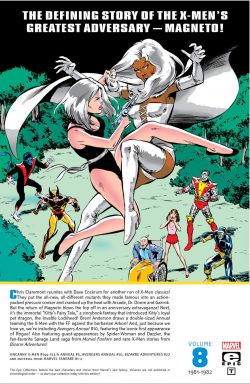
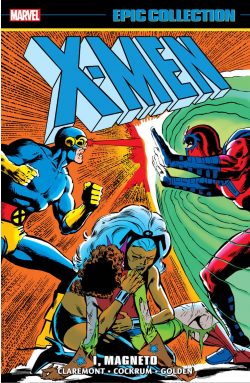
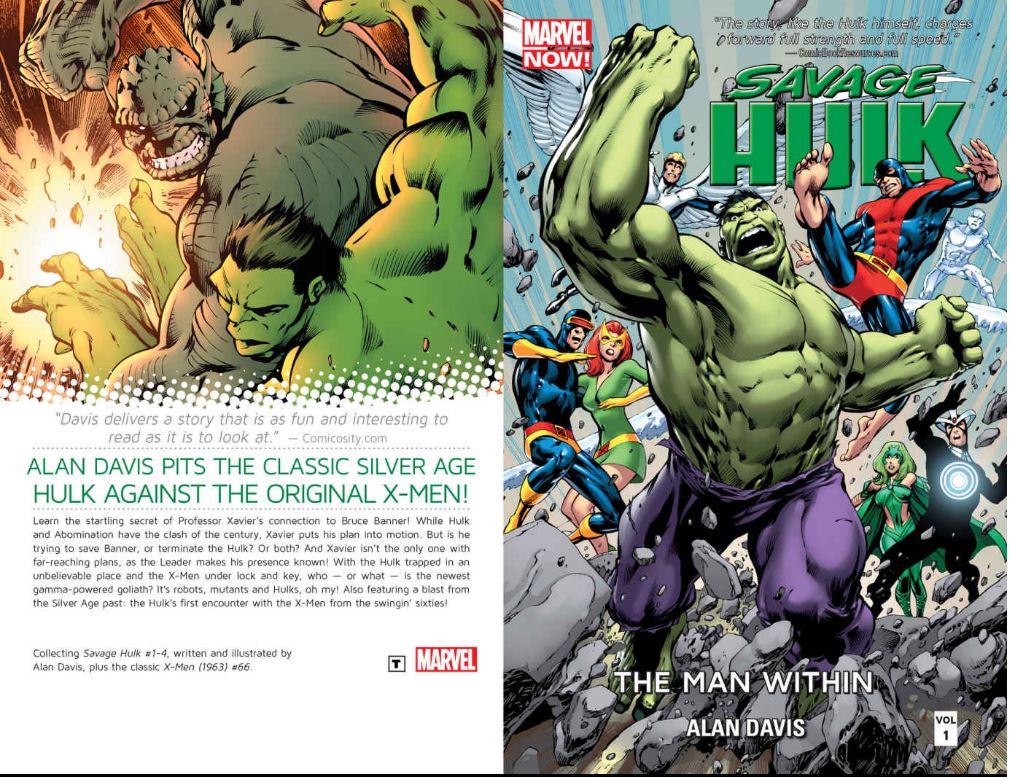
X-Men Epic Collection volume 7: 1980-1981 – The Fate of the Phoenix


By Chris Claremont & John Byrne, Jo Duffy, Scott Edelman, John Romita Jr., Ken Landgraf, Brent Anderson & various (Marvel)
ISBN: 978-1-3029-2253-5 (TPB)

In autumn 1963, The X-Men #1 introduced Scott (Cyclops) Summers, Bobby (Iceman) Drake, Warren (Angel) Worthington, Jean (Marvel Girl) Grey and Hank (The Beast) McCoy: unique students of Professor Charles Xavier. Their teacher was a wheelchair-bound telepath dedicated to brokering peace and integration between the masses of humanity and the emergent off-shoot race of mutants dubbed Homo superior; considered by many who knew him as a living saint.

After almost eight years of eccentrically spectacular adventures the mutant misfits virtually disappeared at the beginning of 1970, during another periodic downturn in superhero comics sales. Just as in the 1940s, mystery men faded away as supernatural mysteries and traditional genres dominated the world’s entertainment fields. The title returned at year’s end as a reprint vehicle, and the missing mutants were reduced to guest-stars and bit-players throughout the Marvel universe. The Beast was refashioned as a monster fit for the global uptick in scary stories.

Everything changed in 1975 when Len Wein & Dave Cockrum revived and reordered the Mutant mystique with a brand-new team in Giant Size X-Men #1. To old foes-turned-friends Banshee and Sunfire were added one-shot Hulk hunter Wolverine, and new creations Kurt Wagner, a demonic German teleporter codenamed Nightcrawler; African weather “goddess” Ororo Monroe – AKA Storm; Russian farmboy Peter Rasputin, who transformed at will into a living steel Colossus and bitter, disillusioned Apache superman John Proudstar who was groomed into joining the makeshift squad as Thunderbird.

The revision was an instant hit, with Wein’s editorial assistant Chris Claremont writing the series from the second story onwards. The Uncanny X-Men reclaimed their own comic book with #94, and it quickly became the company’s most popular – and highest quality – title.

After Thunderbird became the team’s first fatality, the survivors slowly bonded, becoming an infallible fighting unit under the brusque and draconian supervision of Cyclops. Cockrum was succeeded by John Byrne and as the team roster changed the series rose to even greater heights.

This comprehensive compilation (available in trade paperback and eBook editions) is perfect for newbies, neophytes and even old lags nervous about reading such splendid yarns on fragile but extremely valuable newsprint paper. It celebrates the absolute peak of Claremont & Byrne’s collaborative synergy (with regular inker Terry Austin very much a part of the magical experience) as the mutants confirmed their unstoppable march to market dominance through groundbreaking, high-quality stories: specifically issues #129-143 of the decidedly “All-New, All-Different” – (latterly re-renamed “Uncanny”) X-Men; Annual #4, vignettes from Marvel Treasury Edition #26-27 and material from Marvel Team-Up #100, spanning January 1980 to March 1981. Also included are chronologically askew additional treats from Phoenix: The Untold Story #1 (April 1984).

Having saved Edinburgh and perhaps the world from reality-warping Proteus, Uncanny X-Men #129 sees another happy reunion as the heroes (all but the now retired Banshee) find Charles Xavier awaiting them when they reach their Westchester home in ‘God Spare the Child…’.

Thanks to sinister psionic predator Jason Wyngarde, Jean is increasingly slipping into visions of a former life as a spoiled, cruel child of privilege, contrasting sharply with her renewed love for Scott, but the home atmosphere is troubled by another discordant factor. Xavier is intent on resuming training the team, haughtily oblivious that this group are grizzled, seasoned veterans of combat, rather than the callow teenagers he first tutored.

Elsewhere, a cabal of mutants and millionaires plot murder and conquest. Black King Sebastian Shaw, White Queen Emma Frost and the rest of the Hellfire Club hierarchy know Wyngarde is an ambitious and presumptuous upstart, but the possibility of subverting the almighty Phoenix to their world-dominating agenda is irresistible…

When two new mutants manifest, Xavier splits the team to contact both, taking Storm, Wolverine and Colossus to Chicago and meeting the nervous parents of naive 13-year- old Kitty Pryde who has just realised that, along with all the other problems of puberty, she now falls through floors and walks through walls…

However, no sooner does the Professor offer to admit enrol her in his select and prestigious private school than they are all attacked by war-suited mercenaries and shipped by Emma Frost to the Hellfire Club. Only Kitty escapes, but instead of running, she stows away on the transport; terrified but intent on saving the day…

The other Homo Superior neophyte debuts in #130 as Cyclops, Phoenix and Nightcrawler head to Manhattan’s club district, tracking a disco singer dubbed ‘Dazzler’. They are unaware that they too have been targeted for capture…

However, Kitty’s attempts to free the captives at the Hellfire base forces the villains to tip their hand early and with the assistance of Dazzler Alison Blair – a musical mutant who converts sound to devastating light effects – the second mercenary capture team is defeated…

The drama concludes in #131 as Kitty is forced to frantically ‘Run for Your Life!’ – happily, straight into the arms of the remaining X-Men. Soon the plucky lass – after an understandable period of terror, confusion and kvetching – leads a strike on the lair of the White Queen: freeing Wolverine, Colossus and Xavier as Frost faces off in a deadly psionic showdown with a Phoenix far less kind and caring than ever before…

The war with the plutocratic Hellfire Club resumes in #132 as ‘And Hellfire is their Name!’ brings The Angel back into the fold. Their foes are in actuality a centuries-old association of the world’s most powerful and wealthy individuals, and Warren Worthington’s family have been members in good standing for generations. What better way of infiltrating the organisation than with someone already deep on the ultra-privileged inside?

As Wolverine and Nightcrawler scurry through sewers beneath the society’s palatial New York mansion, Warren inveigles the others in through the grand front doors, attending the year’s swankiest soiree whilst he and the Professor await events…

It’s a bold but pointless move. Although the rank and file are simply spoiled rich folk, there is an Inner Circle led by mutant supremo Sebastian Shaw comprising some of Earth’s most dangerous men and women who have been waiting and watching for the mutants-in-mufti’s countermove…

As soon as the heroes are inside, Wyngarde strikes, pushing Jean Grey until she retreats into to a manufactured persona he has woven over months to awaken her darkest desires. With the Phoenix’s overwhelming power added to the Inner Circle’s might, former friends quickly fall before the attack of super-strong Shaw and cyborg human Donald Pierce. Even Wolverine is beaten, smashed through the floor to his doom by mass-manipulating mutant Harry Leland…

As the Inner Circle gloat, Cyclops – connected to Jean by a psionic rapport – sees the world through his lover’s corrupted, beguiled eyes and despairs. However, when Wyngarde – exposed as illusion caster Mastermind – apparently stabs Cyclops, the effect on “his” Black Queen is far from anticipated…

Far below their feet, a body stirs. Battered but unbowed, ‘Wolverine: Alone!’ begins to work his ruthless, relentless way through the Club’s hired minions. His explosive entrance in #134’s ‘Too Late, the Heroes!’ gives the captive heroes a chance to break free and strike back, soundly thrashing the Hellfire blackguards. Sadly for Mastermind, not all his tampering has been expunged, and when Jean catches him, his fate is ghastly beyond imagining…

As the mutants make their escape the situation escalates to crisis level. Months of mind-manipulation finally unleash all Jean’s most selfish, self-serving desires and she shatteringly transforms into ‘Dark Phoenix’…

Manifested as a god without qualm or conscience, Jean attacks her comrades before vanishing into space. In a distant system, and feeling depleted, she casually consumes the local sun, indifferent to the entire civilisation that dies upon the planet circling it. Passing the D’Bari system is a vast and powerful ship of the Shi’ar fleet. Rushing to aid the already extinct world, they are merely a postprandial palate cleanser for the voracious Phoenix…

Uncanny X-Men #136 opens with horrified Shi’ar Empress Lilandra mobilising her entire military machine and heading for Earth, determined to end the threat of the ‘Child of Light and Darkness!’ On that beleaguered world, Cyclops has called on the Beast to build a psychic scrambler to disrupt Jean’s immeasurable psionic might, but when she cataclysmically reappears to trounce the team, the device burns out in seconds.

Jean’s gentler persona erratically appears, begging her friends to kill her before she loses control, but Dark Phoenix is close to destroying Earth before – in a cataclysmic psychic duel – Xavier shuts down her powers and establishes mental circuit breakers to prevent her ever going rogue again. With Jean left as little more than mind-maimed human, the exhausted heroes suddenly vanish in a flash of light…

The epic concludes in X-Men #137 as the outraged and terrified Shi’ar arrive in orbit to settle ‘The Fate of the Phoenix!’ With observers from the Kree and Skrull empires in attendance, Lilandra has come to exact justice and prevent the Phoenix from ever rising again. She is not prepared to accept her fiancé Charles Xavier’s word that the threat is already ended…

Summary execution is only avoided when Xavier invokes an ancient rite compelling Lilandra to instigate trial-by-combat. Relocating to the enigmatic Blue Area of the Moon (with its artificial pocket of breathable atmosphere) the mutants engage in all-out war with a brigade of cosmic champions – the Shi’ar Imperial Guard (an in-joke version of DC’s Legion of Super Heroes). However, despite their greatest efforts, the mutants are pushed to the brink of defeat.

With collapse imminent and her friends doomed, Jean’s psychic shackles slip and the Phoenix breaks free. Horrified at what will inevitably happen, Jean allows herself to be killed to save the universe…

Days later on Earth, the X-Men mourn her passing in #138’s ‘Elegy’ as Cyclops recalls his life with the valiant woman he loved so deeply – and we get a comprehensive recap of the mutant team’s career to date. Heartbroken, the quintessential X-Man resigns just as Kitty Pryde moves in…

Breaking from the monthly run, X-Men Annual #4 then describes ‘Nightcrawler’s Inferno!’ (by Claremont, John Romita Jr.& Bob McLeod) with Doctor Strange called in after Kurt Wagner is targeted by a demonic Lord of Limbo and uncovers a secret family connection to uber-witch Margali Szardos…

A new day dawns in issue #139’s ‘…Something Wicked This Way Comes!’ as the Angel returns just in time to see Nightcrawler join Wolverine in heading north for a reconciliation with the Canadian’s previous team, Alpha Flight. The visit turns into a hunt for carnivorous magical monster Wendigo, culminating in a brutal battle and an increasingly rare clean win in #140’s concluding chapter ‘Rage!’

An evocative and extended subplot opens which would dictate the shape of mutant history for years to come follows as ‘Days of Future Past’ depicts an imminently approaching dystopian apocalypse wherein almost all mutants, paranormals and superheroes have been eradicated by Federally-controlled Sentinel robots. These mechanoids rule over a shattered world on the edge of utter annihilation. New York is a charnel pit with most surviving superhumans kept in concentration camps and only a precious few free to fight a losing war of resistance.

In this dark tomorrow, aging Katherine Pryde is the lynchpin of a desperate plan to unmake history. With the aid of telepath named Rachel (eventually to escape that time-line and become a new Phoenix), Pryde swaps consciousness with her younger self in a last-ditch attempt to prevent the pivotal event which created the bleak existence where all her remaining friends and comrades are being pitilessly exterminated, one by resolute one…

‘Mind Out of Time’ sees the mature Pryde in our era, inhabiting her own 13-year-old body and leading disbelieving team-mates on a frantic mission to foil the assassination of US senator David Kelly on prime-time TV by a sinister new iteration of the Brotherhood of Evil Mutants – super-terrorists determined to make a very public example of the human politician attacking the cause of Mutant Rights…

Rocket-paced, action-packed, spectacularly multi-layered, bitterly tragic and agonisingly inconclusive – as all such time-travel tales should be – this cunning, compact yarn is one of the best individual tales of the Claremont/Byrne era, resetting the mood, tone and agenda for all the following decades of mutant mayhem…

With the timeline restored and tragedy averted, things slow down at the X-Mansion, but in the real world, John Byrne had left for pastures new. His swan song in #143 is a bombastic romp which finds lonely, homesick Kitty home alone at Christmas… except for a lone N’garai ‘Demon’ determined to eat her. Her solo trial decimates the X-Men citadel and proves once and for all that she has what it takes…

An era might have ended but mutant life goes on, as seen here in a brace of short stories taken from tabloids Marvel Treasury Edition #26 and 27.

The first is a light-hearted clash between off-duty, grouchy Logan and fun-loving, girl-chasing godling Hercules inadvertently gracing the same bar ‘At the Sign of the Lion’ (by Mary Jo Duffy, Ken Landgraf and a young George Pérez), proving exactly why most pubs reserve the right to refuse admission…

It’s accompanied by The Avenging Angel taking a ‘Joyride into Jeopardy’ courtesy of Scott Edelman, Brent Anderson & Bob McLeod before being attacked by a vengeance-crazed killer seeking payback for the sins of his father…

An intriguing safari into the unknown comes next: the untold story of how Storm and Black Panther T’Challa first met as kids in the wilds of Africa. By Claremont, Byrne & McLeod, it originated as a back-up in Marvel Team-Up #100, cunningly revealing how the kids enjoyed an idyllic time on the veldt (reminiscent of Henry De Vere Stacpoole’s 1908 novel The Blue Lagoon) until a South African commando team tried to kidnap the Wakandan prince for a bargaining chip.

Now, as adults in America they are hunted by the vicious Afrikaner Andreas de Ruyter who has returned, seeking to assassinate Ororo before exacting final revenge upon the Black Panther. Cue long-delayed lover’s reunion and team-raid on an automated House of Horrors…

Wrapping up the mutant mayhem are a selection of snippets retroactively crafted for this period of X-history. The first is a marketing oddity of the period. Phoenix: The Untold Story was released in 1984 and reprinted X-Men #137… mostly…

By all accounts, that epic conclusion was originally completed with a different ending and Jean Grey surviving the battle against the Shi’ar. That was before then Editor-in-Chief Jim Shooter overruled the outcome, decreeing she should die for her sins. You can judge the merits of the decision for yourself from the alternate version delivered here.

Also included are Jim Salicrup’s editorial ‘She’s Dead, Jim!’: ‘The Dark Phoenix Tapes – a candid conversation between Byrne, Shooter and Claremont’ on the contentious issue.

More extras include a wealth of original art pages, unseen pencils, house ads, pin-ups, lost and spoof covers; character sketches; the pertinent entry from 1981’s Marvel Comics 20th Anniversary Calendar and images from Marvel Super Hero Portfolio: The Uncanny X-Men with 4 original Byrne drawings remastered by painters Steve Fastner & Rich Larson and monochrome plates from Éditions Déese 1993 World’s Finest Comic Book Artists Portfolio by John Byrne. There’s also a gallery of X-Men collection covers by Byrne, Salvador Larroca, Bill Sienkiewicz and others.

For many fans these tales comprise the definitive X-Men. Rightly ranking amongst some of the greatest stories Marvel ever published, they remain thrilling, groundbreaking and painfully intoxicating: an invaluable grounding in contemporary fights ‘n’ tights fiction no fan or casual reader can afford to ignore.
© 2021 MARVEL