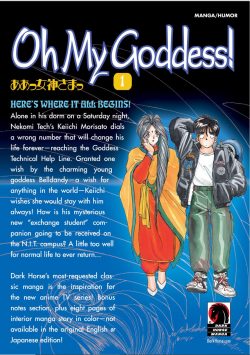

Oh My Goddess! volume 1


By K?suke Fujishima, original translation by Dana Lewis, Alan Gleason & Toren Smith (Dark Horse Manga)
ISBN: 978-1-59307-387-9 (tank?bon TPB) eISBN: 978-1-62115-755-7

Talking of school – as we were the other day – college days also offer plenty of opportunities for comics creativity and, as is usually the case, manga has been there first and explored avenues you never even realised existed.

Fujishima K?suke was born in Chiba, Japan on July 7th 1964, and after completing High School, got a job as an editor. His plans to be a draughtsman had foundered after failing to secure a requisite apprenticeship, and he instead joined Puff magazine in that backroom role. Life began looking up after he became assistant to manga artist Tatsuya Egawa (Be Free, Golden Boy, Magical Taluluto)

Fujishima graduated to his first solo feature in 1986: writing and illustrating police series You’re Under Arrest until 1992. In 1988, he began a consecutive second series: a fantasy comedy that would reshape his life forever. Although he would work on other manga like Paradise Residence and Toppu GP over the decades, Aa! Megami-sama – alternatively translated as Ah! My Goddess and Oh My Goddess! became his signature work and one that has made him a household name in Japan.

The series began in the September 1988 issue of Kodansha’s seinen (“young males”) manga periodical Monthly Afternoon. The strip ran until April 2014, generating enough stories for 48 tank?bon volumes, a spin-off series and spawning anime, special editions, numerous TV series, musical albums, games and all the attendant spin-offs and merchandise such popular success brings.

In 2020 there were 25 million physical copies of the editions in circulation and an unguessable number of digital sales. OMG! has won awards, been translated across the globe in print and on screens and has a confirmed place in comics history…

Oh My Goddess! is a particularly fine example of a peculiarly Japanese genre of storytelling combining fantasy with loss of conformity and embarrassment. In this case, and as seen in opening chapter ‘The Number You Have Dialled is Incorrect’ nerdy engineering sophomore Keiichi Morisato dials a wrong number one night and inadvertently connects to the Goddess Technical Help Line.

When the captivatingly beautiful and cosmically powerful minor deity Belldandy materialises in his room offering him one wish, he mockingly asks that she never leave him. This rash response effectively traps her on Earth, unable even to move very far beyond his physical proximity. Her powers are mighty but also come with a bucketload of provisos and restrictions. The most immediate and terrible repercussion manifests quickly as he is ejected from his student residence for having a girl in his room…

Belldandy’s profligate use of her divine powers, utter naivety and tendency to attract chaos and calamity make their search for a new home a fraught exercise, but finally second chapter ‘Lair of the Anime Mania’ finds Keiichi trying the apartment of old friend Sada. He was not a preferred choice because he is addicted to anime: a living zombie of fannishness who welcomes the refugees in without even noticing them …or letting go of the TV and video remotes…

All too soon however, and again thanks to the Goddess’ gifts, Sada notices Belldandy’s similarities to his cartoon fantasies and they have to move again…

After a night on the freezing streets, providence smiles on them when a Buddhist priest welcomes them into his dwelling. An individual prone to conclusion-jumping, the holy man’s eventual deduction of her true nature prompts him to undertake a pilgrimage of rediscovery, bequeathing them custody of his earthy abode in ‘A Man’s Home is His… Temple?’

With accommodation secured, the hapless student needs to get back to his education, and in a structured society like Japan there’s plenty of scope for comedy when a powerful and beautiful female seemingly dotes on a barely average male, especially as Keiichi’s new girlfriend seems unwilling to even leave his side…

The solution is to use her powers to “enrol” at his school – the Nekomi Institute of Technology. However, when the clearly “European” newcomer becomes a ‘College Exchange Goddess’ she can’t help but draw unwelcome attention, particularly from Keiichi’s macho, petrolhead fellow students and creepy lecturer Dr. Ozawa. The lifelong rival of Morisato’s favourite teacher “Doc” Kakuta has his suspicions aroused when all his students switch to the classes Belldandy audits and he begins a covert campaign to get rid of her…

More trouble materialises in ‘Those Whom Goddess Hath Joined Together, Let No Woman Put Asunder’ as thoroughly unlikeable campus queen and predatory Mean Girl Sayoko Mishima realises the new kid is a threat to her social supremacy and sets her destructive sights and wealth on Belldandy’s hapless chump. The goddess is more aware of the interlopers inadvertent mystical bad mojo and takes kind, gentle but firm retaliatory action…

College is a series of crucial interconnections and – other than Belldandy – Morisato is closest to his colleagues in the Nekomi Institute of Technology Motor Club: a gang of overbearing, bullying gear-head maniacs, always spending his money, eating his food and getting him into trouble…

However, the earthbound divinity’s role is to aid those in need and when she detects chief brute Otaki is enduring unrequited love she plays matchmaker in ‘Single Lens Psychic: The Prayer Answered’ and sets off a chain of domestic shock and awe…

This mainly monochrome compendium is peppered with brief full colour sections and one such opens ‘Lullaby of Love’ as Morisato finally summons the nerve to move beyond the painfully platonic life sentence he’s been locked into. Sadly, books like Going Steady for Dummies can get him no closer to even kissing his goddess and their first stab at an intimate dinner date turns into a disaster further compounded in ‘The Blossom in Bloom’ as financial shortfalls presage the introduction of Morisato’s little sister Megumi: a gossip spreader and imaginative tale teller. What family furore she will make of him living with a gorgeous exotic foreigner cannot be allowed…

She causes chaos from the start: bearing enough cash to tide them over but only if Keiichi boards her for a week while she takes some important entrance exams. There’s no way the kid won’t expose Belldandy’s supernatural nature to the world…

What big brother should have fretted over was the actual tests, as Megumi aces he exams and is admitted to Nekomi Tech. Now Morisato is plagued with ‘Apartment Hunting Blues’ as he hunts for a decent place to house her. It’s a good thing that Belldandy accompanies the siblings as – once they find the perfect place – the goddess has to exorcise and transform the evil spirit haunting it …the true reason it was so cheap in the first place…

Following the comics comes a text feature by editor Carl Gustav Horn. ‘Letters to the Enchantress’ details the strip’s history and evolution to an English language series, and is supplemented by ‘Editor’s Commentary on Vol. 1’: an expansive collection of footnotes clarifying everything from explaining untranslated background kanji and graphics to detailing significant cultural clues that might bypass most readers.

Oh My Goddess! is a beguiling, engaging and eminently re-readable confection, at once frothy fun and entrancing drama. Think of it as a Eastern take on Bewitched or I Dream of Genie, especially as the romance develops: one that both mortal and immortal protagonists are incapable of admitting to. Throw in the required supporting cast of friends, rivals, insane teachers and interfering entities and there’s plenty of light-hearted fun to be found in this bright and breezy manga classic.
© 2005 by Kosuke Fujishima. All Rights Reserved. This English language edition © 2005 Dark Horse Comics.

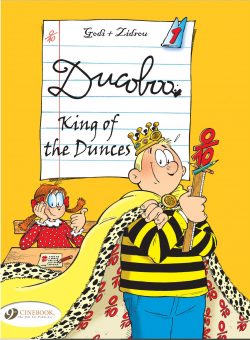
Ducoboo volume 1 – King of the Dunces


By Godi & Zidrou, coloured by Véronique Grobet & translated by Luke Spear (Cinebook)
ISBN: 978-1-905460-15-1 (Album PB/Digital edition)

School stories and strips of every tone about juvenile fools, devils and rebels are a lynchpin of modern western entertainment and an even larger staple of Japanese comics – where the scenario has spawned its own wild and vibrant subgenres. However, would Dennis the Menace (ours and theirs), Komi Can’t Communicate, Winker Watson, Don’t Toy with Me, Miss Nagatoro, Power Pack, Cédric or any of the rest be improved or just different if they were created by former teachers rather than ex-kids or current parents?

It’s no surprise the form is so evergreen: school life takes up a huge amount of children’s attention no matter how impoverished or privileged they are, and their fictions will naturally address their issues and interests. It’s fascinating to see just how much school stories revolve around humour, but always with huge helpings of drama, terror romance and an occasional dash of action…

One of the most popular European strips employing the eternal basic themes and methodology began in the last fraction of the 20th century, courtesy of scripter Zidrou (Benoît Drousie) and illustrator Godi.

Drousie is Belgian, born in 1962 and for six years a school teacher prior to changing careers in 1990 to write comics like those he probably used to confiscate in class. Other mainstream successes in a range of genres include Petit Dagobert, Scott Zombi, La Ribambelle, Le Montreur d’histoires, African Trilogy, Shi, Léonardo, a revival of Ric Hochet, and many more. However, his most celebrated and beloved stories are the Les Beaux Étés sequence (digitally available in English as Glorious Summers) and 2010’s Lydie, both illustrated by Spanish artist Jordi Lafebre.

Zidrou began his comics career with what he knew best: stories about and for kids, including Crannibales, Tamara, Margot et Oscar Pluche and, most significantly, a feature about a (and please forgive the charged term) school dunce: L’Elève Ducobu

Godi is a Belgian National Treasure, born Bernard Godisiabois in Etterbeek in December 1951. After studying Plastic Arts at the Institut Saint-Luc in Brussels he became an assistant to comics legend Eddy Paape in 1970, working on the strip Tommy Banco for Le Journal de Tintin whilst freelancing as an illustrator for numerous comics and magazines. He became a Tintin regular three years later, primarily limning C. Blareau’s Comte Lombardi, but also working on gag strip Red Rétro by Vicq, with whom he also produced Cap’tain Anblus McManus and Le Triangle des Bermudes for Le Journal de Spirou in the early 1980s. He soloed on Diogène Terrier (1981-1983) for Casterman.

He then moved into advertising cartoons and television, cocreating with Nic Broca the animated TV series Ovide. He only returned to comics in 1991, collaborating with newcomer Zidrou on L’Elève Ducobu for magazine Tremplin. The strip launched in September 1992 before transferring to Le Journal de Mickey, and collected albums began in 1997 – 25 so far in French and Dutch, 8 for Turkish readers, and 6 for Indonesia.

When not immortalising modern school days for future generations, Godi latterly diversified, co-creating (1995 with Zidrou) comedy feature Suivez le Guide and game page Démon du Jeu with scripter Janssens.

The series has spawned a live action movie franchise, a dozen pocket books plus all the usual attendant merchandise paraphernalia. and we English-speakers’ introduction to the series (5 volumes thus far) came courtesy of Cinebook with 2006’s initial release King of the Dunces which was in fact the 5th European collection L’élève Ducobu – Le roi des cancres.

The format is loads of short – most often single page – gag strips starring a revolving cast who are all well established by this point, but also fairly one-sided and easy to get a handle on.

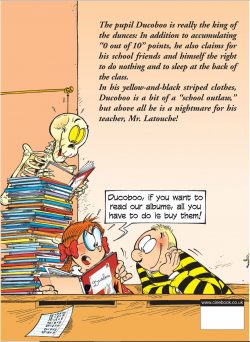
Our star is a well-meaning, good natured young oaf who doesn’t get on with school. He’s sharp, inventive, imaginative, inquisitive, personable and just not academical at all. We might today put him on a spectrum or diagnose a disorder like ADHD, but at heart he’s just not interested and has better things to do…

Dad is a civil servant and Mum left home when Ducoboo was a baby, but then there’s a lot of that about. Leonie Gratin – from whom he constantly copies answers – only has a mum.

The boy and his class colleagues attend Saint Potache School and are mostly taught by draconian Mr Latouche who’s something of humourless martinet. Thanks to him, Ducoboo has spent so much time in the corner with a dunce cap on his head that he’s struck up a friendship with the biology skeleton. He calls himself Neness and is always ready with a theory or suggestion for fun and frolics…

In this volume, after being caught cheating again, Latouche applies what he calls “truth serum” to the squabbling kids. The wild kid fakes taking it, but Leonie is an obedient child and soon can’t help blurting out her hidden feelings for the class outlaw – thereby ensuring he voluntarily tries keeping his distance for some time after …or at least until the next test or exercise…

On view are fresh riffs on being late and missing class; roll calls and registers; new and old class furniture; novel ways to copy answers; writing lines and how to hack the system; the power of art; collecting educational stickers; yawning in class; grammar and grandmas, punctuation, warring student radio stations; the restorative blessings of short naps whilst working; the ultimate futility of bad boys actually working and still being called a cheat and always, always cheating, copying and guessing answers…

Also encountered are jaunts to a circus, educational psychologists, Teachers’ changing pay and conditions, new ways to learn, the origins of his skeletal comrade, Nativity plays and mistletoe mischief, classical poetry – like ‘The Nitwit and the Trickster’ by bony scribe Nessy de la Fontanelle, dress codes for kids from other cultures (especially fascinating new girl Fatima and her lovely chador), new romantic fancies and classroom exoticism, outrageous example test papers and – as a main event – the educational crucible of April Fool’s Day and its cumulative effect on Latouche…

Wry, witty and whimsical whilst rehashing evergreen childhood themes, Ducuboo is an up-tempo, upbeat addition to the genre that any parent or pupil can appreciate and enjoy. If your kids aren’t back at school quite yet, why not keep them occupied a little longer with the King of the Dunces – whilst thanking your lucky stars that he’s not yours?
© Les Editions du Lombard (Dargaud- Lombard) 2000 by Godi & Zidrou. English translation © 2006 Cinebook Ltd.