Elephant Man


By Greg Houston (NBM)
ISBN: 978-1-56163-588-7 (TPB)

This book includes Discriminatory Content produced for comedic effect.

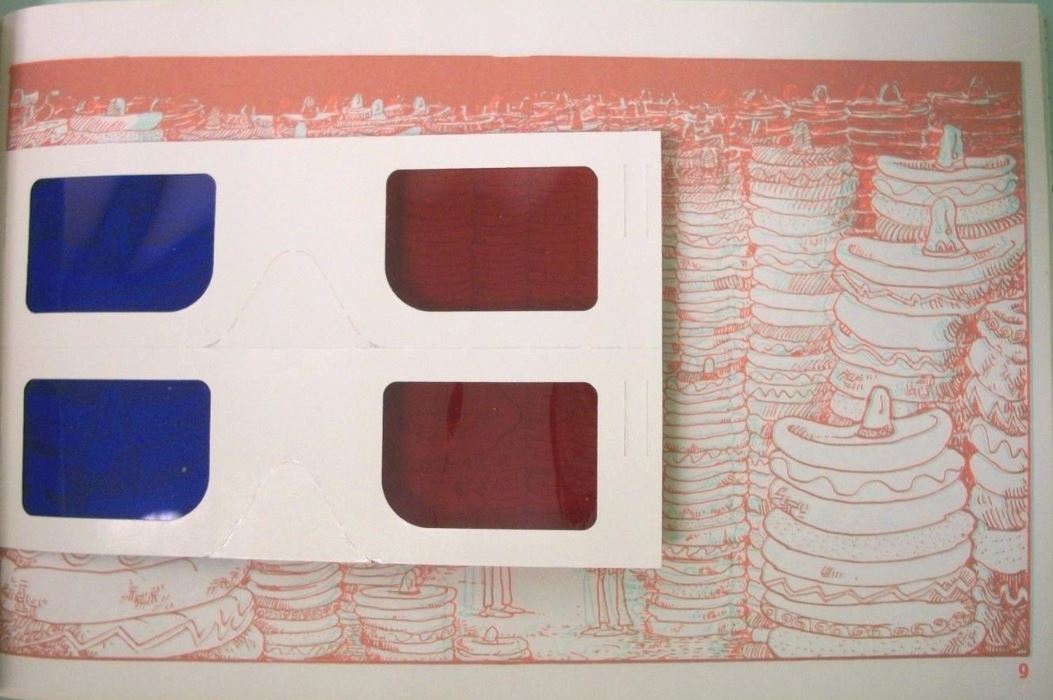
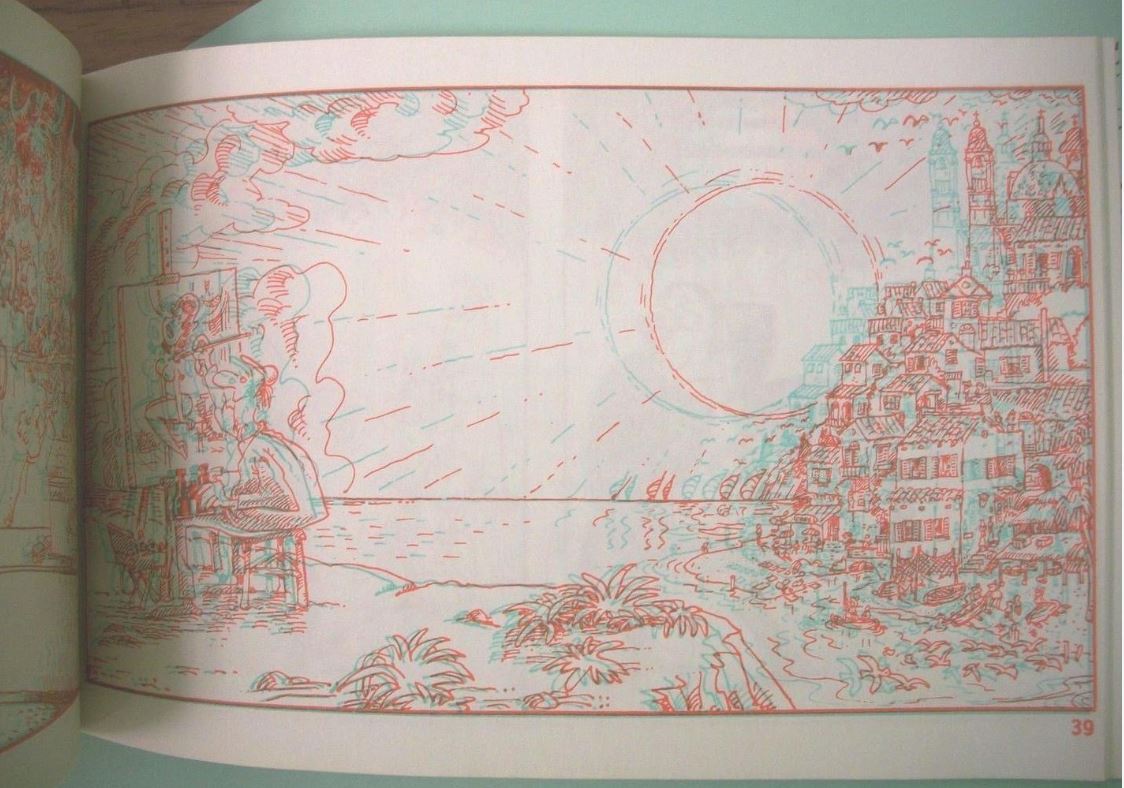
Cartoonist, caricaturist, designer, educator, actor and major fan of old movies, Greg Houston delights in the baroque and comically grotesque; positively revelling in taking taste-free pot-shots at societal and popular culture icons (see Vatican Hustle for more of his measured, manic musings) and this marvellous and madcap monochrome missal has a go at the very bedrock of our medium by parodying and pastiching the classic superhero scenario.

Baltimore has its own Costumed Crusader and he is the perfect symbol of a city with so little to recommend it. This crusading costumed boy scout doesn’t have any proper powers, but the people love him and on the fifth anniversary of his first appearance the minor metropolis is holding a week of commemorative events…

Local paper The Daily Crab is following events, particularly feisty journo Tracie Bombasso, cub reporter Dud Cawley and mild-mannered, colonically-challenged reporter Jon Merrick (yes, that kind of Elephant Man), despite the rantings of unpopular on-air TV presenter Handsome Dick Denton – but he’s just jealous, right?

Also determined to spoil everything is sinisterly macabre conjoined villain The Priest, the Rabbi and the Duck: twisted victim(s?) of an old joke and a tragic accident involving alcohol and Science…

Can Merrick keep his identity secret from his fellow reporters, foil the machinations of Denton and stop the three-headed Hydra of Pique? Of course he can, but along the way there are bizarre characters old and new (keep your eyes peeled for cameos from Boss Karate Black Guy Jones and other uber-odd Vatican Hustle alumni), cripplingly painful embarrassing moments and enough ugly hilarity to have a very good time indeed.

And lest you think we’re being unkind to the place let me reveal that Houston is Baltimore born-and-bred, and gets a pass on being nigh-litigiously critical…

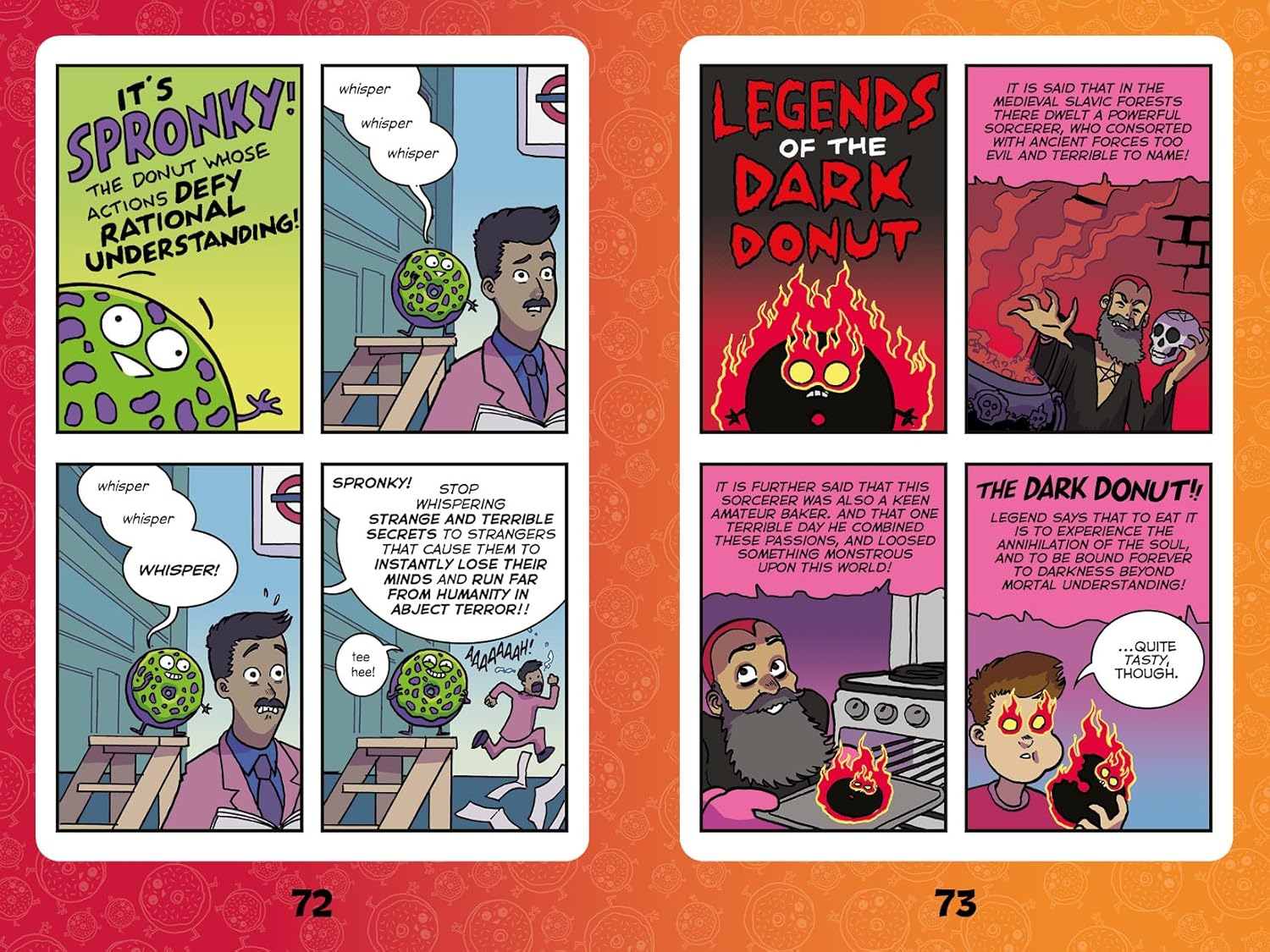
Beneath the outrageous parody and extreme mock-heroics is a witty and genuinely funny adult romp poking edgy fun at everything from politicians to donuts, and weathermen to beauticians, gleefully making some telling observations about Heroes and how to treat them, all rendered in a busy, buzzy, black-&-white line that appeals and appals in equal amounts.

Warning: this book contains six-foot talking flies and shaved, car-racing monkeys.
© 2010 Greg Houston. All rights reserved.

Today in 1952 scriptwriter Hilary Bader (Batman, Superman, Star Trek) was born, followed by Brazilian Rafael Grampá in 1978; Christina Strain in 1981 and Zeb Wells in 1983.

1902 today saw the start of Ed Payne’s strip Professor O. Howe Wise and Professor I.B. Schmart with Stan Lynde’s outrageous comedy western feature Rick O’Shay launching this date in 1958. However in 1991, Spirou’s creator Rob-Vel (François Robert Velter) passed away.

Frank Robbins’ Johnny Hazard volume Two – the Newspaper Dailies 1945-1947


By Frank Robbins with an introduction by Daniel Herman (Hermes Press)
ISBN: 978-1-61345-017-8 (HB/Digital edition)

This book includes Discriminatory Content produced in less enlightened times.

Johnny Hazard was a newspaper strip created in the style and manner of Terry and the Pirates, but in many ways this steely-eyed hero most accurately resembles – and in fact predates – Milton Caniff’s second masterwork Steve Canyon.

Unbelievably, until 2011 this influential, impressively enthralling adventure strip had never been comprehensively collected in archival volumes – at least not in English or even America’s version of it – although selected highlights had appeared in magazines like Pioneer Comics, Dragon Lady Press Presents and the Pacific Comic Club.

Boston born, Franklin Robbins (9th September 1917 – 28th November 1994) was an artistic prodigy who shone from early on. At age nine he was awarded a scholarship to the Boston Museum of Fine Arts and at 15 moved to New York City to attend the National Academy of Design on a Rockefeller grant. Skilled, inventive and prolific as both painter and graphic artist, Robbins freelanced continually, even working with Edward Trumbull on the legendary murals for the NBC building and Radio City Music Hall. He created graphics for RKO Pictures, worked in advertising and magazine illustrations but never stopped painting, with work shown at the Whitney Museum of American Art, Metropolitan Museum of Art, The Corcoran Gallery of Art and Walker Art Gallery, although he found his perfect medium of expression when invited to take over a top comic strip…

Even whilst relentlessly creating a full seven days of newspaper strips, he exhibited work at the Whitney’s Annual show and, after ceasing his comics career, retired to Mexico to end his days with a brush in his hand.

The plain truth is that comics changed Robbins’ life. He was a brilliant natural cartoonist whose unique artistic and lettering styles lent themselves equally to adventure, comedy and superheroic tales, whilst his expansive raconteur’s nature made him one of the industry’s best writers over three generations.

He first found popular fame in 1939 after taking over aviation strip Scorchy Smith from Bert (The Sandman) Christman, when he quit isolationist America to fight with the Flying Tigers in China. Robbins thrived in the role, and created a Sunday page for the strip in 1940. This groundbreaking feature had been originated by John Terry before the astounding Noel Sickles replaced him: revolutionising Scorchy Smith and – with Milton Caniff – inventing a new impressionistic style of narrative art to reshape the way all comics were drawn and perceived.

Robbins remained until 1944 and was then offered high-profile Secret Agent X-9. Instead, he devised his own lantern-jawed, steely-eyed man of action. A tireless and prolific worker, even whilst producing the daily and Sunday Hazard (crafting separate but congruent storylines for each), Robbins continued freelancing as an illustrator for The Saturday Evening Post, Look, Life and other mainstream magazines. He also tried comic books for the first time when Johnny Hazard won his own title in 1948-1949, just as costumed superheroes began losing ground to ordinary he-men, mobsters and monsters…

Robbins returned to funnybooks in 1968, quickly becoming a key contributor as both artist and writer on Superboy, The Flash and The Atom, as well as a regular contributor to humour mag Plop! and DC’s mystery, horror and war anthologies. He particularly shone on Batman, Batgirl and in Detective Comics where, with Neal Adams, he pulled the Caped Crusader out of the TV show-inspired silliness. They created Man-Bat together and Robbins followed Michael Kaluta as artist on The Shadow. Moving to Marvel in the 1970s, Robbins concentrated on drawing a variety of titles including Captain America, Daredevil, Ghost Rider, Morbius, The Man from Atlantis, Human Fly, Power Man and The Invaders – which he co-created with Roy Thomas.

When Johnny Hazard launched on Monday June 5th 1944, he was an aviator in the US Army Air Corps. When hostilities ceased, he briefly became a freelance charter pilot and spy before settling into the life of a globe-girdling, troubleshooting mystery-solver: a modern day Knight Errant. The strip folded in 1977: one more victim of diminishing panel-sizes and the move towards simplified, thrill-free, family-friendly gag-a-day graphic fodder to frame small-ads. In its time it was syndicated in nine different languages in thousands of newspapers across the world, and even scored a residency in 1950s British weekly Rocket.

This fabulous hardcover/digital series – reproduced from original King Features proofs – re-presents the definitive magnum opus in fitting form: a monochrome, landscape format archival collection. This second shot covers serialised daily thrills (spanning November 19th 1945 to August 16th 1947), to resurrect the Amazing Aviator in fans’ hearts and remind them of what we’ve all missed whilst hopefully finding a few new fervent followers.

Fully embracing noir sensibilities of the era but keeping things light, frothy, sexy and funny the globetrotting glee is preceded by Daniel Herman’s Introduction ‘A Look Back at Johnny Hazard before the preflight fun begins…

Previously we met coolly capable flyer Lt. Johnny Hazard who escaped from a German POW camp, broke into a Nazi airfield, stole a bomber and flew home. Liberated and ready-for-duty he met feisty, headstrong, utterly dedicated war photographer Brandy during an air raid and all kinds of sparks flew. A series of spectacular events constantly pushed them together and ultimately impassioned fury and disgust on both sides turned to something else amidst all the deadly missions and exploding ordnance.

The strip could not keep up with the fast-moving events after D-Day (the real world Allies invaded “Fortress Europa” the day after Johnny Hazard debuted) and third story arc ‘Sun Tan and General Mariwana’ – opening on September 11th 1944 – saw the hero’s squadron transferred to the Pacific Theatre of Operations to reinforce the battle against Japan. Brandy inveigled herself into the picture as newly promoted Captain Hazard and his crew undertook a top-secret mission couriering a Chinese resistance leader back to her people. Enigmatic, exotic, staggeringly beautiful and lethally dangerous Sun Tan was a magnet for trouble…

Foiling Japanese assassination plots while dodging Brandy’s jealous displeasure, Hazard faced baroque opponents like disfigured pilot Colonel Mariwana, Colonel Kiri, General Ishigaki and his glamorous French “assistant” Mademoiselle Touché but also found a stalwart new ally and wingman in Captain “The Admiral” Slocum: last in an unbroken line of valiant patriotic mariners, but reduced to defending his country in the skies since his debilitating sea sickness prevents him from serving afloat like a true warrior…

Across Iran, Japan, China, and the Himalayas, Hazard, Slocum and Brandy ducked death over and again and when official hostilities ended, encountered charismatic US underworld émigré, pool-addict and deal-maker Side-Pocket Sam. Debonair, charming and utterly amoral, he led Chinese bandits and vied with our heroes for possession of Japan’s failsafe game plan for World War III…

Now, in ‘Fancy Fluff’ (running from November 19th 1945 to June 15th 1946) finally and officially released from their country’s service, Hazard and Slocum barely have time to adjust to civilian life before desperate Fluff Randall recruits them to help find her missing brother. A former comrade of Hazard, “Bounce” Randall was wounded in action and shipped home, but soon disappeared. The last Fluff heard, despite a head injury that prevented him being a pilot, he was in French Guiana, flying private planes for mystery man “Dr. Fox”

Soon the brothers in arms are on the trail, securing passports, papers and a reconditioned army surplus plane which they cheerfully dub Fancy Fluff in honour of their sponsor and despite the suspicions of suddenly-arriving Brandy. Her latest assignment is investigating a wave of jailbreaks in the penal colonies of that very country and a lift would be nice…

Soon the quartet are far south and negotiating with clearly corrupt cops and customs officers, dodging murder attempts and investigating local saint/Good Samaritan Docteur Reynard. A dramatically delivered letter from brother Bounce begging them to leave does nothing to deter them and before long they have uncovered not only an underground railroad using air transport to spring savage escapees but also murderous drug dealers using terror, mesmerism and narcotics to enslave Fluff’s brother among so many other victims…

It’s as much luck as competence that saves the valiant Americans from death and disaster a dozen times over, but in the end Reynard, his leg breakers Elf and Beeg Ox and all those bribe-taking officials pay for their crimes. Bounce is wounded again but at last healed of his enslavement and debilitating head injuries. However the overall cost is high. Admiral is lost to the world of action after falling for Fluff and that sappily contagious condition almost ensnares Johnny and Brandy too. Thankfully, common sense and sheer bile on both sides brings them to their senses before it’s too late…

Each serial storyline is garnished and bookended by Robbins’ original art designs for advertising the strip and after a comforting close up of Hazard second saga ‘The Flying Freight Mystery’ (June 17th – November 2nd) sees “just friends” Johnny and Brandy heading back to the USA but stalled on take-off when Johnny is conned by deviously mysterious entrepreneur M. Côte’-Poche into delivering to neighbouring nation Estantio a cargo of “typewriters”…

In flight, when Brandy discovers diminutive stowaway Wild Bill Hiccup and that the load is automatic weapons, an aerial ambush by “sky rustlers” leads to a less-than-longed-for reunion with Side-Pocket Sam. He is embroiled in ongoing war with ruthless river pirate Captain Gore who wants the emeralds Sam regularly ships from a mine to the coast. The baroque blubbery buccaneer is obsessed with piratical mythology and alongside fellow plunderers Mistuh Dirk and voluptuous siren Lady Mist opened a bizarre rogues gallery of foes who bedevilled Hazard over the next thirty years.

With Hazard as his air force, Sam has the upper hand until Mist infiltrates his freighter as an shipwrecked innocent: a daunting (and hilarious) job of acting that fools everyone but Brandy and leads to a spectacular display of air versus sea power, a brutal final mano-a-mano duel in the jungle and a surprise twist ending…

Another Canyon pinup segues into a yarn spanning November 4th 1946 to January 18th 1947. Hazard and Brandy arrive in tropical dump Querrero to find her journalistic colleague and Bureau Chief “Timely” Malcolm awaiting the outcome of a clash between government troops and bandit-turned-rebel ‘Major Risk’. Brandy opts to go to the story and with Johnny reluctantly flying her in, arrives at the frontline to find rival reporter “Blitz” (AKA “Loose-Lip”) Martin actively making the story happen.

With natural advantages and no scruples Brandy vamps the Government general for intel before tricking Johnny into delivering her right into the rebels’ hands. Her sharp scheme goes terribly awry and before long she is a hostage and bargaining chip between the sides and needs actual rescuing for a change. Thankfully, Hazard and Martin are willing to try it even if the shiny soldiers are not…

Back in Querrero and hired by Timely Martin as a ferry pilot for his reporters, Hazard faces unlikely danger in penultimate yarn ‘The Stout Man’ (January 20th to March 29th 1947). Repairs and search for spare parts sees the ex-airman as a passenger on a flight to San Tomayo, but the departure is interrupted by rude, rowdy and very bulky Brit Mr. Am and late-arriving Blitz Martin.

Away at last, Johnny befriends fellow traveller and prestigious nuclear boffin Noble Caldwell until Am hijacks the plane and sends it into a death-spin and crash. However, as Am escapes with Caldwell using parachutes hidden under his coat, Hazard manages to crash land the plane. Lost, starving and dying of thirst, the survivors are accidentally saved when Am returns in a helicopter to clear up loose ends and stupidly lets Johnny get the drop on him…

A deadly impasse ensues with both sides holding out against attrition and deprivation, but the balance of power shifts after indigenous tribesmen arrive, pointing their deadly blowpipes indiscriminately at all the unwelcome intruders…

A Vava Lavoum pinup segues into closing yarn ‘Danger À La Carte’ (March 29th – August 16th 1947) as freshly-fired Hazard is stranded in San Ruiz, catching the attention of jewel thieves Gloves Diamond and Mellow as well as their criminal competitors Side-Pocket Sam and Lady Mist. Before long Hazard and Blitz are bemused, befuddled and bamboozled, buffeted between opposing nefarious forces and unable to understand how a gourmet café delivering meals by jet plane can possible be profitable…

Not knowing all the facts doesn’t stop Johnny hiring on as a pilot and becoming an unwittingly accomplice, transporting human contraband to the heart of Casablanca’s wicked underworld. When he seeks to rectify his mistake, the fur, fists, knives and bullets start to fly but in the end justice wins again…

Ending with more advertising pinups – Kitty Hawkes, Sabina Eden, Baroness Flame and Sequinthis is another fast-paced, sharp-tongued and utterly gung-ho roster of romps starring a charming, happy-go-lucky lout, insouciantly ruthless and ever ready to risk his own life and limb to help the little guy and distressed damsels.

Sharp, snappy and devilishly funny repartee in the style of movies like Howard Hawks’ His Girl Friday and Frank Capra’s It Happened One Night are a hallmark of these rapid fire yarns, some of the greatest comic strips in history, but that can present a few problems for modern readers. Contemporary attitudes to sexuality, gender and particularly race are far from what we find acceptable – or should even tolerate – today. We know better now – at least most of us do – but must accept and understand that hurtful and unjust as such terms are, they did exist and we’re doing history and our society a hugely dangerous disservice by ignoring, downplaying or worst of all self-censoring those terms and the attitudes that fed them.

In truth, Johnny Hazard was far less egregious than most: Robbins may have used visual shortcuts and slang but all characters were portrayed fairly and did not unnecessarily suffer from the worst propagandist nonsense used by the Allies to bolster a united war spirit and vilely resurrected by modern populists today.

All ethnicities are treated with the full dignity of different but equal cultures and depicted as competent comrades in arms, not ignorant primitives needing white men’s saving graces. However, arch comedian Robbins clearly couldn’t resist playing mischievous games with accents, names and speech patterns that would do Benny Hill, Hogan’s Heroes or Charlie Chan (the opposite of) proud, so if you don’t think you’re capable of remaining historically detached, best to forgo those delights that have transcended time…

To be continued…

These exotic all-action intrigues and romances perfectly capture the mood and magic of a distant yet incredibly familiar time; with cool heroes, hot dames and exceedingly intemperate baddies encountering exotic locales and stunning scenarios, all peppered with blistering tension, slyly mature humour and vivid, visceral excitement.

Johnny Hazard is a brilliant two-fisted thriller-strip too long forgotten, and this is your chance to remedy that.
© 2013 King Features Syndicate, Inc. ® Hearst Holdings Inc. All rights reserved.

Today in 1914 Aquaman creator Paul Norris was born, followed two years alter by George Tuska (Iron Man, Crime Does Not Pay), Belgian national treasure Victor Hubinon (Buck Danny, Redbeard) in 1924 and Marty Greim in 1942. In 1954 Kerry Gammill joined the party as did Brad W. Foster one year later and François Schuiten (Les Cités Obscures) in 1956, with John Paul Leon checking in in 1972.

Today in 1969 the last issue of the first iteration of Eagle was published.

Comic Therapy – Meditations for Reflection


By Kay Medaglia (SelfMadeHero)
ISBN: 978-1-914224-39-3 (pocket HB)

Author and graphic artist Kay Medaglia moved from Ontario, Canada to wild & woolly Reading in Britain nearly twenty years ago and ever since has sought ways to share their ideas of better living through enhanced wellbeing. In a prodigious outpouring of gently stated, multimedia-delivered suggestions, they have advocated calmer ways to get along and stay stable through such varied avenues as the UK small press scene; self-published sensation Wu Wei, and global arenas like The Huffington Post and Elephant Journal. As well as editing issues-based publications dealing with autism, dementia, mental health and sexual assault, their hugely successful One Year Wiser series has brought those notions to ever-wider audiences. They have even explored modern metaphysics with their bestselling Luna Sol Tarot.

Here drawing together genteel humour, funny animals (and bugs, actually) and traditional philosophical observations lensed through practicality and common sense, Medaglia offers self-contained, image-led emotional pep-talks as Comic Therapy: spiritually enriching reminders of who and where you are – or could be. These graphic epigrams compile and project easily assimilable visual life-coaching and pictorial pick-me-ups, broaching topics from the minute and mundane to the cosmically crushing, or life-changing. As well as encouraging loving others and yourself, the image interludes especially confront themes of rejection, dejection, hopelessness, self-worth, self-compassion, resilience and mindfulness and lack of direction with breezy light humour and whimsy.

Resembling still-running romance homily panel Love Is… (created by New Zealand cartoonist Kim Grove/latterly Kim Casali) and delivered in Japan’s popular Yonkoma manga format, these four panel public service announcements for the soul are personal common sense messages from a global traveller seasoned with flavours of Hindu imagery and basic Buddhist tenets wedded to primal western gag delivery systems.

Employing and urging the deployment of wit, patience, whatever faith or spirituality you can accept, and subtle but constant reminders that you don’t have to wallow alone, this is a book that should perk up most moody buggers and provide a judgement free first nudge to fix whatever ails you from within and because You want to…

If you can’t actually hug a kitten or juggle ducklings in moments of crisis or despondency, dipping unto this handy pocket-sized package might just restore equilibrium and restart your jammed perspective generators…
© Kay Medaglia, 2026. All rights reserved.

Today in 1915 Mort Weisinger was born, with Johnny Craig arriving in 1926 and Asterix co-creator Albert Uderzo coming one year later. In 1952 historian researcher and uberfan Peter Sanderson was born.

In 1940 today Batman #1 went on sale. Four years later the utterly unique George (Krazy Kat) Herriman passed away.

Alone volumes 1 and 2: The Vanishing and The Master of Knives


By Gazzotti & Vehlmann, translated by Jerome Saincantin (Cinebook)
ISBNs: 978-1-849181-96-9 (PB Album/Digital edition vol 1) 978-1-84918-206-5 (PB Album/Digital edition vol 2)

These books include potentially Discriminatory Content produced for dramatic effect.

Fabien Vehlmann was born in 1972 yet his prodigious canon of work (from 1998 to the present) has earned him the soubriquet of “the Goscinny of the 21st Century”. He entered the world in Mont-de-Marsan and grew up in Savoie, growing up to study business management before taking a job with a theatre group. In 1996, after entering a writing contest in Le Journal de Spirou, he caught the comics bug. Two years later with illustrative collaborator Denis Bodart he published a mordantly quirky, sophisticated portmanteau period crime comedy entitled Green Manor. From there on his triumphs grew to include – amongst many others – Célestin Speculoos for Circus, Nicotine Goudron for L’Écho des Savanes, The Marquis of Anaon and major-league property Spirou and Fantasio

Bruno Gazzotti is Belgian, born in 1970 and was a student of Institut Saint Luc in Liège. Another artist addicted to comics from his earliest years, he started being paid to draw them in 1988, after being hired by Le Journal de Spirou editor Patrick Pinchart on the strength of his portfolio alone. Before long he was illustrating Le Petit Spirou with Tome & Janry. In 1989, he and Tome created New York Cop Soda, which kept Gazzotti busy until 2005, when he resigned to co-create award-winning feature Seuls

Alone volume 1: The Vanishing

Released in January 2006, Seuls – La disparition is a superb example of a kids’ thriller suitable for all ages: evoking the eerie atmosphere of TV series Lost, with notes of modern phenomenon Stranger Things and the most disturbing elements of Philip Wylie’s novel The Disappearance and William Golding’s Lord of the Flies.

Translated as The Vanishing, the first chapter show glimpses of an ordinary bustling town, with simple folk going about their business. Our swift peeping settles on a cross section of kids: Ivan, an imaginative child of wealth who wants for nothing but never sees his dad anymore and Leila, a born engineer, inventor and tinkerer. Her poor but honest dad always has time to play and favourably critique her latest gadget…

Camille is studious and over-focussed on exams and achievement and Terry is pretty much still a baby. He certainly acts like one, trying to stay up late, binge watching TV and throwing tantrums if he doesn’t get his way. Sadly, not all the children in town have such typical lives. Dodzi has just been taken into the social care system. His early life has made him tough and resilient but won’t stop other young inmates handing him a beating on this ominous, odd-feeling portentous night…

Morning dawns overcast and forbidding. The city is quiet. Roaming empty streets, Dodzi calls out to anyone who can hear and is met – actually run over – by Leila and Terry on her bike. They are all pretty scared and have seen nobody else at all…

No one else is around. All the adults are gone, and every kid they know. The internet is down, television and radio only roar out static. Above, fearsome ponderous storm clouds gather. Within minutes fear turns to panic and violence before, eventually, Dodzi brutally enforces calm and leads them away, only to stumble into Camille being attacked by a dog. As the tough guy tries to fight it off, the rabid beast senses something in the shadows of an alley and bolts away…

As the youngsters wander, someone watches the shocked, scared waifs, and after they joyously blow off steam in a fountain, they meet final lost boy Ivan. He invites them back to his mansion at the edge of town where they find food while being subjected to his theories on what’s happened… everything from a shared dream to an extinction event to the possibility that they’re dead and in hell…

Needing more information, Dodzi and Leila try to drive one of many cars on the estate while the smaller kids sort out a proper meal. Neither task goes well. The cooking is a disaster while the near-lethal reconnaissance only reveals more empty streets, wrecked shop fronts and wild animals roaming the avenues and alleys. While the motoring minors seek to evade two rhinos, Terry and Camille are nearly eaten by a white tiger that’s got through the estate gates! When Dodzi and Leila return – and following a burst of viciously released tensions – the kids modify and weaponize a 4-by-4 and head back into town. Ivan’s dad owns the tallest building in the city: somewhere stuffed with crucial resources and a place easily fortified and defended…

As the first day alone ends, the kids are bloated with vending machine snacks and playing in the vast office block’s upper reaches, but de facto leader Dodzi is still uneasy. When Leila reports tiny Terry is missing, the notional “man-in-charge” heads out to search, finding to his horror where all those animals came from: a scene of destruction that distracts Dodzi enough that a hidden stalker almost takes him. Naturally, the others have completely ignored his orders and followed, so it isn’t Dodzi who dies…

Thus begins a spooky, powerful and often shocking tale of mystery and imagination with bereft children facing increasingly daunting physical hazards and an escalating series of events which can have no logical or rational explanation…

To Be Continued…

Alone volume 2: The Master of Knives

Debut volume The Vanishing showed an ordinary bustling town rendered an empty mausoleum overnight, with a small cross-section of kids left to survive or die. When it happened, the mystified minors wandered a terrifyingly quiet, suddenly unfamiliar environment until finding each other and the relief of “bad kid” Dodzi who reluctantly took responsibility for their staying alive. Adults were gone, all outside contact severed and wild beasts stalked them so Dodzi brutally enforced calm and lead them away to find a succession of temporary – albeit palatial – refuges to regroup and think. Encounters with escaped circus animals resulted in the little band settling in the towering Majestic Hotel to await whatever came next…

Originally released as Seuls: Le Maître des couteaux in 2007, The Master of Knives opens with Dodzi scouting the vacant metropolis and helping Leila consolidate supplies for a long stay in the lap of luxury. His nervousness remains high as close calls with the liberated beasts in the streets come continually, but the younger children seem to be adapting well. It certainly helps that they are hoarding every toy and treat they find in abandoned shops and houses. Ivan has a plan to occupy him too: systematically calling every telephone number in the phone book. No luck yet, though…

Things start to go south swiftly after he finds his father’s pistol and tempts Leila into a spot of rooftop target practice. When Dodzi furiously confiscates the lethal plaything, he has no idea that he has now become the preferred prey of a mystery stalker. As this masked pursuer enacts a chilling campaign of terror, stressed-out Dodzi agonisingly learns that he is not the only obsession of the terrifying, nebulous cloaked figure draped in blades and daggers…

While the others obliviously fritter away the day, pressure-laden Dodzi is remorselessly hunted over rooftops by the manic killer. When he briefly eludes the hunter, the Master simply doubles back to menace the children in the hotel. Ultimately a shocking confrontation ensues, with the tables turned… but only at the cost of Dodzi’s closely withheld shameful secrets being exposed to all…

In the painful aftermath, the days of innocence are discarded and the orphan family prepares to hit the open road to see if other cities have been emptied too…

To Be Continued…

This spooky, powerful, frequently shocking tale of mystery and imagination sees bereft children facing increasingly daunting physical hazards and an escalating series of events which apparently have no logical or rational explanation. Tension and terror inexorably amplifies with every instalment – just like the real world at the moment.

Alone – running to 12 translated volumes thus far of a projected 14 – was one of the biggest critical and commercial comics hits of the last decade (more than 2 million copies sold!). Seuls even made it to the big screen in 2017, so if you love eerie enigmas and powerful tale-telling, you’ll soon be buying this, you’ll buy these and successive releases to know why…
© Dupuis 2006 and 2007 by Gazzotti & Vehlmann. All rights reserved. English translation © 2014 Cinebook Ltd.

Today in 1912, Terry and the Pirates crafter George Wunder (officially in charge from December 30, 1946 to 1973) was born, followed in 1930 by filmmaker and occasional Superman comics scripter Richard Donner. That same year cartoonist/children’s book illustrator Howie (Eek & Meek) Schneider arrived. In Canada in 1957, small press maven John McLeod (Dishman, Space Kid) joined the party, as did superhero/cover star J.G. Jones in 1962.

This date in 1981 we lost the great Howard Purcell (Sargon the Sorcerer, Green Lantern, Gay Ghost, Mister District Attorney, Enchantress, Sea Devils, Nick Fury, Black Knight, DC mystery and Sci Fi anthologies) and in 2004 comics author and scripter Nat Gertler initiated the first 24-hour comics day.

The Incredible Hulk Marvel Masterworks volume 15


By Roger Stern, John Byrne, Steven Grant, Doug Moench, Sal Buscema, Carmine Infantino, Steve Ditko, Jack Abel, Mike Esposito, Alfredo Alcala, Joe Sinnott, Al Milgrom & various (MARVEL)
ISBN: 978-1-3029-3805-5 (HB/Digital edition)

This book includes Discriminatory Content produced in less enlightened times.

Bruce Banner was a military scientist accidentally caught in a gamma bomb blast of his own devising. As a result, stress and other factors cause him to transform into a giant green monster of unstoppable strength and fury. He was one of Marvel’s earliest innovations and first failure, but after an initially troubled few years finally found his size-700 feet and a format that worked, becoming one of the company’s premiere antiheroes and most popular features.

The Gamma Goliath was always graced with artists who understood the allure of shattering action, the sheer cathartic reader-release rush of mighty “Hulk Smash!” moments, and here – following in the debris-strewn wake of Jack Kirby, Steve Ditko, Marie Severin and Herb Trimpe – Sal Buscema had been showing the world what he could do when inspired and unleashed…

This chronologically complete monster monolithic monster mash-up re-presents Incredible Hulk #234-244 plus Annuals #8 & 9, collectively spanning April 1979 through February 1980, featuring tales and ancillary material generated while the Growling Green Giant utterly dominated global TV screens. Prior to that torrent of tumult, however, we open with another behind-the-scenes reminiscence from writer/editor Roger Stern in his engaging Introduction.

Previously, having failed to end the curse of the Hulk through psychoanalysis, S.H.I.E.L.D. agent Clay Quartermain and gamma-charged psychologist Doc Samson had witnessed the man-monster defeat insidious villains Moonstone and the Leader before Banner and the Hulk were ensnared in the schemes of criminal cabal The Corporation – specifically an internecine power struggle between West Coast Chief Curtiss Jackson and (ultimately ousted) East Coast head/corrupt US Senator Eugene Stivak, operating under the nom-du-crime Kligger.

Now, with Jackson in hiding and Kligger dethroned thanks to the Hulk, S.H.I.E.L.D., Captain America, The Falcon, Marvel Man/Quasar, and – in related operations Torpedo and Machine Man, the aftermath saw the Emerald Titan flee. Linking up with drop-out pal Fred Sloan, their quixotic road trip ended on the campus of the University of California at Los Angeles where the man-monster was reunited with another old friend…

Trish Starr championed an alternative, magic-adjacent lifestyle when The Defenders battled her mad scientist uncle Egghead  and had since moved her peace-&-love message into a student house in Berkeley where laid-back student dudes get a taste of another world when the Hulk moves in with them. However, fear and suspicion are impossible to suppress and when one “drops a dime and calls the fuzz” (or notifies the authorities if you prefer) it results in chaos.

Of course, the authorities informed are not cops but The Corporation, where franticallyrebuilding Jackson sees opportunity to re-ingratiate himself with the fearsome Board of Directors and remove two thorns in his side. Crafted by Stern, Sal Buscema & Jack Abel, Incredible Hulk #234 sees the Gamma Goliath angry and unleashed in ‘Battleground: Berkeley!’ after Jackson frames Machine Man for kidnapping Trish. This lures the Jade Juggernaut (and Fred) to Jackson’s Central City base – The Mid-State Tower – where his forces are ready to end the blockbusting brute…

Meanwhile the real robot hero has been cleared of crimes covertly orchestrated by Kligger and is a free “man” when #235’s ‘The Monster and the Machine’ (inked by Mike Esposito) finds the furious Hulk attacking Machine Man’s human friend and advisor Dr Peter Spaulding. The clash rapidly escalates in ‘Kill or Be Killed!’ with the Hulk now nigh-mindless with rage. His mechanical foe is far more controlled and detects Jackson’s radio communications. Sadly so does the viridian berserker who heads for the Corporation’s secret skyscraper HQ to save Trish and punish Jackson…

The Hulk is beyond all reason and turns his wrath on Jackson with everyone else in sight caught in the carnage. As Machine Man (who went on from this clash into his own revived solo title) valiantly strives but fails to stop the man-brute, the earthshaking battle culminates in the fall of the tower in #237’s ‘When a City Dies!’ (Abel inks). With Jackson done and dusted, emerging from the rubble of the 80-storey shambles, Hulk’s appetite for destruction is still not sated. Thankfully, before collapsing in the robot version of utter exhaustion, Machine Man mesmerises the monster into a coma and employs an anti-gravity push to send the sleeping beast, far, far away…

Incredible Hulk Annual #8 follows as ‘Sasquatch!’ – written by Roger Stern & John Byrne, with art from Sal B & Alfredo Alcala – sees still-surly Hulk waking up in the mostly unoccupied region of British Columbia. Befriended by understandably nervous, self-imposed hermit Maureen Mores Friesen, he gradually calms enough to revert to Banner, but only until the Canadians deploy their own gamma monster – Dr Walter Langowski of government super-squad Alpha Flight – to end the incursion whatever the cost…

The Canadian catastrophe that results sees the Hulk still at large as US President Jimmy Carter, Quartermain and S.H.I.E.L.D. researchers survey what remains of Central City in Incredible Hulk #238’s ‘Post Hulk …Post Holocaust!’ (Stern, Buscema & Abel). Meanwhile, the monster’s peregrinations bring him to the attention of a clandestine cabal who bedevilled heroes for years. Cautiously, “They-Who-Wield-Power” plan their next atrocity…

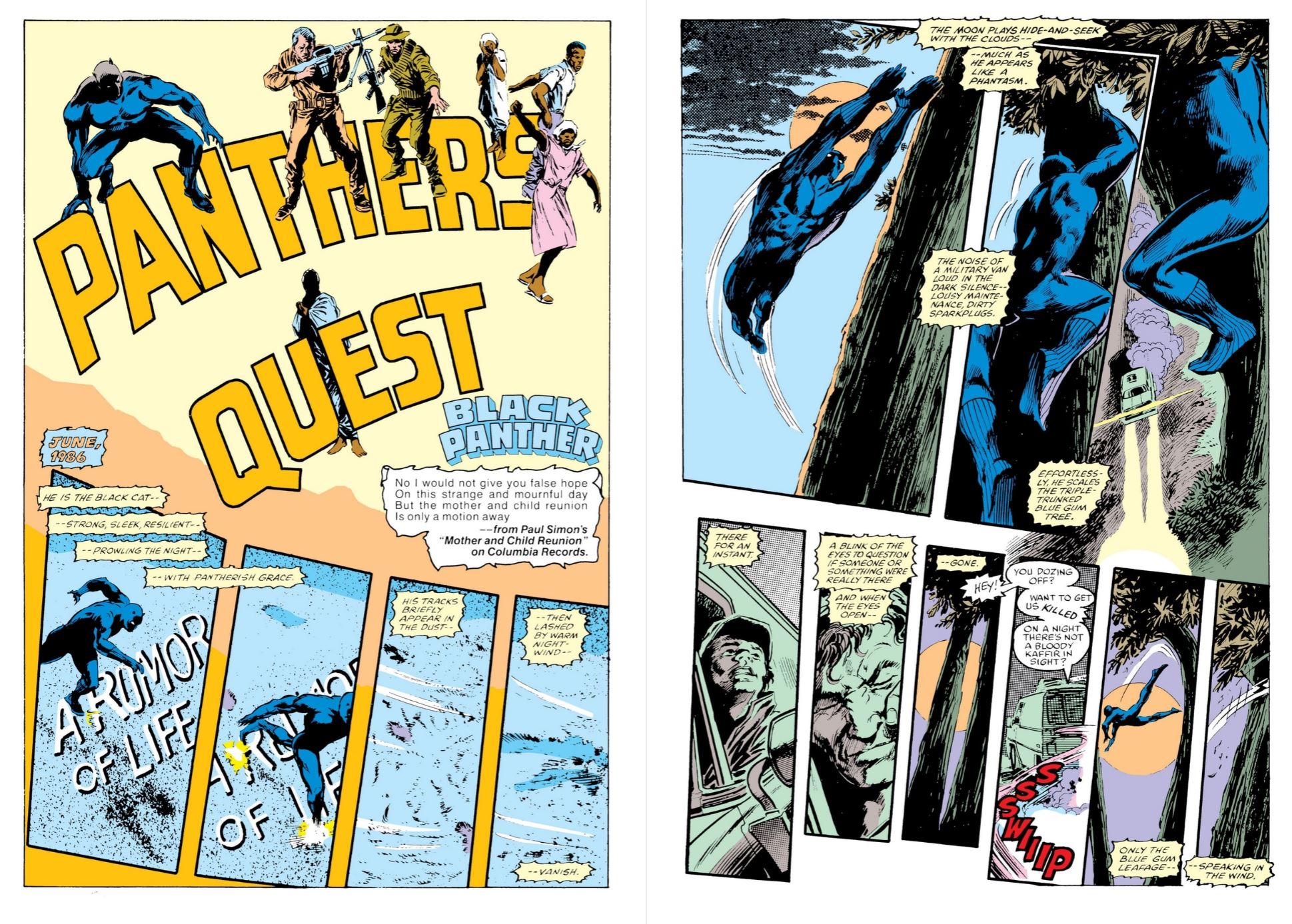
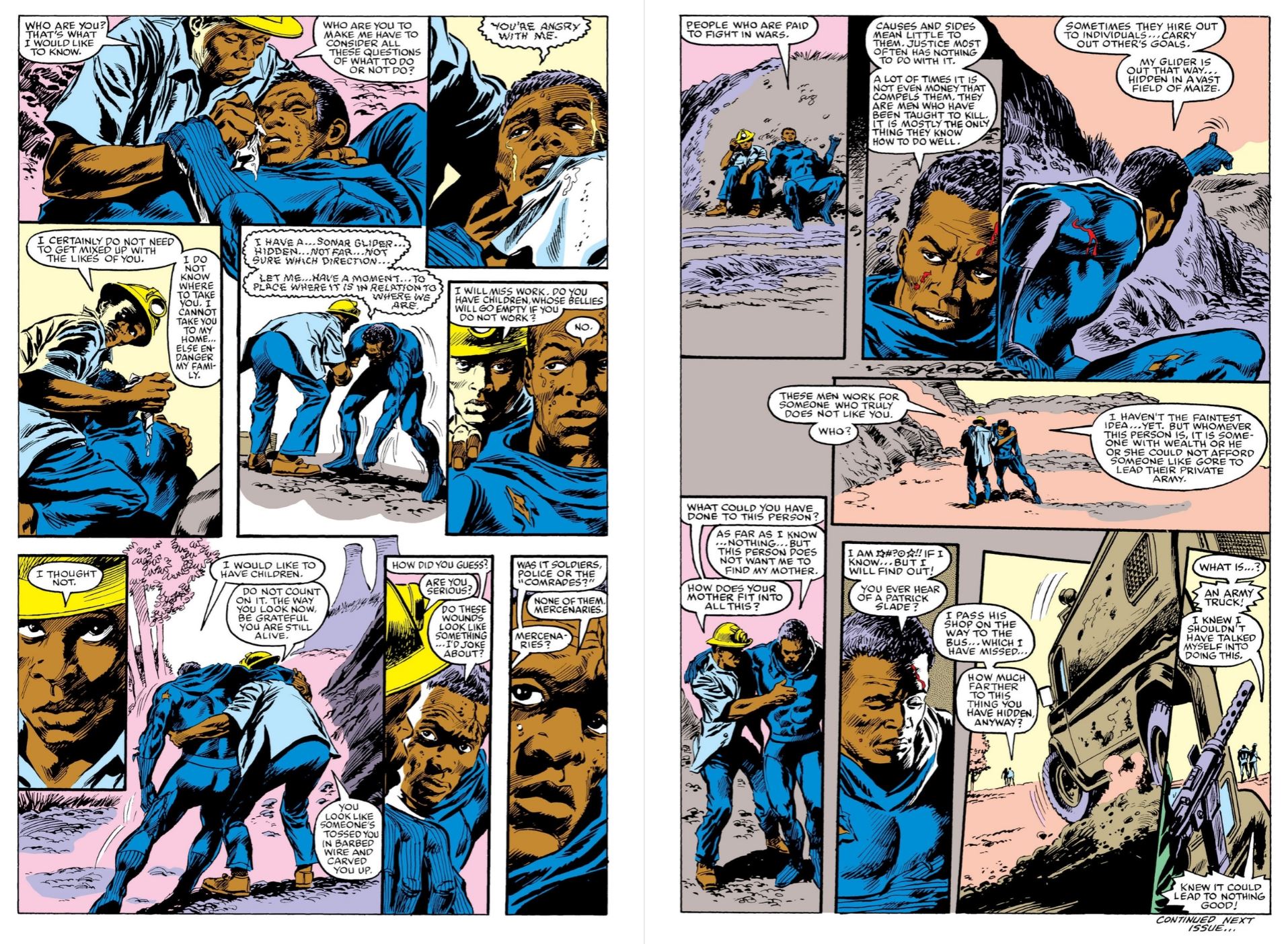
As seen primarily in Marvel Team-Up, a shadowy trio of observers with an undisclosed agenda had monitored superbeing episodes and provided advanced technologies for monsters and villains like Lava Men, Stegron and The Orb to battle Spider-Man, Hercules, Nova, Ghost Rider, Black Panther, Thor and more. Now they subtly pull strings drawing the Gamma Juggernaut southwards, using bullion bandit Goldbug as their latest instrument…

It comes together in #239’s Esposito-inked ‘All That Glitters…’ as a brief pause on Hulk’s travels sparks a military incident. Taking a nap atop national monument Mount Rushmore, the monster is confronted by a joint military and S.H.I.E.L.D. response. However, instead of more shattering violence, the stand-off ends peacefully when Goldbug slips in, offering escape in his new ship. Sadly, it’s designed to siphon Hulk’s energies to power the vessel all the way to South America where the thief can plunder a literal city of gold in the Andes. Hulk is not happy and escapes, but not before they reach their destination where The Brotherhood of They are waiting.

In #240’s ‘…And Now El Dorado’ (inked by Joe Sinnott) years of scheming come to fruition as a hidden civilisation (last seen as the Forbidden Land in Avengers #31, August 1966) welcomes the outcast and the criminal mastermind to an idyllic paradise covertly controlled by a back-stabbing triumvirate seeking dominion of Earth. Autocrat Prince Rey and cleric Lann, Keeper of the Sacred Flame have warred for decades, but the balance is maintained by aged enigmatic Des who perpetrated They’s campaign to create global tectonic anomalies that fed the Flame. Des also exerts a shocking hold on the Hulk, dangling the prospect of resurrecting his lost love Jarella if the monster behaves and follows orders…

A bitter truth is revealed in the Buscema-inked ‘Partners in Deception!’ when Banner too becomes fuel for the Sacred Flame, with Des stealing that power to eradicate his allies and regenerate himself. Revealed as one of the Hulk’s earliest enemies and with Goldbug forced into playing hero to save his own skin, ‘Sic Temper Tyrannus!’ sees the unlikely outworlder allies saving Earth as their enemy ascends to godhood before inevitably overextending himself… and again underestimating the sheer bloody-mindedness of the Jade Juggernaut…

The end comes courtesy of plotter Stern, scripter Steven Grant & Sal B, in #243’s ‘Death… and Destiny!’ With the world restored, the Hulk resuming his wandering and Goldbug getting just what he deserves, in the wings, the mental collapse of General Thaddeus Ross has left a vacuum the US government fills with his protégé Glenn Talbot, newly promoted to lead America’s anti-Hulk task force…

Written by Doug Moench and illustrated by Steve Ditko & Al Milgrom, Incredible Hulk Annual #9 offers a short diversion as the monster is targeted by chess-obsessed millionaire Charles Reigel, leading fellow members of the Gotham Game Club in a high-tech campaign against the epitome of unreasoning brute force. Sadly, ‘A Game of Monsters and Kings’ is not what the Green Goliath wants and the Hulk does not play well with others…

This titanic tome wraps up its storytelling component with a brief continuity palate cleanser as #244 reintroduces Hollywood special effects wizard Bob O’Bryan who, thanks to alien invaders, can possess and animate a gigantic stone statue. His efforts to keep the mighty It, the Living Colossus from evil Dr. Vault was once the stuff of L A legend, but means nothing to Bruce Banner when he awakes from another Hulk-out in Tinseltown.

Incredible Hulk #244’s ‘It Lives!’ (by Grant, Carmine Infantino  & Esposito) sees coincidence and concatenation conspire to bring all player together for Vault’s last pursuit of the prize, only to learn that gamma beats granite every time…

To Be Hulk-inued…

With covers by Milgrom, Bob Layton, and Ditko the bonus portion of this blockbusting bonanza includes the covers (front & back) of Hulk-starring reprint tabloids  Marvel Treasury Edition #20 and 24 – by Bob Budiansky & Abel and Budiansky & Bob Wiacek respectively. There are also house ads and a gallery of Hulk pinups by Ron Wilson, Frank Giacoia, Dave Hunt & Pablo Marcos created for Marvel UK titles plus a large section of designs by Mark Gruenwald revamping Goldbug, his ship and Tyrannus.

The Incredible Hulk is one of the most well-known comic characters on Earth, and these stories, as much as the movies, cartoons, TV shows, games, toys and action figures are the reason why. For an uncomplicated, earnestly vicarious experience of Might actually being Right, you can’t do better than these exciting episodes, so why not Go Green – even if it’s only in your own delirious head?
© 2021 MARVEL.

Today in 1964 Brazilian artist Sergio (Lone Ranger) Cariello was born, with Stephanie (Harley Quinn, Wonder Woman, Spider-Gwen, Grim) Phillips arriving in 1991. On the debit side this date in 1957 saw the end of Italian comics legend Guido Fantoni (Capitan Walter, Nutor, Flash Gordon, Brick Bradford, The Phantom, Mandrake the Magician); mature content Spanish wizard Alfredo Pons in 2002; Disney mainstay Romano Scarpa in 2005 and our own national treasure Leo Baxendale (Minnie the Minx, The Bash Street Kids, Wham!, Pow!) in 2017.

Marney the Fox


By Scott M. Goodall & John Stokes (Rebellion Studios)
ISBN: 978-1-78108-598-1 (HB/Digital edition)

This book includes Discriminatory Content produced in less enlightened times. This book also contains Discriminatory Content included for dramatic effect.

At first glance British comics prior to the advent of 2000 A.D., Action and Misty seemingly fell into fairly ironclad categories. Back then, you had genial and fantastic preschool fantasy; a prodigious selection of adapted TV and media properties; action; adventure; war and comedy strands. A closer look, though, would confirm that there was always a subversive undertone, especially in such antihero series as Dennis the Menace, The Spider or the early Steel Claw.

…And then there was Marney the Fox.

Created and scripted by prolific Scott Goodall (Captain Hurricane, Kelly’s Eye, Cursitor Doom, Captain Scarlet and dozens more), the series ran in all-purpose anthology Buster from June 22nd 1974 to September 4th 1976 and – even in a weekly periodical notorious for its broad and seemingly mismatched mix of themes and features – stuck out like a sore thumb.

Not for any lack of quality, of course.

Compellingly scripted by Goodall and set in his beloved Devonshire country, the serial was lavishly, almost hauntingly illustrated by frequent collaborator John Stokes (Black Knight, Father Shandor, Maxwell Hawke, L.E.G.I.O.N., Aliens, Star Wars, The Invisibles), with whom the writer had already crafted for Buster seminal classics Fishboy and The War Children.

Marney the Fox was very much a passion project and a creature of its times. If you look at the ordering descriptions online or even revel in the gorgeous and serene cover embellishing this luxurious hardback/digital compilation, you might conclude it’s a natural history strip or animal adventure along the lines of Lassie or Black Beauty.

Don’t be deceived. The books you should be thinking of here are Ring of Bright Water, Tarka the Otter and A Kestrel for a Knave (or Kes, if you don’t read As Much As You Should, but do watch movies). The deftly-constructed atrocities beautifully limned in every 2-page monochrome instalment were – and remain – brilliant nature propaganda and should be mandatory reading for every person who lives in, near or with the natural environment…

For two years the weekly trials and tribulations of barely-weaned orphaned fox cub Marney the Wandering One were a painfully beautiful, frequently harrowing account of the horrors rural folk – from poachers to soldiers on manoeuvres to roadbuilders to landed gentry and their bloody hounds – all casually inflicted on unwelcome wildlife: ones that must have traumatised and successfully indoctrinated a generation of kids.

From his first encounter with and narrow escape from despicable mankind, young Marney endures a ghastly litany of close shaves, bolstered by far too few happy, peaceful moments as he flees from crisis to crisis until mercifully finding refuge and contentment. I had to put that last bit in because this is a sublime piece of comics wonderment that everybody should read, but the seven-day-cliffhanger cycle and sheer mental and physical abuse the little guy barely survives every week would have Batman, Daredevil and Judge Dredd rushing for Valium and comfort blankies in an instant…

So take it from me: the fox lives happily ever after, okay?

Augmented by an Introduction from John Stokes, this is magical and unique comics entertainment, suitably acid-coating the hard, harsh life of British wildlife and the ignorance and cruelty of many – but not all – people. It’s also a story you must see and will never forget…
™ & © 1974, 1975, 1976, & 2017 Rebellion Publishing Ltd. All Rights Reserved.

Today in 1923 Marvel’s man behind the curtain Sol Brodsky was born, as was writer Steve Englehart in 1947; editorial whirlwind Marie Javins in 1966; British boys Ian Churchill in 1969 and Bryan Hitch one year later.

Today long ago, Machiko Hasegawa’s yonkoma manga Sazae-san began its epic 68-volume run (April 22nd 1946 – February 21st 1974) and in 1990, Scott Stantis began the still-running family strip The Buckets. In 2002 we lost British journeyman illustrator Denis (The Shark, Commando, Buffalo Bill, Wizard) McLoughlin.

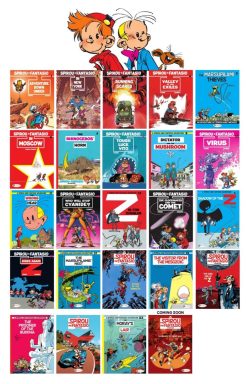
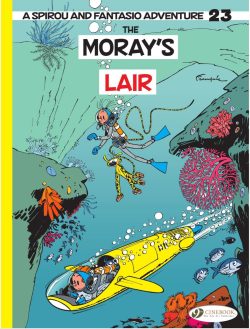
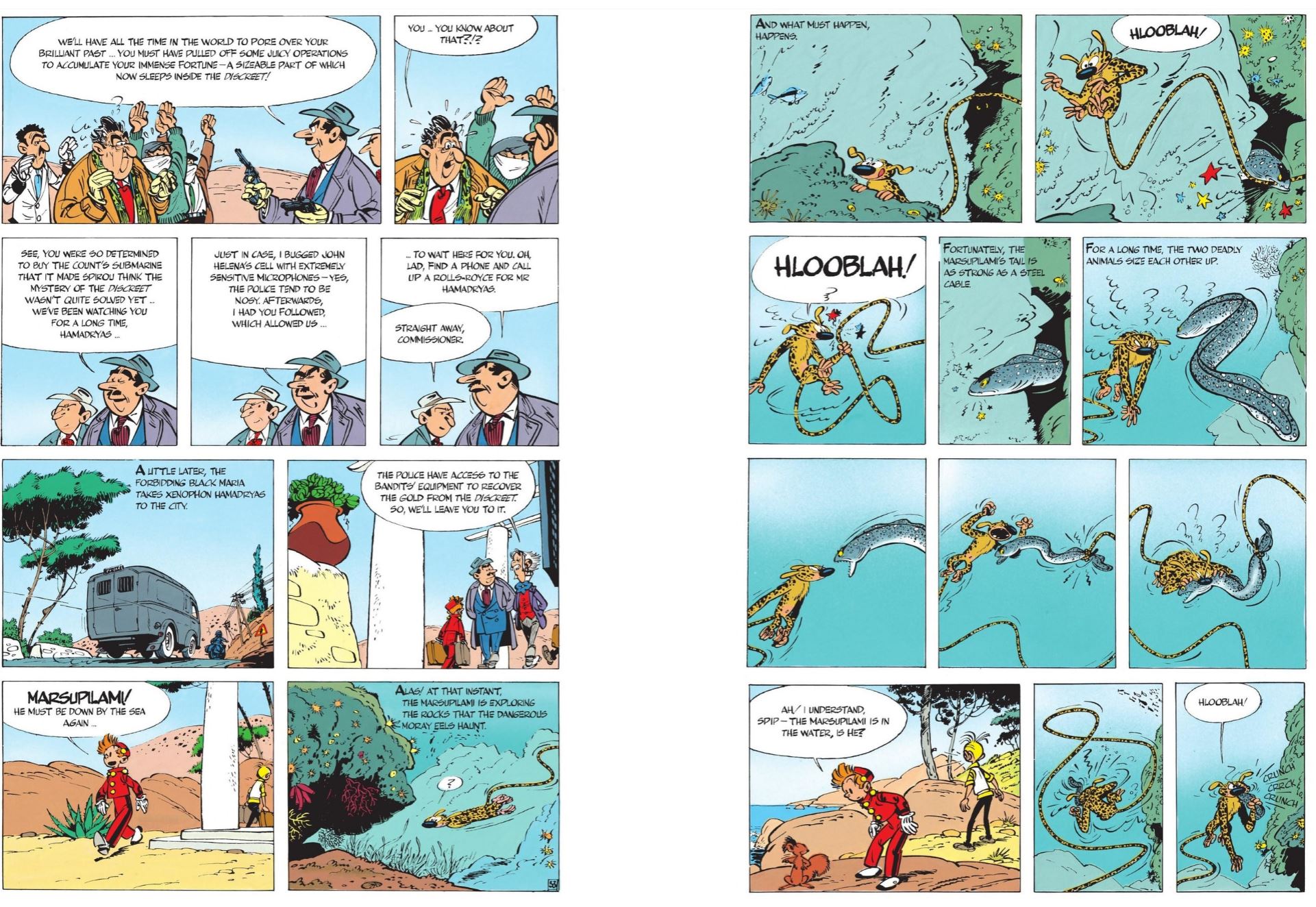
Spirou and Fantasio volume 7: The Rhinoceros’ Horn


By André Franquin, translated by Jerome Saincantin (Cinebook)
ISBN: 978-1-84918-224-9 (Album PB/Digital edition)

This book includes Discriminatory Content produced in less enlightened times. This book also contains Discriminatory Content included for comedic effect.

André Franquin was born in Etterbeek, Belgium on January 3rd 1924 and died on January 5th 1997. In between there were good times and bad, which he offset by creating the most incredible characters and stories, and by making people laugh and think – but mostly laugh. This is one of the very best you can find translated into English.

Adventure-seeking brave lad Spirou headlined the magazine he was named for from the first issue (dated April 21st 1938). He was created by French cartoonist Françoise Robert Velter using his pen-name Rob-Vel for Belgian publisher Éditions Dupuis in direct response to the success of Hergé’s Tintin for rival outfit Casterman. Originally a plucky bellboy/lift operator employed by the Moustique Hotel (a puckish reference to the publisher’s premier periodical Le Moustique), his improbable exploits with pet squirrel Spip gradually but steadily grew into high-flying, far-reaching, surreal comedy dramas. That evolution was mainly thanks to Velter’s wife Blanche “Davine” Dumoulin who took over the strip when her husband enlisted in 1939 and Belgian artist/assistant Luc Lafnet… at least until 1943 when Dupuis purchased all rights to the property, after which comic-strip prodigy Joseph Gillain (Jijé) took the helm.

When Jijé handed his own trainee/assistant total responsibility for the flagship feature part-way through serial Spirou et la maison préfabriqué (Le Journal de Spirou #427, June 20th 1946), André Franquin ran with it for the next 20 years, enlarging the scope and horizons until it was purely his own. Almost every week fans would meet startling new characters such as comrade/rival Fantasio or crackpot inventor and Merlin of mushroom mechanics the Count of Champignac. Spirou and Fantasio became globe-trotting journalists, travelling to exotic places, uncovering crimes, exploring the fantastic and clashing with a coterie of exotic arch-enemies such as Zorglub and Fantasio’s unsavoury cousin Zantafio.

Franquin, plagued in later life by bouts of depression, passed away in 1997 but his legacy remains; a vast body of work which reshaped the landscape of European comics.

With that brave experiment clearly having paid dividends over decades it’s perhaps timely to remind readers that times and taste having changed radically since then, and as such current UK publisher Cinebook felt the need to issue a heartfelt warning and carefully considered apologia regarding some content of The Rhinoceros’ Horn

I’ll précis it here: it was seventy years ago and our attitudes to hunting, other ethnicities and especially the modern obscenity of killing for ivory and horn have thankfully changed. Please read this book with that in mind. The publishers, of course, phrased it much better…

The Rhinoceros’ Horn was originally serialised in two sequences in Le Journal de Spirou: #764-787 (Spirou et la Turbotraction) and #788-797(La corne de rhinocéros), and spanned 1952 and early 1953 before being united in 1955 hardback album La corne de rhinocéros. The story begins with Spirou exulting over the success of Fantasio’s latest enterprise – personal helicopters worn as backpacks – but discovers his pal is rather down in the dumps. The ingenious journo’s just been dressed down by his editor on The Mosquito and warned that the paper has hired a new reporter: a real go-getting hotshot. Dejected and desperate, Fantasio resolves to revive his flagging career by staging a publicity stunt: robbing the Good Bazaar Department Store

As the rattled reporter draws up his plans and sends a warning to the store of his intentions, a colossal explosion shakes the town. Persons unknown have blown up the nearby Turbot car plant. With even more to prove now, Fantasio proceeds…

Dragged along for the ride and to photograph the stunt, Spirou and snarky squirrel Spip reluctantly join their pal in the harebrained venture. Alighting on the roof of the emporium courtesy of those petrol-powered “Fantacopters”, they deftly break in through the fire-door, Spirou recording everything with his gigantic flash camera. Of course, our lead-footed burglars make an appalling clatter and tremendous mess, but no night-watchmen confront them. They’ve all been incapacitated and tied up by real robbers…

Hearing villains approaching, the lads take refuge in a wardrobe in the bedrooms department and discover an old acquaintance already there. Behring works for Turbot and was wounded in the explosion earlier. Moreover, he’s carrying the company’s blueprints for their latest advancement. The burglars in the darkened store are actually trying to finish him off to get them. Handing the boys an envelope and begging them to get it to his employer Mr. Martin, the troubleshooter loses consciousness just as the involuntary heroes are challenged by a shadowy figure demanding the precious prize. It’s not the bad guys, however, but Fantasio’s journalistic nemesis…

Cellophine is already streets ahead of them: she knows of the plot to steal Turbot’s revolutionary supercar. All she needs is the address Behring muttered to secure an interview with the in-hiding Martin and her next terrific scoop.

…And that’s when the gun-toting goons make their move, demanding blueprints and the rendezvous address. Thankfully, Spirou is still holding the camera and super-bright flashgun…

Calamitously – and hilariously – fleeing for their lives through the darkened store, the guys eventually escape via fantacopters from the top storey, allowing Cellophine to lock the bandits up on the roof before dragging Behring to safety. Next morning the boys are in Whistleton but Martin has already fled. His note reveals nothing, but later a sinister stranger in a café advises them to surrender the blueprints and warns them not to join Mr. Martin at Bab-el-bled in North Africa.

Ignoring him and returning home, they encounter distressingly persistent Cellophine and Spirou clues her in. Sadly, the thugs have also tracked them down and overhear the plans, so when the boys catch a jet liner to Africa, heavily disguised heavies are in the seats behind them…

These villains are on the lads’ tails all though the avenues and alleyways of Bab-el-bled, before a wig malfunction in the Souk warns Spirou that they’re being shadowed and another hectic chase ensues. Thinking they’ve at last shaken their pursuers our heroes go to Martin’s house only to learn he was ambushed by the bandits…

Happily the troubled Turbot exec had escaped and fled further into North Africa. He’s apparently rushing off to the M’saragba Animal Reservation but as the boys try to follow Cellophine appears and pips them to the last spot on the plane – stowed away in the baggage hold.

Forced to follow by train, it is eight days later when Fantasio & Spirou finally reach the Reserve and yet again – as infinitely aggravating Cellophine explains – they’ve just missed Martin. He was chased into the bush by the implacable bandits…

Going after him they find him just after the thugs do. Having shot Martin, the villains are smugly gloating when the sinister stranger from Whistleton café appears. He’s a cop and finally has enough evidence to arrest them for blowing up the factory, but they are all too late. The harassed entrepreneur has already got rid of his portion of the plans, giving them to a local friend to hide.

As Martin is carried to hospital, Spirou & Fantasio volunteer to retrieve those accursed documents but have not reckoned on the quirky ingenuity of the chief of the Wakukus, the vastness of the reserve and the sheer bloody-mindedness of local flora and fauna. After days of unpleasant and painful adventures, they finally locate the safeguarding tribe and, following even more nerve-wracking moments convince the chief that they too are friends of Martin. That’s when the king delivers his bombshell…

Tasked with keeping safe the plans – now contained on a spool of microfilm – the wily Wakuku had his subjects capture a rhino before drilling a hole in its horn and sealing the container within. They then released it back into the wild. He has no idea where it is now or even which of the 200 in the park it might be…

Determined to complete their mission, the lads spend months tracking and capturing assorted beasts. The task becomes only slightly easier after they find a dipsomaniac white trader who sells them hunting gear and latterly, yellow paint so that they can tell the rhinos they’ve already checked from the ones so cunningly evading them…

It’s a backbreaking, heartbreaking and increasingly pointless task but only when their resolve crumbles and they brokenly give up and head for home do they find the prize in the very last place they looked…

Even the trip back is a tribulation, and eventually they collapse only to awake in a nice clean hospital with Martin and Cellophine offering to fill in the blanks on this baffling case. Six weeks later the lads are recuperating at home when Behring shows up. He’s got a little reward for them from the grateful Turbot Company but, as usual, Cellophine is on hand to spoil it for Fantasio…

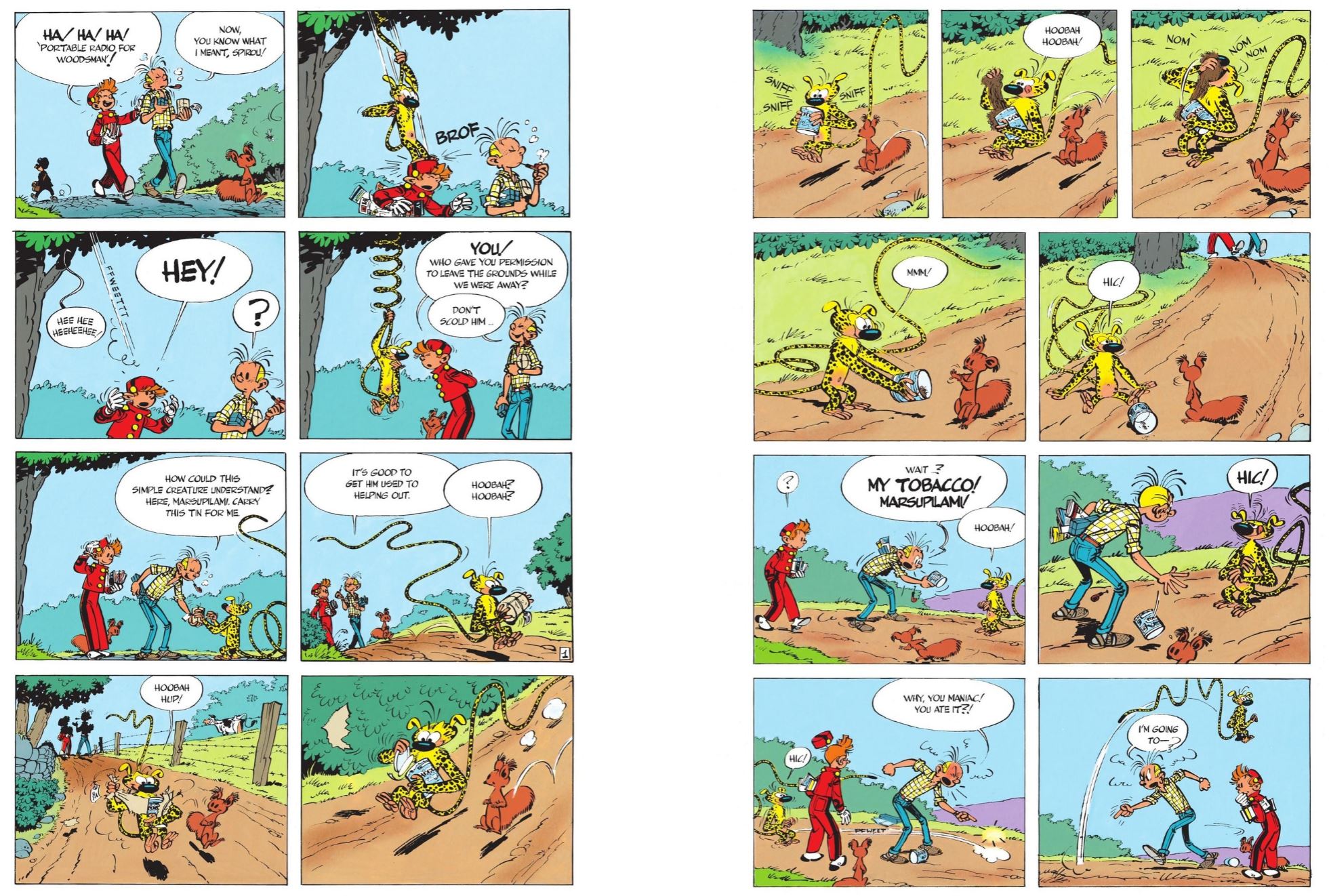
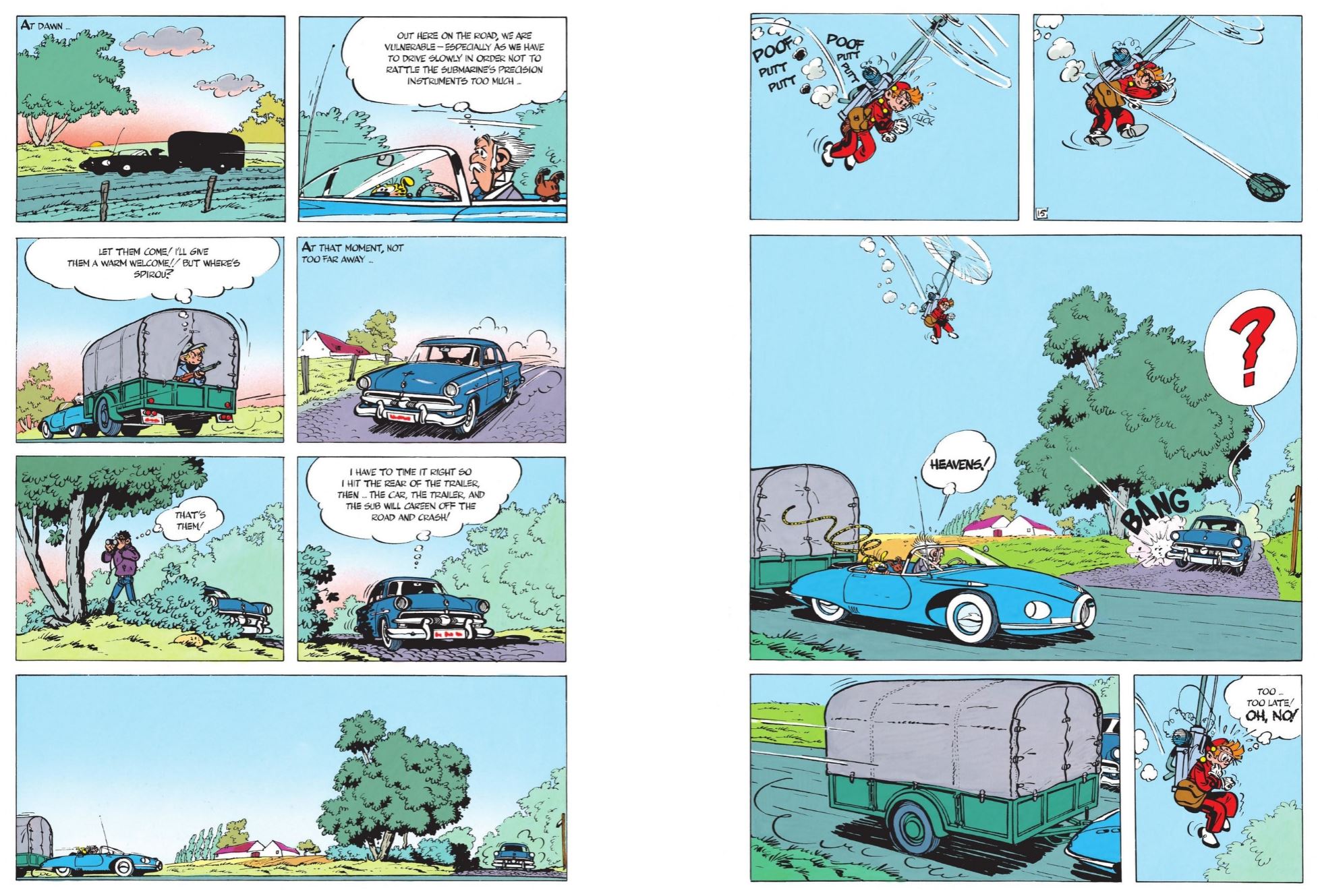
Stuffed with superb slapstick situations, riotous Keystone Cops chases and gallons of gags, this exuberant, high-spirited yarn is a true celebration of angst-free action, thrills and spills. accessible to readers of all ages and drawn with all the beguiling style and seductively wholesome élan which makes Asterix, and Lucky Luke so compelling, this is an enduring comics treat from a long line of superb exploits, certain to be as much a household name as those series – and even that other kid with the white dog…
Original edition © Dupuis, 1955 by Franquin. All rights reserved. English translation 2014 © Cinebook Ltd.
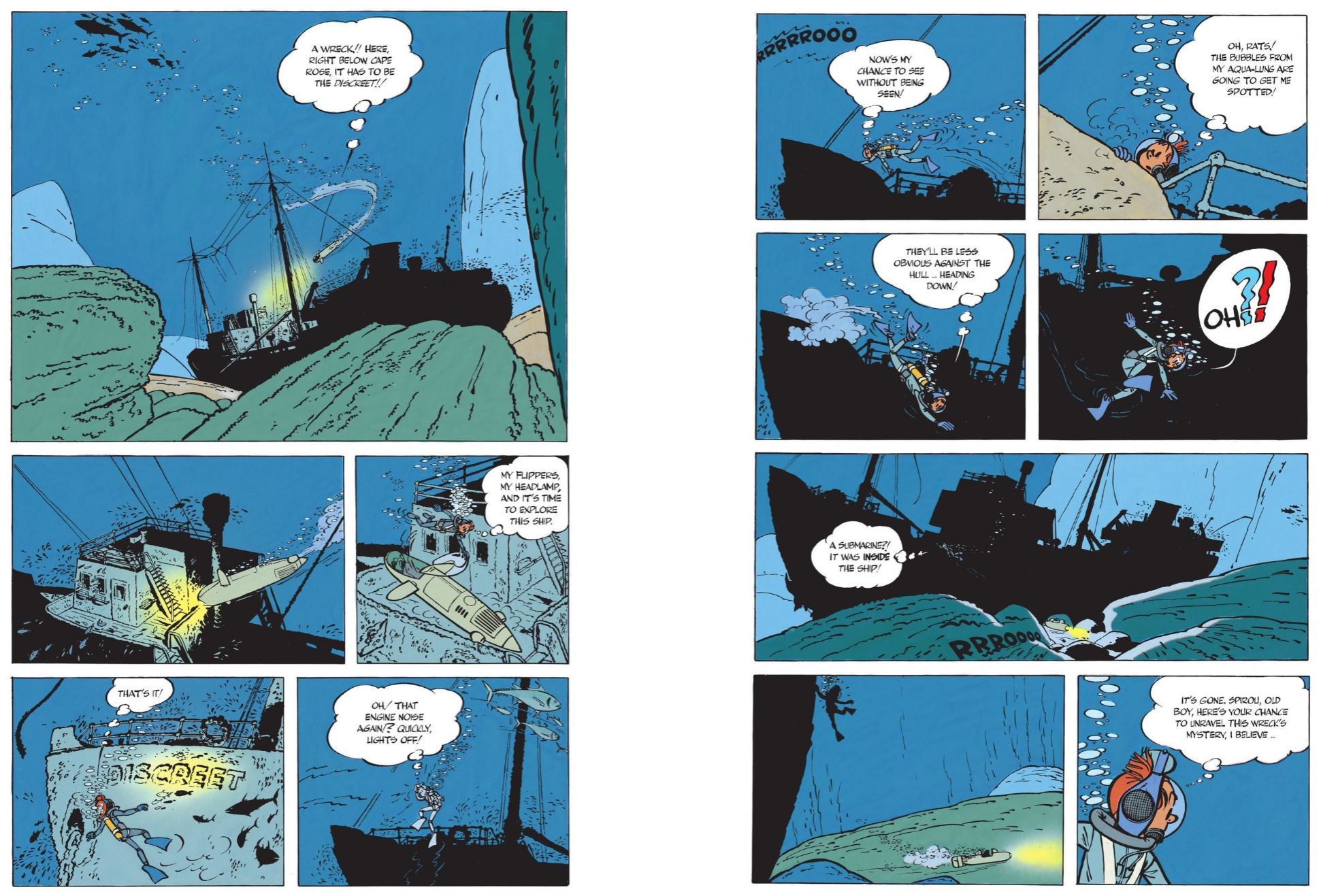
Today in 1942 Underground Commix pioneer Dan O’Neill (Air Pirates Funnies, Odd Bodkins) was born, preceding both Teris Sue Wood (Wandering Star) in1965 and super-glamour artist Michael Turner (Witchblade, Fathom, Superman/Batman) in 1971.

Deaths on this date include British satirist & caricaturist Thomas Rowlandson in 1827. In 1962 Golden Age cartoonist/animator Robert Winsor McCay (Nemo in Adventureland, Impie, Bulletman, Ajax the Sun Man, Blackstone the Magician) and animator turned cartoonist Bob Wickersham (Spencer Spook, Funny Films, Ha Ha Comics, The Kilroys, The Kellys, Flippity and Flop, Colonel Punchy Penguin) both passed on as did veteran comics book illustrator Art Saaf (Sheena, Jumbo Comics, Princess Pantha, Boris Karloff Tales of Mystery, Ripley’s Believe It or Not!, The Twilight Zone, Supergirl) in 2007.

In 1938 on this date, Tif et Tondu and Spirou premiered in the debut issue of Le Journal de Spirou.

The Steel Claw: Invisible Man


By Ken Bulmer & Jesús Blasco & various (Rebellion)
ISBN: 978-1-78108-906-4 (TPB/Digital edition)

This book includes Discriminatory Content produced in less enlightened times.

One of the most fondly-remembered British strips of all time is the startlingly beautiful Steel Claw. From 1962 to 1973 the stunningly gifted Jesús Blasco and his small studio of family members thrilled the nation’s children, illustrating the angst-filled adventures of scientist, adventurer, secret agent and even – occasionally – costumed superhero Louis Crandell.

The majority of the character’s career was scripted by comic veteran Tom Tully, but initially follows the premise of HG Wells’ original unseen adversary with prolific science fiction novelist Ken Bulmer devising a modern spin and contemporary twist on The Invisible Man.

Another superb salvo of baby boomer nostalgia from Rebellion’s Treasury of British Comics strand, initial collection The Steel Claw: Invisible Man gathers material from beloved and enduring weekly anthology Valiant, spanning 6th October 1962 to 21st September 1963 and also includes stories from the Valiant Annuals for 1965 and 1966.

Following an Introduction from Paul Grist, the tense drama begins with our (eventual) hero debuting as a rather surly assistant to the venerable Professor Barringer, working to create a germ-destroying ray. Crandell is an embittered man, possibly due to having lost his right hand in a lab accident. After its replacement with a steel prosthetic and his notional recovery, he is back at work when the prof’s new device explodes. Crandell receives a monumental electric shock and is bathed in radiation from the ray-device which, rather than killing him, renders him totally transparent. Although he doesn’t stay unseen forever, this bodily mutation is permanent. Electric shocks cause all but his metal hand to disappear.

Kids of all ages, do not try this at home!

Whether venal at heart or temporarily deranged, Crandell goes on a rampage of terror against society and destruction of property culminating in an attempt to blow up New York City before finally coming to his senses. Throughout Crandell’s outrages, Barringer is in guilt-fuelled pursuit, determined to save or stop his former friend…

The second adventure channels another classic (The Strange Case of Dr Jekyll and Mr Hyde), intriguingly pitting the Claw against his therapist, who – in an attempt to treat him – is also traumatically and life-changingly exposed to Barringer’s ray. Instead of permanent invisibility, Dr. Deutz develops the ability to transform himself into a bestial ape-man who malevolently turns to crime and frames Crandell for a series of spectacular robberies and outrages.

On the run and innocent for once, Crandell is saved by the intervention of Barringer’s niece Terry Gray. After weeks of beast-triggered catastrophe and panic in the streets, the Steel Claw is vindicated and proved a hero …of sorts…

Bulmer’s next tale changes location to the Bahamas as our star shifts from outlaw to hero. While recuperating on an inventor-friend’s yacht, Crandell is accidentally embroiled in a modern-day pirate’s attempt to hijack an undersea super-weapon system. After would-be bullion bandit Sharkey and his nefarious gang steal the device and use it to capture a submarine, their convoluted scheme to rob an ocean liner finally falters when a steel-fisted ghost starts picking them off one by one…

More than any other comics character, the Steel Claw was a barometer for reading fashions. Starting out as a Quatermass-style cautionary sci fi tale, the strip mimicked fresh trends of the greater world, becoming a James Bond-style superspy strip with Crandall eventually tricked out with outrageous gadgets, and latterly, a masked-&-costumed super-doer when TV-show-sparked “Batmania” gripped the nation and the world.

When that bubble burst, he resorted to becoming a freelance adventurer, combating eerie menaces and vicious criminals. However, before we head too far down that path, his potent contributions to Valiant Annuals 1965 and 1966 – respectively released in Autumn 1964 and 1965 – afford rather more constrained thrills and chills as Crandell defeats a gang using an electricity-supressing gadget to rob a blacked-out London and (one year later) assists the Metropolitan Police force in corralling a bunch of apparently invisible bandits dubbed the Phantom Raiders

The thrills of the writing are engrossing enough, but the real star of this feature is the artwork. Blasco’s captivating classicist drawing, his moody staging and the sheer beauty of his subjects make this an absolute pleasure to look at. Buy it for the kids and read it too; this is a glorious book, and brace yourself for even better yet to come…
© 1962, 1963, 1965, 1966 & 2021 Rebellion Publishing IP Ltd. All Rights Reserved.
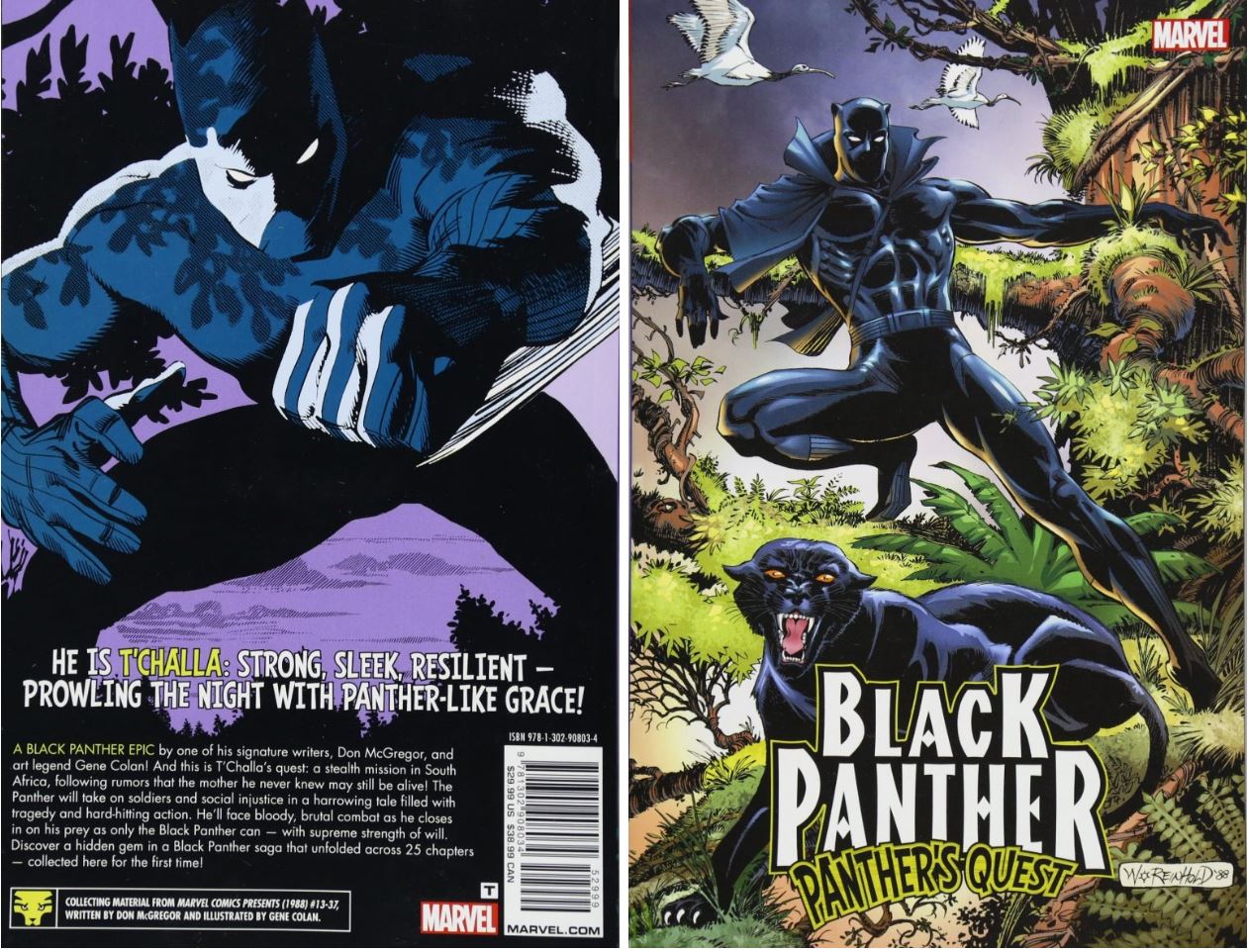
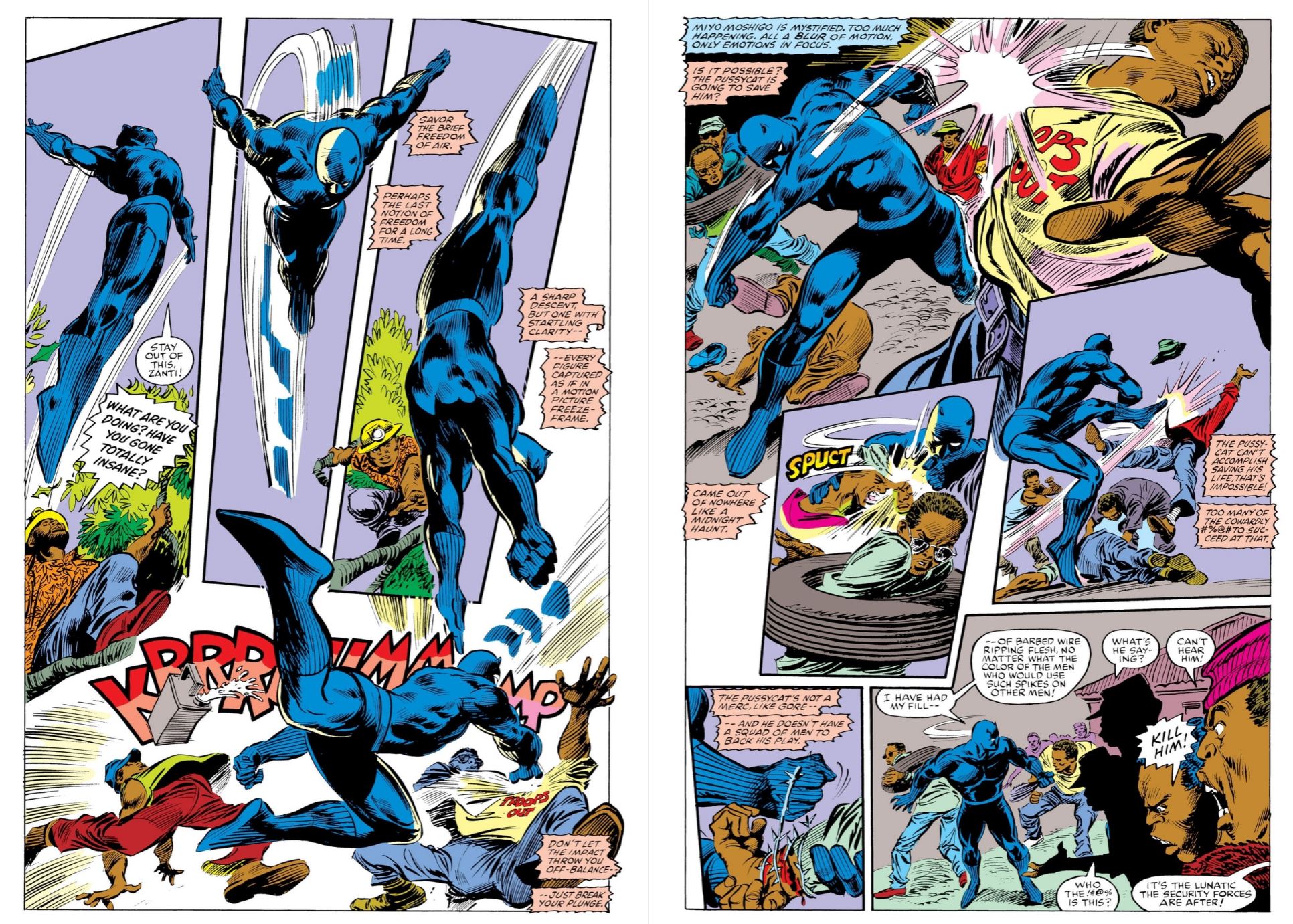
Today in 1949 actor turned comics writer John Ostrander (Oracle, The Spectre, Grimjack, Firestorm, Suicide Squad, Star Wars, Magnus Robot Fighter) was born, as was Norwegian creator Christopher Nielson (To Trøtte Typer) in 1963 and funny, funny guy Evan Dorkin (Milk and Cheese, Welcome to Eltingville, Dork, Beasts of Burden) in 1965.
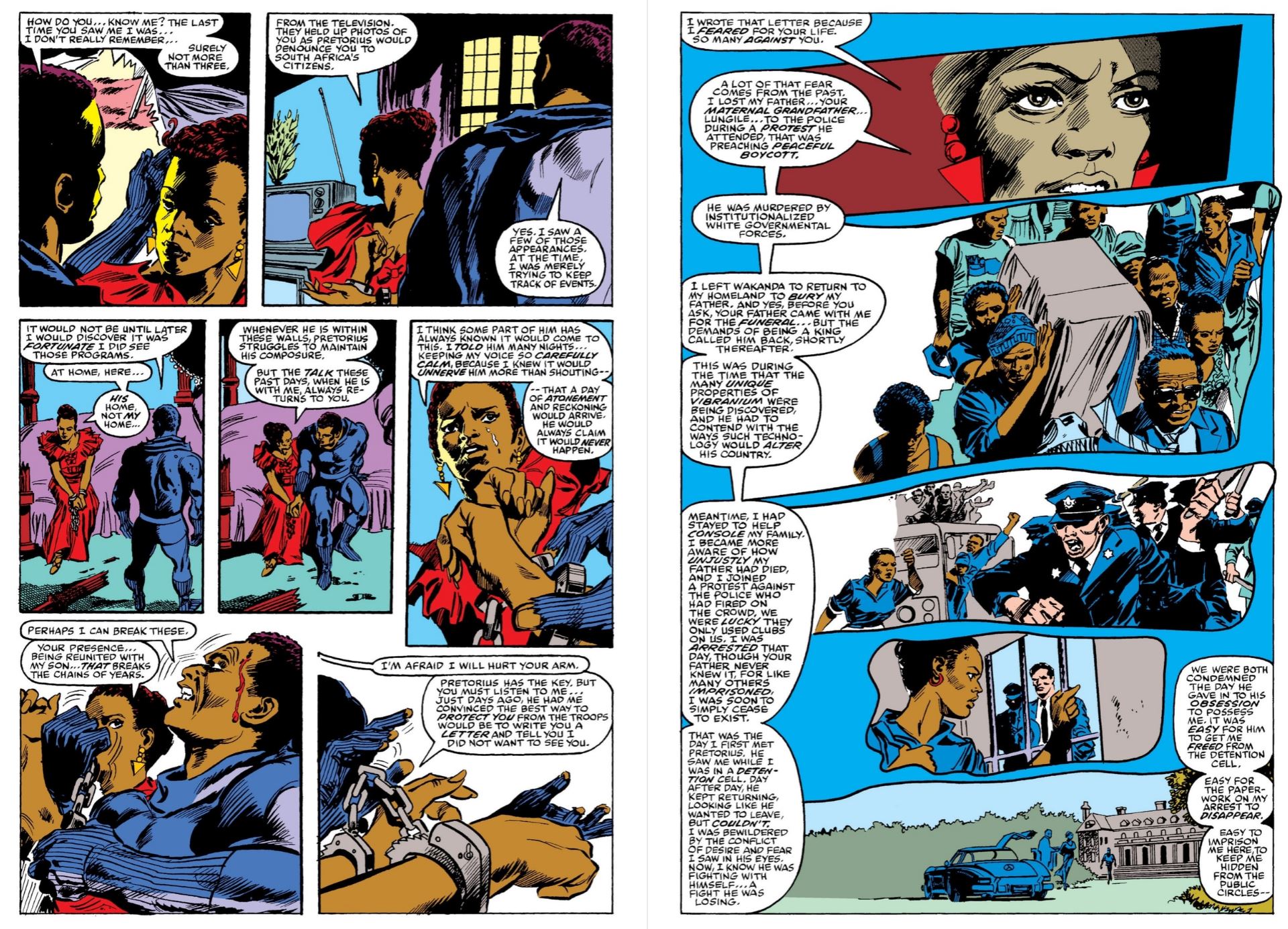
In 1968 comedy master and Katzenjammer Kids creator Rudolph Dirks died. And while we remember laughing, let’s celebrate that Crockett Johnson’s astounding 10-year wonder Barnaby debuted on this date in 1942.

The Phantom – The Complete Series: The Charlton Years Volume Two


By Pat Boyette, Joe Gill, D. J. Arn
eson
& various (Hermes Press)
ISBN: 978-1-61345-032-1 (HB/Digital edition)

This book includes Discriminatory Content produced in less enlightened times.

In the 17th century a British sailor survived an attack by pirates, and, washing ashore on the African coast, swore on the skull of his murdered father to dedicate his life and that of all his descendants to destroying all pirates and criminals. The Phantom fights crime and injustice from a base deep in the jungles of Bengali, and throughout Africa is known as the “Ghost Who Walks”…

His unchanging appearance and unswerving war against injustice have led to him being considered an immortal avenger by the credulous and the wicked. Down the decades one hero after another has fought and died in an unbroken family line, and the latest wearer of the mask, indistinguishable from the first, continues the never-ending battle.

Lee Falk created the Jungle Justice dealer at the request of his syndicate employers who were already making history, public headway and loads of money with his first strip sensation Mandrake the Magician, and although technically not the first ever costumed hero in comics, The Phantom’s astounding popularity made him the prototype paladin: wearing the later demi-compulsory skintight bodystocking and mask with opaque eye-slits.

He debuted on February 17th 1936 (Yep! Ninety nonstop years!!) in an extended sequence pitting him against a global confederation of pirates called the Singh Brotherhood. Falk wrote and drew the daily strip for the first two weeks before handing over the illustration side to artist Ray Moore. A hugely successful Sunday feature began in May 1939. However, for such a long-lived and influential series, in terms of compendia or graphic collections, The Phantom has been very poorly served by the English language market – except in Australia where he has always been accorded the status of a pop culture god.

Numerous companies had begun releasing books of the strips – one of the longest continually running adventure serials in publishing history – but in no systematic or chronological order and never with any sustained success, but, even if only of historical value (or just printed for Australians), surely the mysterious Mr. Kit Walker was worthy of a definitive chronological compendium series?

Happily, and perhaps because of the tights and mask, his comic book adventures have fared slightly better – especially in recent times. From November 1962 through July 1966, all new adventures were published by West Coast giant Gold Key Comics after which King Features Syndicate dabbled with a comic book line of their biggest stars – including Popeye, Blondie, Flash Gordon, Mandrake and The Phantom – between 1966 and 1967. When they gave up the ghost (see what I did there?), plucky dependable, cheap Charlton Comics were there to pick up the slack…

The Phantom was no stranger to funnybooks, having appeared since the Golden Age in titles like Feature Book and Harvey Hits, albeit only as reformatted newspaper strip reprints. Gold Key’s efforts were tailored to a big page and a young readership, a model King Features maintained for their own run, but which was carefully tweaked when Charlton acquired the license. This splendid full-colour tome gathers the contents of The Phantom #39-47 (originally released between August 1970 and December 1971) and opens with an erudite Introduction and appreciation from Don Mangus who reveals everything of the history and involvement of a much-sidelined star in ‘Sworn to the Oath of the Skull – Pat Boyette’.

San Antonio born on 27th July 1923, Aaron P. Boyette was pure mythical Texan: self-taught in everything that mattered and unstoppably confident. A true and tireless entrepreneur, he was a key component of the development of commercial radio in Texas: a journalist who researched, wrote, broadcast, managed, and presented shows. If you’ve read Golden Age Green Lantern, everyman hero Alan Scott – who did all the jobs – could have been patterned on Pat…

Boyette forsook burgeoning stardom to become a cryptographer during WWII. Coming out, he performed the same do-it-all trick with early television and later moved into making movies. After anchoring TV news, he abruptly moved sideways again, and took to comics: writing, editing, lettering, painting and illustrating as Pat Boyette, Sam Swell, Alexander Barnes & Bruce Lovelace.

Working for Charlton, DC, Warren, Archie, Acclaim; a host of eighties indie outfits and as a self-publisher, he produced newspaper strip Captain Flame; drew prestigious DC title Blackhawk; and found a lasting home at Charlton Comics. Here Boyette co-created The Peacemaker and assumed creative duties on Pete (“PAM”) Morisi’s Peter Cannon: Thunderbolt. As the superhero boom faded he increasingly output on their anthological lines, crafting hundreds of genre short stories for romance, war, western horror, science fiction, fantasy and other titles. Boyette also handled Charlton’s biggest and most high-profile licensed features including The Six Million Dollar Man; Space: 1999; Korg: 70,000 B.C; Flash Gordon; Jungle Jim and the company’s runaway top seller: The Phantom. Boyette’s work was continually published at Charlton until at least 1986 when the outfit was being wrapped up. He readily adapted to the growing indie market, with his last work appearing in DC/Paradox Press’s The Big Book of the Weird Wild West in 1998.

Pat Boyette died of oesophageal cancer on January 14th, 2000 in Fort Worth, Texas.

The majority of the bi-monthly yarns here are scripted by Boyette, backed up by Joe Gill in #40, 41 & 45 (and also perhaps occasionally by predecessor scripter D.J. Arneson?): utterly workmanlike and hitting all the expected bases, with each issue offering a pictorial Contents Page teaser and terse, spartan, stripped-back action; mystery yarns with themes and plots that readers of newspapers and dyed-in-the-wool superhero fans could appreciate equally. There are plenty of mad scientists, aliens, monsters, war criminals, brutal beasts, sadistic potentates, thieves & pirates and many admiring women, but no costumed villains…

We open with The Phantom #39 as ‘A Small War!’ sees a ruthless filmmaker provoke conflict between old tribal friends until the Ghost-Who-Walks steps in, after which the hero foils thinly-disguised Nazis seeking to recover lost gold from the ‘Canyon of Death!’, and scuppers ‘The Silent Thieves!’ using their U-Boat to raid a river-adjacent diamond mine…

Boyette and his associates often sagely left their time period vague and unconfirmed, allowing creative anachronism to play out in tales that could often be starring earlier Phantoms of the undying dynasty. In #40, following a sample of original art pages, a wryly fond homage to earlier legends sees the masked marvel battle once again a giant warrior with quarterstaffs over a river crossing in ‘The Ritual’, before a vengeful criminal frames the Phantom for multiple murders with a diabolical device leaving his death’s head signature – ‘The False Mark’ – on native victims. The issue closes with a distraught heiress seeking her long-missing father and momentarily gulled by ‘The Second Phantom’ until the true titan turns up…

Scripted by Joe Gill, #41’s opener ‘Slave of Beauty’ sees our hero captured by an immortal queen resurrecting her fallen desert empire through slavery. However, Hegara is not all she seems and the Jungle Juggernaut readily crushes her dream before chasing a stolen Bandar treasure across the world. Savagely seized by murderous white hunter Waldo Brunn, ‘The Idol’ is only ultimately recovered after a bizarre alliance, and is followed by a devious clash with a ‘Deadly Foe’ developing viruses in the wilderness who proves to be anything but…

The Phantom #42 opens with a cruel high-tech attack on elephants perpetrated by plutocratic monster Rama Jahn and requiring all the ingenuity of the Ghost-Who-Walks to save the ‘Keeper of the Herd!’, before a simple good deed generates chaos in ‘Who Needs Enemies?’ Seeking to repay his debt, multi-millionaire E.R. Randall bombards the Bengali villagers with gifts and money that disrupt their lives. Moreover, he’s extremely unhappy when they begin to reject his unwanted largesse…

‘Prey of the Hunter’ then reveals what must be done when hunter Hugo Lusk becomes addicted to killing and the Judge of the Jungle must stop the slaughter, Sadly, that involves first becoming Lusk’s latest trophy…

Up front in #43 ‘Test of an Idol!’, finds fabulously attractive, utterly spoiled screen star Iris Benton attempting – and initially succeeding – in beguiling the hero and making The Phantom her latest conquest. Thus he permits a movie of his exploits and even participates but is tragically unprepared when her allure crosses the species barrier and leads to her abduction by apes!

A clever use of the hero’s historical longevity drives ‘Paid in Full’ when the descendent of a long-dead British victim of jungle larceny (saved by a Ghost who Walked in 1653) demands reparations – and compound interest – on a sum of money that went missing at the time. Happily Edward Cowper-Smythe is reasonable man…

The issue closed with a clash against most modern witchdoctor Medugli, who refused to follow the Phantom’s Peace and returned to torment the Bandari with a technological terror-weapon provided by colonising secret allies. Happily, ‘The Rain Stopper!’ was no mystery to the hero and ecological catastrophe was averted in the nick of time

In #44, ‘To Right a Wrong!’ sees marauding Achmid Raj successfully plunder the fabled Skull Cave only to be hunted down by the Ghost Who Walks, after which ‘Danger in Bengali’ reintroduces the contemporary hero’s true love Diana Palmer who regrettably arrives at the Cave just as a diabolical, piratical impostor is plundering it. Taken hostage she soon learns that her man – and his wolf Devil – are not dead, but in hot pursuit and really, really angry…

When replacement Bandari witch-man Zulanga proves just as nefarious as his predecessor, The Phantom again exiles him, and almost pays a fatal price as the wily rogue covertly returns with serpents and poisons to inflict ‘Death from Far Away!’ Almost…

A rare Phantom failure is rectified after 105 years in #45’s opening saga ‘Return of the Ruby!’ as the descendent of the hero who lost an unparalleled gem to bandits locates the precious prize. Now he must solve the moral dilemma of depriving its current – honest and innocent – owner to restore it to the family of the original ones…

In 1777, as tyrannical Captain Mustaphi ravaged the seas around Tripoli, an alliance to scuttle the slavers’ schemes paired an earlier Ghost Guardian with a Revolutionary War icon in ‘Phantom and John Paul Jones’ before a return to the present sees the death of the Bandar monarch and a vigil in the ‘Cave of Kings’. Happily The Phantom is paying his respects when hostile blood-enemies the Yumyu attempt to slaughter the grieving subjects and steal the incomparable grave goods…

The Phantom and Diana face devilish duplicates and legendary cult terrors the Leopardmen in #46’s lead yarn ‘Last of the Cat’, only to learn that vengeful old enemy Felix Cattmann is out of jail and behind all the Leopard-y jeopardy (sorry not sorry!) after which fantasy blends with larceny as Piranha Men raid the Skull Cave from the lakes and rivers beneath it. Of course, ‘The Vanishing Thieves!’ grievously underestimated the hero’s lung capacity and resolve, and their defeat lonely led to the Ghost Who Walks daring a deadly mountain peak to rescue abducted princess Inja from slave-raider Kruug and the eagles defending the ‘Nest of the Man-Eaters’

Last issue in this tome of thrills and terrors, The Phantom #47 offered another trio of wild adventures beginning with entry into ‘The False Skull Cave’ constructed after avaricious Busas used government spy-plane systems to map vast “undiscovered” Bengali and ferret out the location of the world’s greatest treasure store. Of course, finding either cave or escaping alive were entirely different matters…

In ‘Soundless Voices!’ another cunning attempt to replace the Ghost with a diabolical doppelganger is foiled by the hero’s ferocious will to live and the long-range communications net of whale song, before the episodes pause after exposure to ‘The Vapors of Vulcan’. When Morpheus Negri, the mostly-dormant volcano in a remote corner of Bengali erupts again, the incredible immortals who live within it again plunder and ravage the land, seeking slave-prospects from the fittest of surface dwellers Who could they possibly pick this millennium?

Undying ruler Brilla has faced a Phantom long before and this one also rejects her offer of eternal “companionship” and escapes her alternate tactic of being consumed to sustain her energies for another century…

Packed and peppered throughout with pages of Boyette original art, this is another riveting, nostalgia-drenched triumph: straightforward, stripped down, nonstop rollicking action-adventure that has always been the staple of comics fiction and the Ghost Who Walks. If that sounds like a good time to you, this is a traditional action-fest you must not miss…
The Phantom® © 1970-1971 and 2013 King Features Syndicate, Inc. ® Hearst Holdings, Inc. Reprinted with permission. All rights reserved.

Today in 1946 horror story mangaka Hideshi Hino (Hell Baby, Hino Horrors, Panorama of Hell) was born, whilst strip debuts include Russell MyersBroom Hilda in 1970 and Aaron McGruder’s The Boondocks in 2006. We lost crucial Disney animator Milt Kahl in 1987, DC cartoonist Henry Boltinoff in 2001 and Mexican creator/founder of their Academy of Arts Alberto Beltrán a year later.

Ant Wars


By Gerry Finley-Day, José Luis Ferrer, Alfonso Azpiri, Luis Bermejo, Lozano, Peña, Simon Spurrier & Cam Kennedy & various (Rebellion/REBCA)
ISBN: 978-1-78108-622-3 (HB/Digital edition)

This book includes Discriminatory Content produced in less enlightened times.

The sun’s out and the sarnies are packed so let’s shamble down memory lane with a bug-beguiling packed lunch for all us oldsters which might, perhaps, offer a fresh, untrodden path for younger fans of the fantastic in search of a typically quirky British comics experience.

This stunning paperback/eBook package provides another knockout nostalgia-punch from Rebellion Studios’ scintillating 2000 A.D. treasure-trove, gathering the 15 weekly episodes of seminal shocker Ant Wars as first seen in Progs #71-85 (July 1st – 7th October 1978). There’s also a later resurgence of creepy creatures, which initially infested The Judge Dredd Megazine (#231-233, May to July 2005).

The strip debuted with ferociously prolific writer Scots Gerry Finley-Day (Ella on Easy Street, The Camp on Candy Island, Rat Pack, The Bootneck Boy, D-Day Dawson, The Sarge, One-Eyed Jack, Hellman of Hammer Force, Sgt. Streetwise, Dredger, Dan Dare, Invasion, Judge Dredd, Harry 20 on the High Rock, The V.C.s, Rogue Trooper, Fiends of the Eastern Front and dozens more) establishing a contemporary scenario to explore human greed and venality against a setting of increased pollution and eco-barbarism in the heart of the Amazon basin. The creepily compelling visuals came via an international tag team of illustrators – beginning with co-creator José Luis Ferrer, and followed by Alfonso Azpiri, Luis Bermejo, Lozano and Peña -who skilfully combined local knowledge of Central/South American locales with old fashioned monster movie riffs to deliver a wicked and wild cautionary tale.

In an era of burgeoning eco-politics, increasing environmental awareness and growing advocacy for Indigenous rights, the saga confronted entrenched corporate greed, Military-Industrial Complex arrogance and political complacency in a rip-roaring, grossly anarchic Doomwatch scenario that revelled in an innate love of irony married to macabre and bloody carnage. It was also pretty cool to see an utter absence of Yanks or Brits casually saving the day…

It begins in the depths of the Brazilian rain forest as helicopter-borne soldiers descend on “wild Indians” they find eating ants. After despatching the disgustingly primitive indigenes, the troops complete their mission, expediting a test of GGS: a new super-insecticide created by a multinational corporation which needs testing without too much oversight…

Some months later captive natives are being forcibly “civilised” by those soldiers in a Reservation Camp. The captives (grudgingly) wear clothes and can speak to their “benefactors” now, but recidivism remains stubbornly high. When one youngster is caught eating ants again, he endures another punishment beating before escaping. Delighted to have something to do, the soldiers board their copters and track him into the verdant hell all around them. That’s when they discover skyscraper-sized anthills and are ambushed by hungry Formicidae the size of buses and far smarter than they are or, indeed, most humans…

The squad are wiped out, but Captain Villa survives, aided by the Indian boy they had disparagingly dubbed “Anteater”. His speed, agility and dexterity with a machete are the only counter to the big bugs – which readily dismember troops and destroy aircraft – so the enemies form a reluctant partnership to escape the ant-controlled jungles and alert humanity to the imminent peril they all face. The boy understands bugs implicitly and his knowledge saves them over and again as they struggle through green hells barely ahead of an endless army of colossal soldier ants apparently intent on eradicating humankind.

After many close calls and stomach-churning hairsbreadth escapes – avoiding the plantation-consuming, outpost-conquering, riverboat-confiscating bugs, Villa and Anteater reach Rio de Janeiro, and at last convince people with actual power and authority of the existential threat, but it is far too late. Ant queens have already established forward bases there and as the humans waste time and resources partying at Carnival, a horrific battle for control of the continent and ultimately the planet begins.

Soon ant colonies are found in Argentina, Bolivia and beyond and the struggle must be decided by humanity’s most unforgivable armaments…

And in the aftermath, there are many profitable opportunities to test even better bug sprays and formulations…

In 2005 the concept was retooled, crafted in tribute to the original by Simon Spurrier & Cam Kennedy. A notional sequel set in the future world of Mega-cities and mass madness where Judges like Joe Dredd were sworn to curtail and control Zancudo was a short serial running across 2000 A.D. spin-off title The Judge Dredd Megazine (issues #231-233). It focused on less-than-upstanding Judges Xavi Ancizar and Sofia Perez as they escort sociopathic “mutie” telepath Fendito “El Bandito” in a medical-supply flyer bound for the penal facility in La Paz. It’s 2171 and they have left sprawling metropolis Cuidad Barranquilla to risk the perils of the Peruvian rainforest, but don’t get far. When the ship is brought down, and even after surviving the crash, their chances diminish every second as they are attacked by giant intelligent mosquitos. They are also blithely unaware that the device neutralising El Bandito’s psionic powers has malfunctioned…

Although Judges are trained to resist, smart giant bugs are easier to handle, and it might have all worked out differently for the mind-thief if they hadn’t stopped to save a little girl and stumbled into Los Zancudo Pichu. This bizarre embattled colony is home to human natives enslaved to Mosquito queens and where all inhabitants – even the big bugs – are slowly expiring of a malarial infection they call The Blight…

Those downed Judge medical supplies promise a cure for the dying city and all its inhabitants, and Fendito is delighted to betray his own (more or less) kind to save his skin, but even corrupted, debased Judges have standards, so their discovery of the original purpose of Zancudo prior to the insects’ triumphal takeover offers a slim chance of atonement if not personal survival…

A grand, old fashioned Mankind vs Monsters yarn dripping with wit and edgy social commentary, Ant Wars is an unreconstructed romp to while away a little time with and a splendid way to prepare for the long hot and possibly few days ahead.
© 1978, 2005 & 2018 Rebellion A/S. All Rights Reserved.

Today in 1828 trailblazing cartoonist, caricaturist and author Frank Bellew was born, with Marvel bulwark Carl (Human Torch) Burgos coming along in 1916 and – in 1986 – mainly-Marvel comic book illustrator Paulo Siqueira.

Ken Reid’s Roger the Dodger debuted in The Beano this date in 1953, but we lost British underground star and newspaper cartoonist Edward Barker (International Times, The Largactilites, The Galactilites) in 1997 and Steve Canyon artist Dick Rockwell in 2006.