
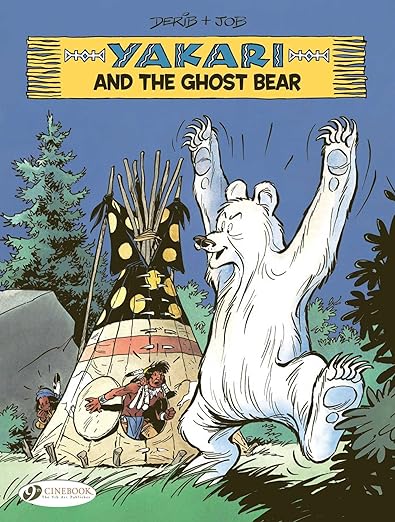
By Derib & Job, coloured by Dominique and translated by Jerome Saincantin (Cinebook)
ISBN: 978-1-80044-173-6 (Album PB/Digital edition)
Win’s Christmas Gift Recommendation: The World We All Want … 9/10
In 1964 children’s magazine Le Crapaud à lunettes was founded by Swiss journalist André Jobin (25/10/1927 – 08/10/2024), who then wrote for it under the pseudonym Job. Three years later, he hired artist and fellow Swiss Francophone Claude de Ribaupierre, AKA “Derib”.
The illustrator had launched his own career as an assistant at Studio Peyo (home of Les Schtroumpfs): working on Smurfs strips for venerable weekly Le Journal de Spirou. Thereafter, together they created the splendid Adventures of the Owl Pythagore prior to striking pure comics gold a few years later with their next collaboration.
Born in Delémont, Jobin split his time between bande dessinées – 39 Yakari albums and 3 for Pythagore – and his other writing, editing and publishing briefs: an admirably restrained and outstandingly effective legacy to be proud of.
Derib – equally au fait with enticing, comically dynamic “Marcinelle” cartoon style yarns and devastatingly compelling meta-realistic action illustrated action epics – became one of the Continent’s most prolific and revered creators with such groundbreaking strips as Buddy Longway, Celui-qui-est-nà-deux-fois; Jo (first comic to deal with AIDS): Pour toi, Sandra and La Grande Saga Indienne. They haven’t been translated into English yet, but still we patiently wait in hope and anticipation…
Yakari is considered by fans and critics to be the strip which led Derib to his deserved mega-stardom. Debuting in 1969, self-contained episodes trace the eventful, nomadic life of an Oglala Lakota boy on the Great Plains, with stories set sometime after the introduction of horses (by colonising Conquistadores) but before the coming of modern Europeans. The series – which also generated two separate animated TV series and a movie – has notched up 42 albums thus far: a testament to its evergreen vitality and brilliance of its creators, even though originator Job moved on in 2016, replaced by Frenchman Joris Chamblain.
Abundant with gentle whimsy and heady compassion, Yakari’s life is a largely bucolic and happy existence: at one with nature and generally free from privation or strife. For the sake of dramatic delectation, however, the ever-changing seasons are punctuated with the odd crisis, generally resolved without fuss, fame or fanfare by a little lad who is smart and brave, and who can – thanks to a boon of his totem guide the Great Eagle – converse with all the beasts of the field and birds of the air…
In 1998, Yakari et l‘Ours fantôme became the 24th European album, but as always, content and set-up are both stunningly simple and sublimely accessible, affording new readers total enjoyment with a minimum of familiarity or foreknowledge required…
It’s high summer and life is slow, easy and comfortable. Yakari’s chores are few and there’s time to canoe on the river and catch up with old pals like the beaver Linden. Suddenly, however, a sudden glimpse of something unusual in the overgrown riverbank undergrowth intrigues the little wise man and leads to a fresh adventure and more new friends…
Tracking the strange sight, Yakari is disturbed at its abrupt disappearance and fears he’s found a ghost. Sleep that night is hard to find and in the morning he’s up early to seek the mystery, much to the annoyance of young chums Rainbow and Buffalo Seed, who are quite content to stay home and snooze more. A little consideration has convinced the beast-speaker that what he encountered was a polar bear far, far from home. It wouldn’t be his first…
Resolved to meet and greet the visitor, Yakari sets off by canoe, as his valiant pony Little Thunder is still asleep too and does not like early calls…
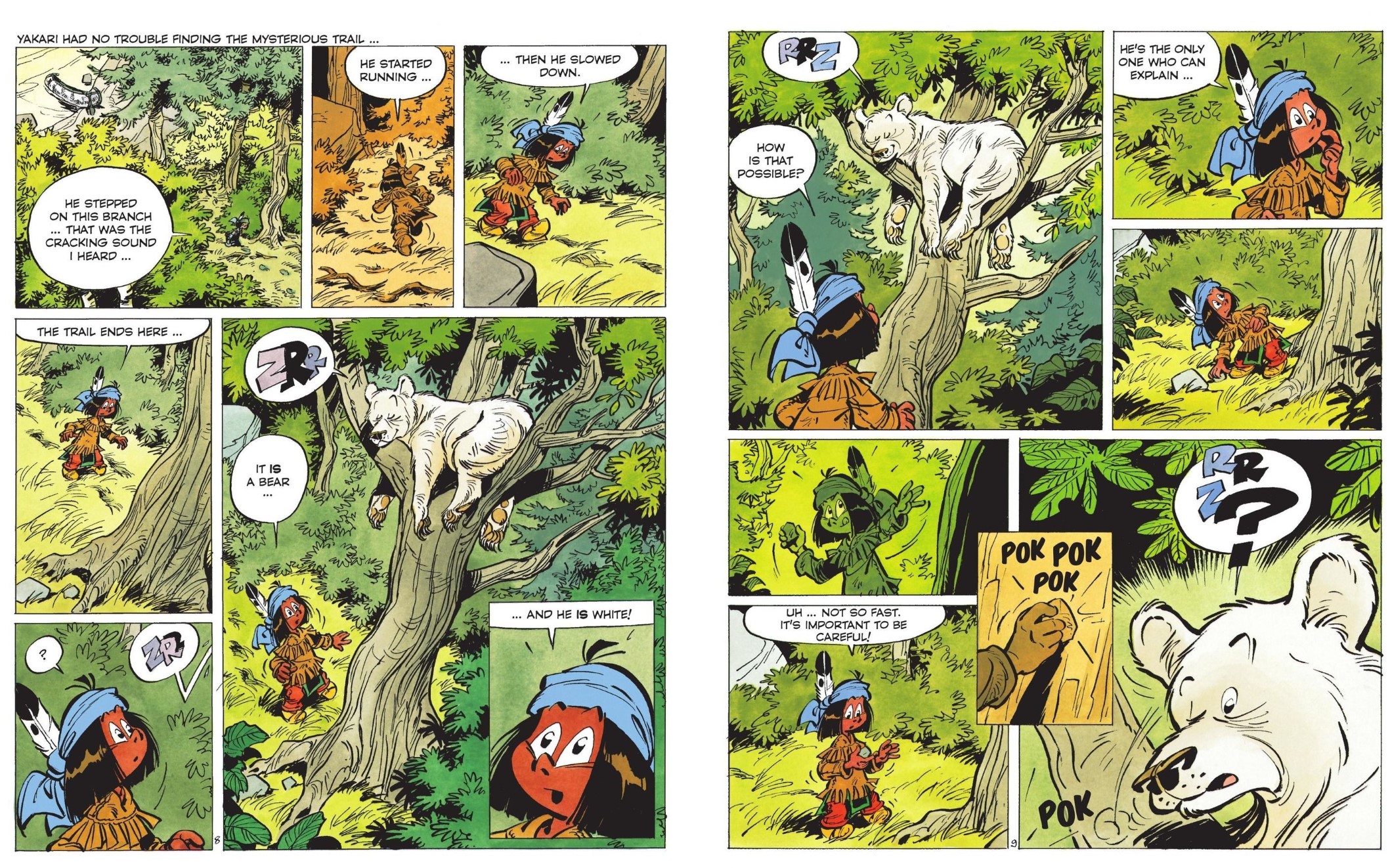
Gifted and schooled in many vital skills, the wilderness lad soon tracks his quarry, but a tense first encounter accidently leaves the spectral bruin fully exposed but totally unconscious. Plagued with guilt, Yakari fetches honeycombs and waits to formally apologise. On the big beast’s awakening, the boy realises this is no lost far-north denizen, but something even stranger…
Gradually warming to each other, the “ghost” explains that he is actually a Black Bear who was born with white fur. His mother called him Snowball, and he was alternatively teased and picked on or chased by vacuous impressionable females dazzled by his glamourous differences. Thus, fed up and impatient, Snowball left home, crossing the Rocky Mountains and following the river ever southwards…
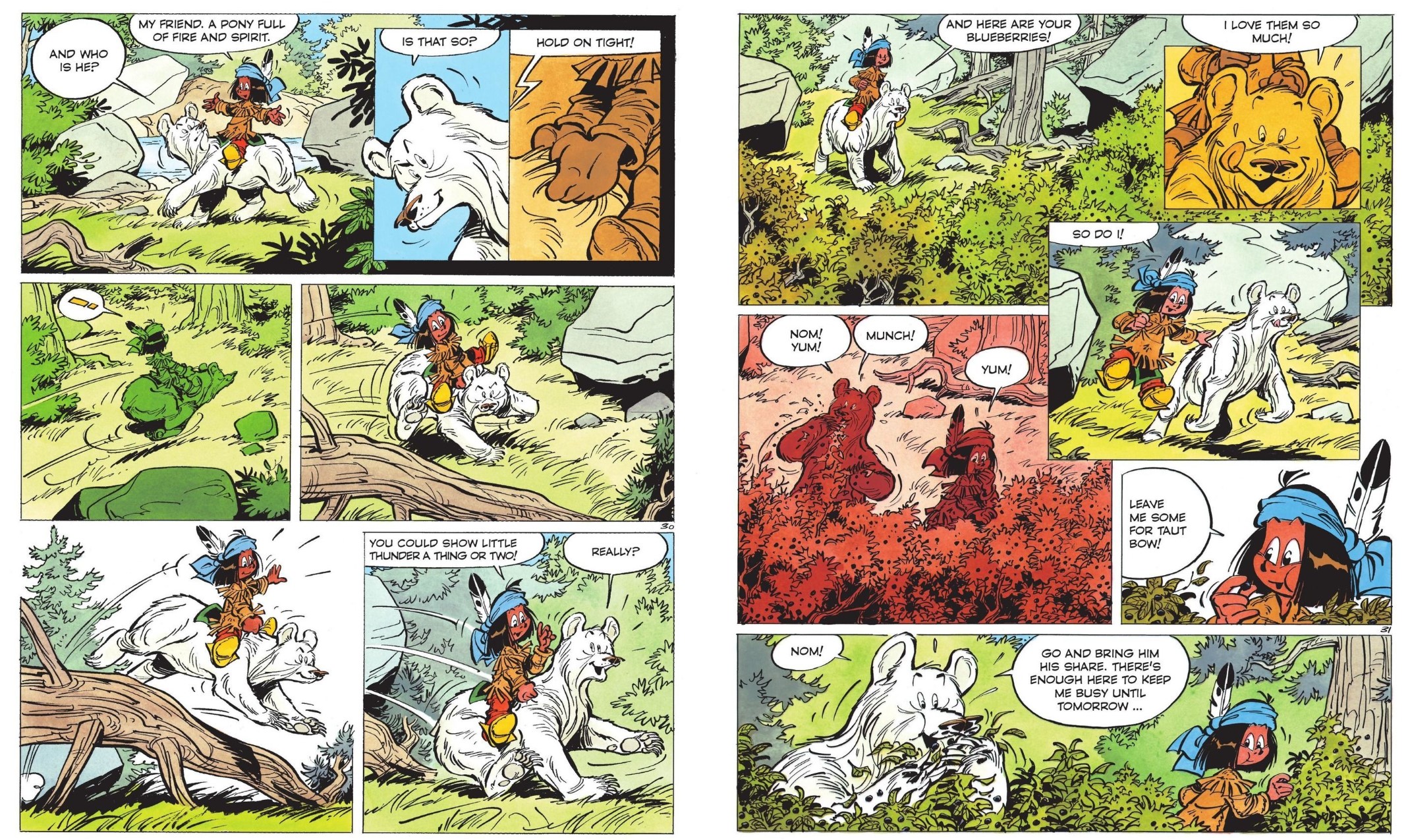
Soon the adventurous pair are best pals, loafing, fishing and having fun, and when Yakari returns to camp he’s anticipating much more to come. He even puts off Rainbow and Buffalo Seed when they enquire if he found his ghost bear, but sadly, they are all unaware that someone else has overheard the conversation.
Taut Bow is a professional hunter who services many local tribes, but he has a problem. As he later proudly shows Yakari, the inveterate, infallible stalker adores white fur. He has killed and preserved the hides of countless animals all the “colour of winter”. Moreover, with what he’s overheard, the travelling butcher can finally complete his collection by adding a white bear skin to it. Of course, he will need Yakari’s help…
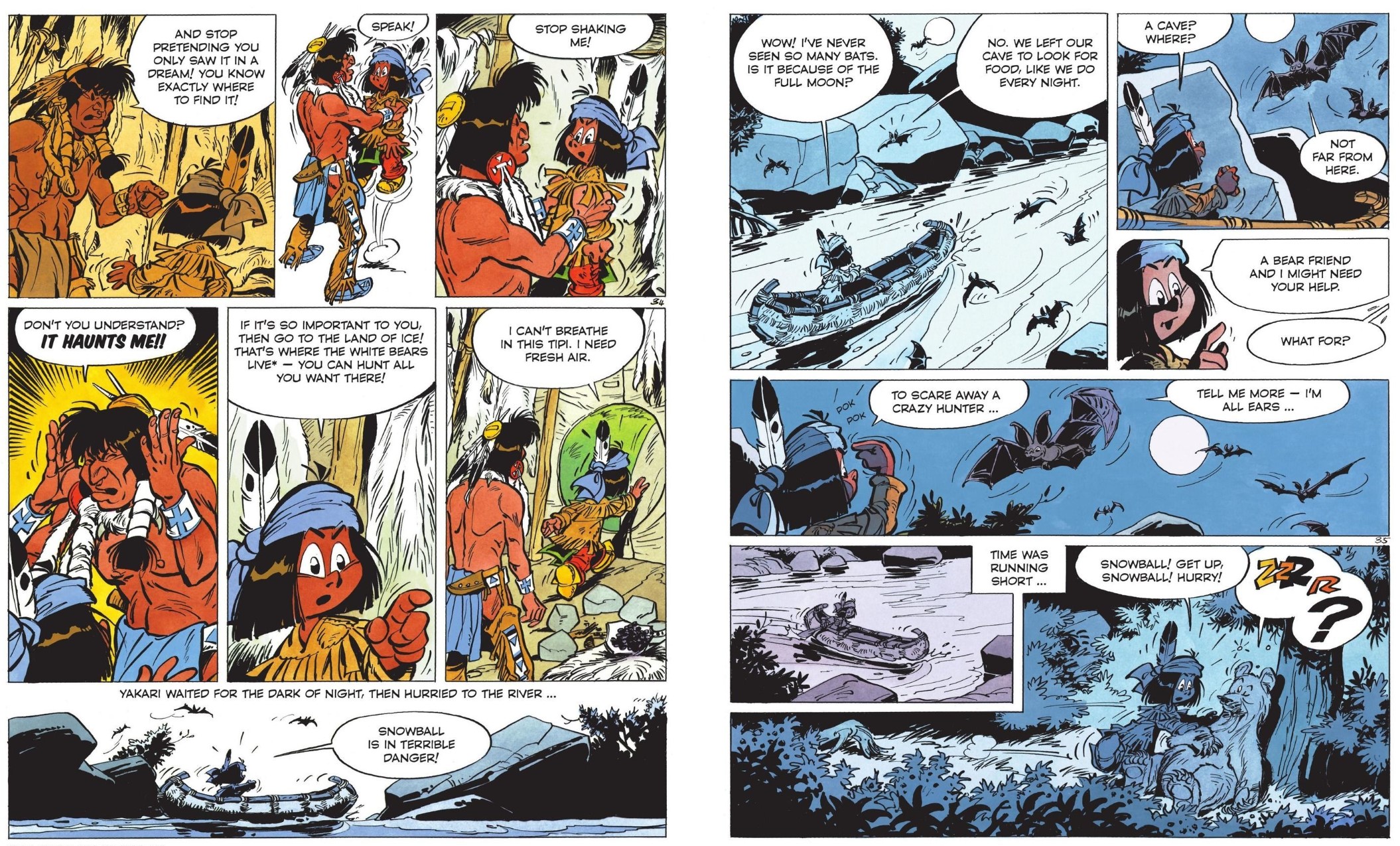
Unable to dissuade, defect or deter the fervent tracker, Yakari devises a devious scheme that is not without risk and involves some nasty sticky business with caves and bats, before ultimately finding a way to deflect Taut Bow’s obsessive attentions and move him on to other hunting grounds.
… And in the peaceful aftermath of a riotous night, spirit raven Venerable Beak delivers a telling lecture pointing out the duty and purpose of those animals chosen to live in white livery: one that changes Snowball’s attitude, destiny and future destinations…
Yakari is one of the most unfailingly absorbing and entertaining all-ages comics strips ever conceived. It should be in every home, right next to Tintin, Uncle Scrooge, Asterix, Calvin and Hobbes and The Moomins. It’s never too late to start reading something wonderful, so why not get back to nature as soon as you can?
Original edition © Derib + Job – Editions du Lombard (Dargaud – Lombard s. a.) – 2002. All rights reserved. English translation © 2025.
In 1904 the magnificent “Marge” (Marjorie Lyman Henderson Buell) was born. Did her childhood in any way affect or drive her cartoon classic Little Lulu? Sixteen years later Steve Canyon inheritor Dick Rockwell arrived himself followed by Wee Pals creator Morrie Turner in 1923.
In comic books, John Buscema was born in 1927 and Mary Marvel debuted in Captain Marvel Adventures #18, cover-dated December 11th 1942. Hate-filler Peter Bagge was born in 1957 and in 2011 the astounding Jerry Robinson died.
If you don’t fear foreigners you might care to celebrate Argentinian Carlos (Cybersix) Meglia’s natal arrival in 1957 and 1964’s auspicious advent of Frenchman Laurent Chabosy who becomes Lewis Trondheim to build bande dessinée magic such as Little Nothings volumes 1-4: The Curse of the Umbrella, The Prisoner Syndrome, Uneasy Happiness, My Shadow in the Distance.