
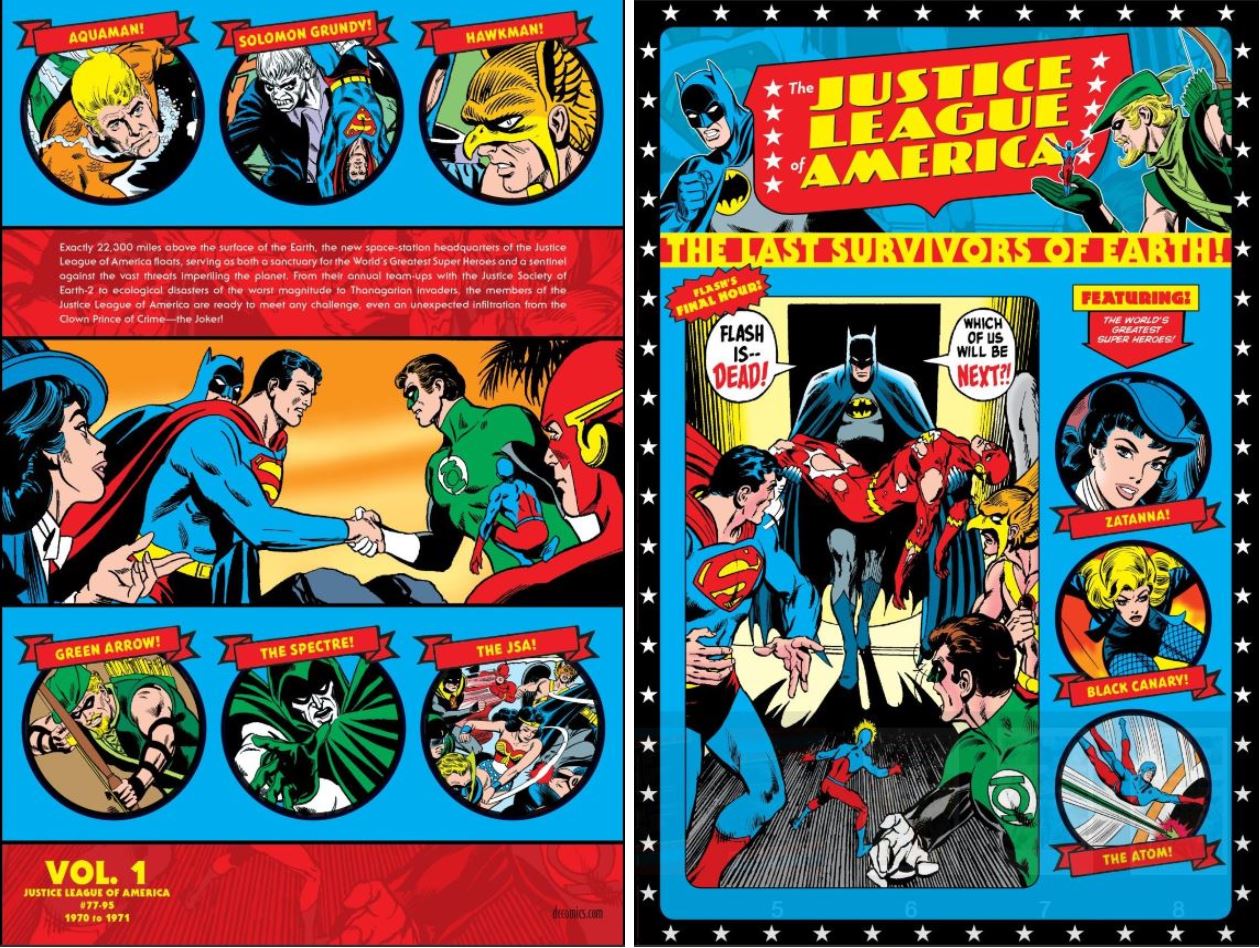
By Denny O’Neil, Mike Friedrich, Robert Kanigher, Dick Dillin, Neal Adams, Joe Giella, Murphy Anderson, Curt Swan, Dick Giordano & various (DC Comics)
ISBN: 978-1-4012-8920-1 (TPB/Digital edition)
This book includes Discriminatory Content produced in less enlightened times.
Win’s Christmas Gift Recommendation: Action, Imagination and Social Conscience: a True Xmas Tradition… 9/10
After the actual invention of the comic book superhero – for which read the Action Comics debut of Superman in 1938 – the most significant event in the industry’s progress was the combination of individual sales-points into a group. Thus, what seems blindingly obvious to us with the benefit of four-colour hindsight was proven: a number of popular characters could multiply readership by combining forces. Plus, of course, a mob of superheroes is just so much cooler than one… or one-and-a-half if there’s a sidekick involved…
And so, the debut of the Justice Society of America is rightly revered as a true landmark in the development of comic books, and when Julius Schwartz revived the superhero genre in the late 1950s, the turning point came with an inevitable union of his reconfigured mystery men. That moment came with #28 of The Brave and the Bold, a classical adventure title that had recently transformed into a try-out magazine like Showcase. Just before Christmas 1959 the ads began running. …Just Imagine! The mightiest heroes of our time… have banded together as the Justice League of America to stamp out the forces of evil wherever and whenever they appear!…
The rest is history: the JLA captivated the youth of a nation, reinvigorated an industry and even inspired a small family concern into creating the Fantastic Four, thereby transforming the art-form itself. Following a spectacular rise, TV spin-offs brought international awareness which led to catastrophic overexposure: by 1968 the new superhero boom looked to be dying just as its predecessor had at the end of the 1940s.
Sales were down generally in the comics industry and costs were beginning to spiral, and more importantly “free” entertainment, in the form of television, was by now ensconced in even the poorest household. If you were a kid in the sixties, think on just how many brilliant cartoon shows were created in that decade, when artists like Alex Toth and Doug Wildey were working in West Coast animation studios. Moreover, comic book heroes were now appearing on the small screen. Superman, Aquaman, Batman, upstart Marvel’s heroes and even the Justice League of America were there every Saturday in your own living room…
It was also a time of great political and social upheaval. Change was everywhere and unrest even reached the corridors of DC. When a number of creators agitated for increased work benefits the request was not looked upon kindly. Many left the company for other outfits. Some quit the business altogether… and some were pushed out…
This fabulous compendium volume reflects the turmoil of those times as the original writer and penciller who had created every single adventure of the World’s Greatest Superheroes since their inception gave way to a new wave of scripters and a fresh if not young artist.
Richard Allen “Dick” Dillin (17th December 1928 – 1st March 1980) had started in the 1940s at Quality Comics on Blackhawk, Plastic Man and their war anthologies. An utterly reliable prolific draughtsman, he moved to DC when the company bought out Quality and spent over a decade drawing their Blackhawk. When Sekowsky left, he would draw every JLA issue for the next twelve years, as well as many other adventures of DC’s top characters – and even a wealth of horror stories when the company started scaring kids for money again…
Collecting issues #77-95 (cover-dates December 1969 to December 1971) and generously re-presenting the stirring covers of #85 & 93: giant all-reprint editions, this tome captures a culture in transition and visible change in the way DC stories were told, over a period when the market changed forever, and comics stopped being casual disposable mass-entertainment.
By the end of the period covered in this volume the publishers had undertaken the conceptual and commercial transition from a mass-market medium which slavishly followed trends and fashions to become a niche industry producing only what its dedicated fans wanted…
Without preamble the drama commences with the heroes’ confidence and worldview shattered after enigmatic political populist Joe Dough suborns and compromises their beloved teen mascot in ‘Snapper Carr… Super-Traitor!’ as crafted by Denny O’Neil, Dillin & Joe Giella, a coming-of-age yarn that changed the comfy, cosy superhero game forever.
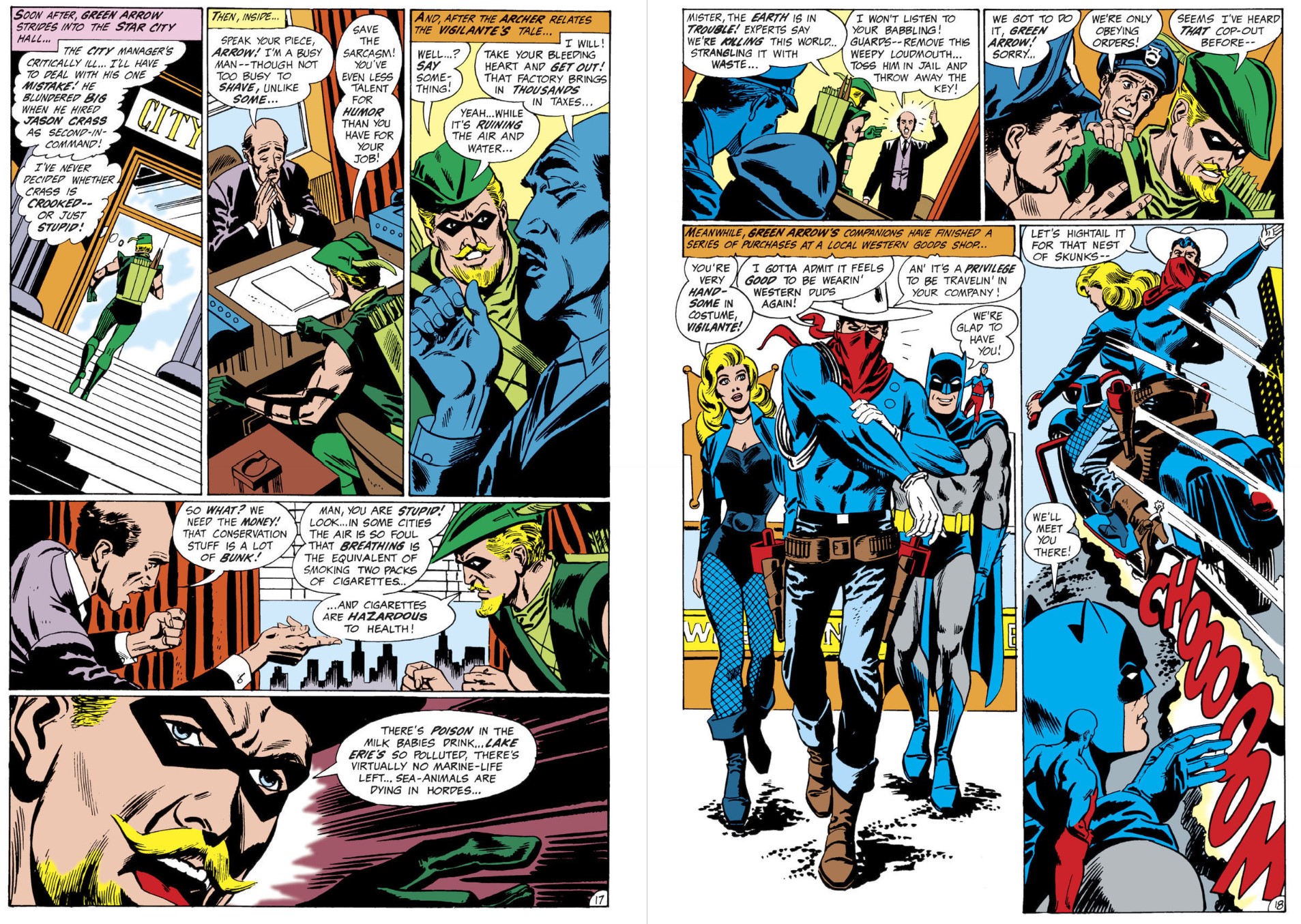
Greater social awareness parading through comics at this time manifested in the next epic 2-parter, which also revives another Golden Age Great (presumably to cash in on the mini-boom in screen Westerns). The Vigilante – a cowboy-themed superhero who battled bandits and badmen in a passel of DC titles from 1941-1954 – here alerts the team to ‘The Coming of the Doomsters!’ just in time to foil alien invaders who use pollution as their secret weapon. The vile plot concludes in ‘Come Slowly Death, Come Slyly!’ as the heroes stop the toxic baddies whilst subtly introducing young readers to potential ecological disasters in the making. This gave us plenty of time to offset greenhouse gases and end our dependence on fossil fuels and has given us the healthy planet we enjoy today…
Another landmark of this still-impressive tale was the introduction of the JLA Satellite, as the team moved from a hole in a mountain to a high-tech orbiting fortress. As they are moving in, ‘Night of the Soul-Stealer!’ sees Thanagarian Lorch Nor collecting heroic spirits in a magic box, but it is only prelude to an even greater threat as JLA #81 reveals his good intentions when the ‘Plague of the Galactic Jest-Master’ threatens to inflict a greater mind-crushing horror upon our entire universe…
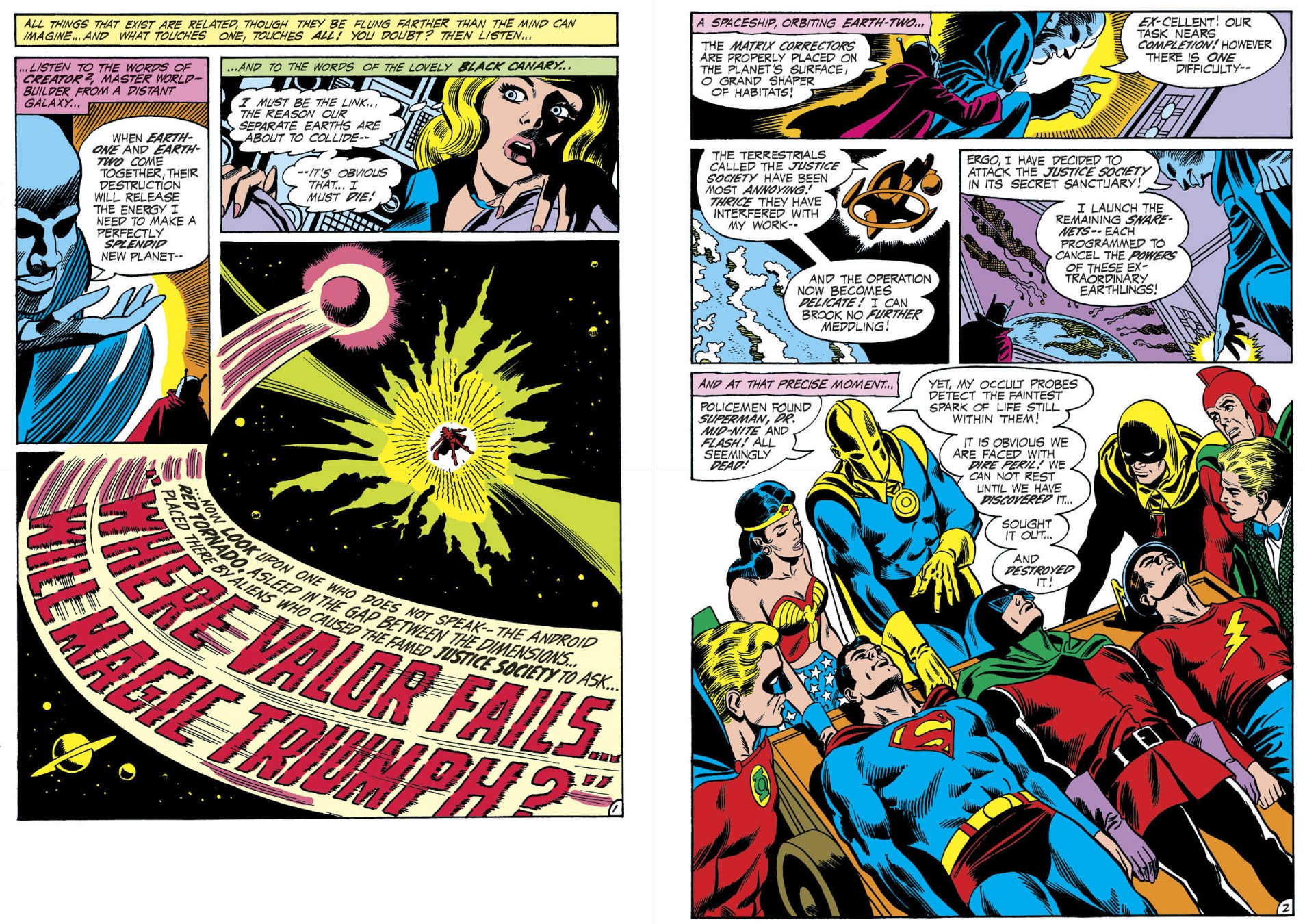
Next is another grand collaboration between JLA and the Justice Society of America as ruthless property speculators (is there any other kind?) from outer space seek to raze two separate Earths in ‘Peril of the Paired Planets’. Only the ultimate sacrifice of a true hero averts trans-dimensional disaster in climactic conclusion ‘Where Valor Fails… Will Magic Triumph?’
Justice League of America #84 (November 1970) hosted ‘The Devil in Paradise!’: a guest-script from veteran Robert Kanigher wherein a well-meaning but demented scientist builds his own Eden to escape Earth’s increasing savagery, before going off the deep end and attempting to cleanse the world and start civilisation afresh.
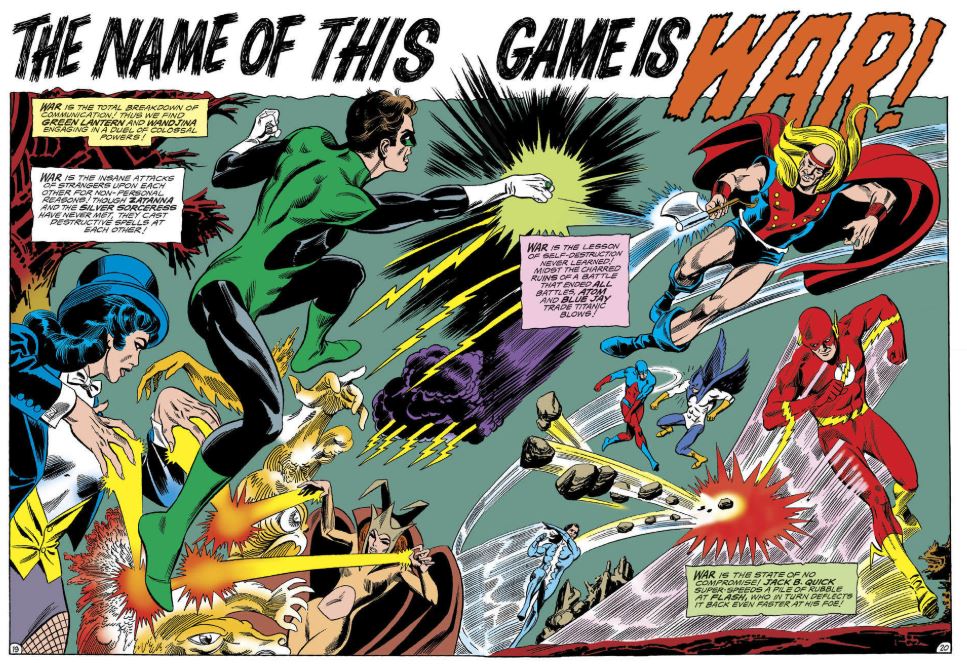
With superheroes on the outs the team was severely truncated too. JLA #86 confronted issues of overpopulation and impending global starvation as Mike Friedrich began a run of excellent eco-thrillers with ‘Earth’s Final Hour!’. Here crooked business entrepreneur (can I say “any other kind” again?) Theo Zappa tries to trade away Earth’s plankton (base of our entire food-chain) to a race of aliens with only Superman, Batman, Flash, Aquaman, Atom & Hawkman on hand to thwart him, whilst #87’s ‘Batman… King of the World!’ brings in occasional guest-star Zatanna and semi-retired Green Lantern Hal Jordan to tackle a deadly alien robot raider. This was a devious and barely veiled attack on Big Business and the Vietnam war, most renowned these days for introducing a group of alien superheroes mischievously based on Marvel’s Mighty Avengers.
The human spirit and enduring humanity are highlighted as ancient refugees from the lost city of Mu return to find us in charge of the planet they had abandoned millennia ago. ‘The Last Survivors of Earth!’ proves that even when superheroes are outmatched by scientifically-instigated global catastrophes, the simple patience, charity and self-confidence of ordinary folks can move mountains and save worlds…
‘The Most Dangerous Dreams of All!’ is one of the oddest tales in the JLA canon, with a thinly disguised Harlan Ellison psychically inserting himself into the consciousness of Superman and Batman to woo Black Canary with near-fatal repercussions, in a rather self-indulgent but intriguing examination of the creative process. Back on – and under – solid ground again for #90, ‘Plague of the Pale People!’ sees Aquaman’s submerged kingdom of Atlantis conquered by a primitive subsea tribe (the Saremites from Flash #109) using nerve gas negligently dumped in the ocean by the US military. In a mordant and powerful parable about lost faith and taking responsibility, the JLA must deal with problems much tougher than whomping monsters, repelling invaders and locking up bad guys…
JLA #91 (August 1971) heralds a hero-heavy first chapter in the annual JLA/JSA team-up with ‘Earth… the Monster-Maker!’ as the Supermen, Flashes, Green Lanterns, Hawkmen, Atoms & Robins of two Realities simultaneously and ineffectually battle an alien boy and his symbiotically-linked dog on two planets a universe apart. The result is meaningless carnage and imminent death until ‘Solomon Grundy… the One and Only!’ gives all concerned a life-saving lesson on togetherness and lateral thinking…
Following the cover of reprint giant #93, Neal Adams steps in to provide additional pencils for tense mystery ‘Where Strikes Demonfang?’ as ghostly guardian Deadman helps Batman, Aquaman & Green Arrow foil a murder mission by previously infallible archer Merlyn and the League of Assassins.
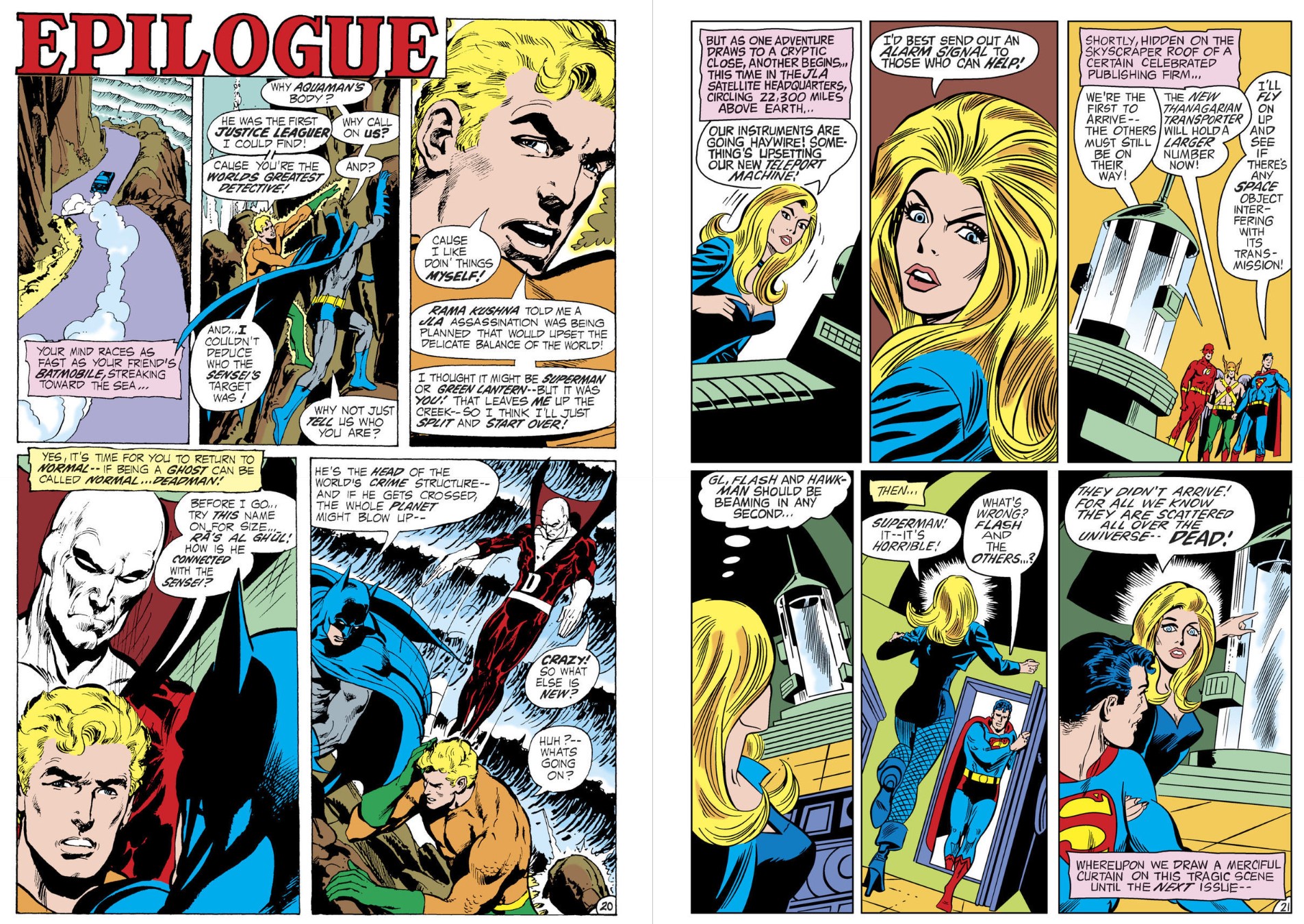
The issue and this tome end on a cliffhanger as Flash, Green Lantern & Hawkman are lost in a teleporter accident, leaving Batman, Black Canary, Green Arrow & Atom to fight ‘The Private War of Johnny Dune!’ wherein a disaffected African American freshly returned from Vietnam discovers the power and temptation of superpowers. Tragically, even the ability to control minds isn’t enough to change an unjust society 200 years in the making…
Augmented by stunning covers from Murphy Anderson, Curt Swan, Dick Giordano & Adams, these thoroughly wonderful thrillers mark an end and a beginning in comic book storytelling as whimsical adventure was replaced by inclusivity, social awareness and tacit acknowledgement that a smack in the mouth can’t solve all problems.
The audience was changing and the industry was forced to change with them. But underneath it all the drive to entertain remained strong and effective. Charm’s loss is drama’s gain and today’s readers might be surprised to discover just how much punch these tales had – and still have.
And for that you must get this book…
© 1969, 1970, 1971, 2019 DC Comics. All Rights Reserved.
Today in 1929, Dick Dillin was born. You can appreciate his lifetime of comics creation drawing everyone from Aquaman to Zatanna in everything from Blackhawk to World’s Finest Comics… and you should. Or you could just scroll up.
In Britain, Strongman’s Daughter Pansy Potter debuted in 1938, courtesy of Hugh McNeill and The Beano. Red Ryder co-creator Stephen Slesinger died today in 1953 and in 2006 ultra prolific comics phenomenon Joe Gill passed away. He co-created Captain Atom and most reprinted Charlton comics you’ve heard of. Why not track down Strange Suspense: The Steve Ditko Archives vol 1 for a taste?