
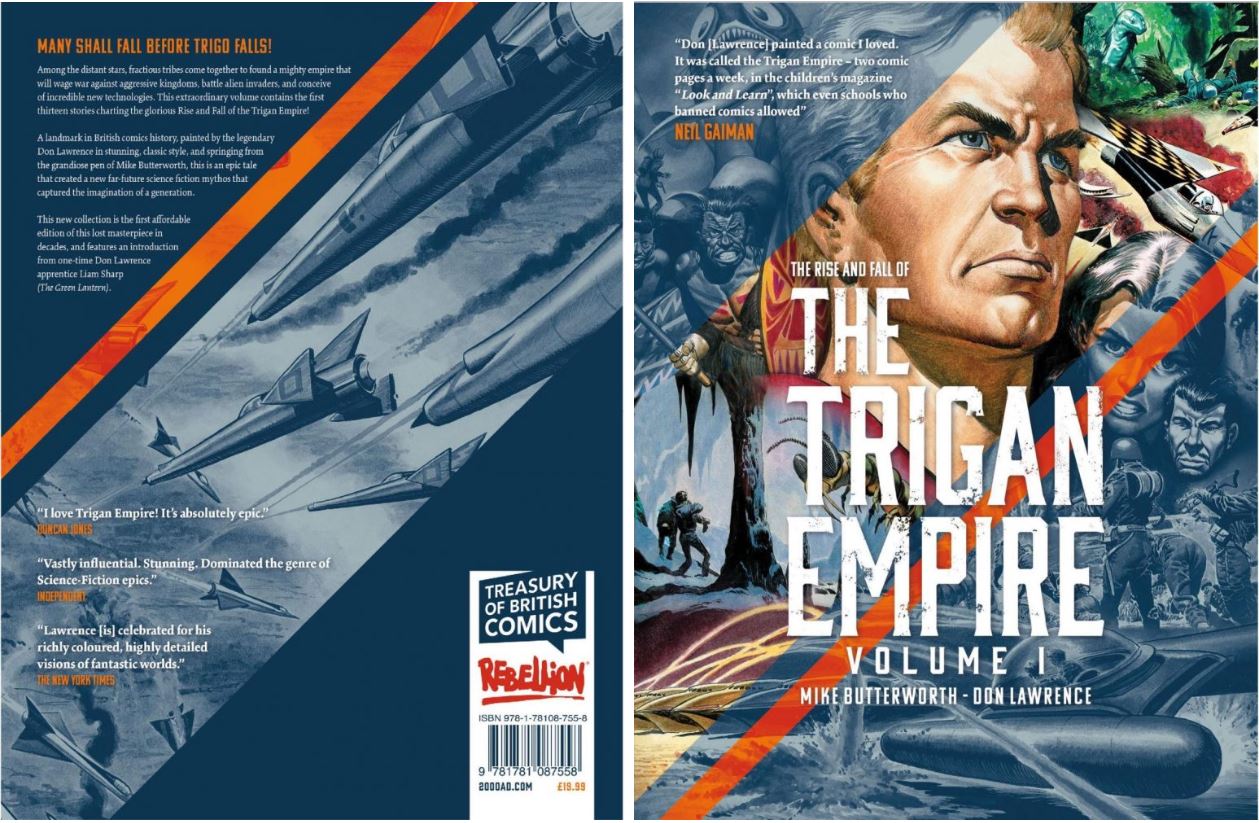
By Mike Butterworth & Don Lawrence & various (Rebellion Studios)
ISBN: 978-1-78108-755-8 (TPB/Digital edition)
This book includes Discriminatory Content produced in less enlightened times.
For British – and Dutch – readers of a certain age and prone to debilitating nostalgia, The Trigan Empire (or The Rise and Fall of the Trigan Empire to give it its ponderous full title) was only ever about two things: boyish wish-fulfilment and staggeringly beautiful art.
The strip was created by Senior Group Editor Leonard Matthews and given to the editor of Sun and Comet to develop and continue. A trained artist, Mike Butterworth became writer of many historical strips such as Buffalo Bill, Max Bravo, the Happy Hussar, Battler Britton and Billy the Kid – and latterly a crime and gothic romance novelist with more than 20 books to his pen names.
Based in equal part on cinematic Sword & Sandal/Biblical epics and the space age fascination of a planet counting down to a moonshot, for the saga Butterworth combined his love of the past, a contemporary comics trend for science fiction and that long-established movie genre of manly blockbusters to construct a vast sprawling serial of heroic expansionism, two-fisted warriors, wild beasts, deadly monsters and even occasionally the odd woman.
The other primary influence on the series was the fantasy fiction of Edgar Rice Burroughs (especially John Carter of Mars and Pellucidar) but without his concentration on strong and/or blatantly sexy women – usually as prizes for his heroes to save. In the formative days of the Trigan Empire, ladies dressed decorously, minded their manners and were dutiful wives or nurses… unless they were evil, vindictive or conniving…
The compellingly addictive, all-action thematic precursor to Warhammer, Civilisation and Warcraft might have been a short run venture had it not been for the art. The primary illustrator was Don Lawrence (Marvelman, Wells Fargo, Billy the Kid, Karl the Viking, Fireball XL5, Maroc the Mighty, Olac the Gladiator, The Adventures of Tarzan, adult comedy strip Carrie and his multi-volume Dutch magnum opus Storm), who painted each weekly instalment.
Initially he used watercolours before switching to quicker-drying gouaches, rendered in a formal, hyper-realistic style that still left room for stylistic caricature and wild fantasy, and one that made each lush backdrop and magnificent cityscape a pure treasure. Other, later artists included Ron Embleton, Miguel Quesada, Philip Cork, Gerry Wood and Oliver “Zack” Frey, as the strip notched up 854 weekly instalments, beginning in September 1965 and only ending in 1982. Along the way, it had also appeared in Annuals and Specials and become a sensation in translated syndication across Europe.
Even after it ended – and, thanks to these collections, it has recently resumed! – the adventure continued: in reprint form, appearing in the UK in Vulcan and across the world; in two Dutch radio plays; collected editions sold in numerous languages; a proposed US TV show and numerous collected editions from 1973 onwards. Surely someone must have a movie option in process: if only Kirk Douglas, Burt Lancaster and Tony Curtis were still around, we could completely close the creative circle…
Lawrence (17th November 1928 – 29th December 2003) inspired a host of artists such as Brian Bolland and Dave Gibbons, but as he worked into the 1990s, his eyesight was increasingly hindered by cataracts and he took on and trained apprentices such as Chris Weston and Liam Sharp (who offers his own potent reminiscences in the Introduction to this first archival volume from Rebellion Studios’ Treasury of British Comics). Sharp collaborated with the venerable artist on his last Storm stories…
Inescapably mired in powerful nostalgia, but also standing up remarkably well on its own merits, this first collected volume re-presents the series from its enigmatic opening in high-end tabloid weekly magazine Ranger, combining comics with a large selection of factual features. The fantasy soon began to steal the show and was the most noteworthy offering for the entirety of the publication’s 40 week run, spanning 18th September 1965 to 18th June 1966. It then carried over – with a few other choice strips – into Look and Learn, beginning with #232: remaining until the magazine closed with #1049 (April 1982).
Ranger had been a glossy, photogravure blend of traditional comic anthology strips and educational magazine, and when it folded, the only publication able to continue The Trigan Empire in its full grandeur was Look and Learn…
One of our most missed publishing traditions is the educational comic. From science, history and engineering features in the legendary Eagle to a small explosion of factual and socially responsible boys and girls papers in the late 1950s to the heady go-getting heydays of the 1960s & 1970s, Britons always enjoyed a healthy sub-culture of comics that informed, instructed and revealed – and that’s not even counting all the pure sports comics!
Amongst many others Speed & Power, Treasure, World of Wonder, Tell Me Why, and Look and Learn spent decades making things clear, illuminating understanding and bringing the marvels of the changing world to our childish but avid attentions with wit, style and – thanks to the quality of the illustrators involved – astonishing beauty. Look and Learn launched on 20th January 1962: brainchild of Fleetway Publications’ then Director of Juvenile Publications Leonard Matthews. The project was executed by editor David Stone (almost instantly replaced by John Sanders), sub-editor Freddie Lidstone and Art Director Jack Parker.
For 20 years it delighted children, and was one of the country’s most popular children’s weeklies. Naturally there were many spin-off tomes such as The Look and Learn Book of 1001 Questions and Answers, Look and Learn Book of Wonders of Nature, Look and Learn Book of Pets and Look and Learn Young Scientist as well as utterly engrossing Christmas treat tradition The Look and Learn Book and – in 1973 – The Look and Learn Book of the Trigan Empire: the serial’s very first hardback compilation.
Strangely, many, many kids learned stuff they didn’t think they cared about simply because it filled out the rest of that comic that carried the Trigan Empire…
In this tome we review 25th June1966 through 17th May 1968, encompassing Ranger #1-40 and Look and Learn #232-331: subdivided for your convenience into 13 chapter plays of what we oldsters absorbed as one continuous unfolding procession of wonder…
Depicted with sublime conviction and sly wit, it begins with ‘Victory for the Trigans’ (18th September 1965 – 29th January 1966) as fishermen in the Florida swamps witness a spaceship crash. All aboard are dead, and after, the global news cycle wearies of the story, the craft is reduced to a sideshow attraction whilst scholars meticulously investigate its technology, dead voyagers and a huge set of journals written in an indecipherable language. No one succeeds and eventually, no one cares…
All except student Richard Peter Haddon, who spends the next half century looking for the key and – at age 70 – cracks the code, subsequently translating the history of a mighty race of aliens so very like earthmen…
From then on the scene switches to distant twin-sunned world Elekton, where numerous kingdoms and empires-in-waiting jostle for dominance. In many ways it’s like Earth a few thousand years before the birth of Christ… except for all the monsters, skycraft and ray guns…
In the wilds and wastes between the nations of Loka, Tharv, Davelli and Cato, brutish far-ranging tribes of nomadic Vorg hunt and clash and live brief free lives, until three brothers decide existence could be so much more…
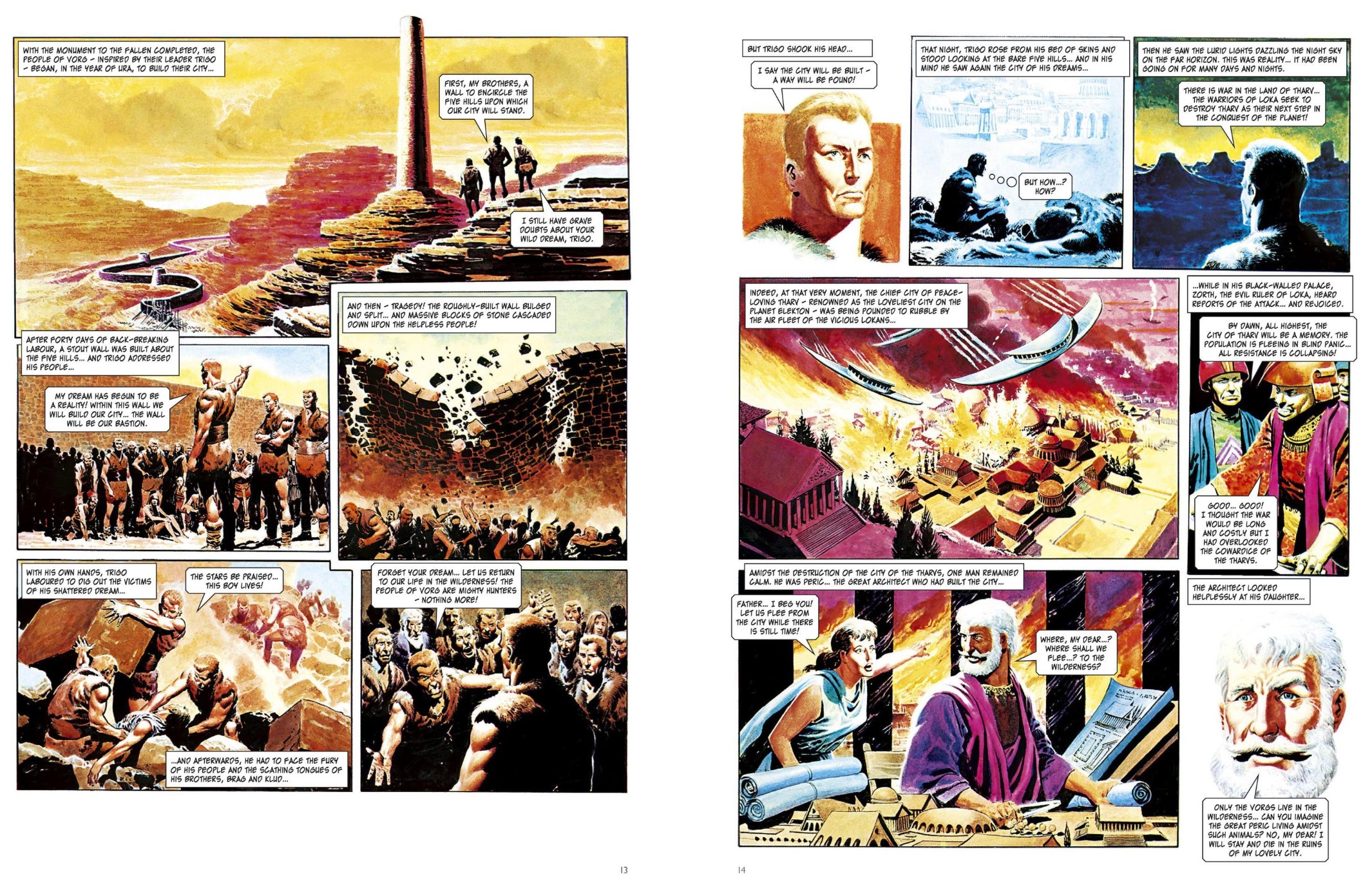
Driven, compelling and charismatic, notional leader Trigo has a dream and convinces his siblings Brag and Klud to ask their people to cease following roving herds of beasts and settle by a river where five hills meet. Before long they have raised a city and begun the march to empire. Of course, all those defiant libertarians were initially resistant to becoming civilised, but that ended after the more advanced Lokans began hunting them for sport from their flying ships…
By the time Loka’s King Zorth finally gets around to conquering Tharv and formally annexing the lands of Vorg in his plan to become global dictator, Trigo has begun building his city and invited refugees from Tharv to join him. Amongst the many displaced survivors of Lokan atrocity is Peric – an architect and philosopher generally acclaimed as the smartest man alive. He is cared for by his daughter Salvia. Both will play major roles in the foundation of the Trigan Empire…
When Zorth at last turns to consolidation by taking Vorg, his air, sea and land forces are met by an unbeatable wall of death and history is rewritten. It comes at great cost, most notably to Trigo as victory is almost snatched from him when brother Klud attempts to murder him, seize power and betray their people to the Lokans…
With an empire established, one translated book ends, and Professor Haddon’s life’s work moves on to what we’ll call ‘Crash in the Jungle’ (5th February – 19th February 1966), introducing young warrior/pilot Janno. The son of Brag, he is childless Trigo’s nephew and heir apparent: enjoying many dynamic adventures as an imperial troubleshooter whilst being groomed for rule. Here, still wet behind the ears, the lad crashes in the plush rainforests of Daveli, befriends Keren – son of a formerly antagonistic aboriginal chieftain – and facilitates their alliance with the ever-expanding Trigan Empire. When Janno returns to pilot training, Keren is beside him and will be his constant companion in all further exploits…
Planetary chaos erupts next as ‘The Falling Moon’ (26th February – 28th May 1966) reshapes Elekton’s political map. When Gallas impacts sister moon Seres, the cosmic collision sends the satellite smashing into Loka where – forewarned – Zorth seeks to relocate his power base and entire populace by seeking sanctuary in Trigo’s city. Once admitted and welcomed, the Lokans bite the hand that shelters them by seizing the city. Valiant Brag manages to save wounded Trigo, but they are captured and enslaved by desert raiders of the Citadel…
As Janno and Keren escape to mount a futile resistance to the Lokans, slave worker Trigo foils an assassination and earns the gratitude of the Citadel king, who lends him a band of warriors to retake his own city. When they link up with Janno & Keren, Zorth’s defeat and doom are assured…
Time moves differently on Elekton and many events seem telescoped, but as the strip jumps to a new home, continuity manifests in ‘The Invaders from Gallas’ (4th June – 18th June) in Ranger before continuing in Look and Learn #232-237 from 25th June to 30th July 1966. As the fallen moon cools, aliens dwelling inside emerge to attempt the conquest of their new world via their mind control techniques. With the Trigans crazed and killing each other, only a deaf man holds the key to their survival…
Look and Learn #238-242 (6th August – 3rd September 1966) featured ‘The Land of No Return’ – which sees Janno accidentally sent along the River of Death (a rather cheeky “tribute” to Burroughs’ Mars stories), debunking an insidious religious belief that had for millennia curtailed life for Elekton’s elderly whilst ending a cult of elder-abusing slavers…
‘The Revolt of the Lokans’ (L&L #243-255, 10th September – 3rd December 1966) returns to the exiled former-conquerors who poisoned and deranged Trigo before retaking his city. Thankfully, Keren and Peric find a way to restore order to the city and its ruler, after which #256-264 (10th December 1966 – 4th February 1967) detail ‘War with Hericon’ as Trigo marries Lady Ursa, sister of King Kassar: ruler of the aloof, distant empire (a visual melange of Earth’s Persian and Byzantine kingdoms).
The diplomatic love match is soured by a single sinister malcontent when Yenni – a vengeful criminal outcast of both Hericon and Trigan – foments racial unrest in both realms and lets human nature do its worst…
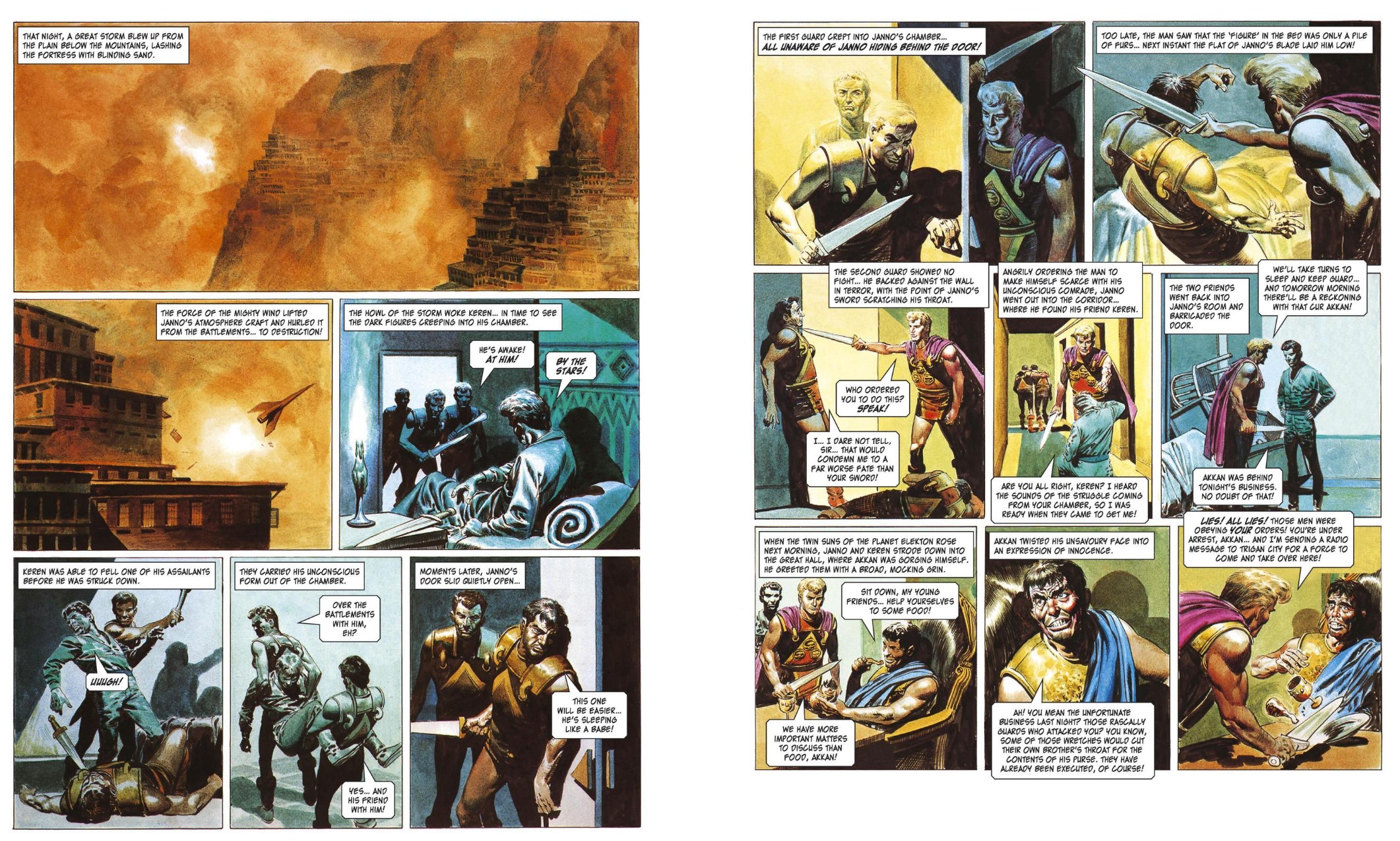
Janno & Keren took the lead again in ‘Revolution in Zabriz’ (#265-273, 4th February – 8th April 1967), when despatched to survey a distant mountain outpost only to uncover a plot by its governor. He uses captive labour to finance a coup to oust Uncle Trigo and take over the empire, after which ‘The Lokan Invasion’ (L&L #274-279, 15th April – 20th May) sees the brothers-in-arms stumble into a devious scheme by chemist Vannu to destroy the Trigans by contaminating their water with amnesia-inducing potions…
Vengeful retaliation is once more the pivotal factor as ‘The Revenge of Darak’ (#280-290, 27th May – 5th August) reveals how Trigan’s greatest pilot betrays his emperor and is punished with slavery in the mines. After a year, he escapes and uses his insider knowledge to drive a wedge between Trigo and Brag, poison Peric and embroil Hericon in war. Thankfully, brotherly love trumps hurt feelings and justice conquers all…
A taste of horror comes with ‘The Alien Invasion’ L&L #291-297 (13th August – 23rd September) as energy beings land on Elekton. Able to possess organic brains, the intruders work their way up the planet’s food chain until Keren, Kassar and Trigo are fully dominated, but the cerebral tyrants have not reckoned on Peric’s wit or Janno’s cunning…
The first major role for a woman comes in ‘The Reign of Thara’ (L&L #298-316, 30th September 1967 – 3rd February 1968) as the royal family is ousted by deceit and a secret society of soldiers instals the daughter of Klud in Trigo’s place. Vain, haughty and imperious, she is intended to be a puppet of secret manipulators, but proves to possess too much pride and backbone to allow the empire to fall to mismanagement and enemy incursions. Happily, the actual Royal Family have survived their well-planned dooms and returned, leading an army of liberated slaves and a fleet of pirates sworn to Trigo’s service…
During the campaign, Kern & Janno befriend a rural bumpkin, obsessed with flying, and clownish Roffa becomes their third “musketeer”, playing a major role in the concluding tale here.
Spanning Look & Learn #317-331 (10th February – 17th May 1968), ‘The Invasion of Bolus’ sees the trio captured by rogue scientist Thulla and pressganged into joining his mission to build a ship and conquer Elekton’s inhabited moon. Unable to defy or escape, they become unwilling members in his army, before defecting to the super-advanced but pacifistic Bolans. At least the lads left a warning before lift-off: one that – eventually – reaches Trigo & Peric.
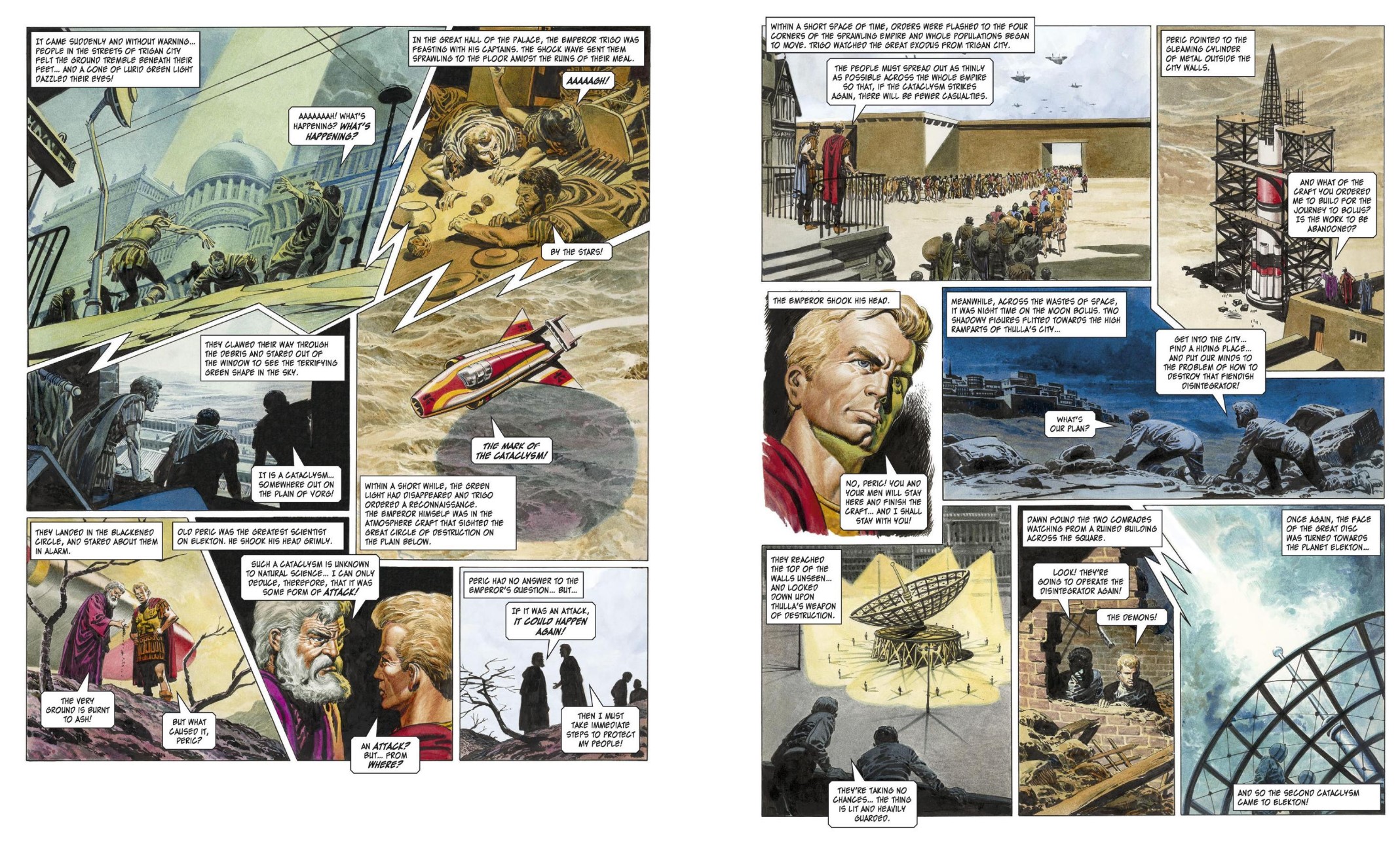
As the Trigans rush to construct a rescue vessel, Thulla brutally seizes the moon people’s city and commences the second part of his plan: building a colossal ray cannon to destroy all life on Elekton. As Trigo’s ship takes off – too late to stop devasting blasts from Bolus – Janno & Keren are forced to desperate measures to save their people from the murderous madman…
Incorporating a tantalising teaser for the next volume and creator biographies, this spectacular visual triumph is a monument to British Comics creativity: one that simultaneously pushes memory buttons for old folk whilst offering a light but beautiful straightforward space opera epic readily accessible to the curious and genre inquisitive alike.
Is that you or someone you know?
The Rise and Fall of the Trigan Empire is ™ Rebellion Publishing IP Ltd. © 1965, 1966, 1967 & 2019 Rebellion Publishing IP Ltd. All Rights Reserved.
Literally born yesterday in 1928 Stanley Lieber – AKA Stan Lee – did a whole lot and appears many times in this blog. You should go look. In 1967 groundbreaking Acme Novelty Library cartoonist Chris Ware arrived, followed two years later by sound fella P.J. Holden (2000 AD, Judge Dredd, Warhammer) who we last covered in Bad Magic – A Skullduggery Pleasant Graphic Novel.
However, TODAY in 1946, Milton Caniff’s last Terry and the Pirates episode appeared. Whilst he rose to even greater heights with Steve Canyon, George Wunder carried Terry, Pat & Co. until 1973.
In 1963 Dave McKean was born, but otherwise today is one for the “loss” column, with Raeburn van Buren dying in 1987, Disney artist Tony Strobl in 1991, Barbarella creator Jean-Claude Forest in 1998 and wonderful Don Lawrence in 2003. As always you can search our engine or find one of your own preference for more…