
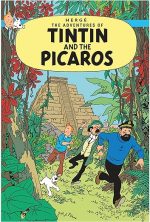
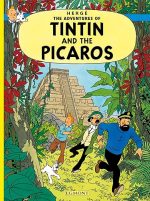
By Hergé and Studios Hergé, translated by Leslie Lonsdale-Cooper & Michael Turner (Egmont)
ISBN: 978-1-40520-823-9 (album HB) 978-1-405206-35-8 (Album PB)
This book includes Discriminatory Content produced in less enlightened times.
Georges Prosper Remi, AKA Hergé created an undying masterpiece of graphic literature with his serialised tales of a plucky boy reporter and entourage of iconically odd associates. Singly, and later with assistants including Edgar P. Jacobs, Bob de Moor, Roger Leloup and other supreme stylists comprising the Hergé Studio, he created 23 timeless yarns (initially episodic instalments for a variety of newspaper periodicals) which have since grown beyond their mass-entertainment roots to attain the status of High Art and international cultural icons.
On leaving school in 1925, Remi began working for conservative Catholic newspaper Le Vingtiéme Siècle where he fell under the influence of its Svengali-esque editor Abbot Norbert Wallez. A devoted Boy Scout, one year later the young artist was producing his first strip series – The Adventures of Totor – for monthly Boy Scouts of Belgium magazine. By 1928 Remi was also in charge of producing the contents of the LVS’s weekly children’s supplement Le Petit Vingtiéme.
While Remi was illustrating The Adventures of Flup, Nénesse, Poussette and Cochonette – written by the staff sports reporter – Wallez required his compliant creative cash-cow to concoct a new and contemporary adventure series. Perhaps a young reporter who roamed the world, doing good whilst displaying solid Catholic values and virtues?
The rest is history…
Some of that history is quite dark: During the Nazi Occupation of Belgium, Le Vingtiéme Siècle was closed down and Hergé was compelled to move his supremely popular strip to daily newspaper Le Soir (Brussels’ most prominent French-language periodical, and thus appropriated and controlled by the Nazis). He diligently toiled on for the duration, and, following Belgium’s liberation, was accused of collaboration and even of being a Nazi sympathiser. It took the intervention of Belgian Resistance war hero Raymond Leblanc to dispel the cloud over Hergé, which he did by simply vouching for the cartoonist through words and deeds.
Leblanc provided cash to create a new magazine – Le Journal de Tintin – which he published and managed. The anthology comic swiftly achieved a huge weekly circulation, allowing Remi and his studio team to remaster past tales: excising material dictated by the Fascist invaders to ideologically shade the wartime adventures. Post-war modernising exercises also improved and updated the great tales, just in time for Tintin to become a global phenomenon, both in books and as an early star of animated TV adventure.
With the war over and his reputation restored, Hergé entered the most successful period of his artistic career. He had mastered his storytelling craft, possessed a dedicated audience eager for his every effort and was finally able to say exactly what he wanted in his work, free from fear or censure, if not his personal demons and declining health…
The greatest sign of this was not substantially in the comics tales – although Hergé continued to tinker with the form of his efforts – but rather in how long the gaps were between new exploits. The previous (22nd) romp had completed serialisation in 1967 and was duly collected as an album in 1968. It was then eight years before Tintin et les Picaros was simultaneously serialised in Belgium and France in Tintin-l’Hebdoptmiste magazine (from 16th September 1975 to April 13th 1976) but at least the inevitable book collection came out almost immediately upon completion.
Tintin and the Picaros is in all ways the concluding adventure, as many old characters and locales from previous tales make one final appearance. A partial sequel to The Broken Ear (please link to September 15, 2018) it finds operatic phenomenon Bianca Castafiore implausibly arrested for spying in Central American republic San Theodoros, with Tintin, Captain Haddock and Professor Calculus eventually lured to her rescue.
Insidious Colonel Sponsz – last seen in The Calculus Affair (please link to June 13, 2019) – is Bordurian Military Advisor to the Government of usurper General Tapioca, and has used his position to exact revenge on the intrepid band who humiliated him in his own land. When Tintin & company escape into the jungles during a murder attempt they soon link up with old comrade Alcazar, now leading a band of Picaro guerrillas dedicated to restoring him to power.
Central and South American revolutions were all the rage in the 1970s and Hergé’s cast had been involved with this one on and off since 1935. With the welcome return of anthropologist Doctor Ridgewell and the hysterical Arumbayas, and even an improbable action role (kind of) for obnoxious insurance salesman and comedy foil Jolyon Wagg, the doughty band bring about the final downfall of Tapioca in a thrilling yet bloodless coup during Carnival time, thanks to a hilarious comedy maguffin (initially targeting dipsomaniac Haddock) that turns out to be a brilliant piece of narrative misdirection by the author.
Sly, subtle, thrilling and warmly comforting, this tale was generally slated when first released but with the perspective of intervening decades can be seen as a most fitting place to end The Adventures of Tintin… but only until you pick up another volume and read them again – as you indubitably will.
Tintin and the Picaros: artwork © 1976 by Editions Casterman, Paris & Tournai. Text © 1976 Egmont UK Limited. All rights reserved.
Today in 1887 Betty Boop creator Bud Counihan was born, as was Dixie Dugan creator J.P. McEvoy in 1894. In 1909 DC stalwart Jack Miller (Rip Hunter, Aquaman, Deadman) was born, and as you’ve just seen Tintin debuted today in 1929 in the first episode of Tintin in the Land of the Soviets.
In 1932 the first Sunday Mickey Mouse page appeared as did UK footie mag Scorcher in 1970. Most momentously, Marvel mainstay John Buscema died today in 2002.