
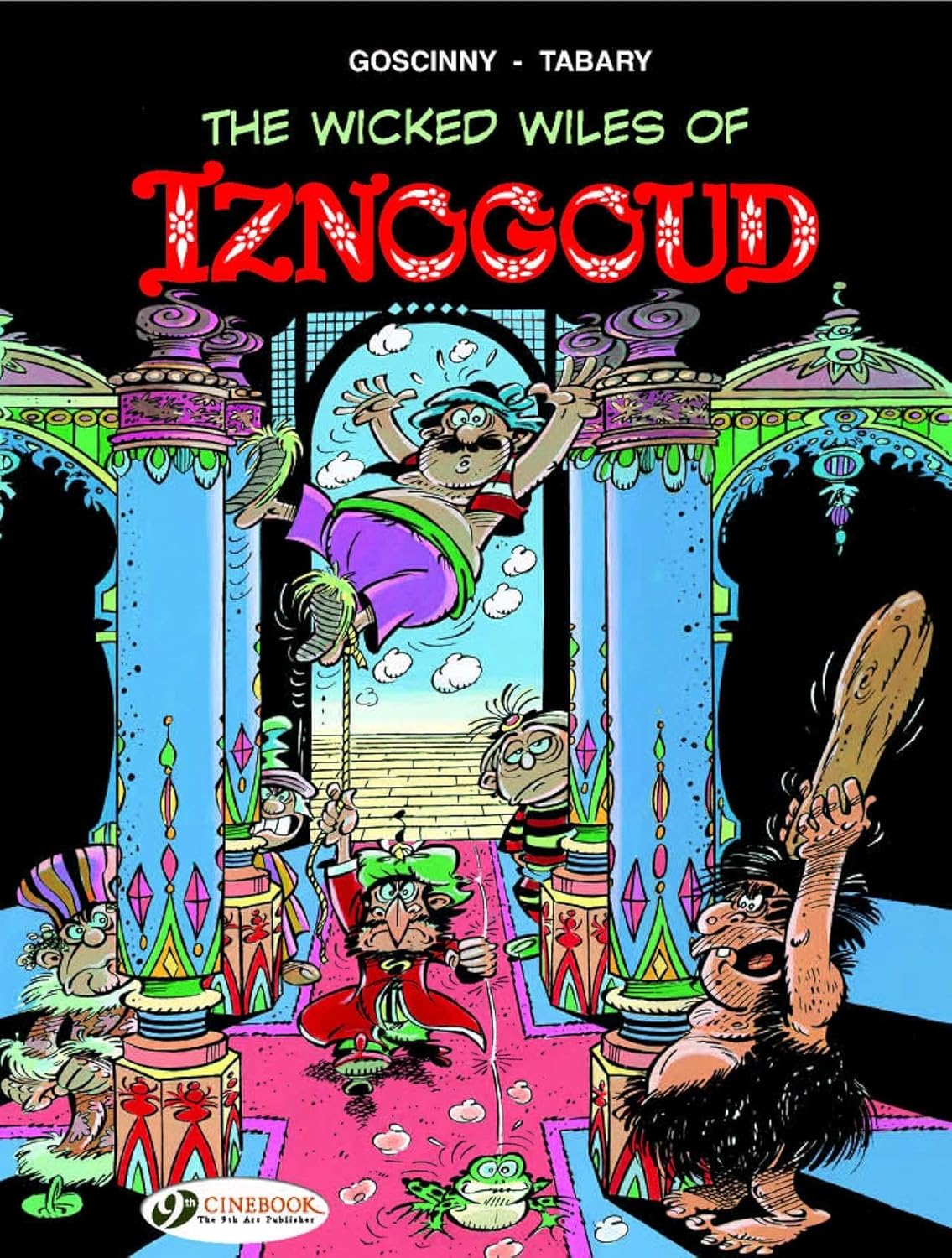
By René Goscinny & Jean Tabary, translated by Anthea Bell & Derek Hockridge (Cinebook)
ISBN: 978-1-905460-46-5 (Album TPB/Digital edition)
This book includes Discriminatory Content produced in less enlightened times.
It’s anniversary time again! Today in 1962 something smart and wildly wicked first appeared, and just hung around. Please read on…
For the greater part of his too-short lifetime (1926-1977) René Goscinny was one of (if not The) most prolific, most-read writers of comic strips the world had ever seen. He still is.
Among his most popular comic collaborations are Lucky Luke, Le Petit Nicolas and, of course, Asterix the Gaul, but there were so many others, such as the dazzling, dark deeds of a dastardly usurper whose dreams of diabolical skulduggery perpetually proved to be ultimately no more than castles in the sand…
Scant years after the Suez crisis, the French returned to those hotly-contested deserts when Goscinny teamed with sublimely gifted Swedish émigré Jean Tabary (1930-2011). He numbered Richard et Charlie, Grabadu et Gabaliouchtou, Totoche, Corinne et Jeannot and Valentin le Vagabond amongst his other hit strips but found a moment to detail the innocuous history of imbecilic Arabian (im)potentate Haroun el-Poussah. However, it was the strip’s villainous foil, power-hungry vizier Iznogoud who stole the show – possibly the conniving little imp’s only successful coup…
The notion of the series apparently came from a throwaway moment in Les Vacances du Petit Nicolas, but – once it was fully formed and independent – Les Aventures du Calife Haroun el Poussah was created to join the roster in Record, with the first episode appearing in the January 15th 1962 issue. An assured if relatively minor hit, the strip jumped ship to Pilote – a picture-packed periodical created and edited by Goscinny – where it was artfully refashioned into a starring vehicle for the devious little ratbag who had increasingly been hogging all the laughs and limelight.
Like all great storytelling, Iznogoud works on multiple levels: for youngsters it’s a comedic romp with adorably wicked baddies invariably hoisted on their own petards and coming a-cropper, whilst older, wiser heads revel in pun-filled, witty satires and astoundingly wry yet accessible episodic comic capers. Just like our Parliament today. That latter aspect is investigated in this collection of short episodes…
This same magic formula (no, I’m being figurative, not literal) made its more famous cousin Asterix a monolithic global success and – just like the saga of the indomitable Gaul – our irresistibly addictive Arabian Nit was originally adapted into English by master translators Anthea Bell & Derek Hockridge, who made those Franco-Roman Follies so very palatable to British tastes. Always, deliciously malicious whimsy is heavily dosed with manic absurdity, cleverly contemporary cultural critiques and brilliantly delivered creative anachronisms which serve to keep the assorted escapades bizarrely fresh and hilariously inventive. However, like so many comics inventions, the series grew beyond its boundaries…
The retooled series launched in Pilote in 1968, quickly growing into a massive European hit, with 31 albums to date (carried on by Tabary’s children Stéphane, Muriel & Nicolas after his passing in 2011); his own solo comic; a computer game; animated film, TV cartoon show and a live-action movie.
When Goscinny died in 1977, Tabary started scripting his own sublimely stylish tales (from the 13th album onwards), gradually switching to book-length complete adventures, rather than the compilations of short, punchy vignettes which typified the collaborations.
In October 1974, whilst the shifty shenanigans were unfolding to the delight of kids, its sand-struck star began moonlighting. Pulling double duty as a commentator and critic of real-world politics and social issues in French newspapers the little wart scored a side hustle with a sidebar series that began as a statement and grew into a separate second career for the vindictive viper. Some oiks, like sand, just get everywhere…
So, what’s it all about?
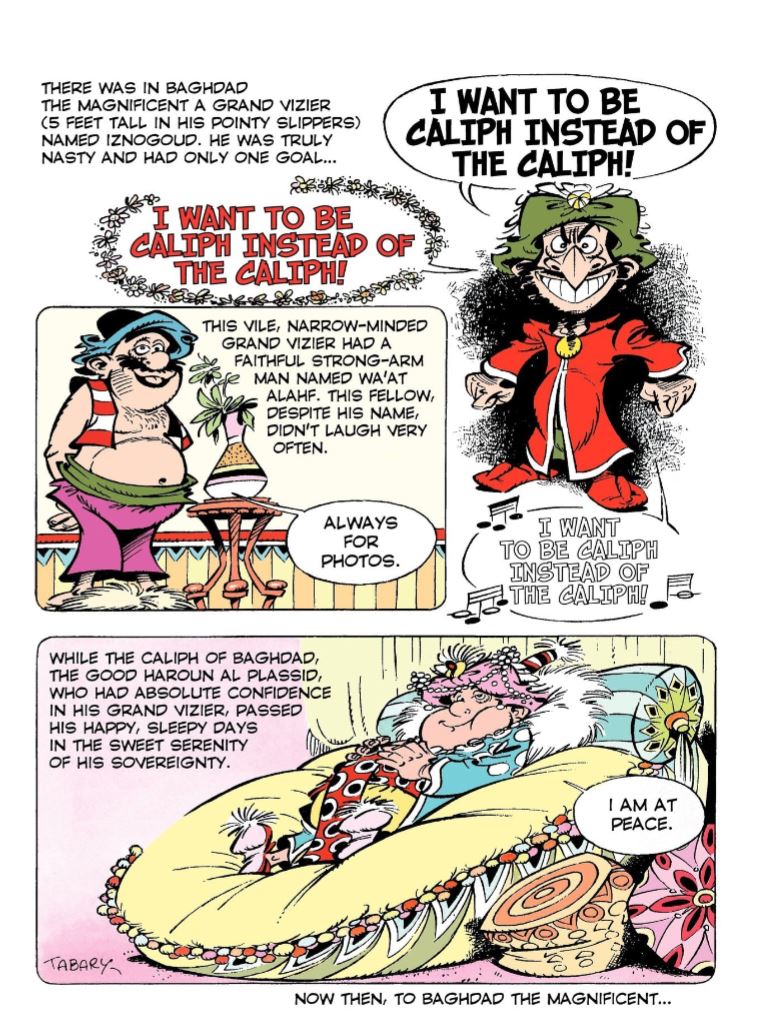
Iznogoud is Grand Vizier to Haroun Al Plassid, Caliph of Ancient Baghdad, but the conniving little shyster has loftier ambitions – or as he is always shouting it – “I want to be Caliph instead of the Caliph!”…
The vile vizier is “aided” – and that’s me being uncharacteristically generous – in his endeavours and schemes by bumbling assistant Wa’at Alahf, and in this first album they begin their campaign with ‘Kissmet’, wherein pandemonium ensues after a talking frog is revealed as an ensorcelled Prince who can only regain human form if smooched by a human being.
Iznogoud sees an opportunity if he can only trick the simple-minded Caliph into puckering up; unfortunately but typically, the little rotter forgets that he’s not the only ambitious upstart in Baghdad…
‘Mesmer-Eyezed’ finds him employing a surly stage hypnotist to remove the Caliph whilst ‘The Occidental Philtre’ sees him employ a flying potion obtained from a lost, jet-lagged western sorcerer, each with hilarious but painfully counter-productive results.
Tabary drew himself into ‘The Time Machine’ wherein a comic artist desperate to meet his deadlines falls foul of a mystical time cabinet. However, when he meets the vizier, that diminutive dastard can clearly see its Caliph-removing potential… to his eternal regret…
Soon after in ‘The Picnic’ Iznogoud takes drastic action, luring Haroun Al Plassid into the desert, but as usual his best-laid plans really aren’t, before we conclude with ‘Chop and Change’ as our indefatigable villain obtains a magic goblet that can switch the minds of any who drink from it, forgetting that Caliphs are important people who employ food-tasters…
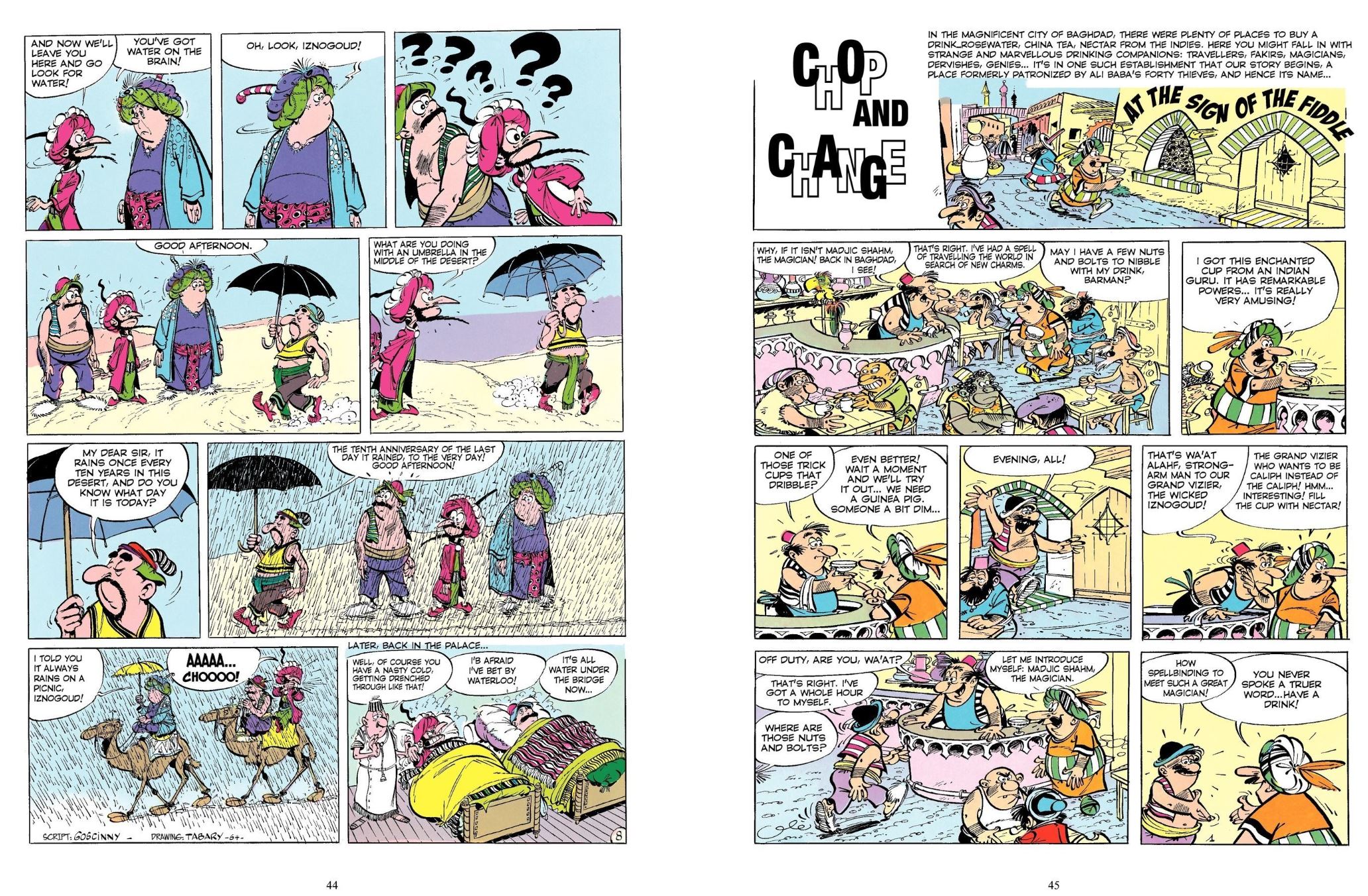
Snappy, fast-paced slapstick and painfully delightful word-play abound in these mirthfully infectious tales and the series is a household name in France; said term has even entered French political life as a description for a certain type of politician: over-ambitious, unscrupulous – and usually short in stature…
Eight albums were originally translated into English during the 1970s and 1980s without really making any little impact here, but once Cinebook’s revival the vile Vizier finally caught on in a superb sequence of gloriously readable and wonderfully affordable comedy epics that found an appreciative audience among British kids of all ages. That said, it’s been a while since the last one, but perhaps that’s the setting not the stories…
© 1967 Dargaud Editeur Paris by Goscinny & Tabary. All Rights Reserved.
Today in 1905, the last episode of Gustave Verbeek’s The Upside Downs ran in the New York Herald and in 1924 writer Stan Kay (Casper the Friendly Ghost, Richie Rich, Sad Sack, Fraggle Rock, The Muppets) was born. Practically yesterday, writer Scott Snyder (American Vampire. Batman. Justice Leafue) was born in 1976 whilst ten years later we lost Alfred Bestall of Rupert Bear fame.