
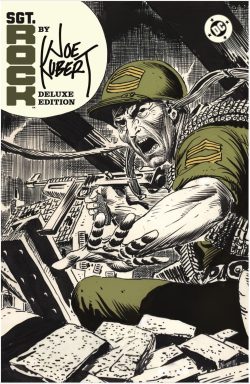
By Joe Kubert and Robert Kanigher, Bob Haney, Paul Levitz, Frank Springer, Al Milgrom, Tatjana Wood, Jack Adler, Andy Kubert, Gaspar Saladino, John Costanza, with Len Wein, Marv Wolfman, Tony Isabella, Mike W. Barr, Gary Cohn, Paul Kupperberg, Bob Rozakis, Greg Weisman, E. Nelson Bridwell, Peter Sanderson, Todd Klein, Anthony Tollin, Tom Zuiko & various (DC Comics)
ISBN: 978-1-7995-0904-2 (HB), 978-1-7995-1356-8 (Digital edition)
This book includes Discriminatory Content produced in less enlightened times.
Win’s Christmas Gift Recommendation: Unconventional Star at the Top of the Tree… 9/10
Joe Kubert was born in 1926 in rural Southeast Poland (which became Ukraine and might briefly be Outer Russia as you read this). At age two his parents took him to America to grow up in Brooklyn. According to his own Introduction in another book of his incredible stories, Joe’s earliest memory of cartooning was Hal Foster’s Tarzan Sunday strips…
Joe’s folks encouraged him to draw from an early age and the precocious kid began a glittering career at the start of the Golden Age, before he was even a teenager. Working and learning at the Chesler comics packaging “Shop”, MLJ, Holyoke and assorted other outfits, he began his close association with National/DC in 1943. A canny survivor of the Great Depression, he also maintained outside contacts, dividing his time and energies between Fiction House, Avon, Harvey and All-American Comics, where he particularly distinguished himself on The Flash and Hawkman.
In the early 1950s he and old school chum Norman Maurer were the creative force behind publishers St. Johns: creating evergreen caveman Tor and launching the 3D comics craze with Three Dimension Comics. Joe never stopped freelancing, appearing in EC’s Two-Fisted Tales, Avon’s Strange Worlds, Lev Gleason Publications & Atlas Comics. This went on until 1955 when, with the industry imploding due to censorship and competition from TV, he took a permanent position at DC. It only slightly diluted his output whilst he concurrently illustrated contentious, controversial newspaper strip Tales of the Green Berets from 1965 to 1968. From then on, he split his time drawing Sgt. Rock and other features, designing covers and editing DC’s line of war comic books.
And then DC acquired Tarzan…
This collection of one of his most important co-creations marks Joe’s centenary and begins with a candid contextual introduction in ‘Foreword I’ by his son Andy Kubert and a passionate appraisal of the effects and legacy of his work in ‘Foreword II’ by Brian Azzarello…
Sgt Rock and Easy Company rank amongst the greatest and most influential – if not enduring – creations of America’s comic-book industry. The gritty meta-realism of Robert Kanigher’s ordinary guys in life-or-death situations captured the imaginations of generations of readers, young and old. Most closely associated with these characters is legendary creator Joe Kubert, who worked as artist, writer, letterer, colourist, editor, Graphic Novelist and especially Educator since the earliest days of the medium.
So pervasive are the “combat-happy Joes” that’s it’s hard to grasp that Rock is not an immortal industry prototype like Superman, Batman, Wonder Woman or the original Captain Marvel – with us since the earliest moments of the industry – but was, in fact, a rather late addition to and child of Silver Age Comics… and one who perpetually disappears from publishing schedules for years at a time…
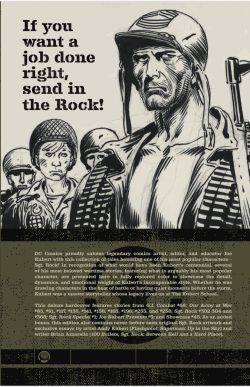
This deluxe hardcover/digital tribute to auteur Joe Kubert features stories from G.I. Combat #68; Our Army at War #83, 91, 117, 135, 141, 158, 165, 196, 233 & 238; Sgt. Rock #302-304 & 368; Sgt. Rock Special #1; Joe Kubert Presents #5 and Showcase #45 and also offers never-before-seen original artwork, covering January 1959 through April 2013: a period wherein the comic book market was undergoing a staggering revolution in style, theme and quality.
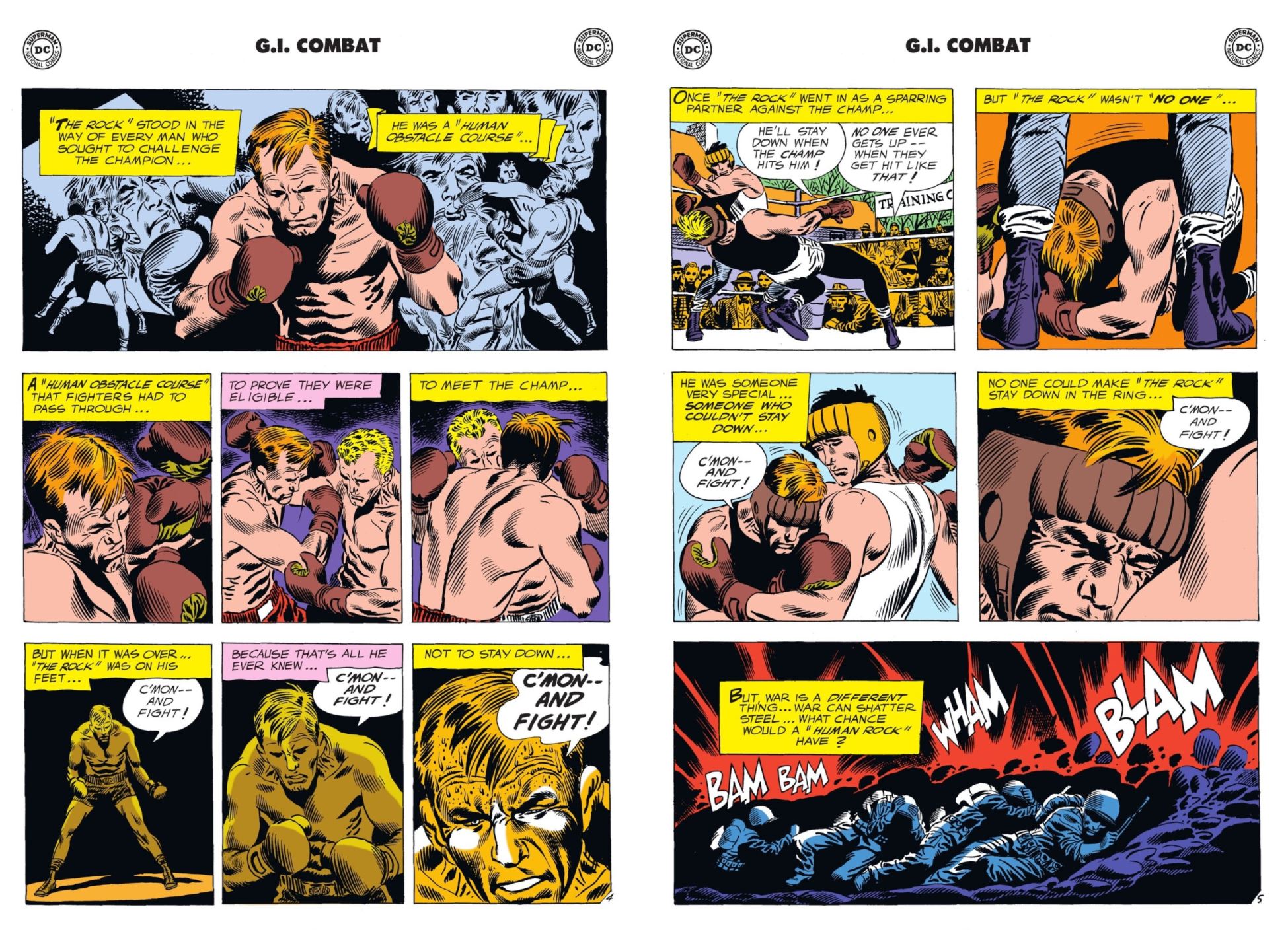
The majority of stories come courtesy of Kanigher at his declarative creative peak, and are lettered by Joe & Andy Kubert, Gaspar Saladino or John Costanza, and we open with a little something from anthological “battle-mag” G.I. Combat #68. This was a quiet, moodily unassuming fable of an anonymous boxer who wasn’t particularly skilled but simply refused to be beaten. When ‘The Rock!’ enlisted in the US Army, however, those same Horatian qualities attained mythic proportions as he held back an overwhelming Nazi attack by sheer grit and determination, remaining bloody but unbowed on a field littered with dead and broken men.
Dubbed “Rocky”, the character returned as a sergeant in the April Our Army at War (#81, but not seen here), and again in #82 (ditto) before fully entrenched now, OAaW #83 (June 1959) detailed the true launch of the immortal everyman hero in Kanigher & Kubert’s ‘The Rock and the Wall!’: a tough-love, battlefield tutor shepherding his men to competence and survival amidst the constant perils of war. This time the grizzled noncom met a rival for his men’s admiration in the equally impressive Joe Wall…
Traditionally anthological, Our Army at War offered three complete Sgt. Rock tales in #91, beginning with ‘No Answer From Sarge!’ as the NCO risked everything to drag a recruit out of a crippling funk; ‘Old Soldiers Never Run!’ where he had to weigh an old man’s pride against Easy’s continued existence, and the Bob Haney-scripted tragic fable of a sole-surviving Scottish soldier in ‘The Silent Piper!’
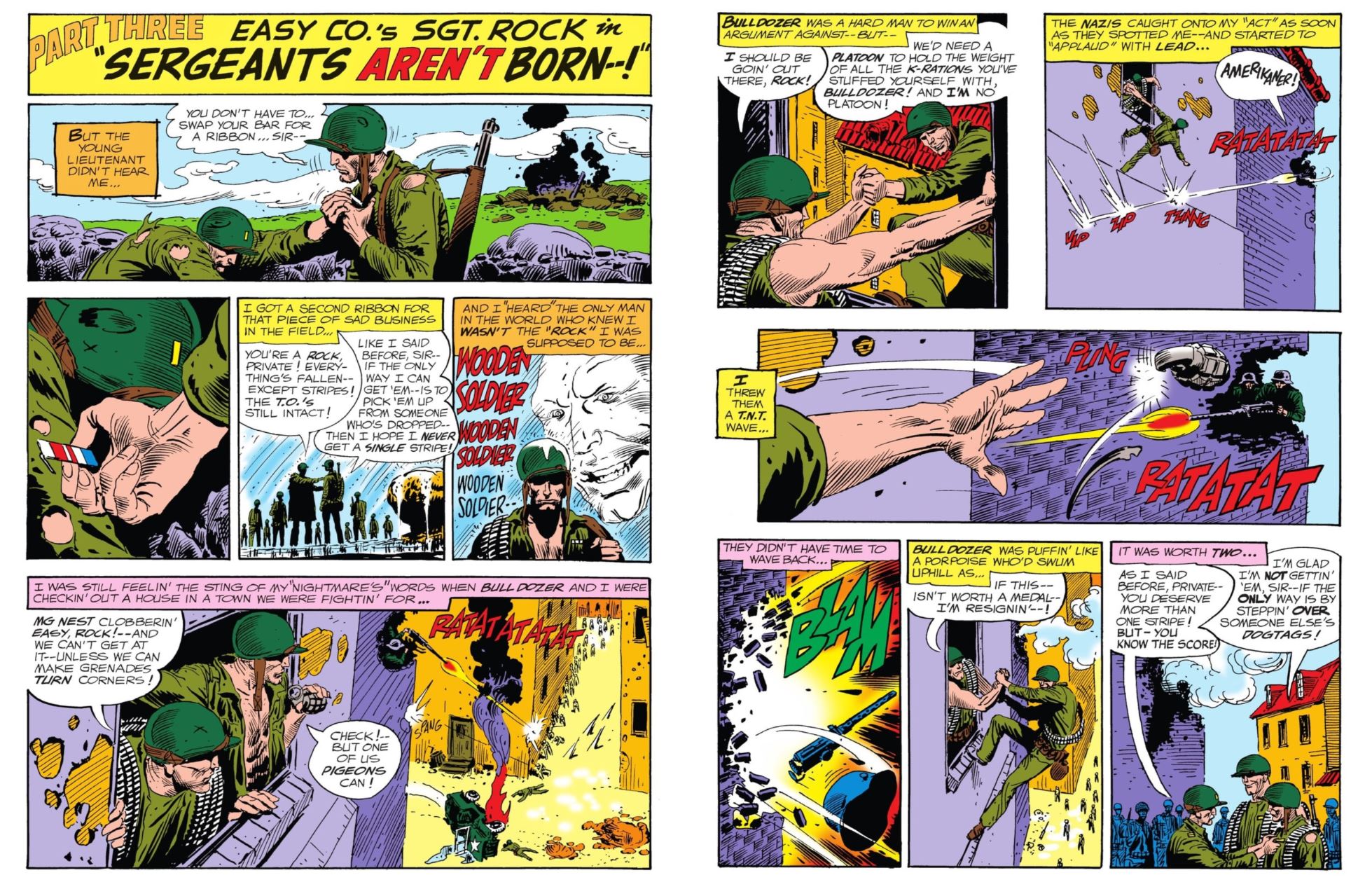
Next comes a dramatic tale of three hopelessly square pegs who finally find their deep, round holes in #117’s traumatic saga of a ‘Snafu Squad!’… but only by paying the ultimate price, On the rise and looking for features to carry their own title, Rock turned up in Showcase #45 (July/August 1963) in a full-length Kanigher saga ‘Sergeants Aren’t Born…!’ Now, whilst battling across Europe in charge of an admiring Easy Co., Rock finally faces an old foe who has had a psychological choke-hold on him since his earliest training days…
In OAaW #135 (October 1963) ‘Battlefield Double!’ reviewed Rock facing a German non-com who was in almost every way his doppelganger and match in warcraft, physicality and valour, before #141 (April 1964) detailed how a timid old school friend turns up, still needing Rock’s protection. “Shaker” finally pulled his weight and the ‘Dead Man’s Trigger!’ but it was no triumph or victory…
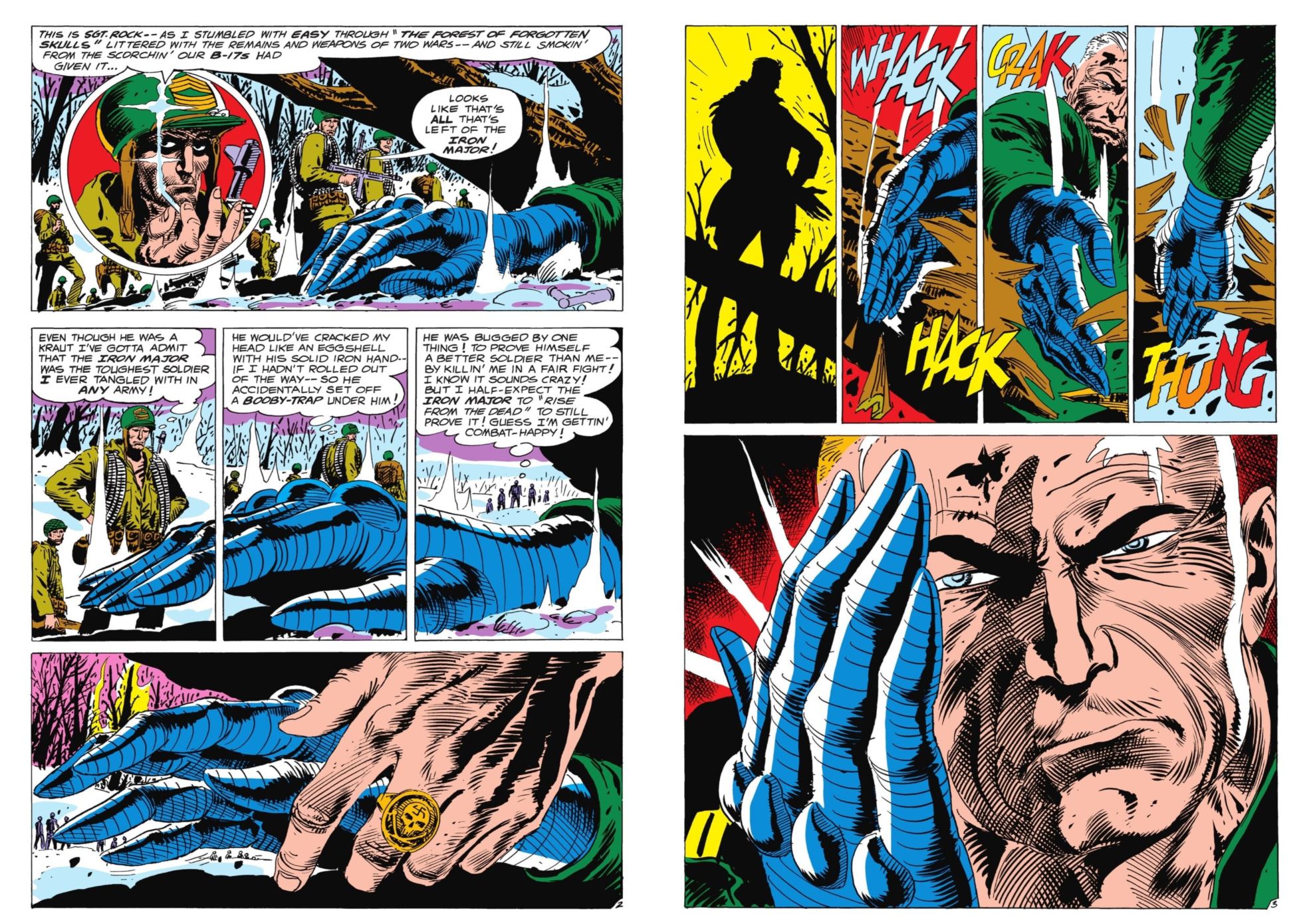
Another novel-length Kanigher epic came in #158 (September 1965) as ‘Iron Major – Rock Sergeant!’ offered telling insights into the pre-war, civilian world of Frank Rock, as well as a new antithesis and archenemy for Easy’s front man. Here, with the topkick captured, tortured and used as bait in a blizzard by a steel-handed master strategist, it took sheer guts and unflinching resolve to save Easy from deadly ambush, but even after a close won victory the monster was not done…
In #165 (March 1966 ) the ‘Return of the Iron Major!’ saw the Nazi Superman back from the dead and hungry for payback. It didn’t help that when they finally clashed, Rock was kissing his fiendish foe’s former fiancée Contessa Helga von Hohenschlag-Lowenburg…
As the Vietnam War escalated through the 1960s the USA increasingly mirrored the conflict in a Home Front death-struggle pitting deeply-ingrained Establishment social attitudes against a youth-oriented generation with a radical new sensibility. In response, DC’s military- comics became even more bold and innovative. However, with a sudden downturn in super hero sales leading to serious rethinking, although war titles maintained and even built sales, the editors tried to beef up anthological elements and began openly expressing anti-war sentiments.
In Our Army At War #196 (August 1968) ‘Stop the War – I Want to Get Off!’ was an all- Kubert tale foresightedly exploring PTSD before we even had the term. It saw constant loss, relentless pressure and sheer bloody terror push Rock beyond his emotional limits until a mysterious figure helps him out with a perspective-altering voyage through history…
With Kanigher writing, Tatjana Wood colouring and John Costanza lettering, later tales saw Rock increasingly a mouthpiece for such sentiment: experiencing the horror and stupidity of fighting and revealing what lay behind the glory and patriotic fervour. In ‘Head-Count!’ (OAaW#233, June 1971) a new replacement to Easy Co. exploited the conflict to feed his own sick appetites, and would not stop until made to…
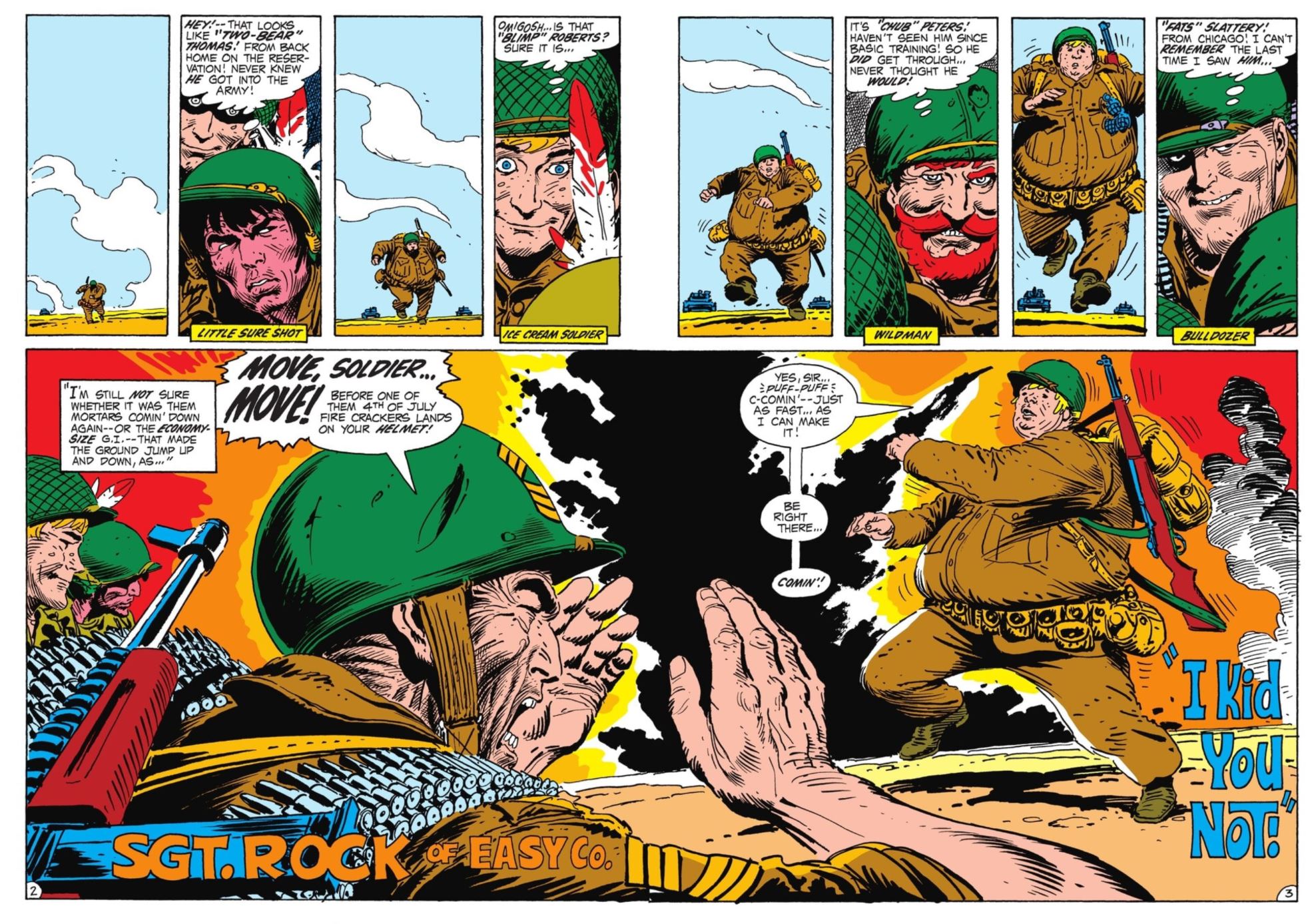
Supplemented by the original cover art, Our Army At War #238 (June 1971) ‘I Kid You Not!’ took a rare light(ish) look at replacement Horace “Heavy” Smith as his immense girth was gradually perceived as an life-saving asset and not a handicap, to seal the last Joe offering of this period. With passion project Tarzan looming large on writer/artist/editor Kubert’s artistic horizons, his connections to the war books would be long range and detached for a few years to come…
Thus we jump to March through May 1977 for Sgt. Rock #302-304 and a deeply personal take on an epic examination of a major event. Crafted by Kubert & Kanigher with inkers Frank Springer & Al Milgrom, it begins in ‘Anzio – The Bloodbath Part One’ (Springer) as Easy storm the Italian beaches only to be caught up in a family feud between replacement Tony Dante, his Nazi-supporting brother and the woman they both want…
The private war boils over in ‘Anzio – The Bloodbath Part Two: Operation Massacre!’ (Milgrom) before explosively tragically ending in ‘Anzio – The Bloodbath Part Three: Firing Squad for a Brother!’
Then just as war comics were disappearing, anniversary tale ‘30 Years of Dogtags’ (Kanigher, Joe & Andy Kubert and Tat Wood in Sgt. Rock #368 September 1982) saw the war-weary warrior briefly drowning under the weight of loss before soldiering ever on…
In October 1992 Sgt. Rock Special #1 revealed an intimate mission by Kubert & Kanigher as the noncom is tested to his limits keeping a Hollywood starlet safe and sound behind German lines in ‘What’s To Tell?’
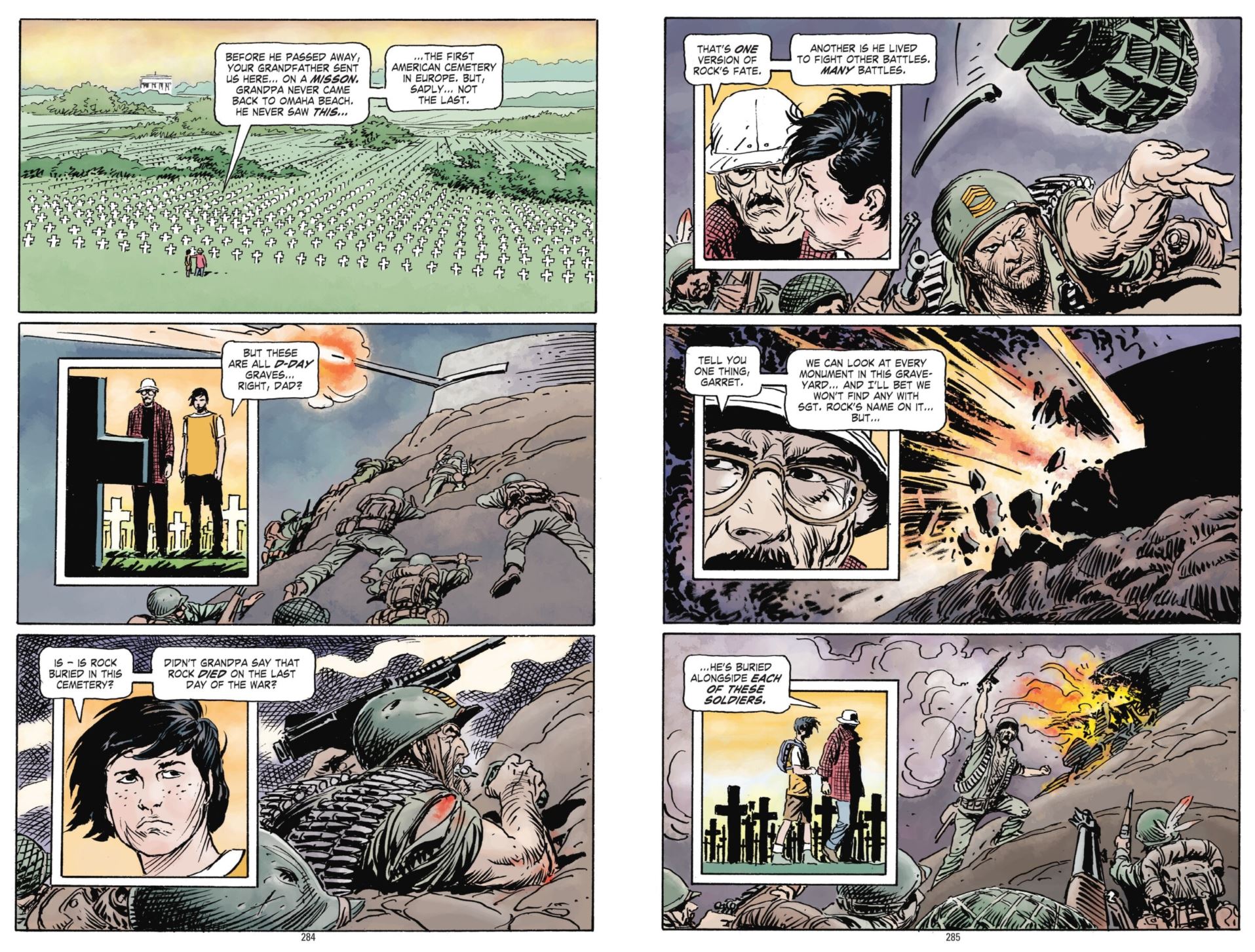
Readers’ understanding and appreciation of war stories constantly matured over the decades and by the time of the last tale here (from Joe Kubert Presents #5 April 2013) the tales were part of niche market and practically indistinguishable from film or TV fare. Seldom a matter of immediacy or even good versus evil any more, here the war itself – one long-ended – was the issue. Written by Paul Levitz with Joe doing everything else ‘Farewell’ focuses on a family holiday and how later generations respond to the gradual fading away of the dwindling warriors of the Last Good War…
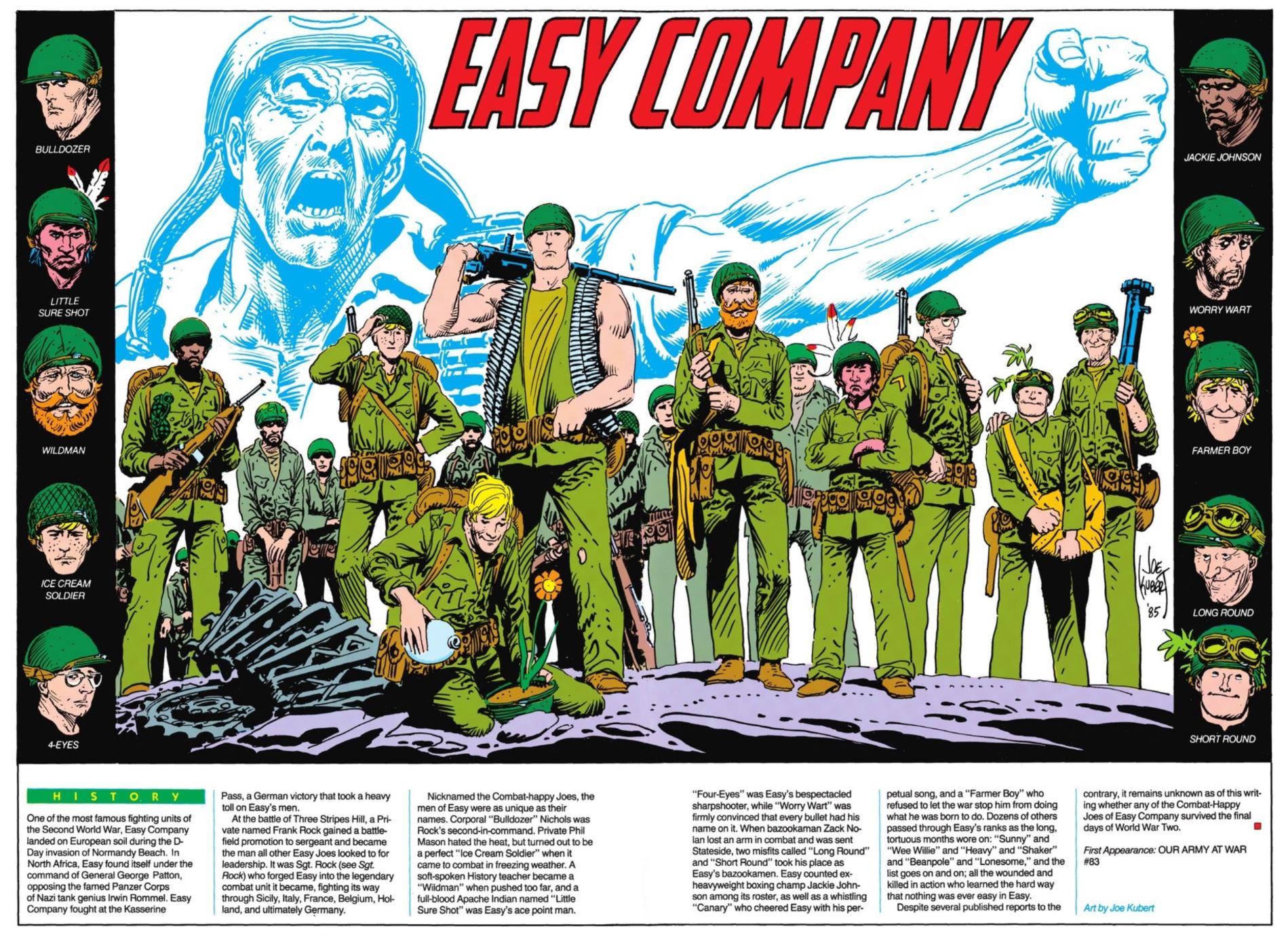
The celebration concludes with a trawl through the pictionary of Characters and histories produced to accompany the worlds-shattering Crisis of Infinite Earths which signalled a (brief) cessation in combat comics. Who’s Who: The Definitive Directory of the DC Universe covered every character in the company’s history and from #7 (September 1985) ‘Easy Company’ are revealed in a team effort by the master. It’s followed by ‘Iron Major’ (#11 January 1986) and ‘Sgt. Rock’ (#20 October 1986) with all non-visual efforts due to a diligent horde of researchers and contributors including Marv Wolfman, Tony Isabella, Len Wein, Paul Kupperberg, Paul Levitz, Bob Rozakis, Greg Weisman, E. Nelson Bridwell, Peter Sanderson, Todd Klein, Anthony Tollin, Tatjana Wood. Tom Zuiko.
With superb and iconic combat covers from Kubert fronting many episodes, this battle-bible closes with a vast ‘Sgt. Rock Original Artwork Gallery’ displaying in unedited glory 35 pages of covers, story pages, sketches and layouts to enthral and beguile all art lovers.
Sgt. Rock by Joe Kubert: The Deluxe Edition is a visually vivid introduction and vitally valuable touchstone for jaded comics readers looking for more than flash and dazzle and a perfect example of true Shock and Awe from an era when US soldiers were welcome almost everywhere. These are war stories all comics fans and combat collector must see.
© 1959, 1960, 1962, 1963, 1964, 1965, 1966, 1968, 1971, 1972, 1975, 1976, 1977, 1978, 1979, 1982, 1985, 1986, 1987, 1988, 1992, 2013, 2026 DC Comics. All Rights Reserved.