By Stan Lee & Jack Kirby, Steve Ditko, Larry Lieber, Roy Thomas, Gerry Conway, Denny O’Neil, Chris Claremont, David Michelinie, John Byrne, Jim Shooter, Roger Stern, Walter Simonson, Mark Waid, Dwayne McDuffie& Ed Brubaker, Bob Layton, Tom DeFalco, Christopher Priest, Wally Wood, Gene Colan, Mike Sekowsky, Keith Giffen, Bob Hall, Frank Miller, Dave Cockrum, John Romita Jr., Mike Zeck, Mike Mignola, Mike Wieringo, Casey Jones & Pablo Raimondi, Frank Giacoia, George Tuska, John Buscema, Arthur Adams & Paolo Rivera, & many & various (MARVEL).
ISBN: 978-1-3029-3420-0 (HB), 978-1-3029-4119-2 (Digital edition)
Win’s Christmas Gift Recommendation: One of Marvel’s Mightiest… 10/10
With Avengers: Doomsday set to premiere on December 18th and Christmas looming large, let’s look at the ideal comics primer both in terms of a way for swot up on the immense backstory of the character that probably won’t make that final cut, but also as the perfect gift for interested non-nerds in need of prezzies and pre-mansplaining material…
Once upon a time, you hadn’t really made it as a Marvel hero – or villain – until you’d clashed with Doctor Doom. Victor Von Doom is a troubled supergenius who escaped the oppression heaped on his Romani people via an ultimately catastrophic scholarship to America. Whilst there, he succumbed to an intense rivalry with young Reed Richards, even then perhaps the most brilliant man alive.
Arrogant Victor performed unsanctioned experiments which went wrong and marred his perfect features, leading him down a path of super-science and sinister sorcery and fuelled his overwhelming hunger for ultimate power and total control. From the ashes of his failure, Von Doom rebuilt his life, returned to seize control of his Balkan homeland and become a danger to the world and the multiverse.
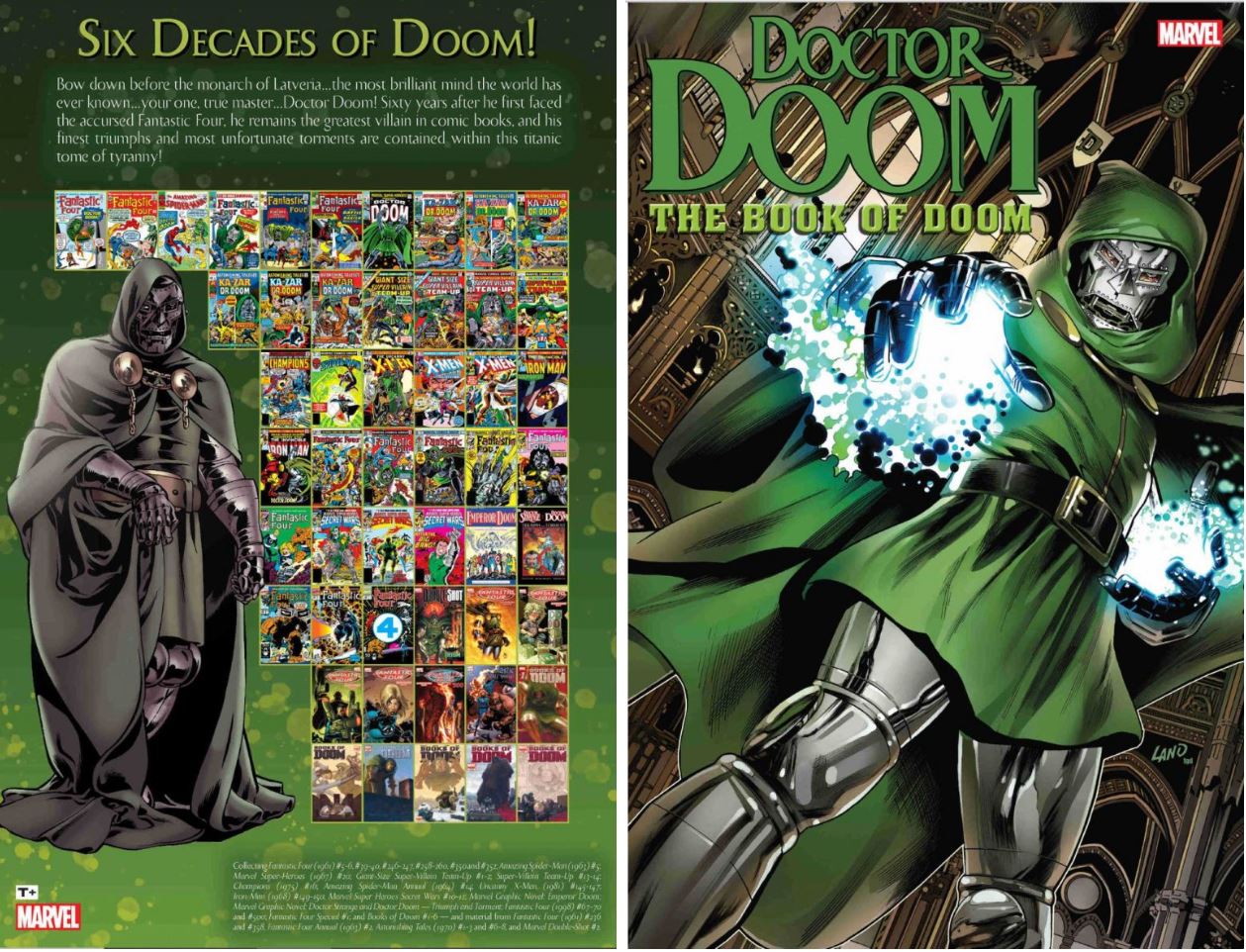
This truly king-sized and epically imperious compendium was released to celebrate the 60th anniversary of the Lord of Latveria, who debuted in Fantastic Four #5 April 1962. It gathers many of his greatest battles and landmark moments of triumph and tragedy, and opens with a contextualising Introduction from Ralph Macchio before reprising the contents of Fantastic Four #5, 6, 39-40, 246-247, 258-260, 350, 352, 500; Amazing Spider-Man #5 & Annual #20; Marvel Super-Heroes #20; Giant-Size Super-Villain Team-Up #1 & 2 & Super-Villain Team-Up #13-14; Champions #16; Uncanny X-Men #145-147; Iron Man #149-150; Marvel Super-Heroes Secret Wars #10-12; Marvel Graphic Novel Emperor Doom; Marvel Graphic Novel Doctor Strange and Doctor Doom: Triumph and Torment; Fantastic Four (vol. 2) #67-70; Fantastic Four Special (2005) #1 and Books of Doom #1-6, as well as material from Fantastic Four #236, 358 & Annual 2; Astonishing Tales #1-3, 6-8 and Marvel Double-Shot #2 collectively spanning July 1962-June 2006.
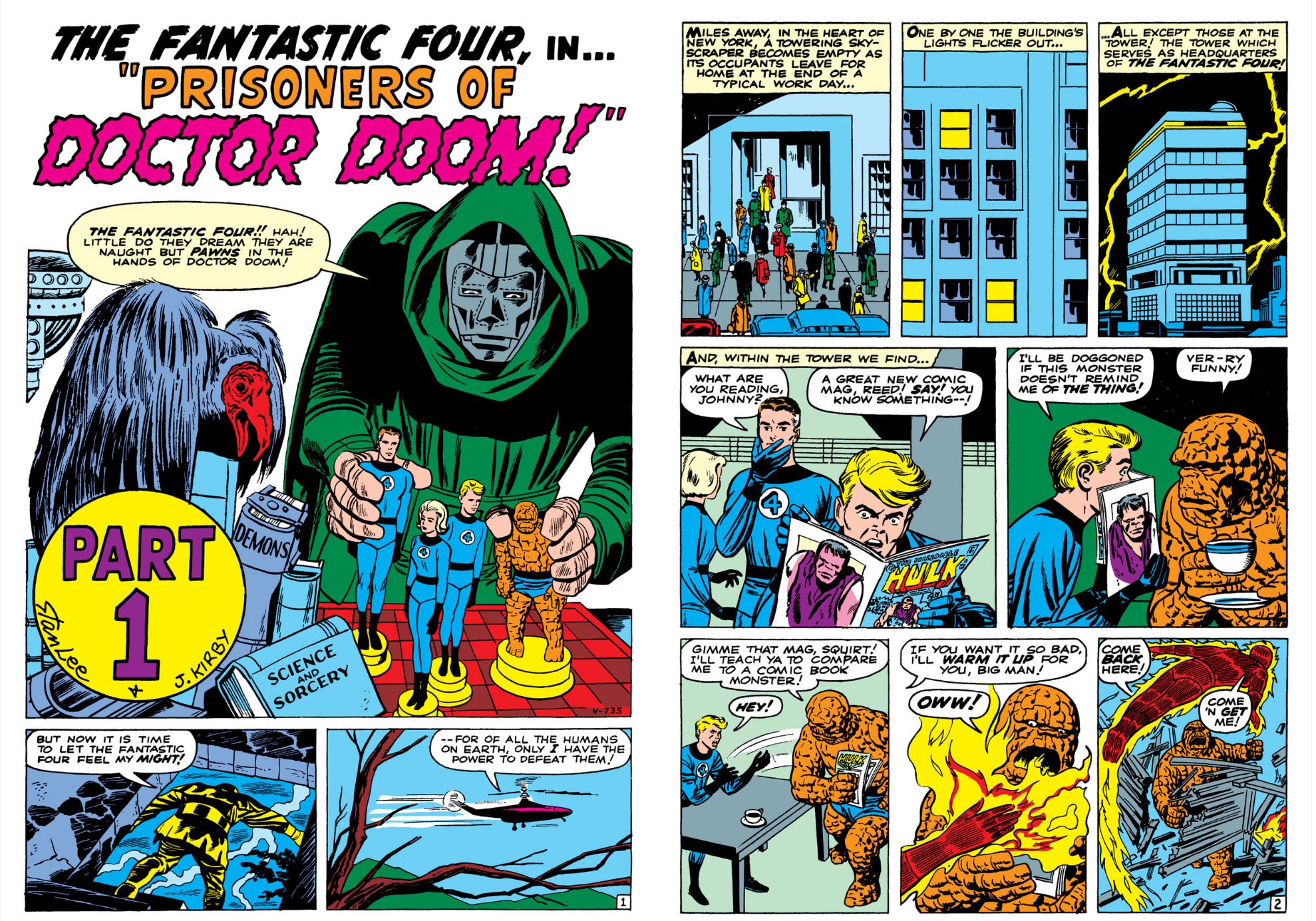
The drama begins as it must with that debut in Fantastic Four #5. Back then, aliens – especially monsters – played a major part in (pre) Marvel output. However, after a tentative start, Stan Lee & Jack Kirby’s recreation of super-heroes embraced the unique basics of the idiom: taking a full bite out of the Fights ‘n’ Tights apple by introducing the first full-blown, unrepentant supervillain to the budding Marvel Universe. Admittedly The Mole Man appeared in #1, but that tragic little gargoyle, for all his plans of world conquest, wouldn’t truly acquire the persona of a costumed foe until his more refined second appearance in FF #22.
Here, however, ‘Prisoners of Doctor Doom’ (inked by sublimely slick and perfectly polished Joe Sinnott) had it all. An attack by a mysterious enemy from Mr. Fantastic’s past; super-science, magic, lost treasure, time-travel, even pirates. Ha-Haar, me ‘earties! The tale is sheer comics magic and Stan & Jack knew they were on to a winner, since the Dread Doctor returned in the very next issue, teaming with recently revived, recalcitrantly reluctant Sub-Mariner to attack our heroes as ‘The Deadly Duo!’ in the first Super-Villain Team-Up of the Marvel Age…
Prince Namor, the Sub-Mariner was the second superstar of the Timely Age of Comics – but only because he followed cover-featured Human Torch in the running order of 1939’s Marvel Mystery Comics #1. He has had, however, the most impressive longevity of the company’s original “Big Three”: Torch, Subby & Captain America. The Marine Marvel was revived in 1962 in FF #4; once more a conflicted “noble” villain, and prominent in the company’s pantheon ever since. Inked by Dick Ayers, FF #6 also reintroduced the concept of antiheroes as Namor was promptly betrayed by Doom and ended up saving the heroes from death in space: founding a truly complex dynamic with his fellow rogue monarch and the FF. The Master of Latveria’s inevitable betrayal colours the relationship of both kings to this day.
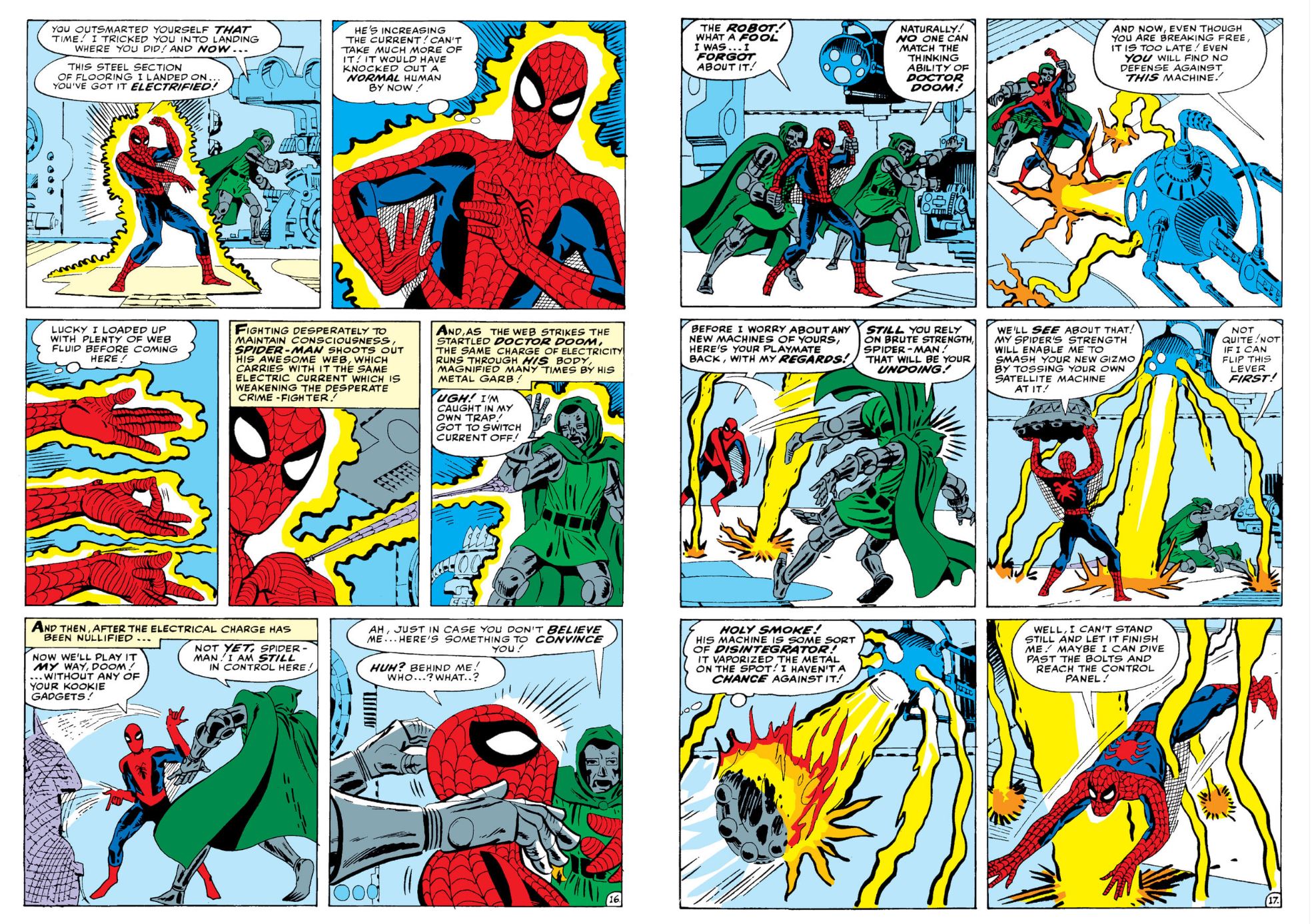
Doom was a frequent threat to the Quirky Quartet and was the first foe to break another unspoken rule by going after other heroes in the cohesive shared universe Lee & Kirby were building. Cover dated October 1963, Amazing Spider-Man #5 saw the webspinner ‘Marked for Destruction by Dr. Doom!’ – not so much winning as surviving his clash with the deadliest man on Earth. In a titanic comedy of errors the villain again sought superpowered pawns for his war on humanity, but seriously underestimated his juvenile opponent…
The one-dimensional mad scientist was recast as a tragic figure forever shackled by his flaws thanks to the primary contents of Fantastic Four Annual #2 (September 1964) where Chic Stone inked ‘The Fantastic Origin of Doctor Doom!’ A 12-page scene-setter momentously detailing how brilliant “gypsy” youth Victor Von Doom remade himself into the most dangerous man in creation: ruthlessly overcoming obstacles such as ethnic oppression, crushing poverty and the shocking stigma of being the son of a sorceress. That past informed the present as the villain again attacks Reed Richards and is left falsely believing he has achieved ‘The Final Victory of Dr. Doom!’ through guile, subterfuge and mind-control. Instead, he has in fact suffered his most ignominious defeat. The clash also debuted a long-running plot thread connecting the Monstrous Monarch to time-travelling tyrant Rama Tut/Kang the Conqueror.
Jumping forward to the summer of 1965, FF #39 (cover-dated June, with Frank Giacoia – as Frank Ray – inking) saw the team stripped of their powers and targeted by an enraged Doom in ‘A Blind Man Shall Lead Them!’ Here Daredevil stepped up to provide their only hope of staying alive. The tale concluded in #40’s ‘The Battle of the Baxter Building’ with Vince Colletta inking a bombastic battle revealing the undeniable power, overwhelming pathos and indomitable heroism of the brutish Thing who – cruelly restored to his monstrous mutated form – handed Doom the most humiliating defeat of his life.
Experimental try-out title Marvel Super-Heroes #20 (May 1969) awarded Doom his first full-length solo shot in ‘This Man… This Demon!’ Written by Larry Lieber & Roy Thomas, with art by Lieber, Giacoia & Colletta, it restated Doom’s origins and revealed a youthful dalliance with an innocent Romani maid named Valeria. In the now, that failed relationship was exploited by immortal alchemist Diablo who claimed to need an ally and partner, but truly sought a slave. Doom dealt with the charlatan in typically effective style…
As the decade turned, the metal-shod maniac profited from Marvel’s first big expansion and won his own solo-series (Astonishing Tales #1-8). It began with ‘Unto You is Born… the Doomsman!’ (July-August 1970) wherein Thomas & Wallace Wood depicted the master manipulator’s struggle to maintain iron control over Ruritanian kingdom Latveria: crafting a super-robot to crush incipient rebellion led by ousted Crown Prince Rudolfo and a mysterious sponsor. However, the use of Victor Von Doom’s lost love had the desired effect and the rebels almost succeeded in driving the tyrant from Doom Castle. In the attendant chaos the Doomsman device wandered away…
AT #2 declared ‘Revolution!’, proving Doom was not the only master of mechanoids as Rudolfo and the Faceless One used the lost Doomsman to wreak havoc throughout Latveria, before the final assault in ‘Doom Must Die!’ (scripted by Lieber) saw all the tyrant’s enemies vanquished and the Monarch of Menace once more firmly in control…
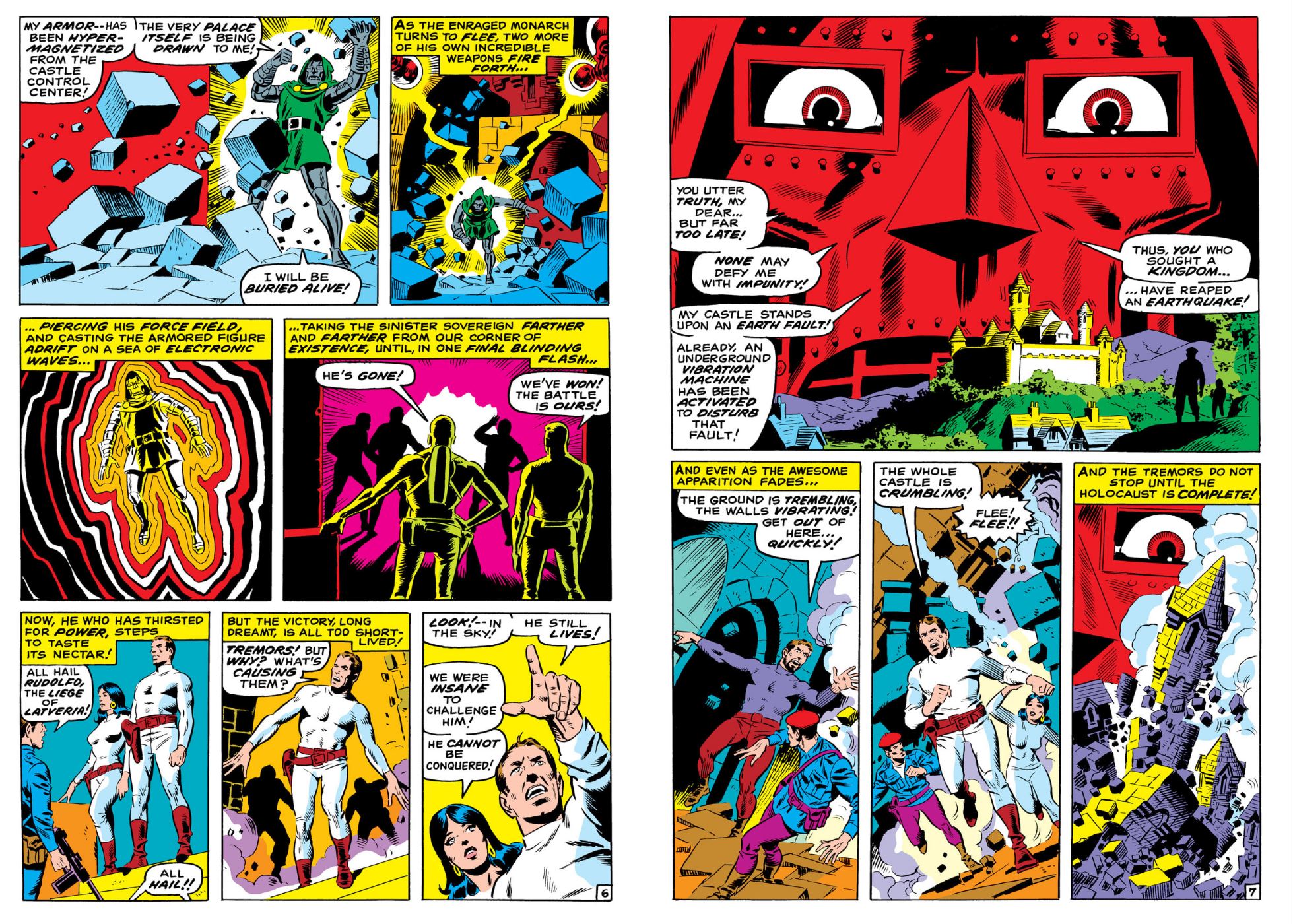
For June 1971, Lieber, George Tuska & Mike Esposito had the Lord of Latveria invade African nation Wakanda in Astonishing Tales #6, deploying ‘The Tentacles of the Tyrant!’ to seize its Vibranium, only to fall to the furious tenacity of king T’Challa/Black Panther in ‘…And If I be Called Traitor!’ (Gerry Conway, Gene Colan & Frank Giacoia) before a major plot and character strand was added for Doom’s final solo story in AT #8 (October 1971). ‘…Though Some Call it Magic!’ is a minor landmark wherein Conway, Colan & Tom Palmer reveal the Devil Doctor’s darkest secret. On one night every year the villain duelled the rulers of Hell in the vain hope of liberating his mother’s soul. She had been a sorceress, and burned in the inferno for the unholy powers she used in life, powers which her son also possesses. Victor fought to free her from eternal torment and always failed: a tragic trial to punish both the living and the dead…
With this tragic revelation even more depth and drama were added to the Marvel Universe’s greatest villain. His residency ended without warning; Doom resumed his status as premier antagonist until Giant-Sized Super-Villain Team-Up #1 (cover-dated March 1975): again bathing the Iron Dictator in a starring spotlight beside aggrieved acquaintance Namor the Sub-Mariner. The special and its sequel led to significant series Super-Villain Team-Up and major crossovers in The Avengers and The Champions.
Giant-Sized Super-Villain Team-Up #1 detailed how Doom & Namor grudgingly reunited, in a framing sequence by Thomas, John Buscema & Sinnott interlaced with reprints of previous meetings. In the years since FF #6, Namor had won and lost his own series, despite many radical, attention-grabbing stunts. At the close, surface dwellers dumped nerve-gas into the sea, accidently but catastrophically altering Namor’s hybrid body, forcing him to wear a hydrating-suit to breathe. The same toxin had plunged the entire nation of Atlantis into a perpetual coma…
Here, in ‘Encounter at Land’s End!’, Prince Namor – alone and pushed to the brink of desperation – rescues Doom from a deadly plunge to Earth after the Iron Dictator’s latest defeat (by the FF & Silver Surfer) in an impressively effective framing sequence bracketing two classic reprint tales (the aforementioned ‘This Man… This Demon!’ and ‘In the Darkness Dwells Doom!’ from Sub-Mariner #20 – and not included in this already too-heavy tome).
Sub-Mariner is in dire need of scientific wizardry to cure his sleeping kin and prepared to offer an alliance against mankind to get it. Initially refused and rebuked by Doom, Namor refuses to back down…
Following Thomas’ editorial ‘The Road to Land’s End’, Giant-Sized Super-Villain Team-Up #2 sees Doom reconsider the partnership deal in ‘To Bestride the World!’ (June 1975; Thomas, Mike Sekowsky & Sam Grainger) after his own vast robot army rebels. The crisis is caused by the tyrant’s long-lost Doomsman droid – in its new guise of Andro – who returns to co-opt the mechanoids for war against all organic life. As a result of the blistering battle and extensive carnage-wreaking, Namor & Doom triumph together and part as uneasy allies, only to regroup in Super-Villain Team-Up #1 (August 1975) in a chaotic ongoing series…
SVTU #13 (August 1977) ended the sleeping Atlantis storyline as Doom finally fulfilled his oath, and resurrected the mer-people, but only after a blistering sub-sea battle between Namor, amphibian arch-nemesis Krang and a Brobdingnagian sea beast in ‘When Walks the Warlord!’ (courtesy of Bill Mantlo, Keith Giffen & Don Perlin).
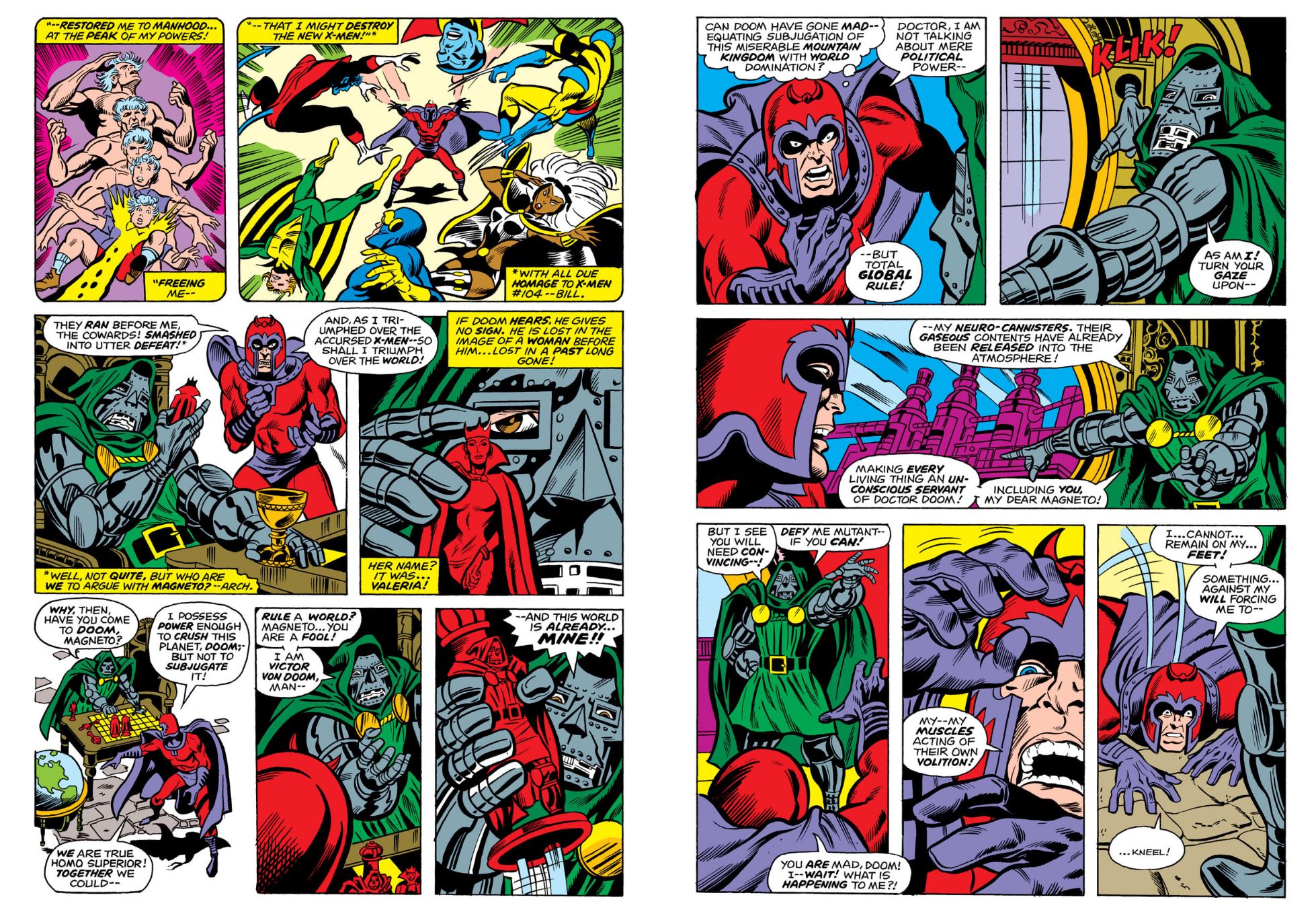
With Atlantis and Namor restored, a new era began in Super-Villain Team-Up #14 (October 1977). ‘A World for the Winning!’, by Mantlo, Bob Hall, Perlin & Duffy Vohland found mutant villain Magneto tricked into a duel with Doom who was at that moment de facto master of the world since seeding the planet’s atmosphere with mind-control gas. Ever the sportsman, the Lord of Latveria released Magneto from mental control, allowing him to liberate one other thrall and challenging them both to save the world from his ultimate dominance. It was SVTU’s last issue and the story concluded in The Champions #16 (November 1977) as the Master of Magnetism and The Beast overcame all odds to save the day in ‘A World Lost!’ (Mantlo, Hall & Mike Esposito).
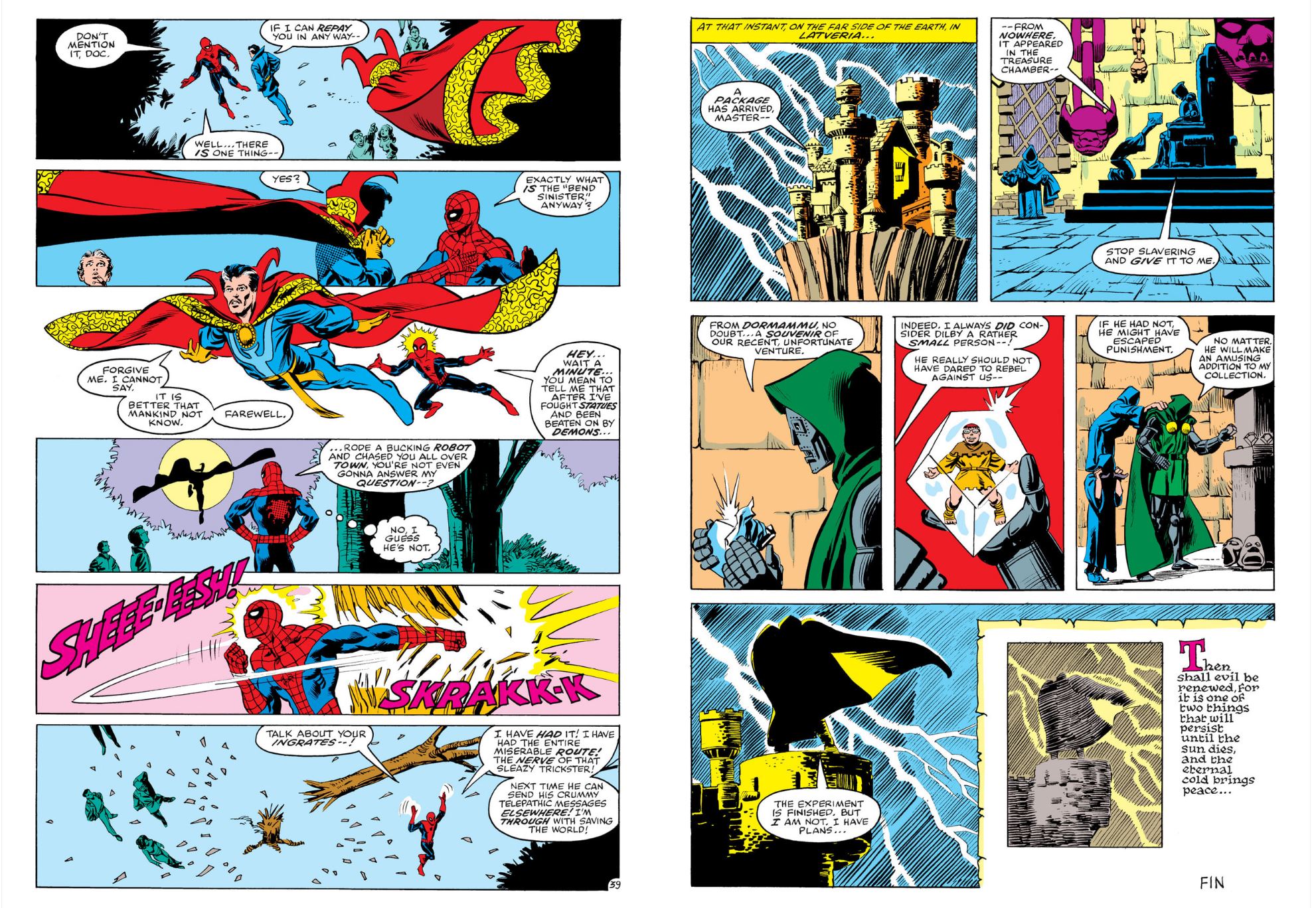
Despite appearing seemingly everywhere, we pick up Doom 3 years later as Amazing Spider-Man Annual #14 (1980) sees Frank Miller & Tom Palmer perfectly recapture the moody mastery of Ditko’s peak period. That year’s summer offering was a frantic magical mystery masterpiece scripted by Denny O’Neil wherein Doom and extra-dimensional dark god Dread Dormammu attempt to unmake Reality by invoking the arcane armageddon of “The Bend Sinister”. ‘The Book of the Vishanti’ reveals how an unsuspecting dupe captures Doctor Strange for the malevolent allies, almost unleashing cosmic hell with only the wondrous wallcrawler left to literally save the world: a thrilling confection of magic and mayhem that deeply references and reverences the glory days of Ditko, by channelling the legendary first team-up of webspinner with wizard as seen in Spidey’s second annual.
In Uncanny X-Men #145-147 (May – July 1981) Chris Claremont, Dave Cockrum & Joe Rubinstein oversaw an extended clash of cultures with ‘Kidnapped!’ finding the mutant outcasts targeted by Doom. The assault was triggered through the machinations of deranged assassin Arcade, with half of the team – Storm, Colossus, Angel, Wolverine & Nightcrawler – invading the Diabolical Dictator’s castle whilst a substitute-squad consisting of Iceman, Polaris, Banshee & Havoc despatched to the latter maniac’s mechanised ‘Murderworld!’ to rescue innocent family & friends kidnapped as a preliminary to the plot. Sadly, in the interim Doom triumphs over his castle intruders, but by entrapping claustrophobe Ororo Doom sparks a ‘Rogue Storm!’ that threatens to destroy the USA…
August & September 1981’s Iron Man #149-150, saw David Michelinie, John Romita Jr. & Bob Layton craft a time-travel clash with Marvel’s deadliest malcontent. In ‘Doomquest!’ & ‘Knightmare’ the Armoured Avenger and Demon Doctor are trapped in the days of King Arthur and must unite to rebuild themselves and their tech, as well as defeat evil sorceress Morgana Le Fey before they can return to their home time!
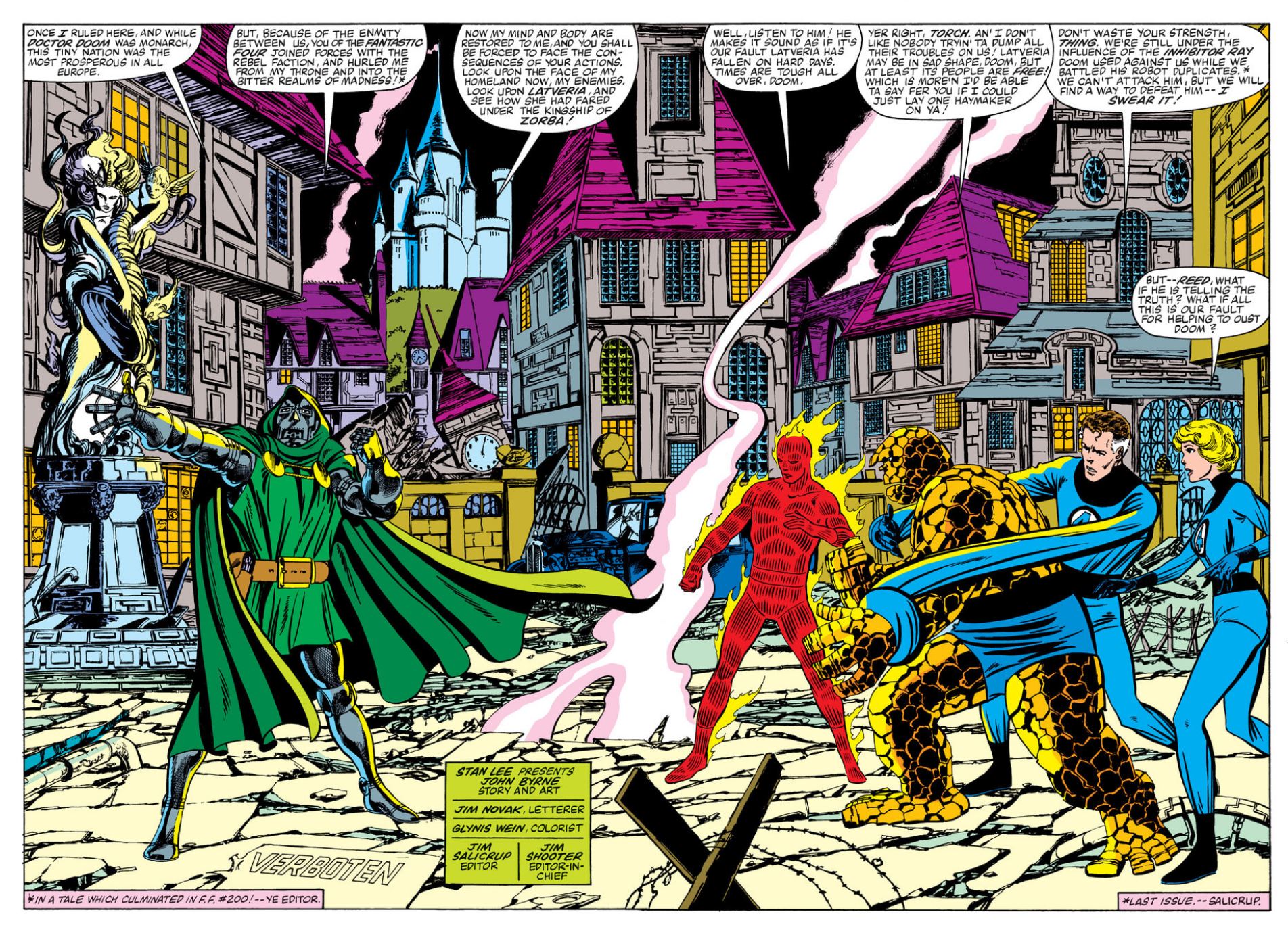
After achieving superstar status on The X-Men, writer/artist John Byrne moved on to carve out a one-man renaissance of the Fantastic Four, beginning with #232. He achieved his dream of relatively complete autonomy when assigned all the creative chores on Marvel’s flagship book and hit an early peak in #236’s ‘Terror in a Tiny Town’ (cover-dated November 1981). His fifth issue was a 40-page epic crafted to celebrate the 20th anniversary of the team, reprising the origin and crafting a classic confrontation with both Doom and Puppet Master. It remains one of the very best non-Kirby tales of the entire canon. The Lord of Latveria returned in a thematic sequel in FF #246 & 247 (September & October 1982) as ‘Too Many Dooms’ saw the dictator escape incarceration to launch a retaliatory strike against all his enemies and reclaim his shattered but free kingdom in concluding chapter ‘This Land is Mine!’
Another extended Doom drama appeared in FF #258-260 (September – November 1983) beginning with ‘Interlude’ as the newly-reinstalled ruler schools and programs his appointed heir Kristoff in statecraft and dominance whilst preparing his next strike against his enemies. Recruiting cosmic marauder Terrax the Tamer, he launches that attack in ‘Choices’, only to apparently perish when the Silver Surfer joins the escalating battle ‘When Titans Clash!’
Regarded as dead and replaced by Kristoff as a legacy tyrant, Victor Von Doom was the star of Marvel Super Heroes Secret Wars: kickstarting the seemingly insatiable modern passion for vast, braided mega-crossover publishing events, which came about because of an impending action figures licensing deal with toy monolith Mattel. Marvel Editor-in-Chief Jim Shooter, a great advocate of tales accessible to new, younger readers as well as the dedicated fan-base, apparently concocted the rather simplistic but engaging saga starring the House of Ideas’ top characters: building his tale around a torrent of unsolicited, inspirational mail from readers, all begging for one huge dust-up between all the heroes and villains…
The 12-issue Limited Series launched with a May 1984 cover-date and closed (April 1985) with a double-sized blockbusting battle that left many characters changed forever – or at least as “Forever” as comics get…
The premise was that all-powerful force The Beyonder abducted many Earth heroes and villains – and Galactus – in a quest to understand the emotion of desire. The enigmatic, almighty entity dumped the abducted on a purpose-built Battleworld created from and populated with fragments of other planets as a vast arena in which to prove which was better: “self-gratification or sacrifice”. As crafted by Shooter, Mike Zeck & John Beatty, it saw Avengers, X-Men, FF, Hulk, Spider-Man, Doom, Molecule Man, Ultron, Dr. Octopus, the Lizard, Enchantress, Absorbing Man, Kang the Conqueror, Wrecking Crew and Galactus teleported into the deep unknown…
After Doom fails to convince his fellow villains of the underlying threat, he tries to join the heroes before, in exasperation, taking charge for himself. Represented here by Secret Wars #10-12 (February-April 1985), ‘Death to the Beyonder!’ sees Doom make his move, using a hastily constructed device to absorb the omnipotent instigator’s power, using those stolen energies to rebuild himself and declare the Secret War over and Doom the sole victor…
In ‘…And Dust to Dust!’, he exults in the joys of becoming omnipotent, but the troubled new god finds it hard to hang on to lust for conquest, or even personal ambition after achieving all-consuming divinity, and his benign acts and vapid indolence betray a certain lack of drive and ambition. With heroes and villains nervously awaiting the new supreme one’s next move, events take a subtly disturbing turn as a strange energy wisp begins to possess a succession of heroes, making its way ever closer to the Doom Deity…
The other heroes remain deep in conference, debating their response to the self-proclaimed but apparently benevolent saviour of the universe. At the moment they finally decide to oppose him they are all vaporised by a bolt of energy. Of course it doesn’t end there as the resurgent Beyonder battles through heroic and villainous proxies to reclaim his purloined power and put everything to rights – sort of – in blockbusting finale ‘…Nothing to Fear!…’
Returned to mortal life, he appears here next as Emperor Doom (1987): an Original Graphic Novel conceived by Mark Gruenwald, Michelinie & Shooter, scripted by Michelinie with art by Bob Hall & Keith Williams. The plot is delightfully sly and simple: for once eschewing rash attacks against assembled superheroes, deadly dictator Doom dominates humanity through subtler means. Inviting Sub-Mariner to act as his agent, the mastermind uses the subsea antihero to neutralise mechanical heroes and rivals prior to using a pheromonal bio-weapon to make all organic beings utterly compliant to his will. Naturally, Doom then again betrays his aquatic ally…
Meanwhile, energy-being Wonder Man is undergoing a month-long isolation experiment to determine the nature of his abilities. When he exits the chamber, Simon Williams finds the entire planet has willingly, joyously accepted Doom as their natural and beloved ruler. Alone and desperate, the last Avenger must devise a method of saving the world from its contented subjugation…
Of course there’s another side to this story. Doom, ultimately utterly successful, has turned the planet into an orderly, antiseptic paradise with no wars, no want, no sickness and no conflict, just happy productive citizens doing what they’re told. In this totalitarian triumph, all trains run on time and nobody is discontented. All Doom must do is accept heartfelt cheers and do the daily paperwork. Sadly, with the entire world an idealised clone of Switzerland, the Iron Despot is bored out of his mind…
So it’s with mixed emotion that Doom realises Wonder Man and a select band of newly liberated Avengers are coming for him, determined to free the world or die…
Tense and compelling, this intriguingly low-key tale abandoned traditional all-out action for a far more reasoned and sinisterly realistic solution – disappointing and baffling a large number of fans at the time – but the clever premise and solution, understated illustration and wickedly tongue-in-cheek attitude remove this yarn from the ordinary Fights ‘n’ Tights milieu and elevate it to one of the most chillingly mature Avengers epics ever produced.
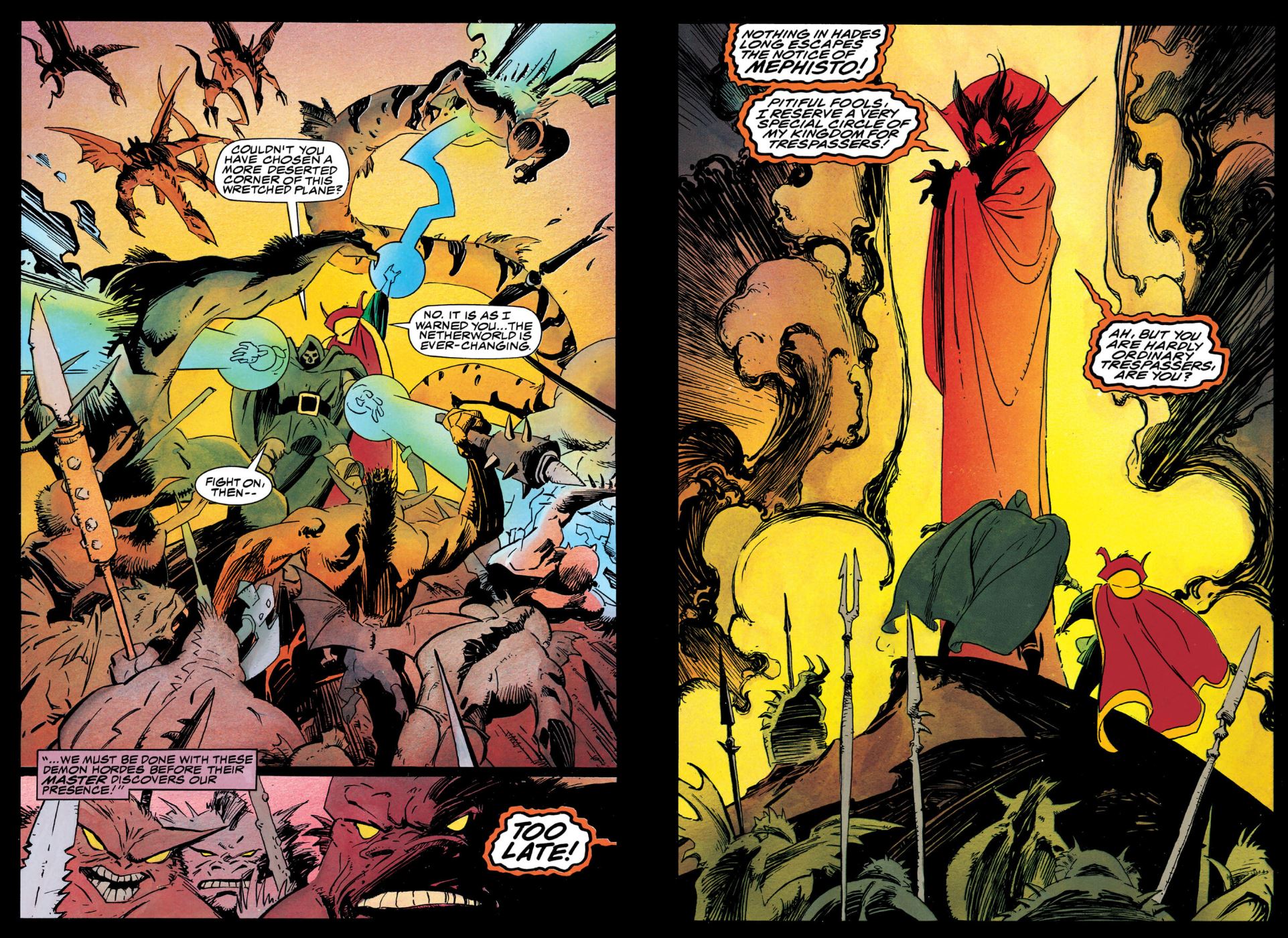
It’s followed by another OGN: Triumph and Torment by Roger Stern, Michael Mignola & Mark Badger. This occult odd couple concoction is one of the very best Marvel Universe yarns; a powerful tale contrasting the origins of the two doctors to produce effective motivations for and deeper insights into both characters.
Stephen Strange was America’s greatest surgeon, a vain and arrogant man who cared nothing for the sick except as a means to wealth and glory. When a drunken car crash ended his career, Strange hit the skids until an overheard barroom tall tale led him to Tibet, an ancient magician, and eventual enlightenment through daily redemption. He battles otherworldly evil as Sorcerer Supreme and Master of the Mystic Arts. As a magical call goes out to all the World’s adepts, offering a granted wish to the victor in a contest of sorcery, both Doom and Strange are among those gathered. Once mystic combat reduces the assemblage to the two doctors, Doom’s granted wish is to rescue his mother’s soul from Hell, but it’s not as simple as it promises…
A classic quest saga, Triumph & Torment saw the twinned mages storm the Underworld in a mission of vain hope and warped mercy, battling the hordes of Mephisto and their own natures in a mesmerizing epic of power and pathos. Stern was at his absolute writing peak here and the art team of Mignola and Badger defy any superlatives I could use. The art is simply magical, especially the mesmerising colour, also courtesy of Mr Badger. It’s augmented here by Macchio’s Afterword to the original release.
Writer/artist Walt Simonson and inker Allen Milgrom ended years of confusion in ‘The More Things Change…! (Or… It’s the Real Thing…’ (FF #350, cover-dated March 1991) as Doom, Kristoff and a horde of rogue Doombots battle to decide who’s the real deal: a conflict mirrored by two overlapping iterations of the FF also deciding – far less lethally – who will stay in the official line up. With treachery and betrayal everywhere, the tale concludes in #352 (May 1991) as ‘No Time Like the Present! (Or… It Ain’t Funny How Time Slips Away!’ sees both clashes coincide as time itself is sundered and bureaucratic myrmidons the Time Variance Authority step in. Crucial clarity regarding the chaos comes in FF #358 (November 1991) as Tom DeFalco & Arthur Adams provide ‘The Official Story (A Tale of Doom!)’ to reset reality and usher in a less confused cosmos…
A beautifully painted vignette from Marvel Double Shot #2 (February 2003 by Christopher Priest & Paolo Rivera), ‘Masks’ is a character piece revealing how a psychological assassin almost ends the tyranny of Doom before FF (vol. 3) #67-70 & (vol. 1) #500 – cumulatively spanning May to September 2003 – views the villain reinventing himself and (almost) win his eternal war against Reed Richards. This saga concluded the FF’s third volume before the series reverted to its original numbering with #500: capping a spectacular run by Mark Waid & Mike Wieringo, gloriously celebrating their “back-to-basics” approach which utterly rejuvenated the venerable property in 2003. Key to that revival was reassessment and revision of their greatest foe as seen in ‘Under her Skin’ (#67, inked by Karl Kesel) wherein Doom abandons his technological inclinations, rejecting them for overwhelming sorcerous might to humiliate and destroy his greatest rival. All he must do is sacrifice his greatest love and only hope of redemption…
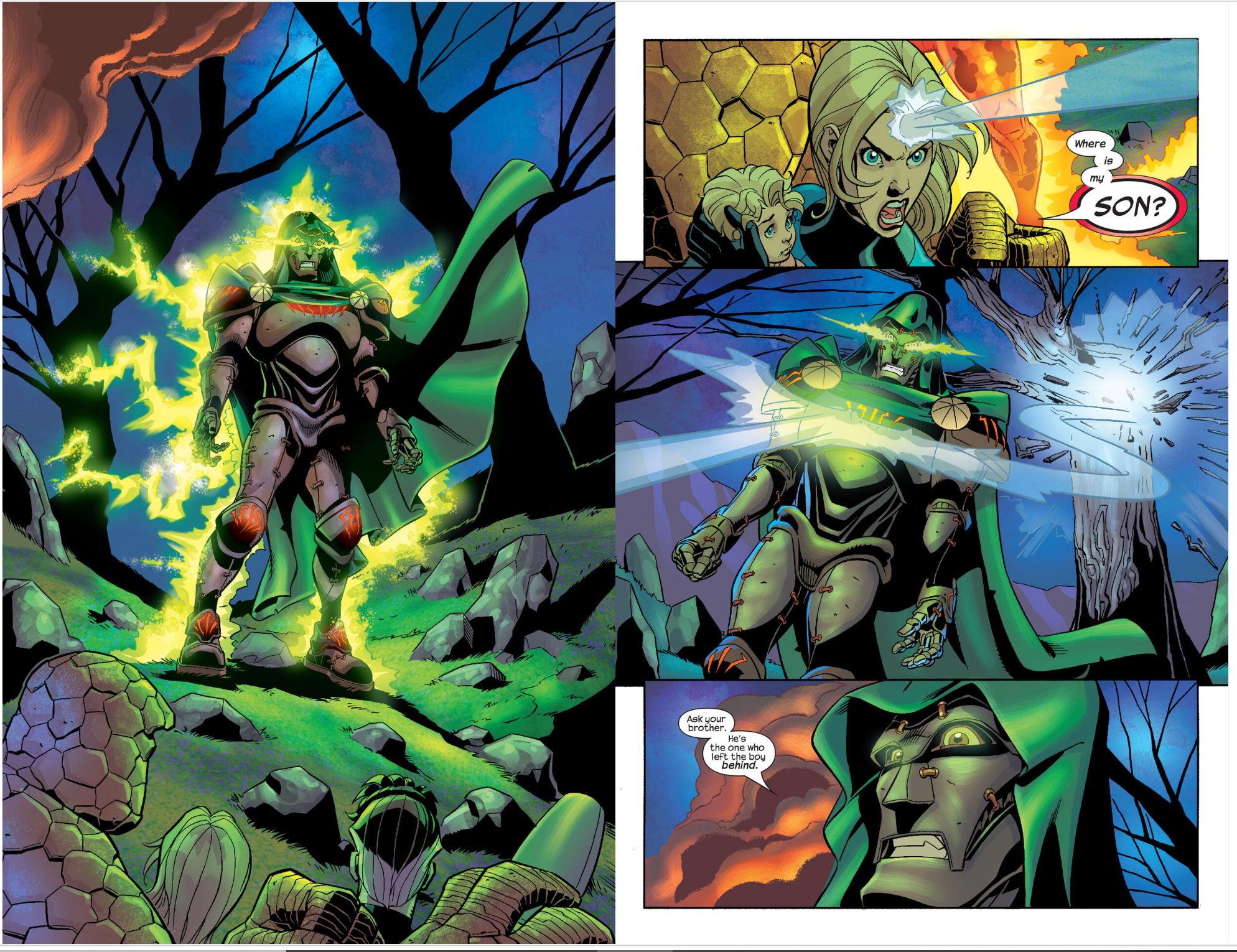
This terrifying glimpse into his past and stunning character study in obsession was but prologue to 4-part epic ‘Unthinkable’ which opened one month later. Waid’s greatest gift is his ability to embed hilarious moments of comedy into tales of shattering terror and poignant drama, and it’s never better displayed than here when Marvel’s First Family suddenly find their daily antics and explorations ripped from them. The method is straightforward enough: Doom attacks them through their children, using baby daughter Valeria as a medium for eldritch exploitation and sending firstborn Franklin Richards to Hell as part-payment to demons to whom the debased doctor has sold the last dregs of his soul.
Supreme technologist Richards had never truly accepted the concept of magic, but with Mystic Master Stephen Strange oddly unwilling to help, reeling and powerless Mr. Fantastic nonetheless leads his team to Latveria for a showdown, still unable to grasp just how much his archfoe has changed. Invading the sovereign rogue nation, they fight the greatest battle of their lives and lose anyway. The normally quicksilver mind of Richards seems unable to deal with his new reality and the FF are locked in prisons specifically and sadistically designed to torment them. As a sign of his utter disdain, Doom seals his broken rival in a colossal library of grimoires and mystic manuscripts, knowing the defeated, dogmatic scientist can never make use of what is there. Big mistake…
Before attacking the FF, Doom had ensorcelled Dr. Strange, but again underestimated the Sorcerer Supreme. Struggling to free himself, Strange established contact with Richards and began teaching the unbelieving ultra-rationalist the basics of magic. By the time Doom discovers his danger, Reed has freed his comrades and daughter. In the catastrophic battle that follows, the Iron Dictator replaces Franklin as the hostage of Hell, but not before one final act of malice…
Dwayne McDuffie, Casey Jones & Vince Russell then deliver restrained psycho-drama ‘My Dinner with Doom’ (Fantastic Four Special, February 2006) where the rivals intellectually spar: testing each other’s defences as the Latverian simultaneously seeks to wipe out all his lesser enemies. The story portion of this book concludes as Ed Brubaker, Pablo Raimondi, Mark Farmer, Drew Hennessy & Robin Riggs revisit, in-fill, expand to apply mature modern nuance to the monster’s origins and life. The Books of Doom #1-6 (January-June 2006) detail how a hounded boy turned wounded exile defied all obstacles – physical, emotional and ethical – to become supreme ruler of Latveria and menace to all who lived…
Comic classics are complemented by covers from Kirby with Sinnott, Ayers, Wood & Giacoia, Ditko, Lieber, Colletta; Marie Severin, John Buscema, John Verpoorten, Bill Everett, Esposito, John Romita Sr., Herb Trimpe; Ron Wilson, Gil Kane, Giffen, Byrne, Terry Austin, Miller, Cockrum, John Romita Jr., Simonson, Zeck, Hall, Williams, Mignola, Paul Ryan, Joe Jusko, Wieringo, Kesel, Rivera and Leinil Francis Yu with even more to adore.
The graphic grimoire grinds on with Doom pinups from Fantastic Four Annual #1 (1963, by Kirby), Amazing Spider-Man Annual #1(1964, by Ditko), Marvelmania Poster (1970, by Kirby) and Quotations from Chairman Doom 1984 (F.O.O.M. #4 Winter 1973, by Robert Cosgrove Kirby); Doom’s entry from the Official Handbook of the Marvel Universe Deluxe Edition (1985, Gruenwald, Peter Sanderson, Byrne & Kirby), spoof ads from Marvel 1989: The Year in Review (Mignola & Gregory Wright) plus a Marvel Masterwork Pin-up by Ron Frenz & Sinnott from FF #358. Dedicated art lovers can luxuriate in layouts, design sketches and unused art from Wieringo and covers to The Villainy of Doctor Doom TPB (1999 by Kirby, Klaus Janson & Marie Javins) – plus Tom Brevoort’s Introduction to that tome – and earlier Doom depictions revisited in this big book. These include covers to Marvel Masterworks Fantastic Four vol. 4 (Kirby & Dean White) & FF Annual #7 (1969, Kirby & Sinnott); Spider-Man Classics #6 (Frenz & Austin, September 1993); Spider-Man Collectible Series #11 (Frenz & Milgrom, October 2006); X-Men Classic #49 & 51 (Steve Lightle; July & September 1990); Iron Man vs. Doctor Doom (Julie Bell, 1994); Greatest Villains of the Fantastic Four TPB (Vince Evans 1995), variant covers to Emperor Doom & Triumph and Torment, FF #500 Directors Cut (2003 by Wieringo, Kesel & Richard Isanove.
Sheer comic enchantment, this a book no lover of the fantastic fiction can afford to ignore -just as long as they eat plenty of Spinach…
© 2022 MARVEL