
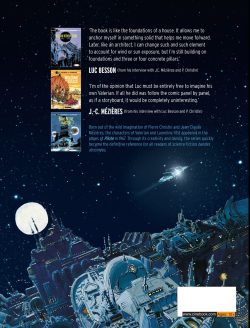
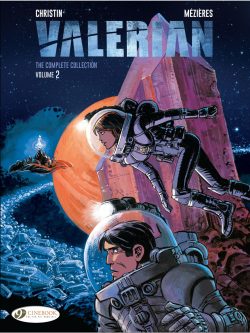
By J.-C. Mézières & P. Christin with colours by E. Tranl? with Stan Barets & translated by Jerome Saincantin (Cinebook)
ISBN: 978-1-84918-356-7 (HB), 978-1-84918-470-0 (Digital edition)
This book includes Discriminatory Content produced in less enlightened times.
Win’s Christmas Gift Recommendation: No Tree Big Enough to Hang These Stars On… 9/10
I just rewatched Besson’s Valerian and the City of a Thousand Planets for the umpteenth time so guess what’s coming next…
Valérian is arguably the most influential pictorial science fiction series ever published – and yes, I am including both Buck Rogers and Flash Gordon in that expansive and undoubtedly contentious statement.
Although to a large extent those landmark, ageless and evergreen newspaper strips formed the medium itself, anybody who has seen a Star Wars movie has seen some of Jean-Claude Mézières & Pierre Christin’s brilliant imaginings as that filmic phenomenon has shamelessly and for decades plundered everything from the look of the Millennium Falcon to Leia’s Slave Girl outfit. Simply put, more carbon-based lifeforms have experienced and marvelled at the uniquely innovative, grungy, lived-in tech realism and light-hearted swashbuckling roller-coasting of Mézières & Christin than any other cartoon spacer ever imagined possible.
Valérian: Spatio-Temporal Agent launched in the November 9th 1967 edition of Pilote (#420, running until February 15th 1968). Although a huge hit, graphic album compilations only began with second tale The City of Shifting Waters, as all concerned considered the first yarn a work-in-progress and not quite up to a preferred standard. You can judge for yourself, by getting hold of the previous compilation volume…
The groundbreaking series followed a Franco-Belgian mini-boom in sci fi triggered by Jean-Claude Forest’s 1962 creation Barbarella. Other notable successes of the era include Greg & Eddy Paape’s Luc Orient and Philippe Druillet’s Lone Sloane cosmic excursions, which all – with Valérian – stimulated mass public reception to science fiction and led in 1977 to the launch of dedicated fantasy periodical Métal Hurlant.
Valérian and Laureline (as the series became) is a light-hearted, wildly imaginative time-travel adventure-romp (a bit like Doctor Who, but not really all that much), warped with wry, satirical, humanist, socio-political commentary, starring (at least at the start) an affable, brawny, capably unimaginative, by-the-book cop tasked with protecting universal time-lines and counteracting paradoxes caused by casual chronal-voyagers. In the first case Valerian picked up fiery, capable Laureline – who originated in the 11th century before becoming our hero’s (far smarter) assistant/deputy. After the indomitable lass trained as a Spatio-Temporal operative she began accompanying Val on missions throughout time-space… luckily for him.
Valérian was initially serialised in weekly Pilote until the conclusion of 13th adventure The Rage of Hypsis (January 1st – September 1st 1985) after which the mindbending exploits simply premiered as new complete graphic novels, until the magnificent saga seemingly concluded in 2010.
(One clarifying note: in the canon “Hypsis” is counted as the twelfth tale, due to the collected albums being numbered from The City of Shifting Waters. When Bad Dreams was finally released in a collected edition in 1983 it was counted as number #0).
This splendid second oversized hardback compendium (also available digitally) was designed to cash in on the spectacular movie adaptation by Luc Besson and again boasts a wealth of text features. These include the next chapter of the continuing ‘Interview Luc Besson, Jean-Claude Mézières and Pierre Christin’, after which Stan Barets picks out creative highpoints and methodology of the creators in his essay ‘The Intergalactic Unites the Human Race!’.
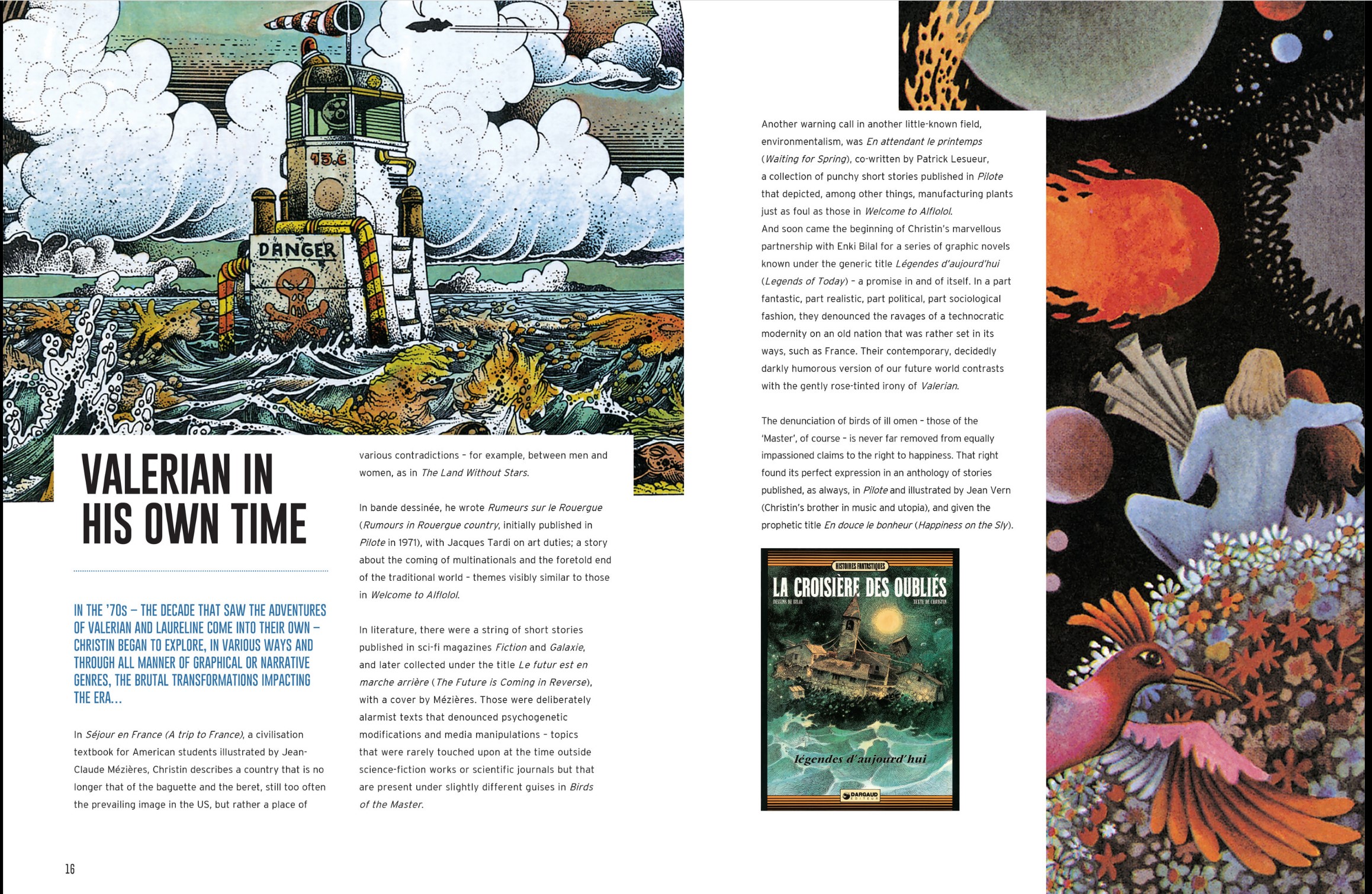
‘Valerian in His Own Time’ traces the development of the strip in France, with unseen and remastered art examples. Between 1981 & 1985, Dargaud-Canada and Dargaud-USA published a quartet of albums in English (with a limited UK imprint from Hodder-Dargaud) under the umbrella title Valerian: Spatiotemporal Agent. Written by Will Eisner & Daniel Richie, the original Introductions to two pertinent early editions are included here after which ‘The Stories in this Book’ offers context and a taste of things to come…
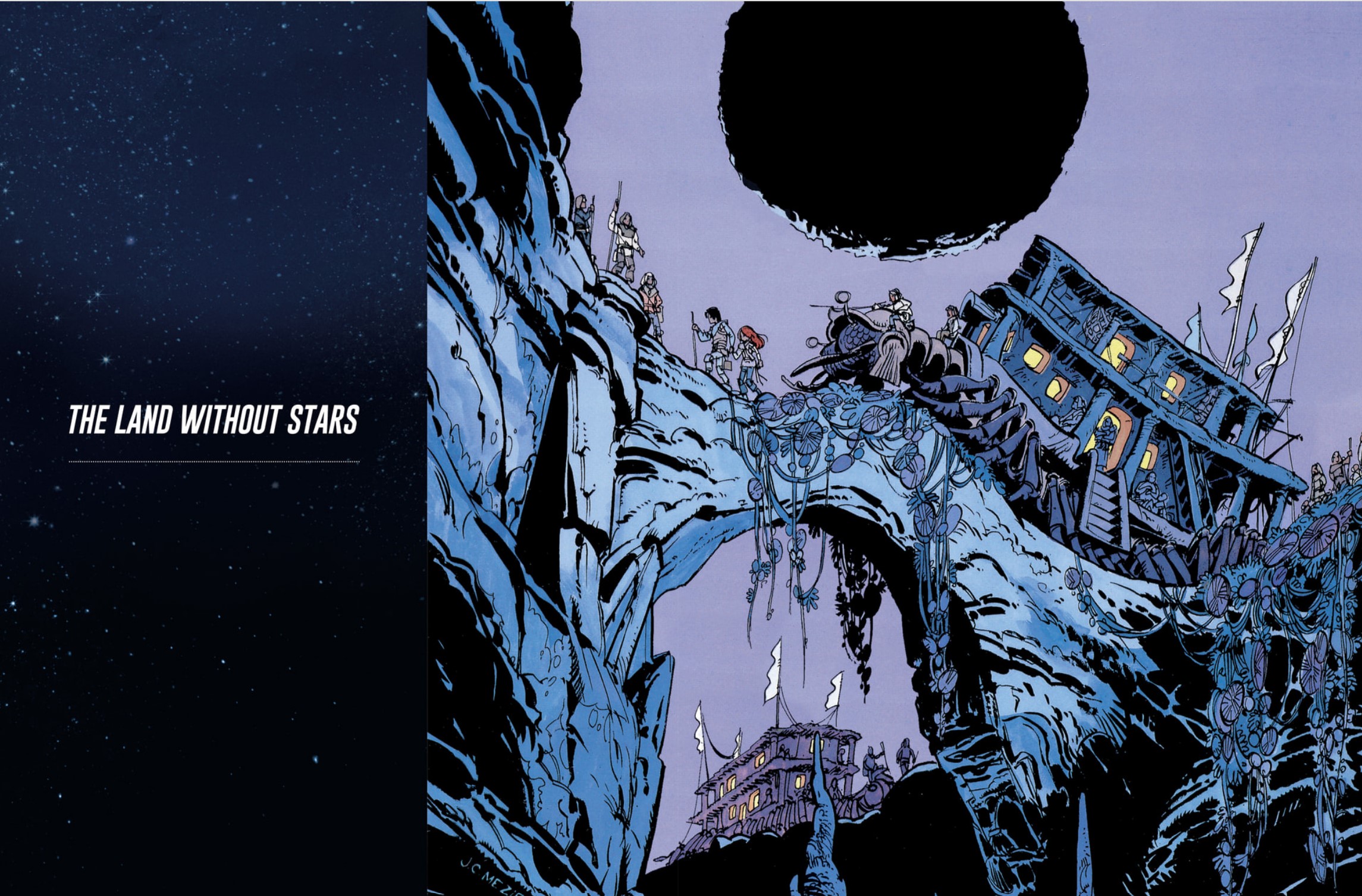
Re-presenting three classic formative fantasy-fests, the fabulous fun recommences here with The Land Without Stars as originally seen in Pilote #570-592 (October 8th 1970 to March 11th 1971). It follows the Spatio-Temporal agents as they undertake a tedious pro forma inspection of a cluster of new Terran colonies in the Ukbar star-system at the very edge of intergalactic space. However, the mission goes awry when a wandering world is detected on a collision course with the system and Valerian, still labouring under the effects of too many local alcoholic “diplomatic protocols”, decides that they should investigate at close quarters…
Despite being pickled, the insufferable lead agent lands with his long-suffering assistant on the runaway planet and discovers that this celestial maverick is hollow. Moreover, a thriving ancient culture or three thrive therein, utterly unaware that they are not the only beings in all of creation. Moreover and so typical of sentient beings everywhere, two of the civilisations are currently locked in a millennia-old war, and being armed and supplied by the third…
When an accident wrecks their exploratory scout ship Valerian & Laureline deduce the constant warfare originally caused the hollow world to tumble unchecked through space and will eventually result in its complete destruction, so in short order the professional meddlers split up to infiltrate the warring nations of Malka and Valsennar.
They are in for more surprises. Both city-states are divided on gender grounds, with Malka home to prodigious warrior women who subjugate their effete, feeble males whereas aristocratically foppish yet deadly dandies of Valsennar delight in beautiful, proficient and lethally lovely ladies… but only as totally compliant servants and chattels!
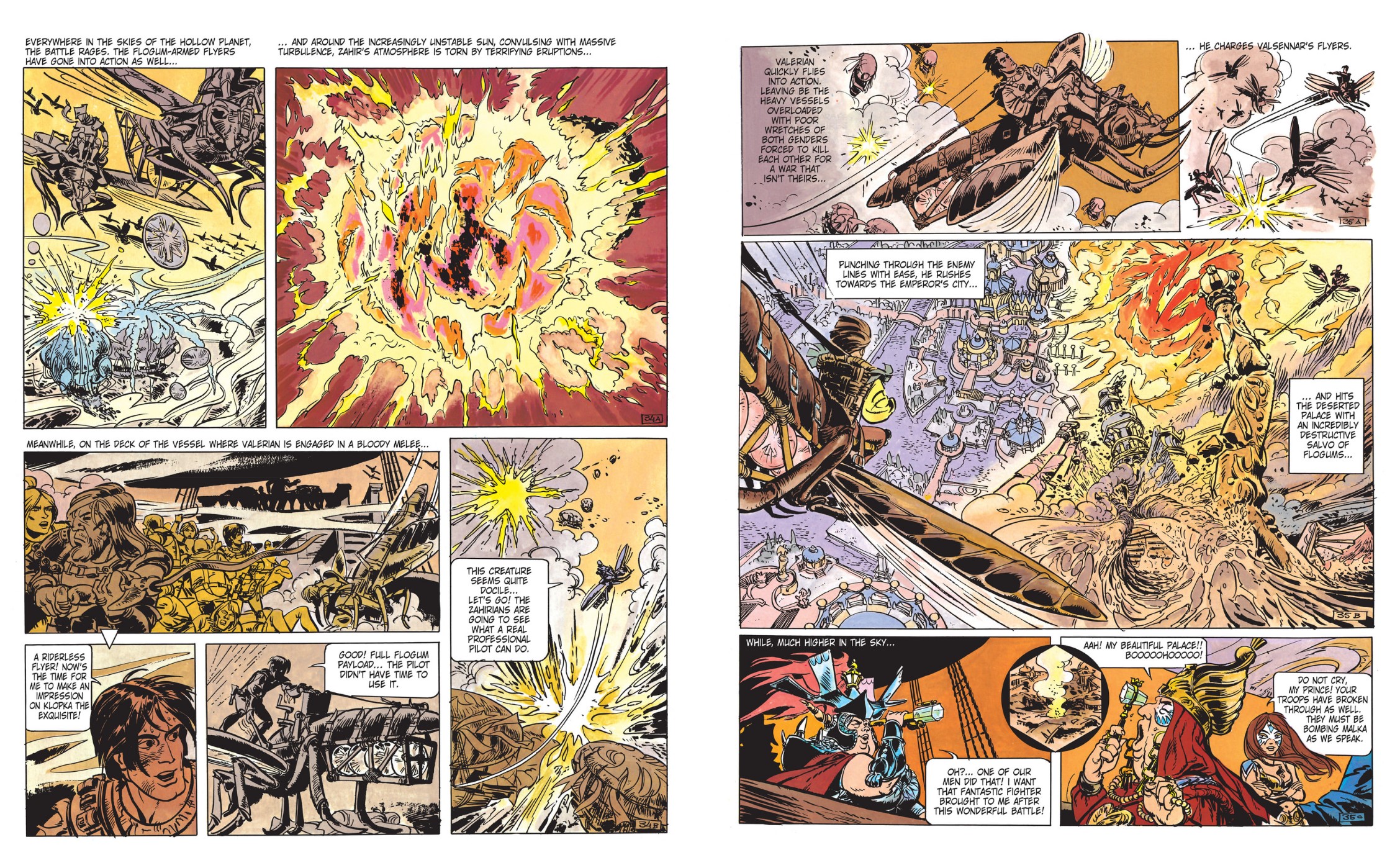
The highly-trained Galaxity operatives quickly rise in the ranks of each court – from slaves and toys to perfectly placed, trusted servants – and soon have ample opportunity to change the nature of the doomed civilisations inside the collision-course planet, after which our heroes concoct a cannily cunning method of ending the hollow world’s random perambulations; giving it a stable orbit and new lease on life…
All in a day’s work, naturally, although it does take a few months to sort out: still what’s time to a couple of brilliant Spatio-Temporal agents?
Happily, this mind-boggling socio-sexual satire is packed with astounding action, imaginative imagery and fantastic creatures to provide zest to a plot that has since become rather overused – sure proof of the quality of this delightful, so-often imitated original yarn – but, as always, the space-opera is fun-filled, witty, visually breathtaking and stunningly ingenious. Drenched in wickedly wide-eyed wonderment, science fiction sagas have never been better than this.
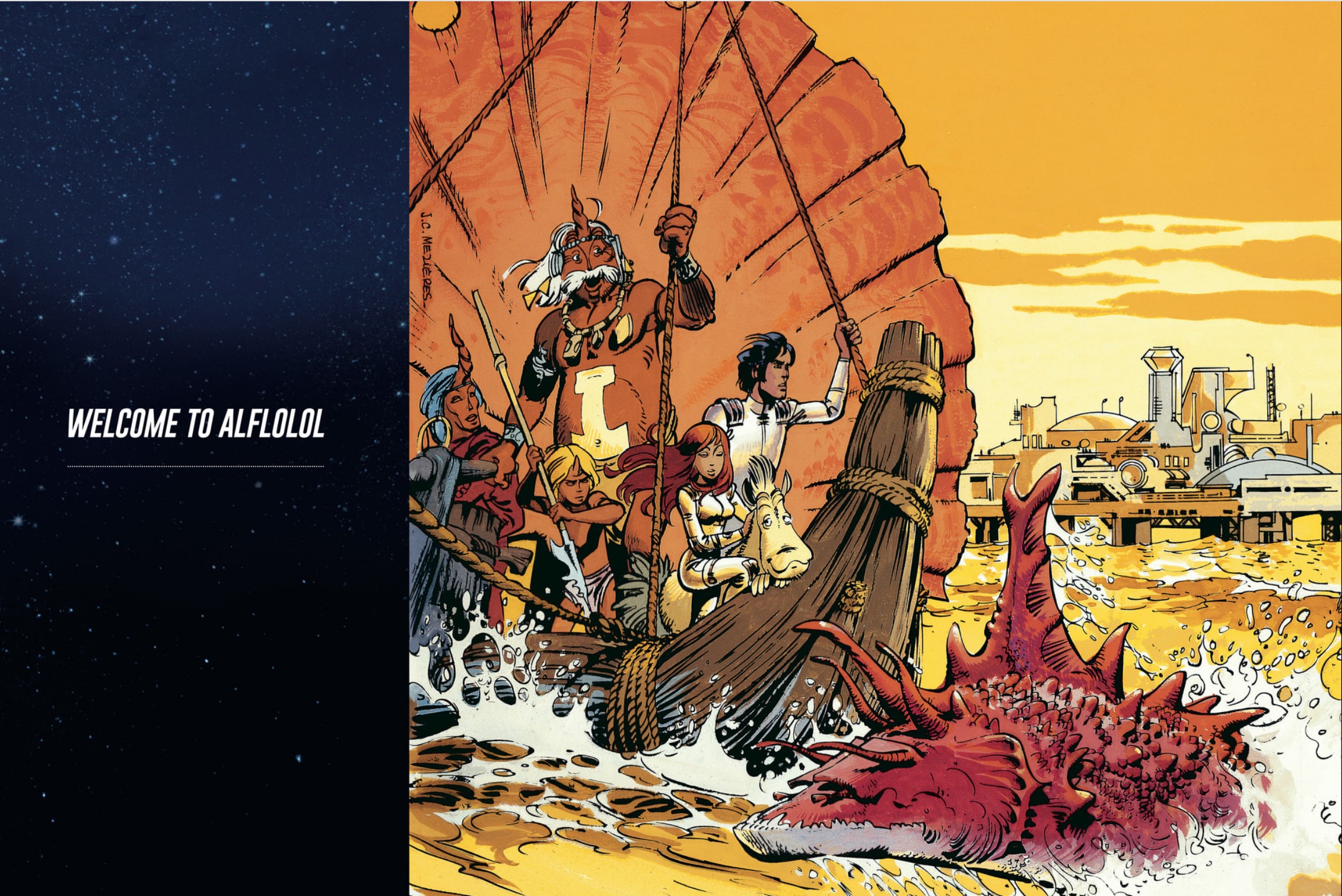
Welcome to Alflolol ran in Pilote #631-652 (December 1971-May 1972) and starts as the Spatio-Temporal agents depart from Technorog, a desolate industrial planet whose vast resources are crucial to the running of human civilisation. So vital in fact, that Galaxity sends her best agents just to inspect it every now and then…
As the S-T agents negotiate the immense forcefield and lethal asteroid belt surrounding the harsh, ferociously capitalistic factory world, Laureline is repeatedly possessed by an uncanny force. The fits draw them to an immense craft which has foundered between floating rocks and searing energy screen. Investigating the vessel (which is purposely open to hard vacuum) Laureline again lapses into a glowing coma and eerily drifts towards a family of incredibly powerful yet rustically affable primitives sitting on the hull of a seemingly derelict vehicle. Valerian, closely following, prevents a nasty accident to his companion and is warmly greeted by the strangers, who explain that the eldest of their contingent is very ill and in her fevered throes has locked minds with his female. If they’re not careful, both might die…
Garrulous, easy-going Argol agrees to let Valerian treat the problem, so his wife Orgal telekinetically transports the Earthlings, her full family and their pet Gumun to the astroship in an instant. Soon, Terran tech has saved human and alien and Argol settles back to explain what happened. These wanderers are naively friendly and immensely long-lived – like all their species – and are simply returning to their homeworld Alflolol after an amusing, gentle perambulation through space. However, since their departure – 4,000 Earth years ago – somebody else has rudely moved in…
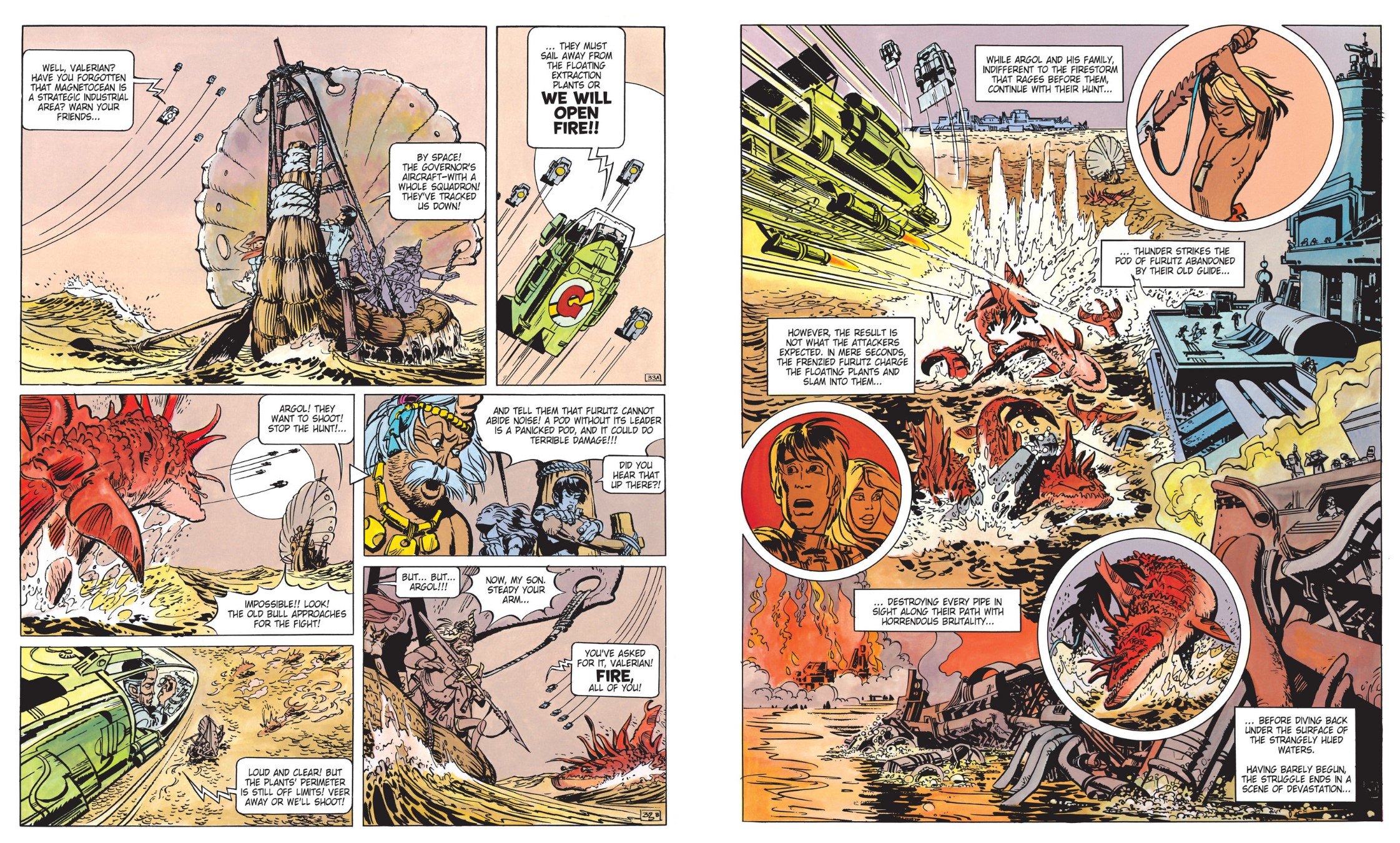
Problems soon occur. Despite the Technorog Governor’s outrage and protests, Galaxity law is clear. The Alflololians must be allowed back on their planet, no matter the cost to profits and productivity. However, the wheedling plutocrat – secure in his job’s importance to the empire – realises he doesn’t have to hand over the keys, just make room for five meek, polite “cosmic gypsies”. The nomadic returnees simply cannot grasp the concept of business and don’t understand why anybody would put up lots of flimsy, ugly buildings that spoil the hunting…
Valerian allows the businessmen to walk all over the aliens’ rights but Laureline goes berserk: arguing for Argol’s family whilst indulging in a little light-hearted sabotage as the gentle giants won’t do it for themselves…
She needn’t have bothered: their mere presence and arcane abilities are enough to disrupt the Governor’s precious productivity especially once they tire of sterile human accommodations and return to their ancestral ranges. The true crisis begins when all the other Alflololians return: one hundred ships full of natives protected by law and fully entitled to reclaim their homes. Sadly, the humans won’t leave and soon the Governor is herding wanderers onto a reservation and demanding they work if they want to eat.
Big mistake…
Poignantly challenging when not ruthlessly crusading, this is one of the earliest comics sagas to catch the 1970s wave of ecological awareness and still ranks amongst the very best to explore social iniquities besetting indigenous peoples at a time when most European dying empires were still grudgingly divesting themselves of colonial possessions. The theme of Capitalism versus Native Culture and eternal struggle between territorial imperatives, moral rights and holy profit have seldom been dealt with in such an effective, sardonic, hilariously surreal manner. Ending on an outrageous twist, the story has lost none of its wit and punch more than half a century later.
And, of course, there’s the usual glorious blend of astounding action, compelling imagery and fantastic creatures to leaven the morality play with space-operatic, visually breathtaking and stunningly ingenious wide-eyed wonderment…
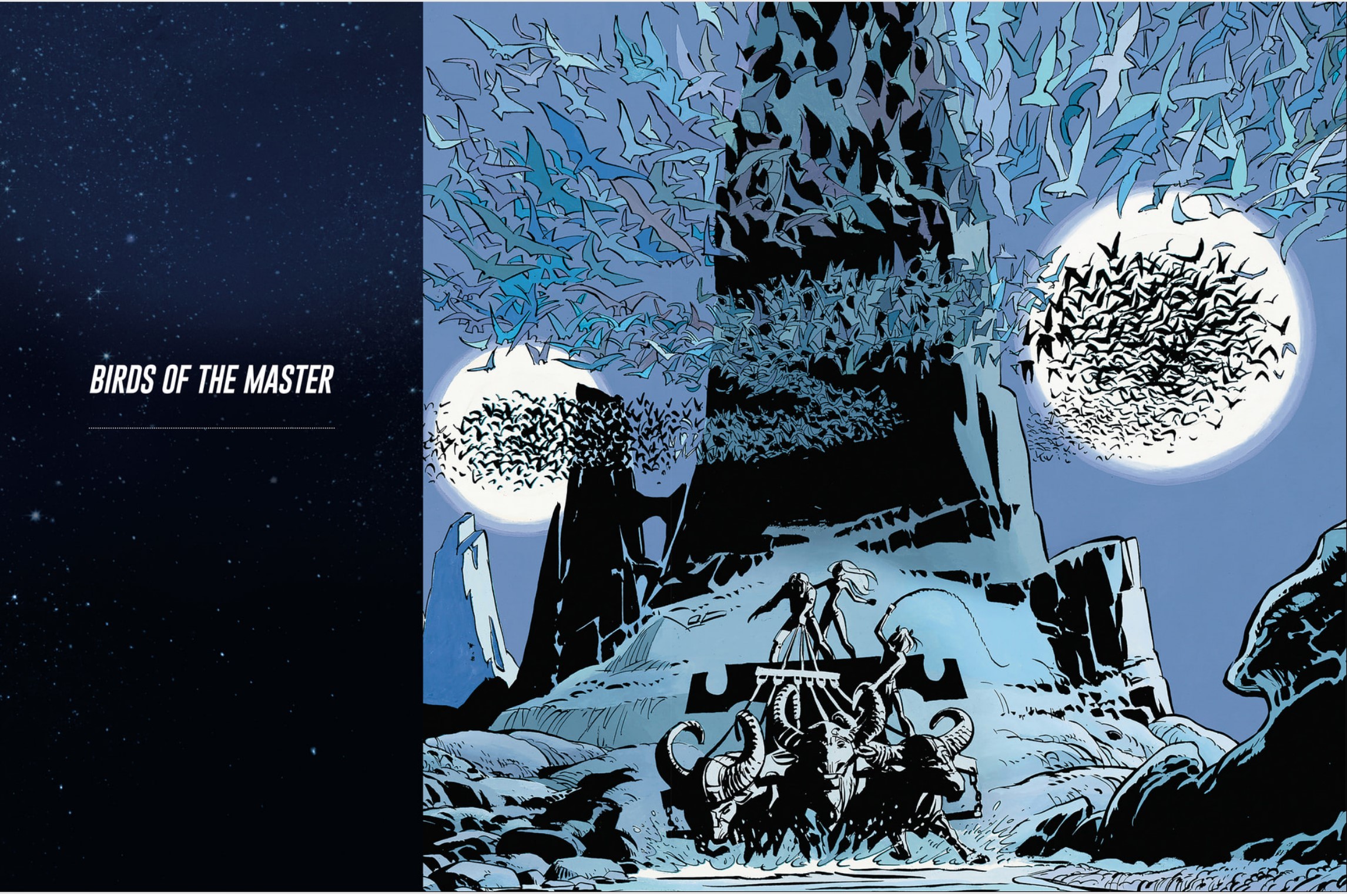
Concluding intergalactic investigations this go-round is Birds of the Master (serialised in Pilote #710-720; June 14th to September 16th 1973) joining a now perpetually bickering odd couple as they are drawn into an eerie space Sargasso and marooned on a planetoid that has become a cemetery for spaceships. Swept away by a tidal wave over a colossal waterfall, they are drowning amidst beds of kelp when a motley band of fisherfolk – comprised of many varying species – haul the S-T agents aboard a ramshackle boat. In the skies above, a vast cloud of malevolent birds circle, the same creatures which had brought down their astroship.
Compelled to join in gathering seaweed, the humans soon learn this crop is destined for mysterious unseen overlord The Master and the critically circling ugly avians are his enforcers: violent beasts inflicting madness with a bite…
Workers are nothing but despondent slaves. Bitterly discontented Sűl takes it upon himself to teach Valerian & Laureline what they need to survive as slimy cargo is torturously shipped across bleak, unforgiving and forlorn terrain. As they toil onwards the humans observe an entire society dedicated to providing vast amounts of food for the hidden overlord. At a central gathering point where assorted food items from a hundred different sources are reduced to a liquid mass dubbed “Klaar” one starving toilers cracks, seeking to consume a morsel of the Master’s provender. Instantly set upon by the sinister Birds of Madness the worker is aided by Sűl who is similarly accosted. Cautious Valerian can barely stop his partner using a concealed ray-weapons in a futile attempt to save them…
When the Birds are done the battered survivors can barely speak. The first rebel now believes he can fly whilst Sűl is left a babbling, aggressive shadow of his former self. With all the Klaar safely dispatched through a complex system of pipes to a distant and clandestine destination, the emaciated workers fall upon any spilled scraps before hurling the Birds’ newest victims into the Pit of Crazies. Despite being brutally beaten in the melee, our heroes follow; joining Sűl in a peculiar enclave of the deranged, each manifesting a unique brand of bewilderment yet all sharing the same strange, disturbing speech impediment…
Valerian & Laureline are again viciously attacked when they seek aid from “sane” slaves, and instead follow the pipeline alongside the most ambulatory of the insane, heading deep into increasingly inhospitable country to confront the closeted cause of their woes. At first followed by the outraged slave force, the visitors eventually outdistance their pursuers as they head deeper into the harsh, barren wastelands… until attacked by the ever-circling Birds. As a result, the Spatio-Temporal agents are also infected by the speech-mangling madness…
Pressing on, the raving rovers track a glowing mist and at last confront the vile thing which has lured, trapped and enslaved so many sentient beings. Subjected to overwhelming psychic assault that no single mind – sane or otherwise – could resist, all hope seems lost.
Happily, the Master has never faced anyone as ingenious as Laureline. Her desperate plan enables the assembled “Loonies” to fight back, driving the predatory horror offworld and into space. With the creature’s pernicious influence dispelled, all voyagers’ senses return and the victims return to the settlements where slaves have descended into a food-fuelled debauch. Surprisingly, once Valerian & Laureline have freed and repaired the astroship from the stellar graveyard, only Sűl wants to leave with them…
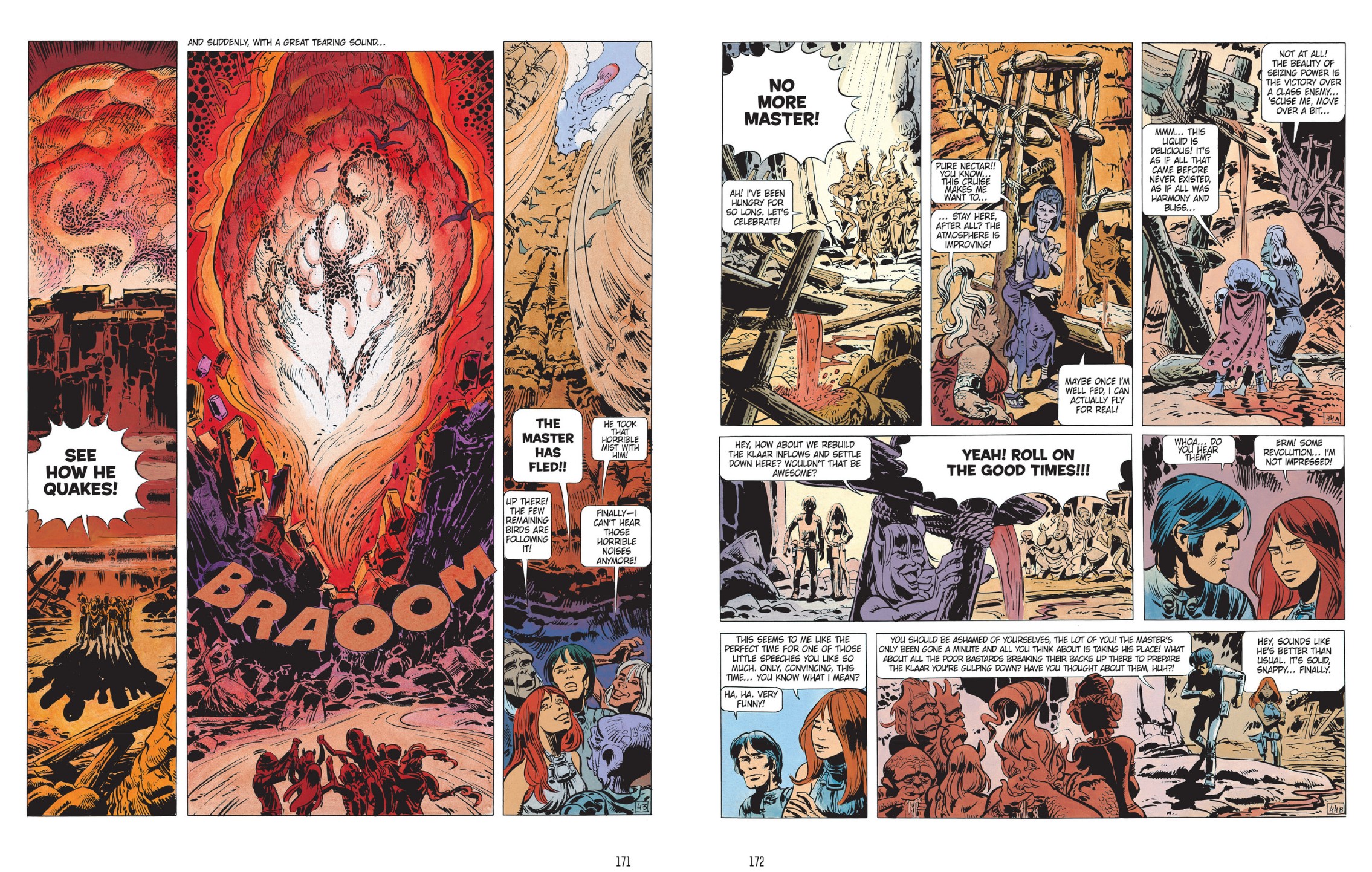
Expansive, thrilling, funny, clever and holding back one last wry twist in the tale, The Birds of the Master might be one a lesser galactic classic of this superb series, but still packs potent narrative punch and some of the most impressive artwork ever to grace sci-fi comics.
These spectacular space-opera romps are fun-filled, action-packed, conceptually engaging and mind-bogglingly ingenious: drenched in wide-eyed fantasy wonderment, this is a slice of science fiction heaven that has never been bettered…
© Dargaud Paris, 2016 by Christin, Mézières & Tranl?. All rights reserved. English translation © 2016 Cinebook Ltd.