
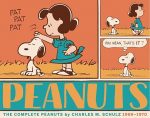
By Charles M. Schulz (Fantagraphics Books/Canongate Books UK)
ISBN: 978-1-68396-126-0 (US TPB) 978-0857862143 (Cannongate HB)
This book includes Discriminatory Content produced in less enlightened times.
Win’s Christmas Gift Recommendation: Towering Monumental Tradition Writ (and Drew) Large… 10/10
Peanuts is unequivocally the most important comic strip in the history of graphic narrative. It is also the most deeply personal. Cartoonist Charles M Schulz crafted his moodily hilarious, hysterically introspective, shockingly surreal philosophical epic for half a century: 17,897 strips spanning October 2nd 1950 to February 13th 2000. He died – from complications of cancer – the day before his last strip was printed.
At its height, Peanuts ran in 2,600 newspapers, in 21 languages and75 countries. Many of those venues still run it as perpetual reprints, and have done ever since “Sparky” passed. During his lifetime, book collections, a merchandising mountain and television spin-offs had made the publicity-shy doodler an actual billionaire at a time when that really meant something…
None of that matters. Peanuts – a title Schulz loathed, but one the syndicate forced upon him – changed the way comics strips were received and perceived: proving cartoon comedy could have edges and nuance and meaning as well as too-soon-forgotten pratfalls and punchlines.
We begin with an effusive and enthusiastic foreword from author/animator/illustrator Mo Willems (Don’t Let the Pigeon Drive the Bus!, Knuffle Bunny, Sheep in the Big City) expressing his debt to the strip.
On the pages, this period heralds a true renaissance probably triggered by headlines in an era of swiftly shifting changes in social attitudes and rampant cultural exploration. Notionally, our focus and point of contact remains quintessentially inspirational loser Charlie Brown who, despite slowly taking a few steps behind fanciful, high-maintenance mutt Snoopy, remains squarely at odds with the mercurial supporting cast. They are still hanging out doing what at first sight seems to be Kids Stuff in an increasingly hostile and intrusive universe of perverse happenstance. Except perhaps that Lucy Van Pelt kid. She’s not like the others…
Neatly interspersed with daily doses of gloom, the Peanuts Sunday page first debuted on January 6th 1952: a standard half-page slot offering more measured fare than 4-panel dailies. Thwarted ambition, sporting failures, crushing frustration abound, alternating with Snoopy’s inner life of aviation and war stories, star gazing, shooting the breeze with bird buddies, weather woes and food fiascos. These and other signature sorties across the sabbath indulgences afforded Schulz room to be his most imaginative, whimsical and provocative…
Regular tentpole moments to relish include more Snoopy v Lucy deathmatches/ambush snogs/dance offs; Charlie Brown’s food feud with the beagle, an assortment of night terrors; Lucy’s emphatically simple solutions to complex questions; doggy dreams; the power of television; sporting endeavours and the sharply-cornered romantic triangle involving Lucy, Schroeder & Beethoven – albeit wedded to “sophisticated” fallout when pushy Frieda decides she also wants to play…
Always, gags centre on play, varying degrees of musicality, pranks, interpersonal alignments, the mounting pressures of ever-harder education, mass media lensed through young eyes and a selection of sports in their season. All are leavened by agonising teasing, naked contempt, kindled and crushed hopes, the making of baffled observations and occasionally acting a bit too much like grown-ups. However, in this tome, themes and tropes that define the entire series (especially in the wake of many animated TV specials) become mantra-like yet endlessly variable, but focus less on Charlie and more on those around him. Also, the outside grown-up world considerably encroaches, as when Lucy declares herself a “ New Feminist” although no one looking can see any difference to any presumably previously un-enlightened Miss van Pelt…
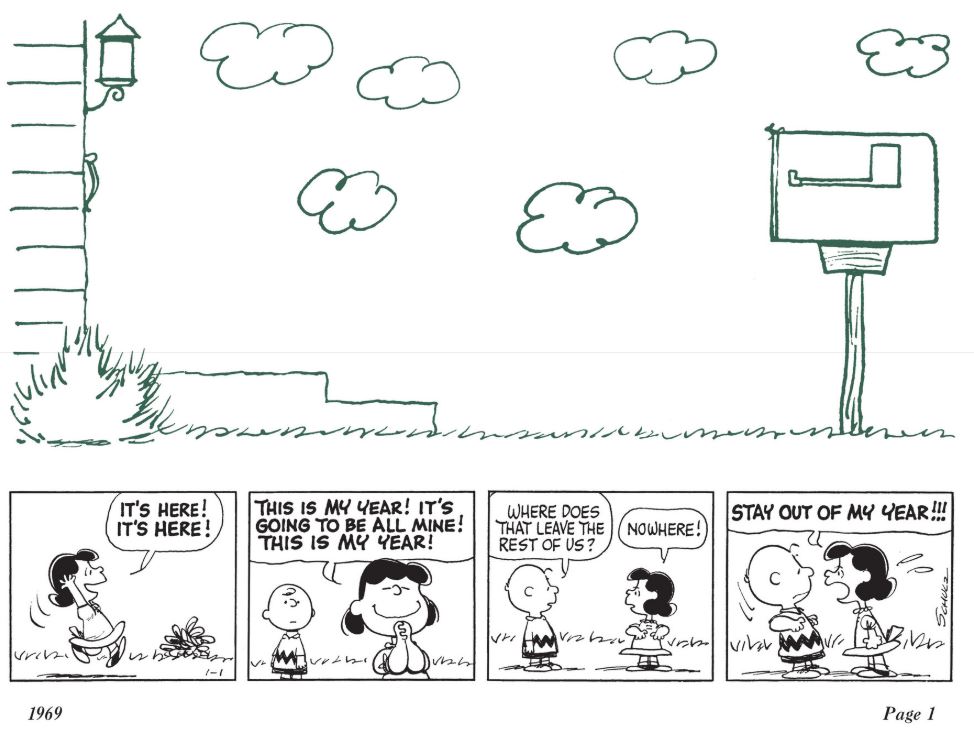
Human interactions still find the boy a pitiable outlier. Mean girl Violet, musical prodigy Schroeder, self-taught psychoanalyst/dictator-in-waiting Lucy, her brilliantly off-kilter little brother Linus and dirt-magnet “Pig-Pen” are fixtures honed and primed to generate joke-routines and gag-sequences around their signature foibles, but some early characters have faded away in favour of fresh attention-attracting players. Newcomers sidle in and shuffle off without much flurry or fanfare but in our real world the use of “Minority” characters José Peron of New Mexico and African American Franklin drew much attention and controversy – because, I guess, there will always be gits and arseholes – especially if the oblivious readers elected them…
The most significant expansion is that weird upside bird bugging the beagle gets a name – Woodstock (as revealed on June 22, 1970) – and a job as his dogsbody – secretary, actually – whilst shock near-cripples the round-headed kid when he discovers that the “little red-haired girl” he almost plucked up the nerve to talk to moves to a new city. It’s a blow he’s still reeling from when this book ends two years later, and one only Linus really understands. After all, his teacher Miss Othmar is gone after the teacher’s strike…
There is much more madcap politically-tinged material, including repeated riffs on a recently inaugurated new real-world president (Richard Milhous Nixon on January 20, 1969) as seen when Snoopy briefly becomes the most powerful mutt in the Free world after being chosen as the new Grand Beagle…
At least the Brown boy’s existential crisis/responsibility vector/little sister Sally has grown enough to become just another trigger for relentless self-excoriation. As she grows, pesters librarians, forms opinions and propounds steadfastly authoritarian views, Charlie is relegated to being her dumber, but eternally protective, big brother especially as her biggest bugbear is starting school and Charlie is such an expert on all things scholastic…
Resigned to – but far from uncomplaining about – life as a loser in the gunsight of cruel and capricious fate, the boy Brown is helpless meat in the clutches of openly sadistic Lucy. When not sabotaging his efforts to kick a football, she monetises her spiteful verve via a 5¢ walk-in psychoanalysis booth (although supply and demand economics also affects this unshakeable standard), ensuring that whether at play, in sports, kite-flying or just brooding, the round-headed kid truly endures the character-building trials of the damned.
One deliciously powerful constant that grows more abundant is the boy’s utter inability to fly that kite. Here war with wind, gravity and landscape reaches absurdist proportions, as the tree haunts Charlie Brown’s adored pastime with vicious, violent and malign venom. Moreover, other kids are aware of its growing power. After one terse musical interlude with Schroeder, Lucy lobs our reluctant lover-boy’s beloved piano into the voracious carnivorous conifer…
By now, the beagle is the true star of the show, with his primary quest for more and better playing out against an increasingly baroque inner life, wild encounters with birds, sports, dance marathons and skating trysts (especially the close-order combat called ice hockey!), philosophical ruminations, and ever-more-popular catchphrases. Here, burgeoning whimsy leads to more glimpses of the interior world: his WWI other life, peppered with dogfights against the accursed Red Baron, but also careers as an astronaut, a sports coach, a prairie dog and a detective seeking his lost mother. That tragic obscured past as an alumni of the Daisy Hill Puppy Farm leads to constant introspection… and dancing… lots and lots of dancing…
Naturally, Snoopy soon subverts all that misery and curiosity to fuel his creative side and begins the Great American Novel that will change literature forever… but that’s before the Browns go on vacation and leave the dog with the Van Pelts. Naturally, Lucy has an idea about finally fixing the pooch. It doesn’t end well…
As always, timeless episodes of play, peril, peewee psychoanalysis and personal excoriation are beards for some heavy topics. Rendered in marvellous monochrome, there are crucial character introductions, plot developments and creation of more traditions we all revere to this day. Of particular note is the growing role of Patricia Reichardt – AKA tomboy Peppermint Patty – who heartbreakingly deals with the so-early discovery that she will never be pretty or beautiful. Even Snoopy’s most concerted efforts can’t quite salve that sting…
Another trenchant continued gag-series resumes Lucy obsessive attempts to “cure” Linus of his blanket dependency by again playing him off against Grandma who will give donations to charities if the boy grows up…
Snoopy is the only force capable of challenging if not actually countering Lucy. Over these two years, her campaign to curb that weird beagle, cure her brother of blanket addiction and generally reorder reality to her preferences reaches astounding heights and appalling depths, but the dog keeps trying and scores many minor victories. As always the book opens and closes with many strips riffing on snow, food, movie-going and television – or the gang’s responses to it – becoming ever more pervasive. And as always, Lucy constantly, consistently sucks all the joy out of the white wonder stuff and the astounding variety offered by the goggle-box. Perpetually sabotaged, and facing abuse from every female in their life, Brown and Snoopy endure more casual grief from smug, attention-seeking Frieda, who champions shallow good looks over substance. At least Linus is growing: hardened inside by what happened to teacher Miss Othmar, but Lucy’s amatory ambitions for Schroeder grow ever more chilling and substantive. She will never move on…
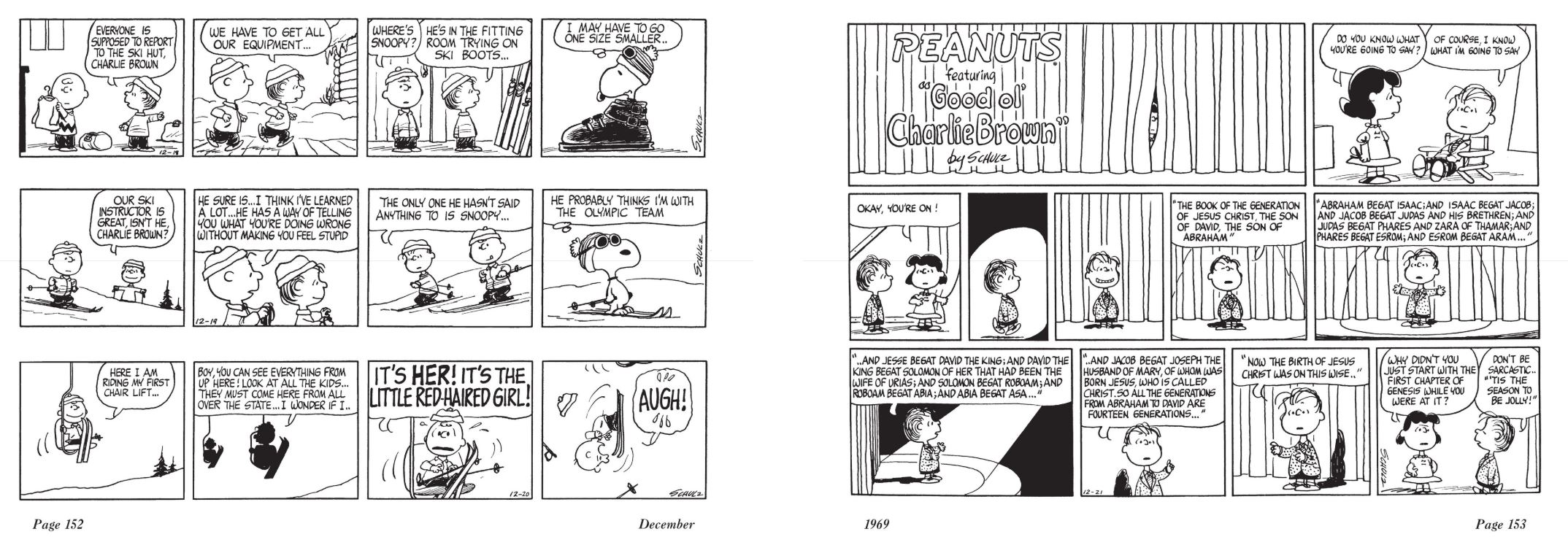
Schulz established way points in his year: formally celebrating certain calendar occasions – real or invented – as perennial shared events: Mothers and Fathers’ Days, Fourth of July, National Dog Week strips accompanied in their turn yearly milestones like Christmas, St. Valentine’s Day, Easter, Halloween/Great Pumpkin Day and Beethoven’s Birthday were joined this year by a return to another American ritual as many of the cast return to summer camp. At least there is unbridled joy when Brown’s baseball team hits a winning streak and Charlie meets his all-time sporting idol – except of course they’re not quite the boons they first appear…
Sports loom large and terrifying as ever, but star athlete Snoopy is more interested in new passions than boring old baseball or hockey. Even Lucy finds far more absorbing pastimes but still enjoys crushing the spirits of her teammates in whatever endeavour they are failing at. Anxiety-wracked Brown even steps down from the baseball team to ease his life, but that only intensifies his woes, and does nothing to help his kite wielding or football kicking…
Linus endures more disappointment in two Great Pumpkin seasons and before you know it, there’s the traditional countdown to Christmas and another year filled with weird, wild and wonderful moments…
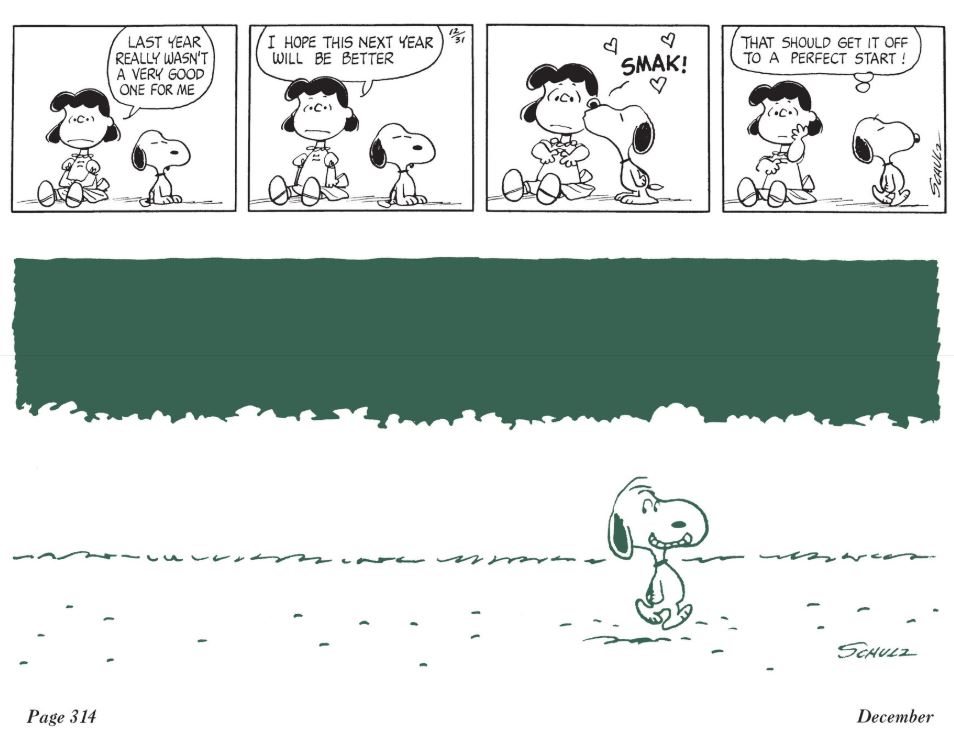
Wrapping it all up, Gary Groth celebrates and deconstructs the man and his work in ‘Charles M. Schulz: 1922 to 2000’, preceded by a copious ‘Index’ offering instant access to favourite scenes you’d like to see again…
Available in multiple formats, this volume guarantees total enjoyment: comedy gold and social glue metamorphosing into an epic of spellbinding graphic mastery that still adds joy to billions of lives, and continues to make new fans and devotees long after its maker’s passing.
The Complete Peanuts: 1969-1970 (Volume Ten) © 2008 Peanuts Worldwide, LLC. The Foreword is © 2008, John Waters. “Charles M. Schulz: 1922 to 2000” © 2008 Gary Groth. All rights reserved.
Today in 1946 Lucky Luke “debuted” in the Spirou Alamanch Annual – except if you read Lucky Luke: The Complete Collection Volume One you’ll know that ain’t necessarily so…
And in 1970 the incredible Rube Goldberg shuffled off this mortal coil. It was probably one he had designed in his masterful cartoons. Go google Rueben Awards…