
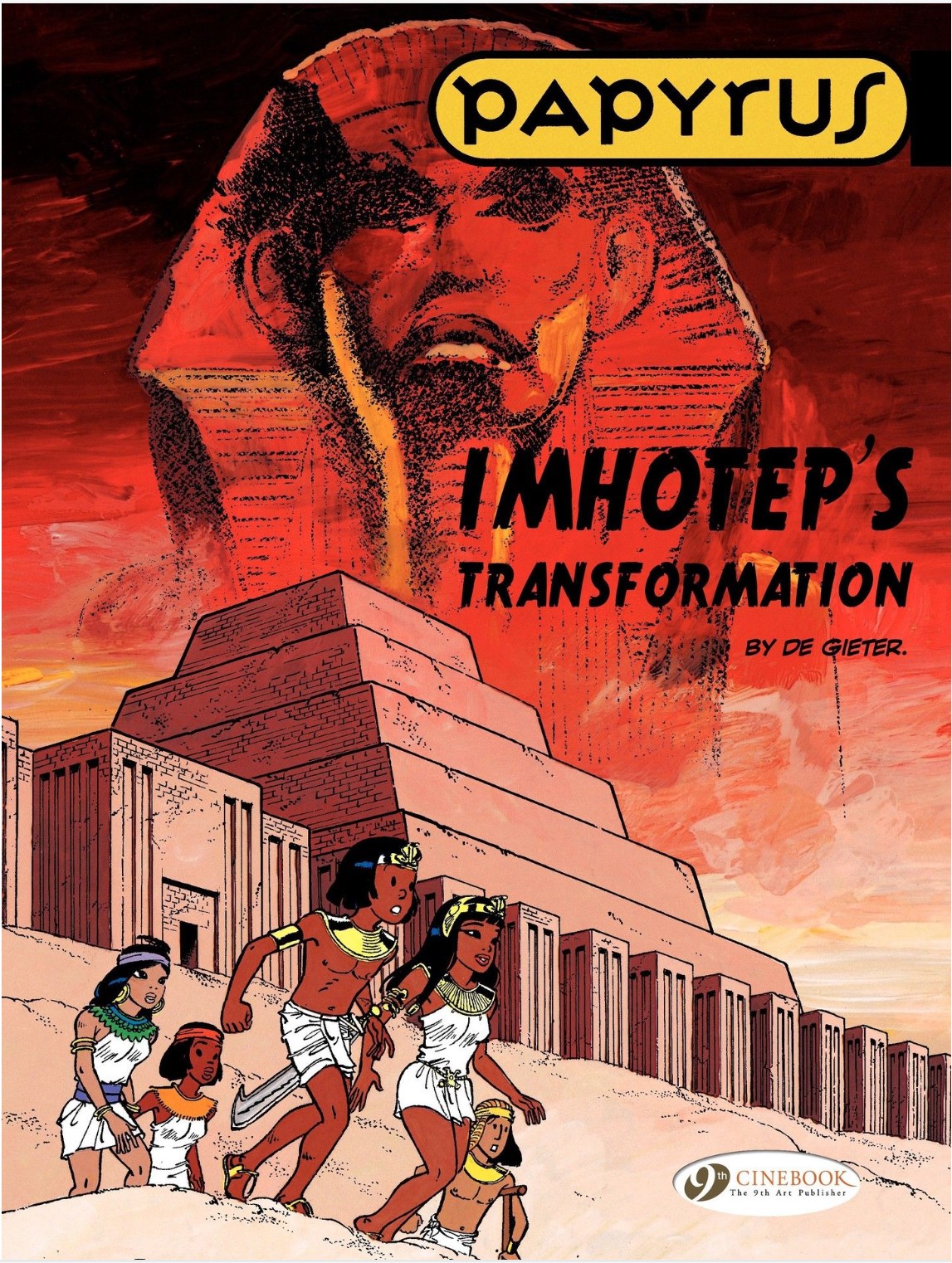
By Lucien De Gieter, coloured by Colette De Gieter: translated by Luke Spear (Cinebooks)
ISBN: 978-1- 905460-50-2 (Album PB/Digital edition)
This book includes Discriminatory Content produced in less enlightened times.
British and European comics have always been happier with historical strips than our cousins across the pond (a pugnacious part of me wants to say that’s because we have so much more past to play with – and yes, I know they can claim Prince Valiant, but it’s an exception, not a rule), and our Franco-Belgian brethren in particular have made an astonishing art form out of days gone by.
The happy combination of past lives and world-changing events blended with drama, action and especially broad humour has generated a genre uniquely suited to beguiling readers of all ages and tastes. Don’t take my word for it – just check out Asterix, Adele Blanc-Sec, The Towers of Bois-Maury, Empress Charlotte, Iznogoud or Thorgal to name the merest few which have made it into English, or even our own much missed classics such as Olac the Gladiator, Dick Turpin, Heros the Spartan or Wrath of the Gods – all long overdue for collection in mass market album form and on the interweb-tubes…
Papyrus is the spectacular magnum opus of Belgian cartoonist Lucien de Gieter. It began in 1974 in the legendary weekly Le Journal de Spirou, running to 36 albums, plus a wealth of merchandise, a television cartoon show and a video game.
The plucky “fellah” (go look it up) was blessed by the gods and gifted with a magic sword courtesy of the daughter of crocodile-headed Sobek. His original brief was to free supreme Horus from imprisonment in the Black Pyramid of Ombos and thereby restore peace to the Two Kingdoms. More immediately however the lad was also charged with protecting Pharaoh’s wilful and high-handed daughter Theti-Cheri – a princess with an unmatchable talent for finding trouble…
De Gieter was born in 1932 and studied at Saint-Luc Art Institute in Brussels before going into industrial design and interior decorating. He made the logical jump into sequential narrative in 1961, first through ‘mini-récits’ inserts (fold-in, half-sized-booklets) for Le Journal de Spirou of his jovial little cowboy Pony, and later by writing for established regular art stars as Kiko, Jem, Eddy Ryssack and Francis.
He then joined Peyo’s studio as inker on Les Schtroumpfs – AKA The Smurfs – and took over the long-running newspaper strip Poussy. In the mid-1960s he created South Seas mermaid fantasy Tôôôt et Puit’, even as Pony was promoted to the full-sized pages of Spirou, so De Gieter deep-sixed his Smurfs gig to expand his horizons, producing work for Le Journal de Tintin and Le Journal de Mickey. From 1972-1974 he assisted cartooning legend Berck on Mischa for Germany’s Primo, whilst putting finishing touches to his new project. This creation would occupy his full attention – and delight millions of fervent fans – for the next 40 years.
The annals of Papyrus encompass a huge range of themes and milieus: blending boys-own adventure with historical fiction and interventionist mythology, gradually evolving from traditionally appealing Bigfoot cartoon content towards a more realistic, dramatic and authentic iteration. Throughout, these light fantasy romps depict a fearless, forthright boy fisherman favoured by the gods as a hero of Egypt and friend to Pharaohs.
Imhotep’s Transformation was the second Cinebook translation (and 8th yarn, originally released in 1985 as La Métamorphose d’Imhotep): opening with our hero and his one-legged friend Imhotep (no relation) paddling a canoe through the marshes of the Nile. The peaceful idyll is wrecked when Theti-Cheri and her handmaidens hurtle by in their flashy boat, but the boys don’t mind as they have a message for the princess and were looking for her…
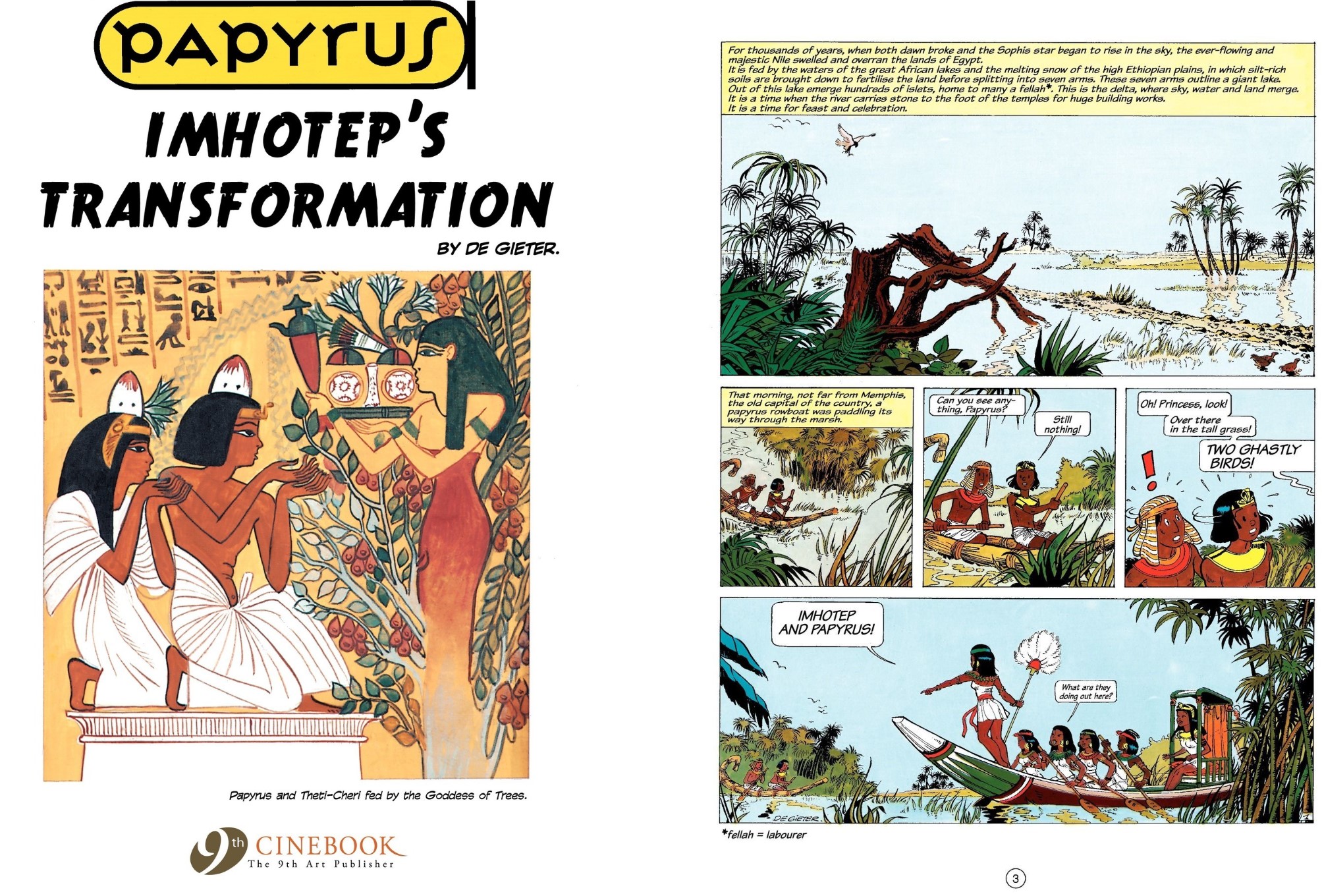
The new sacred statue of her father has arrived from the Priests of Memphis and the daughter of Heaven is required at the ceremony to install it at the pyramid of Saqqara before the annual Heb Sed King’s Jubilee. As girls and boys race back, an old peasant is attacked by a crocodile and diving after him; Papyrus wrestles the reptile away. He is about to kill it when Sobek appears, beseeching him to spare it.
On the surface Theti-Cheri and her attendants are ministering to the aged victim and the princess can’t help noticing how he bears an uncanny resemblance to her dad…
By the time they all reach the pyramid, the monumental task of hauling the statue into place is well under way, but suddenly blood begins pouring out of the monolith’s eyes. Terrified workers panic and the colossal effigy slips, crashing to destruction. The populace are aghast and murmurs of curses and ill omens abound. Rather than running away, Imhotep heads for the rubble and discovers the statue’s head is hollow. Moreover, inside there is a dead dwarf and a smashed flask which had held blood…
Papyrus is in the royal compound where recent events have blighted the anticipation of the court. During Heb Sed, the Pharaoh has to run around the sacred pyramid three times and fire his bow at the four corners of the kingdoms to prove his fitness to rule, but now it appears the gods have turned against their chosen emissary on Earth…
Papyrus is not so sure and when he tries to speak to a royal server the man bolts. Giving chase, the lad is in time to prevent the attendant’s murder, but not his escape. Then a cry goes up: Pharaoh has been poisoned…
Knowing there is no love lost between the Memphis Priests of Ptah and loyal Theban clerics doctoring the fallen king, Papyrus warns of a possible plot, but can offer no proof. What is worse, Chepseska, leader of the Memphis faction, is of royal blood too and will inherit the kingdom if Pharaoh is unable to complete the Heb Sed ritual. As loyal physicians and priests struggle to save their overlord’s life, Theti-Cheri remembers the old man in the swamp. If only the crocodile bite has not left him too weak to run…
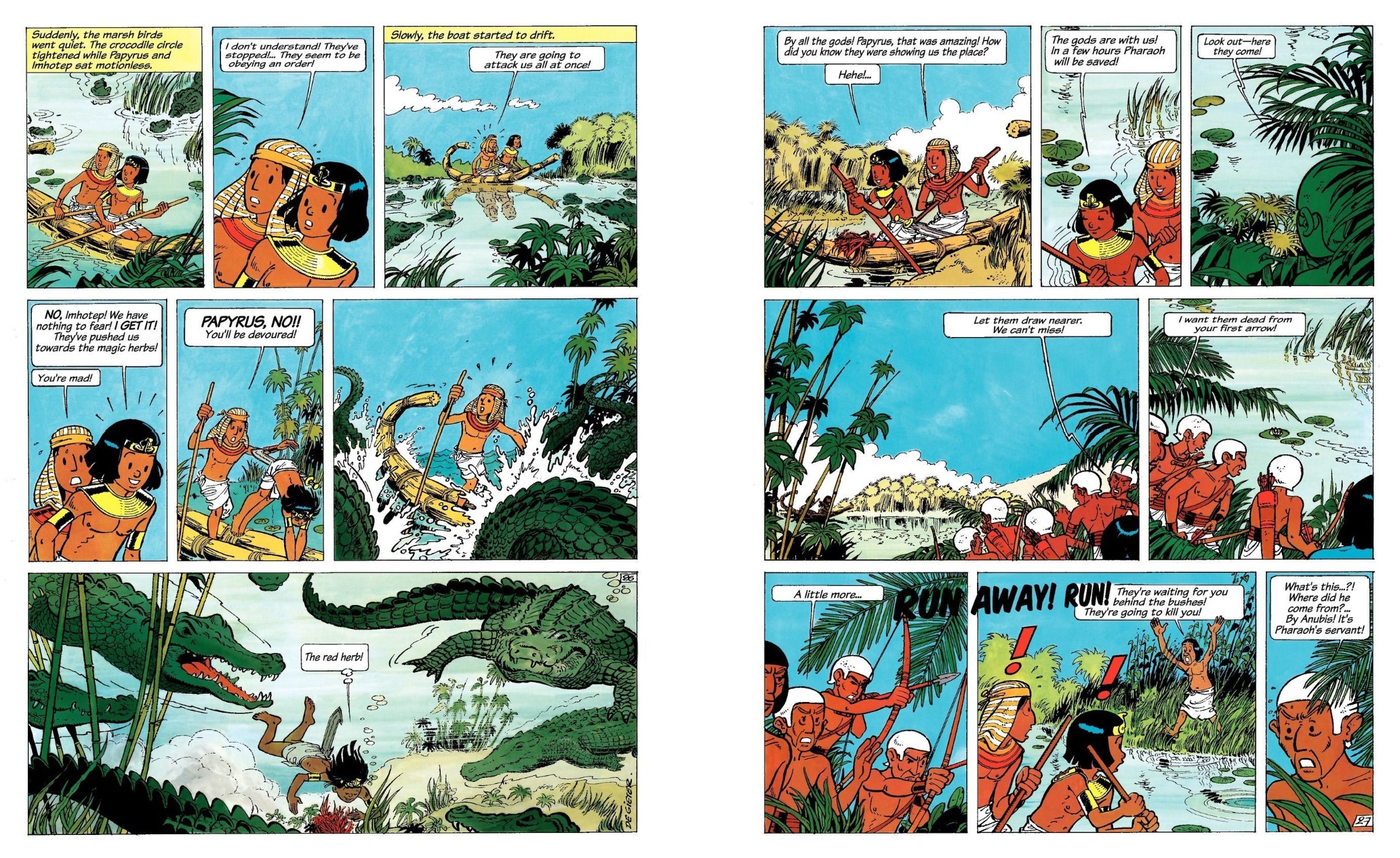
The doughty dotard is willing to try and also knows of a wise woman whose knowledge of herbs can cure Pharaoh. However, ruthless Chepseska is on to the kids’ ploy and dispatches a band of killers to stop Papyrus and Imhotep.
The gods, however, are behind the brave kids and after the assassins fall to the ghastly judgement of Sobek, the boys rush an antidote back to Saqqara, only to fall into the lost tomb of Great Imhotep, first Pharaoh, builder-god and divine lord of the Ibis.
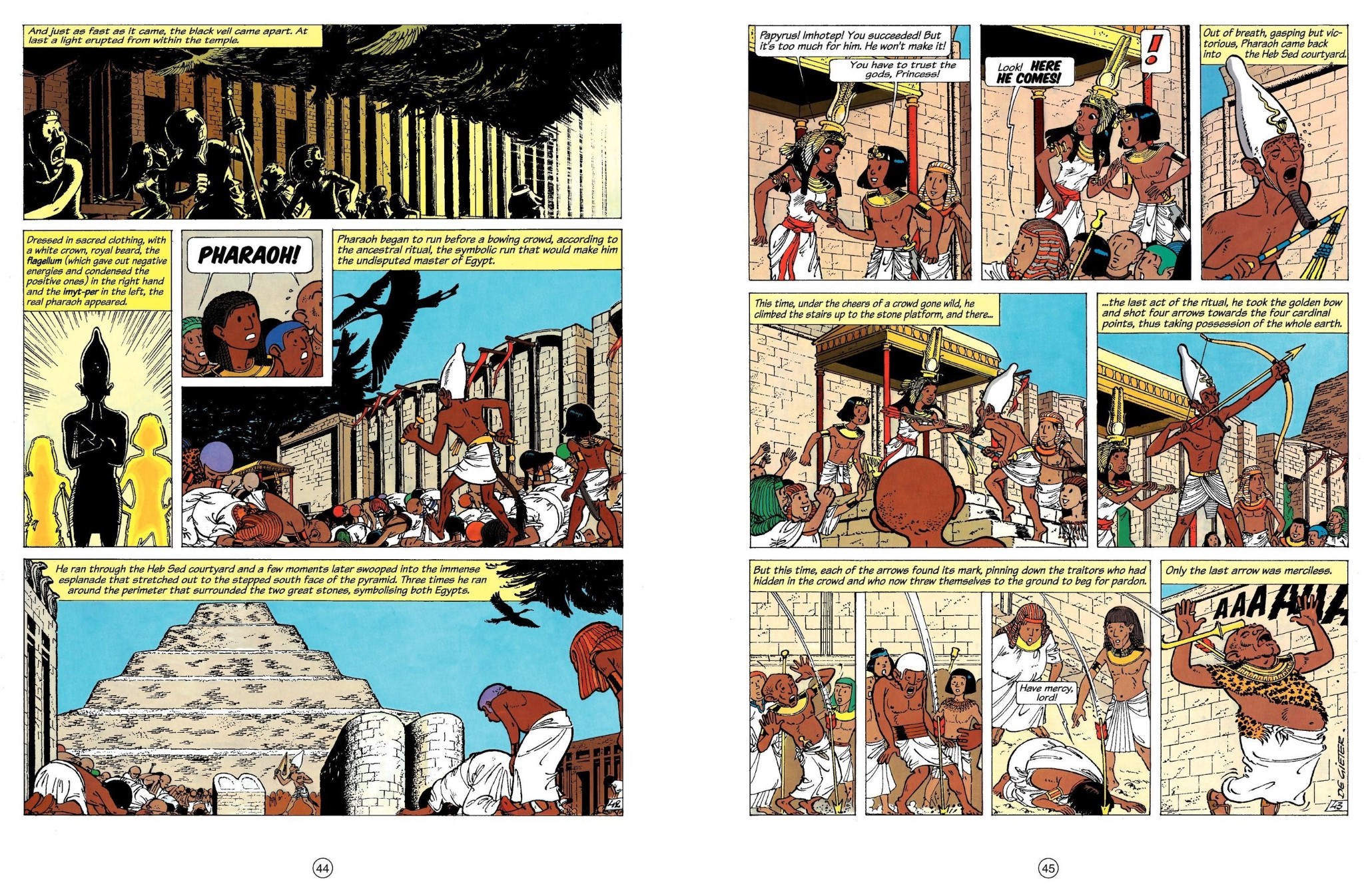
With time running out for his distant descendent, the resurrected ruler rouses himself to administer justice for Egypt and inflict the punishment of the gods upon the usurpers…
This is an amazing exploit to thrill and astound fans of fantastic fantasy and bombastic adventure. Papyrus is a brilliant addition to the family-friendly pantheon of continental champions who marry heroism and humour with wit and charm. Anybody who has worn out those Tintin, Lucky Luke or Asterix tomes would be wise beyond their years in acquiring these classic chronicles tales.
… And Cinebook would be smart to resume translating these magical yarns, too…
© Dupuis, 1985 by De Gieter. All rights reserved. English translation © 2008 Cinebook Ltd.
Born today in 1920 was pioneering woman mangaka Machiko Hasegawa (Sazae-san) as was Belgian auteur Jef Nys (Jommeke) in 1927. Writer Dann Thomas (Conan, All-Star Squadron, Young All-Stars, Arak, Son of Thunder, Crimson Avenger, Avengers West Coast) turned up in 1952 with comics cartoonist and satirist Fred Hembeck arriving a year later. It’s also Denys Cowan’s birthday (1961), Rhoda (Pakkin’s Land) Shipman (1968) and Michael Avon-Oeming (1973); and in 1971 we saw the last episode of Abbie an’ Slats.