
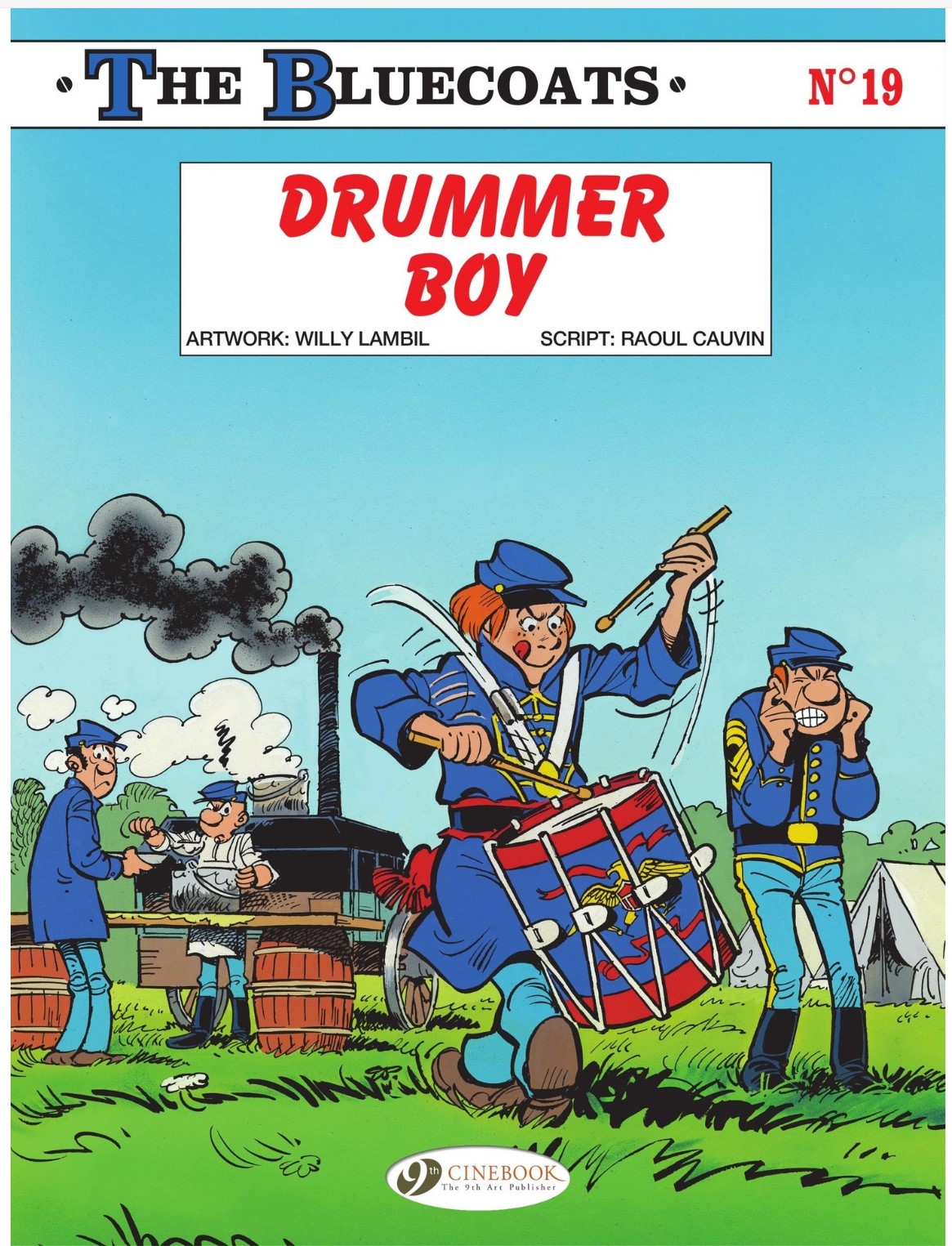
By Willy Lambil & Raoul Cauvin, with Leonardo; translated by Jerome Saincantin (Cinebook)
ISBN: 978-1-80044-177-4 (Album PB/Digital edition)
This book includes Discriminatory Content produced in less enlightened times but also emphasised for dramatic and comedic effect.
Devised by Louis “Salvé” Salvérius & Raoul Cauvin – who scripted the first 64 volumes until retirement in 2020 – Les Tuniques Bleues (or Dutch iteration De Blauwbloezen) began as the 1960s ended: created to soften the blow of losing Lucky Luke when that mild-mannered maverick megastar defected from Le Journal de Spirou to arch-rival periodical Pilote. From the start, the substitute strip was popular: swiftly becoming one of the most-consumed bande dessinée series in Europe. After stints by the Jose-Luis Munuera/BeKa writing partnership, it is now scribed by Kris and up to 68 volumes…
Salvé was a cartoonist in the Gallic big-foot/big-nose humour manner, and after his sudden death in 1972, successor Willy “Lambil” Lambillotte gradually moved towards a more realistic – but still overtly comedic – tone and look. Born in 1936, Lambil is Belgian and, after studying Fine Art in college, joined publishing giant Dupuis in 1952 as a letterer. Arriving on Earth two years later, scripter Cauvin was also Belgian and (prior to joining Dupuis’ animation department in 1960) studied Lithography. He soon discovered his true calling was comedy and began a glittering, prolific writing career at LJdS. In addition, he scripted dozens of long-running, award winning series including Cédric, Les Femmes en Blanc and Agent 212: clocking up more than 240 separate albums. Les Tuniques Bleues alone has sold over 15 million copies… and counting.
Cauvin died on August 19th 2021, but his vast legacy of barbed laughter remains and – as of ten minutes ago – Lambril, at 87, is still drawing the Boys in Blue…
The Bluecoats are long-suffering protagonists Sergeant Cornelius Chesterfield and Corporal Blutch: worthy, honest fools in the manner of Laurel & Hardy; ill-starred US cavalrymen defending a vision of a unified America during the War Between the States – well, at least one of them is…
The original format offered single-page gags set around an Indian-plagued Wild West fort, but from second volume Du Nord au Sud, the sad-sack soldiers were situated back East, perpetually fighting in the American Civil War. Subsequent exploits are set within the scant timeframe of the Secession conflict, but – like today’s tale – occasionally range far beyond the traditional environs of the sundered USA, dipping into and embracing actual events (also like today’s tale), tackling genuine, thoroughly researched moments of history…
Blutch is an everyday, whinging little-man-in-the street: work-shy, mouthy, devious and ferociously critical of the army and its inept orchestrators and commanders. Ducking, diving, deserting at every opportunity, he’s you or me – except at his core he’s smart, principled, loyal and even heroic… if no easier option presents itself. Chesterfield is a big, burly professional fighting man: a proud career soldier of the 22nd Cavalry who devoutly believes in patriotism and esprit-de-corps of The Army. Brave, bold, never shirking his duty and hungry to be a medal-wearing hero, he’s quite naïve and also loves his cynical little pal. Naturally, they quarrel like a married couple, fight like brothers and simply cannot agree on the point and purpose of the horrendous war they are trapped in. That situation again stretches their friendship to breaking point in this cunningly conceived instalment, in which both find themselves pretty much fish out of water…
On offer this time is a rather more straightforward and trenchant outing with characters rather than settings providing most of the humour. Coloured as ever by Vittorio Leonardo, Les Tuniques Bleues – Drummer Boy was serialised continentally in Le Journal de Spirou #2720-2730, before becoming the 31st album in 1990, and now Cinebook’s 19th translated Bluecoats book.
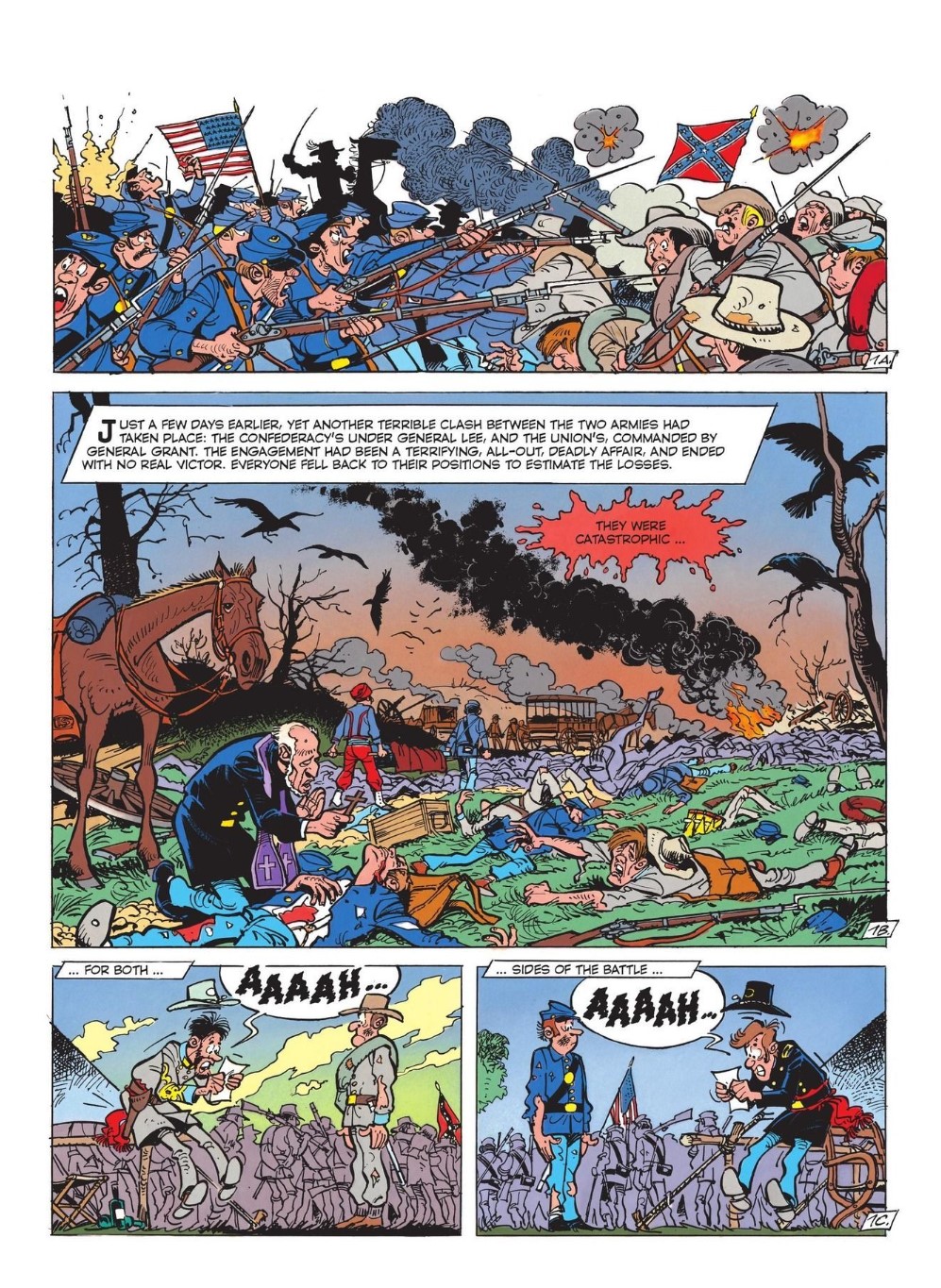
As already hinted, it differs somewhat from the majority of tales, which tread a fine line between comedy and righteous anger, so if you share these books with younger kids, best read it first. However, biting wit and sardonic comedy are curbed for a mostly moving message here as a battlefield policy decision divides the old comrades and unleashes calamity and catastrophe. It begins in polemical mode as the aftermath of another battle leaves corpses and cripples underfoot (on both sides) and colonels and generals (ditto) unable to ascertain why their great plans and bold strategies just don’t work.
As always the casualty lists provoke a drive for new recruits, the one area where Union forces can outdo the Confederacy. As Chesterfield & Blutch indulge a rare quiet moment in a nearby town, they dispassionately watch the hundreds of poor folk, recent immigrants, unemployed men and thirsty ne’er-do-wells signing up, but only until Blutch spots a very young boy in the queue. Chesterfield cannot understand his pal’s towering outrage as Blutch tries everything to get the so-determined kid out of the line and away from the meatgrinder of imminent slaughter. What lands the little rebel in the guardhouse, however, is the patriotic Sergeant “taking care” of the problem by rushing the waif to the front of the line and personally signing him up.
At war with each other for the rest of the tale, Blutch – as chuck wagon commissary server – provides most of the laughs from this point on, as even the madmen running the 22nd Cavalry and Union top brass can find no suitably bellicose role for the plucky orphan in their ranks. Thus little Pucky Potts is made company drummer boy as both sides build up for the next – deciding – pitched battle.
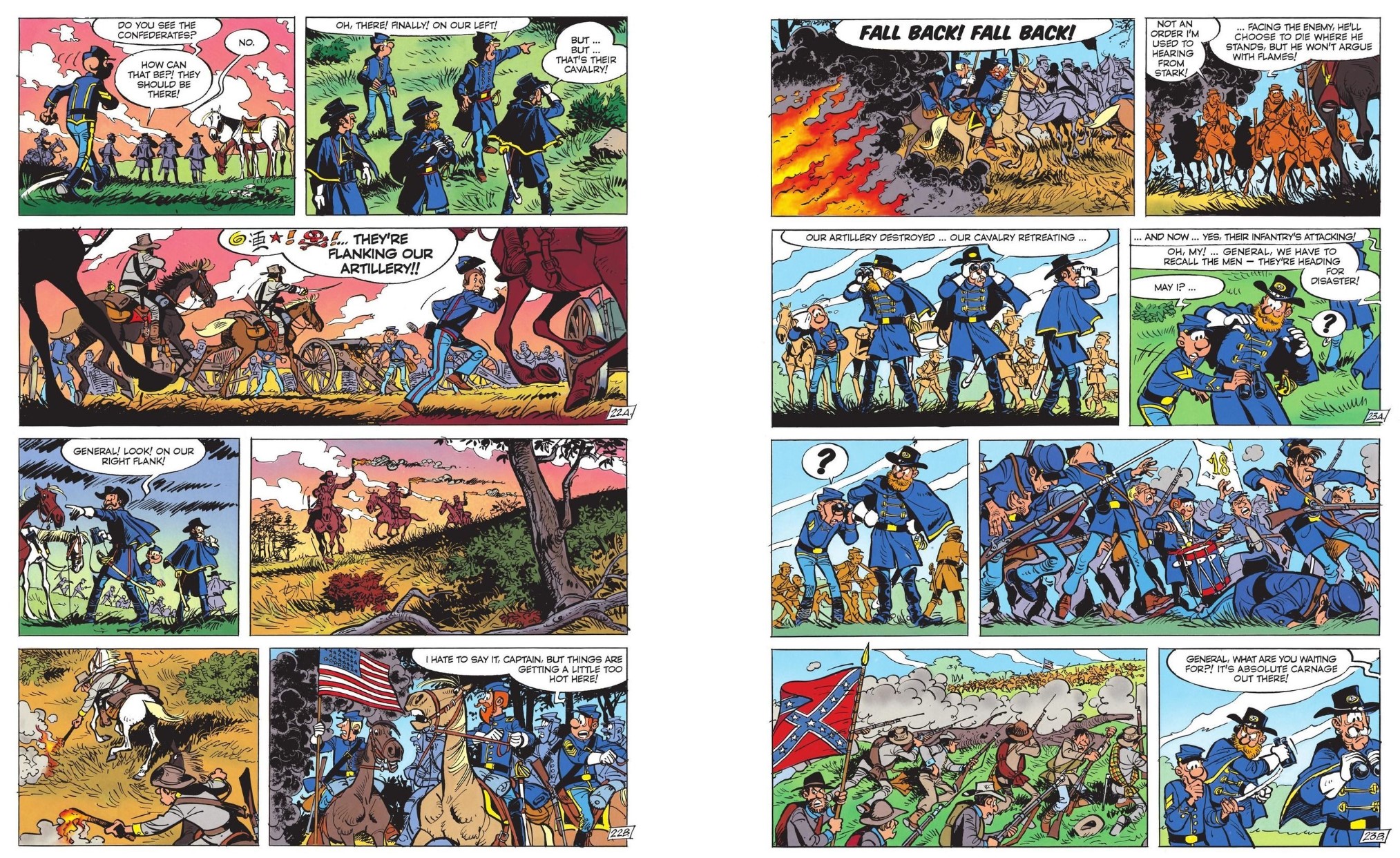
Only that’s not quite how things work out, as the Rebs somehow anticipate every move and stratagem before delivering a stinging defeat. It keeps happening and eventually even the Generals work out what Blutch has already deduced. Pucky is a spy for the other side…
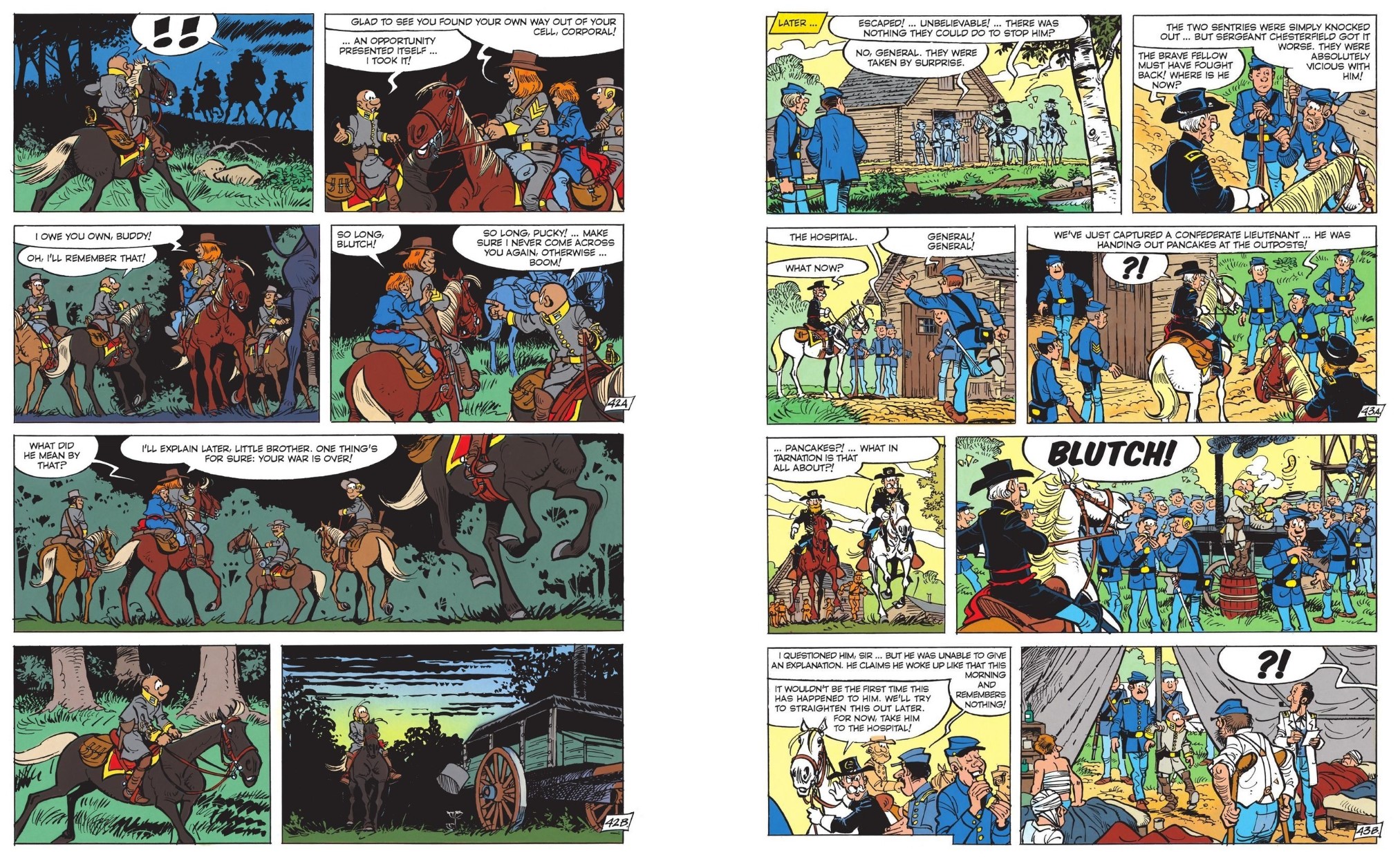
Refusing to let any child be killed for this stupidity, the corporal pulls out all the stops and even makes up with his old ally to ensure that the travesty of an underage execution will not happen. First, though, he has to stop being thrown in the guardhouse and get Chesterfield to talk to him…
Again highlighting not only divisions and disparities of officers and enlisted men but also of the American class structure – particularly the inherent racism driving rich and poor players on all sides – Drummer Boy is another disturbingly edgy epic that makes fun from the very worst of human endeavour. Shocking, powerful and hard-hitting as well as funny, thrilling, beautifully realised and eminently readable, this is one of finest Bluecoats yarns in the entire canon and best kind of war-story/Western. it appeals to the best, not worst, of the human spirit and hopefully that means you. © Dupuis 1990 by Lambil & Cauvin. All rights reserved. English translation © 2025 Cinebook Ltd.
Today in 1912 Mexican cartoonist German Butze (The Supersabios) was born, with Bringing up Father follow-up artist Zeke Zekley arriving three years later, and Danish multi-talented Peter Snejbjerg not joining us until 1963.
In 1977 Us cartoonist Ben Batsford (Billy’s Uncle; Doings of the Duffs; Little Annie Rooney; Frankie Doodle; Mortimer and Charlie) died, as did gekiga mangaka Jiro Taniguchi (Icaro; A Distant Neighorhood; The Summit of the Gods; A Journal of My Father) in 2017.