
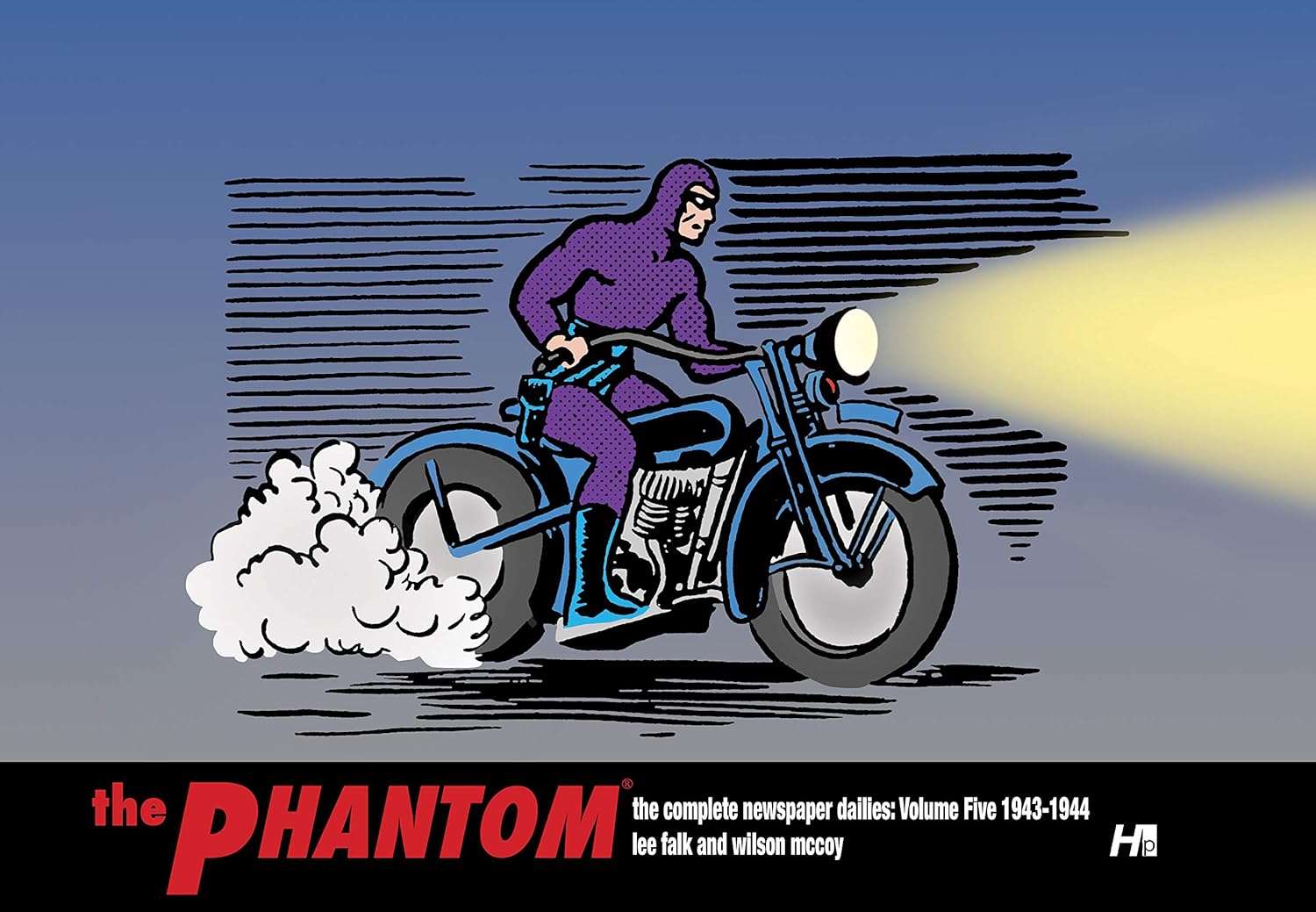
By Lee Falk & Wilson McCoy: introduction by Ed Rhoades (Hermes Press)
ISBN: 978-1-61345-030-7 (HB/Digital edition)
This book includes Discriminatory Content produced in less enlightened times.
Born Leon Harrison Gross, Lee Falk created the Ghost Who Walks at the request of his King Features Syndicate employers who were already making history, public headway and loads of money with his first strip sensation Mandrake the Magician. Although technically not the first ever costumed champion in comics, The Phantom became the prototype paladin to wear a skin-tight body-stocking and the first wearing a mask with opaque eye-slits…
The undying, generational champion debuted on February 17th 1936, in an extended sequence pitting him against an ancient global confederation of pirates. Falk wrote and drew the daily strip for the first two weeks before handing over illustration to artist Ray Moore. The equally enthralling, hugely influential Sunday feature began on May 28th 1939. Both are still running.
For such a long-lived, influential series, in terms of compendia or graphic collections, “the Ghost Who Walks” was quite poorly served in the English language market (except in the Antipodes, where he’s always been accorded the status of a pop culture god). Lots of companies have sought to collect strips from one of the longest continually running adventure serials in publishing history, but in no systematic or chronological order and never with any sustained success. That has been mostly rectified recently by archival specialists Hermes Press who launched curated collections in 2010, making nearly all the various canonical iterations accessible to the devoted.
This fifth landscape Dailies edition is currently only available digitally. Released in 2013, its pages are stuffed with sumptuous visual goodies like panel and logo close-ups, covers and lots of original art, and opens with ‘Introduction: Passing the Torch’: a memories-rich text feature stuffed with sumptuous visual goodies from much-missed uber-fan Ed Rhoades, after which we resume the never-ending story in progress…
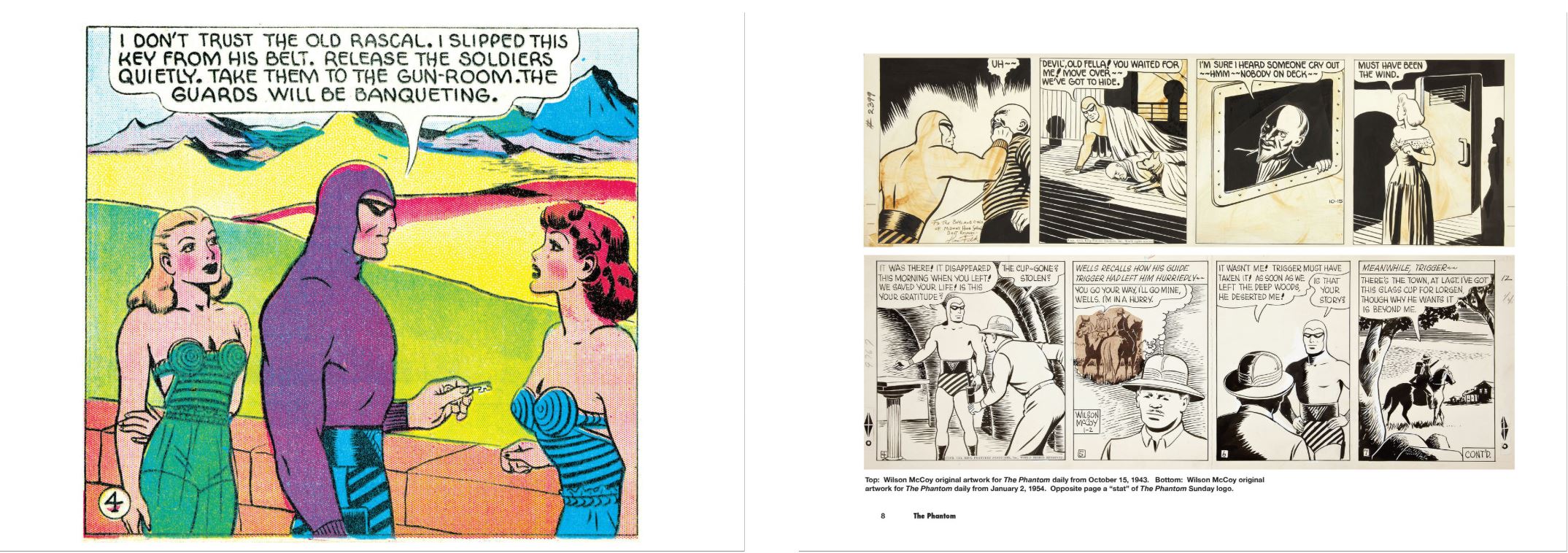
Previously – and in a volume STILL agonisingly unavailable: a colossal war campaign in the African jungles catapulted the reclusive do-gooder into global headlines as the “masked commander of Bengali” and the triumphant “Hero of The Oolan”: unwanted attention which made The Phantom an unhappy but extremely well known heroic public figure. During the siege his adored Significant Other Diana Palmer was gravely wounded. As she recuperates in the USA, attended by faithful failed-suitor Captain Byron, the Ghost who walks is being flown to the Land of the (currently) Free for pointless military bombast and tedious morale-boosting backslapping. It’s a situation he plans on escaping ASAP …
The vintage blood-&-thunder fun begins with brooding, tension-packed thriller ‘Bent Beak Broder’ (originally running Mondays to Saturdays, January 11th to May 22nd 1943) wherein Phantom – and faithful wonder-wolf companion Devil – duck the escorts and parades to head for Diana’s home and sickbed. It involves a tedious cross country hitchhiking stint and lands the hero-in-mufti in the middle of a prison break. When ruthless rogue Bent Beak kidnaps a young girl and goes on a rampage, our seasoned crimebuster is duty-bound to postpone his romantic reunion and hunt down the monstrous malcontents in a stunning display of psychological warfare and thundering fists, leaving the convicts mentally scarred for life and marked with the Phantom’s signature Death’s Head ring brand…
Neatly segueing into soap opera romance with a side order of comedy, ‘The Phantom’s Engagement’ (24th May – 24th July) at last finds him at her doorstep and bedside just as Byron makes one more play for her heart. Gently rebuffed and at last accepting that she will never be his, the captain prepares to leave. However, pushed by Diana’s family – and especially her Uncle Dave – the uncharacteristically nervous masked marvel girds himself to propose but is briefly distracted by the arrival of terrifying African emissary Prince Karna of the Ismani and a religious rite that cannot be deferred. Renewal rite wrapped up, The Phantom perseveres and pops the question.
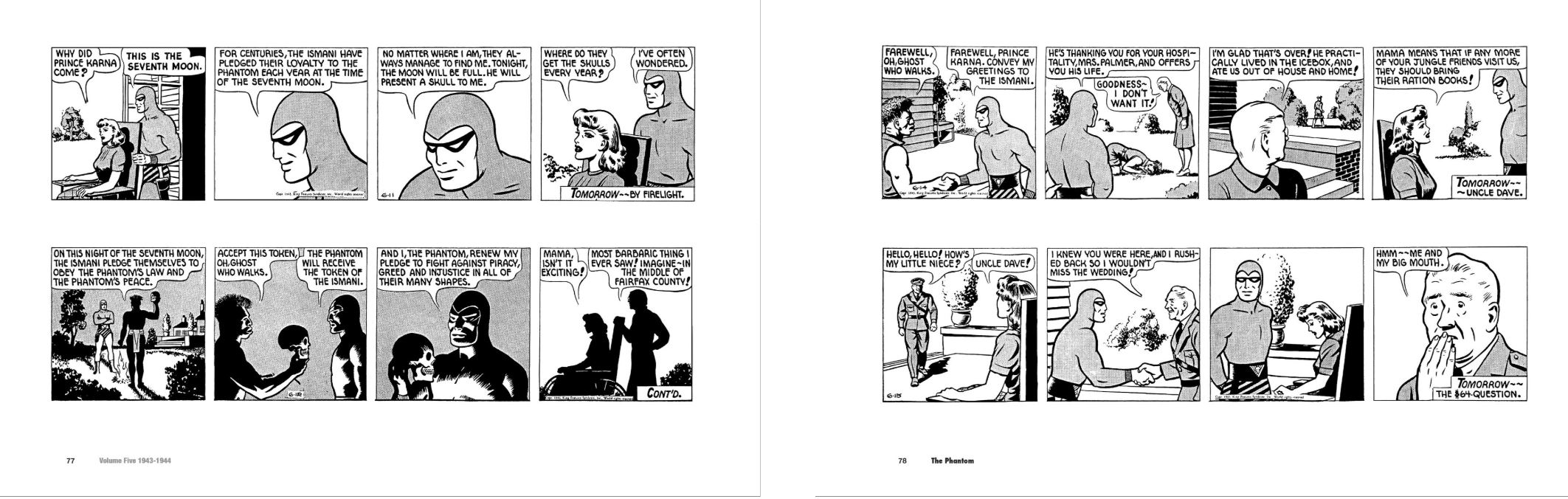
Everything seems fine (and funny to all observing) until Diana, who initially accepts his proposal to extend the Phantom line unto a another generation, abruptly changes her mind and turns him down, saying that she is promised to Byron. Baffled and broken, The Phantom is unaware that Diana mistakenly believes herself unable to walk ever again…
Upon learning that her paralysis was temporary, Diana tries to follow The Phantom back to Africa, with the reluctant but big-hearted help of Byron, but by now “Kit Walker” and Devil are far out at sea and facing the opening gambits of epic yarn ‘High Seas Hijackers’ (26th July 1943 – 26th February 1944). Here the Jungle Judge renews his eternal war on pirates against a wicked band employing a diabolical new gimmick…
Across oceans still wary of submarine attacks, glamorous, eye-catching agent provocateur/fifth columnist Suzie is fascinated by enigmatic never-seen fellow passenger Mr. Walker. Not so much her snooty superior Mrs J who isn’t, but won’t let it stop them preparing the freighter conveying them all – the S.S. Harvey – for capture by sea marauders. Not far away, the sinister General has devised a tactic for scaring away crews and taking ships without a struggle, but this stratagem almost founders when a masked maniac is found haunting the current target. Eventually, The Phantom is captured and the General, a pirate to his core, recognizes the undying nemesis of his kind. As he starts to unravel, Suzie interrogates the prisoner and finds her own merciless worldview shifting, but cannot stop her terrified boss throwing the captive overboard tied to tons of machinery…
His escape and subsequent pursuit brings him to a tropical island nation where the villainous General is actually the richest, most respected and second most powerful man there. However with Suzie switching sides The Phantom and Suzie dismantle his powerbase as Governor, before exposing him to the far distant politically isolated President. This involves a sustained struggle employing a war of nerves, guerilla tactics and sheer fortitude after the villain sets the entire military on their trail… all to no avail. In the end justice is served but the cost is shockingly high and deeply personal…
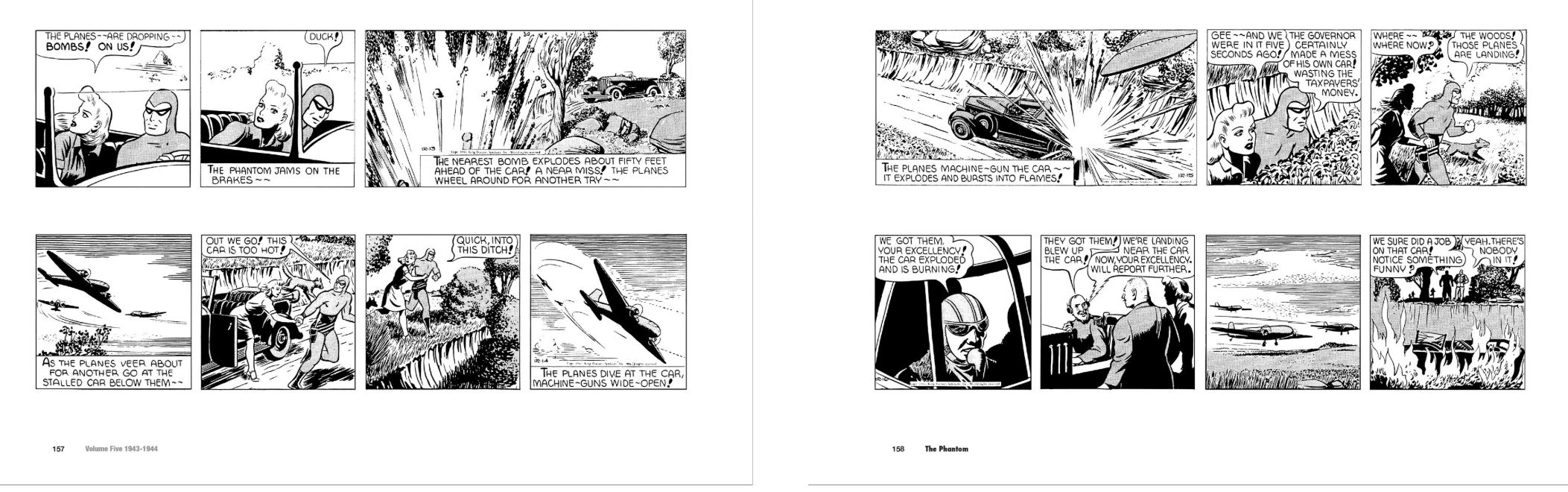
Saddened by his loss, The Ghost Who Walks decides on one last (secret) glimpse of Diana before losing himself in the Jungles of Bengali and returns to America just in time to become embroiled in ‘The Spy Game’ (28th February – 20th May). Byron and Diana are “Just good friends” now, and when the Captain is ordered by Uncle Dave (a big deal in US Military Intelligence) to courier a briefcase of secrets to a specific location at a certain time, Diana adds cover as his wife. Unfortunately the couple are under surveillance already, by a deadly ring of spies: a certain masked hero and his wolf who get the wrong idea. When Kit Walker notices their other shadows, he gets involved behind the scenes, safeguarding them on a spectacular and mindbending Hitchcock-like odyssey of peril and intrigue involving planes, trains and automobiles, and non-stop action, that ends with The Phantom and Diana reunited and engaged again. However Byron, already despatched on another mission, has extracted a promise that she will marry no one else until his return…
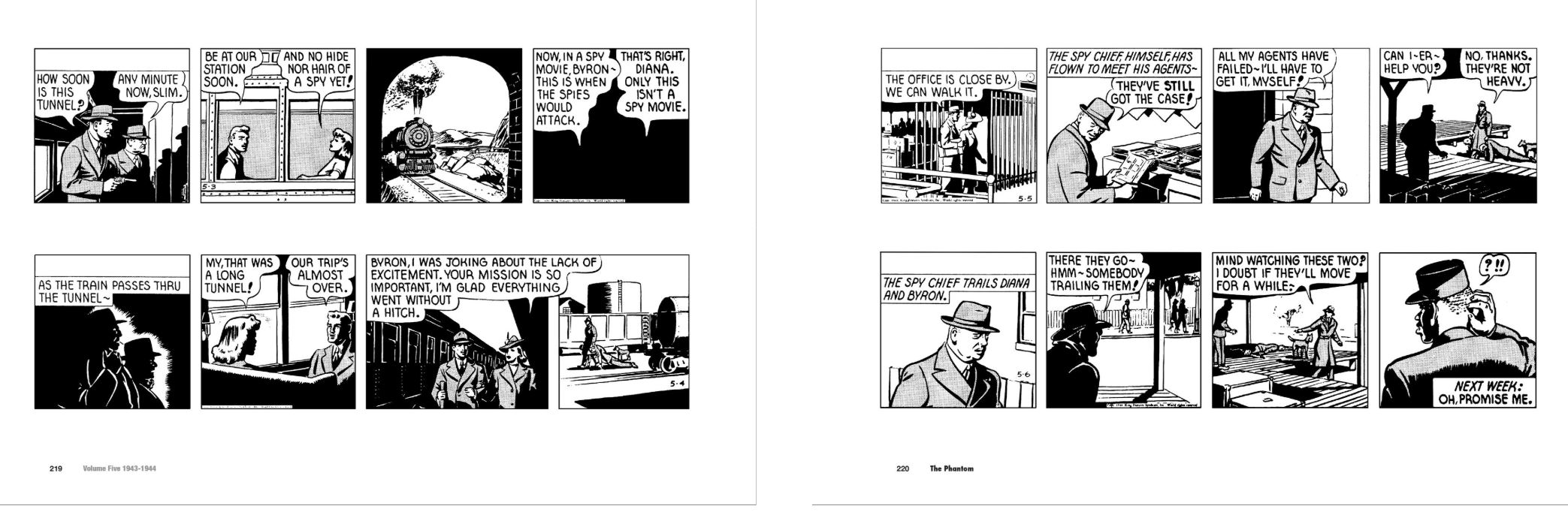
It’s back to crime and the public’s growing fascination with gangsterism for closing adventure ‘The Crooner’ (22nd May – 26th August 1944). This felonious mastermind’s grand idea is to frame the Phantom by committing brutal crimes all “signed” with his Death’s Head mark, but soon learns the power of that symbol when the hero dismantles his operation with chilling efficiency…
Short on actual jungle tales but stuffed with chases, cruises, air clashes, assorted fights, torture, action antics, daredevil stunts and many a misapprehension in the-then modern milieu of America and a war-torn contemporary world, this is sheer pulp-era excitement that still packs a breathtaking punch and many sly laughs. Rollercoaster thrills delivered at rocket pace, these pared-down, gripping episodes display artist Wilson McCoy developing his craft and honing skills on every panel, making the strip visually his until his untimely death in 1961, after which Carmine Infantino and Bill Lignante filled in until Sy Barry took over.
© 2013 King Features Syndicate, Inc.: ® Hearst Holdings, Inc.; reprinted with permission. All rights reserved.
Yesterday in 1902 British cartoonist Brian White was born. His greatest contrition to world peace and global morale was Nipper. Just as important – to me at least – are the arrivals of letterer Sam Rosen in 1922, and multitasking comics maestro Joe Orlando in1927. Barely less important, scripter, editor and “DC Answer Man” Bob Rozakis arrived in 1951 as did cover artist Dave Johnson in 1966.
In 1991 we lost legendary EC horror and romance artist Graham Ingels, whilst 1997 saw the passing of trailblazing African American comics creator Billy Graham (Vampirella, Eerie, Creepy, Luke Cage, Black Panther, Sabre).
Today in 1916, writer/artist/editor/publisher Bernard Baily (The Spectre, Hourman, Gilda Gay, Frankenstein) was born, and in 1941 so was Archie Comics mainstay Victor Gorelick. Mangaka Akira Toriyama (Dragon Ball) arrived in 1955; cartoonist Dan Perkins – AKA Tom Tomorrow (This Modern World) – in 1961 and “Legend”-ary creator Art Adams (Longshot, X-Men, Superman, Batman, Monkeyman & O’Brien, Gumby and practically everyone else) in 1963.
And also today in 2005 we lost glass-ceiling shattering cartoonist Dale Messick, first woman to create her own syndicated newspaper strip: Brenda Starr, Reporter.