
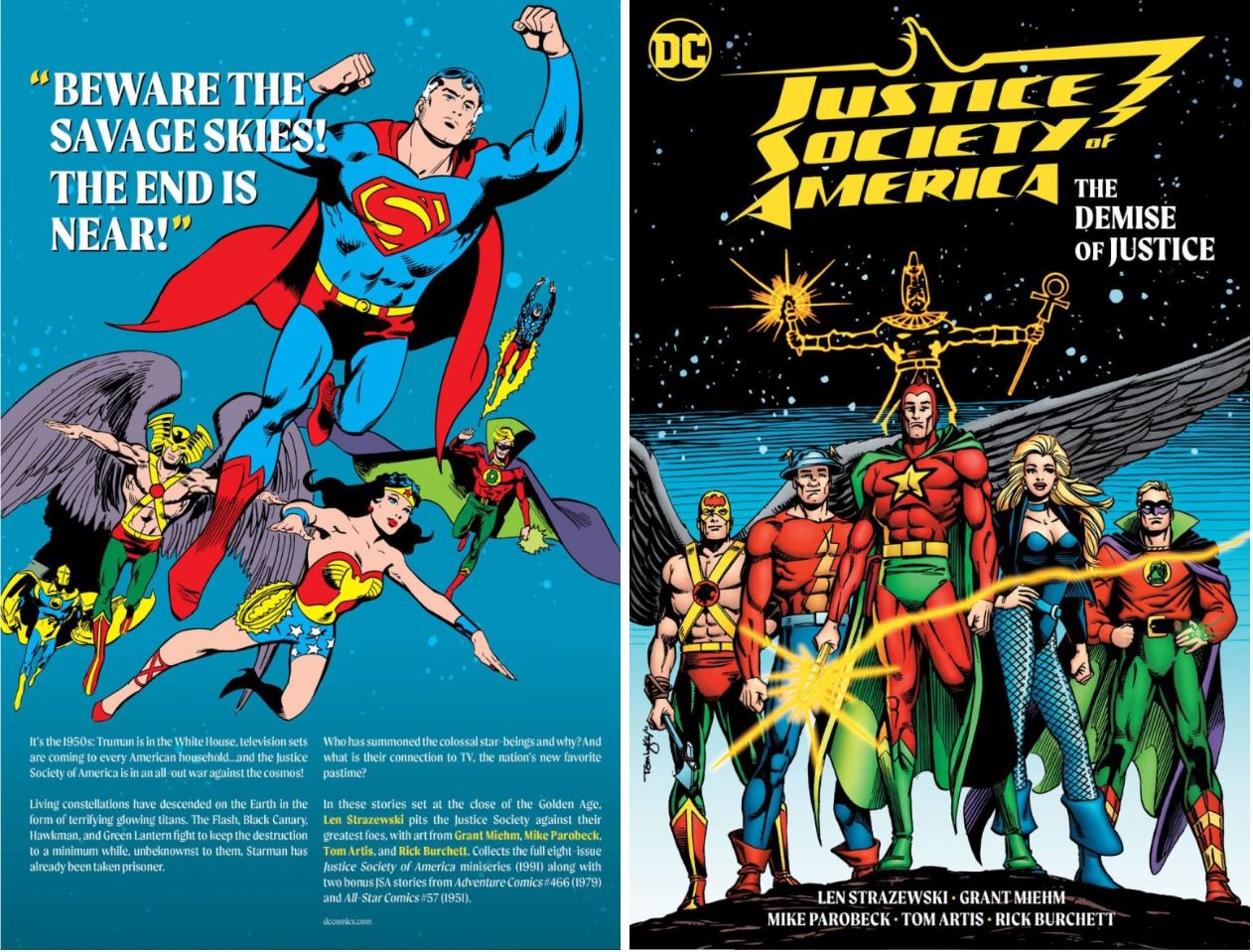
By Len Strazewski, John Broome, Paul Levitz, Rick Burchett, Grant Miehm, Mike Parobeck, Tom Artis, Frank McLaughlin, Frank Giacoia, Arthur Peddy, Bernard Sachs, Joe Staton & various (DC Comics)
ISBN: 978-1-7795-0744-0 (HB) 978-1-77951-209-3 (Digital edition)
This book includes Discriminatory Content produced in less enlightened times.
After the actual invention of comic book superheroes with the Action Comics debut of Superman in 1938, the most significant event in the industry’s history was the combination of individual sales-points into a group. Thus what seems blindingly obvious to us with the benefit of four-colour hindsight was proven: consumers couldn’t get enough of garishly-hued mystery men, and combining many characters inevitably increased readership. Plus, of course, a mob of superheroes is just so much cooler than one – or one-and-a-half if there’s a sidekick involved…
The creation of the Justice Society of America utterly changed the shape of the budding business and – technically – All Star Comics #3 (cover-dated Winter 1940-1941, and on sale from November 22nd 1940) was the kick-off. However, in that landmark issue, the assembled heroes merely had dinner whilst recounting recent cases and didn’t actually go on a mission together until #4 (cover-dated April 1941). With the simple notion that mighty mystery men hung out together, history was made and it wasn’t long before they started working together…
When WWII ended, superheroes gradually declined, and most companies had shelved them by 1950. That plummet in popularity led to rekindled interest in traditional genre-themed titles and characters, and it was a stripped-down team (Flash, Green Lantern, Hawkman, The Atom, Black Canary, Dr. Mid-Nite &Wonder Woman) who battled on in trendily tailored crime or sci fi sagas before the title abruptly changed to All Star Western with #58.
It would take a second age of superheroes to revive them, this time as the champions of a parallel universe dubbed Earth Two…
Gathered here is a near-forgotten limited series focussed on the latter days of the team’s Golden Age which originally ran in Justice Society of America #1-8 (April – November 1991), augmented by the last case of the original era from All-Star Comics#57, (February/March 1951), plus a turning point tale from Adventures Comics #466 (December 1979). They are preceded a sparkling, informative and appreciative Foreword by Golden Age aficionado and super scripter Mark Waid.
The miniseries – subtitled Vengeance from the Stars! – comprising the majority of this tome was scripted by journalist/educator/author Len Strazewski (February 16th 1955 – April 27th 2026) whose comics included Speed Racer, The Flash, Phantom Lady, Starman, The Fly, The Web, Prime, Prototype, Elven and more. It was illustrated by a rotating tag team of artists, opening as Rick Burchett draws ‘Beware the Savage Skies’. Here recently-retired mystery man Ted Knight – AKA the original Starman – is attacked in his private New Mexico observatory by incredible astral energy beings. Broken and dispirited, he is then enslaved by an old enemy who purloins his wondrous Gravity Rod before luring Jay (Flash) Garrick into a deathtrap that results in power outages across America…
The plot thickens with ‘The Sack of Gotham’ (art by Grant Miehm) as radio/television executive Alan Scott seeks to keep the lights on in his city whilst Black Canary prowls the darkened streets deterring looters and career criminals. Distracted by a museum break-in, she finds herself punching way, way up as undead monster/functional moron Solomon Grundy and a gang of very determined bandits help themselves to ancient Egyptian artefacts at the behest of a hidden client.
By the time Scott arrives as Green Lantern, the Canary has been thrashed and captured, leaving him to battle an animated star constellation dubbed Sagittarius…
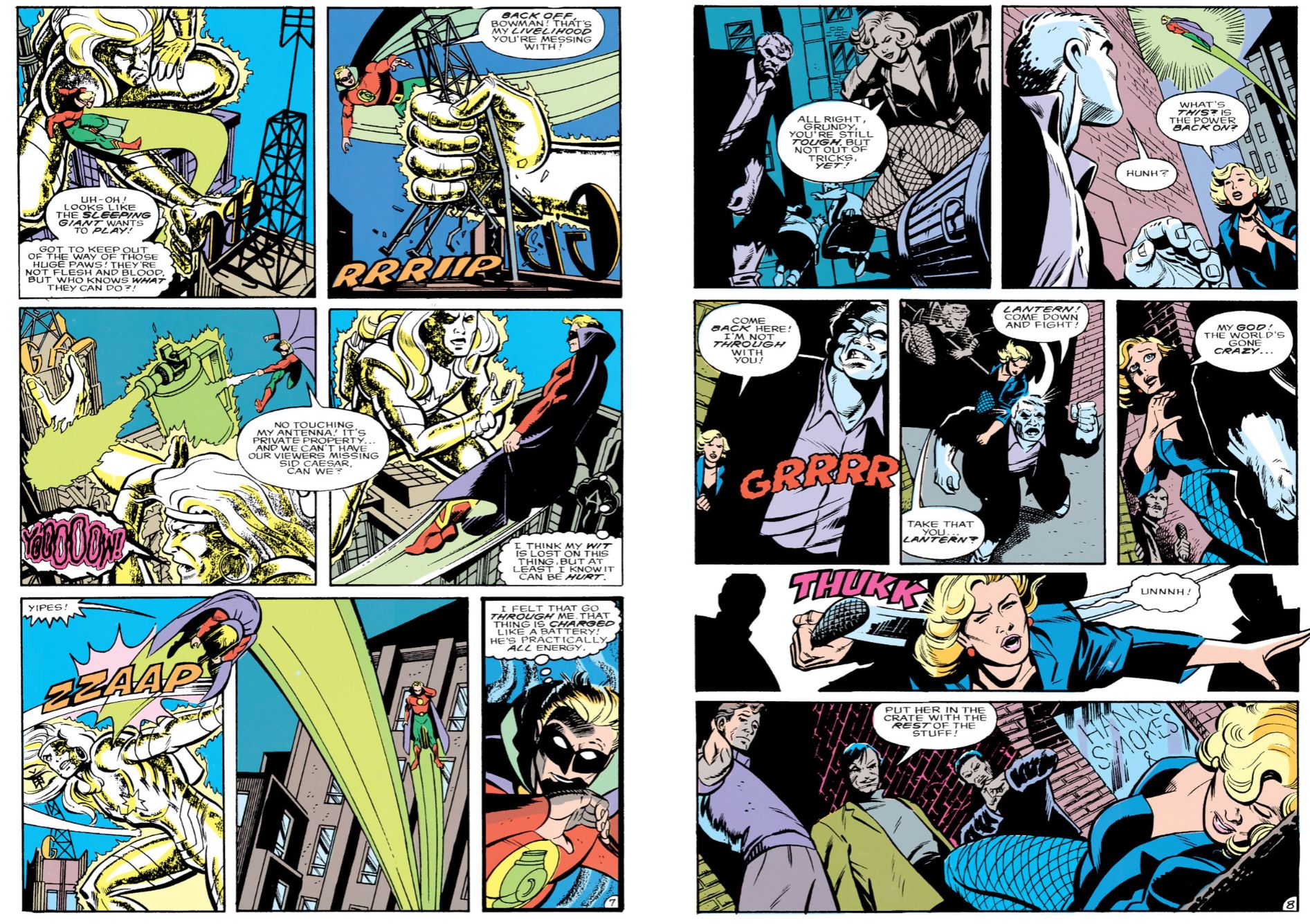
Burchett inks the astoundingly talented Mike Parobeck in #3’s ‘Dead Air’, as the star thing blacks out Gotham and Scott struggles to stop it. Complications occur when Grundy – afflicted with an obsessive hatred of Green Lantern – forgets the orders from the mystery Machiavelli to attack his emerald enemy. Far away, Ted Knight learns his gleeful foe intends to conquer Earth by eradicating modern technologies and attitudes and replace them with primordial magic and tyranny…
Tom Artis & Frank McLaughlin limn #4 as ‘Evil of the Ancients’ sees reincarnating Egyptian warrior Hawkman uncovering star-themed neolithic treasures in his day job as archaeologist Carter Hall. These findings expose the history and provenance of the constellation creatures, but also trigger the arrival of another. Despite aerial valour and the US Army’s best efforts, deadly colossus Andromeda storms off with a clutch of atom bombs and only the sudden arrival of Flash prevents utter disaster. The clash resumes in ‘Double Star Rising!’ by Parobeck & Burchett, as arcane knowledge and modern engineering savvy combine to trace the stellar plunderer and incredible pyramid of power it is constructing. When the heroes try to destroy it, they are confronted with a second energy horror but find a way to defeat both at once, compelling the man behind the plot to finally take a personal hand in the fight…
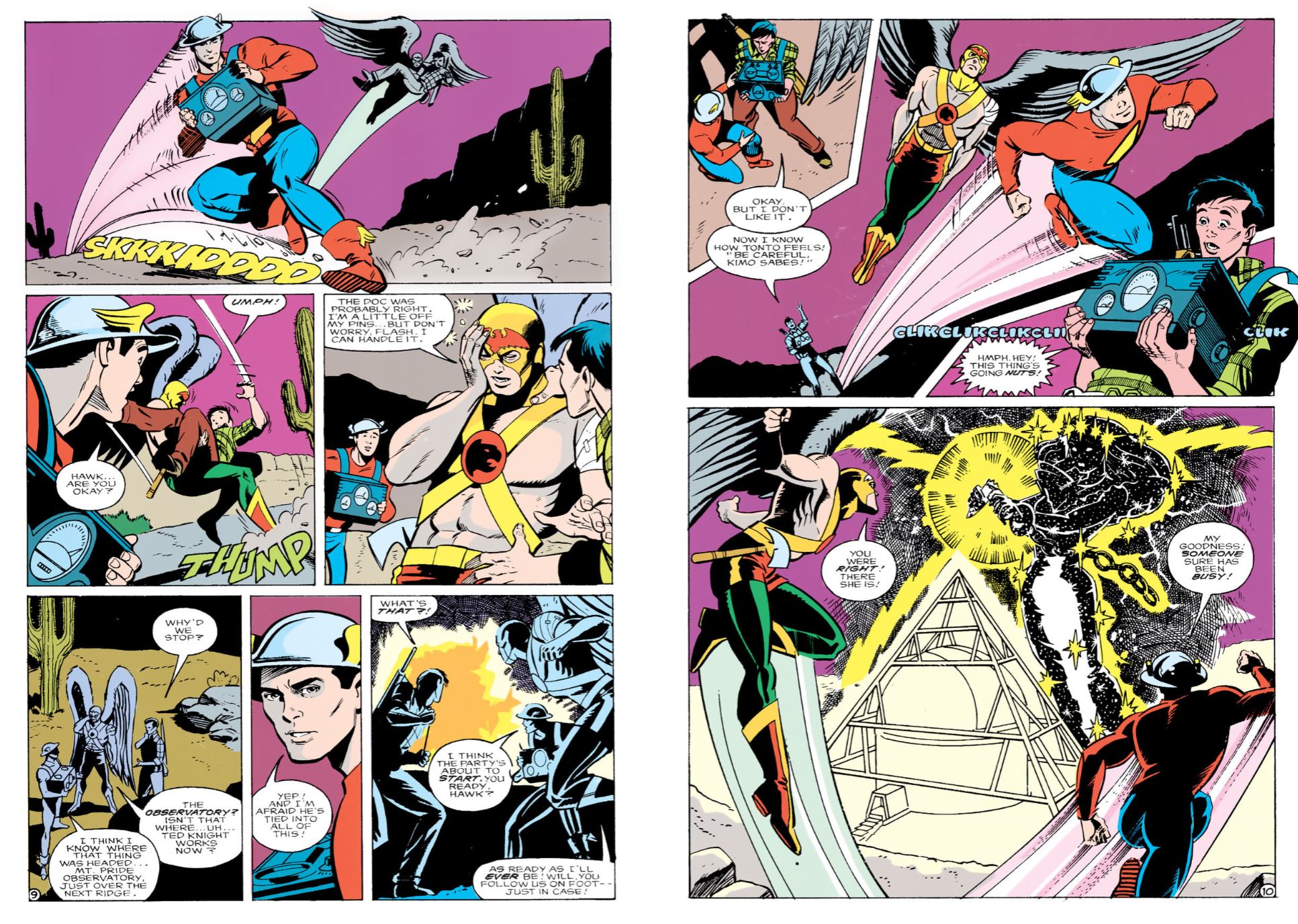
Far across the country the Lantern and the Canary escape captivity in ‘Danger Flies the Skies’ (Artis & McLaughlin), thanks to some timely aid from valiant sidekick Doiby Dickles, and track west after the museum artefacts in time to reinforce Flash and Hawkman in ‘The Return of the Justice Society’ (art by Miehm & Burchett). Redeemed and reinspired, Knight once more takes up his costumed identity to end the villain’s plot in ‘Battle of the Stars!’
In the heady aftermath, the JSA ponder what the next decade will bring, unaware that political conspiracies, public paranoia and a wave of intolerance masquerading as social conformity was waiting to change the world in ways no one could anticipate…
In continuity terms, this was technically the antepenultimate adventure of the JSA, with the rousing romp slyly heralding mood swings in the heartland of Democracy. It is thus smartly supplemented by the team’s final Golden Age appearance (All-Star Comics #57) and a chilling, thematically-aligned codicil from Adventures Comics #466.
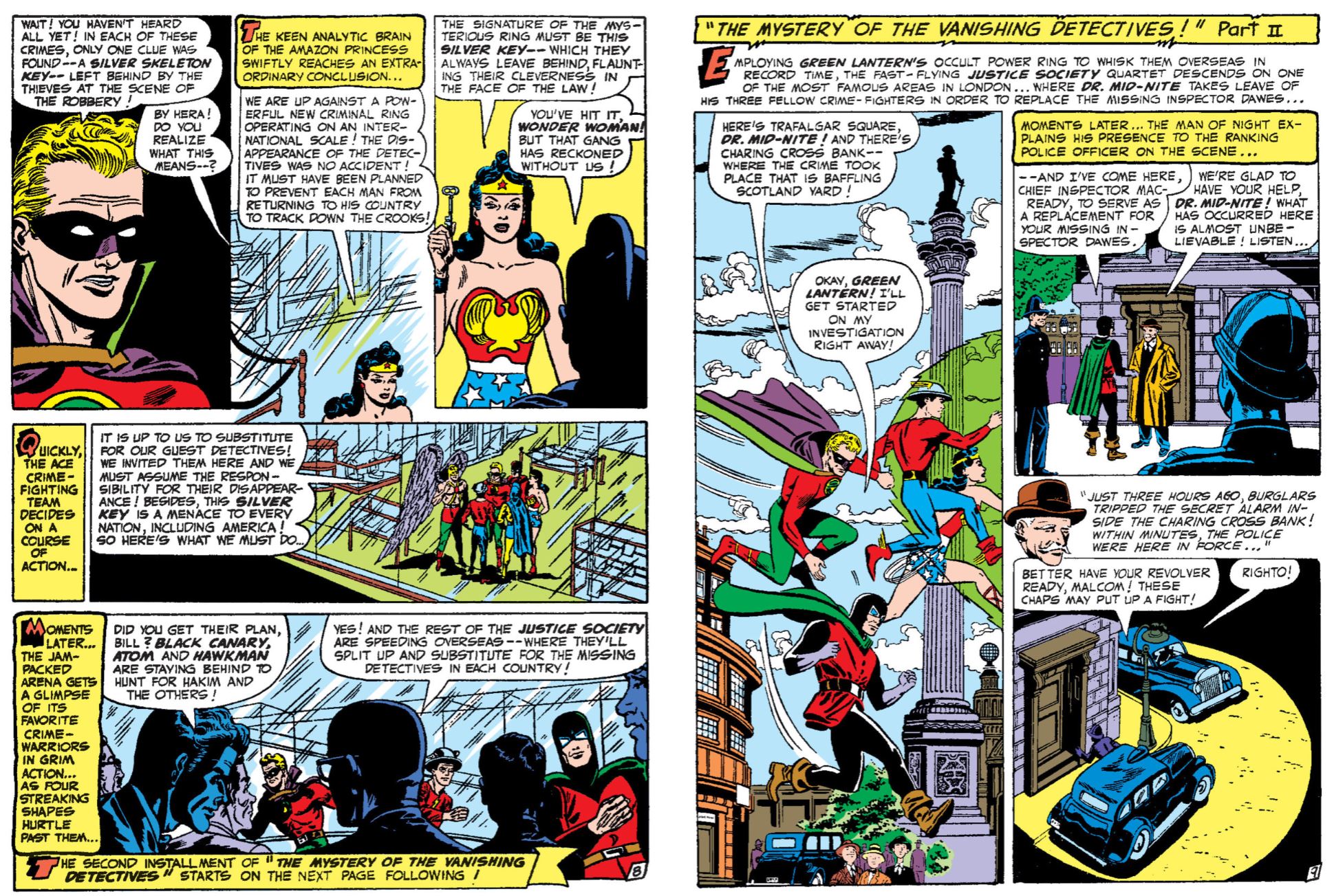
Written by John Broome and illustrated by Frank Giacoia, Arthur Peddy & Bernard Sachs, it was the JSA’s last hurrah as ‘The Mystery of the Vanishing Detectives!’ pitted them against criminal mastermind The Key. When he abducted Earth’s greatest criminologists in advance of a spectacular robbery spree, the superheroes were called in to solve the case and prevent an impending catastrophe. It took a lot of time and effort, but the JSA never fail…
The fallow period and return of the JSA was a major success of fan power in the 1960s, but that decade too ended with superheroes in decline. During the torrid, turbulent 1970s, many of the industry’s oldest publishing ideas were finally laid to rest. The belief that characters could be “over-exposed” was one of the most pernicious and long-lasting (although it never hurt Superman, Batman or the original Captain Marvel), garnered from years of experience in an industry which lived or died on that fractional portion of pennies derived each month from the pocket-money and allowances of children which wasn’t spent on candy, toys or movies.
By the end of the 1960s, comic book costs and retail prices were inexorably rising and a proportion of titles – especially newly revived horror stories – were consciously being produced for older readerships. Nearly a decade of organised fan publications and letter writing crusades had finally convinced publishing bean-counters what editors already knew: grown-ups avidly read comics too. Moreover, they happily spent more than kids and craved more, more, more of what they loved.
Explicitly: If one appearance per month was popular, extras, specials and second series would be more so. By the time Marvel Comics Wunderkind Gerry Conway left The House of Ideas, DC was willing and ready to expand its variegated line-up with some oft-requested fan-favourite characters. Paramount among these was the JSA, the first super-team and a perennial gem whose annual guest-appearances in Justice League of America and other superhero titles had become a beloved tradition and treat.
Thus in 1976 writer/editor Conway marked his second DC tenure (he had first broken into the game writing horror shorts for Joe Orlando) by reviving All Star Comics with #58. In 1951, the original title transformed overnight into All Star Western with the numbering running for a further decade for the home of cowboy crusaders like Strong Bow, The Trigger Twins, a different Johnny Thunder and Super-Chief. Now, set on Earth-Two, and in keeping with the editorial sense of ensuring a series be relevant to young readers too, Conway reintroduced the veteran team, leavened with a smattering of teen heroes forming a contentious, generation gap-fuelled “Super Squad”…
Augmented by Robin (a JSA-er since the mid-1960s and Justice League of America #55), Sylvester Pemberton/Star-Spangled Kid and a busty young thing who rapidly became the feisty favourite of a generation of growing boys: Kara Zor-L: Power Girl. Closing this collection is a short piece as she and fellow newcomer Huntress discuss how the Golden Age died. Taken from 68-page anthology title Adventure Comics 466 where Paul Levitz & Joe Staton delivered a pithy history lesson exposing the reason why the team vanished at the beginning of the 1950s, ‘The Defeat of the Justice Society!’ shows how the US Government cravenly betrayed their greatest champions. Set during early days of the McCarthy era anti-communist witch-hunts, a sham trial provoked the mystery men into voluntarily withdrawing from public, heroic life. There they stayed until the costumed stalwarts of Earth-One started the whole Fights ‘n’ Tights scene all over again…
These exuberant, rapid-paced and imaginative yarns perfectly blend the naive charm of Golden Age derring-do with cynically hopeful modern sensibilities. Here you will be reassured that no matter what, in the end our heroes will always find a way to save the day. These are classic tales from simpler times and a glorious example of traditional superhero storytelling at its finest: fun, furious and ferociously engaging, excitingly written and beguilingly illustrated. No Fights ‘n’ Tights fan should miss these marvellous sagas.
© 1951, 1979,1991, 2020 DC Comics. All Rights Reserved.
Today in 1907, Dutch Indo painter and cartoonist Joseph Ferdinand Doeve was born, with Us comics writer Jerry Coleman (Superman, Batman) arriving in 1913; Dutch comics author Wim Booster in 1918.
This date saw the passing of artists Mike Parobeck (Batman Adventures, El Diablo, Elongated Man, Justice Society of America, The Fly) in 1996 and John Cullen Murphy (Prince Valiant) in 2004.