
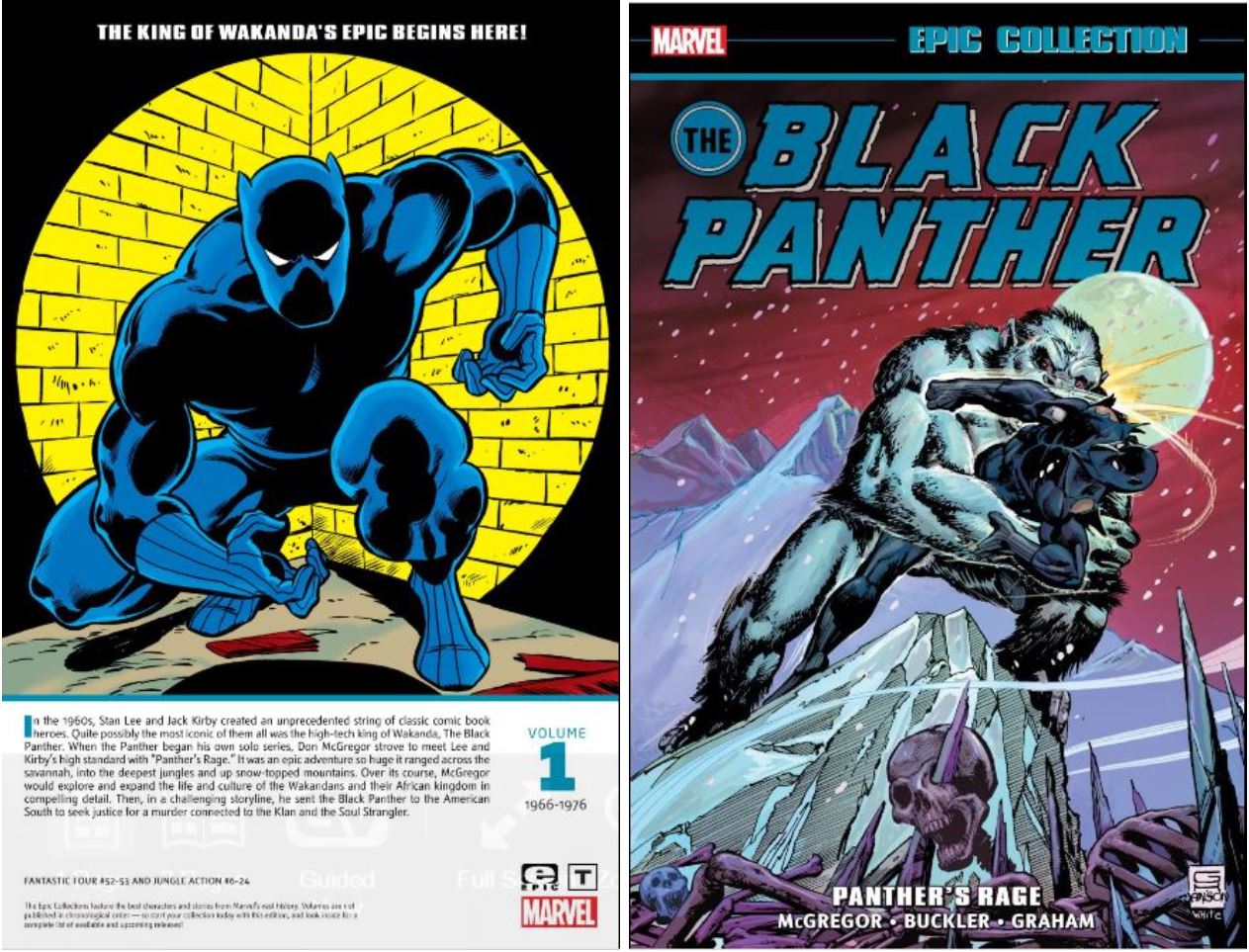
By Stan Lee & Jack Kirby, Don McGregor, Rich Buckler, Gil Kane, Billy Graham, Keith Pollard, Klaus Janson, Joe Sinnott, Klaus Janson, P. Craig Russell, Pablo Marcos, Dan Green, Bob McLeod, Jim Mooney & various (MARVEL)
ISBN: 978-1-3029-0190-5 (TPB) 978-1-3024-9321-9 (Digital edition)
This book includes Discriminatory Content produced in less enlightened times. This book also includes Discriminatory Content utilised for dramatic effect.
With democracy under fire and American Civil Rights enduring active and constant attack in the Land of the Free, let’s look back on more progressive times and comics as we all stagger towards the 250th Fourth of July, shall we?
Acclaimed as the first black superhero in US comics and one of the first to carry his own series, the Black Panther’s popularity and fortunes have waxed and waned since he first appeared in Fantastic Four. In fact, the cat king actually attacked Marvel’s First Family as part of an extended plan to gain vengeance on the murderer of his father.
T’Challa was also the first black superhero in US comics, debuting in summer 1966. As created by Jack Kirby & Stan Lee, T’Challa, son of T’Chaka, is an African monarch whose deliberately hidden kingdom is the only known source of vibration-absorbing wonder mineral Vibranium. The miraculous alien ore – supposedly derived from a fallen meteor which struck the continent in lost antiquity – is the basis of the country’s immense wealth, enabling it to become one of the wealthiest and most secretive nations on Earth. These riches also allow the young king to radically remake his country, creating a high tech paradise even after he left Africa to fight as one of America’s Avengers.
Since time immemorial Wakanda has been an isolated, utopian wonderland with tribal resources and people safeguarded and led by a human warrior-king deriving cat-like physical advantages from secret ceremonies and a mysterious heart-shaped herb. This has ensured the generational dominance of the nation’s Panther Cult and sacrosanct hereditary Royal Family…
The “Vibranium mound” had guaranteed the nation’s status as a clandestine superpower for centuries, but in modern times increasingly made Wakanda a target for subversion, incursion and even invasion as the world grew ever smaller. This colossal compendium gathers the dynamic debut from Fantastic Four #52-53 (cover-dated July and August 1966) in advance of groundbreaking solo stories from Jungle Action (vol. 2) #6-24, collectively covering September 1973 through November 1976.
Before all that though, the innovative and unforgettable character debuted in ‘The Black Panther!’: an enigmatic African monarch whose secretive kingdom was the only source of a vibration-absorbing alien metal. These mineral riches had enabled him to turn his country into a technological marvel before he lured the FF into his savage super-scientific kingdom as part of an extended plan to gain vengeance on the murderer of his father. After battling the team to a standstill, King T’Challa revealed his tragic origin in ‘The Way it Began..!’, detailing how his father was murdered by marauding sonic science researcher Ulysses Klaw. As the monarch details how he took vengeance and liberated his people, word comes of incredible solidified-sound monsters attacking the region. Klaw has returned at last…
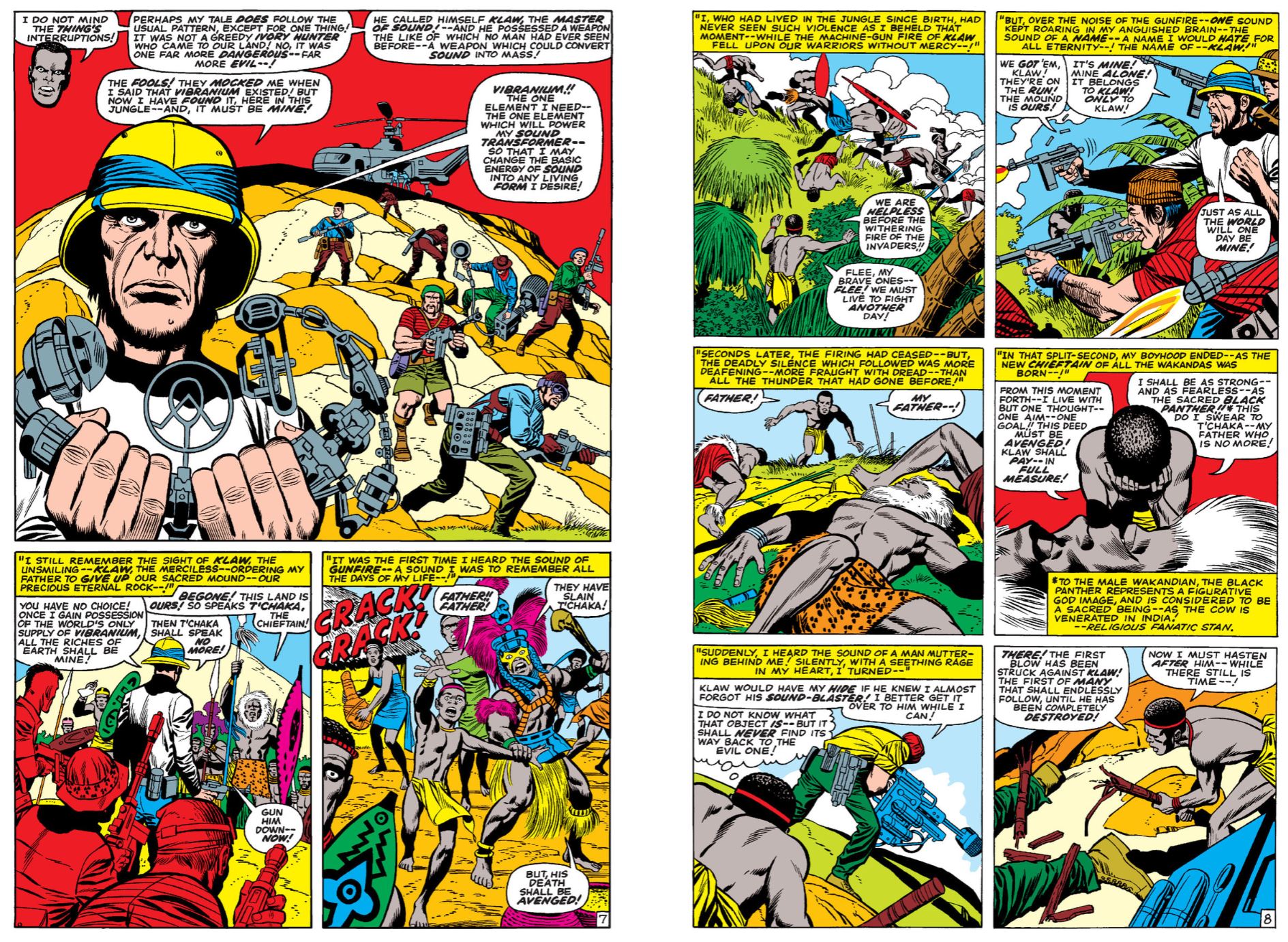
The cataclysmic clash that follows set the scene for the Warrior-Chieftain to guest star with numerous Marvel superstars before breaking out into the wider world, but it would years before he finally won his own solo series…
After roaming around the Marvel Universe, enjoying team-ups and saving Earth on a semi-regular basis as one “Earth’s Mightiest Superheroes”, the summer of 1973 saw the Black Panther finally become a solo star in his own series. Scripter Don McGregor opted to return the King to his people for an ambitious epic of love, death, vengeance and civil war: inventing from whole cloth and Kirby’s throwaway notion of a futuristic jungle the most unique African nation ever seen in comics or anywhere else…
Jungle Action had launched with an October 1972 cover-date: a cheap reprint vehicle for old Atlas-era Tarzan and Sheena knock-offs like Tharn, Jann and Lorna (all equally “…of the Jungle”). The fifth issue (not included here) abruptly changed tack, reprinting a Black Panther-starring saga from Avengers #62 as prelude to the start of T’Challa’s own all new adventures. These open here with # 6 and the eponymous ‘Panther’s Rage’, illustrated by Rich Buckler & Klaus Janson. The story opens with the Panther back in his contradictory homeland, stumbling upon the torture of an elderly farmer. Despite T’Challa’s best efforts, the victim dies in his arms, swearing he never lost faith in king or country…
Learning the attack is the work of brutal rebel leader Erik Killmonger, T’Challa sets all the resources of his inner court circle to finding the monster. With reports of further atrocities mounting, he all but abandons his American lover Monica Lynne to hunt the perpetrators and soon confronts his potential usurper at the potently symbolic Warrior Falls roaring above the life-sustaining River of Grace and Wisdom. The barbarous-seeming giant is not cowed by the Panther’s power or prowess and easily wins the no-holds barred battle that follows…
The initial episode is supplemented by detailed maps of Wakanda (the first fans had ever seen) before JA #7 mobilises ‘Death Regiments Beneath Wakanda’. Barely surviving his clash with Killmonger, T’Challa is nursed back to health by Monica at the Palace, even as hideously disfigured American Horatio displays his skill with snakes and poisons to his friend N’Jadaka. Known to their recruits as Venomm and Erik Killmonger, these rebel leaders plot their next attack resulting in the reptilian insurgent ambushing T’Challa when the king investigates an unsanctioned, illegal mine. This shocking atrocity is being used to siphon off raw Vibranium to pay for Killmonger’s increasingly violent and widespread attacks on the outlying population centres…
Although triumphant this time, T’Challa realises this is a many-layered war: one he might not win…
Whilst the Panther renews his powers through ancient ritual, Jungle Action #8 introduces another super-powered rebel with ‘Malice by Crimson Moonlight’ revealing a spear-wielding wonder woman invading the Royal Palace. Advisor Taku is interrogating Venomm (and gradually making inroads into turning the bitter outcast) when she attacks. Only the power of the Panther saves the servitor and prevents the brutal jailbreak from succeeding…
After maps of the hidden country and detailed plans of ‘Central Wakanda’s Palace Royale’ the saga resumes in #9 with ‘But Now the Spears Are Broken’ (spectacularly illustrated by Gil Kane & Janson) as T’Challa goes in-country to learn the effects of the power struggle on ordinary Wakandans. After saving little boy Kantu from a rhino, the king is made painfully aware that the common people view his foreign woman Monica with as much suspicion as the constantly-raiding insurgents. That feeling even penetrates to the heart of the palace. When advisor Zatama is murdered, Monica is arrested for the crime…
T’Challa is not there to protest or defend her. He has returned to Kantu’s village to investigate strange disappearances, discovering a seeming mass-rising of zombies led by skeletal maniac Baron Macabre. Once more the Great Cat is forced to ignominiously retreat…
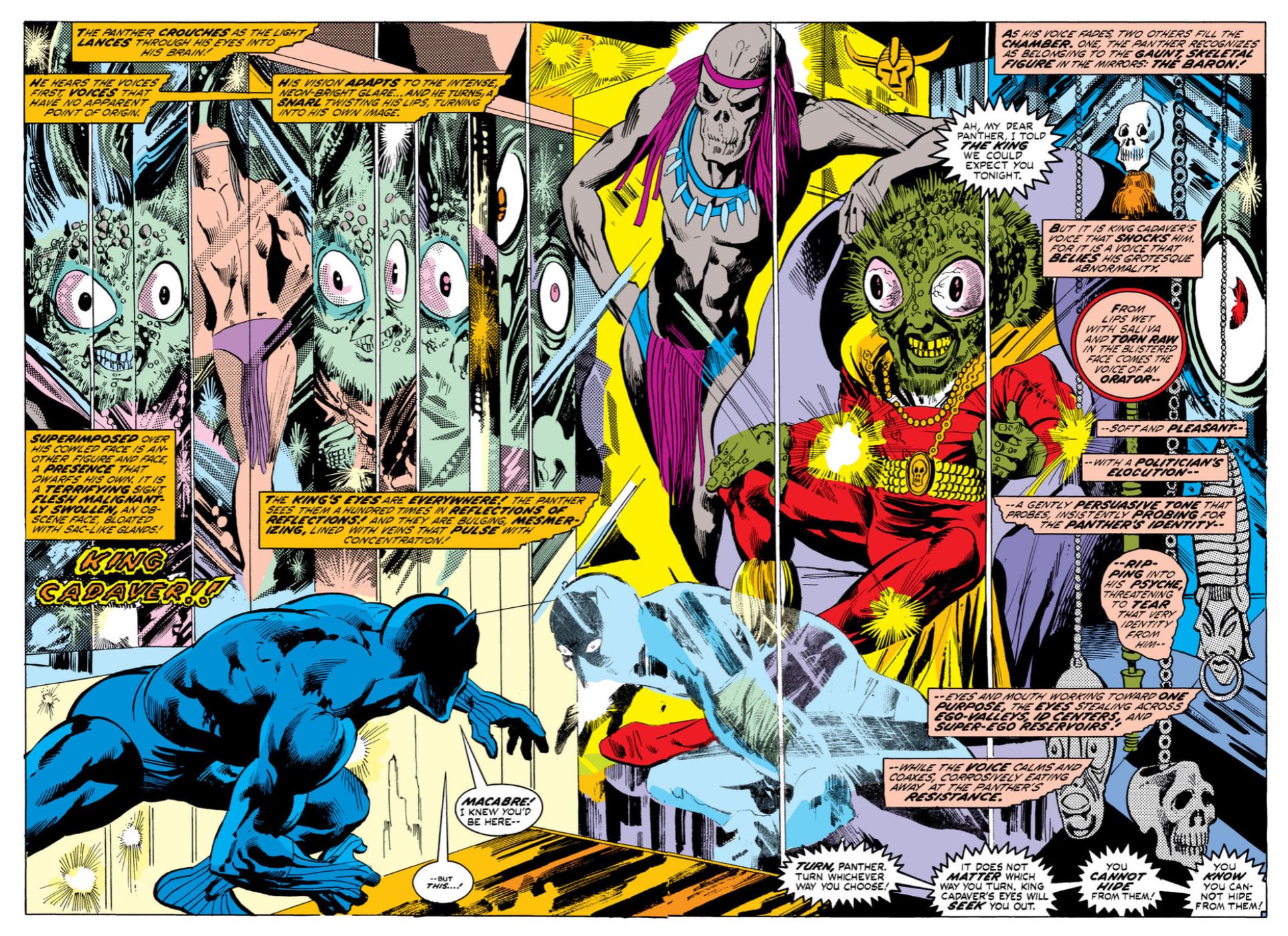
Supreme stylist Billy Graham takes over pencilling with #10 as the Black Panther returns to the zombie nest, exposing a cunning charade beneath the deserted village as well as a super-scientific base run by a malignant, mind-warping mutant in ‘King Cadaver is Dead and Living in Wakanda!’
Accompanying the dark drama here are examples of ‘Black Panther Artistry’ – specifically, Kirby’s first designs for the hero back when he was going by provisional title ‘The Coal Tiger’ and Buckler & Janson’s initial depiction of ‘Erik Killmonger’. Due to an extremely unfavourable publishing schedule, Panther’s Rage unfolded with agonising slowness, but the lengthy wait between episodes allowed McGregor the latitude to pick and choose key events, with readers accepting that some stuff was actually occurring between issues.
By JA #11 (September 1974), the civil war had proceeded unchecked and ‘Once You Slay the Dragon!’ sees the Panther and his forces launching the long-awaited counterattack on Killmonger’s base in N’Jadaka Village. The battle is vicious and brief, introducing yet another powered lieutenant in the shape of pitiless high-tech armourer Lord Karnaj. And on the home front, T’Challa finally clears Monica and captures actual Zatama’s killer…
With Killmonger temporarily in retreat, the Panther goes on the offensive, using the rebel’s most inconsequential converts – Tayete and Kazibe – as reluctant guides to follow his ultimate nemesis to his most secret strongholds. Heading into the mountains and fabled Land of Chilling Mists, the Panther discovers a mutagenic temple… the Resurrection Altar. Employed by Killmonger to create his grotesque super-warriors, it is presided over by scientifically-spawned vampire Sombre. When T’Challa confronts them both, he is again overpowered by Erik and left for wolves to devour in ‘Blood Stains on Virgin Snow!’
- Craig Russell inked the next chapter as, enduring incomprehensible hardships in sub-arctic conditions, T’Challa perseveres and survives to follow Killmonger into the temperate swamps of Serpent Valley in #13. However, this is only after facing a pack of Wakanda’s white apes. To survive, the Panther must blasphemously ignore the sacred (to many of his subjects) religious aspect of the mighty carnivores and become ‘The God Killer’…
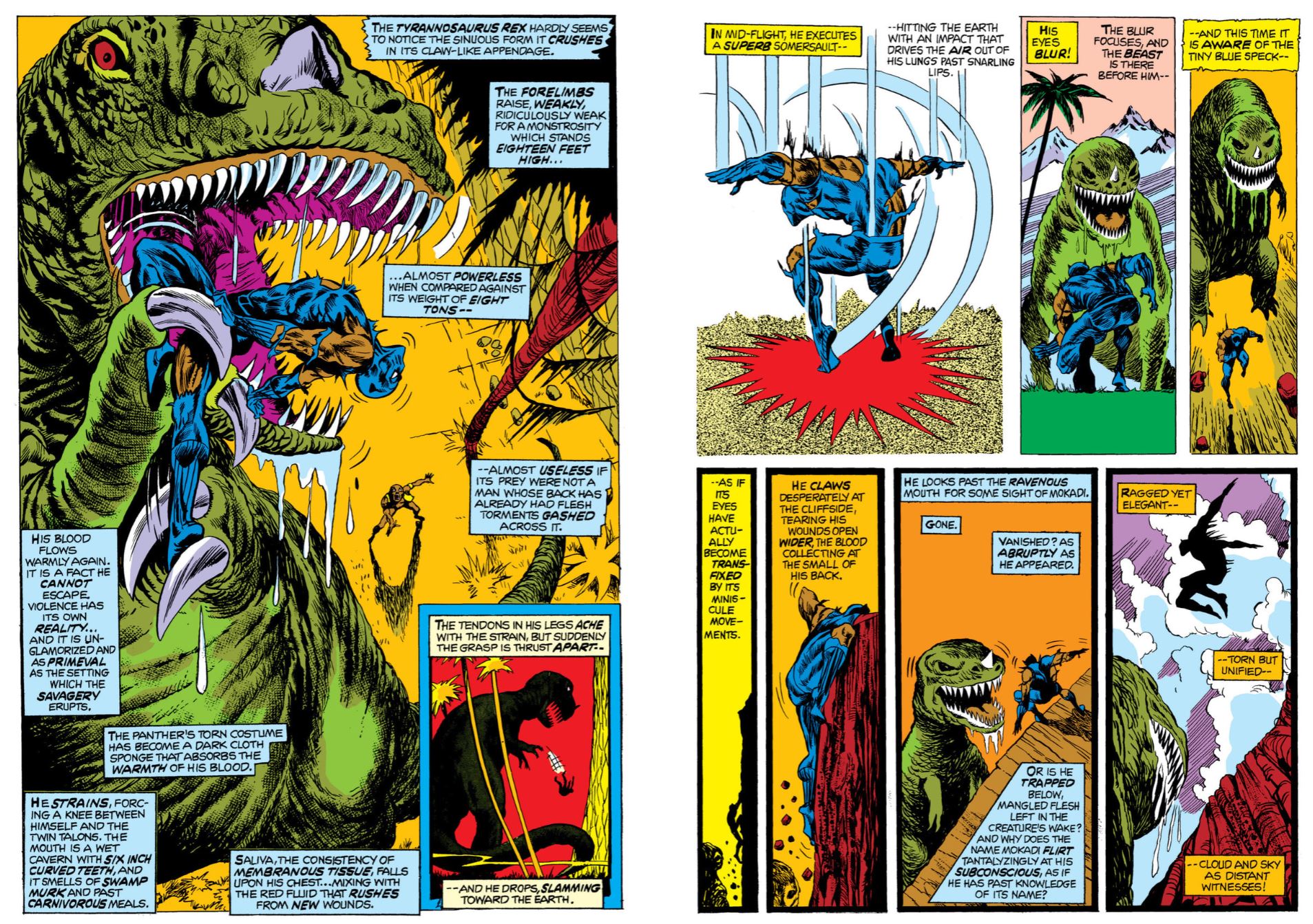
Following a Venomm pin-up, #14 then reveals ‘There Are Serpents Lurking in Paradise’ (inked by Pablo Marcos) as T’Challa clashes once more with Sombre before encountering an affable forest sprite guarding Serpent Valley. Pixie-like Mokadi asks difficult moral questions as T’Challa rushes towards his next battle with Killmonger, making him too late to stop the rebel capturing a legion of the valley’s awesome dinosaurs. The usurper even has time to leave one behind as a lethal parting gift for the embattled, exhausted Wakandan chieftain…
The endgame rapidly approaches in #15 as ‘Thorns in the Flesh, Thorns in the Mind’ (Dan Green inks) finds T’Challa still tracking his foe only to be overcome by Killmonger’s archer assassin Salamander K’Ruel. Beaten and left to be dismembered by a ravenous Pterosaur, T’Challa incredibly overcomes every challenge before – against all odds – staggering back to Monica for another bout of recuperation…
Graham inked his own pencils for the beginning of the end in #16 as T’Challa & Monica’s time of idyllic passion culminates in catastrophe when ‘And All Our Past Decades Have Seen Revolutions!’ reveals Killmonger’s origins as the vast cast converges for one final battle. That comes in #17 as an army of war-trained dinosaurs invades Central Wakanda only to be finally crushed by the Panther’s forces and Wakandan technology. The affair concludes as it began at Warrior Falls, but ‘Of Shadows and Rages’ also holds a shocking twist as the great game of kings is ultimately decided by a player no one considered of any relevance…
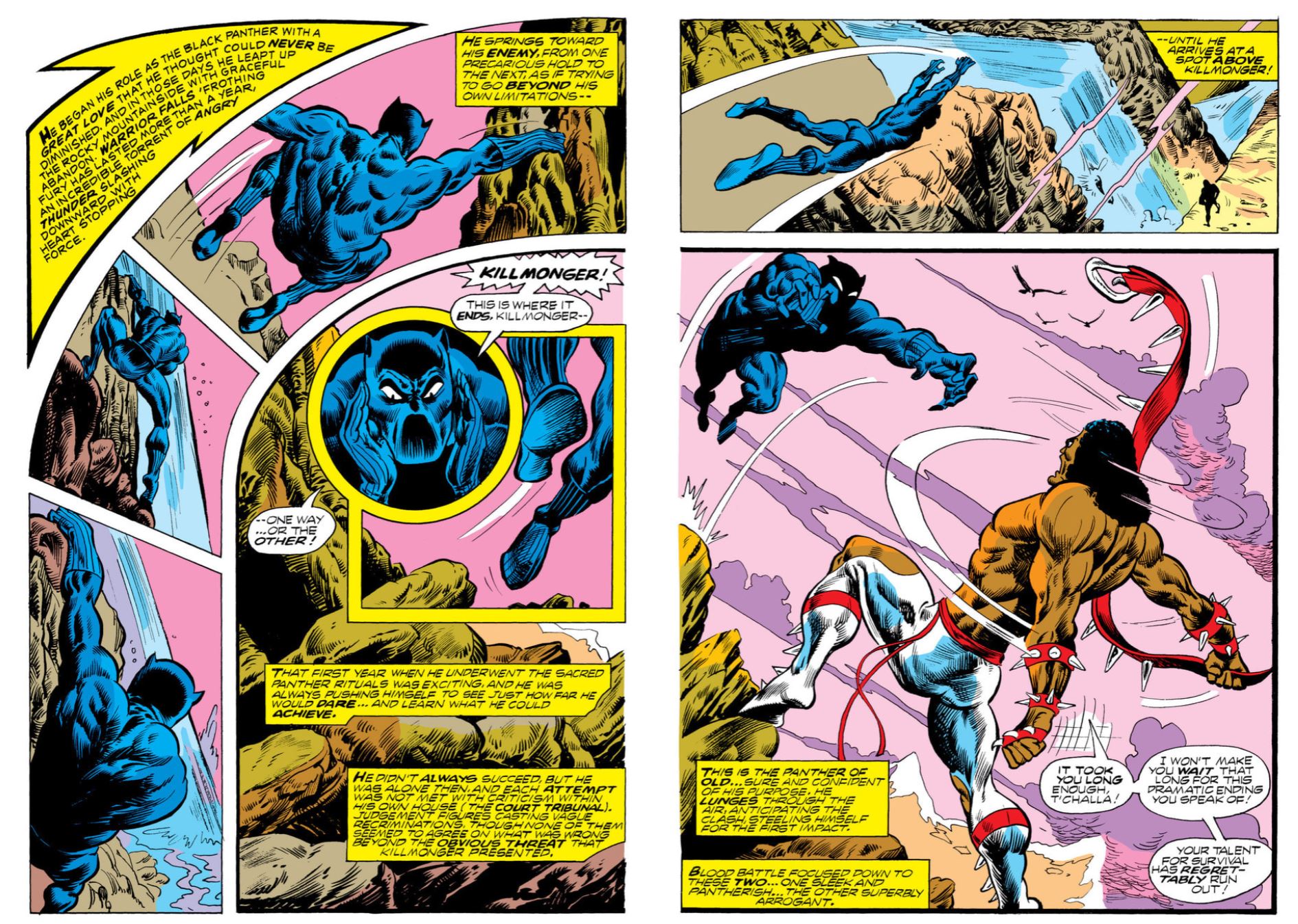
With its nuanced emotional interplay, extended scope and fiercely independent supporting cast, Panther’s Rage was a milestone in dramatic comics storytelling but it harboured one last punch in a gripping ‘Epilogue!’(Jungle Action#18, November 1975). Bob McLeod inked McGregor & Graham’s forceful look at the repercussions of conflict, which finds T’Challa and maimed security chief Wakabi targeted by feral woman Madame Slay: Killmonger’s ardent and unsuspected lover who believes her loss can only be assuaged by having her pack of loyal leopards eviscerate the victorious Wakandans…
Cover-dated January 1976, Jungle Action #19 premiered McGregor’s most audacious and ultimately frustrating project, with T’Challa accompanying Monica back to America. The Panther versus the Klan shifted focus from war stories to crime fiction, substituting exotic Africa for America’s poverty-wracked, troubled, still segregated-in-all-but-name Deep South for a head-on collision with centuries of entrenched and endemic racism. Illustrated by Graham & McLeod, ‘Blood and Sacrifices!’ sees Monica back with her family after her sister is murdered. All too soon T’Challa is ferociously battling a gang of purple-hooded killers who appear to have set up in opposition to the ancient but apparently not supremacist enough white-hooded Ku Klux Klan.
Moreover, both sects are determined to conceal the truth of Angela Lynne’s death, but a break comes when bumbling, well-meaning reporter Kevin Trublood stumbles into an attack on the newcomers by the strangely multi-racial Klan sect calling itself The Dragon Circle…
With neither townsfolk nor lawmen offering any welcome, T’Challa faces unbridled hostility and suspicion at every turn. He is even attacked by cops and a mob of citizens when he thwarts a knife attack on Monica. Although Sheriff Roderick Tate makes all the right noises and seems helpful, in ‘They Told Me a Myth I Wanted to Believe’, the Panther opts to pursue his own investigation before being overwhelmed by an army of white-robed Klansmen who tie him to a burning cross and leave him to die…
As Monica and Kevin puzzle out the convoluted web of mysteries, the Panther exerts all his uncanny gifts to escape becoming ‘A Cross Burning Darkly Blackening the Night!’ Later, as he recovers in hospital, Monica’s family, Kevin and Tate review the few verifiable facts of Angela’s demise before patriarch Lloyd Lynne urges T’Challa to stop looking. He only has one daughter left after all…
Nevertheless, when the Panther and Trublood invade and disrupt a Klan rally, Lloyd is right there with them…
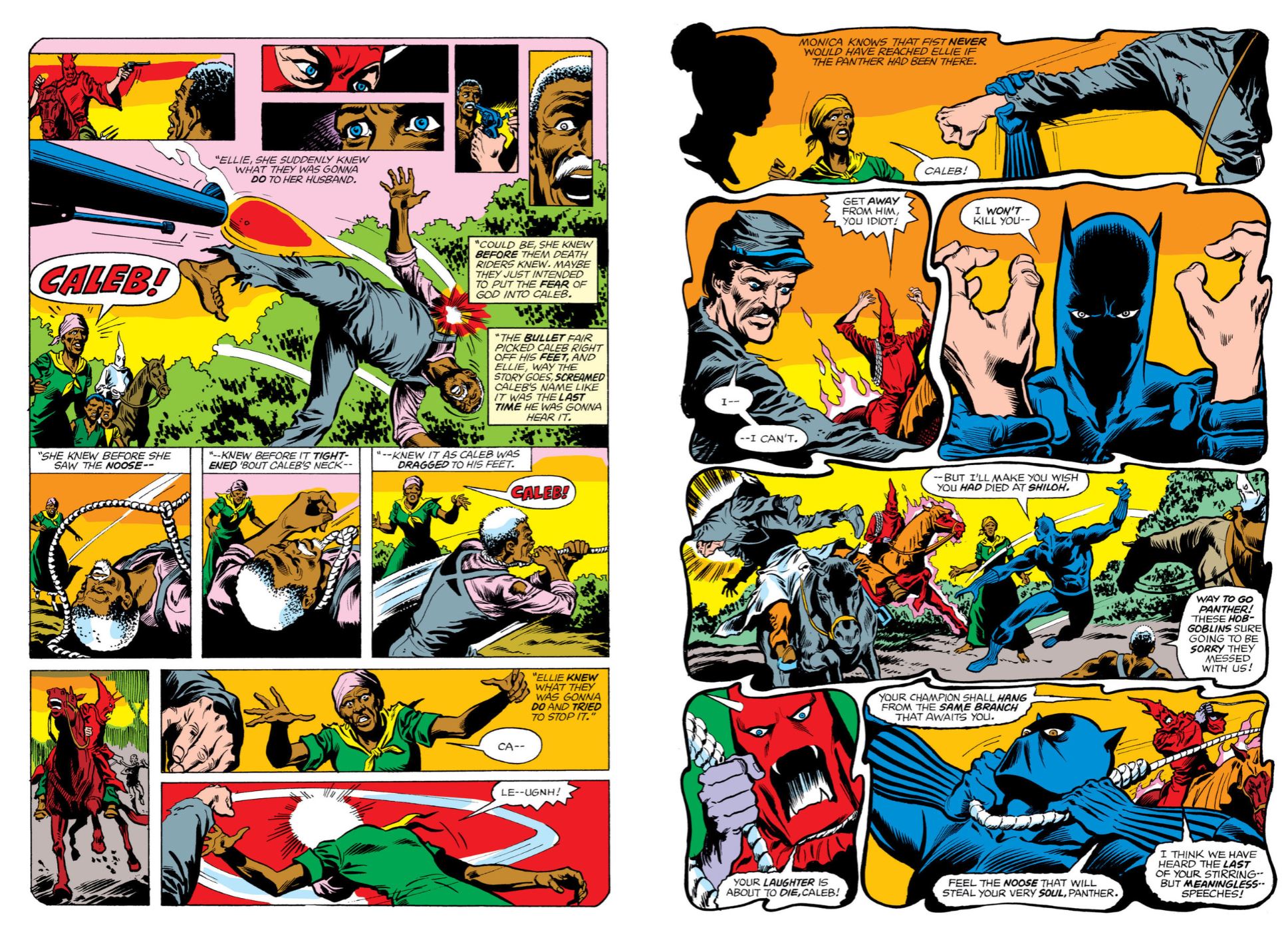
With Buckler joining Graham on pencils and Jim Mooney alternating with McCleod on inks, Jungle Action #22 takes a bizarre turn as ‘Death Riders on the Horizon’ explores a Lynne family legend dating back to the formative days of the Klan in 1867 when old Caleb was targeted by the vile “southern knights” and their seemingly supernatural sponsor the Soul Strangler. As Monica listens to the ghastly, appallingly unjust tale, her mind fills in how T’Challa would have acted in such a hopeless situation…
JA #23 (September 1976) was a deadline missed and rapidly-sourced reprint from Daredevil #69 – represented here only by its cover and a Buckler pin-up – before this tantalising tale is unhappily cut short in final published instalment ‘Wind Eagle in Flight’ (McGregor, Buckler & Keith Pollard).The multi-layered, many-stranded plot suddenly expands as the Panther is almost killed by a mysterious new player who flies into the ever more bewildering clash between cops, Klan, Dragon Circle and Lynne family but, before the mystery could move any further, Jungle Action was cancelled…
A wholly different kind of Black Panther and utterly unrelated adventures would reappear two months later, under the auspices of returning creative colossus Jack Kirby and it would be years before the enigma of Angela’s death and the hero’s war against the Klan was resolved…
Bonus extras here include Kirby & Sinnott’s unused original art cover for FF #52, John Romita’s cover for Jungle Action #5; McGregor’s correspondence with then-fan Ralph Macchio and the author’s original working notes, plot synopses and candid contemporary photos of the close-knit creative team. Also on show: original cover art, pages and sketches by Buckler & Janson & Kane; pencils & layouts by Graham & Buckler, plus Steve Gerber’s ‘Jungle Re-Actions’ editorial feature from Jungle Action #7. Capping off the freebie joys are un-inked Buckler story pages that would have been #25…
A truly groundbreaking classic of comics narrative, Don McGregor’s Black Panther is stark, vibrant proof that the superhero genre works best when ambitious and passionate creators are given their head and let loose to get on with it.
© 1973, 1974, 1975, 1976, 2016 Marvel Characters Inc. All rights reserved.
Today in 1917 US artist/production wizard Jack Adler was born, followed in 1935 by pioneering African American artist Billy Graham (Luke Cage, Black Panther, Sabre) and writer Mike Baron (Nexus, Badger, Flash, The Punisher) in 1949.
In 1952 today, Australia’s beloved Ginger Meggs strip creator Jimmy Bancks died, and the date also saw the debut of Judd Winick’s Frumpy the Clown strip in 1996 and launch of manga collective CLAMP’s Angelic Layer series in 1999.