
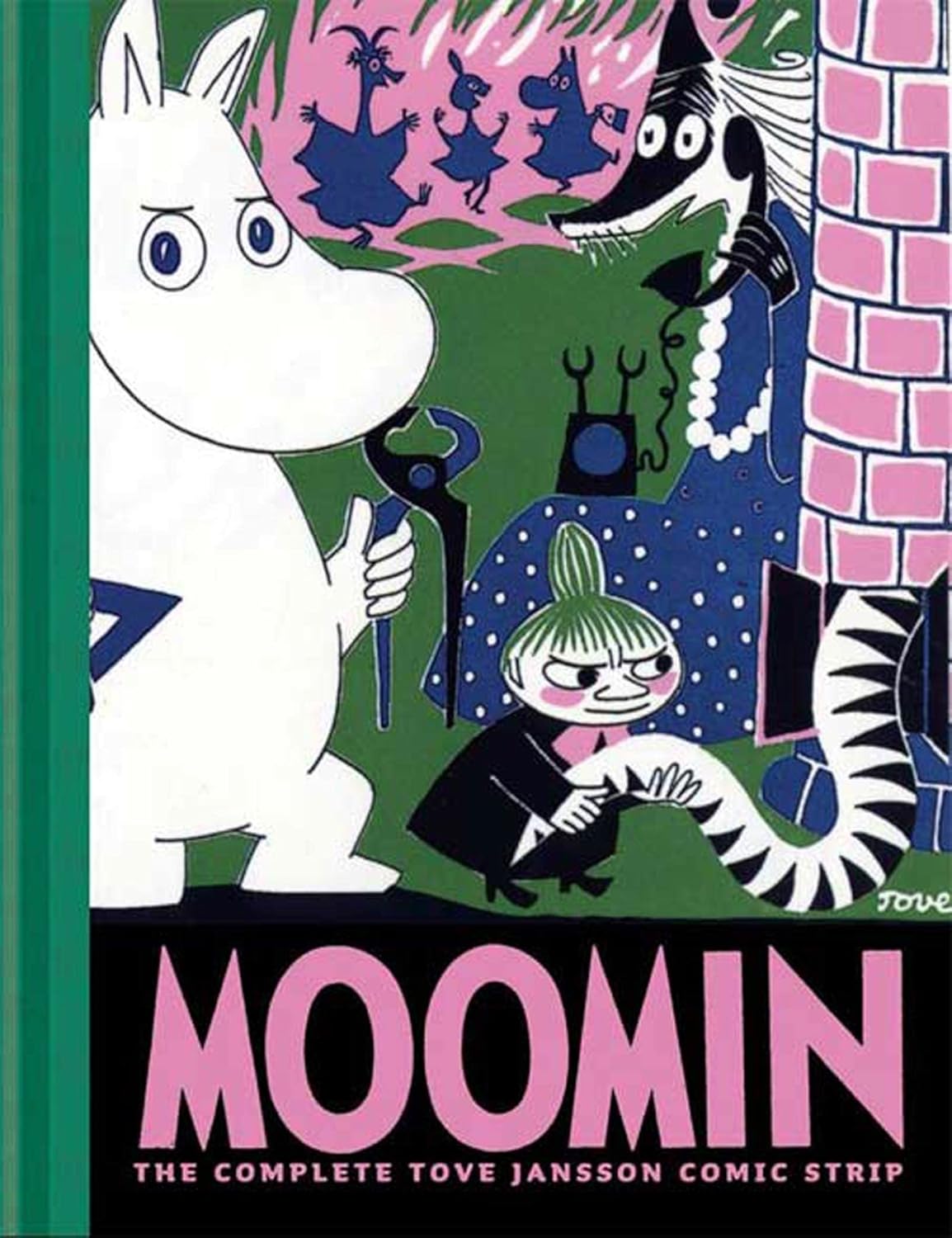
By Tove Jansson with Lars Jansson (Drawn & Quarterly)
ISBN: 978-1-897299-19-7 (Album HB) 978-1-770465-49-7 (Digital edition)
Tove Marika Jansson was born into an artistic, intellectual and practically Bohemian Swedish family in Helsinki, Finland on August 9th 1914, making today her 112th anniversary, so hyvää vuosipäivää to her and all you fans…
Her father Viktor was a sculptor, whilst mother Signe Hammarsten-Jansson enjoyed a successful career as illustrator, graphic designer and commercial artist. Tove’s brothers Lars and Per Olov became a cartoonist/writer and photographer respectively. The family and its close intellectual, eccentric circle of friends seem to have been cast rather than born, with a witty play or challenging sitcom as the piece they were all destined to act in.
After a period of intensive study from 1930-1938 (University College of Arts, Crafts and Design, Stockholm, the Graphic School of The Finnish Academy of Fine Arts, then L’Ecole d’Adrien Holy and L’Ecole des Beaux-Arts, Paris), Tove became a successful exhibiting artist through the troubled period of the war. Intensely creative in many fields, she published the first fantastic Moomins adventure in 1945: Småtrollen och den stora översvämningen (The Little Trolls and the Great Flood or more euphoniously The Moomins and the Great Flood): a whimsical epic of gentle, inclusive, accepting, understanding, bohemian, misfit trolls and their strange friends. Always an over-achiever, from 1930 to 1953 she worked as an artist and cartoonist for Swedish satirical magazine Garm, achieving a measure of notoriety with an infamous political sketch of Hitler in nappies (a political method of self-expression currently back in vogue with many modern im-Potentates), lampooning the Appeasement policies of Chamberlain and other European leaders in the build-up to World War II. Tove was also a much-in-demand illustrator for many magazines and children’s books. She had been selling her own comic strips as early as 1929…
Moomintroll was literally her signature character. The lumpy, big-eyed goof began life as a spindly sigil beside her signature in political works. She called him “Snork” and claimed she had designed him in a fit of pique as a child – the ugliest thing a precocious little girl could imagine – as a response to losing an argument about Immanuel Kant with her brother.
The term “Moomin” came from maternal uncle Einar Hammarsten who attempted to stop Tove pilfering food when she visited by warning her that a Moomintroll guarded the kitchen, creeping up on trespassers and breathing cold air down their necks. Over childhood years and far beyond, Snork/Moomin filled out, became timidly nicer (if a little clingy and insecure), a placid therapy-tool to counteract the grimness of the post-war world.
The Moomins and the Great Flood was relatively unsuccessful but she persisted, as much for her own therapeutic benefit as any other reason, so in 1946 the sequel Kometjakten (Comet in Moominland) was published. Many commentators believe this terrifying tale a skilful, compelling allegory of Nuclear destruction, with both it and 1948’s third illustrated saga Trollkarlens hatt (Finn Family Moomintroll – occasionally The Happy Moomins) translated into English in 1952. The success prompted British media giant Associated Press to commission a newspaper strip about her seductively sweet, sensibly surreal surrogate family.
Jansson had no prejudices regarding strip cartoons. Her earlier works included Lunkentus (Prickinas och Fabians äventyr, 1929); Vårbrodd (Fotbollen som Flög till Himlen, 1930) and Allas Krönika (Palle och Göran gå till sjöss, in1933). She had already successfully adapted Comet in Moominland for Swedish/Finnish paper Ny Tid. Thus, Mumintrollet och jordens undergång (Moomintrolls and the End of the World) was proven a popular feature and Jansson readily accepted a chance to extend her message across the world.
In 1953, The London Evening News launched the first of 21 Moomin serial sagas which captivated readers of all ages. Tove’s involvement ended in 1959, a casualty of her own success and a punishing publication schedule. So great was the pressure that she had early on recruited brother Lars to help. He proudly and most effectively continued the feature until its end in 1975. Free of the strip, she returned to painting, writing and her other creative pursuits: generating book illustrations, plays, murals, public art, stage designs, costumes for dramas and ballets, a Moomin opera, 9 more Moomin-related picture-books & novels, as well as 13 books and short-story collections more obviously intended for grown-ups.
Her awards are too numerous to mention (literally dozens of international art and literary plaudits), but consider this: how many modern artists – let alone comics creators – get their faces on the national currency or have commemorative coins struck bearing their image?
Tove Jansson died on June 27th 2001 but her timorous critters and their better, nicer world has proliferated beyond belief.
Tove could deploy slim economical line and pattern to create sublime worlds of fascination, and her dexterity made simple forms into incredibly expressive and potent symbols. In this second oversized (312 x 222mm) monochrome hardback (or electrical options are available for the screen of your preference!) compilation commences with ‘Moomin’s Winter Follies’, wherein the rotund, gracious and deeply considerate young troll has an accident on ice that prompts the family to begin their annual preparations for the winter’s hibernation.
However, after all these efforts lead to nothing but petty disaster, boldly unconventional Moomin Pappa decides that tradition isn’t everything and decrees that they shall all stay awake for the icy months ahead…
The family and their many friends are soon bedevilled by the obnoxiously enthusiastic Mr. Brisk who cajoles the easygoing Moomins to indulge in his abiding passion for winter sports. Results are painful and far from impressive, but ruggedly athletic Brisk does turn the head of overly romantic and lonely Mymble. As usual, the object of her affections is blithely oblivious, with eyes only for the upcoming Winter Games, but when beauteous Snorkmaiden also starts succumbing to Brisk’s physical charms, Moomin is forced to take up ski-jumping just to win back her attention.
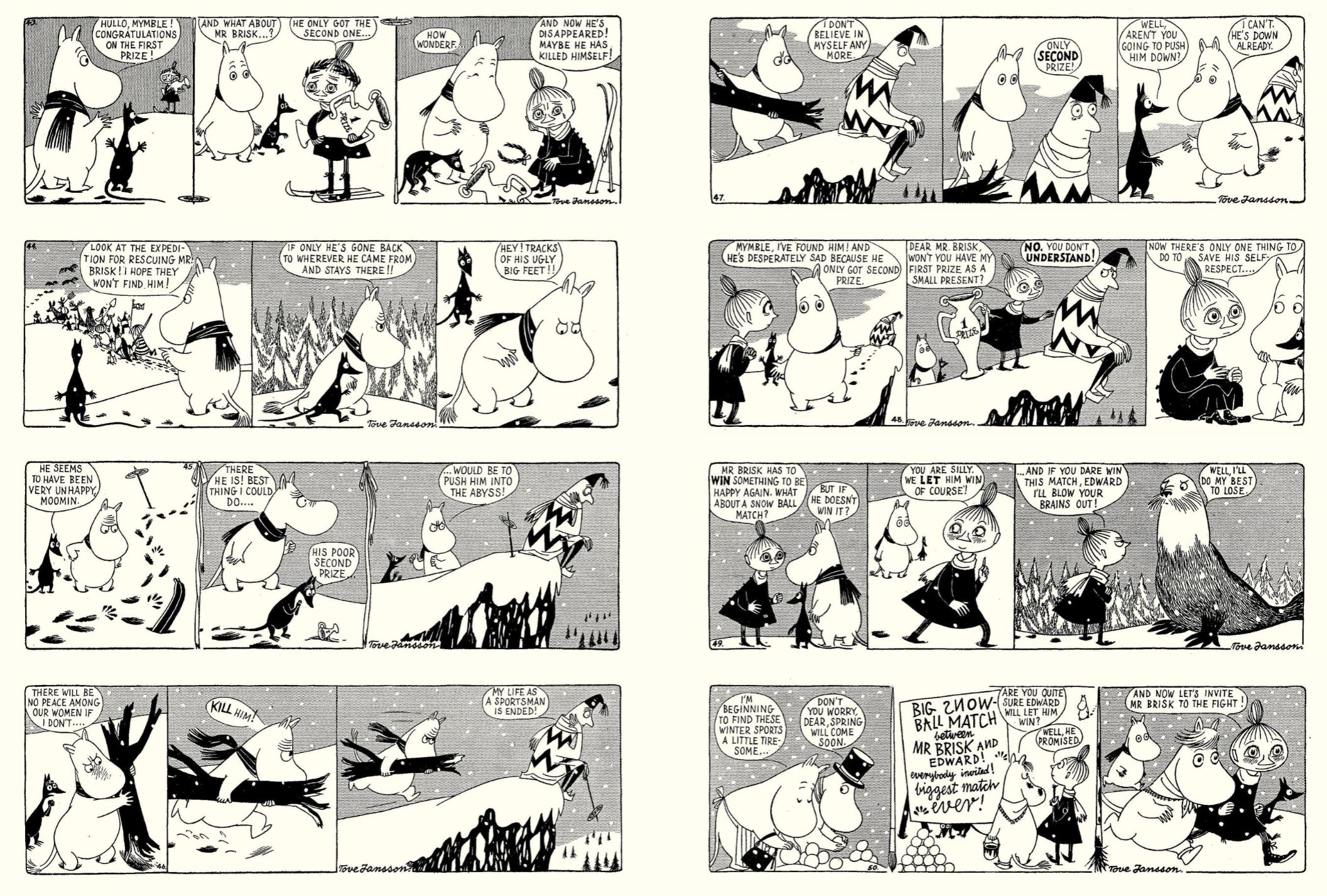
When that goes poorly, he is tempted into contemplating murder until cooler heads, his own gentle nature and the onset of spring produces a milder and more suitable solution…
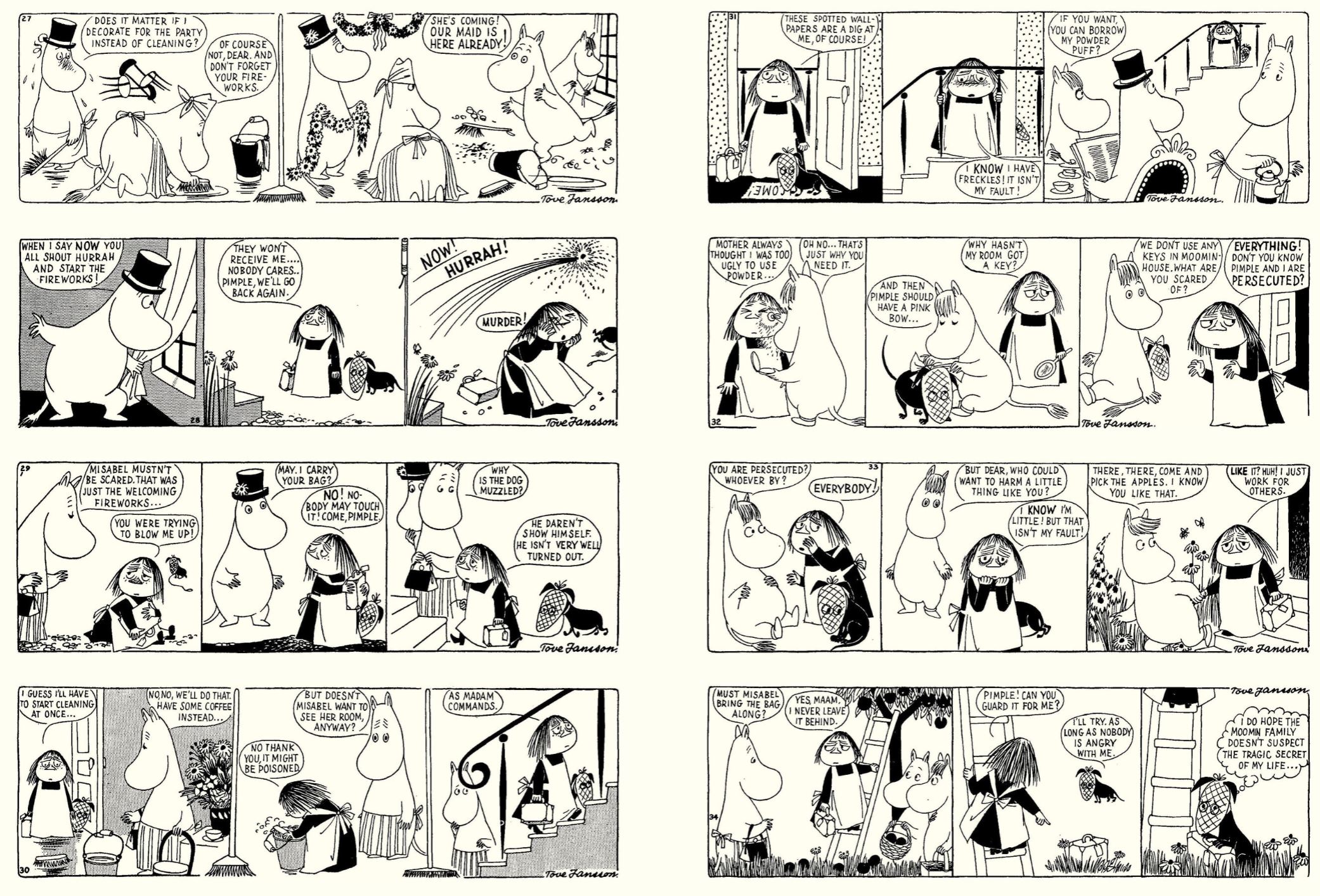
Moomins are placid free spirits, bohemians untroubled by hidebound domestic mores and societal pressures. Moomin Mamma is warm and capable but overly concerned with propriety and appearances, whilst Pappa spends most of his time trying to rekindle his adventurous youth or dreaming of fantastic journeys. However, when prideful snobbish Mrs. Fillyjonk moves in next door, her snooty attitudes unfavourably affect the entire family, resulting in the hiring of ‘Moomin Mamma’s Maid’.
The search for a suitable servant results in disruption and discontent before dour, distressed and doom-obsessed Misabel – along with her direly depressed dog Pimple – further blight the formerly happy household. Misabel suffers from secrets and persecution complexes, and when Fillyjonk goes missing, a detective starts hanging around, adding to the general aura of anxiety until Moomin Mamma shakes herself out of her status-induced funk and starts a campaign to cheer up and change the latest additions to her wildly imaginative, but oddly welcoming, home…
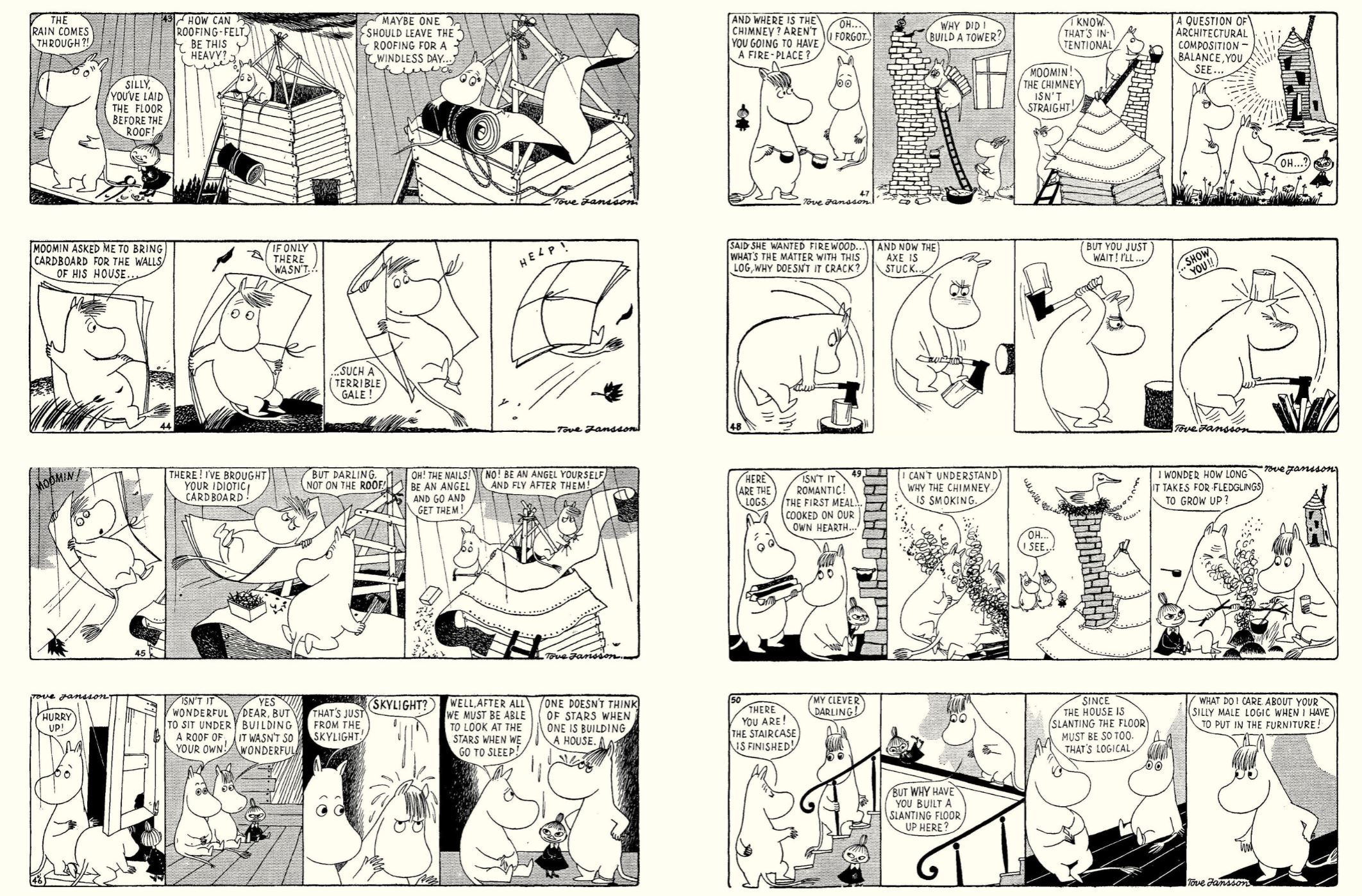
‘Moomin Builds a House’ sees Mymble’s eccentrically forgetful yet fruitful mother come to visit, inflicting her latest batch of wild & wilful youngsters (17, or thereabouts!) on the normally compassionate and understanding trolls. The children are, to put it mildly, little monsters: destructive, practical joking, firestarter hellions who would put the Belles of St. Trinian’s to shame and to rout…
Soon, impressionable Moomin is driven out of his home and, egged on by the worst of the brood Little My, attempts to build his own house in the woods. With none of Moomin Pappa’s craft skills, the lad’s efforts are far from satisfactory but nonetheless his flighty paramour Snorkmaiden soon joins him, intent on making the shaky edifice their romantic hideaway. Sadly, with Little My still around, their best laid plans quickly come unstuck…
This utterly incomparable and heartwarming box of graphic delights concludes with a brilliantly satirical salutary romp as ‘Moomin Begins a New Life’, wherein an itinerant thinker enters the valley, sharing his secret recipe for “How to be Happy”. Although self-proclaimed, The Prophet is remarkably convincing and, seeing how his pronouncements and suggestions have changed the lives of all their friends and neighbours, the graciously impressionable Moomins attempt to adjust their behaviour to maximise their joy, unaware that they are already as happy and content as anyone can be…
With the entire locality blissed out, the well-intentioned Prophet then convinces the constable to release all the folk in jail, allowing mischievous trickster and devoted scofflaw Stinky to resume his prankish shenanigans. After convincing Pappa to set up an illicit still producing hard liquor – which incites Snorkmaiden to run off with another young man – Stinky subsequently convinces desolate, deserted Moomin to turn to the dark side, becoming a glamorous highwayman and jewel thief to win her back…
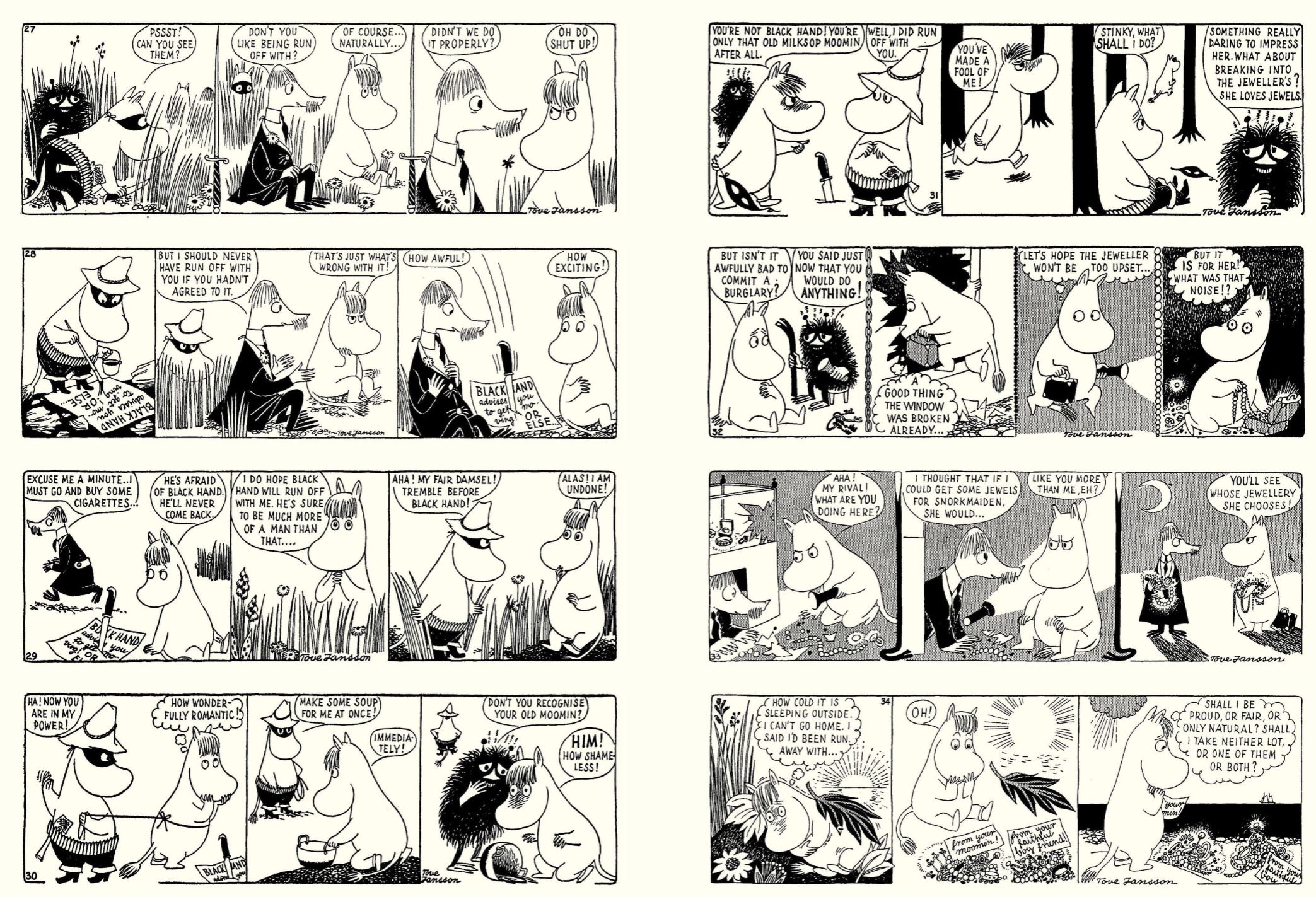
Having spread malice and disorder, Stinky’s next stunt is badly misjudged. He invites a puritan, fire-&-brimstone rival philosopher dubbed the Black Prophet to come and save all the sinners. Thankfully, as the rival Prophets’ war of words escalates, Moomin Mamma at last reaches the end of her patience and intervenes…
Following the Wild Things wonderment is short essay ‘Tove Jansson: To Live in Peace, Plant Potatoes, and Dream’: a comprehensive biography and commentary by Alisia Grace Chase, PhD celebrating the astound achievements of this genteel giant of literature and the arts.
These are truly magical tales for the young laced with the devastating observation and razor-sharp mature wit which enhances and elevates only the greatest kid’s stories into classics of literature. These volumes are an international treasure and no fan of the medium – or biped with even a hint of heart and soul – can afford to be without them.
© 2007 Solo/Bulls. All other material © its creators. All rights reserved.
Today in 1907 nonstop cartoonist Mel Graff (Adventures of Patsy, Secret Agent X-9, Captain Easy) was born, sharing the day with utterly unique Tove Jansson who joined the party in 1914 as did eventual pulp scribe turned Atlas Comics & EC genre anthology author Daniel Keyes (Flowers for Algernon) in 1927.
Mandrake the Magician artisan Fred Fredericks came along in 1929; Belgian creator William Vance (XIII, Marshall Blueberry, Bob Morane, Bruno Brazil) in 1935; British cartoonist Posy Simmons (Bear, Mrs Weber’s Diary, Gemma Bovary, Tamara Drewe) in 1955 and comic book craftsman Bob McLeod (New Mutants, Conan, Wonder Woman, Superman) in1951. Ultra stylist Rick Leonardi (Spider-Man 2099, Uncanny X-Men, Cloak and Dagger, Batman Beyond) arrived in 1957, sharing cake & candles with Fish Police creator Steve Moncuse, and Gene Luen Yang (Chinese Born American, Superman Smashes the Klan, Monkey Prince) popped by in 1971.