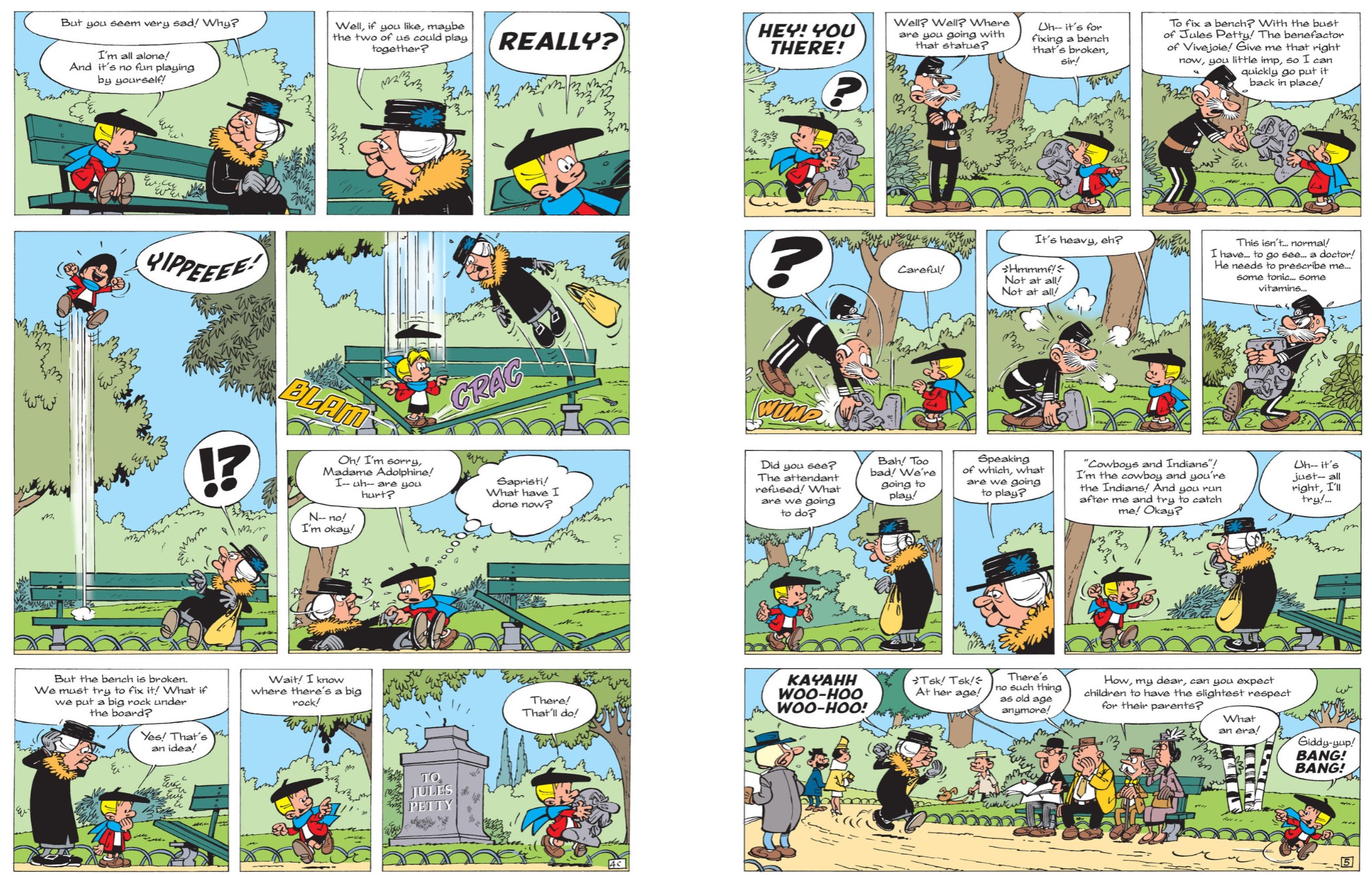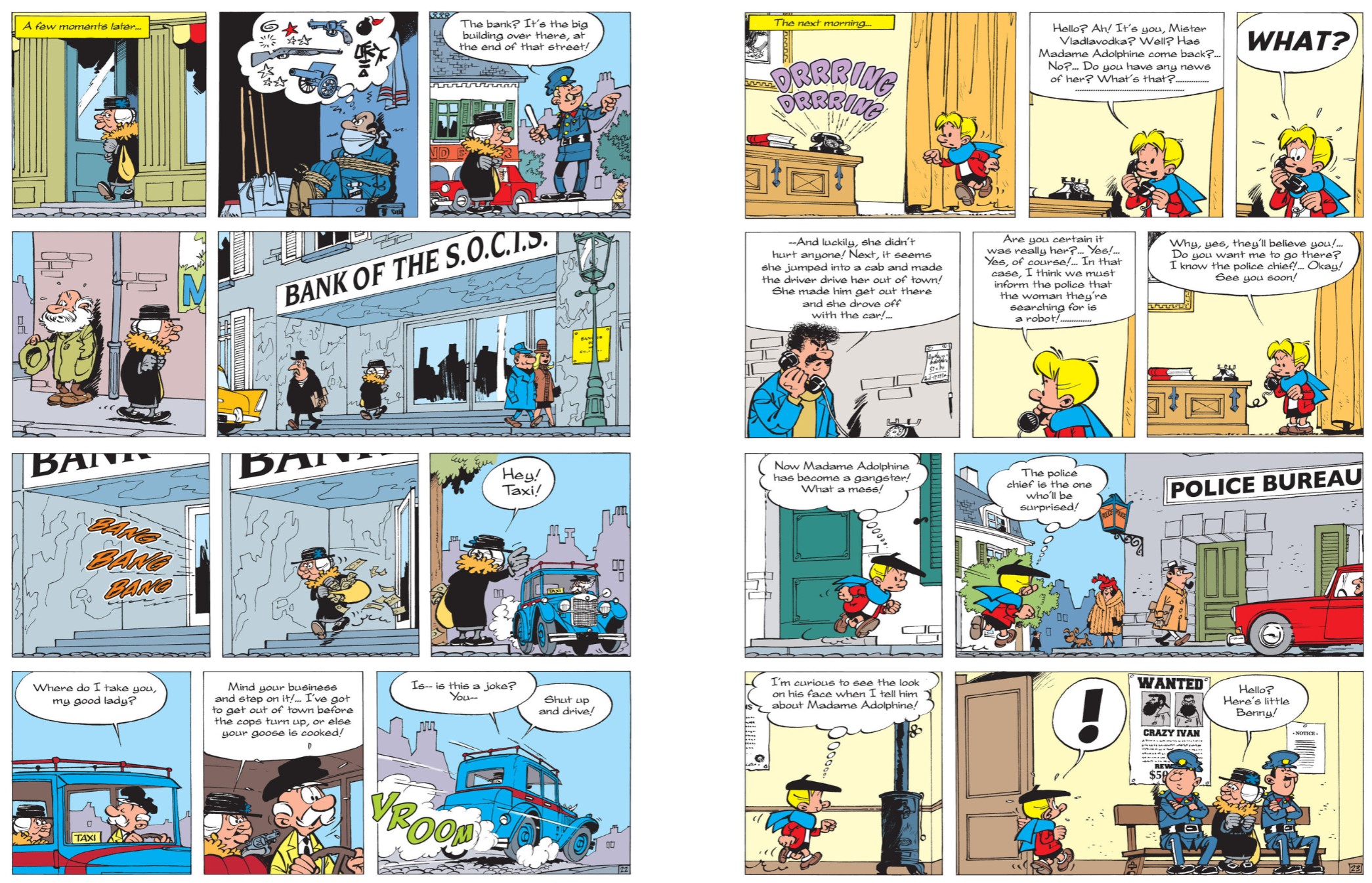
The Spider’s Syndicate of Crime vs Spider-Boy (volume 4)


By Jerry Siegel & Reg Bunn with John Burns, Geoff Campion and various (Rebellion)
ISBN: 978-1-83786-560-4 (Album TPB/Digital edition), 978-1-83786-685-4 (Webshop Exclusive edition)

This book includes Discriminatory Content produced in less enlightened times.

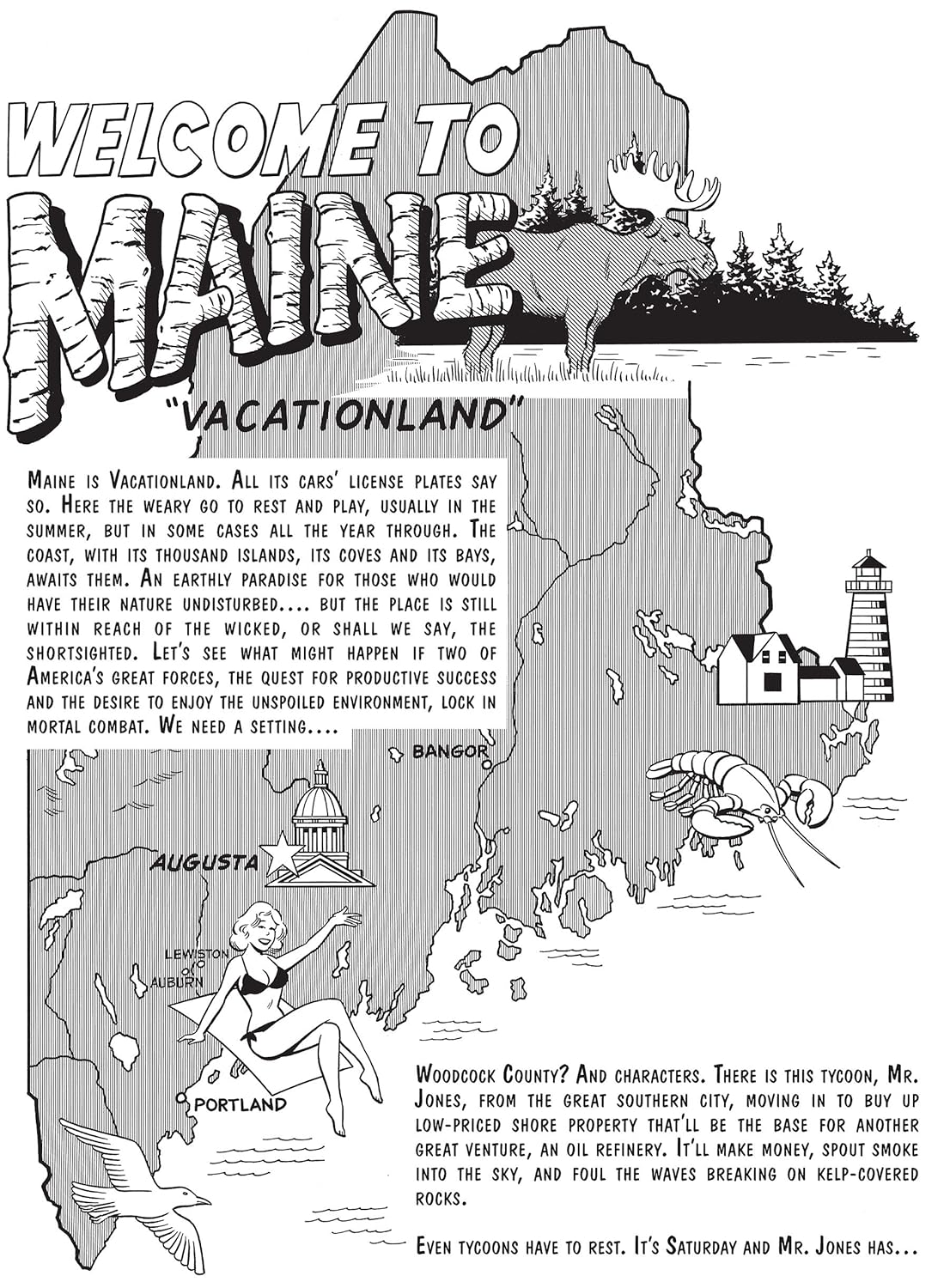
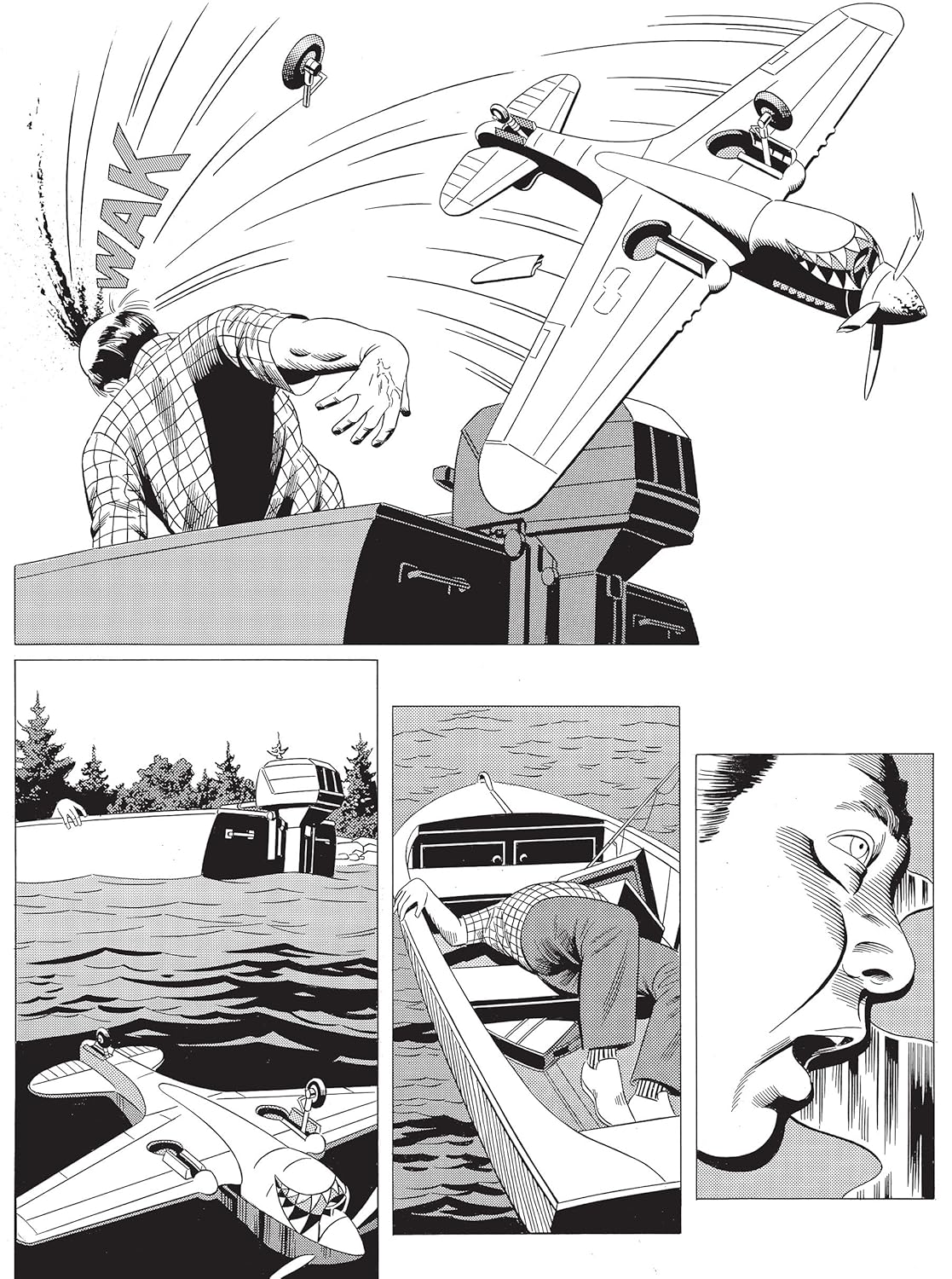
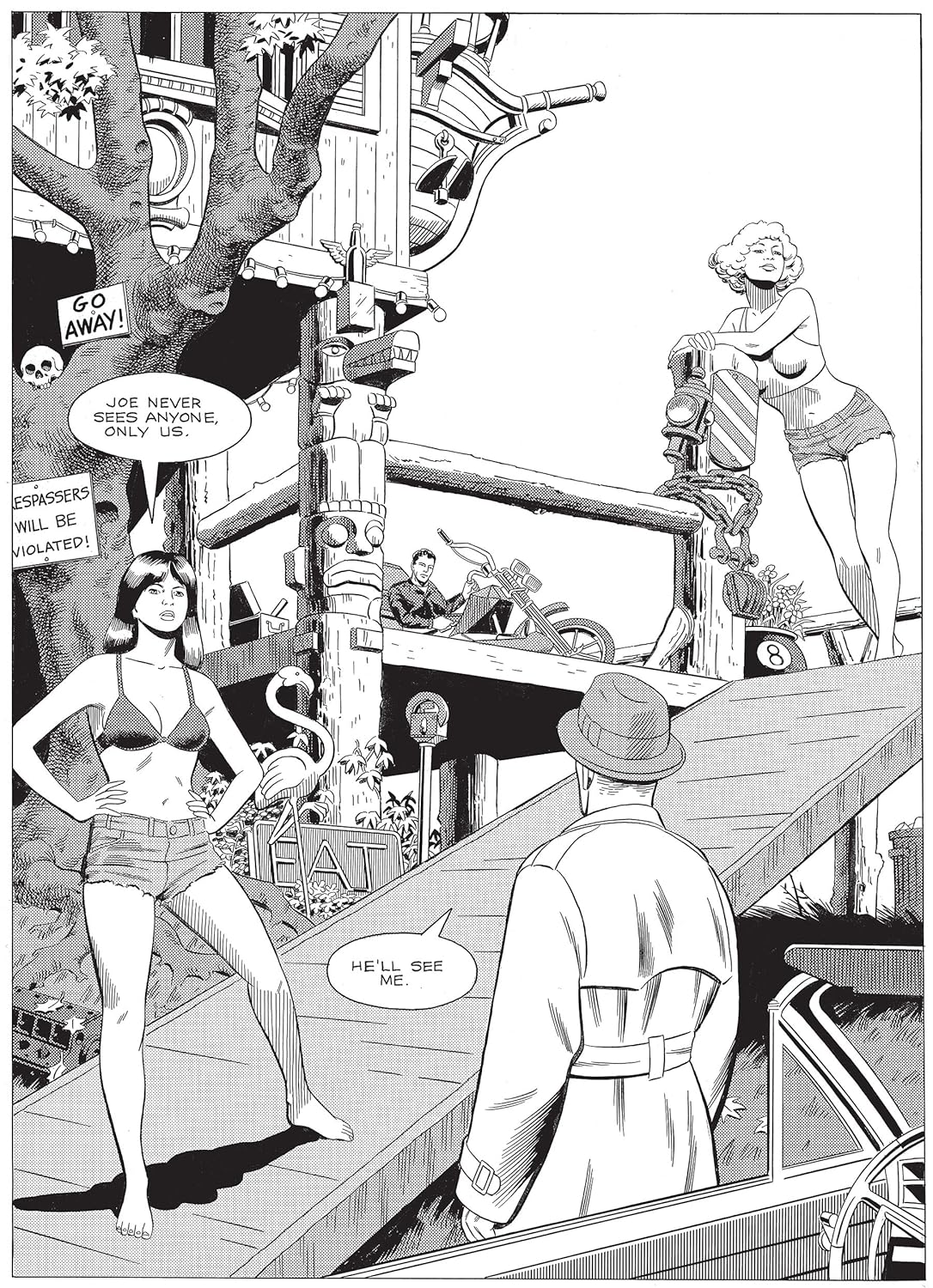
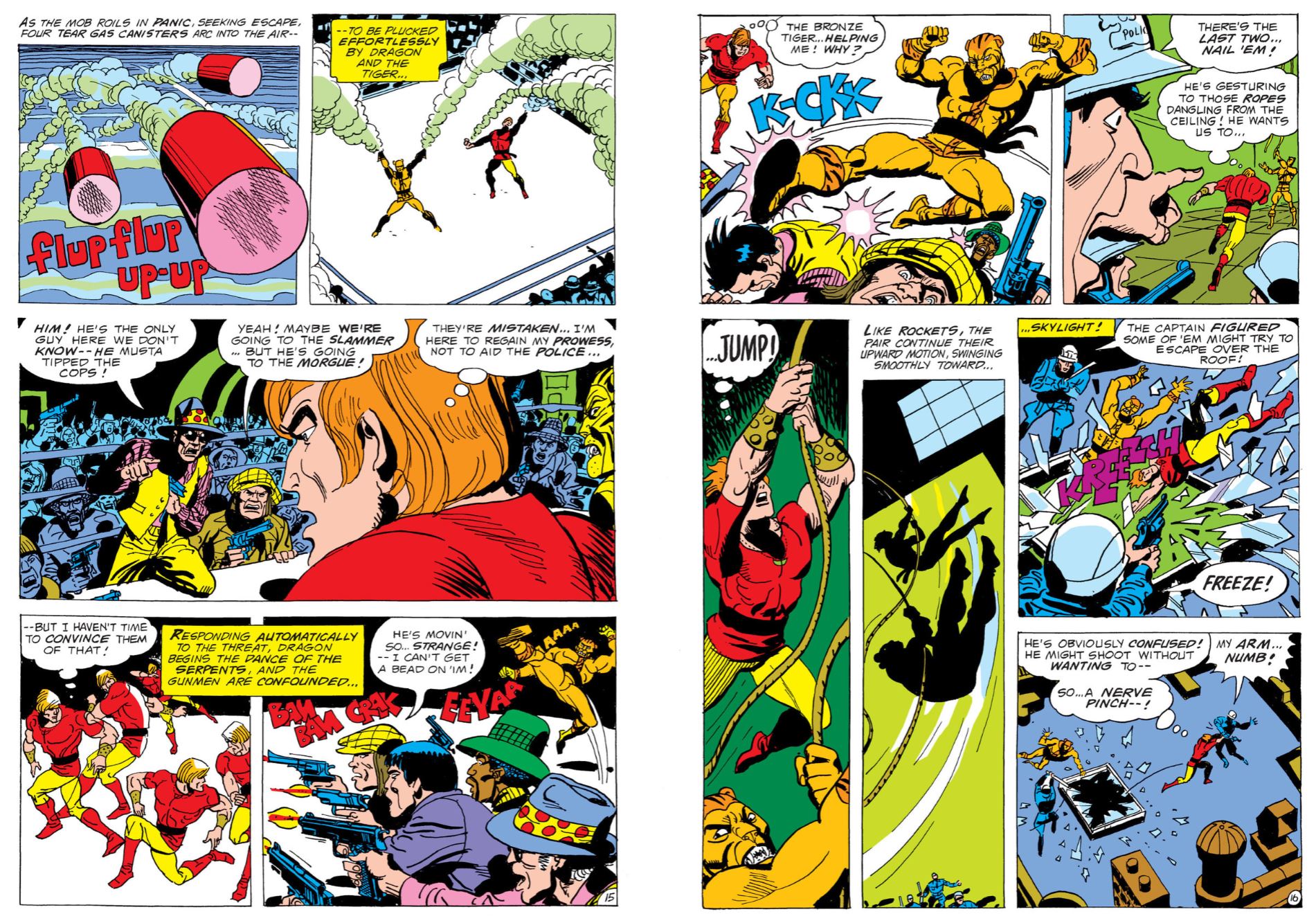
Another triumph of Rebellion’s Treasury of British Comics line, The Spider’s Syndicate of Crime vs. Spider-Boy is the latest offering in what I pray will be a complete revival of the UK’s most marvellous vintage comics fantasies (bring on Thunderbolt the Avenger, Smoke Man, Tri-Man, Gadget Man & Gimmick Kid and even the Phantom Viking… we can take it!).

Gathering material from peerless weekly anthology Lion, originally spanning May 27th to October 7th 1967 and including material from a later reprinting (Lion December 8th 1973), this collection also includes a prose done-in-one yarn from Lion Annual 1970 to complete another wildly whacky superhero romp as only the cocreator of Superman could envision it…

Mystery criminal genius and eventual superhero The Spider debuted on June 26th 1965 and reigned supreme until April 26th 1969. He has periodically returned in reprints and occasional new stories ever since. As first introduced by Ted Cowan (Paddy Payne, Adam Eterno, Robot Archie) & William Reginald Bunn.

“Reg” was an absolute master of his field and much beloved. His other work in comics (like Robin Hood, Buck Jones, Black Hood, Captain Kid and Clip McCord) spanned 1949 to his death in 1971 as, once the industry found him, he was never without work. Reg died on the job and is still much missed. For The Spider there was the ultimate accolade as, after opening on 2 pages per episode, the feature kept winning a bigger page count. Even so, lots had to happen in short order and Bunn never stinted or short-changed his audience. Played out for months at breakneck rollercoaster pace, each monochrome episode positively bulged with imaginative ingenuity, manic combats and crazy inventions peppering wide-eyed British kids with a bizarre conception of the USA…

Originally The Spider was man of unbelievably colossal vanity: a moody malcontent super-scientist whose goal was to be acclaimed the greatest criminal of all time. A flamboyantly wicked narcissist, he began his public career by recruiting crime specialists – scurvy, skeevy safecracker Roy Ordini and genteelly timid evil genius inventor Professor Pelham – prior to a massive gem-theft from America’s greatest city. He was foiled by cruel luck and resolute cops Gilmore &Trask: crack detectives cursed with the job of catching the arachnid archfiend. Cowan scripted the first two serialised sagas before handing over to comics royalty: Jerry Siegel (Superman, Superboy, The Spectre, Doctor Occult, Slam Bradley, Funnyman, The Mighty Crusaders, Starling), who had been forced to look elsewhere for work after an infamous dispute with DC Comics over the rights to the Man of Steel. His supervision of UK arachnid amazement began just as Britain and the entire, but somehow less fab & groovy, world succumbed to “Batmania”…

In case you’re not old, that term covers a period of global hysteria sparked by the 1966 Batman TV show, when the planet went crazy for superheroes and an era dubbed “camp” saw humour, satire, and fantastic psychedelic whimsy infect all categories of entertainment. It was a time of peace, love, wild music and radical change, and I believe there were lots of drugs being experimented with at the time…

British comics were always especially vulnerable to any passing trend or zeitgeist, and a host of more conventional costumed crusaders sprang up in our traditionally unconventional pages. Scripted by the godfather of the genre – and an inveterate humourist – The Spider remained an utterly arrogant sod even as he skilfully shifted gears without a squeak to become a superhero. Battling in rapid succession The Exterminator, Crime Incorporated, The Silhouette, Dr. Mysterioso, The Android Emperor, The Infernal Gadgeteer, The Crook From Outer Space, an evil Genie, transdimensional monstrogs and immortal Queen Lana of Valley of the Doomed he starts here as global figure of approbation and acceptance, only to see all his glittering glories plucked away…

As previously stated, the strip had grown ever more popular, and by the time of this epic encounter demanded a full 5 pages per episode, in a periodical where 1 or 2 pages a week was the norm. Another masterclass of illustrative wonderment displaying Bunn’s incredible gift for visualisation, the lengthy campaign finds The Spider, Pelham & Ordini targeted by honest greed, dastardly ambition and cruel misunderstanding as the tale in this tome reconnects with normal(ish) Good, Evil and Vengeance. Here The Spider duels a deadly criminal scientist only to find himself distracted and diverted by a young and ferocious deadly doppelganger…
When criminal inventor Sylvester Jenkins (DO NOT call him “Silly”) teams up with Fury Gang boss “Turk” Dobbs, the first results are a wave of super-powered bandits such as The Bolt and insulting defeat by The Spider and his crew. In response Jenkins murders Dobbs (who coined the “Silly” moniker) and frames the hero for it. With the Spider on the run and unable to clear his name, let alone face a rush of mutated mobster/monsters, the situation grows truly complicated as a brilliant but vicious teenager wearing stolen Spider gear hunts and humiliates the great hero time and again.

Outfought, outmanoeuvred and on the run, the prospects are dire after Jenkins recruits Spider-Boy and orchestrates his following forays against the despised fallen hero, until the kid learns a bitter truth and shares a tragic secret that changes everything…

A far darker and more traditionally motivated tale, the delivery still rockets along with wild invention as incidental dangers pile up: horrors such as trigger-happy cops, Jenkins’ relentless monster experiments, naturally-occurring rival bio-terrors, rampaging bug-bots, flying castles, mutated circus and zoo animals and a climactic showdown in a lost city of super technologies, before all the truths come out and justice is served…

The Extras section then offers a rare treat from a later era, as – when the serial was truncated and re-run in 1973 – the editors opted to commission a new final episode and alternate conclusion; scripted by an unknown writer but illustrated by John Burns as seen in Lion December 8th 1973. It’s followed by text thriller ‘The Spider Meets the Fly’. Illustrated and written by hands unknown for Lion Annual 1968 this yarn pits the Spider and Co. against a world-conquering science villain and his volcano-dwelling army of high-tech assassins… with the usual results, and is accompanied by the book’s original full-colour frontispiece highlighting the clash as painted by Geoff (Battler Britton, Captain Condor, Typhoon Tracy, The Spellbinder, D-Day Dawson) Campion.

This titanic tome confirms that the King of crime crushes is still top of the heap and should find a home in every kid’s heart and mind, no matter how young they might be, or threaten to remain. Batty, baroque and often simply bonkers, The Spider proves that although crime does not pay, it can offer a huge amount of white-knuckle fun…
© 1967, 1969, 1973 & 2025 Rebellion Publishing IP Ltd. All Rights Reserved.

Today in 1777 English caricaturist and illustrator Richard Newton was born, followed in 1903 by Jimmy Olsen, Captain Marvel artist Pete Costanza; Ralph Reese (Solomon Kane, Witzend, One Year Affair) in 1949, and Argentine cartoonist Maitena Burundarena (Mujeres Alteradas) in 1962.

In 2017, comic book chameleon Rich Buckler (Deathlok, Fantastic Four, All-Star Squadron, Batman, Superman vs Shazam, Red Circle Comics) died.
Amazing Mysteries: The Bill Everett Archives volume 1


By Bill Everett and others, edited and complied by Blake Bell (Fantagraphics Books)
ISBN: 978-1-60699-488-7 (HB/Digital edition)

This book includes Discriminatory Content produced in less enlightened times.

Thanks solely to modern technology and diligent research by dedicated fans, there is a sublime superabundance of collections featuring the works of too-long ignored founding fathers and lost masters of American comic books these days. A magnificent case in point is these curated chronicles (available in both print and digital formats) revisiting and yet barely touching upon the incredible gifts and achievements of one of the greatest draughtsmen and yarn-spinners our industry has ever seen.

You could save some time and trouble by simply buying them now rather than waste your valuable off-hours reading my preposterous blather and piffle, but since I’m keen to carp on anyway feel free to accompany me as I delineate just why these tomes need to join the books on your “Favourites” shelf.

The star under scrutiny here was a direct descendent and namesake of iconoclastic poet and artist William Blake. Bill was quite possibly the most technically accomplished artist in the US comic book industry and his tragic life and awe-inspiring body of work reveal how a man of privilege and astonishing pedigree was wracked by illness, addictive personality traits (especially alcoholism) and sheer bad luck, but nevertheless shaped an art-form. Bill Everett left twin legacies: an incredible body of superlative stories and art, and, more importantly, he redeemed many broken lives by becoming a dedicated mentor for Alcoholics Anonymous in his later years.

William Blake Everett was born in 1917 into a wealthy and prestigious New England family. Bright and precocious, he contracted tuberculosis at age twelve and was dispatched to arid Arizona to recuperate. This chain of events began a life-long affair with the cowboy lifestyle: a hard-drinking, chain-smoking, tall-tale-telling breed locked in a hard-to-win war against slow self-destruction.

All this and more is far better imparted in a scholarly, fact-filled, picture-packed Introduction by Blake Bell in Amazing Mysteries: The Bill Everett Archives volume 1. This covers the development of the medium in ‘The Golden Age of Comics’; the history of ‘Bill Everett the Man’ and how they came together in ‘Centaur + Funnies Inc. = Marvel Comics #1’. The essay also includes an astounding treasure trove of found images and original art, including samples from 1940s Sub-Mariner, 1960s Daredevil and 1970s Black Widow stories, amongst many others.

Accompanied by the covers (that’s the case for most of the titles that follow: Everett was fast and slick and knew just how to catch a punter’s eye) for Amazing Mystery Funnies vol. 1 #1, 2, 3a, 3b and vol. 2 #2 (August 1938 – February 1939, from Centaur) are a quartet of rousing but muddled interstellar exploits starring sci fi troubleshooter Skyrocket Steele. These are followed by a brace of anarchic outer space shenanigans starring futuristic wild boy Dirk the Demon culled from Amazing Mystery Funnies (vol. 1 #3a and vol. 2 #3; November 1938 & March 1939 respectively).

The undisputed star and big draw at Centaur was always Amazing-Man who was a Tibetan mystic-trained orphan, adventurer and do-gooder named John Aman. After many years of dangerous, painful study that young man was despatched back to civilisation to do good… for a relative given value of “good”…

Aman stole the show in monthly Amazing Mystery Comics (#5-8, spanning September -December 1939) as seen in the four breakneck thrillers re-presented here and opening with ‘Origin of Amazing-Man’ followed by an untitled sequel episode with the champion saving a lady rancher from sadistic criminals; ‘Amazing-Man Loose’ (after being framed for various crimes) and a concluding instalment wherein the nomadic hero abandons his quest to capture his evil arch rival ‘The Great Question’ and instead heads for recently invaded France to combat the scourge of Nazism…

As previously stated, Everett was passionately wedded to western themes and for Novelty Press’ Target Comics he devised an Arizona-set, rootin’ tootin’ cowboy crusader called Bull’s-Eye Bill. Taken from issues #1 & 2 (February & March 1940), ‘On the trail of Travis Trent’ and ‘The Escape of Travis Trent’ has our wholesome yet hard-bitten cowpoke battling the meanest, most determined owlhoot in the territory. Accompanying the strips is an Everett-illustrated prose piece attributed to “Gray Brown” entitled ‘Bullseye Bill Gets his Moniker’.

Thanks to his breakthrough Sub-Mariner sagas, Everett became inextricably linked to water-based action adventures and immensely popular, edgy heroes. That’s why Eastern Comics hired him to create human waterspout Bob Blake, Hydroman for their bimonthly anthology Reg’lar Fellers Heroic Comics.

Here – spanning issues #1-5 and August 1940 to March 1941- are five spectacular, eerily offbeat exploits, encompassing ‘The Origin of Hydroman’ and covering his patriotic mission to make America safe from subversion by “oriental invaders”, German saboteurs and assorted ne’er-do-wells, after which a Polar Paladin rears his frozen head. Sub-Zero Man debuted in Blue Bullet Comics vol. 1 #2 cover-dated July 1940. He was a Venusian scientist stranded on Earth who, through myriad bizarre circumstances, became a chilly champion of justice. Everett is only credited with the episode ‘The Power of Professor X’ (vol. 1 #5, October 1940) but also included here are the cover of vol. 1 #4 and spot illustrations for the prose stories ‘Sub-Zero’s Adventures on Earth’ and ‘Frozen Ice’ (from Blue Bullet Comics vol. 1 #2 and vol. 2 #3).

The Conqueror was another quickly forsaken Everett creation: a Red, White & Blue patriotic costumed champion debuting in August 1941’s Victory Comics #1. Daniel Lyons almost died in a plane crash but was saved by cosmic ray bombardment which granted him astounding mental and physical powers in ‘The Coming of the Conqueror’. He promptly moved to Europe to “rid the world of Adolf Hitler!” with Everett’s only other contribution being the cover of issue #2 (September 1941). Accompanied by a page of original artwork from Reg’lar Fellers Heroic Comics #12 (May 1941), The Music Master then details how dying violinist John Wallace was saved by mystic musical means and becomes a sonic-powered superman righting injustices and crushing evil…

Rounding out this initial cavalcade of forgotten wonders are a selection of covers, illustrations and yarns which can only be described as Miscellaneous (1938-1942). These comprise the cover to the 1938 Uncle Joe’s Funnies #1; procedural crime thriller ‘The C-20 Mystery’ (from Amazing Mystery Funnies vol. 2 #7, June 1939) and ‘The Story of the Red Cross’ from True Comics #2 (June 1938). The cover for 1941’s Dickie Dare #1 is followed by a range of potent images from text tales beginning with three pages for ‘Sheep’s Clothing’ (Funny Pages vol. 2 #11, November 1940); a potent pic for ‘Birth of a Robot Part 2’ (Target Comics vol. 1 #6, July 1940); two pages from ‘Death in a Box’ courtesy of Reg’lar Fellers Heroic Comics #5 (March 1941) and two from ‘Pirate’s Oil’ in RFHC #13 (July 1942), before the unpublished, unfinished 1940 covers for Challenge Comics #1 and Whirlwind Comics #1 bring the potent nostalgia to a close.
© 2011 Fantagraphics Books. Introduction © 2011 Blake Bell. All art © its respective owners and holders. All rights reserved.

Heroic Tales: The Bill Everett Archives volume 2


By Bill Everett and others, edited and complied by Blake Bell (Fantagraphics Books)
ISBN: 978-1-60699-600-3 (HB/Digital edition)

This book includes Discriminatory Content produced in less enlightened times.

The second visit to the works of Bill Everett also opens with a fact-filled, picture-packed Introduction by Blake Bell which covers ‘The Early Years of Comics: 1938-1942’, ‘The Birth of Marvel Comics’ and ‘The Comic Book Production System’, before ‘The Heroes’ precedes a selection of astounding, astonishing prototypical adventure champions accompanied a brief essay on the set-up of Centaur Comics, Novelty Press, Eastern Color Printing, Hillman and Lev Gleason Publications.

Augmented by covers for Centaur’s Amazing Mystery Funnies vol. 2 #3, 5 & 6 (March, May & June 1939) are three outer space exploits of futuristic troubleshooter Skyrocket Steele, whilst Tibetan-trained superhero Amazing-Man offers a transformative triptych of titanic tales spanning war-torn Europe, augmented by covers to Amazing-Man Comics #9-11 (February-April 1940).

Everett’s deeply held sagebrush sentiments are served with another brace of barnstorming Bull’s-Eye Bill from Target Comics #3-4 (Novelty Press, April & May 1940) whilst from #7-9 (August-October 1940), the author smoothly switched to sophisticated suspense as master of disguise The Chameleon cunningly crushed contemporary criminals in scintillating escapades from Target Comics’ answer to The Saint, The Falcon and The Lone Wolf.

Everett’s other aquatic adventurer – Eastern Comics’ human waterspout Bob Blake, Hydroman returns next, as seen in Reg’lar Fellers Heroic Comics # 6-9 (May – November 1941, with Bill’s covers for #6 & 7): four spectacular, eerily, offbeat exploits, covering an extended battle against foreign spies and American Fifth Columnists, after which Red Reed in the Americas! (created by Bob Davis & Fitz) offers the first two chapters in a political thriller wherein a college student and his pals head South of the Border to fight Nazi-backed sedition and tyranny in a stunning tour de force first seen in Lev Gleason’s Silver Streak Comics #20 & 21 (April & May 1942).

A section of Miscellaneous and text illustrations follows, blending Western spot drawings with eye-catching covers from Amazing Mystery Funnies vol. 2 #18; Target Comics #5 & 6; Blue Bolt (vol. 1 #11, vol. 2 #1, 2 &~ 3) and Famous Funnies #85. The Humorous and More then details Everett’s forays into other markets: niche sectors such as licensed comics, comedy and romance, and even  a return to pulp and magazine illustration as he strove to stay one step ahead of a constantly shifting market and his own growing reputation for binges and unreliability.

‘What’s With the Crosbys?’ is a superbly rendered gossip strip from Famous Stars #2 (1950, Ziff-Davis) whilst a stunning monochrome girly-pin-up of ‘Snafu’s Lovely Ladies’ (from Marvel’s Snafu #3, March 1956), and the cover of Adventures of the Big Boy #1 (also Marvel, from the same month) lead into the back cover of Cracked #6 (December 1958, Major Magazines) and other visual features from that Mad magazine mimic, as well as the colour cover to less successful imitator Zany (#3, from March 1959). Everett’s staggering ability to draw beautiful women plays well in the complete romance strip ‘Love Knows No Rules’ (Personal Love #24, November 1953 Eastern Color), before this section concludes with a gritty monochrome title page piece from combat pulp War Stories #1, courtesy of Marvel’s parent company Magazine Management, and cover-dated September 1952.

The Horror concentrates on our post-superhero passion for scary stories: an arena where Bill Everett absolutely shone like a diamond. For more than a decade he brought a sheen of irresistible quality to the generally second-rate chillers Timely/Atlas/Marvel produced in competition with genre frontrunners EC Comics. It’s easy to see how they could compete and even outlive their gritty, gore-soaked competitor, with such lush and lurid examples of covers and chillingly beautiful interior pages…

Following a third informative background essay detailing his life until its cruelly early end in 1973, a choice selection of his lesser known or celebrated efforts opens with tale of terror ‘Hangman’s House’ (Suspense #5, November, 1950),; a grim confrontation with Satanic evil, followed by futuristic Cold War shocker ‘I Deal With Murder!’ and a visit to a dark carnival of purely human wickedness in ‘Felix the Great’(both from Suspense #6, January 1951).

Adventures into Weird Worlds #4 (Spring 1952) offered a laconic, sardonic glimpse into ‘The Face of Death’, whilst from the following issue (April 1952) ‘Don’t Bury Me Deep’ tapped untold depths of tension in a moodily mordant exploration of fear and premature burial. Hard on the heels of the cover to Journey Into Unknown Worlds #14 (December 1952) comes one of its interior shockers as ‘The Scarecrow’ helps an aged couple solve their mortgage problems in a most unusual manner. The Marvel madness concludes with a cautionary tale of ‘That Crazy Car’ from Journey into Mystery #20, December 1954, concluding a far too brief sojourn amidst arguably Everest’s most accomplished works and most professionally adept period.

This magnificent collection ends with a gallery of pages and one complete tale from the end of his career; selected from an even more uninhibited publisher attempting to cash in on the adult horror market opened by Warren Publishing with Eerie, Creepy and Vampirella.

Skywald was formed by industry veteran Israel Waldman and Everett’s old friend Sol Brodsky, tapping into the burgeoning black-&-white, mature-reader market with supernatural flavoured magazines Hell-Rider, Crime Machine, Nightmare, Psycho and Scream. Offered an “in”, Everett produced incredible pin-ups (included here are three from Nightmare (#1, 2 & 4, December 1970-June 1971); ‘A Psycho Scene’ (Psycho #5, November, 1971); a stunning werewolf pinup from Psycho #6 and one of revived Golden Age monstrosity ‘The Heap’ from Psycho #4. Most welcome is a magnificent 10-page monochrome masterpiece of gothic mystery ‘The Man Who Stole Eternity’ from Psycho #3 (May, 1971).

Although telling, even revelatory and concluding in a happy ending of sorts, what these books truly celebrate is not the life but the astounding versatility of Bill Everett. A gifted, driven man, he was a born storyteller with the unparalleled ability to make all his imaginary worlds hyper-real; and for nearly five decades his incredible art and wondrous stories enthralled and enchanted everybody lucky enough to read them.
© 2013 Fantagraphics Books. Text © 2013 Blake Bell. All art © its respective owners and holders. All rights reserved.

Bill Everett was born today in 1917, as was Mad mainstay Don Martin in 1931, foundational Underground Commix publisher/empresario Don Donahue (AKA Apex Novelties) in 1942 and in 1953 both Alan Kupperberg (Blue Devil, Dragonlance) and Arthur Suydam (Cholly and Flytrap, Marvel Zombies).

Today in 2017, Oscar González Guerrero died. The Mexican comic artist, art director and educator had started taletelling in the 1950s and created Zor y Los Invencibles, Hermelinda Linda, Burrerías, Smog, Don Leocadio El Tío Porfirio, Las Aventures de Capulina and run ¡Ka-Boom! Estudio.
Upside Dawn


By Jason (Fantagraphics Books)
ISBN: 978-1-68396-652-4 (HB/digital edition)

This book includes Discriminatory Content included for dramatic, comedic and ironic effect.

Born in 1965 in Molde, Norway, John Arne Sæterøy is known by enigmatic, utilitarian nom de plume Jason. The shy & retiring auteur first took the path to cartoon superstardom in 1995, once debut graphic novel Lomma full ay regn (Pocket Full of Rain) won Norway’s biggest comics prize: the Sproing Award. From 1987 he had contributed to alternate/indie magazine KonK while studying graphic design and illustration at Oslo’s Art Academy.

From there he took on Norway’s National School of Arts and, on graduating in 1994, founded his own comic book Mjau Mjau. Constantly refining his style into a potent form of meaning-mined anthropomorphic minimalism, Jason has cited Lewis Trondheim, Jim Woodring & Tex Avery as primary influences. He moved to Copenhagen, working at Studio Gimle alongside Ole Comoll Christensen (Excreta, Mar Mysteriet Surn/Mayday Mysteries, Den Anden Praesident, Det Tredje Ojet) and Peter Snejbjerg (Den skjulte protocol/The Hidden Protocol, World War X, Tarzan, Batman: Detective 27).

Jason’s efforts were internationally noticed, making waves in France, The Netherlands, Slovenia, Spain, Germany and other Scandinavian countries as well as the Americas and he won another Sproing in 2001 – for self-published series Mjau Mjau – before in 2002 turning nigh-exclusively to producing graphic novels. He won even more major awards.

Jason’s breadth of interest is wide & deep: comics, movies, animated cartoons, music, literature, art, history and pulp fiction all feature equally with no sense of rank or hierarchy. Jason’s puckish, egalitarian mixing & matching of inspirational sources always and inevitably produces picture-treatises well worth a reader’s time. Over a succession of tales he has built and re-employed a repertory company of stock characters to explore deceptively simplistic milieux based on classic archetypes distilled from movies, childhood yarns, historical and literary favourites. These all role-play in deliciously absurd and surreal sagas centred on his preferred themes of relationships and loneliness. Latterly, Jason returned to such “found” players as he built his own highly esoteric universe, and even has a whole bizarre bunch of them “team-up” or clash…

As always, visual/verbal bon mots unfold in beguiling, sparse-dialogued, or even as here silently pantomimic progressions, with compellingly formal page layouts rendered in a pared back stripped-down interpretation of Hergé’s Claire Ligne style: solid blacks, thick outlines dominating settings of seductive monochrome simplicity augmented by a beguiling palette of stark pastels and muted primary colours.

A master of short-form illustrated tales, many Jason yarns have been released as snappy little albums before later inclusion in longer anthology collections. The majority of tales brim with bleak isolation, swamped by a signature surreality even in the most comedic of moments. They are largely populated with cinematically-inspired, darkly comic, charmingly macabre animal people ruminating on inescapable concerns whilst re-enacting bizarrely cast, bestial movie tributes. That’s a style that has never been more apropos than right here, as the more modern Art Forms bow before the onslaught and tirade of organised anti-art philosophers, socially intellectual terrorists, wandering pop stars and a lost Vulcan…

Here the auteur returns to short individual pieces – or are they? – and fondly dabbles with words, terms and aural meanings whilst opening with an understandable failure to communicate over a meal in ‘Woman, Man, Bird’ before noted cerebral French auteur/filmmaker and playfully adrift word-&-meaning warper Georges Perec is repositioned as a hardboiled gumshoe searching for a missing woman in a yarn laced with omissions, mis-hearings and misapprehensions. Nevertheless, if you’re looking for a truth – any truth – ‘Perec PI’ is on the case…

A rapid pictorial transit to a peregrination through a typical life is recalled at full pelt in ‘I Remember’ after which ‘Vampyros Dyslexicoa’ dips deep into literary hinterlands in a pastiche/homage to Joseph Sheridan Le Fanu’s 1872 Gothic novella Carmilla. However the sordid obsessions of sapphic vampire Mircalla are only the entrée to wilder scriptorial regions and a nasty case of creative anachronism as ‘Seal VII’ takes us deep into modern “Scandi” folklore when a certain Knight and Death meet up for a game in Sweden in 1357 and don’t really cotton to the notion of chess for souls…

The scenes shifts to Prague in 1919 where a certain agent of the crown abruptly quits his job and is renditioned to a strange, picturesque high-tech surveillance Village where he has to wear a blazer as ‘The Prisoner in the Castle’ prior to popping back to St Peterburg in 1865 to gorily relive the trials and tribulations of Great Russian Literature at first hand via some eccentric ‘Crime and Punishment’

As much as Jason has played with visual meaning and manipulated derived imagery-context in his past forays, the later relater is here gripped by the confusing potentials of words and verbal meanings. Such facile surface fascinations are apparent during Leopold Bloom’s rather violent visit with the absolute master of “what did that mean” Dublin in June offers a walk with James Joyce, a leprechaun, Stephen Dedalus and Molly as we ponder stuff and not-nonsense in ‘Ulysses’. Then ‘Ionesco’ introduces random judgement to the final days of avant-garde playwright Eugène Ionesco, as a parade of bizarre celebrities and notables eulogise or defame him before he goes…

Slipping into a partial colour palette (yellow, if you care), ‘What Rhymes with Giallo?’ uses rhyming couplets to detail a sordid stabbing spree before resuming monochromatic mode as the tense future proves too much for one scientific stoic. Stress compels Mr Spock to desert the Enterprise and migrate to Montparnasse, Paris in ‘The City of Light, Forever’. It’s 1925 and he finds contentment as a minor Japanese painter (of cats) until Captain Kirk comes looking for him. If you follow Jason, this is where you start to realise that a lot of his work overlaps and intercepts itself in the strangest places…

Adding red and blue to black & white, ‘Who Will Kill the Spider?’ is a classic child’s nightmare of terror and confusion as Dad uses escalating tools and allies to deal with a bug in the bedroom who just won’t quit, after which words literally fail us in ‘One Million and One Years B.C.’: a silent science spoof of dinosaurs, cave-folk, time-travelling soldiers and stupid assumptions which leads into tribute diptych ‘EC Come…’ (a bloody tale of domestic ghouls and zombies) and ‘…EC Go’ (pointed satire of the comic company’s sublime Ray Bradbury adaptations of interplanetary First Contacts).

Then inevitably it devolves into a spoofing shot at the Sci Fi Fifties care of Curt Siodmak via Ed Wood in alien invasion ‘From Outer Space’ before ‘Etc.’ stages a celebrity-stacked movement-moment that begins in London circa 1972 as immortal musketeer Athos meets David Bowie meets a mummy meets Elvis meets Moses meets Sinatra meets Van Gogh meets Frank Zappa meets Death ad infinitum for a miasmic, abstractly construed big finish…

Visually mesmerising, this cunningly concocted Dadaist picture salad conceals underlying connections you really have to stay untuned for, referring relentlessly to modern icons and ancient shibboleths in equal measure, and perpetually sampling the feeling and furniture of war films, scary stories, true romances gone bad, Monty Python, Star Trek, a million movies, books, tunes and comics and even his own burgeoning “Jason-verse”. Upside Dawn absolutely should not be your first dip into his works, but don’t let that stop you from getting them all and getting all caught up…
All characters, stories, artwork and translation © 2022 Jason.
This edition of Upside Dawn © 2022 Fantagraphics Books, Inc. All rights reserved.
Today in 1892 Scots artist and future Charlie Chaplin comics illustrator Wally Roberson was born, followed in 1912 by John Liney (who limned the Henry strip), and in 1917, Hal Seeger who wrote & drew Betty Boop and later Leave it to Binky. In 1925 eventual East German cartoonist Hannes Hegen (Mosaik) arrived, with US letterer-to be Stan Starkman (Batman, Doom Patrol, Metamorpho) coming along in 1927. 3D comics guy Ray Zone was born in 1947, the same day and year that we lost the astounding Reg Perrott, artist on Roly and Poly the Two Bear Cubs, Land of the Lost People, Whirling Around the World, Wheels of Fortune, Red Ryder, The Young Explorers, The Golden Arrow, Golden Eagle, Sons of the Sword and more, as well as becoming producer/studio manager of UK mainstay Mickey Mouse Weekly.

In 1952 Hägar the Horrible artist Chris Browne was born, as was Chester Brown (Yummy Fur, Louis Riel) in 1960 and John Arne Sæterøy/Jason in 1965.

This date in 1964 Malcom Judge’s Billy Whizz first hurtled into the hearts of Beano readers, and in 2012 marked the passing of comic book workhorse Ernie Chan (Conan, Batman, Dracula Kull, The Hulk).

Marvel Visionaries: Gil Kane


By Gil Kane, with Stan Lee, Jack Kirby, Roy Thomas, Jim Shooter, Tony Isabella, Dan Slott, Mike Esposito, Joe Sinnott, Dan Adkins, Frank Giacoia, Dick Giordano, Klaus Janson, Jim Mooney & various (MARVEL)
ISBN: 978-0-7851-0888-7 (TPB), 978-1-3029-3737-9 (Digital edition)

This book includes Discriminatory Content produced in less enlightened times.

This year marks the centenary of Eli Katz, who, as Gil Kane, worked from the Golden Age until his death (on January 31st 2000) to make comics the art form it is today. Diligent, resolute and always challenging himself, Kane was a trendsetting pioneer in style, in form and in comics philosophy. He was also a visual architect of the superhero revival in the Silver Age and a key component in the evolution of the Graphic Novel.

Kane started young and toiled as an artist all his life. An ever-more effective and influential one, he drew and wrote for many companies since his debut (thus far verified as inking Carl Hubbell on The Scarlet Avenger in Zip Comics #14 and cover-dated May 1941): illustrating superheroes, action/adventure, war, mystery, romance, horror, movie adaptations and, perhaps most importantly, Westerns and Science Fiction tales. In the 1950s he was one of DC editor Julius Schwartz’s go-to artists for regenerating the superhero. Yet by 1968, at the top of his (admittedly much denigrated) profession, this relentlessly revolutionary and creative man felt so confined by juvenile strictures of the industry that he struck out on new ventures, jettisoning job security, and the editorial format bounds of comic books for new visions and media. However, the time was not right and after brief forays at other companies (like Dell and Tower) and attempting to create graphic narratives outside the comic book industry – such as His Name Is Savage and Blackmark – Kane began selling his services to Marvel Comics…

Kane’s earliest comic book output included Boy Commandos, Young Allies & Newsboy Legion, Doll Man, Zip Comics, Airboy Comics and many more, but by the Fifties he was settled at National/DC and working on Johnny Thunder, Jimmy Wakely, Matt Savage, Hopalong Cassidy, Rex the Wonder Dog and hundreds of genre yarns – romance, war, sci fi, western and horror. When Superheroes returned, he co-created Green Lantern and The Atom, and generated countless pages and captivating covers for Plastic Man, Batman, Superman, Flash, Teen Titans, Robin, Batgirl, Hawk and Dove, Captain Action and everything in between. Then, in 1966, with ever-increasing bureaucracy and panic over a new upstart rival gripping DC, Kane tentatively – and initially using the pseudonym Scott Edwards – began looking at other publishers, leading to breakthrough art for T.H.U.N.D.E.R. Agents, U.N.D.E.R.S.E.A. Agent, Dell Four Color, The Lost World, Brain Boy, The Frogmen, dozens of TV westerns and other licensed properties, and began his long association with modern Marvel Comics.

Initially a poor fit (he was asked to draw The Hulk over Jack Kirby’s layouts!), Kane persisted, going on to spectacularly redefine if not pictorially reinvent Amazing Spider-Man, Conan, Captain America and Captain Marvel; co-create Adam Warlock, Morbius, and Iron Fist and put his indelible stamp on Thor, Hulk, Ka-Zar, Daredevil, Marvel Team-Up and all the rest. Kane adapted John Carter, Warlord of Mars and other literary adventure-fantasy properties and reinvigorated dozens of horror-hero and superhero stalwarts, all while filling in on seemingly every character and cover going. Restless and craving what the medium could still achieve, he worked on newspaper strips too. Even before co-creating Star Hawks in 1977 with Ron Goulart, he had limned the daily Flash Gordon for King Features in the 1960s, and Tarzan Sunday pages.

Kane’s latter career included animation/design, and choice comics book outings as well as numerous special projects like Jason Drum for Le Journal de Tintin and The Ring of the Nibelung.

Although Marvel Visionaries: Gil Kane was originally released in 2002, it’s still readily available as it was digitally rereleased in 2021, so if you can read this you can find that…

Offering a brief selection of the many tales crafted by Kane, this tome re-presents gems first seen in Tales to Astonish #76; Tales of Suspense #88-#91; Captain Marvel #17; Amazing Spider-Man #99; Marvel Premiere #1 & 15 and Daredevil #146 plus material from What If #3 & #24 and Marvel Comics Presents #116, as well as offering a host of appealing production and art extras at the far end.
The trek through Marvel History begins with a fulsome appraisal of the artist’s career and achievements from frequent collaborator Roy Thomas in his foreword ‘The Mark of Kane’ after which it’s “on with the motley” and that first foray from Tales to Astonish #76. Cover-dated February 1966, this was on sale from November 4th 1965 and saw Kane draw – over Kirby layouts and under Mike Esposito finishes – an episode of a time-bending sequence with the Green Goliath helplessly trapped in a compounded by a doom-drenched duel with time-lost Asgardian immortal The Executioner
Assume and accept that you will need to find other collections to experience the full force of these extracted snippets and then move on to those portions of Tales of Suspense #88-#91 (cover-dates April -July 1967) that featured Captain America. Here Lee scripts all four chapters of a classic clash as Kane takes his first run on the character. The extended saga comprises ‘If Bucky Lives…!’ and ‘Back from the Dead!’, as inked by Kane before Joe Sinnott joins as embellisher for ‘…And Men Shall Call Him Traitor!’ and ‘The Last Defeat!’ for a superb thriller of blackmail and betrayal starring the Red Skull. The fascist felon had baited a trap with a robotic facsimile of Cap’s dead partner, triggered it with malign super-hirelings Power Man and The Swordsman whilst blackmailing the Star-Spangled Sentinel into betraying his country and stealing a new atomic submarine. It all turned out okay in the end though…

Next up is Captain Marvel #17 (cover-date October 1969), sole example from a stunning and influential run on the Kree Captain Mar-Vell. Captain Marvel as we know him really begins with this reinvention wherein Thomas, Kane & Dan Adkins totally retooled and upgraded the character.

‘And a Child Shall Lead You!’ sees the imperilled star warrior inextricably bonded to voice-of-a-generation/professional sidekick Rick Jones who – just like Billy Batson (the boy who turned into the original Fawcett hero by shouting “Shazam!”) – switched places with a mighty adult hero when danger loomed by striking together a pair of ancient, wrist-worn “Nega-bands”. This allowed them to temporarily trade atoms: one active in our universe whilst the other floated, a ghostly untouchable, ineffectual voyeur to events glimpsed from the ghastly Negative Zone. As thrilling and as revolutionary as the idea of a comic written from the viewpoint of a teenager was, the real magic comes from Kane’s experimental page layouts and phenomenally kinetic artwork, and whose mesmeric staging of proportionally warped yet somehow still perfect human-form-in-motion rewrote the playbook on superhero illustration with this series.

Kane’s ascendancy was confirmed as he became the regular illustrator on Marvel’s greatest hit. A monumental first run on the wallcrawler is marked here by Amazing Spider-Man #99 (August 1971) portraying ‘A Day in the Life of…’: an all-action, social drama-tinged palate-cleanser with Peter Parker and Gwen Stacy finally getting their love-life back on track, only marginally diverted by a prison breakout easily quelled by the Arachnid Avenger, whilst highlighting the growing scandal of prison conditions…

Jump forward to tumultuous turbulent November 1971 where the April cover-dated Marvel Premiere #1 boldly proclaimed on its cover The Power of… Warlock. Inside, the stunning fable by Thomas, Kane & Adkins declared ‘And Men Shall Call Him… Warlock’ neatly recapitulated artificial man Him’s origins as a lab experiment concocted by rogue geneticists eager to create a superman they could control for conquest. Also on view is the manufactured man’s face off with the Fantastic Four, and clash with Thor over the rights to a mate before returning to an all-encompassing cosmic cocoon to evolve a little more.

Now that shell is plucked from the void thanks to the moon-sized ship of self-created god The High Evolutionary. Having artificially ascended to godhood, he is wrapped up in a bold new experiment…

Establishing contact with Him as he basks in his cocoon, the Evolutionary explains that he is constructing from space rubble a duplicate planet Earth on the opposite side of the sun. Here he will replay the development of life, intending that humanity on Counter-Earth will evolve without the taint of cruelty and greed and deprived of the lust to kill. It’s a magnificent scheme that might well have worked, but as the Evolutionary wearies, his greatest mistake intervenes…

Man-Beast was over-evolved from a wolf and gained mighty powers, but also ferocious savagery and ruthless wickedness. Now he invades the satellite, despoiling humanity’s rise and ensuring the new world’s development exactly mirrors True-Earth’s. The only exception is the meticulous exclusion of enhanced individuals. The beleaguered orb has all Earth’s woes but no superheroes to save or inspire its people. A helpless witness to the desecration, the golden being furiously crashes free of his cocoon to save the High Evolutionary and rout Man-Beast and his bestial cronies (all similarly evolved animal-humanoids called “New-Men”). When the despondent, enraged science god recovers, he decides to erase his failed experiment but is stopped by his rescuer. As a helpless observer, Him saw the potential and value of embattled humanity. Despite all their flaws, he believes he can save them from imminent doom caused by their own unthinking actions, wars and intolerance. When his pleas convince the Evolutionary to give this mankind one last chance, the wanderer is hurled down to Counter-Earth, gifted and graced with a strange “Soul Gem” to focus his powers, on a divine mission to find the best in the fallen and a name of his own…

Enjoying and thriving in an era and atmosphere of experimentation, Kane returned to Marvel Premiere with #15 (May 1974) for the debut of masked martial artist Iron Fist. His saga began on a spectacular high with Thomas, Kane & Dick Giordano’s ‘The Fury of Iron Fist!’, as a teenaged masked warrior defeats the cream of a legendary combat elite in a fabled other-dimensional city before returning to Earth.

Ten years previously little Daniel Rand had watched his father and mother die at the hands of Harold Meachum whilst the party of millionaire adventurers risked Himalayan snows to find the legendary city of K’un Lun. Little Danny had travelled with his parents and business partner Meachum in search of the fabled city – which only appeared on Earth for one day every decade. Wendell Rand had some unsuspected connection to the fabled Shangri La but was killed before they found it, whilst Danny’s mother sacrificed herself to save the child from wolves and her murderous pursuer.

As he wandered alone in the wilderness, the city found Danny. The boy spent ten years training: mastering all forms of martial arts in a militaristic, oriental, feudal paradise while enduring countless arcane ordeals, living only for the day he would return to Earth and avenge his parents. After conquering all comers and rejecting immortality, the Iron Fist returned to Earth, a Living Weapon able to channel his force of will into a devastating super-punch…

Alternate worlds vehicle What If? #3 (June 1977) provided one of the most memorable stories of the era and one of Kane’s greatest triumphs. Scripted by Jim Shooter and inked by Klaus Janson ‘What If the Avengers Had Never Been?’ diverted from established Marvel Continuity at the end of Avengers #2 when Hulk quit the still-forming team. In this instance, the act sunders the entire squad who go their own ways with shocking, spectacular and ultimately tragic consequences. If you buy this book for only one tale it will be this one…

That same month in Daredevil #146 the artist again demonstrated his brilliance in staging dramatic fight scenes. Scripted by Shooter and inked by Jim Mooney, ‘Duel!’ saw the sightless swashbuckler searching Manhattan for maniac marksman Bullseye even as his quarry was setting up a lethal showdown. The brutally bruising climax came when the crazed killer took an entire TV studio hostage but ended with his being soundly defeated yet again…

With Tony Isabella writing and Frank Giacoia inking, Kane revisited one of his greatest comics triumphs in What If? #24 (December 1980), as ‘What If Gwen Stacy had Lived?’ explored an Alternity where Spider-Man saved his fiancée from Green Goblin Norman Osborn and went on to marry her before losing everything he loved to the obsessive hatred of J. Jonah Jameson

This compelling compilation notionally concludes with a late treat from Marvel Comics Presents #116 (cover-dated November 1992) with future superstar scripter Dan Slott taking Kane back to his cowboy roots for a short rip-roaring romp featuring the Two-Gun Kid. Here the occasional Avenger and prototype Marvel Mystery-man hero serves up ‘Just Deserts’ to vicious scheming owlhoots John Baker and the Unlucky Thirteen Gang before marching the sole survivor back across the searing Devil’s Cauldron back to Tombstone city jail…

Providing pertinent covers by Kane, this tome offers additional pictorial treats including Kane’s favourite cover (Mighty Marvel Western #44) plus a gallery of others such as Western Gunfighters #31, Kid Colt, Outlaw #161, Sub-Mariner #44 & Captain Marvel #23), the extras also deliver a vast selection of page layouts, design roughs, fully-pencilled pages and covers as well as inked and completed pages of marvels.

Also working as Gil Stack, Scott Edward, Stack Til, Stacktil, Pen Star and Phil Martell, Gil Kane became a foundation stone of comics and remains a vivid, vital inspiration to future generations of creators and readers. With all that in mind why not have a far too brief look at some of the man’s early Marvel superhero triumphs and gently remind the Powers-that-Be that this is only the tip of a graphic iceberg that includes plenty of room for barbarian, sci fi and horror collection one day…
© 2021 MARVEL.

Born today in 1924, cartoonist Brad Anderson (Marmaduke), Belgian illustrator Willy Lambillotte AKA Lambil (Sandy, The Bluecoats, Pauvre Lampil) in 1936 and cartoonist/illustrator Norm Fueti (Retail, Gil, The King of Kazoo) in 1970.

Today we lost someone you’ve probably never heard of: letterer, designer and production artist/manager Gerda Gattel (October 28th 1908 – May 14th 1993). She was filling the ballons and fixing pages for Timely-Atlas from 1947 to the company’s implosion and then moved across town to National DC where she did the same thing from 1958 to her retirement as Production Coordinator in 1973.

The Detection Club parts 1 & 2


By Jean Harambat, coloured by Jean-Jacques Rouger translated by Allison M. Charette (Europe Comics)
eISBN: 979-1-032809-95-2 (part 1), 979-1-032809-96-9 (part 2)

This book includes Discriminatory Content included for dramatic and literary effect.

Apparently, everybody loves mystery to chew on. With that in mind, here’s a brace of superb cartoon conundrums from the continent, based on an unlikely but actual historical convocation.

As seen on Wikipedia, – The Detection Club was a literary society of British crime writers, founded in 1930, with the likes of G.K. Chesterton, Dorothy L. Sayers and Agatha Christie as early Presidents. In 1936, American émigré John Dickson Carr became the first non-Brit elected to the august body; and probably pretty snarky elitist gathering.

They did stuff, wrote stories, held events and upheld (Ronald) Knox’s Commandments which detailed the proper rules of mystery writing. The group is the basis of later media McGuffin’s such as Batman’s Mystery Analysts of Gotham City and every bunch of screen authors matched against evil geniuses everywhere…

I’m pretty sure the story here collected in two volumes by award-winning cartoonist, screenwriter, graphic novelist, historian, philosopher and journalist Jean Harambat (Les Invisibles, Ulysses, the Songs of Return, Operation Copperhead) is apocryphal, but you never know…

Originally released in 2019, our case du jour opens in a prologue, with the reciting of those Knox commandments and the confirmation of Mr. Dixon Carr at a slap-up feed at London hostelry Ye Olde Cheshire Cheese – a pub that doesn’t seem to mind the odd celebratory gunshot…

Present are President Chesterton, Dixon Carr, Christie, Sayers, Baroness Emma Orczy, Major A.E.W. Mason and Monsignor Ronald Knox himself, and – as the posh repast winds down – proceedings are somewhat disturbed by the arrival of a flying, talking robotic bird bearing a strange invitation…

Eccentric man of means Mr. Roderick Ghyll wishes the company of the sagacious society at his extraordinary domicile on April 1st. Briarcliff House is situated on a private island where Ghyll wishes to celebrate the future through his latest contrivance, therefore promising “challenges”, “enchantments” and “the renaissance of crime fiction”…

Chapter I opens with the scribes and scribblers approaching ‘An Island in Cornwall’ and still heatedly debating the motives of the mystery man. Ghyll greets them effusively before zooming off in a bizarre electric unicycle leaving them to make their way to his palatial manse: a gleaming tribute to sleek, tripped down modernism – if not actual futurism…

Apart from the domestic staff chef Alphonse, maid Madeline, implacable (not to say positively “inscrutable”) Asian manservant Fu, and stepdaughter Millicent, the only other human present is technical assistant Dr. Zumtod and Ghyll’s haughty beautiful wife Honoria. A future generation would call her a “trophy”…

The old plutocrat is a deeply unpleasant and smugly overbearing host who boasts of one more personage that the sharp-minded, brain-testing authors must meet. With smugness and great ceremony he introduces Eric: a mechanical man with more than human insight who can outwit any mortal and easily determine the culprit in any tale they might concoct…

Although challenged with the details of a string of classic novels – which Eric easily and correctly concludes with the name of the perpetrators – the writers remain insulted and unconvinced. Dixon Carr even oversteps the bounds of polite decency by probing the automaton in search of a pre-prepped dwarf or amputee and the display is halted for dinner where Ghyll continues to advocate a world filled with his “metal friends”…

The evening wears on with the usual social distractions balanced by heated argument on many topics sparked by Eric’s existence and the magnate’s pronunciations that art and literature must make way for a machine-run world. At last, the affair breaks up with the guests retiring to their assigned rooms in a state of high dudgeon…

That all ends in esteemed literary tradition, with screams and the writers breaking into Ghyll’s savagely disarrayed bedroom to discover electronic Eric inert in a chair and clear evidence of ‘The Billionaire Out the Window’. Far below, a dressing gown sinks beneath choppy waves and subsequent frantic searches result in no sign of their host…

Well-versed if not actually experienced in investigation, the writers set about interviewing the staff and then the residents. Zumtod then suggests the painfully obvious: turning Eric loose on the problem. The response is as rapid as the answer is shocking…

While waiting for the outer world to re-establish contact with the isolated isle, “Queen of Crime” Christie bonds with the presumed widow and probes the step-daughter, whilst Chesterton continues to scour the entire vicinity. He’s suspicious of everything – including whether there has been any crime at all – and rapidly unearths many unsuspected secrets even as each writer cleaves to their particular speciality, makes their own assessment and forms a personal hypothesis.

…And then a body washes ashore…

The Detection Club’s second volume begins with third chapter ‘Seven Amateur Detectives’ and an armada of late-arriving constabulary. Led by Inspector Widgeon they proceed to interview the drawing room sleuths. Mounting tensions, contrary theories and wounded pride quickly drive all concerned into fractious conflict, even as potential heir Millicent’s banished and outcast twin Watkyn re-emerges. Has he only returned because of his despised step-father’s demise or was he actually back just before it happened?

Events seemingly come to a head when Christie expounds her latest theory and provokes a minor hostage crisis until the villain is apprehended through unlikely team work. As the constabulary step in with the handcuffs however, new evidence emerges that sets the cogitators back on the murder-trail… until straightforward ratiocination leads one author to the only possible solution…

Wry, witty, and decidedly well-plotted, with smart characterisations and devastatingly sharp, catty dialogue (kudos to translator Allison M. Charette), this lively, lovely lark is also charmingly limned: a grand and glorious tribute to days gone by and superb stylists who tested our wits and expanded our entertainment horizons. This is a tale no whimsy-inclined crime fan can afford to miss.
© 2020 – DARGUAD – HARAMBAT. All rights reserved.

Today in 1911, Canuck-by-migration Ed Furness (Freelance, Commander Steel, “Canadian Whites publications” era) was born, followed by Dick Tracy collaborator Mike Curtis in 1953; Matt Feazell (Amazing Cynicalman) in 1955 and original Men in Black artist Sandy Carruthers arrived in 1962.

On this date we lost Chester Gould (Dick Tracy) in 1985 and Italian megastar artist Ferdinando Tacconi (Journey into Space and Jeff Hawke in Junior Express, Sciuscià, Susanna, Gli Aristocratici, Uomini senza gloria, L’uomo di Rangoon, Nick Raider, Dylan Dog) in 2006. Pioneering Filipino artist Tony DeZuñiga (Black Orchid, Outlaw, Jonah Hex, practically every character at DC & Marvel) died in 2012.

After 1269 weekly issues UK girls comic Mandy folded today in 1991. It had debuted on 21st January 1967.

Marvel Two-In-One Epic Collection volume 3 (1977-1979): Remembrance of Things Past


By Marv Wolfman, Jim Starlin, Roger Slifer, Tom DeFalco, David Anthony Kraft, Ralph Macchio, Peter B. Gillis, Alan Kupperberg, Bill Mantlo, Jo Duffy, John Byrne, Steven Grant, Allyn Brodsky, David Michelinie, Ron Wilson, Sal Buscema, Bob Hall, Chic Stone, Frank Miller, Jim Craig, Pablo Marcos, Josef Rubinstein, Jim Mooney, Alfredo Alcala, Sam Granger, Frank Giacoia, Dave Hunt, Tex Blaisdell, Gene Day, Joe Sinnott, Bob McLeod, Bruce Patterson, Mike Esposito & various (MARVEL)
ISBN: 978-1-3029-5564-9 (TPB/Digital edition)

This book includes Discriminatory Content produced in less enlightened times.

Above all else, Marvel has always been about team-ups. The concept of team-up books – an established star pairing, or battling (often both) with less well-selling company characters – was not new when Marvel awarded their most popular hero the same deal DC had with Batman in The Brave and the Bold. Although confident in their new title, they wisely left options open by allocating an occasional substitute lead: the Human Torch. In those long-ago days, editors were acutely conscious of potential over-exposure – and since super-heroes were actually in a decline they may well have been right.

Nevertheless, after the runaway success of Spider-Man’s guest vehicle Marvel Team-Up, the House of Ideas carried on the trend with a series starring bashful, blue-eyed Ben Grimm – the Fantastic Four’s most iconic and popular member. They began with a test run in Marvel Feature #11-12, before awarding him his own team-up title, with this third power-packed compendium gathering in the contents of Marvel Two-in-One #37-52; MTIO Annuals #2-4 and Avengers Annual #7, covering November 1977 to June 1979.

The action begins with ‘The Final Threat’ (by Jim Starlin & Joe Rubinstein) from Avengers Annual #7, wherein Kree warrior Captain Marvel and Titanian mind-goddess Moondragon return to Earth with vague anticipations of impending cosmic catastrophe. Their premonitions are confirmed when galactic wanderer Adam Warlock arrives with news that death-obsessed Thanos has amassed an alien armada and built a Soul-gem powered weapon to snuff out the stars like candles. Broaching interstellar space to stop the scheme, the united heroes forestall interstellar incursion and prevent the Mad Titan destroying the Sun, but only at the cost of Warlock’s life…

Then Marvel Two-in-One Annual #2 undertakes a ‘Death Watch!’ (Starlin & Rubinstein): finding Peter Parker plagued by prophetic nightmares disclosing how Thanos had snatched victory from defeat and now holds the Avengers captive whilst again preparing to extinguish Sol. With nowhere else to turn, anguished, disbelieving Spider-Man heads for the Baxter Building to borrow a spacecraft, unaware The Thing also has history with the terrifying Titan. Although utterly outpowered, the mismatched champions of Life subsequently upset Thanos’ plans, allowing the Avengers and the Universe’s true agent of retribution to end the Titan’s threat forever… or at least until next time…

Marvel Two-In-One’s apparent function as a clearing-house for old, unresolved series and plot-lines was then briefly put on hold as issue #37 teamed Ben with Matt Murdock (not alter ego Daredevil) for Marv Wolfman, Ron Wilson & Pablo Marcos’ legal drama ‘Game Point!’

Ben had been framed for monstrous acts of wanton destruction, and when the case went badly, he faced decades in jail. However, the Man Without Fear and eccentric street punk Eugene the Kid determined the Mad Thinker was behind the plot to place the ‘Thing Behind Prison Bars’ (Roger Slifer, Wilson & Jim Mooney): tackling the maniac whose ultimate game plan is to corner the future, mass-producing his own squadron of the synthezoid Avenger in #39’s conclusion ‘The Vision Gambit’ (inked by Marcos).

Slifer, Tom DeFalco, Wilson & Marcos then detail a spooky international yarn as the Black Panther is involved in a monstrous reign of terror with a zombie-vampire stalking the streets and abducting prominent African Americans. Concluding chapter ‘Voodoo and Valor!’ – by David Anthony Kraft, Wilson & Marcos – sees Jericho Drumm/Brother Voodoo volunteer his extremely specialised services to Ben and T’Challa in hopes of ending the crisis. The trail takes our heroes to Uganda for a confrontation with Doctor Spectrum and the far more dangerous real-world crazed killer Idi Amin

Crafted by Ralph Macchio, Sal Buscema, Alfredo Alcala & Sam Grainger, Marvel Two-In-One #42 then debuts a future mainstay of Marvel Universe continuity as Project Pegasus premiers in ‘Entropy, Entropy…’

The Federal research facility designated Potential Energy Group/Alternate Sources/United States is dedicated to investigating new and exotic power sources and naturally became the most sensible place to dump energy-wielding super-baddies once they were subdued. Ben finds and begins trashing the place whilst tracking down his educationally – and emotionally -challenged ward Wundarr after the kid was renditioned by the Government. The furious Thing is soon confronted and contained by Captain America in his role as security advisor and together they stumble over a sabotage scheme by martial maniac Victorius who unleashes a deadly new threat in the ghostly form of Jude, the Entropic Man. This phantasmic force easily trounces Cap and Ben but finds the macabre Man-Thing far harder to handle in concluding chapter ‘The Day the World Winds Down’ from Macchio, John Byrne & Friends & Bruce Patterson)…

The third Marvel Two-In-One Annual then hosts a great big, old-fashioned world-busting blockbuster wherein Nova the Human Rocket battles beside Ben to free captive alien princesses and save Earth from colossal cosmos-marauding space invaders: a simple yet entertaining tussle entitled ‘When Strike the Monitors!’ all crafted by Wolfman, Sal Buscema, Frank Giacoia & Dave Hunt… after which, back in the monthly comic book, issue #44 strays away from standard fare with ‘The Wonderful World of Brother Benjamin J. Grimm’ (Wolfman, Bob Hall & Frank Giacoia) with the Thing telling rowdy kids a fanciful bedtime story concerning his recent partnership with Hercules to free Olympus from evil giants…

Marvel Two-In-One #45’s sees Kree Captain Marvel warned by his Cosmic Awareness that the Thing had been targeted by vengeful Skrulls in ‘The Andromeda Rub-Out!’ (Peter Gillis, Alan Kupperberg & Mike Esposito), after which the Incredible Hulk’s new TV show compels an outraged Ben to head for Hollywood, only to become accidentally embroiled in a ‘Battle in Burbank!’ (Kupperberg & Chic Stone)…

The Thing’s self-appointed gadflies The Yancy Street Gang headlined in MT-I-O #47 as ‘Happy Deathday, Mister Grimm!’ (Bill Mantlo & Stone) sees a cybernetic tyrant long believed dead take over Ben’s old neighbourhood… until the hero pays a visit. The invasion exposed, it is quickly concluded once awesome alien energy powerhouse Jack of Hearts joins the fight against ‘My Master, Machinesmith!’ (in #48 by Mantlo, Stone & Tex Blaisdel).

Mary Jo Duffy, Alan Kupperberg & Gene Day piled on spooky laughs in #49 as the ‘Curse of Crawl-Inswood’ highlights how Doctor Strange manipulates Ben into helping crush a paranormal incursion in a quaint and quiet seaside resort…

Anniversary issue #50 was everything a special issue should be. ‘Remembrance of Things Past’ by Byrne & Joe Sinnott takes a powerful and poignant look at the Thing’s history as a monster outcast and posits a few what-might-have-beens…

Following another failure by Reed Richards to cure Ben’s rocky state, The Thing steals the chemical and travels into his own past, determined to use the remedy on his younger, less mutated self. However, his bitter, brooding, brittle earlier incarnation is hardly prepared to listen to another monster and, inevitably, catastrophic combat ensues…

Issue #51 was even better. ‘Full House… Dragons High!’ by Peter Gillis, up-&-coming artist Frank Miller & Bob McLeod, details how a weekly poker session at Avengers Mansion is interrupted by rogue US General Pollock, who again tries to conquer America with stolen technology. Happily, Ben and Nick Fury find Ms. Marvel (not today’s teenager Kamala Khan but current Captain Marvel Carol Danvers), Wonder Man and The Beast better combat comrades than poker opponents…

A note of sinister paranoia creeps in with Marvel Two-In-One #52’s ‘A Little Knight Music!’ (Steven Grant, Jim Craig & Marcos), as the mysterious Moon Knight joins Ben in stopping CIA Psy-Ops master Crossfire brainwashing the city’s superheroes into killing each other, prior to MTIO Annual #4 providing an old-fashioned, world-busting fantasy finale – for now – as ‘A Mission of Gravity!’(plotted by Allyn Brodsky, scripted by David Michelinie, limned by Craig, Bob Budiansky & Patterson) unites Ben and Inhuman monarch Black Bolt (and Good Boi Lockjaw!) to stop unstable maniac Graviton turning into a black hole and taking the world with him…

Backed up by the covers of Starlin, Rubinstein, Wilson, Sinnott, Marcos, Terry Austin, George Pérez, Walt Simonson, Sal Buscema, Hall, Giacoia, Keith Pollard, Layton, Stone, Budiansky, and Al Milgrom, there is also a big bold bonus section including contemporary house ads, covers from reprint title The Adventures of the Thing (by Sam Keith, Mike Mignola & Joe Quesada) and original art pages by Starlin, Rubinstein, Perez & Sinnott.

This tome of tales from Marvel’s Middle Period are admittedly of variable quality. They are, however, offset by truly timeless classics, still as captivating today as they ever were. Most fans of Costumed Dramas will have little to complain about and there’s lots of fun to be found for young and old readers. So why not lower your critical guard and have an honest blast of pure warts ‘n’ all comics craziness? You’ll almost certainly grow to like it…
© 2025 MARVEL.

This date in 1754 – and attributed to Benjamin Franklin – the first American newspaper cartoon “Join, or Die” was published in The Pennsylvania Gazette.

Somewhat less momentously – perhaps – today in 1893 Wonder Woman co-creator William Moulton Marton was born as was Short Ribs cartoonist Frank O’Neal in 1921; Half Hitch and Henry illustrator Dick Hodgins, Jr. in1931 and multi-directional art scribe Barbara Slate (Yuppies From Hell, Angel Love, Sweet XVI, Ms. Liz) in 1947. They were joined in 1953 by writer Pat McGreal (Chiaroscuro; The Private Lives of Leonardo DaVinci, Veils, I, Paparazzi and more Disney comics than seems humanly possible); in 1955 by American Splendor illustrator Brian Bram; inveterate comics publisher David Campiti in 1958, and the astoundingly funny Ty Templeton (Stig’s Inferno, Batman Adventures, The Simpsons) in 1962.

Today in 1991 The Simpsons episode “Three Men and a Comic Book” aired, giving Comic Book Guy to the world…

DC Finest: The Joker – The Last Ha-Ha


By Dennis O’Neil, Elliot S! Maggin, Bob Haney, Martin Pasko, David V. Reed, Steve Englehart, Len Wein, Paul Levitz, Dick Dillin, Neal Adams, Irv Novick, Jim Aparo, Ernie Chan, José Luis García-López, John Calnan, Marshall Rogers, Walter Simonson, Don Newton, Joe Staton, Joe Giella, Dick Giordano, Vince Colletta, Tex Blaisdell, Frank McLaughlin, Bob Wiacek, Terry Austin, Steve Mitchell & various (DC Comics)
ISBN: 978-1-79951-025-3 (TPB)

This book includes Discriminatory Content produced in less enlightened times.

HEY! WHO LET THAT CLOWN IN? IS THERE A PARTY SOMEWHERE?

An old adage says that you can judge someone by the calibre of their enemies, and that’s never been more ably demonstrated than with Batman. For most of his near century of existence, but most especially ever since the 1970s, the position of paramount antagonist has been indisputably filled by Clown Prince of Crime The Joker! He first hit newsstands in Batman #1 (cover-dated Spring and officially on sale from April 25th 1940). That’s 86 exploding candles and poisoned cakes and he’s still totally, lethally crazy after all these years…

Spanning cover-dates December 1969 to September 1981, this compilation collects stories from Justice League of America #77; Batman # 251, 260, 286, 291-294 & 321; Detective Comics #475-476 & 504; eccentric team-ups from The Brave and the Bold #111, 118, 129-130 & 141: The Joker volume 1 #1-10 and Earth-Two appearances from Wonder Woman volume 1 #280-283, a comprehensive but by no means complete carry on of one of the most conflicted and confusing characters in comics.

In the late 1960s superheroes experienced a rapid decline in popularity – presumably reaction to global media’s crass and crushing overexposure. When that bubble burst, Batman’s comic franchise sought to escape the zany, “camp” image by methodically re-branding the hero and returning to the original 1930s concept of a grim, driven Dark Avenger. Although hugely popular, TV’s sappy buffoon/thieving villain version of The Joker was almost fatal to the character on the printed page. However, a deftly calculated return to his Golden Age, eerie cheery killer persona began almost immediately. Thus this collection which kicks off with the Mountebank of Mirth manically upping his game and expanding his pool of enemies…

In Justice League of America #77 (cover-dated December 1969), the smugly complacent confidence and cheery worldview of the World’s Greatest Superheroes is shattered after enigmatic political populist Joe Dough suborns and compromises their beloved teen mascot in ‘Snapper Carr… Super-Traitor!’ This revelatory rite of passage comes from Denny O’Neil, Dick Dillin & Joe Giella: a coming-of-age yarn that saw the team lose public support and even their secret HQ, as the comfy, cosy superhero game changes forever… and no guesses for who Joe Dough really is!

The dark transformation of the Crime Clown was fully accomplished in Batman #251 (September 1973 by O’Neil & Neal Adams). ‘The Joker’s Five-Way Revenge!’ reinstated the psychotic, diabolically unpredictable Killer Clown who scared the short pants off readers of the 1940s. A true milestone utterly redefining the hero’s nemesis for the modern age, the frantic moody yarn sees the Mirthful Maniac stalking his old gang, seeking to eradicate them all, with a hard-pressed Gotham Guardian desperately playing catch-up. As crooks die in all manner of byzantine and bizarre ways, Batman realises his archfoe has gone irrevocably off the deep end. Terrifying and beautiful, for many fans this is the definitive Batman/Joker story.

Cover-dated February/March 1974, The Brave and the Bold #111 boasted “the strangest team-up in history” as writer Bob Haney & artist on fire Jim Aparo had the Gotham Guardian join forces with the Harlequin of Hate for a brilliantly twisty tale of cross-&-double-cross in ‘Death has the Last Laugh!’ Complex and compelling, this murder-spree yarn possibly led to the Crime Clown’s own short-run series a year later.

Meanwhile, from Batman #260 (January/February 1975 by O’Neil, Irv Novick & Dick Giordano), ‘This One’ll Kill You Batman!’ finds the grim, po-faced Darknight Detective racing to save his own life after being poisoned by Joker Toxin that acts like irresistibly lethal laughing gas, after which B&B #118 (April) sees Wildcat and Batman forced to brutally battle each other in ‘May the Best Man Die!’ after being sucked into Joker’s scheme to poison boxers (and anyone else in range) with a deadly, blood-borne virus…

Within 18 months of the breakthrough revision in Batman #251, The Joker won his own series. Titles starring villains were exceedingly rare back then and provided quite a few problems for writers and editors still labouring under the edicts of the Comics Code Authority. The outré experiment ended after 9 issues – spanning May 1975 to October 1976, (plus one formerly unpublished digital issue in 2019) – and had utilised some of the most talented creators in DC’s employ. It remained a peculiar historical oddity for decades. Now, in these less doctrinaire times those strange tales of the Smirking Slaughterman have an appreciative audience…

The murderous merriment commences with ‘The Joker’s Double Jeopardy!’ Here fellow Arkham Asylum inmate Two-Face arrogantly escapes, pinking the Felonious Funnyman’s pride and compelling the giggling ghoul to similarly break out to prove he’s the greater criminal maniac. Their extended duel of wits and body-counts only lands them both back inside. That “revolving door” security at Arkham eventually leads to the firing of much-harassed guards Marvin Fargo & Benny Khiss in #2’s ‘The Sad Saga of Willie the Weeper!’ However, as the again-at-liberty Lethal Loon attempts to boost the confidence of a lachrymose minor-league larcenist for his own purposes, those defrocked jailers determine to restore their honour and fortunes and astoundingly, they succeed.

Written by O’Neil with art by Ernie Chan (nee Chua) & José Luis García-López, ‘The Last Ha Ha’ in #3 details a burglary and kidnapping of superstar cartoonist Sandy Saturn by a green-haired, cackling crazy. Witness accounts lead the cops to the ludicrous conclusion that The Creeper is the culprit. Cue lots and lots of eerie chortling, mistaken identity shenanigans and murderously manic explosive action…

The ethical dilemma of a star who’s arguably the world’s worst villain is further explored in ‘A Gold Star for the Joker!’ (Elliot S! Maggin, García-López & Vince Colletta) wherein our Perfidious Pagliacci inexplicably develops a crush on Black Canary’s alter-ego Dinah Lance and resolves to possess her or kill her. Typically, even though she’s perfectly capable of saving herself, Dinah’s beau Green Arrow (see what I did there?) is also the possessive aggressive kind of consort…

‘The Joker Goes Wilde!’ (Martin Pasko, Irv Novick & Tex Blaisdell) finds the Clown Prince in bombastic competition with similarly playing-card themed super-bandits The Royal Flush Gang. Everyone wants to secure a lost masterpiece, but even as he’s winning that weird war, the Mountebank of Menace is already after a hidden prize.

More force of nature than mortal miscreant, the Pallid Punchinello meets his match after assaulting actor Clive Sigerson in #6. Famed for stage portrayals of a certain literary detective, Sigerson sustains a nasty blow to the bonce which befuddles his wits and soon ‘Sherlock Stalks the Joker!’ (O’Neil, Novick & Blaisdell), foiling a flood of crazy schemes and apprehending the maniac before his concussion is cured…

We learn surprising facts about the Clown Prince of Carnage when he steals the calm, logical intellect of Earth’s most brilliant evil scientist. Naturally, psychic transference in ‘Luthor… You’re Driving Me Sane!’ (Maggin, Novick & Frank McLaughlin) is two-way and, whilst the newly cognizant Clown becomes ineffably intelligent, Lex Luthor is reduced to a risk-taking maniac unphased by potential consequences and determined to have fun no matter who dies. The Joker’s eighth outing covered a clash with Gotham’s self-acclaimed Master of Terror as ‘The Scarecrow’s Fearsome Face-Off!’ (Maggin, Novick & Blaisdell) saw the top contenders for scariest guy in town (not counting Batman!) steal each other’s thunder whilst vying for that macabre top spot, before the villainous vignettes conclude with a claws-out clash as ‘The Cat and the Clown!’ (Maggin, Novick & Blaisdell) sees an aged comedian and his million-dollar kitty targeted by rival rogues Catwoman and Joker. Unhappily for the crooks they had both underestimated the grizzled guile of their octogenarian victim…

In Fall of 2019 the unpublished tenth issue was released digitally and appeared in monolithic, print-only, rather inaccessibly expensive The Joker: The Bronze Age Omnibus (Collected). There – and here – Pasko & Novick’s tale ‘99 and 99/100% Dead!’ involves a deal with the Devil (AKA “Lou Cipher”) and scheme to murder Earth’s greatest heroes – The JLA – that doesn’t quite come about and ends on a cliffhanger…

Here, however, we resume with a rare two-parter from The Brave and the Bold #129 & 130: a jam-packed action-romp with ‘Claws of the Emperor Eagle’ pitting Batman, Green Arrow and The Atom against Joker, Two-Face and hordes of bandits in a manic race to possess a statue that had doomed every great conqueror in history. The epic, globe-trotting saga concluded with an ironic bang in ‘Death at Rainbow’s End’

In Batman #286,‘The Joker’s Playground of Peril!’ (April 1977 by O’Neil, Novick & Bob Wiacek) sees The Clown escape Arkham Asylum prompting panic in the lawyer who failed get him off and the fence who cheated the loon when selling his ill-gotten gains. The fugitives make it easy for the manic by hiding in the same Amusement park but the Dynamoc Duo are clued in and waiting…

Next is an extended saga from Batman #291-294 (cover dates September through December 1977) written by author David V. Reed and illustrated by John Calnan & Tex Blaisdell. Over four deviously clever issues ‘Where Were You the Night Batman Was Killed?’ sees hordes of costumed foes the Caped Crimebuster has crushed assemble to verify the stories of various felons claiming to have done the deed. This thematic partial inspiration for Neil Gaiman’s “Last Batman Story” kicks off with ‘The Testimony of the Catwoman’ followed by ‘The testimony of…’ The Riddler, Lex Luthor and The Joker before satisfactorily concluding with a twist in a spectacular grand manner.

The only real contenders for the plaudits of being the best Joker yarn ever follows: a two-part saga from Detective Comics #475-476 (February & April 1978) concluding a breathtaking, signature run of retro tales by Steve Englehart, Marshall Rogers & Terry Austin. The absolute zenith in a short but stellar sequence resurrecting old foes naturally peaked with the Dark Knight’s nemesis at his most chaotic, and began with ‘The Laughing Fish!’ and culminating in ‘The Sign of the Joker!’, comprising one of the most reprinted Bat-tales ever concocted. It was even adapted as an episode of the award-winning Batman: The Animated Adventures TV show in the 1990s. In fact, you’ve probably already read it. But if you haven’t… what a treat awaits you!

As seafood sporting the Joker’s horrific smile began turning up in sea-catches all over the Eastern Seaboard, the Clown Prince attempts to trademark them. When patent officials foolishly tell him it can’t be done, they start dying – publicly, impossibly and incredibly painfully…

The story concluded in a spectacular apocalyptic clash which shaped, informed and redefined the Batman mythos for decades to come…

The best was saved for last, with continuity altering sub-plots concerning Bruce Wayne’s current inamorata Silver St. Cloud, crooked politico “Boss” Rupert Thorne and the Gotham City Council who had outlawed the hero, and even the recurring ghost of Hugo Strange culminating in THE classic confrontation with The Joker.

B&B #141 (May/June 1978) offers another Batman team-up with Black Canary as ‘Pay – or Die!’ (by Haney & Aparo) finds Dinah Lance looking at a modelling career but pausing to help Batman and Alfred quash the Joker’s bizarrely byzantine extortion/loan sharking/crooked mortician scheme in ‘Pay – Or Die!’

The gleeful terror continues with ‘Dreadful Birthday, Dear Joker…!’ by Len Wein, Walt Simonson & Giordano (from Batman #321 March 1980), wherein the Malevolent Mummer planned to celebrate his anniversary in grand style: kidnapping a bunch of old chums like Robin, Jim Gordon, Alfred Pennyworth, Catwoman and others to be the exploding candles on his giant birthday cake…

The Joker has the rare distinction of being perhaps the most iconic villain in comics and can claim that title in whatever era you choose to concentrate on; Noir-ish Golden Age, sanitised Silver Age or malignant modern and Post-Modern milieus. This book captures just a fraction of all those superb stories and with the benefit of another two and a half decades of material since the release of this compendium, just think of what a couple of equally well-considered sequels might offer…

Cover-dated July 1981, Detective #504 – by Gerry Conway, Don Newton & Dan Adkins – details ‘The Joker’s Rumpus Room Revenge!’ Closing the Batman related portion of the book, here the Murderous Mummer again slips out of Arkham and murders an old puppet-maker to lure the Dark Knight into a killzone packed with killer toys and robots…

During the late Seventies and early Eighties Helena Wayne was the daughter of the deceased Earth-2 Batman and Catwoman Selina Kyle. As The Huntress, the immensely popular character sprang from a then-current Justice Society of America series in All Star Comics into her own relatively long-running back-up feature initially in Batman family and then in Wonder Woman (#271 September 1980 through #321, November 1984). She died in but notionally survived the Crisis on Infinite Earths by being retooled as mob-orphan Helena Bertinelli to become a post-Crisis Dark Knight adjunct.

From Wonder Woman #280 – 283 (vol. 1, June to September 1981) and crafted by Paul Levitz, Joe Staton & Steve Michell ‘Lion at Bay’ sees Huntress crush her mother’s old nemesis Lionmane, but not before his mass jailbreak allows a declining but still demented and deadly Harlequin of Hate to escape Gull’s island prison. Refusing to believe Batman is dead, elderly Joker proceeds to poison old foes like Commissioner O’Hara to draw out his enemy. Stalked by Huntress in ‘Always Leave ‘em Laughing’ before recruiting another old Crazy Clown combatant to help trick and trap the madman, the end comes in ‘First Laugh…’ and final encore ‘…Last Laugh!’

With covers by Murphy Anderson, Adams, Tatjana Wood, Nick Cardy, Aparo, Giordano, Ross Andru, Chan, García-López, Drew Moore, Rogers & Austin, Simonson, Jim Starlin, Rich Buckler, and George Pérez, this quirky oddment offers slick plotting and startling visuals as madcap misdemeanours are soundly upstaged and shoved aside by lunatic larks, malign malice and a more mounting degree of murderous mayhem than most classical fans might be comfortable with, but always sustained and supported by strong storytelling and stunning art to delight fans of traditional Fights ‘n’ Tights sagas.
© 1969, 1973, 1974, 1975, 1976, 1977, 1978, 1980, 1981, 2026 DC Comics. All Rights Reserved.

Today in 1913 author and groundbreaking comics scripter John Broome (aka John Osgood & Edgar Ray Meritt) was born, followed in 1928 by Filipino art maestro Nestor Rendondo (Darna, Rima the Jungle Girl, The Bible, Swamp Thing); Belgian cartoonist Joseph Loeckx/“Jo-El Azara” (Taka Takata, Clifton) in1937, and our own astounding John Ridgway (Commando Picture Library, Famous Five, Young Marvelman, Judge Dredd, Bozz Chronicles, Hellblazer) in 1940.

This date in 1953 welcomed US cartoonist/book illustrator Doug Cushman (Aunt Eater, Holiday Mice!); Canadian Underground artist Patrick Henley AKA Henriette Valium in 1959; Mad magazine illustrator Tom Richmond in 1966; Scott Kolins in 1968 and Ale Garza in 1977.

We lost today editor Lou Stathis in 1997, and Henry Sunday page artist Don Trachte in 2005 but the day did give us Richard F. Outcaul’s Buster Brown which launched in 1902, Ivy the Terrible’s debut in The Beano, courtesy of Roy Nixon in 1985 and the very first Free Comic Book Day today in 2002.

The James Bond Omnibus volume 001


By Ian Fleming; adapted by Anthony Hern, Peter O’Donnell, Henry Gammidge & John McLusky (Titan Books)
ISBN: 987-1-84856-364-3 (TPB)

This book includes Discriminatory Content produced in less enlightened times.

It’s sad to admit but there are very few British newspaper strips to challenge the influence and impact of classic daily and Sunday “funnies” from America, especially in the febrile but slowly expiring the field of adventure picture-fiction.

The 1930’s and 1940’s were rich in popular, not to say iconic, creations. You would be hard-pressed to come up with homegrown household names to rival Popeye, Dick Tracy, Buck Rogers or Flash Gordon, let alone Terry and the Pirates, Steve Canyon, or the likes of Little Lulu, Blondie, Li’l Abner, Little Orphan Annie or Popeye and yes, I know I said him twice, but Elzie Segars’s Thimble Theatre was funny as well as thrilling, constantly innovative, and really, really good.

What strips can you recall to equal simple popularity let alone longevity or quality in Britain? Rupert Bear? Absolutely. Giles? Technically, yes. Nipper? Jane? The Perishers? Garth? Judge Dredd? Scorer?

I’d like to hope so, but I doubt it. The Empire didn’t quite get it until it wasn’t an empire any more. There were certainly very many wonderful strips being produced: well-written and beautifully drawn, but that stubborn British reserve plus a completely different editorial view of the marketplace (which just didn’t consider strips infallible, readership-attracting magnets, as American did) never seemed to be in the business of creating household names – until the 1950’s. Something happened in ‘50s Britain, but I’m not going to waste any space here discussing it. It just did.

In a new egalitarian spirit that seemingly craved excitement and accepted previously disregarded, comics (as well as all tawdry “entertainment” media from radio serials to paperback novels) got carried along on the wave. Just like television, periodicals such as Eagle, the regenerated Dandy and Beano and girls’ comics in general all shifted into creative high gear… and so at last did newspapers.

And that means that I can properly extol the virtues of a graphic collection with proven crossover appeal for once. Debut 007 novel Casino Royale was published in 1953 and was subsequently serialised – after much dithering and nervousness on behalf of author Fleming – as a strip in The Daily Express from 1958. It was the start of a beguiling run of novel and short story adaptations scripted by Anthony Hern, Henry Gammidge, Peter O’Donnell and Kingsley Amis, before Jim Lawrence, a jobbing writer of US features (and who’d previously scripted the aforementioned Buck Rogers) came aboard for The Man With the Golden Gun, completing the transfer of the Fleming canon to strip format. Thereafter Lawrence was invited to create new adventures, which he did until the strip’s demise in 1983.

The art on the feature was always of the highest standard. Initially John McLusky handled the illustration until 1966’s conclusion of You Only Live Twice and, although perhaps lacking in flash or verve, the workmanlike clarity of his drawing easily coped with a daunting array of locales, technical set-ups and sheer immensity of cast members, whilst satisfying the then-novel directive of advancing a plot daily whilst ending each episode on a cliff-hanging hook every time.

McLusky was succeeded by Yaroslav Horak, who debuted on Man with the Golden Gun, offering a looser, edgier style, at once more cinematic and with a closer attention to camera angle and frenzied action that seemed to typify the high-octane 1960’s. Horak limned 26 complete adventures until 1977 when The Daily Express axed the Bond feature with a still-running adventure suddenly switching to The Sunday Express from January 30th until conclusion on May 22nd. Later adventures had no UK presence at all, and only appeared in syndication in European papers. This state of affairs continued until 1981 when British paper The Daily Star restored the feature to Britons with ‘Doomcrack’.

Titan Books re-assembled those scarce-seen tales – a heady brew of adventure, sex, intrigue and death – into addictively accessible monochrome Omnibus Editions, (sadly not available digitally at present) with a dedicated band of creators on top form proving how the world’s greatest agent never rests in his mission to keep us all free, safe, shaken (if not stirred) and thoroughly entertained…

This premier no-nonsense paperback gem adapting 11 of Fleming’s best, frantic derring-do and dark, deadly diplomacy commences with ‘Casino Royale’ as British operative Bond is ordered to gamble with and bankrupt Le Chiffre: a communist agent who has insanely embezzled away his Soviet masters’ operating capital.

The moodily compelling tale of tension that results depicts torture and violent death as well as oppressively suspenseful scenes of graphic gambling, heady stuff for newspaper readers of 1958, when it first ran.

Without pausing for breath or a fresh martini, the Bond briefing segues straight into ‘Live and Let Die’ which sees 007 and US agent Felix Leiter tackle Mr. Big, another scurrilous commie agent/devious genius who rules the Harlem underworld through superstition, voodoo and brutal force. Then, ‘Moonraker’ details the attempt by ex-Nazi officer Hugo Drax to drop a guided missile on London, a task made far simpler since the maniac has infiltrated the British aristocracy…

These newspaper strips come from a period when dependable John McLusky was developing a less formal approach, before going on to produce some of his best work. ‘Casino Royale’ was the opening strip in a near 25-year run, and the somewhat muted artwork shows an artist still not completely comfortable with his task. It was adapted and scripted by Anthony Hern, who had won the author’s approval after writing condensed prose versions of the novels for the Daily Express. Live and Let Die and Moonraker were both adapted by Henry Gammidge.

As McLusky settled in for the long haul, he warmed to the potentialities of the job with cracking tales of Cold-War intrigue and fast, dangerous living set in a multitude of exotic locales, and provides here a welcome return to public gaze of some of the most influential – and exciting – comic strips in British history.

The adaptation of ‘Diamonds are Forever’ pits Bond against an insidious diamond smuggling criminals, in an explosive if uncomplicated all-action romp before shifting into terse, low-key thriller ‘From Russia With Love’ (both courtesy of Gammidge & McLusky). The artist hit a creative peak with ‘Dr No’ – perhaps because of the sparkling script from Peter O’Donnell before he sloped off to create the amazing Modesty Blaise. As Bond returns to Jamaica and investigates the disappearance of two operatives he stumbles upon a plot to sabotage the US rocketry program. These stories come from an age at once less jaded but more worldly; a place and time where readers lived daily with the very real threat of instant annihilation. As such, the easy approachability of the material is a credit to the creators.

‘Goldfinger’ faithfully adapts Fleming’s novel of the world’s most ambitious bullion robbery, so if you’re only familiar with the film version there will be some things you’ve not seen before. The action fairly rockets along and tense suspense is maintained throughout this signature tale. Following that is ‘Risico’ as 007 is tasked with stopping heroin smugglers whose motive is not profit but social destabilisation. Next is ‘From a View to a Kill’: a traditional, low-key Cold War thriller with Bond trailing gangsters stealing state secrets by ambushing military dispatch riders…

In the Roger Moore film incarnation Risico was folded into ‘For Your Eyes Only’ but here you get the real deal with a faithful adaptation of Fleming’s short story, wherein Bond is given a mission of revenge and assassination. Set in Jamaica with Nazi war-criminal Von Hammerstein as culprit and target for the man licenced to kill, it’s a solid piece of dramatic fiction that again bears little similarity to the celluloid adventure.

The volume concludes with the then-controversial ‘Thunderball’ adaptation. That particular tale was savagely censored and curtailed at the behest of Daily Express owner Lord Beaverbrook. Five days of continuity were excised but what remains is still pretty engrossing comic fare and at least some effort was made to wrap up the storyline before the strip ended. In case you don’t recall: When Bond is sent on enforced medical leave, he stumbles into a deadly plot to steal nuclear weapons by a subversive organisation calling itself Spectre

These grand stories are a must for not only aficionados of Bond but for all thriller fans, as an example of truly gripping adventure uncluttered by superficial razzamatazz. Get back to basics, and remember that classic style is never out of fashion.
All strips are © Ian Fleming Publications Ltd/Express Newspapers Ltd 1987. James Bond and 007 are ™ & © Danjaq LLC used under license from Ian Fleming Publications Ltd. All rights reserved.

In 1915 prolific scripter Hank Chapman was born, with artistic maestro John Cullen Murphy (Prince Valiant) coming along four years later. Miss Pearl and Momma creator Mel Lazarus popped up in 1927, and Belgian Sammy draughtsman Berck (Arthur Berckmans) in 1928. Comic book legend Denny O’Neil was born in 1939 and Bill Sienkiewicz in 1958. German cartoonist Jan-Michael Richter – of Jamiri fame – came along in 1966 as did Nina Paley in 1968, and Mexican Gerardo Sandoval (Tomb Raider, Venom), and the date saw the first appearance of Zig et Puce (by Alain Saint-Ogan) in 1925; the premiere of Donald Duck (a bit player in Silly Symphony: The Wise Little Hen) in 1934; the launch of Dutch silent comic Fred’nand in 1937and the debut of Tiger by Bud Blake in 1965.

Milton Caniff died today in 1988.

Daredevil Marvel Masterworks volume 17


By Frank Miller, Roger McKenzie, Klaus Janson, Terry Austin & various (MARVEL)
ISBN: 978-1-3029-4925-9 (HB/Digital edition)

This book includes Discriminatory Content included for dramatic effect.

Matt Murdock is a lawyer obsessed with saving the innocent. Thanks to a childhood nuclear accident in his Hell’s Kitchen neighbourhood, he lost his sight but discovered his remaining senses were hyper-stimulated to a miraculous degree. This allowed him to become an astonishing acrobat, formidable fighter and living lie-detector. He also developed a kind of biological radar giving him complete awareness of his local environment.

Very much a second-string hero for most of his early years, Daredevil was nonetheless a striking and popular one, due in large part to the captivatingly humanistic art of Gene Colan. DD fought gangsters, super-villains and even the occasional monster or alien invasion (specifically the sight-stealing Queega). He quipped and wise-cracked his way through life and life-threatening combat, but under the auspices of Jim Shooter, Roger McKenzie and finally Frank Miller, the breezy hero morphed into a dark, moody avenger and grim, quasi-religious metaphor of justice and retribution…

This compilation – representing Daredevil #182-191 and spanning May 1982 to February 1983) – sees the Sightless Swashbuckler on top of the comics world as Miller & Klaus Janson continued to reinvent him through increasingly dark, bleakly nihilistic, Noir-stained thrillers, set in an increasingly mythological corner of Manhattan where the streets and towers became part of the tightly woven cast.

Following an Introduction from Ralph Macchio (with a matching one by Janson at the back, taken from 2001’s Daredevil Visionaries: Frank Miller vol. 3) the action opens with ‘She’s Alive’ as bereft, grieving Murdock seeks to prove his delirious belief that first love Elektra Natchios – recently murdered by Bullseye – is not in her grave. As the Devil rampages through Manhattan, at Ryker’s Island penitentiary, new inmate The Punisher is reducing prison overcrowding his way, until a spook with no official connection to law-enforcement offers a deal: liberty in exchange for certain services…

Frank Castle saw his family gunned down in Central Park after witnessing a mob hit. Dedicating his life to eradicating criminals everywhere, his methods are violent and permanent. It’s intriguing to note that unlike most heroes who debuted as villains (Wolverine, Hawkeye or Black Widow, for example), The Punisher actually became more immoral, anti-social and murderous, not less. It was the buying public that shifted a communal perspective; Castle never toned down or cleaned up his act, nor did his moral compass ever deviate…

Comics gossip goes that Marvel were reluctant to give Punisher a starring vehicle in their standard colour comic-book line, feeling the character’s very nature made him a bad guy and not a good one. Debuting as a deluded villain in Amazing Spider-Man #129 (February 1974), he was created by Gerry Conway, John Romita Sr. & Ross Andru, in response to popular prose anti-heroes such as Don Pendleton’s Mack Bolan: the Executioner and other returning Viet Nam vets who all turned their training and talents to take on organised crime.

Maybe that genre’s due for a revival as sandy GI boots hit US soil in the months to come?

The crazed crime-crusher had previously starred in Marvel Preview #2 (1975) and Marvel Super Action #1 (1976) but these were both monochrome magazines aimed at a far more mature audience. However, in the early 1980s, high profile guest shots in Captain America #241, Amazing Spider-Man Annual #15 and the extended epic here convinced the Powers-That-Be to finally risk a miniseries on the maniac vigilante…

As Murdock finally accepts Elektra is gone, ‘Child’s Play’ (#183) sees Castle clandestinely removed from prison to stop a shipment of drugs the authorities can’t touch. Of course, once he’s killed the Kingpin’s mobsters, Castle refuses to go back to jail. This story, concerning school students using drugs, was started by Roger McKenzie & Miller but shelved for a year due to heavy protests by the Comics Code Authority, before being reworked into a stunningly powerful and unsettling tale once Miller & Janson assumed the full creative chores on the title.

It begins as Murdock visits a High School and is a helpless witness to a little girl going berserk, attacking staff and pupils prior to throwing herself out of a third floor window. She was high on Angel Dust and after the appalled hero vows to track down the dealers he encounters her distraught younger brother Billy, determined to exact his own vengeance. The boy then encounters coldly calculating Castle who has the same idea, far more experience and no shred of mercy. The hunt leads Billy, Punisher – and late-coming DD – to a certain street pusher; and they all find their target at the same moment. After a spectacular clash thoroughly beaten Daredevil is left with only a bullet-ridden corpse with Billy holding a smoking gun…

The kid is innocent – and so, this time at least, is Castle – and after Murdock proves it in court, the investigation resumes and focuses on the dead pusher’s boss Hogman. When DD’s super-hearing confirms the scumbag’s claims of innocence, alter ego Murdock successfully defends the vile dealer, only to have the exonerated slimeball gloatingly admit to committing the murder after all. Horrified, shocked, betrayed and determined to have justice, Daredevil eventually finds a connection to a highly-placed member of the school faculty deeply involved with Hogman…

Concluding chapter ‘Good Guys Wear Red’ sees that information come far too late. Castle and Billy have both decided to end the matter Hogman’s way…

Tough, disturbing, beautiful and chillingly plausible, this epic encounter redefined both sides of the heroic coin for decades to come and remains one of the most impressive stories in both character’s canons. It also sparked a wave of reprint mania as the burgeoning comic store explosion supported a wave of expensive archive-trawling reprint collections that publishers were delighted to release for collectors to eagerly scoop up.

Meanwhile back in bread-&-butter periodical publishing, Daredevil #185 hones in on Murdock’s wealthy fiancée Heather Glenn as she battles her own crooked – and potentially murderous – board of directors beside Matt’s best friend Foggy Nelson. When those struggles bring them into contention with the Kingpin, the old reliable DD is on hand to secretly save Heather and ‘Guts’ Nelson – although it does lead to the hero being again exposed to radioactive materials…

An archaic archenemy sort-of steps up in #186 as Stilt-Man is hired to remove Heather. Sadly, what the plotters get is second-rate substitution as ‘Stilts’ sees another sidebar cast member in over his head and utterly unable to deliver, especially after an oddly-off-kilter Man Without Fear joins the party…

DD #187’s ‘Overkill’ reveals how that second radiation bath has amped the Devil’s senses to an uncontrollable, intolerable degree, prompting a desperate hunt for old mentor Stick, just as old flame Natasha Romanoff is facing ninjas who evaporate when defeated. The hunt expands into magical oriental fantasy in #188 wherein ‘Widow’s Bite’ exposes her to mind-altering contamination just as Stick begins the slow laborious process that will rebalance Murdock. The old man is thus exposed as part of ancient warrior sect The Chaste, sworn to contest evil Ninja cult The Hand – sneaky invasive infiltrators with a nasty knack of resurrecting the dead, such as their lethal champion Kirigi – and who are planning something similar with dear departed Elektra…

Thankfully in ‘Siege’, Murdock’s expedited cure allows him to join Stick (and Chaste allies Claw, Stone and Shaft) in a costly fightback to save the Black Widow before all the complex double-dealing is brought to light and (mostly) thwarted in #190’s epic climax. This exposes the missing years of Elektra, who – having impatiently abandoned study with The Chaste – joined The Hand in search of vengeance for her assassinated father. However, her death and ‘Resurrection’ costs all concerned far more than they can afford to lose (such as a unwise , far-reaching alliance with Kingpin) but leaves the reborn warrior woman ready for a fresh start…

We close for now with the Terry Austin inked Daredevil #191, as a recent case involving innocent kids with crooked parents prompts the unpicking of painful childhood memories for Matt Murdock. These he assuages by visiting the bedside of paraplegic paralysed archfoe Bullseye for some therapeutic psychological torture and a little game of Russian ‘Roulette’

A truly monumental bonus section kicks off with Mark Gruenwald-produced pages from The Official Handbook of The Marvel Universe (1983), and info-briefings of Daredevil; his Apartment and Billy Club; Angar the Screamer; The Ani-Men; Black Widow and her Sting/Line; Bullseye; Death-Stalker; Elektra; Kingpin, Frog-Man; Jester; Man-Bull, Mauler; Mister Fear, The Owl; Paladin; The Plunderer; Punisher; Purple Man; Queega; Silver Samurai; Stilt-Man (with schematics of his Battle-Suit) and Torpedo, backed up by dozens of unused/Comics Code rejected pages by Miller, Janson & Austin and published original art, followed by the layouts, breakdowns and colour guides for DD #190.

Also included are covers and editorial page of reprint Spider-Man and Daredevil Special Edition #1 (March 1984) and pertinent Elektra Saga material from Marvel Age #10 which precedes all of the modified, reformatted and new art from partial reprint series The Elektra Saga #1-4 (1984), as well as its wraparound covers, pinups, frontispieces, biographies and introductions by Mike W. Barr, Jo Duffy & Dennis O’Neil.

The covers of Elektra Magazine #1 & 2 from November & December 1996 by Claudio Castellini are followed by Marvel Press Poster #14’ by Miller & Janson and Daredevil and the Punisher: Child’s Play (1988) cover by Geof Darrow and the book provides editorial pages including Forewords by Macchio & Mike Baron; illustrated biographies of Miller & Janson plus Anne Nocenti’s ‘Afterword’ .The bounty concludes with the covers of The Punisher vs. Daredevil #1’ (June 2000) and Marvel Age #127’ (August 1993) by Miller & George Roussos – which became Marvel Press Poster #152’ when painted over by Paul Mounts. Also seen are Miller & Steve Buccellato’s cover to Daredevil Visionaries: Frank Miller vol. 3’ and its ‘Elektra frontispiece by Miller’

This is pure compulsive comics magic that you must see – before… or even after… you die!
© 2023 MARVEL.

Today in 1926 we all greeted future writer/cartoonist William Overgard (Steve Roper and Mike Nomad, Rudy), jobbing artist/sought after inker Sal Trapani (Nukla, Airboy Comics, Metamorpho) in 1927; Dutch comics artist Martin Lodewijk (Agent 327, Minimum Bug) in 1939 and cartoonist Bill Plympton (Plympton) in 1946.

In 1958 Blondie artist Denis Lebrun came along as did Nat Gertler in 1965. However we lost irreplaceable, nigh-metafictional Belgian star Jean De Mesmaeker – AKA Jidéhem (Sophie, Starter, Ginger, Uhu-man, Spirou et Fantasio, Gaston Lagaffe) in 2017.