The Dancing Plague


By Gareth Brookes (SelfMadeHero)
ISBN: 978-1-910593-98-1 (PB/Digital edition)

Plagues, disasters and mysteries are, quite understandably, on everyone’s minds at the moment. What’s become clear over the last few years is that we all react in different ways to something genuinely too big for mortals to cope with – especially those brightly coloured Idiots-In-Charge, universally elected almost everywhere by us idiots who aren’t…

For auteur extraordinaire Gareth Brookes, the earlier annus horribilis of enforced confinement caused by CoVid involved a deep delve back into history; unto a strikingly different contagion that shook contemporary civilisation and tried the patience, initiative and abilities of the authorities.

It also gave him the perfect arena to examine other societal ills we haven’t cured or properly addressed – such as the role and increasing vile treatment of women; the overwhelming disruptive and corrosive power of dogma and the perpetual inescapable corruption of those at the top by the very power they wield on our behalf.

Brookes is a Capital-A Artist, printmaker, textile creator and educator who learned his craft(s) at the Royal College of Art and who has subsequently appeared in ArtReview; Kus; The British Library’s Comics Unmasked exhibition and numerous classrooms and lecture theatres as inspirational teacher. He began literally crafting comics in 2015 with astounding, disturbing and hilarious epic The Black Project, and followed up two years later with an equally incisive take on perceptual disability: A Thousand Coloured Castles. His latest off-kilter gem was an adaptation of Izaak Walton’s The Compleat Angler (patience! we’ll get there one day).

The Dancing Plague also harks back to a time far removed, but one so-clearly beset with familiar problems, devilishly demonstrating how humanity has barely changed in spite of the passing centuries, a massive shift in dominant worldview and what we’ll graciously call major advances in understanding of the universe and our place in it…

From the 11th century onward, Central European historians and clerics detailed outbreaks of spontaneous, uncontrolled dancing – “choreomania” – which initially gripped and compelled women to prance and cavort without stopping. Causing great injury and always spreading to children, men and apparently, in some cases livestock, these outbreaks were far beyond the ability of civic leaders, theologians or physicians to cure… or even adequately contain.

With instances cited all over the Holy Roman Empire from Saxony to Italy, the fictionalised tale here concentrates on the well-documented outbreak afflicting citizens of Strasbourg, Alsace (now in France) in June 1518, which followed in the wake of a far more well-known pestilence – the Black Death.

Mary is an extraordinary girl gripped by revelations and visions: either a disruptive pawn of devils or the chosen mouthpiece of an outraged Lord and Saviour Jesus. Whatever the cause, she glimpses hidden truths and is compelled to expose the hypocrisy and corruption of high-ranking churchmen who betray their vows and faith. From near-death at her outraged and terrified father’s hands, via a truly unwise ineffective vocational stint as a nun who can’t stay silent, to abused wife and mother, Mary speaks out, steps out and is suitably reviled and punished for it. Happily, something supernatural is keeping an eye on her…

Despite proof of miracles, rampant death, hunger and uncanny phenomena, Mary and her children abide and endure in acceptable normality until one day her drunken husband reports how he saw their neighbour Frau Troffea capering and hopping about in the street. What Mary sees is a woman pulled and bent by the gleefully malign ministrations of demons…

And so, another period of panic, intolerance and governmental ineptitude commences, with as usual tragic consequences for those at the bottom of the social hierarchy who get the chance to be scapegoated and gaslit yet again…

Episodically ducking and diving between 4th June 1500 and an Epilogue set in March 1527, the grand dance unfolds and who knows where or how it will end?

Deeply unsettling, earthily, gloriously vulgar in the manner of the Boccaccio’s Decameron or proper, unexpurgated Chaucer; outrageously witty and slyly admonitory, The Dancing Plague is rendered with (I’m assuming positively therapeutic) mastery in invitingly multicoloured, multi-layered linework reminiscent of woodblock prints, generated by “pyrographic” (inscribed with heated drawing tools) and painstakingly-sewn embroidery. As I’ve said in previous reviews, it’s like nothing you’ve ever seen and serves to form an equally unique narrative.

Preceded by a context-establishing Foreword by Anthony Bale – Professor of Medieval Studies, Birkbeck, University of London – providing all the factual background necessary to understand and enjoy this terpsichorean treat and details on two remarkable female historical figures whose lives inspired this yarn (sorry/mea culpa: I’m weak and couldn’t resist), this is graphic triumph no fan of the medium or social redeemer should miss.
Text and images © 2021 Gareth Brookes. All rights reserved.
Congratulations to Kit Anderson and Avery Hill Publishing as Second Shift made the final cut of nominations for the prestigious Nebula Awards. 2026 is the debut year for the Nebula Award graphic novel category, so check out the book, scope out the competition and come back in June for the canapes, clingy dresses, cheers and crying bit…

Day before yesterday in 1912 vas born German of many talents Franz-Werner Richter-Johnsen (Detektiv Schmidtchen), as were French cartoonists Raymond Maric AKA Raymond Chiavarino in 1927 and in 1951 Plantu (Jean Plantureux). In 1955, US cartoonist Kevin Kallaugher came along, and in 1977 we lost Superman Studio first ranker Ed Dobrotka (and initial visualizer of The Toyman). Finally it wasn’t until today in 1991 that 2000 AD finally went full-colour. You kids don’t know you’ve bin borne…

Yesterday in 1892 Tarzan artist and Turok co-creator Rex Maxon was born, just like artist/cartoonist/animation legend Joseph Barbera was in 1911 and all-rounder Bill Wray in 1956. Eerily connected by Hellblazer, Glenn Fabry was born in 1961 and Steve Pugh in 1966. In 1984 seminal UK horror weekly Scream! premiered on this date whilst in 2007 we lost master draughtsman Marshall Rogers (Batman, Howard the Duck, Cap’n Quick & A Foozle, Coyote, GI Joe).

Today in 1887, strip pioneer and comedy goldminer Robert Quillen (Willie Willis, Aunt Het) was born in Syracuse, Kansas. In 1972 UK Sci Fi licensed product weekly Countdown closed down for good, whilst Tom Batiuk’s controversial (look it up!) media strip John Darling began, running to 1991 when it was quite literally killed…

The Mirror Classic Cartoon Collection


By Peter O’Donnell, Jim Edgar, Barrie Tomlinson, Steve Dowling, John Allard, Frank Bellamy, Martin Asbury, Reg Smythe, Jim Holdaway, Jack Greenall, Jack Clayton, John Gillatt & various, compiled by Mike Higgs (Hawk Books)
ISBN: 978-1-89944-175-4 (Album HB)

This book includes Discriminatory Content produced in less enlightened times.

Not so much now but once upon a time, The Daily Mirror was home to a number of great British strip seldom matched and never surpassed. That proud boast began with one of the Empire’s greatest successes Tiger Tim, (who debuted there in 1904) and culminated with the likes of war-winning, morale-boosting naive nymph Jane, not to mention The Perishers, Garth, Andy Capp (who has frankly long outlived his appeal!) and many others.
Two of the above cited feature in this beautiful compilation from Mike Higgs’ Hawk Books which did so much over the years to keep British cartoon history alive. This particular triumph gathers sample selections from the newspaper’s back catalogue in a spiffily luxurious oversized (280 x 180 mm) hardback stuffed with fun, thrills and quality nostalgia.

The illustrious Garth is the first star, featured in an adventure from 1957 by series originator and longest serving creator Steve Dowling (1943-1969) – who was succeeded by his assistant John Allard, then Frank Bellamy and finally Martin Asbury.

Garth is a hulking physical specimen, a virtual human superman with the involuntary ability to travel through time and experience past and future lives. This simple concept lent the strip an unfailing potential for exotic storylines and fantastic exploits. ‘The Captive’ – written by Peter O’Donnell and illustrated by Dowling & Allard – is a later tale with our hero abducted from Earth as the prize of a galactic scavenger hunt instigated by bored hedonistic aliens who don’t realise quite what they’ve gotten themselves involved with…

A second adventure, ‘The Man-hunt’, is the last Frank Bellamy worked on. The astounding Mr. Bellamy died in 1976 whilst drawing this yarn of beautiful alien predators in search of prime genetic stock with which to reinvigorate their tired bloodlines. Written by Jim Edgar, the strip was completed by Asbury who took over with the 17th instalment. A tongue-in-cheek thriller, full of thrills and fantastic action, it never loses its light humorous touch.

Andy Capp is a drunken, skiving, misogynistic, work-shy, wife-beating scoundrel who has somehow become one of the most popular and well-loved strip characters of all time. Created by jobbing cartoonist Reg Smythe to appeal to northern readers during a circulation drive, he first saw the light of day – with long-suffering, perpetually abused-but-forgiving wife Florrie in tow – on August 5th 1957. It is not something that has travelled well, but at least proves even Brits can evolve and grow some taste…

This volume reprints 37 strips from the feature’s 41-year run, which only ended with Smythe’s death in 1998 and if I’m completely honest the sheer inexplicable magic of this “lovable rogue” is as appallingly intoxicating as it always was, defeating political correctness and common decency alike; A true Guilty Pleasure, I guess…

Romeo Brown began in 1954, drawn by Dutch artist Alfred “Maz” Mazure, starring a private detective with an eye for the ladies and a nose for trouble. The feature was a light, comedic adventure series adding some much-appreciated honestly needed glamour to the dour mid-1950s, but it really kicked into high gear when Maz left in 1957 to be replaced by Peter O’Donnell and brilliant Jim Holdaway who would go on to create the fabulous Modesty Blaise together. Old Romeo shut up shop in 1962 and is represented here by a pair of romps from the penultimate year. ‘The Arabian Knight’ and ‘The Admiral’s Grand-daughter’ combine sly, knowing humour, bungling criminality and dazzlingly visuals in a manner any Carry-On fan would die for.

Useless Eustace was a gag-panel (a single-picture joke) running from January 1935 to 1985. Created by Jack Greenall, its star was a bald, nondescript everyman who met travails of life with unflinching enthusiasm but very little sense. Greenall produced the strip until 1974, and other artists continued it until 1985. Selections here are from the war years and the 1960s. Another comedy panel was Calamity Gulch, a particularly British view of the ubiquitous Western which invaded our sensibilities with the rise of television ownership in the 1950s. Created by Jack Clayton, it began its spoofery sharp-shooting on 6th June 1960, and you can see 21 of the best right here, Pardner.

A staple of children’s comics that never really prospered in newspapers was sports adventure. At least not until 1989 when those grown up tykes opened the Daily Mirror to find a football strip entitled Scorer, written by Barrie Tomlinson and drawn by Barry Mitchell, and eventually John Gillatt. Very much an updated, R-rated Roy of the Rovers, the strip stars Dave ‘Scorer’ Storry and his team Tolcaster F.C. in fast, hot, “sexy” tales of the Beautiful Game that owed as much to the sports pages it began on as to the grand cartoon tradition.

‘Cup Cracker’ included here is by Tomlinson & Gillatt from 1994, and shows WAGS (Wives And GirlfriendS, non-sports fans) were never a new phenomenon.

Not many people know this – or indeed, care – but before I review an “old” book (which I arbitrarily define as something more than three years old) I look on the internet. It’s a blessing then to still see this wonderful and utterly British tome is readily available in France, Germany – most of Europe in fact and even in Britain. Surely that’s a testament to the book’s quality and desirability, and if that’s the case maybe Mirror Group Newspapers (MGN) or some history-loving print philanthropist should expedite a new edition – or even a few proper comprehensive sequels…
© 1998 Mirror Group Newspapers, Ltd. All Rights Reserved.

Today in 1914 cartoon genius John Stanley (Little Lulu, Thirteen Going on Eighteen, Melvin Monster) was born, with fellow leading lights Bernard Krigstein arriving in 1919, and Mort Drucker in 1929. Steve Dillon (Preacher, Laser Eraser & Pressbutton, The Punisher) and Lew Stringer (Tom Thug, Brickman, Combat Colin, Derek the Troll and his glorious blog Blimey!) both began brightening Britain’s murky shores from today in 1959.

In 1937, UK private eye strip Buck Ryan by Jack Monk & Don Freeman began in the Daily Mirror today, Jean Van Hamme & Grzegorz Rosi?ski’s mega-franchise Thorgal began in Le Journal de Tintin and in 1997 the Daily Mirror published its last Garth strip, ending a run that began in 1943.

Sleepwalk and Other Stories


By Adrian Tomine (Drawn & Quarterly Publications 1998/Faber & Faber)
ISBN: 978-1-89659-711-9 (D&Q), 978-0-57123-331-1 (Faber HB)

We often talk of comics and graphic narrative as if it’s one homogenous lump, and as well as doing the medium a tremendous disservice it’s also incredibly misleading. Those people that haughtily declaim “Oh, We Never Watch Television” usually mean they deplore whatever it is you’ve just mentioned, but that their own viewing habits somehow don’t count.

And in a way they’re absolutely correct. For them the term is a group pejorative. But Bake Off is not Eastenders is not The Sky at Night is not Stranger Things. The medium is now a conveyance, the content is a product you can select or decline. Now try that phrase with the concept of comics.

Adrian Tomine draws pictures and tells stories. They are about “Now”, and “I feel that…” and “How does…?” His Spartan monochromatic drawing style works as an ideal camera for his elegiac documentaries. In an art form that too often relies on hyperbole and melodrama – not just for content but for narrative technique – he eschews bravura for insight, telling little tales about the commonplace and the ordinary, showing just how extraordinary and poetic a “realer” life can be. As an exemplar and primer of one of the greatest graphic storytellers of our age (well mine, at least) this is a still his most compelling work, although you (and probably I) might want to reflect and consider 2020’s The Loneliness of the Long-Distance Cartoonist

Originally released as issues 1-4 of Optic Nerve, Sleepwalk presented sixteen vignettes of broken hearts and trampled dreams, of uncompromising self-recriminations and day-to-day reminiscences that make us all shrug and think “well, there’s always tomorrow…”

If you read Maus for the scale of Man’s capacity for evil or Stuck Rubber Baby for his ability to change and overcome, then Sleepwalk should access your capacity to empathise and endure. Few comics comment on the Human Condition without taking a strident position. Here’s one that asks you to choose your own, and choose it every single time. Find it. Buy it. Read it.

Think about it. Agitate for one its many past publishers to re-release it…
© 1995, 1996, 1997, 1998 Adrian Tomine. All Rights Reserved.
Yesterday in 1847, pioneering French cartoonist/caricaturist “Grandville” (AKA Jean Ignace Isidore Gérard/Jean-Jacques/J. J. Grandville et al) ended an era by dying…

In 1877, Dutchman of similar status and impact Albert Hahn was born, as was legendary Marvel Comics icon Flo Steinberg in 1939, and in 1950 German satirist (imagine that!) and comics star creator of Werner Rötger Werner Friedrich Wilhelm Brösel Feldmann arrived, as did Mutts creator Patrick McDonnell in 1956.

Yesterday in 1972 we lost Cuban star Antonio Rubio in 1972 and US cartoonist Russell Patterson (Mamie), but the day in 1951 saw Davie Law’s Dennis the Menace begin in The Beano, the premiere issue of Japan’s Weekly Shonen Magazine in 1959 and the first episode of Greg EvansLuann in 1985.
Today in 1889 Reg’lar Fellers cartoonist Gene Byrnes was born, just like author/artist/inker (Frank McLaughlin (Judomaster, Justice League of America, everything) in 1935.Belgian creator Marcel Denis (Hultrasson) passed away in 2002 and we lost the magnificently macabre Bernie Wrightson (Swamp Thing, Frankenstein, Batman) in 2017. In 1985 UK weekly Buster published the last episode of The Leopard from Lime Street

DC Finest: The Demon – Birth of the Demon


By Jack Kirby with Mike Royer, Bob Haney, Bob Rozakis, Len Wein, Gerry Conway, Jim Aparo, John Calnan, Mike Golden, Steve Ditko, José Delbo, Bob McLeod, Dick Giordano, Dave Hunt & various (DC Comics)
ISBN: 978-1799507437 (HB/Digital edition)

This book includes Discriminatory Content produced in less enlightened times.

Jack “King” Kirby shaped the very nature of comics narrative. A compulsive storyteller, Jack was an astute, spiritual man who had lived through poverty, gangsterism, the Depression and World War II. He had seen Post-War optimism, Cold War paranoia, political cynicism and the birth and death of peace-seeking counter-cultures. He was open-minded and utterly wedded to the making of comics stories on every imaginable subject. He began at the top of his game, galvanising the comic book scene from its earliest days with long-term creative partner Joe Simon: creating Blue Bolt, drawing Captain Marvel and adding lustre to Timely comics with creations such as Red Raven, Hurricane, Captain America and The Young Allies.

In 1942 Simon & Kirby moved to National/DC and hit even more stellar highs with The Boy Commandos, Newsboy Legion, Manhunter and The Sandman before the call of duty saw them inducted into the American military.

On returning from World War II, they reunited, forming a studio working primarily for the Crestwood/Prize publishing outfit. Here they invented the entire genre of Romance comics. Amongst that dynamic duo’s other concoctions for Prize was a noir-ish, psychologically underpinned supernatural anthology Black Magic and its short-lived but fascinating companion title Strange World of Your Dreams. All their titles eschewed traditional gory, heavy-handed morality plays and simplistic cautionary tales for deeper, stranger fare. Until the EC comics line hit their peak, S&K’s were far and away the best and most mature titles on the market.

Kirby understood the fundamentals of pleasing his audience and always strived diligently to combat the appalling state of prejudice about the comics medium – especially from industry insiders and professionals who despised the “kiddies world” they felt trapped in. When the 1950s anti-comics comics witch hunt devastated the industry, Simon & Kirby parted ways. Jack went back to DC briefly and created newspaper strip Sky Masters of the Space Force before partnering with Stan Lee at what remained of Timely Comics to create the monolith of stars we know as Marvel. After more than a decade there he felt increasingly stifled and side-lined and in 1970 accepted an offer of complete creative freedom at DC. The jump resulted in a root and branch redefinition of superheroes in his quartet of interlinked Fourth World series.

When those controversial, grandiose, groundbreaking titles were cancelled, Kirby looked for other concepts to stimulate his vast creativity and still appeal to an increasingly fickle and divided market. General interest in the Supernatural was peaking, with books and movies exploring the unknown in gripping and stylish new ways, and the Comics Code Authority had already released its censorious choke-hold on mystery and horror titles, thereby saving the entire industry from implosion when the superhero boom of the 1960s fizzled away.

At DC’s suggestion, Kirby had already briefly returned to his supernatural experimentation in a superb but poorly received and largely undistributed monochrome magazine. Spirit World launched in the summer of 1971, but as before, editorial cowardice and back-sliding scuppered the project before it could get going. You can see what might have been in a collected edition re-presenting the sole published issue and material from a second, unreleased sequel in Jack Kirby’s Spirit World

With most of his ideas misunderstood, ignored or side-lined by the company, Kirby opted for more traditional fare. Never truly defeated though, he cannily blended his belief in the marketability of the mystic unknown with flamboyant super-heroics to create another unique and lasting mainstay for the DC universe: one whom lesser talents would make a pivotal figure of the company’s continuity.

This compilation collects The Demon #1-16 (1972-1973), classic team-ups from The Brave and the Bold #109 & 137 and key appearances from Batman Family #17, Detective Comics #482-485 and Wonder Woman volume 1 #280-282, cumulatively spanning cover dates August/September 1972 through August 1981, providing a comprehensive introduction to one of Kirby’s most broadly reinterpreted and reimagined characters.

Inked by Mike Royer, The Demon #1 introduces a howling, leaping monstrosity (modelled after a 1939 sequence from Hal Foster’s Arthurian epic Prince Valiant) in ‘Unleash the One Who Waits’. This shocking force of un-nature battles beside its master Merlin as Camelot dies in flames, a cataclysmic casualty of the rapacious greed of sorceress Morgaine Le Fey. Out of that apocalyptic destruction, a man arises and wanders off into the mists of history…

In our contemporary world (or at least the last quarter of the 20th century) demonologist and paranormal investigator Jason Blood has a near-death experience with an aged collector of illicit arcana. This culminates in a hideous nightmare about a demonic being and the last stand of Camelot. He has no idea that Le Fey is still alive and has sinister plans for him…

And in distant Moldavia, strange things are stirring in crumbling Castle Branek, wherein lies hidden the lost Tomb of Merlin…

Blood is wealthy, reclusive and partially amnesiac, but one night he agrees to host a small dinner party, entertaining acquaintances Harry Mathews, psychic UN diplomat Randu Singh and his wife Gomali plus their flighty young friend Glenda Mark.

The soiree does not go well. Firstly, there is the painful small talk, and the sorcerous surveillance of Le Fey, but the real problems start when an animated stone giant arrives to “invite” Blood to visit Castle Branek. This shattering voyage leads to Merlin’s last resting place but just as Blood thinks he may find some answers to his enigmatic past, Le Fey pounces. Suddenly he starts to change, transforming into the horrific beast of his dreams…

Issue #2 – ‘My Tomb in Castle Branek!’ – opens with wary villagers observing a terrific battle between a yellow monster and Le Fey’s forces, but when the Demon is defeated and Blood arrested, only the telepathic influence of Randu back in America can help him. Le Fey is old, dying, and needs Merlin’s grimoire, the Eternity Book, to extend her life.

Thus, she manipulates Blood – who has existed for centuries, completely unaware that Merlin’s hellish attack dog the Demon Etrigan is chained inside him – to regain his memories and awaken the slumbering master mage. It looks like the last mistake she will ever make…

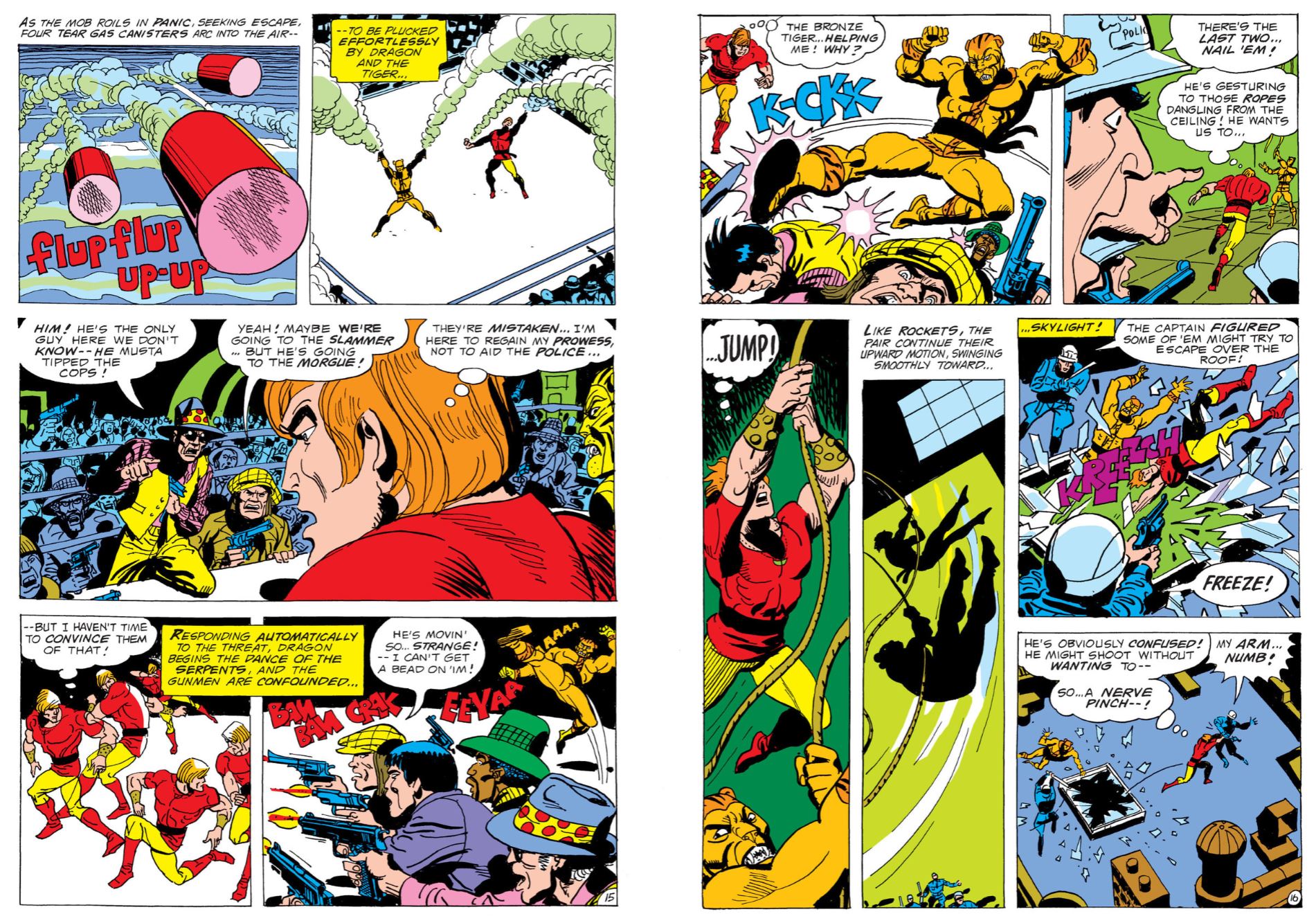
Kirby’s tried-&-trusted approach was always to pepper high concepts throughout blazing, breakneck action, and #3 was one of the most imaginative yet. ‘Reincarnators’ finds Blood back in the USA, aware at last of his tormented history, and with a small but devoted circle of friends. Adapting to a less lonely life, he soon encounters a cult able to physically regress people to a prior life… and use those time-lost beings to commit murder. The Demon #4-5 comprise one single exploit, wherein a simple witch and her macabre patron capture the reawakened, semi-divine Merlin. ‘The Creature from Beyond’ and ‘Merlin’s Word’s …Demon’s Wrath!’ introduce cute little monkey Kamara the Fear-Monster (later used with devastating effect by Alan Moore in Saga of the Swamp Thing #26-27) and features another startling “Kirby-Kritter”: Somnambula, the Dream-Beast

It seems odd in these blasé, anything goes modern times but The Demon was a deeply controversial book in its day – cited as providing the first post-Comics Code depiction of Hell, and one where problems were regularly solved with sudden, extreme violence. ‘The Howler!’ in issue #6 is a truly spooky yarn with Blood hunting a primal entity of rage and brutal terror that transforms victims into murderous lycanthropic killers, whilst #7 debuts a spiteful, malevolent young fugitive from a mystical otherplace.

‘A Witchboy!!’’ introduces Klarion and his cat-familiar Teekl – utterly evil little sociopaths in a time where all comic book politicians were honest, cops only shot to wound and “bad” kids were only misunderstood: thus, another Kirby first…

An extended epic, ‘Phantom of the Sewers’ skilfully combines movie and late-night TV horror motifs in the dark and tragic tale of actor Farley Fairfax, cursed by the witch he once spurned. Unfortunately, Glenda is the spitting image of the departed Galatea, and when, decades later, the demented thespian kidnaps her (in ‘Whatever Happened to Farley Fairfax?!!’) to raise the curse, it could only end in a flurry of destruction, death, consumed souls and ‘The Thing That Screams’…

In case you were wondering: the first musical adaption of The Phantom of the Opera (by Ken Hill) was in 1976, and the one you’re thinking of launched in 1986. The King was always ahead of the curve and subtly influential…

This 3-part thriller is followed by another moody, multi-part masterpiece (The Demon #11-13). ‘Baron von Evilstein’, ‘Rebirth of Evil!’ and ‘The Night of the Demon!’ comprise a powerful parable about worth and appearance, featuring the ultimate mad scientist and the tragic, misunderstood monster he so casually builds. It’s a truth that bears repeating: ugly doesn’t equal bad…

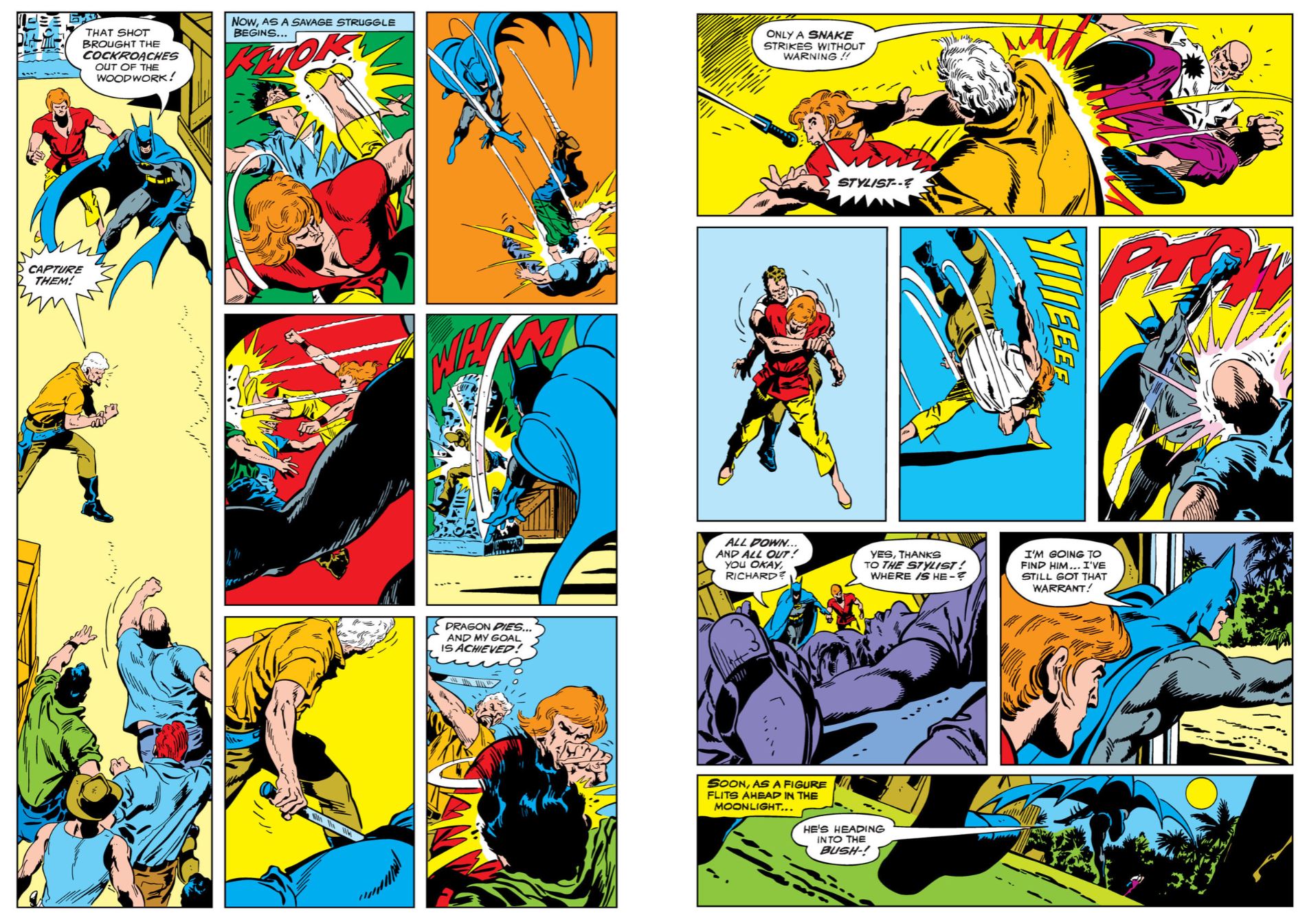
An opportunity to widen the horror-hero’s appeal came next in The Brave and the Bold #109: as Bob Haney & Jim Aparo unship superb supernatural thriller ‘Gotham Bay, Be My Grave!’ wherein the Caped Crusader and Kirby’s Kritter Etrigan the Demon fractiously unite to battle an unquiet spirit determined to avenge his own execution after nearly a century…

Despite the King’s best efforts The Demon was not a monster hit – unlike his science-fiction disaster drama Kamandi – and by #14 it’s clear the book was in its last days. Not because the sheer pace of imagination, excitement and passion diminished – far from it – but because the well-considered, mood-drenched stories were suddenly replaced by rocket-fast, eldritch romps populated with returning villains. First back was Klarion in ‘Return of the Witchboy!’ who creates a deadly doppelganger to replace Jason Blood and kill his friends in ‘The One Who Vanished!!’ (#14-15) before the series succumbed to irresistible economic forces with #16 (cover dated January 1974) in a climactic if hasty showdown with ‘Immortal Enemy’ Morgaine Le Fey…

Etrigan and cohort resurfaced in 1977 and B&B #137 (October) as Haney, John Calnan & Bob McLeod subjected Batman, Jason Blood’s friends and The Demon to war with resurrected Chinese wizard Shahn-Zi at ‘The Hour of the Serpent!’ before in a guest shot led to short revival. In Batman Family #17 (cover-dated April/May 1978), the Man-Bat serial saw Bob Rozakis & Mike Golden celebrate a happy event as the Chiropteran Crusader awaited the natal event of his firstborn child only to learn ‘There’s a Demon Born Every Minute!’ with devil babies infesting the maternity ward the hero welcomes the arrival of Etrigan (eventually) before teaming up to again thwart the diabolical schemes of malign Morgaine Le Fey.

Implicit invite accepted, Gotham resident The Demon took up residence in anthological blockbuster Detective Comics beginning with #482 (February/March 1979). Here Len Wein, Golden & Dick Giordano opened a tense quest for ‘The Eternity Book’ of Merlin. As Steve Ditko added his unique vision to the optics, the chase caught Etrigan clashing with mad mystic academic Baron Tyme in DC #483’s ‘Return to Castle Branek!’ before hurtling to a chaotic, cataclysmic conclusion in #484’s ‘Tyme Has No Secrets!’ and furious finish in #485’s ‘The Fatal Finale!’

The riotous revelries conclude with an often overlooked team-up. For Wonder Woman #280 (volume 1, June 1981), Gerry Conway, José Delbo & Dave Hunt detail how Air Force officers Diana Prince and Steve Trevor investigate the prestigious Delphi Foundation after demon Baal-Satyr abducts their friend Etta Candy. They uncover senatorial corruption and insidious infiltration by witchboy Klarion and use arcane connections to link up with Randu Singh, Blood and his infernal alter ego prior to a rescue raid on ‘The Castle Outside Time!’ (WW #281), enduring more hellish treatment prior to #282’s triumphant, resurgent ‘Return and Redemption’

With covers by Kirby, Royer, Tatjana Wood, Aparo, Rich Buckler, Ross Andru & Dick Giordano, this is a sublime slice of Right Place, Wrong Time entertainment: a wondrously economical collection every comics fan of today should have and cannot help but enjoy.
© 1972, 1973, 1977, 1978, 1979, 1981, 2026 DC Comics. All Rights Reserved.

Today comic strip master Sy Barry arrived in 1928, whilst Graham Nolan didn’t turn up until 1962 and much-missed Italian artist Massimiliano Frezzato (I custodi del Maser, Margot) in 1967.

We lost Barney Baxter cartoonist Frank Miller in 1949, and the amazing Arnold (Deadman, Doom Patrol, Guardians of the Galaxy) Drake in 2007 but could enjoy Treasure Chest comics from 1946 and Hank Ketchum’s (US) Dennis the Menace from 1951.

Batman: The Doom That Came to Gotham


By Mike Mignola, Richard Pace, Troy Nixey, Dennis Janke & Dave Stewart (DC Comics) ISBN: 978-1-4012-5806-1 (TPB/Digital edition)
This book includes Discriminatory Content produced for dramatic effect.

The origins of the Dark Knight are so well-known now that it’s simple to twist and tweak them to suit almost any tale. It doesn’t hurt that the character has a universal recognition factor that holds up in almost any imaginary scenario…

Released in 2015, available in trade paperback and digital formats and collecting a 3-issue Elseworlds miniseries (from November 2000 – January 2001), The Doom That Came to Gotham was written by horror mood-meister Mike Mignola (Hellboy; duh!) and Richard Pace (Negative Burn; Ashes; Starman; Terror Inc.; Imaginary Fiends), limned by Troy Nixey (Harley Quinn; Trout; Only the End of the World Again; The Matrix Comics), inker Dennis Janke & colourist Dave Stewart.

In case you came in late: During the 1990s, DC regrouped to rebrand its frequent dalliances with alternate reality scenarios under the copious and broad umbrella of a separate imprint. The Elseworlds banner and credo declared heroes would be taken out of their usual settings and put into strange places and times – some that have existed, or might have existed, and others that can’t, couldn’t or shouldn’t exist…

No doubts here, however, as the tale deftly takes us back to Roaring Twenties America, dishing out a daring dose of pulp fiction plumb centre of the ghastly spine-chilling mythos of Clark Ashton Smith, H.P. Lovecraft and their darkly-dementing contemporaries…

It’s 1928 and orphaned Bruce Wayne returns to Gotham City two decades after his parents were murdered by a maniac. He’s been roving the world, and recently uncovered the fate of long-lost Professor Cobblepot’s fabled Antarctic expedition. That jaunt resulted in a clash with a naked madman who talked to penguins and a large slab of ice with a creature inside it: a thing that never evolved on this world…

By the time he and his close associates Alfred, Dick, Jason and the rest have docked in his bleakly daunting home town, they have all had more than enough of the vile dreams the thing in the hold has generated…

There are more surprises when he reaches his long-shuttered mansion: a dead man who somehow speaks and a mysterious stranger named Jason Blood who claims he’s been sent to deliver a dire warning. Turning into an actual demon, the visitor warns that to save Gotham, Bruce must cut out its heart. Although shocked, Bruce is ready to act, and dons the bizarre outfit that makes him look like a human bat…

…And thus begins a skilful, macabre pastiche of classic noir horror traditions, as the desperate, driven mystery man haunts the alleys and byways of the city, testing corrupt cops, self-serving officials and outright villains – all with names most comics fans will recognise – uncovering a long-suppressed, centuries-old secret, even as literal Things From Beyond Human Comprehension and the borders of time and space congregate.

Can even a heroic Bat Man triumph against such odds and if so, at what cost…

Taking its title from H.P. Lovecraft’s 1920 novella The Doom That Came to Sarnath and inspired by August Derleth’s 1945 novel The Lurker at the Threshold (written from Lovecraft’s unfinished plot notes), the eldritch epic is complemented by a full cover gallery by Mignola and a hefty sketches & design section featuring pencilled pages by Pace (originally slated to illustrate the tale) and layouts by Nixey.

Bold, compelling, potently stylish and chilling in all the right places, The Doom That Came to Gotham is a supernatural romp to delight and impress: once read and never forgotten. Yes there’s an animated movie released in 2023, but truly that’s just gilding. This dark lily is what you must have…
2000, 2001, 2015 DC Comics. All Rights Reserved.

Today in 1920 Belgian wonder Eddy Paape (Emmanuel, Valhardi, Luc Orient, Johnny Congo) was born, with Gray Morrow (Man-Thing, Tarzan, Buck Rogers, Flash Gordon) arriving in 1934 and Alan Weiss (Warlock, Batman: the Blue, the Grey and the Bat, Steelgrip Starkey) in 1948. In 1949 Godfather of British Comics Pat Mills was born and in 1967 mangaka marvel Ai Yazaw, (Nana, I’m No Angel, Neighborhood Story, Paradise Kiss) arrived. Two years later Cully Hamner (Down, Green Lantern: Mosaic, Blue Beetle, Red) came along, but it was 1978 before Australian horror star Ben Templesmith (30 Days of Night) turned up.

Golden Age Starman Archives volumes 1 & 2

These books include Discriminatory Content produced in less enlightened times.

Golden Age Starman Archives volume 1
By Jack Burnley, Gardner Fox, Alfred Bester, Ray Burnley & various (DC Comics)
ISBN: 978-1-56389-622-4 (HB)

After the staggering, near-instant successes of Superman and Batman, National Comics/DC launched many new mystery men in efforts to capitalise on the phenomenon of superheroes, and – from our almost century-distant perspective – it’s only fair to say that by 1941 the editors had only the vaguest inkling of what they were doing.

Since newest creations The Sandman, The Spectre and Hourman were each imbued with equal investments of innovation, creativity and exposure, editorial powers-that-be were rather disappointed that these additions never took off to the same explosive degree. Publishing partner but separate editorial entity All American Comics had meanwhile generated a string of barnstorming successes like The Flash, Green Lantern, Hawkman and recent radio sensation Hop Harrigan and would imminently produce the only rival to Superman and Batman’s status when Wonder Woman debuted late in the year. Of course, AA had brilliantly “in-tune” creative/editorial prodigy Sheldon Mayer to filter all their ideas through.

Thus, when Starman launched in the April 1941 issue of Adventure Comics (relegating Sandman to a back-up role in the venerable heroic anthology), National/DC trusted in craft and quality rather than some indefinable “pizzazz” they couldn’t get a handle on. The editors were convinced the startlingly realistic, conventionally classical dramatic illustration of Hardin “Jack” Burnley would propel their newest concept to the same giddy heights of popularity as the Action Ace and Gotham Guardian.

Indeed, the strip – always magnificently drawn and indisputably one of the most beautiful of the period – was further blessed with mature and compelling scripts by Gardner Fox and Alfred Bester: compulsive and brilliant thrillers and even by today’s standards some of the very best comics ever produced.

However – according to the artist in his Foreword to this first stunning deluxe hardback collection – that was possibly the problem. Subtle, moody, slower-paced stories just didn’t have the sheer exuberance and kinetic energy of the most popular series, which all eschewed craft and discipline for spectacle and all-out action.

Happily, these days with an appreciably older and more discerning audience, Starman’s less-than-stellar career in his own time can be fully seen for the superb example of Fights ‘n’ Tights wonderment it truly is, and – in his anniversary years – cries out for a definitive archival collection… especially since his legacy descendant Stargirl was a big shot TV sensation…

This epic collection reprints the earliest astounding exploits of the Astral Avenger from Adventure Comics #61-76 (spanning April 1941- July 1942), including some of the most iconic covers of the Golden Age, by Burnley and, latterly, wonder-kids Joe Simon & Jack Kirby.

Burnley came up with the Starman concept but, as was often the case, a professional writer was assigned to flesh out and co-create the stories. In this case said scribe was the multi-talented Gardner Fox who wrote most of them. The illustrator also liberally called on the talents of his brother Dupree “Ray” Burnley as art assistant, and sister Betty as letterer to finish the episodes in sublimely cinematic style.

In those simpler times origins were far less important than today, and the moonlit magic here begins with ‘The Amazing Starman’ from #61. Cover-dated April the book hit newsstands on March 5th 1941. Happy 85th anniversary, space cowboy!

America suddenly suffers a wave of deadly electrical events! Appalled and afraid, FBI chief Woodley Allen summons his latest volunteer operative. Bored socialite Ted Knight promptly abandons his irate date Doris Lee to assume his mystery man persona, flying off to stop the deranged scientist behind all the death and destruction. Almost as an aside we learn that secret genius Knight had previously discovered a way to collect and redirect the energy of starlight through an awesome handheld device he calls a “gravity rod” and thereafter resolved to do only good with his discoveries…

The intrepid adventurer tracks diabolical Dr. Doog to his mountain fortress and spectacularly decimates the subversive Secret Brotherhood of the Electron. Next month, in #62, the Sidereal Sentinel met another deadly deranged genius who had devised a shrinking ray. It even briefly diminishes Starman before the sky warrior extinguishes ‘The Menace of the Lethal Light’, after which ‘The Adventure of the Earthquake Terror’ (#63) depicts the US attacked by foreign agent Captain Vurm, using enslaved South American tribesmen to administer his grotesque ground-shock engines. He too falls before the unstoppable cosmic power of harnessed starlight. America was still neutral at this time, but the writing was on the wall and increasingly villains sported monocles and Germanic accents…

Adventure Comics #64 pitted the Astral All-Star against a sinister mesmerist who makes men slaves in ‘The Mystery of the Men with Staring Eyes’, after which – behind a stunning proto-patriotic cover – Starman solves ‘The Mystery of the Undersea Terror’, wherein the ship-sinking League of the Octopus proves another deadly outlet for the greedy genius of The Light…

In #66 ‘The Case of the Camera Curse’ layered a dose of supernatural horror into the high-tech mix as Starman tackles a crazed photographer employing a voodoo lens to enslave and destroy his subjects, before #67’s ‘The Menace of the Invisible Raiders’ introduced the Astral Avenger’s greatest foe. Mysterious menace had The Mist devised a way to make men and machines imperceptible and would have conquered America with his unseen air force had not the Starry Knight stopped him…

Alfred Bester provides a searing patriotic yarn for #68 as ‘The Blaze of Doom’ sees Starman quenching a forest fire and uncovering a lumberjack gang intent on holding America’s Defence effort to ransom, after which Fox scripts #69’s ‘The Adventure of the Singapore Stranglers’ in which the heavenly hero stamps out a sinister cult. In actuality, the killers were sadistic saboteurs of a certain aggressive “Asiatic Empire”. American involvement in WWII was mere months away…

The martial tone continued in ‘The Adventure of the Ring of Hijackers’ as Starman battled Baron X, whose deadly minions wrecked American trains carrying munitions and supplies to embattled British convoy vessels, although a welcome change of pace came in #71 when ‘The Invaders from the Future’ strike. Brigands from Tomorrow are bad enough, but when Starman discovers one of his old enemies has recruited them, all bets are off…

For #72, an Arabian curse seems the reason explorers are dying of fright, but the ‘Case of the ‘Magic Bloodstone’’ proves to have a far more prosaic – if no less sinister – cause…

With Adventure Comics #73, Starman surrendered the cover-spot, as dynamic duo Simon & Kirby took over ailing strips Paul Kirk, Manhunter and Sandman. However, ‘The Case of the Murders in Outer Space’ proved the Knight Errant was not lacking in imagination or dynamic quality, as he matched wits with a brilliant mastermind murdering heirs to a Californian fortune by an unfathomable method before disposing of the bodies in an utterly unique manner…

Sinister science again reigned in #74 as ‘The Case of the Monstrous Animal-Men’ finds the Starlight Centurion tragically battling ghastly pawns of a maniac who turns men into beasts, whilst #75’s ‘The Case of the Luckless Liars’ details how Ted Knight’s initiation into a millionaires’ fibbing society leads to Starman becoming a hypnotised terror tool of deadly killer The Veil before this initial foray into darkness ends with a rollicking action riot as ‘The Case of the Sinister Sun’ sees cheap thugs of the Moroni Gang upgrade their act with deadly gadgets: patterning themselves after the solar system in a blazing crime blitz… until Starman eclipses them all.

Enthralling, engaging and fantastically inviting, these early Golden Age adventures are a lost highpoint of the era – even if readers of the time didn’t realise it – offering astonishing thrills and amazing chills for today’s sophisticated readership. Starman’s exploits are some of the best of those halcyon days.


Golden Age Starman Archives volume 2
By Ray Burnley, Gardner Fox, Alfred Bester, Don Cameron, Joe Samachson, Ray Burnley, Mort Meskin, George Roussos, Emil Gershwin, Sam Citron & various (DC Comics)
ISBN: 978-1-4012-2283-3 (HB)

When Starman launched in 1941 Adventure Comics National/DC trusted in craft and quality rather than some indefinable pizzazz. Before too long, though, the editors were forced to concede that even the forcefully realistic, conventionally dramatic illustration of Jack Burnley would not propel their newest concept to the same giddy heights of popularity as the Action Ace or Gotham Guardian.

The strip, always magnificently drawn and indisputably one of the most beautifully realised of the period, was further blessed with mature and compelling scripts by Gardner Fox, Alfred Bester, Don Cameron and latterly Joe Samachson but just never really caught on. However, by today’s standards these compelling, compulsive fun-filled and just plain brilliant tales are some one of the very best comics that era ever produced.

Happily these days, with an appreciably older and more discerning audience, Starman’s less-than-stellar War years career might be more fully appreciated for the superb example of Fights ‘n’ Tights fiction it truly was. This volume sees the opening subtly, moody, slow-paced intellectually edgy stories supplanted by shorter yarns brimming with sheer exuberance and kinetic energy as, with the Nazi menace beaten, home grown criminals began to congregate on comics pages…

For this second stunning deluxe hardback outing – completing the Sidereal Sentinel’s tenure in Adventure Comics (issues #77-102, spanning August 1942 to February 1946) – Golden Age guru Roy Thomas offers his own absorbing critical overview in the Foreword and the volume even includes some of the most iconic covers of the Golden Age (by Joe Simon & Jack Kirby) even though most of them only feature Starman in a little insert in one corner!

As was often the case, although Burnley came up with the concept and look for the Astral Avenger, a professional writer was assigned to flesh out and co-create the stories. At first Gardner Fox handled the job, but eventually Alfred Bester supplied the scripts, whilst the illustrator also liberally called on the talents of his brother Ray Burnley as art assistant and inker with sister Betty as letterer finishing the episodes in sublimely cinematic style.

The period peril resumes here with ‘Finders Keepers!’ by Fox & Burnley, wherein arch-nemesis The Mist combined his invisibility gimmicks with a subtle psychological scheme. When members of the public found valuable “lost property” they had no idea each item carried a posthypnotic command to surrender their own valuables to the criminal mastermind, only to become embroiled in a concatenation of increasingly dangerous stunts. Happily Starman was able to turn the repentant fool into a real hero…

Burnley bowed out in style in Adventure #80 (November 1942) in Bester’s ‘The Time-Machine Crime!’ wherein thugs used said purloined device to kidnap William Shakespeare, in hopes his canny mind could plan the perfect crime. Fox returned for another stint in #81 as the explosively kinetic Mort Meskin & George Roussos briefly took on the art. In ‘Starman’s Lucky Star!’ a poor blind boy who wanted to be an astronomer was mistakenly kidnapped instead of his wealthy playmate. Thankfully the Star Sentinel was available to put everything right, after which ‘Hitch a Wagon to the Stars’ (AC #82, Fox, Meskin & Roussos) spotlighted a brilliant young inventor whose obsession with astrology blighted his life, and nearly made him a patsy for Nazi spies… at least until Ted Knight and his alter ego intervened.

With Adventure Comics #83, Emil Gershwin became main illustrator for the series – a solid, polished artist much influenced by Mac Raboy. ‘Wish Upon a Star!’ gave him the opportunity to shine in the moving, socially-charged tale of three prep school boys whose unselfish wishes came true thanks to Starman. At this time the Astral Avenger’s page counts began to decline as his popularity dwindled – from an average of 11 to 7 or 8 – and ‘The Doom From the Skies’ reflected a growing trend towards fast-paced action as a burglar stole the Gravity Rod, leaving our hero an amnesiac and his weapon a deadly death ray, whilst #85’s ‘The Constellations of Crime!’ introduced Astra the Astrologist who used predictions as the basis of extravagantly deadly crimes…

In the next issue a disgraced sportsman pretended to undertake a lunar trip whilst equipping his gang with clever gimmicks to rob and restore his fortune as ‘The Moonman’s Muggs!’ before an element of detection fiction was added in Adventure #87 when Starman exposed a gang selling the inexplicably popular paintings of the worst artist in America as ‘Crime Paints a Picture!’ before rejoining the war-effort in #88 as the Stellar Centurion solved ‘The Enigma of the Vanishing House!’ and smashed a Nazi spy-ring. In #89 old foes the Moroni Gang broke out of jail and restarted their nefarious careers as Sun, Moon and Saturn, but ‘The Plundering Planets!’ quickly fell foul of Starman and a couple of really annoying prankster kids…

Meskin & Roussos popped back in #90 to vividly envision the anonymous thriller ‘Land Beneath the Fog!’ wherein Starman saved a lady scientist accused of witchcraft in a lost medieval kingdom, whilst in the next issue Don Cameron, Meskin & Sam Citron jointly detailed ‘The Rising Star of Johnny Teach!’ as another young man emotionally crippled by a nonsensical faith in astrology found the courage to turn his life around… after a little prompting from Starman.

With Adventure #92 Joe Samachson took over the scripting and Gershwin returned to illuminate the series until its conclusion. The run began with ‘The Three Comets!’ – circus acrobats Starman was convinced doubled as flamboyant thieves. All he had to do was find out where they stashed the loot…

In #93’s ‘Gifts from the Stars!’ the hero almost died after getting in between a squabbling scientist and a financial backer whose protracted arguments allowed robbers to blindside them both, #94’s ‘Stars Fall on Allie Bammer!’ had gangster Blackie Kohl use a meteor shower to gain entrance to an impregnable estate, and ‘The Professor Plays Safe!’ in #95 found a muddle headed astronomer at the wrong conference only to end up locked in a safe – until Starman stepped in. ‘Prediction for Plunder!’ saw Ted Knight and some superstitious crooks both ticked off at the unscrupulous editor of the Weekly Horoscope. The socialite wanted no more scary predictions worrying his nervous friends, but the thugs were actually using those specious prognostications to plan their jobs…

Adventure #97 saw impoverished stargazer Jimmy Wells agree to let wealthy Wesley Vanderloot take all the credit for his discoveries in return for direly needed cash, but his ‘Stolen Glory!’ almost cost the scientist and Starman their lives when the millionaire faced humiliating exposure, after which #98 revealed a stellar conundrum giving the hero belated insight into a bizarre crime-wave where one gang was framing another for their jewel heists in ‘Twin Stars of Crime!’0 Fame was again the spur in ‘My Fortune for a Star!’ when a destitute astronomer discovered a new star and offered to sell the naming rights to the highest bidder. Naturally whenever cash is being thrown around thieves are never far away…

By Adventure Comics #100 Starman had dropped to the back of the book and the plots were beginning to feel a little formulaic. In ‘Life and Death of a Star!’ a friend of Ted’s thought he’d discovered a new star, but upon investigation Starman found the strange light was just a clever signal to convicts planning a jailbreak, whilst in #101 ‘The Sun-Spot Scoundrel!’ featured a savant who posited that mysterious solar blemishes caused increased criminal activity even as they neutralised the mighty Gravity Rod…

It was all over in #102, although the last tale was far from a damp squib. ‘The Meteor Mob’ saw savvy mobster Shiver using a cannon to create his own shooting stars… only these ones only ever fell on banks and jewellery stores…

Despite that unwarranted fizzling out, the Golden Age Starman is a strip that truly shines today. These simple straightforward adventures should be considered a high-point of the era – even if readers of the time didn’t realise it – and his exploits are among the most neglected thrillers of those halcyon days. However modern tastes will find them far more in tune with contemporary mores, making these books unmissable delights for fans of mad science, stylish intrigue mystery, murder and crazy crime capers. Truly terrific treats but what a shame they’re out of print and not available digitally (HINT! HINT!)

© 1941, 1942, 2000 DC Comics. All Rights Reserved.
© 1942, 1943, 1944, 1945, 1946, 2009 DC Comics. All Rights Reserved.

In 1872 Canadian Joseph (Père Ladébauche) Charlebois was born, as was Jean (Iznogoud) Tabary in 1930. One year later Philémon creator Frédéric Othon Théodore Aristidès AKA “Fred” arrived.

In 2007 we lost Yvan Delporte and in 2012 Muntañola AKA Joaquim Muntañola (Josechu el Vasco, Angelina y Cristobalito, Doña Exagerancia), with inker fine artist Dave Hunt dying in 2017 on the same today, and Underground commix legend Jay (Bijou Funnies) Lynch, as well as Dutch journeyman cartoonist/illustrator Frans Meijer (Prikkel-idyllen, Klappertjes, Uzeltje) in 1962.

All the places in between (Wellness and Green Living)


By John Cei Douglas (Liminal 11)
ISBN: 978-1-912634-23-1 (PB)

These days we’re all locked up in our own heads as much as in our homes or inescapably foredoomed lives, constantly in search of solutions to ease anxiety, however we can. Here then – in timely fashion and most serendipitously – is a sublime gem in the conceptual mould of Tove Jansson, laced with oblique yet helpful ruminations on healing mindfulness and enjoyed as a voyage of genuine inner discovery.

Not only is the message calming and helpful – and delivered in beguiling imagery guaranteed to restore your weary disposition – but it also guarantees a solidly entertaining mystery journey helping to moderate your hunger for physical travel and fresh experience.

Crafted in dreamy, silent passages, All the places in between follows a pensive girl by a barren seashore as she fretfully, nervously but determinedly passes from ‘All the places we’ve been’ to ‘All the places we’re going’

On the way she meets her exact opposite and is cast ‘adrift’: occupying ‘the lighthouse’ before finding civilisation drowned and devastated. Time drags ‘between’ before isolation draws her to ‘the city’ where she finds ‘a companion’ to care for.

Eventually that temporary relationship sunders, ‘buried’ in the wreckage of the world and dwarfed by insurmountable chasms prior to a ‘tsunami’ that brings resolution of sorts as ‘the lighthouse returns’, prompting a revelatory resolution in ‘space’

Filled with delightful human moments, and not a book to summarise, but definitely one to look at and wonder over and over again, John Cei Douglas’ oneiric ramble is a calming and enticing trip we can all benefit and draw comfort from.
© 2020 John Cei Douglas. All rights reserved.

Today in 1913, Mickey Mouse Sunday strip illustrator Manuel Gonzales was born, as was British strip maestro Harry Bishop (Gun Law, Bonanza, Tarzan) in 1922. Anticipating an end to war and no need to boost morale anymore(!!) Milton Caniff’s armed services strip Male Call ended today in 1946…
Max Allen Collins (Road to Perdition, Ms. Tree, Batman, Dick Tracy) was born in 1948, and Matthew Dow Smith (Astronauts in Trouble, Doctor Who) in 1950, with Dan Mishkin (Amethyst, Princess of Gemworld, Blue Devil) turning up in 1953 and Claudio Castellini Nathan Never) arriving in 1966.
Today in 1983 Hergé left us, as did Italian Disney superstar Giovan Battista Carpi in 1999.

Bluebeard – A Feminist Fairy Tale


By Metaphrog (Papercutz)
ISBN: 978-1-5458-0412-4 (HB/Digital edition)

The power of fairy tales lies in their ability to reach every generation and impart timeless truths, usually at an age when we’re just starting to grasp how big and wide and scary the world is…

Franco-Scots couple Sandra Marrs & John Chalmers began crafting amazing, beguiling comics in 1995 with their superb series Strange Weather Lately. Garnering much praise and many awards, the duo continued elevating the status and quality of the medium through their graphic novel series starring Louis and via creative collaborations both within and outside the industry as well as through lectures around the world.

In 2015 they began updating classic fairy tales. Papercutz published The Red Shoes and Other Tales and followed up in 2017 with The Little Mermaid. Their next effort then took a jaundiced modern look at one of fiction’s earliest misogynist serial killers in Bluebeard – A Feminist Fairy Tale

Written by Chalmers and painted by Marrs in eerily enchanting, luxuriously vivid hues, the story is told from the point of view of young Eve, in the summer she turns eighteen. A child of a large but poor family, she lives in a bucolic hamlet dominated by a large castle on a high peak. This is the home of wealthy mystery man Bluebeard – a gentleman of frightful repute who engenders many unpleasant stories among the village gossips…

Eve has loved Tom for as long as she’s known him. They played in the dangerous woods and even saved and reared a fallen dove chick together. When her grandmother died, only Tom and older sister Anne could comfort her, even though her parents and brothers did their best…

The village was never really enough to support the population and hunger was common, but nothing like the time when constant rains destroyed both crops and wild foods. That’s when a liveried servant arrived with an invitation. The entire family was to enjoy the benefits of Bluebeard’s castle for a week.

It was glorious, but over far too soon, and while they were enjoying lavish hospitality father endured a discrete and unwelcome conference with the lord and was given a stark choice. In return for supplies to sustain them all, the Count required the hand in marriage of one of his daughters. Either Eve or Anne, it mattered not to him…

A quirk of chance and the denial of choice ends Eve’s dreams of life with Tom, but she fulfils her familial duty. However, her new husband is everything his reputation portends and her fate seems grim and certain, until she defies his commands and begins to chart her own course…

Charming and chilling by turns, this modern interpretation celebrates the classic tale whilst offering a more assertive, competent role for the leading ladies and will delight readers of all ages who need to know that change is possible and control is worth the effort.
© 2020 Metaphrog.

Today in 1903, Little Annie Rooney’s Darrell Craig McClure was born, as was Filipino artist Jess Jodloman in 1929 and all-star cartoonist Arnold Roth (The New Yorker, Poor Arnold’s Almanac) in 1929.

Criminologist raconteur Rick Geary first made the scene in 1946 but we lost commix star Dori Seda in 1988. In 1960 the Elongated Man debuted (in a very long-legged walk-on in Flash #112) and one year later Jack Kirby’s Sky Masters strip ended.

Lost at Sea


By Brian Lee O’Malley (Oni Press)
ISBN: 978-0-932664-16-4 (PB); 978-1-62010-113-1 (10th Anniversary Edition HB)

You’ve no doubt heard that appallingly clichéd phrase “it’s about the journey”?

Well, sometimes it actually is.

This moody, enticingly sensitive and charming not-coming-of-age road-trip argosy is by Bryan Lee O’Malley, whose Scott Pilgrim tales of an adorable boy-idol idle slacker seemed to encapsulate the tone and tenor of the last-but-one generation to have invented sex and music and growing up confused…

Lost at Sea is a lovely languid and lyrical look at a self-confessed outsider, couched in terms of a quasi-mystical mystery and rendered in an utterly captivating, boldly simple style simultaneously redolent of childhood misgivings and anticipatory tales of horror and imagination.

High School senior Raleigh is a passenger in a car slowly meandering its way back to Vancouver from California. She doesn’t really know Stephanie or the boys Dave & Ian. She only met them because dippy Stephanie never deletes any numbers from her phone and pocket-dialled her by coincidental accident, just moments after Raleigh missed her train home. She had been enduring an unfortunate visit with her dad and his latest woman near San Francisco. As the Canadian kids had a car and were heading back north, somehow, although a social misfit and practical stranger, Raleigh ended up travelling homeward with them…

Even though they all go to the same school – Sturton Academy – these kids are not really like her. They weren’t hot-housed or sent to “gifted” classes… and they still have their souls…

Raleigh lives with her mum and really misses her best friend, who she hasn’t seen in four years, six months and 24 days. Raleigh also has a secret internet boyfriend in California (the real reason for visiting Dad and his new lady) and is very confused and lonely after travelling to meet darling Stillman.

Raleigh lost her soul in Ninth Grade when her mother sold it to Satan in return for being successful, but the girl can’t quite remember why it was put into a cat. Ever since then, cats seem to crop up everywhere she goes, even following her, and she can’t tell if she’s crazy or imagining it all.

Naturally, Raleigh is violently allergic to cats…

However, when she finally loosens up and tells Stephanie her satanic secret, the boisterous wild child admits to seeing them too and suggests they should catch them and see if they can be made to cough up that stolen soul. Dave & Ian are game too…

Expressionistic, impressionistic, existential, self-absorbed, vastly compassionate, deeply introspective and phenomenally evocative of that monstrous ball of confusion that is the End of Adolescence, Lost at Sea is a graphic marvel which seems, from my admittedly far-distant perspective, the perfect description of that so-human rite of passage we all endured and mostly survived.

There was a 10th Anniversary edition, but as far as I can tell no digital edition (yet) but that’s still plenty to be going on with, right? Buy it for your teenagers, read it to rekindle your own memories and cherish it because it’s wonderful.

™ & © 2002, 2003, 2005, 2008 Bryan Lee O’Malley. All Rights Reserved.

Today in 1948, Doug Moench (Batman, Moon Knight, Planet of The Apes, Shang Chi, Master of Kung Fu) was born and we lost the amazing, under-adored Don Heck (Iron Man, Avengers, Batgirl, everybody) in 1995. Reading-wise, 1913 saw the launch of Gus Mager’s Hawkshaw the Detective in 1913, Marge’s Little Lulu in 1935 and Britain’s Lion weekly in 1952. It was also the last episode of Makoto Yukimura’s Planetes in 2004.

The Phantom – The Complete Series: The King Years


By Bill Harris, Dick Wood, Pat Fortunato, & Bill Lignante, Giovanni Fiorentini & Senio Pratesi & various (Hermes Press)
ISBN: 978-1-61345-009-3 (HB/Digital edition)

This book includes Discriminatory Content produced in less enlightened times. This book also contains Discriminatory Content included for dramatic effect.

In the 17th century a British sailor survived attack by pirates, and, washing ashore in Africa, swore on the skull of his murdered father to dedicate his life and that of all his descendants to destroying all pirates and criminals. The Phantom fights crime and injustice from a lavish lair deep in the jungles of Bengali, and throughout Africa is known as the “Ghost Who Walks”.

This unchanging appearance and unswerving quest for justice led to him being considered an immortal avenger by the credulous and the wicked. Down the decades one hero after another has fought and died in an unbroken family line, and the latest wearer of the mask, indistinguishable from the first, continues the never-ending battle…

Lee Falk created the Jungle Avenger at the request of his syndicate employers who were already making history, public headway and loads of money with his first strip sensation Mandrake the Magician. Although technically not the first ever costumed hero in comics, The Phantom was the prototype paladin: wearing a skin-tight body-stocking and a mask with opaque eye-slits.

He debuted on February 17th 1936 (Happy 90th anniversary… and a bit!!) in an extended sequence pitting him against a global confederation of pirates dubbed the Singh Brotherhood. Falk wrote and drew the daily strip for the first fortnight before handing over the illustration side to artist Ray Moore. A Sunday feature began in May 1939.

For such a successful, long-lived and influential series, in terms of compendia or graphic novel collections, The Phantom has been very poorly served by the English language market. Various small companies have tried to collect the strips – one of the longest continually running adventure serials in publishing history – but in no systematic or chronological order and never with any sustained success. But, even if it were only of historical value (or just printed for Australians, who have long been manic devotees of the implacable champion) surely Kit Walker is worthy of a definitive chronological compendium series?

Happily, his comic book adventures have fared slightly better – at least in recent times. Between 1966 and 1967 King Features Syndicate dabbled with a comic book line of their biggest stars – Blondie, Popeye, Beetle Bailey, Flash Gordon, Mandrake & The Phantom – developed after the Ghost Who Walks had enjoyed a solo-starring vehicle under the broad and effective aegis of veteran licensed properties publisher Gold Key Comics.

The Phantom was no stranger to funnybooks, having been featured since the Golden Age in titles such as Feature Book and Harvey Hits, but only as straight reformatted strip reprints. The Gold Key exploits were tailored to a big page and a young readership, a model King maintained for their own run.

This superb full-cover hardcover – or eBook for the modern minded – gathers the contents of The Phantom #19-28 (originally released between November 1966 and December 1967) as well as four back-up vignettes from Mandrake #1-4, spanning September 1966 to January 1967. Following fascinating Introduction ‘The Phantom, the King Years’ from fans and scholars Pete Klaus and Howard S. Gesbeck (which includes splendid unseen art and candid photos) the procession of classic wonders resumes.

As with the Gold Key issues, the majority of the stories were scripted by Bill Harris or Dick Wood and (re)drawn in comic book format by Bill Lignante, with covers by or based on images from the daily strip as limned by Sy Barry.

Opening the King archive is a fabulously wry romp as a coterie of crooks inveigles their way into the Phantom’s jungle home, intent on stealing ‘The Treasure of the Skull Cave’. Over the centuries the Ghost Who Walks has amassed the most fantastic hoard of legendary loot and astounding artefacts, but the trio of crooks can’t agree on what is or isn’t valuable and soon pay the price for their folly and genocidal intent…

Issue #19 tapped into the global excitement as America neared its first manned moonshots with ‘The Astronaut and the Pirates’ finding the Phantom hunting seagoing brigands who abduct and ransom an American spaceman after his off-course splashdown lands him in very hot water…

The issue’s second tale relies on more traditional themes with ‘The Masked Emissary’ intervening in a civil war; protecting an ousted democratic leader from a tyrannical despot, until liberty can be restored to the people. The Phantom #20 (cover dated January 1967) led with a bold departure from tradition. Scripted by Pat Fortunato ‘The Adventures of the Girl Phantom’ delved into the meticulous family chronicles to reveal how, a few generations previously, the feisty twin sister of the Ghost Who currently Walked took her brother’s place to police the jungles of Bengali after he was laid low. Counterpointing that radical drama is a moody mad science thriller as the current masked marvel battles old enemy Dr. Krazz and aliens from the Earth’s interior in ‘The Invisible Demon’

In #21, ‘The Treasure of Bengali Bay’ finds The Phantom battling bandits employing their own fake ghost to secure sunken loot, after which grudge-bearing Indian Prince Taran lures our hero to the subcontinent as fodder for specially trained animal assassin ‘The Terror Tiger’. Then full-length drama ‘The Secret of Magic Mountain’ pits the Immortal Avenger against sly shaman Tuluck who mixes misconceived ancient history and a freshly-active volcano to turn local tribes against The Phantom, whilst in #23 merciless pirate ‘Delilah’ takes the place of a Peace Corps worker to get lethally close to the guardian of the jungle.

However, her devious wiles, brainwashing techniques and super-submarine prove of little use against the dauntless and implacable Ghost Who Walks…

Girl Phantom Julie steals the show again in #24 as she and faithful friend Maru challenge the forces of darkness to defeat a vicious manipulator in ‘The Riddle of the Witch’

Writer Giovanni Fiorentini and illustrator Senio Pratesi tackle #25 as the modern hero and famous athlete and sportswoman/prospective bride Diana Palmer frustrate slave-taking diamond smugglers intent on subjugating ‘The Cold Fire Worshippers’ before issue #26 marks a return to double story instalments.

Lignante’s ‘The Lost City of Yiango’ sees the Phantom compelled to solve a 50-year-old mystery and prevent a resurgence of tribal warfare, after which he answers a desperate plea to safeguard an irreplaceable treasure and goes undercover to thwart ‘The Pearl Raiders’

The Phantom #27 reveals the origins of the African Avenger’s wonder-horse as ‘The Story of Hero’ discloses how he once rescued kidnapped Princess Melonie of Kabora and how – following ‘The Long Trip Home’ – he was thanked with a most marvellous equine gift…

The Phantom’s King chronicles concluded in #28 ‘Diana’s Deadly Tour’ as the celebrity embarks on a global exhibition jaunt and is targeted by ruthless spies. Not only must her enigmatic paramour keep her safe but also solve the bewildering mystery of why they keep trying to kill her…

Wrapping up the issue is an ultra-short yarn as a frustrated world champion boxer hunts the Ghost Who Walks determined to prove who’s the toughest guy in ‘The Big Fight’

As previously mentioned the Phantom guested in vignettes in Mandrake #1-4. Those ‘Back-Up Stories’ round out the comics cavalcade here beginning with ‘SOS Phantom’ as the Guardian Ghost responds to secret drum signals to quell an outbreak of fever, before ‘SOS Phantom: The Pirate Raiders’ finds him answering similar “threat tomtoms” to tackle and terrify superstitious coastal raiders…

Those self-same drums are crucial in thwarting a murderous criminal mastermind intent on penning the Phantom in ‘The Magic Ivory Cage’ and the flurry of little epics ends with another outing for ‘The Girl Phantom’ who here outwits a brutal strongman whose brawn and belligerence are no match for a cool head…

Sprinkled liberally with original art, unused cover designs for never-printed issues #29 and 30, examples from foreign editions and a wealth of original art pages by Jim Aparo (from forthcoming volume The Phantom: The Complete Series: The Charlton Years: volume 1) this is another nostalgia drenched triumph: straightforward, captivating rollicking action-adventure that has always been the staple of comics fiction. If that sounds like a good time to you, this is a traditional action-fest you can’t afford to miss.
The Phantom® © 1966-1967 and 2012 King Features Syndicate, Inc. ® Hearst Holdings, Inc. Reprinted with permission. All rights reserved.

Today in 1917, master comic illustrator Reed Crandall was born, with animator/artist Pete Alvarado (Roy Rogers, Chip ‘n Dale, Scamp, Tweety & Sylvester, Road Runner, Yogi Bear, Andy Panda) arriving in 1920. Underground commix raconteur Rand Holmes was born in 1942, and Cliff Chiang in 1974.

John Carter of Mars strip artist John Coleman Burroughs died today in 1979, and in 1990 so did South African cartoon legend icon T.O. Honiball (Oom Kaspaas), followed in 2007 by cartoonist Irwin Caplan, creator of The Saturday Evening Post series Famous Last Words.