
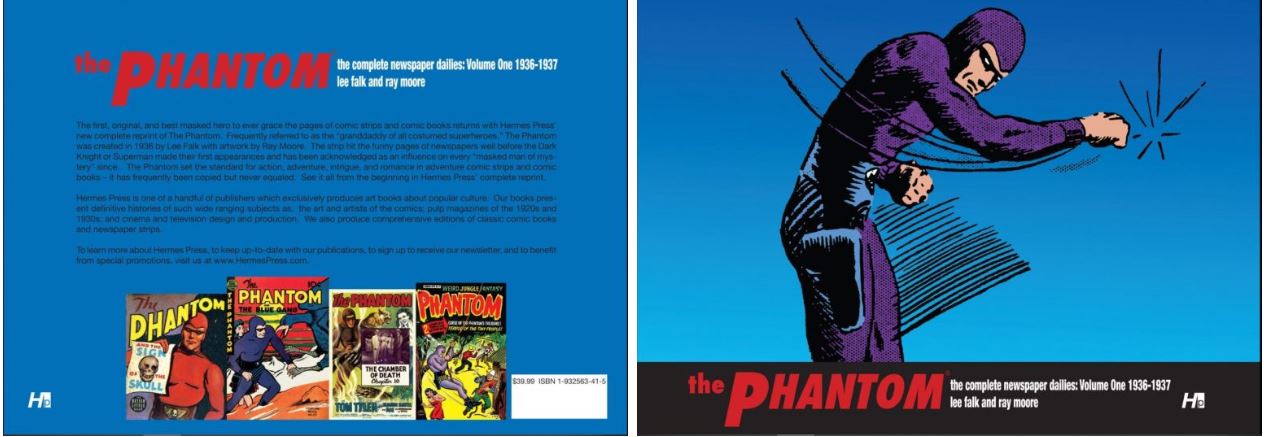
By Lee Falk & Ray Moore: introduction by Ron Goulart (Hermes Press)
ISBN: 978-1-932563-41-5 (HB/Digital edition)
This book includes Discriminatory Content produced in less enlightened times.
There are plenty of comics-significant anniversaries this year, and this guy is probably right at the top of the birthday cake. As next month sees his 90th anniversary here’s tasty reminder of why he is considered one of our industry’s landmark figures.
For such a long-lived, influential series, in terms of compendia or graphic novel collections, The Phantom has been very poorly served by the English language market (except in Australia where he has always been accorded the status of a pop culture god). Numerous companies have sought to collect the strips – one of the longest continually running adventure serials in publishing history – but in no systematic or chronological order and never with any sustained success. At least the former issue began to be rectified with this initial curated collection from Archival specialists Hermes Press. This particular edition is a lovely large hardback (albeit also available in digital formats), printed in landscape format, displaying two days strip per page in black & white with ancillary features and articles in dazzling colour where required.
Born Leon Harrison Gross, Lee Falk created the Jungle Avenger at the request of his King Features Syndicate employers who were already making history, public headway and loads of money with his first strip sensation Mandrake the Magician. Although technically not the first ever costumed champion in comics, The Phantom’s instant popularity made him the prototype paladin as he was the first to wear a skin-tight body-stocking and have a mask with opaque eye-slits…
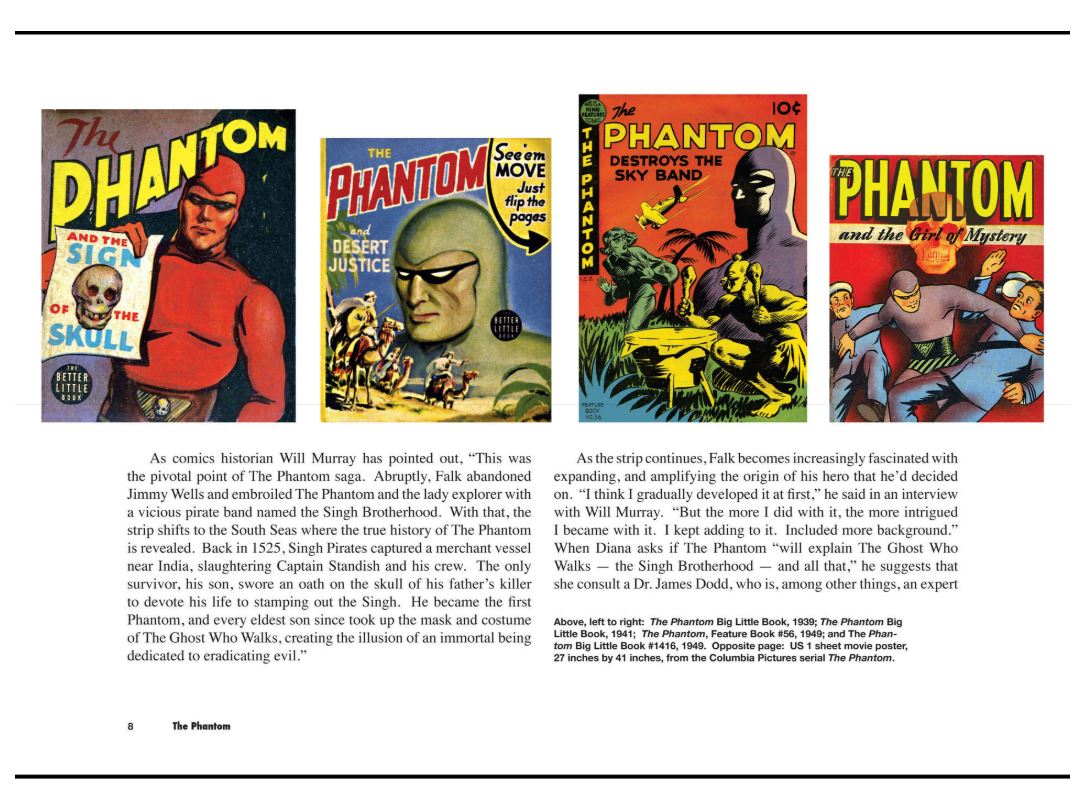
“The Ghost Who Walks” debuted on February 17th 1936 in an extended sequence pitting him against an ancient global confederation of pirates. Falk wrote and drew the daily strip for the first two weeks before handing over illustration to artist Ray Moore. A spectacular and hugely influential Sunday feature began in May 1939. In a text feature stuffed with sumptuous visual goodies like movie posters; covers for comics, Feature and Little Big Books plus many kinds of merchandise, Ron Goulart’s eruditely enticing ‘Introduction: Enter the Ghost Who Walks’ tells all you need to know about the character’s creation before the vintage magic begins with ‘Chapter 1: The Singh Brotherhood’.
American adventurer Diane Palmer returns to the USA by sea, carrying a most valuable secret making her the target of mobsters, sleazy society ne’er-do-wells and exotic cultists. Thankfully, she seems to have also attracted an enigmatic guardian angel who calls himself the Phantom…
Successive attacks and assaults endanger the dashing debutante, and she learns an ancient brotherhood of ruthless piratical thieves wants her secret, but that they have been opposed for centuries by one man. Kidnapped and held hostage at the bottom of the sea, Diana is saved by the mystery man who naturally falls in love and eventually shares an incredible history with her…
In the 17th century a British sailor survived an attack by pirates, and – washing ashore on the African coast – swore on the skull of his murdered father to dedicate his life and that of his descendants to destroying all pirates and criminals. The Phantom fights crime and injustice from a base deep in the jungles of Bengali, and throughout Africa is known as the Ghost Who Walks. His unchanging appearance and unswerving war against injustice have led to him being considered an immortal avenger by the credulous and the wicked. Down the decades, one hero after another has fought and died in an unbroken family line, and the latest wearer of the mask, indistinguishable from the first, continues the never-ending battle. And he’s looking to extend the line and the legend…
In the meantime, however, there’s the slight problem of Emperor of Evil Kabai Singh and his superstitious armies to deal with…
‘Chapter 2: The Sky Band’ (originally published from 9th November 1936 to April 10th 1937) finds the mystery avenger caught in love’s old game as a potential rival for Diana’s affections materialises in the rather stuffy form of career soldier Captain Meville Horton: a decent, honourable man who sadly knows when he’s outmatched, unwanted and in the way. Mistakenly determined to do the right thing too, our masked mystery man concentrates on destroying a squadron of thieving aviators targeting the burgeoning sky clipper trade: airborne bandits raiding passenger planes and airships throughout the orient. Initial efforts infuriatingly lead to the Phantom’s arrest: implicated in the sky pirates’ crimes, before escaping from police custody with the aid of his devoted “pygmy witch doctor” Guran and faithful Bandar tribe allies, he’s soon hot on the trail of the real mastermind…
Upon infiltrating their base, he discovers the airborne brigands are all women, and that his manly charms have driven a lethal wedge between the deadly commander and her ambitious second in command Sala…
A patient plaything of the manic Baroness, The Phantom eventually turns the tide not by force but by batting his invisible eyes and exerting his masculine wiles upon the hot-blooded – if certifiably psychopathic – harridan, unaware until too late that his own beloved, true-blue Diana is watching. When she then sets a trap for the Sky Band, it triggers civil war in the gang, a brutal clash with the British army and the seeming end of our hero, triggering Diana’s despondent decision to return alone to America…

‘Chapter 3: The Diamond Hunters’ opened on April 12th 1936 and revealed how the best laid plans can go awry. In Llongo territory, white prospectors Smiley and Hill unearth rich diamond fields but cannot convince or induce local tribes to grant them mineral rights to the gems they consider worthless. Like most indigenous Africans, they’re content to live comfortably under the “Phantom’s Peace” and it takes all the miners’ guile – including kidnapping a neighbouring chief’s daughter and framing the Llongo; gunrunning and claiming the Ghost Who Walks has died – to set the contented residents at each other’s throats. Recovering from wounds, the Phantom is slow to act, but when he does his actions are decisive and unforgettable…
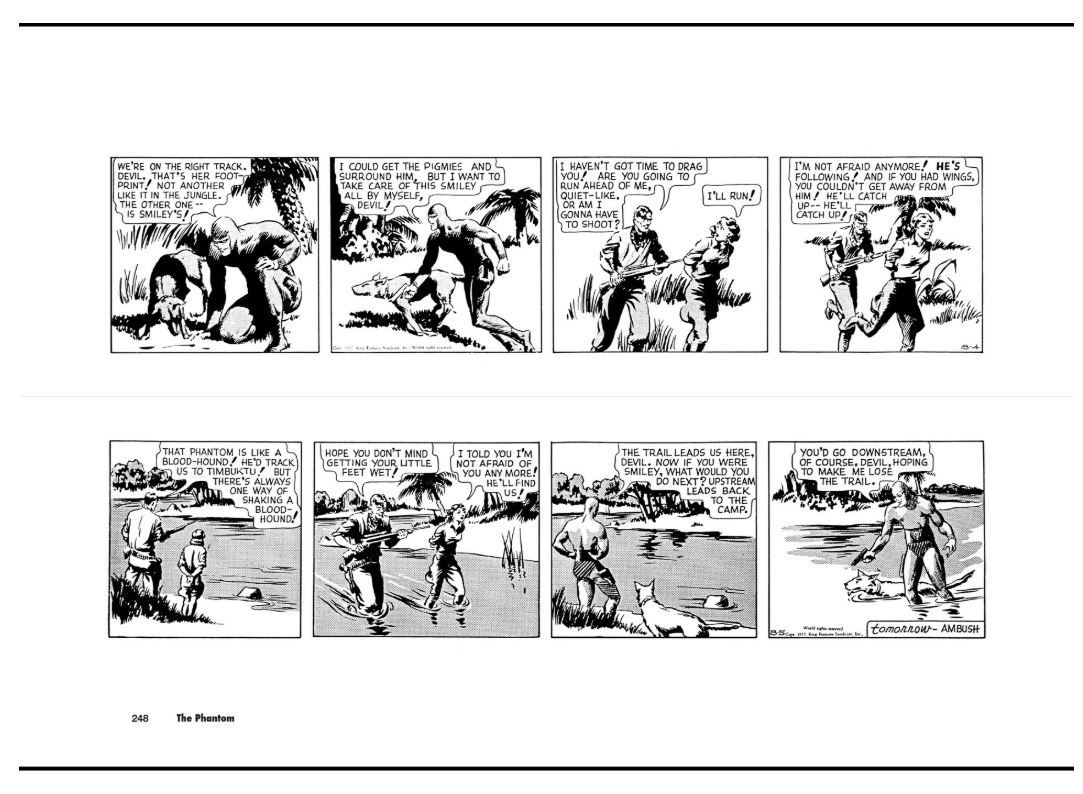
With the plot foiled and peace restored, Smiley flees, only to encounter a returned Diana who has acted on news that her man still lives. Seeing a chance for revenge and profit, Smiley kidnaps “the Phantom’s girl”, provoking his being shunned by all who live in the region, a deadly pursuit and spectacular last-minute rescue. Smiley’s biggest and last mistake is reaching the coast and joining up with a band of seagoing pirates…
At least he is the catalyst for Diana and The Ghost finally addressing their romantic issues…
To Be Continued…
‘Afterword: For Those Who Came in Late…’ then sees editor Ed Rhoades offer his own thoughts on the strip’s achievements and accomplishments.
Stuffed with chases, assorted fights, torture, blood & thunder antics, daredevil stunts and many a misapprehension and coincidence – police and government authorities clearly having a hard time believing a pistol-packing masked man with a pet wolf might not be a bad egg – this a pure enthralling excitement that still packs a punch and plenty of sly laughs.
© 2010 King Features Syndicate, Inc.: ® Hearst Holdings, Inc.; reprinted with permission. All rights reserved.
Today in 1907, astounding illustrator Bruno (Doom Patrol, Teen Titans) Premiani was born, as was artist and inker Chic (Nemesis, Batman, all the best 1960s Thor, X-Men and FF stories) Stone in 1923.
In 1975 Archie co-creator Bob Montana died; and the day is infamous in the UK as the last day Buster was published. Kidding. Nobody noticed because we’d all stopped buying it. We are really sorry now though…