

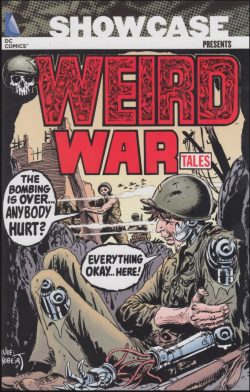
By Robert Kanigher, Bob Haney, Bill Finger, Sheldon Mayer, Jack Oleck, Len Wein, Marv Wolfman, Joe Kubert, Carmine Infantino, Dennis O’Neil, Russ Heath, Mort Drucker, Frank Thorne, Alex Toth, Reed Crandall, Sam Glanzman, John Severin, Howard Chaykin, Ed Davis, Frank Robbins, Nestor Redondo, George Evans, Alex Niño, Russ Heath, Neal Adams & various (DC Comics)
ISBN: 978-1-4012-3694-6 (TPB)
This book includes Discriminatory Content produced in less enlightened times.
American comics just idled along rather slowly until the invention of Superman provided a flamboyant new genre for heroes and subsequently unleashed a torrent of creative imitation and imaginative generation for a suddenly thriving, voracious new entertainment model.
Implacably vested in World War II, these gaudily-attired mystery men swept all before them until the troops came home, but as the decade closed more traditional themes and heroes began to resurface and eventually supplant the Fights ‘n’ Tights crowd.
As a new generation of kids started buying and collecting, many of the first fans who retained their four-colour habit increasingly sought more mature themes in their pictorial reading matter. The war years and post-war paranoia had irrevocably altered the psychological landscape of the readership and as a more world-weary, cynical young public came to see that all the fighting and dying hadn’t really changed anything. Their chosen forms of entertainment (film, theatre and prose as well as comics) increasingly reflected this.
To balance the return of Western, War, Crime and imminent Atomic Armageddon-fuelled Science Fiction, comics created new genres. Celebrity tie-ins, madcap escapist or teen-oriented comedy and anthropomorphic funny animal features sprang up, but gradually another of the cyclical revivals of spiritualism and a public fascination with the arcane led to a wave of impressive, evocative and shockingly addictive horror comics. There had been grisly, gory and supernatural stars before, including a pantheon of ghosts, monsters and wizards draped in superhero trappings but these had usually been victims of circumstance: The Unknown as a power source for super-heroics. Now focus shifted to ordinary mortals thrown into a world beyond their ken with the intention of unsettling, not vicariously empowering the reader.
If we’re keeping score this was also the period in which Joe Simon & Jack Kirby identified another “mature market” gap and filled it by inventing romance comics (Young Romance #1, September 1947) and they too saw the sales potential for spooky material, resulting in the seminal Black Magic (1950) and boldly obscure psychological drama anthology Strange World of Your Dreams (1952). The company which would become DC Comics bowed to the inevitable and launched a comparatively strait-laced anthology that nevertheless became one of their longest-running and most influential titles with The House of Mystery (cover-dated December 1951/January 1952).
After the hysterical censorship debate which led to witch-hunting Senate hearings in the early 1950s was curtailed by the industry adopting a castrating straitjacket of self-regulation, titles produced under the aegis of the Comics Code Authority were sanitised, anodyne affairs in terms of Shock and Gore, but the audience’s appetite for suspense was still high and in 1956 National introduced sister titles Tales of the Unexpected and House of Secrets. Stories were dialled back from uncanny spooky yarns to marvellously illustrated, rationalistic fantasy-adventure vehicles and – eventually – straight monster-busting Sci Fi tales which dominated the market into the 1960s. That’s when superheroes – which had gradually enjoyed their own visionary revival after Julius Schwartz reintroduced The Flash in Showcase #4 – finally overtook them.
Green Lantern, Hawkman, The Atom and a rapidly-expanding coterie of costumed cavorters generated a gaudy global bubble of masked mavens which forced previously staunchly uncompromising anthology suspense titles to become super-character books. When caped crusader craziness peaked and popped, superheroes began dropping like Kryptonite-gassed flies. However, nothing combats censorship better than falling profits and, at the end of the 1960s with the cape-and-cowl boom over and some of the industry’s most prestigious series circling the drain, the surviving publishers of the field agreed to revise the Comics Code, loosening their self-imposed restraints against crime and horror comics.
Nobody much cared about gangster titles but, as the liberalisation coincided with yet another bump in public interest concerning supernatural themes, the resurrection of scary stories was a foregone conclusion and obvious no-brainer.
Thus, with absolutely no fanfare at all, horror comics came back and quickly dominated the US market for more than half a decade. DC led the pack: converting House of Mystery and Tales of the Unexpected into supernatural suspense anthologies in 1968 and resurrecting House of Secrets a year later.
Such was not the case with war comics. Tales of ordinary guys in combat began with the industry itself and although mostly sidelined during the capes-&-cowls war years, quickly re-asserted themselves once the actual fighting stopped. National/DC were one of the last publishers to get in on the combat act, converting superhero/fantasy adventure anthology Star Spangled Comics into Star Spangled War Stories the same month it launched Our Army at War (both cover-dated August 1952). They repurposed All-American Comics into All-American Men of War a month later as a “police action” in Korea escalated.
DC grew the division slowly but steadily, launching Our Fighting Forces (#1, November 1954) – just as EC’s groundbreaking combat comics were vanishing – and in 1957 added GI Combat to their portfolio when Quality Comics got out of the funnybook business.
As the 1950s closed however, the two-fisted anthologies all began incorporating recurring characters such as Gunner and Sarge – and latterly Pooch – from Our Fighting Forces #45 on, (May 1959); Sgt Rock (Our Army at War #83 (June 1959) and The Haunted Tank (G.I. Combat #87, April/May 1961). Soon all DC war titles had a lead star or feature to hold the fickle readers’ attention. The drive to produce superior material never wavered however, hugely aided by the diligent and meticulous ministrations of writer/editor Robert Kanigher.
In America after the demise of EC Comics in the mid-1950’s and prior to the game-changing Blazing Combat, the only certain place to find controversial, challenging and entertaining American war comics was DC. In fact, even whilst Archie Goodwin’s stunning but tragically mis-marketed quartet of classics were waking up a new generation of readers in the 1960s, the home of Superman, Batman and Wonder Woman was a veritable cornucopia of gritty, intriguing, beautifully limned battle tales presenting armed combat on a variety of fronts and from many differing points of view.
Whilst the Vietnam War escalated, 1960s America increasingly endured a Homefront death-struggle pitting deeply-ingrained Establishment social attitudes against a youth-oriented generation with a radical new sensibility. In response, military-themed comic books from National Periodical Publishing, as it then was, became even more bold and innovative.
However, the sudden downturn in superheroes led to some serious rethinking, and although the war titles maintained and even built sales, they also beefed up the anthological elements.
Thus in 1971 a title combining supernatural horror stories with bombastic battle yarns in an anthological setting seemed a forgone conclusion and sure thing to both publishers and readers alike…
This epic monochrome tome collects the contents of Weird War Stories #1-21 (cover-dates September/October 1971 to January 1974), offering a broad blend of genre mash-ups for readers with a taste for the dark and uncanny to relish. The series launched in a 52-page format combining new material with modified reprints featuring a veritable Who’s Who of top flight creative talent – both seasoned veterans and stars in waiting.
WWS #1 saw Editor Joe Kubert writing and illustrating an eerie linking strand entitled ‘Let Me Tell You of the Things I’ve Seen’, wherein a lost GI meets the personification of Death (the title’s long-term narrator in various blood-stained uniforms) who has a few foxhole stories to share…
The Reaper begins with ‘Fort Which Did Not Return!’ (by Kanigher & Russ Heath, as first seen in GI Combat #86), detailing how a bomber continues its mission even after the crew bail out, following up with all-new ‘The Story behind the Cover’ wherein Kubert reveals how a shunned German soldier carried on his duties after death…
From Star Spangled War Stories #71 (July 1958) Bob Haney & Kubert disclosed ‘The End of the Sea Wolf!’, as a sadistic U-Boat captain is sunk by one of his own earlier victims, whilst SSWS #116 (August/September 1964) originally debuted France Herron & Irv Novick’s ‘Baker’s Dozen’, with a fresh-faced replacement to a super-superstitious platoon battling to prove he’s not their unlucky thirteenth man…
The issue ends with that lost GI realising just who has been telling tales in Kubert’s ‘You Must Go!’…
The reprints in these early issues were all taken from a time when supernatural themes were proscribed by the Comics Code Authority, but even so they all held fast to an eerie aura of sinister uncertainty… the merest hint of the strange and uncanny to leaven the usual blood and thunder of battle books. In Weird War Tales #2, Kubert reprised his bridging vehicle as ‘Look… and Listen…’ sees a crashed Stuka pilot meeting a ghastly stranger at a battle-torn desert oasis before ‘Reef of No Return’ (Haney & Mort Drucker from Our Fighting Forces #43, March 1959) details a determined frogman’s most dangerous mission in advance of Kanigher & Frank Thorne’s new WWI silent saga ‘The Moon is the Murderer’ proving that overwhelming firepower isn’t everything…
Kubert’s ‘Behind the Cover’ features a prophetic dream and terrifying telegram, and ‘A Promise to Joe!’ (Kanigher & Novick, G.I. Combat #97 (December 1962-January 1963) sees a dead gunner seemingly save his friend from beyond the grave, after which the superb ‘Monsieur Gravedigger’ – by Jerry DeFuccio & legendary Reed Crandall – follows the follies of a sadistic Foreign Legionnaire who pushes his comrades too far. Cartoonist John Costanza delivers gag-packed ‘Military Madness’ and Kubert & Sam Glanzman offer a fact-packed ‘Sgt. Rock’s Battle Stations’ about ‘The Grenadier’ before Bill Finger, Ross Andru & Mike Esposito examine a young recruit’s rite of passage and development of ‘The Face of a Fighter’ (Our Fighting Forces #25, September 1957) before ‘Oasis’ concludes the sorry saga of that downed Aryan airman.
American Naval Aviators ditching at sea were the unwilling audience for Death’s stories as WWT #3 opens with Kubert’s ‘Listen…’ The roster starts with ‘Been Here Before!’ (Finger, Andru & Esposito, G.I. Combat #44 January 1957) as a soldier under fire turns his mind back to boyhood games to save the day, after which we see an aerial battle and parachute drop from the perspective of ‘The Cloud That Went to War!’ (Our Fighting Forces #17, January 1957) courtesy of Dave Wood, Andru & Esposito.
More Costanza comedy from ‘The Kreepy Korps!’ precedes an early tale by Len Wein & Marv Wolfman, ably illustrated by Heath as both cave tribes and modern soldiers battle to possess ‘The Pool’, before the artist’s earlier collaboration with Bob Haney reveals how ‘Combat Size!’ is all a matter of mental attitude in a tale from Our Army at War #66 (January 1958). After Glanzman’s ‘Battle Album’ explains ‘Flying Guns’, a finny friend helps a US submarine sink an aircraft carrier in Finger & Drucker’s ‘Pilot for a Sub!’ (OAaW #68, March 1958) and the issue ends as Kubert sends a ‘Lifeboat’ for those tragic aviators…
The fourth issue opens with Kubert’s final linking tale as a ‘Gypsy Girl’ and her family find wounded soldier Tony after his buddy runs off to get a medic. They kindly offer to pass the time with him, sharing stories like ‘Ghost Ship of Two Wars’ (Kanigher & Novick, All-American Men of War #81, September 1960) wherein an obsessed WWI pilot seemingly slips into 1944 while pursuing his unbeatable archenemy the Black Ace.
Kanigher & Gene Colan’s ‘Time Warp’ originally appeared as ‘The Dinosaur Who Ate Torpedoes!’ in SSWS #123 (October/November 1965 and part of the uniquely bizarre War That Time Forgot series), pitting US frogmen against colossal sea-going saurians, after which ‘The Unknown Sentinel’ (by author unknown & Mort Meskin from House of Mystery #55, October 1956) saves the lives of two soldiers lost on manoeuvres on America’s most famous battlefield.
Glanzman then offers one of his magnificently engaging autobiographical USS Stevens vignettes with all-new, elegiac ‘Prelude’ before Kubert wraps up his chilling drama as ‘I Know Them to be True’ sees medics arriving to find Tony a much-changed man, leaving Costanza to close things down with a laugh and some ‘Military Madness’.
Weird War Tales #5 opens with Haney & Alex Toth providing a book-end tale of ‘The Prisoner’ held by Nazis in Italy. Seeking a way out, he recalls tales of escape such as ‘The Toy Jet!’ (Haney & Heath, All-American Men of War#78, March/April 1960): a chilling psychological thriller about an interned pilot in North Korea. It’s followed by ‘Human Trigger’ (Herron, Andru & Esposito, Star Spangled War Stories #18, February 1954) which shows how a soldier lying on a mine deftly saves his own life…
Herron & Carmine Infantino then reveal how an US spy is forced to ‘Face a Firing Squad!’ (SSWS #14, November 1953) and Norman Maurer instructs with the history of ‘Medal of Honour: Corporal Gerry Kisters’ before Willi Franz & Heath detail the victory of a ‘Slave’ in Roman times and Haney & Toth offer final release in ‘This Is It!’
Issue #6 saw Weird War cut to a standard 36-page package and take a step into tomorrow with Haney & Toth’s battlefield test of ‘Robots’. Wolfman & Frank Thorne expanded the theme in ‘Pawns’ as humans and mechanoids finally decide who works for whom whilst ‘Goliath of the Western Front!’ (Herron, Andru & Esposito, SSWS #93 – October/November 1960) features a giant mechanical Nazi and American David who finally does for him, before Haney & Toth settle all debate with the conclusive ‘Robot Fightin’ Men’…
Wolfman & Kubert provide thematic bookends for #7, beginning with ‘Out of Action’ and wounded GIs awaiting the worst by trading tales like William Woolfolk, Jerry Grandenetti & Joe Giella’s ‘Flying Blind’ (OAaW #12, July 1953) wherein a wounded pilot must trust someone else for the first time in his life if he wants to land his burning jet. Kanigher & Kubert’s ‘The 50-50 War!’ (A-AMW #41, January 1957) finds sporting rivals forced to help each other after both suffer injuries on an alpine mission, with Costanza adding more welcome levity through his ‘Military Hall of Fame’. ‘The Three GIs’ (Finger & Heath, SSWS #62, October 1957) riffs smartly on those monkeys who respectively can’t see, hear and speak and the Purple Heart yarns end with Wolfman & Kubert’s chilling ‘I Can’t See’…
From WWT #8, editorial control switched to the Mystery division under Joe Orlando and with that reprints were shelved in favour of original material as publication frequency graduated from six times a year to monthly. This all-German-focused issue begins with a gruesome ‘Guide to No-Man’s Land’ (probably written by assistant editor E. Nelson Bridwell and illustrated by Tony DeZuñiga) before moving on to ‘The Avenging Grave’ (Kanigher & DeZuñiga) with SS officers learning too late the folly of desecrating the dead of WWI. Anonymously scripted ‘Thou Shalt Not Kill!’– with art by Steve Harper & Neal Adams – sees more gloating Nazis facing a vengeful golem. Kanigher & DeZuñiga return to reveal the fate of an arrogant 1916 air ace in the skies over No-Man’s Land in ‘Duel of the Dead’ before the artist’s ‘Epilogue’ wraps things up, whilst Weird War Tales #9 invites us to ‘Enter the Portals of War’ in an introduction drawn by Howard Chaykin, swiftly followed by a trio of Kanigher yarns illustrated by the cream of DC’s Filipino artists.
‘The Promise’ was limned by Alfredo P. Alcala, telling a tale in two eras as both Teutonic knights in 1242 and German tankers seven centuries later fail to cross frozen Lake Chud, whilst Gerry Talaoc renders the disastrous end of deathly, determined ‘Blood Brothers!’ during the American Civil War, and incomparable Alex Niño details ‘The Last Battle’ between East and West before Chaykin pops back to declare ‘Death, the Ultimate Winner’.
Sheldon Mayer & Toth open WWT #10 with a deliciously whimsical ghostly love story in ‘Who is Haunting the Haunted Chateau?’ before Raymond Marais & Quico Redondo change the tone as a Death-Camp commandant returns after the war to salvage ill-gotten gains from ‘The Room that Remembered’, whilst Wein & Walter Simonson – in the artist’s pro comics debut – reveal why invading Nazis shouldn’t abuse the town idiot, incurring the wrath of ‘Cyrano’s Army’…
Always experimental, the creative team of Mayer, DeZuñiga, Alcala, Talaoc & Niño tried their hand at a time-twisting complete adventure for #11. Occurring on ‘October 30? over 99 years beginning in 1918, the tale compares the progress of an ambitious German General granted a wish for glory by a treacherous spirit of war, with three ghostly Americans determined to fix a long-standing mistake whatever the cost…
DeZuñiga draws the introduction to #12, featuring tales of ‘Egypt’ starting with Kanigher & Talaoc’s tale of an ancient warlord who learned to regret spitting on the ‘God of Vengeance’, whilst ‘Hand of Hell’ (Kanigher & DeZuñiga) sees Anubis similarly deal with one of Rommel’s least reputable, most sadistic deputies. Arnold Drake & Don Perlin then switch locales to Roman Britain where a centurion takes an accidental time-trip and ultimately overthrows the Druids in ‘The Warrior and the Witch-Doctors!’
Weird War Tales #13 opens with Oleck & Nestor Redondo’s ‘The Die-Hards’, with Nazis realising there are even worse killers than they haunting their latest conquered village, before Drake & Niño determine that ‘Old Samurai Never Die’ when a would-be shogun offends the patron spirit of Bushido. ‘Loser’s Luck’ – by Michael J. Pellowski, George Kashdan & DeZuñiga – details harsh choices facing the unfortunate winners of the next, last war…
Mayer, DeZuñiga & Alcala reunite in #14 to tell an eerie tale of doomed love and military injustice from the days before Pearl Harbor which begins with a ‘Dream of Disaster’, incorporates a deadly flight with a ‘Phantom for a Co-Pilot’ and marines who arrive ‘Too Late for the Death March!’ before finally meeting ‘The Ghost of McBride’s Woman’ and vindicating an unsung hero…
A little lad enamoured of war’s glory learns a lesson in WWT #15 when his dead grandfather takes him back to WWI to see how ‘…Ace King Just Flew in from Hell’ (Drake & Perlin) before Oleck & Talaoc reveal the doom of ‘The Survivor’ of a Viking raid which offends a sorceress, and Oleck & Alcala detail the shocking fate of a fanatical crusader who succumbs to ‘The Ultimate Weapon’ of a Saracen wise man. Drake & Alcala describe transplant science gone mad in #16’s ‘More Dead than Alive!’, whilst the first of a Niño double bill sees him delineate Oleck’s ‘The Conquerors’ who eradicate humanity – but not the things that predate on them – whilst Drake’s ‘Evil Eye’ sees a little boy inflict hell’s wrath on both Allies and Axis alike…
In #17, Kanigher & George Evans disclose how a dishonourable French Air Ace is punished by ‘Dead Man’s Hands’ before Pellowski, E. Nelson Bridwell & Ernie Chan reveal how a murdered soldier is avenged by ‘A Gun Named Marie!’ WWT #18 has Drake & DeZuñiga sketch the brief career of ‘Captain Dracula!’ as he marauds through (mostly) German forces in Sicily before Mayer & Talaoc return for the cautionary tale of a greedy German sergeant in France whose avarice makes him easy prey for the ‘Whim of a Phantom!’
Drake & Talaoc start #19 with the full-length story of an agent who infiltrates the Nazi terror weapon known as ‘The Platoon That Wouldn’t Die!’, and #20 reverts to short stories with Oleck & Perlin’s ‘Death Watch’ of a doomed coward who should have waited one more day before deserting, before Drake & Alcala’s period saga of a witchcraft vendetta ‘Operation: Voodoo!’ and their Battle of Britain chiller wherein a burned-out fighter pilot learns ‘Death is a Green Man’.
This blockbusting blend of military mayhem, magical melee and martial madness concludes with Weird War Tales #21 and ‘One Hour to Kill!’ by Drake & Frank Robbins, wherein an American soldier is ordered to go back in time to assassinate Leonardo Da Vinci and prevent the invention of automatic weapons. Mayer & Bernard Baily then detail just how a foul-up GI becomes an unstoppable hero ‘When Death Took a Hand’…
Classily chilling, emotionally intense, superbly illustrated, insanely addictive and Just Plain Fun, this is a deliciously guilty pleasure that will astound and delight any lover of fantasy fiction and comics that work on plot invention rather than character compulsion.
© 1971, 1972, 1973, 2012 DC Comics. All Rights Reserved.
Today in 1937 Herman creator Jim Unger was born, whilst in 1967, pioneering Golden Age artist Homer Fleming (Craig Kennedy, The Whip, Chuck Dawson, Captain Jim of the Texas Rangers, Classics Illustrated) died.
Also in 1967, British weeklies Pow! and Mandy both launched, as did tabloid treasure The Beezer way back in 1956 today.