
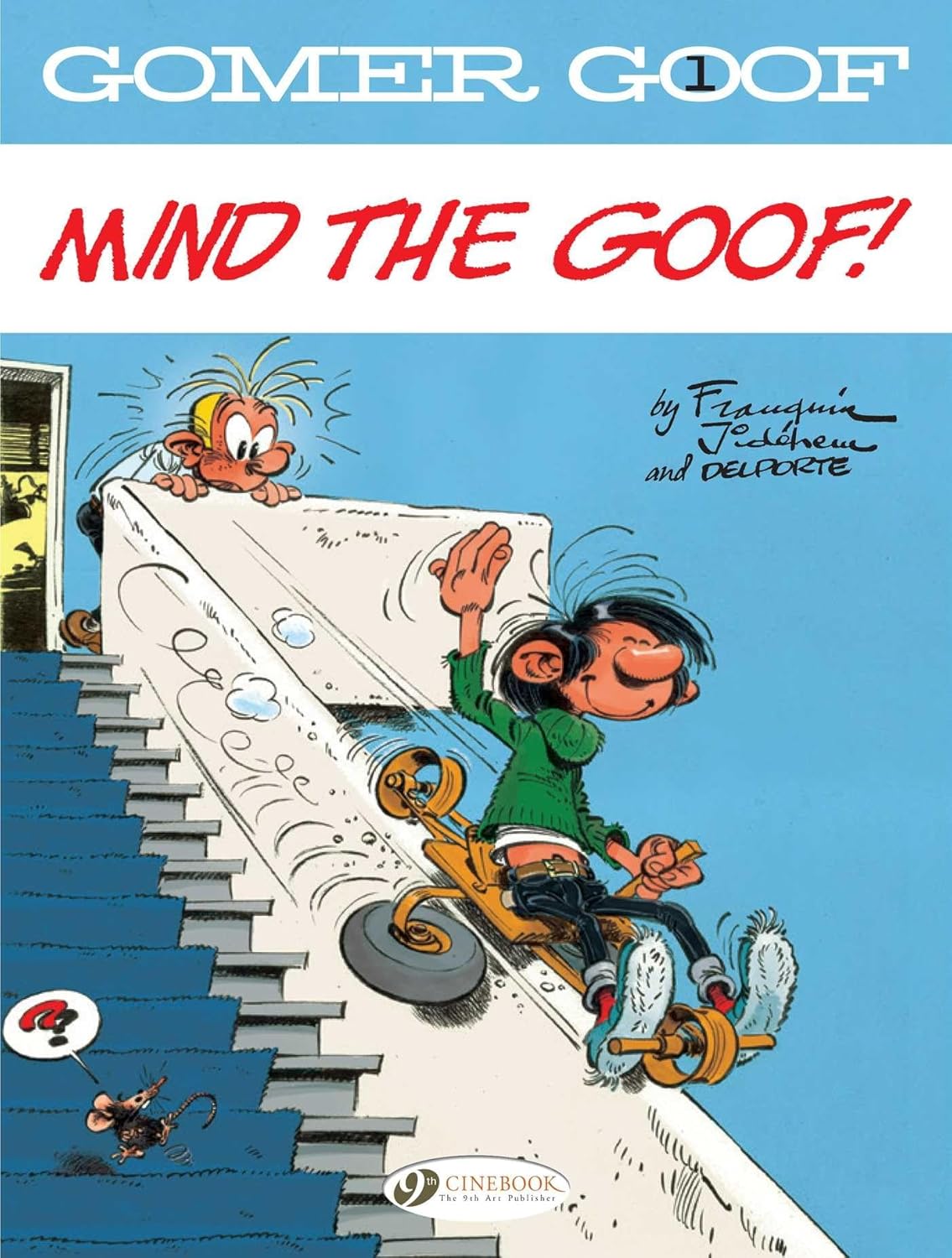
By André Franquin, Delporte & Jidéhem: translated by Jerome Saincantin (Cinebook)
ISBN: 978-1-84918-358-1 (Album TPB/digital edition)
This book includes Discriminatory Content produced during less enlightened times and some used for dramatic and comedic effect.
Born in Etterbeek, Belgium on January 3rd 1924, André Franquin began his astounding career in the golden age of European cartooning. In 1946, as assistant to Joseph “Jijé” Gillain on top strip Spirou, he inherited sole control of the keynote feature, and creating countless unforgettable characters like Fantasio and The Marsupilami. Over two decades Franquin made the strip purely his, expanding its scope and horizons, as co-stars Spirou & Fantasio – with hairy Greek Chorus Spip the squirrel – became globetrotting troubleshooters visiting exotic places, exposing crimes, exploring the incredible and clashing with bizarre, eccentric arch-enemies. Throughout all that, Fantasio remained a full-fledged – albeit entirely fictional – reporter for Le Journal de Spirou, popping back to base between assignments. Regrettably, ensconced there like a splinter under a fingernail was an arrogant, accident-prone office junior. He was Gaston Lagaffe; Franquin’s other immortal – or peut-être unkillable? – conception…
There’s a hoary tradition of comics personalising fictitiously back-office creatives and the arcane processes they indulge in, whether it’s Marvel’s Bullpen or DC Thomson’s lugubrious Editor and underlings at The Beano and Dandy; it’s a truly international practise. Somehow though, after debuting in LJdS #985 (February 28th 1957), the affable dimwit grew – like one of his own monstrous DIY projects – beyond all control. Whether guesting in Spirou’s sagas or his own strips/faux reports for the editorial pages, Lagaffe became one of the most popular and ubiquitous components of the comic he was supposed to paste up.
In initial cameos or occasional asides on text pages, well-meaning foul-up and ostensible studio gofer Gaston lurked and lounged amidst a crowd of diligent toilers until the workshy slacker employed as a general assistant at LJdS’s head office became a solid immovable fixture. Ultimately the scruffy bit-player shambled into his own star feature…
In terms of schtick and delivery, older readers will recognise favourite beats and elements of well-intentioned helpfulness wedded to irrepressible self-delusion as seen in Benny Hill or Jacques Tati vehicles and recognise recurring riffs from Only Fools and Horses and Mr Bean. It’s blunt-force slapstick, using paralysing puns, fantastic ingenuity and inspired invention to mug smugness, puncture pomposity, lampoon the status quoi? (and that’s British punning, see?) and ensure no good deed goes noticed, rewarded or unpunished…
As previously stated, Gaston/Gomer can be seen (if you’re very quick or extremely patient) toiling at Le Journal de Spirou’s editorial offices. At first he reported to Fantasio, but as pressure of work took the hero away, the Goof instead complicated the lives of office manager Léon Prunelle and other harassed and bewildered staffers, all whilst effectively ignoring any tasks he’s paid to actually handle. These notionally include page paste-up, posting packages, filing, clean-up, collecting stuff inbound from off-site and editing readers’ letters – the reason why fans’ requests/suggestions are never acknowledged or answered…
Gomer is lazy, hyperkinetic, opinionated, ever-ravenous, impetuous, underfed, forgetful and eternally hungry: a passionate sports fan, self-proclaimed musician maestro and animal lover whose most manic moments all stem from cutting work corners, stashing or consuming contraband nosh in the office or inventing the Next Big Thing. This situation leads to constant clashes with colleagues and draws in notionally unaffiliated bystanders like increasingly manic traffic cop Longsnoot and fireman Captain Morwater, plus ordinary passers-by who should know by now to keep away from this street.
Through it all, the obtuse office oaf remains affable, easy-going and incorrigible. Only three questions matter: why everyone keeps giving him one last chance, what does gentle, lovelorn Miss Jeanne see in the self-opinionated idiot, and will perpetually-outraged and accidentally abused capitalist financier De Mesmaeker ever get his perennial, pestiferous contracts signed?
If you’re old, new to this and yet experiencing a dose of déjà vu, it might be because the big idiot appeared in a 1970s Thunderbirds annual, rechristened Cranky Franky. Perhaps they should have kept the original title…
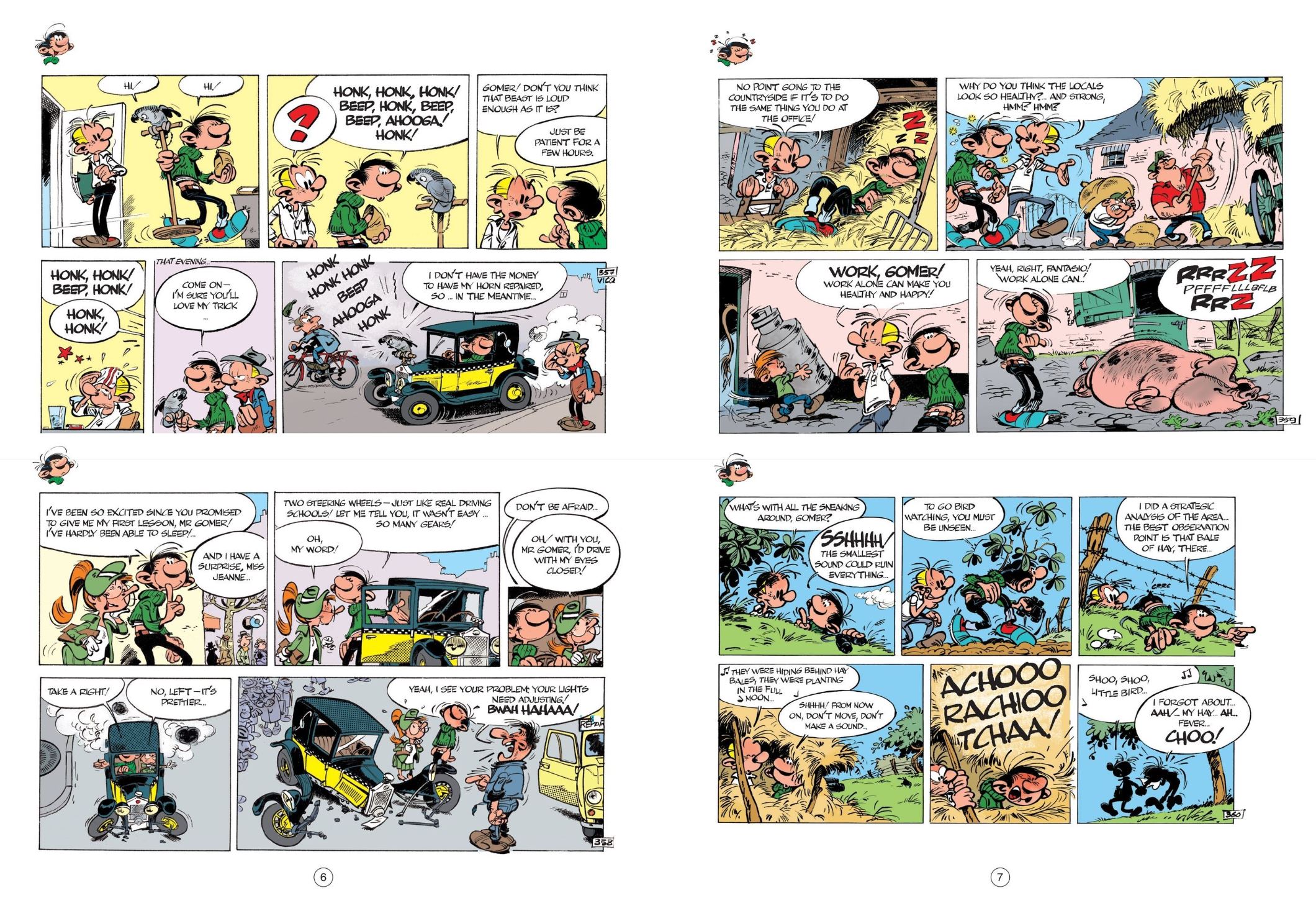
This premier compilation consists of half-page shorts and comedic text story “reports” from the LJdS’s editorial page before ultimately unleashing full episodes of madcap buffoonery. As previously stated Gomer is employed (let’s not dignify his position by calling it “work”) at the Spirou offices, reporting to go-getting Fantasio and foolishly left in charge of minor design jobs like paste-up and reading readers’ letters and general dogs-bodying. He’s lazy, opinionated, forgetful and eternally hungry. Many of his most catastrophic actions revolve around cutting corners and caching illicit food in the office…
Following 26 short, sharp two-tier gag episodes – involving Gomer’s office innovations, his hunt for food, assorted pets and livestock, sporting snafus and his appallingly decrepit and dilapidated Fiat 509 auto(barely)mobile – the first of numerous prose vignettes ‘On the Line’ exposes the fool’s many delusional attempts to become an inventor. Other text forays – punctuated by more pint-sized gag-strips – follow. These comedy briefs include ‘More Than One String to his Bow’, ‘Police Report’, ‘Open Letter to Mr De Mesmaeker’ (Jean De Mesmaeker being the real name of collaborator and background artist Jidéhem and taken for the self-important businessman who became Gomer’s ultimate foil), ‘Winter Stalactites’, ‘Red vs Blue’, ‘Noise Pollution’, ‘Presence of Mind’, ‘Gomer’s stethoscope’, ‘The Firebug Fireman’, ‘Gas-powered bicycle’ and ‘Definitely-not-surreptitious advertising’.
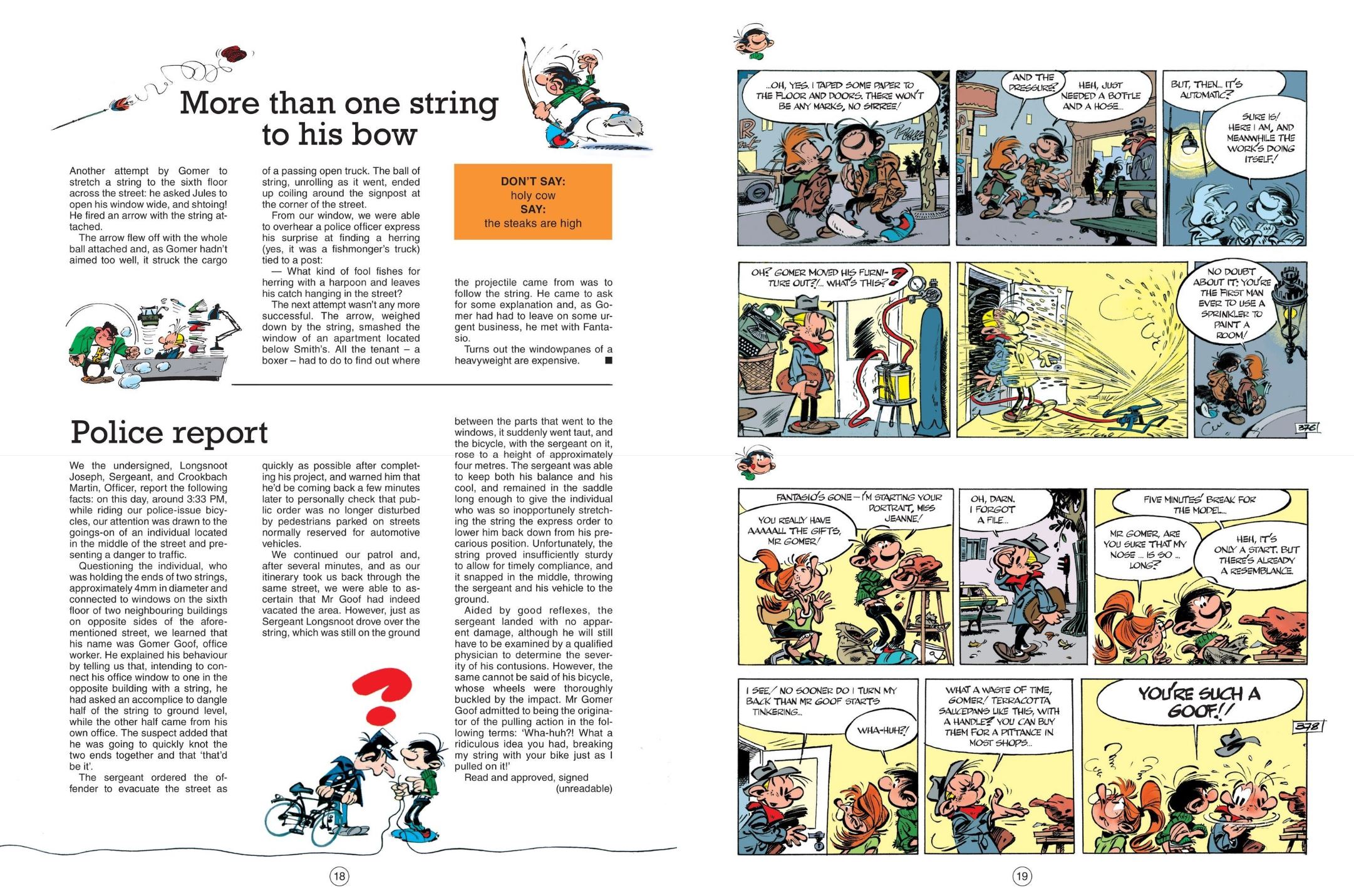
The print then gives way to a long-running procession of half-page strips with our editorial idiot causing a cataclysm of cartoon chaos.
Further prose pieces slip into extended continuity when Fantasio embargoes all canned food (potentially explosive and always a bio-hazard) and Gomer applies all his dubious ingenuity to beating the ban in ‘The tin wars’, ‘Ticking tin bombs’, ‘Diary of a War correspondent’ and ‘Blockade’ before one final strip flurry brings the hilarity to temporary pause…
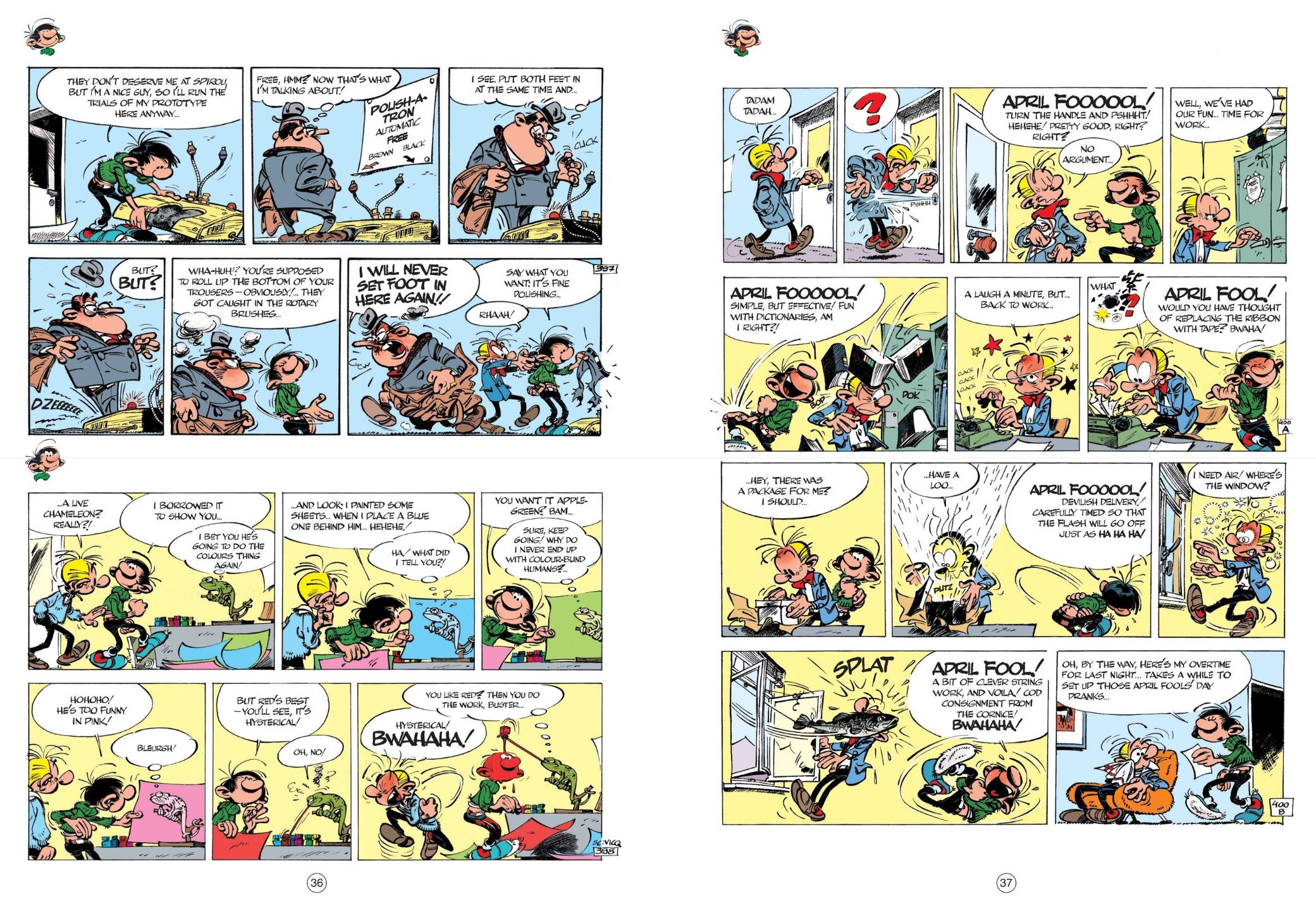
Far better enjoyed than précised or described, these strips allowed Franquin, fellow scenarist Yvan Delporte and Jidéhem to flex their whimsical muscles and subversively sneak in some satirical support for their political beliefs in pacifism and environmentalism, but at their core remain supreme examples of all-ages comedy: wholesome, barbed, daft and incrementally funnier with every re-reading.
So why not start now?
© Dupuis, Dargaud-Lombard s.a. 2017 by Franquin. All rights reserved. English translation © 2017 Cinebook Ltd.
Today in 1907, comic strip god Milton Caniff was born, as was – in 1913 – John Carter of Mars illustrator John Coleman Burroughs. Ditto Japanese teacher/political cartoonist Taizo Yokoyama (Pu-san, Eheh) in1917. Reading wise, André Franquin’s Gaston Lagaffe debuted in 1957.
If there was a February 29th this year, tomorrow we’d be commemorating the birth of Italian superstar Paolo Eleuteri Serpieri (Druuna) in 1944 and the launch of Bil Keane’s The Family Circus in 1960… but we don’t so we ain’t.