
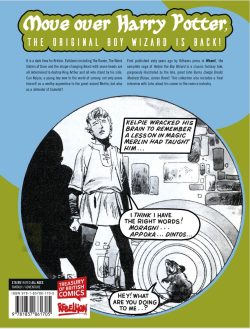
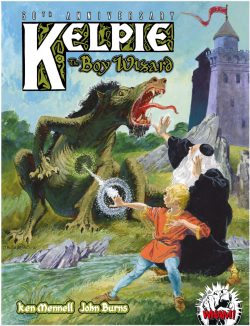
By Ken Mennell & John M. Burns, Keith Chapman & various (Rebellion)
ISBN: 978-1-83786-170-5 (HB), 978-1837865024 (Digital edition)
This book includes Discriminatory Content produced during less enlightened times.
Win’s Christmas Gift Recommendation: Because it’s Ancient and Magical …9/10
Growing up a comic fan in 1960s-1970s Britain was an oddly schizophrenic situation. Not only were we bombarded and enthralled by our own weirdly eclectic mix of TV stars, Dying Empire jingoism and military bluster, as well as fantastic anti-establishment fantasy, science-fiction, detective and sport yarns (all augmented by the inspired, madcap anarchy of gag strips that always accompanied such adventure serials in our anthology weeklies) but from 1959 on, we also had unfettered access to exotic worlds and thinly veiled cultural imperialism of actual US comic books. These were bulk-imported as ballast in cargo ships and readily available in glorious full colour from Lands’ End to John O’Groats, far more so than the Australian iterations of licensed reprints of Superman, Superboy, Aquaman, Tomahawk and select others that occasionally washed up on our dreary shores courtesy of K.G. Murray & Co. or home-generated by British publishers/printers like Len Miller and Alan Class…
As if that wasn’t enough, they were soon increasingly included in some of the more inventive weekly anthologies generated by UK publishers. These were all at that time facing a monumental rise in production costs and declining sales and needed desperately to draw in new readers…
When comics genius Leo Baxendale quit Scots publishing powerhouse DC Thomson (where he had created The Bash Street Kids, Little Plum, The Three Bears, Minnie the Minx and more) he was hired by ascendant editor Alf Wallace to create a humour competitor to The Beano for the “Juveniles” line of London-based Odhams Press. The result was Wham! which ran for 187 weeks from June 20th 1964 to January 13th 1968, whereupon it merged with sister-paper Pow!
Baxendale delivered “a racy and anarchic new breed” of comedy comic which promptly led to companion papers Smash! and Pow! and eventually a subdivision imprint dubbed “Power Comics”. This venture soon added Fantastic! and Terrific! to the exclamatory excitement and rode that aforementioned wave of Marvel reprints until the end of the decade.
Invoking bizarre humour, painful puns, and surreal plots, Baxendale instigated a new kind of comics experience and created a host of cartoon classics for the three titles. These included The Man from B.U.N.G.L.E.; The Tiddlers; The Swots and the Blots; Eagle Eye, Junior Spy; Georgie’s Germs; Danny Dare; Grimly Feendish; Bad Penny; Footsie the Clown; General Nitt and his Barmy Army; Sam’s Spook and Pest of the West, but it was impossible to totally escape tradition and the anarchic avalanche was soundly balanced by a good old fashioned, palate-cleansing adventure strip which lasted until that wave of Marvel reprints ousted British action for American bombast. In Wham! #112 (August 6th 1966) that meant the arrival of The Fantastic Four… supplementing already in play features Spider-Man, The Hulk and Sgt Fury in Pow! and Smash!…
When Wham! launched in 1964, the editors included a traditional UK-centric adventure feature about an apprentice magician set in the days of Camelot. Packed with knights and ogres and wild beasts, Kelpie the Boy Wizard was conceived and written by screenwriter, veteran editorial all-star and prolific comics scripter Ken Mennell (Cursitor Doom, Steel Claw, The Spider and many more), and trusted to master illustrator John M. Burns.
Born in Essex in 1938, Burns became an international star of comics but is still largely unsung in his own country; which, considering the sheer breadth and quality of his output, is possibly the greatest compliment I can pay him. Britain has always been painfully ignorant of its comics heroes.
From 1954, Burns apprenticed at Doris White’s Link Studios before moving on to mega-concern Amalgamated Press where he worked on “Young Juvenile” titles such as Junior Express, Girl’s Crystal and School Friend before graduating to the luxurious photogravure mainstream comic Express Weekly a year later.
For his National Service (we used to conscript our young men for two years’ military training in those hazy Cold War days – just in case…) where he served with the RAF in Singapore. He returned to comics in 1961, adapting Wuthering Heights for DC Thomson’s Diana and drawing Kelpie for AP’s successor Odhams’ in revolutionary weekly Wham! Spreading himself far and wide, Burns followed Ron Embleton on Wrath of the Gods in Boy’s World and Eagle (scripted by Michael Moorcock – now there’s a strip crying out for collection), as well as The Fists of Danny Pike, Dolebusters and Roving Reporter.
Burns was part of the inimitable, beloved and revere artists’ stable working on licensed Gerry Anderson titles TV Century 21 and its sister magazines. He was particularly impressive on Space Family Robinson in Lady Penelope. From 1965, he graduated to newspapers, beginning with The Tuckwells in The Sunday Citizen; The Seekers for The Daily Sketch (1966-1971); The Evening News’ Danielle (1973-74); George and Lynne (1977-1984) and The Royals – the official strip biography of Prince Charles & Diana Spencer (1981) in The Sun. He also too-briefly illustrated Modesty Blaise in The Evening Standard. You can see for yourself by picking up Modesty Blaise: Yellowstone Booty…
Burns revived and worked on the legendary strip Jane for the Daily Mirror (1985-1989) and intermittently worked on many others. He was chosen to conclude Jim Edgar & Tony Weare’s incredible, immaculate long-running western Matt Marriot in 1977.
Burns’ TV-related work is magnificent. He worked with scripter Angus Allan on licensed series for Look-In, TV Action and Countdown, illuminating adventures of UFO, Mission Impossible, The Tomorrow People, Bionic Woman, How the West Was Won and many more. For Germany, he drew the strip Julia (also known as Lilli) and worked with Martin Lodewijk on fantasy series Zetari before in 1980 beginning his long association with British science fiction icon 2000AD, where he has worked on Judge Dredd (from 1991), Trueno, Nikolai Dante and his own contemporary thriller series Bendatti Vendetta.
He was a regular adaptor of significant literary masterpieces, having already completed pictorial versions of Lorna Doone, Wuthering Heights and Jane Eyre. He retired in October 2023 and died on December 29th of that year. His last work Nightmare, New York was posthumously published in 2000 AD in 2024.
In the extended weekly serials re-presented here we find 26-year old illustrator Burns just approaching his mastery after ten years in the business, conscientiously co-crafting warm, thrilling, powerful yet broadly humorous action romps rendered with relative realism to counterpoint the wild eccentric energy and excess of Baxendale inventions as well as the contributions of his gag cartoonist confreres Gordon Hogg, Gordon Dave Jenner, Brian Lewis and others.
Realised in monochrome pen-&-ink line, moody grey-tone & wash episodes, the drama opens eponymously with ‘Kelpie the Boy Wizard’ – an extended epic spanning 20th June – 5th September 1964, that follows compelling and informative introduction ‘John Burns: Kelpie’ – an interview conducted by Karl Stock in 2023.
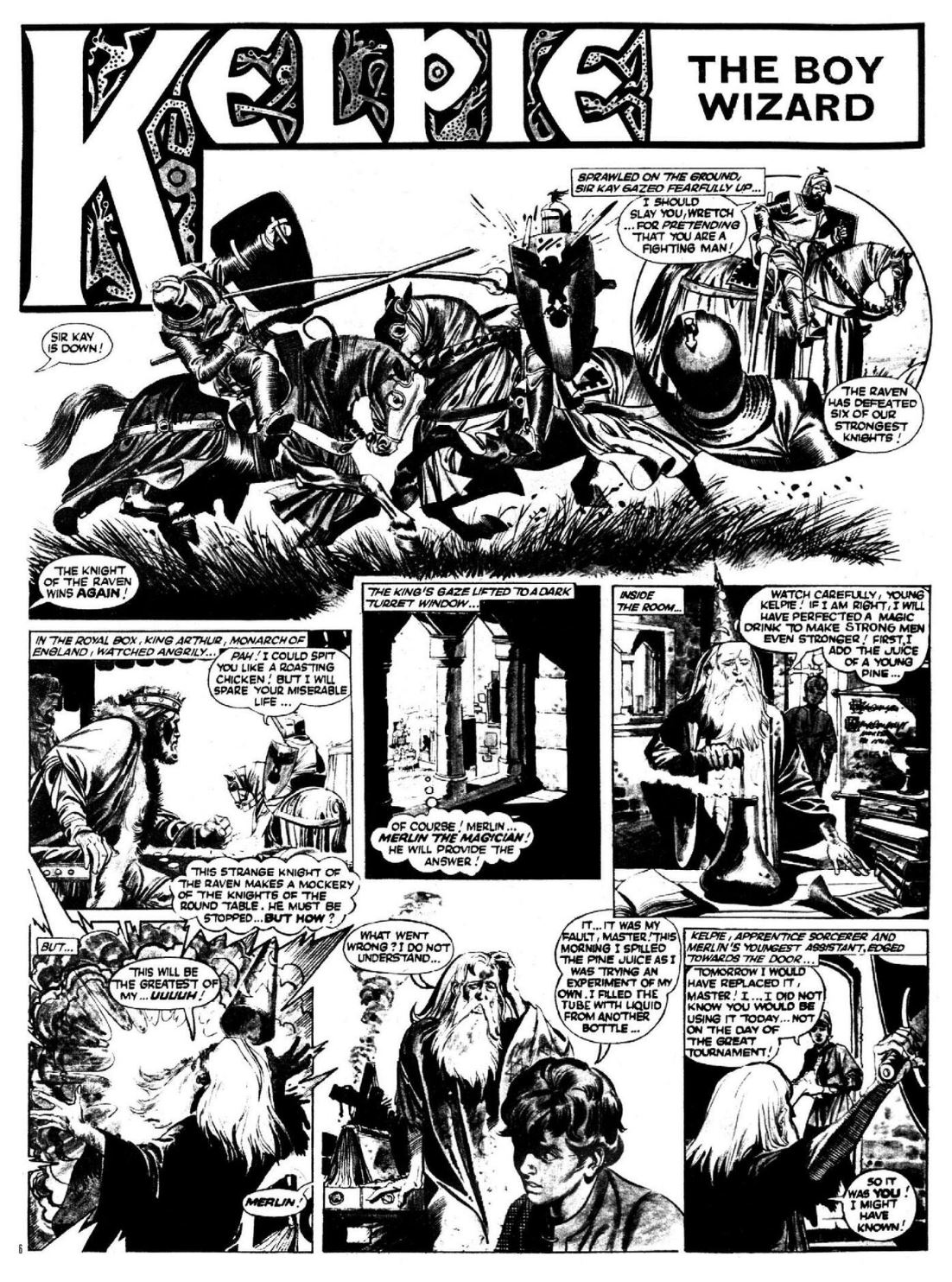
In the heyday of King Arthur’s Camelot, the ruler of a mostly-united Britain rules wisely with his mighty magician advisor Merlin ensuring the sovereign is safe from mystic threats and his own impulsiveness and generous nature. The mage has recently taken on an apprentice, a promising but excitable and impetuous lad named Kelpie. The boy has the knack of magic but is a daydreamer with a pitiful memory and struggles to learn crucial spells of transformation, divination or any other mainstay of magic. Sadly, these deficits occupy Merlin’s attention when he should be dealing with malevolently ambitious mystery knight The Raven…
The arrogant stranger has already defeated every warrior of the Round Table at a joust and openly challenges the king. When the Raven almost “accidentally” kills Merlin, Arthur asks Kelpie to conjure a magical weapon or shield for the forthcoming clash. They prove utterly ineffectual and, with the king wounded, the brash intruder claims lands and a castle to further extend his influence in the world…
Merlin knows something is not right and suspects some previously unknown evil sorcerer is behind the plot. Having briefly become a cat while practising, impetuous, guilt-wracked Kelpie overhears the King’s hasty council-of-war and swears to investigate and destroy the mysterious foe, a task that over the forthcoming weeks pits him against dragons, seasoned warriors, shapeshifters, talking beasts, an enchanted boar and the dread witch Badarach, in far-flung locations ranging from forbidding wild woods to the ghastly Castle of Tears. Thankfully, luck and determination as much as skill are on his side and Kelpie saves many good folk – like noble Sir Guy and even wicked ensorcelled acolyte Sir Hugh – before unmasking a vile and voracious human-bird hybrid and aiding eagerly-watching but late-arriving Merlin in crushing the monster…
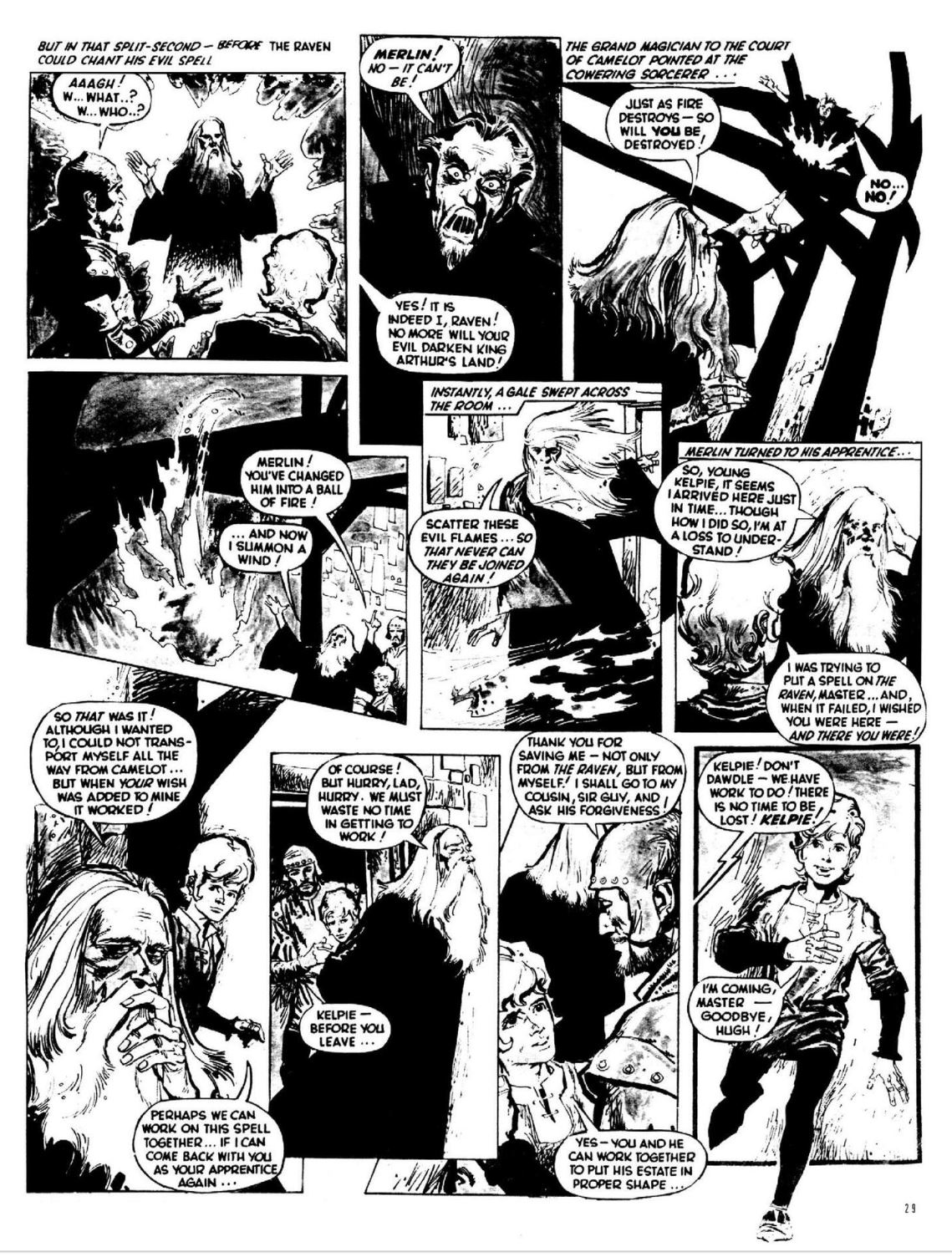
Without pause, that introductory quest was followed by more of the same as ‘The Beast With 7 Heads’ (September 12th 1964 – February 20th 1965) found a more adept but still uncertain junior mage as part of the Court and travelling through distant regions of the kingdom with the king, Merlin and a trusted band of knights. The mission to the lands of Arthur’s cousin was provoked by Merlin’s prophetic visions of impending evil and Arthur’s murder, and Kelpie is obsessed with ending the threat before it starts.
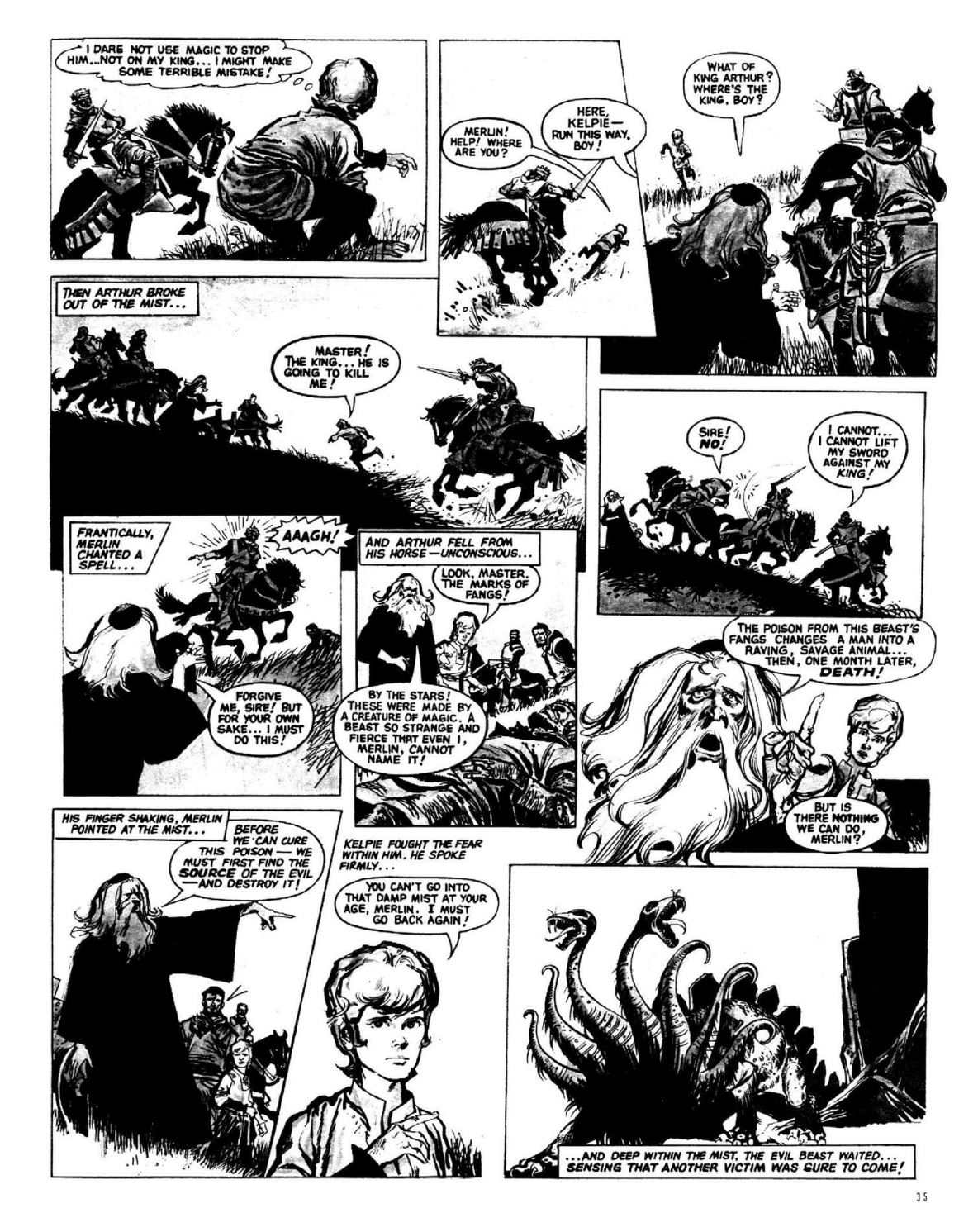
Of course, that’s not the way it plays out. The embassage is attacked by mysterious riders and deadly doppelgangers, and Arthur and the survivors confront a diabolical shape-stealing hydra with seven squabbling faces and personalities. The King kills one of them before being bitten. Dying, he falls into a coma as Kelpie – desperately seeking a cure for the King – strikes off on his own. He cannot avoid the monster, but the beast is not immortal. When he kills one of its heads the valiant boy gains a knowledgeable ally in its liberated former body-slave. This old man kills another head and the monster changes tactics, seeking to subvert and conquer Camelot through its dark magic and at the head of a greedy army of barbarians…
In a savage war of attrition, Kelpie persists in his attacks and – with the monster finally reduced to one single face – learns that Arthur’s cure is the death of the last beast head. As giant warrior Tygron, the beast almost succeeds until he murderously turns on his own human forces, killing them all but sustaining a grievous wound. This gives Kelpie and his latest ally (a bold tinker) the chance they need, and soon the war is won, and the beast is dead. Moreover with the kingdom restored. Kelpie is awarded a well-deserved promotion…
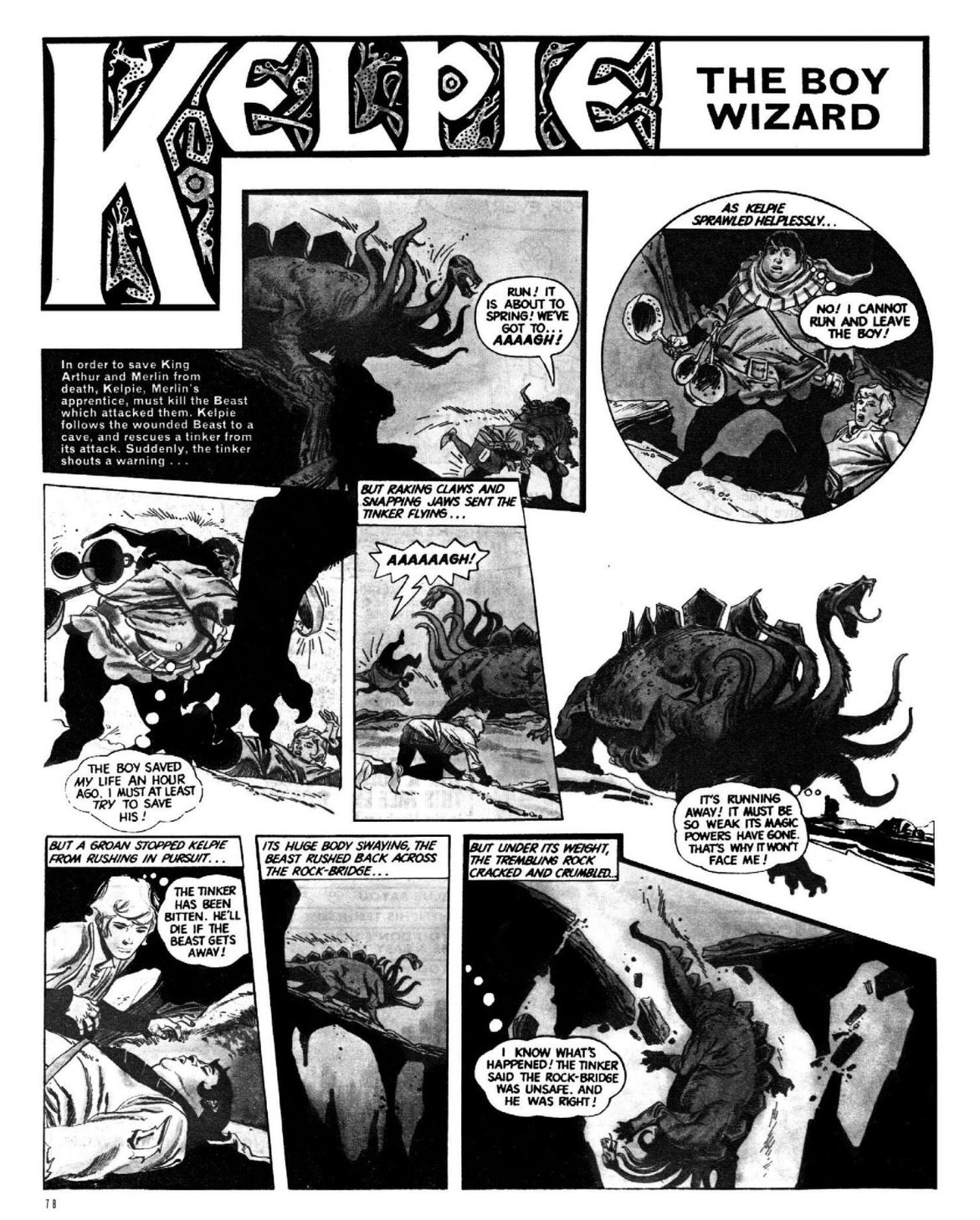
Regarded as ‘Extra Material’, Wham! Annual 1966 provides one last complete tale and rendered by Burns in traditional two-colour (black and sepia on white pages) hues. The short complete yarn was written by Keith Chapman – a jobbing writer/editor of the period who mostly used the penname Chap O’Keefe on Combat Picture Library, Western Adventure Library, Cowboy Adventure Library and others and was especially well-represented in prose and comics tales for the UK Annuals and specials markets.
Here he & Burns pit the apprentice sorcerer against malign witch-clan The Weird Sisters of Doon, rescuing and curing a knight transformed into a frog, restoring stolen lands to their rightful lord and saving Camelot from an invasion by wolves…
Stock then shares the history of the revolutionary comic weekly in ‘Odhams Press & Power Comics’, complete with a biography of Baxendale, Wallace and others, with a rundown of the comics and an explanations of the state of war that existed between Odhams and Fleetway (formerly Associated Press) who were bitter rivals despite both being part of the same company: Mirror Group newspapers…
Then ‘Decades of Draughtsmanship’ (by Stock) offers eulogy and memorial tributes on Burns’ passing, with messages from two dozen major creators who worked with him or were inspired by him. This was originally printed in Judge Dredd Megazine #465, after which we closing on Burns’ original painting for this tome cover and potted biographies of key creators.
Long lauded and much-missed by older fans, the adventurous all-ages epic is back in print, but for all its historical significance, the true worth of Kelpie the Boy Wizard is its sheer beauty and accessibility; offering exciting fantasy fun that adds to our communal heroic mythology and one that delivers glorious grand moments for all who see it. Shouldn’t that include you?
© 1964, 1965, 1966, 2024 Rebellion Publishing IP Ltd. All rights reserved.