
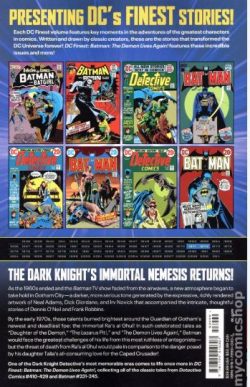
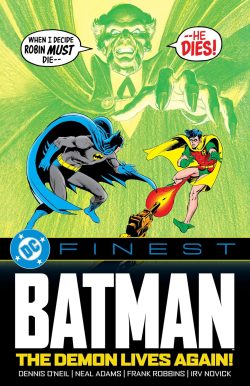
By Denny O’Neil & Neal Adams, Dick Giordano, Frank Robbins, Robert Kanigher, Len Wein, Marv Wolfman, Irv Novick, Bob Brown, Bernie Wrightson, Michael Wm, Kaluta, Nick Cardy, Sol Harrison, Jerry Bingham, Rudy Nebres & various (DC Comics)
ISBN: 978-1-79951-030-7 (TPB)
This book includes Discriminatory Content produced in less enlightened times.
Win’s Christmas Gift Recommendation: Perfect Moments for when the Knights Draw In… 10/10
More than any other hero Batman has come to be defined by his enemies. As part of the reclamation project that ensued once the self-made super saviour had stopped playing the fool on TV for three years, for comics books that meant harsh new interpretations of his venerable rogues gallery but also demanded someone fresh, contemporary, uncompromising and above all else terrifyingly formidable…
After three seasons, the overwhelmingly successful Batman TV show ended in March, 1968. It had clocked up 120 episodes plus a theatrical-release movie since the sensation premiered on January 12th 1966, sparked a global frenzy dubbed “Batmania” and triggered hysteria for all things costumed, zany and Mysteryman-ish. Once the series was done and sentenced to syndication, humanity’s fascination with “camp” superheroes burst just as quickly as it had boomed, and the Caped Crusaders were left to a hard core of dedicated fans and followers who hoped they might now have Their hero back.
For comic book editor Julius Schwartz – who had tried to keep the most ludicrous excesses of the show out of his books whilst still cashing in on the magnified global popularity – the solution was simple: ditch the tired shtick, gimmicks and gaudy paraphernalia and get Batman back to basics; solving baffling mysteries and facing life-threatening perils. After all, that had worked back in 1963 when the problem was silly aliens. Moreover, in an era of teen revolt, that could mean phasing out the boy sidekick, too…
Although college freshman Teen Wonder Dick Grayson would still pop back for occasional guest-shot yarns, this massive monument to comics ingenuity and narrative brilliance features him only sporadically. Robin had finally spread his wings and flown the nest: for a solo back-up slot in Detective Comics, alternating with Batgirl.
Chronologically collecting Batman’s cases from cover-dates April 1971 to November 1972, in issues #231-245 of his own title and the front halves of Detective Comics #410-429, and including bonus marital from Limited Collectors’ Edition #C-51and 1988 reprint series The Saga of Ra’s Al Ghul, the original exploits gathered here (some Batman issues were giant reprint editions, so only their covers are reproduced within these pages) were written and illustrated by forward-thinking creators determined make the hero relevant and interesting on his own terms once more.
One huge factor aiding the transition was that the publishers had finally acknowledged that a large proportion of the faithful readership were discerning teens (or even adults), not just kids looking for a quick, cheap, disposable entertainment fix. Moreover, working through other contemporary tropes – most notably a renewed global fascination in all things supernatural and gothic and an increasing awareness of environmental breakdown – the creators reshaped Batman into a champion capable of working within the new “big things” in comics: realism, organised crime, social issues, suspense and even supernatural horror…
During this period the long road to our modern obsessive, scarily dark Knight incrementally reintroduced a harder-edged, grimly serious caped crimebuster, whilst carefully expanding the milieu and scope of Batman’s universe. That especially meant re-assessing those fearsome foes, who again ceased to be harmless buffoons to and inexorably metamorphose back into the macabre Grand Guignol murder-fiends that had typified the villains of the early 1940s.
This mini-renaissance also resulted in a groundbreaking experiment now lauded as one of the first great extended Batman epics…
The moody mayhem begins with Detective #410 and a chillingly memorable murder-mystery from the most celebrated creative team of the decade. Crafted by Denny O’Neil, Neal Adams & embellisher Dick Giordano at their spectacular best, it revealed an exhausted masked Manhunter tracking one ruthless killer and inadvertently stumbling into another wave of slaughter amidst an enclave of retired circus freaks. Multi-talented Giordano was inker of choice for the Darknight Detective at this time: his slick, lush line and brushwork lending a veneer of continuity to every penciller. Unless I say otherwise, please assume it’s him on every cited saga from now on…
The Caped crimebuster was then lured to Vietnam to save an airliner full of hostages in Batman #231 (by Frank Robbins with Irv Novick pencilling), and barely survived a vicious vengeance scheme triggered by the ‘Blind Rage of the Ten-Eyed Man’. This was war veteran Phil Reardon who blamed Batman for the loss of his sight and a macabre operation that allowed him to “see” through his fingertips!
Next, came the first subtle plot-strands of a breathtakingly ambitious saga unlike anything seen in comics before. They were woven into Detective Comics #411, as still in the East, undercover and hunting Dr. Darrk (leader of the lethally clandestine League of Assassins as introduced in DC #405), Batman’s pursuit leads him ‘Into the Den of the Death-Dealers’ (by O’Neil, Bob Brown &Giordano) where a climactic struggle resulted in the death monger’s demise and freedom for the exotic but biddable hostage he was holding. Her name was Talia…
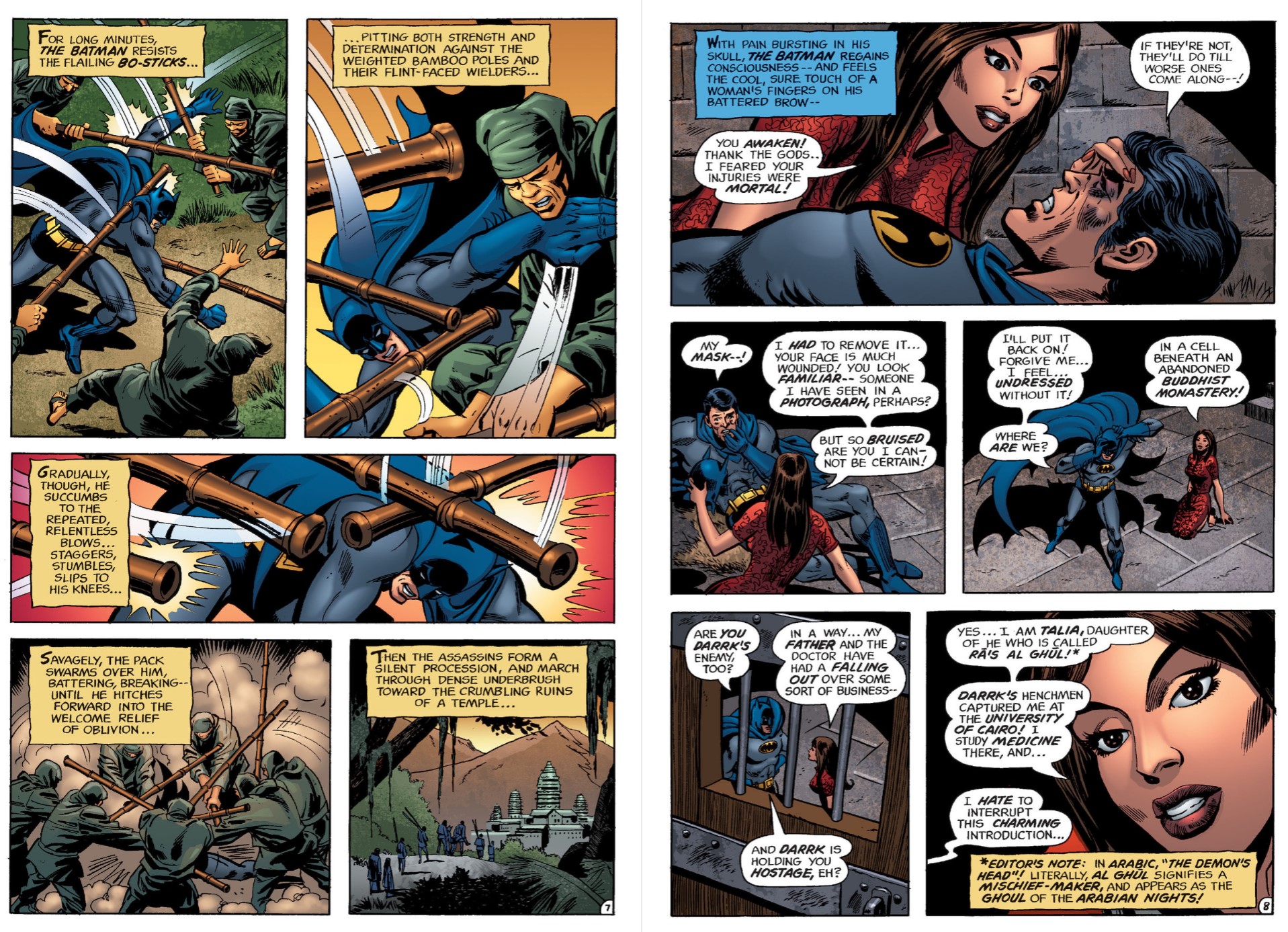
We learned more about her in Batman #232 when O’Neil & Adams introduced her father – an apparently immortal eco-terrorist calling himself Ra’s Al Ghul – in a whirlwind adventure which became a signature highpoint of the entire Batman canon. ‘Daughter of the Demon’ is a timeless globe-girdling pulp-inspired mystery yarn drawing the ever-more grim detective from Gotham’s concrete canyons to the Himalayas in search of Robin and Talia: both apparently hostages purportedly captured by forces inimical to both Batman and the mysterious figure who claims to working in secret to save the world…
Ra’s was a contemporary, yet hopefully more acceptable embodiment of the classic inscrutable foreign devil (typified in a less forgiving age as so many “Yellow Perils” like Dr. Fu Manchu). This sort of alien archetype permeates – more like infests – popular fiction and is still an astonishingly powerful villain-symbol, although back in the 1970s the character’s Arabic origins (neutral at that time) seem to uncomfortably embody a different kind of ethnic bogeyman…
The notion of a villain who has the best interests of the planet at heart is also not new, but Ra’s Al Ghul – whose avowed intent is to reduce teeming humanity to safe, manageable, viable levels and save the world from our poisons – struck a chord in the 1970s: a period where ecological issues originally came to the attention of the young. It was a rare kid who didn’t find a note of sense in what “the Demon’s Head” planned.
Crucially, the spectacular introductory tale ended with a shocking pronouncement of what Ra’s intended for Batman…
A return to relative normality came in Robbins & Brown’s ‘Legacy of Hate!’ (DC #412) with Bruce Wayne heading to Northern England for a convocation of kin gathered to settle the ownership and disposition of ancient Waynemoor Castle. Sadly, even Batman couldn’t separate the spate of attempted murders which followed into purely human perpetrators and the fault of the manor’s vengeful ghost knight Lord Harold…
After pausing to admire Giordano’s cover for reprint edition Batman #233, Detective #413 then blends the spooky tone of the times with a healthy dose of social inclusion as ‘Freak-Out at Phantom Hollow!’ (Robbins & Brown) finds Batman saving two abused hippie kids being picked on by the decent folk in a rural hamlet, only to become embroiled in a local witch’s curse and a mad bomber’s plot prior to Batman #234 spectacularly reintroducing one of the hero’s most tragic foes.
As comics became increasingly anodyne through the 1950s, traumatised, psychologically warped actualised schizophrenic Two-Face slipped from The Gotham Guardian’s roster of rogues, but with ‘Half an Evil’ (O’Neil, Adams, Giordano) coin-tossing Harvey Dent resurfaced at the forefront of grimmer, grittier stories. This time, a string of bizarre, brutal and baffling robberies afflict the city, and bewildered baffled Batman must use all his ingenuity to discern the reasoning and discover the identity of a ruthless hidden mastermind in time to thwart a desperately diabolical scheme…
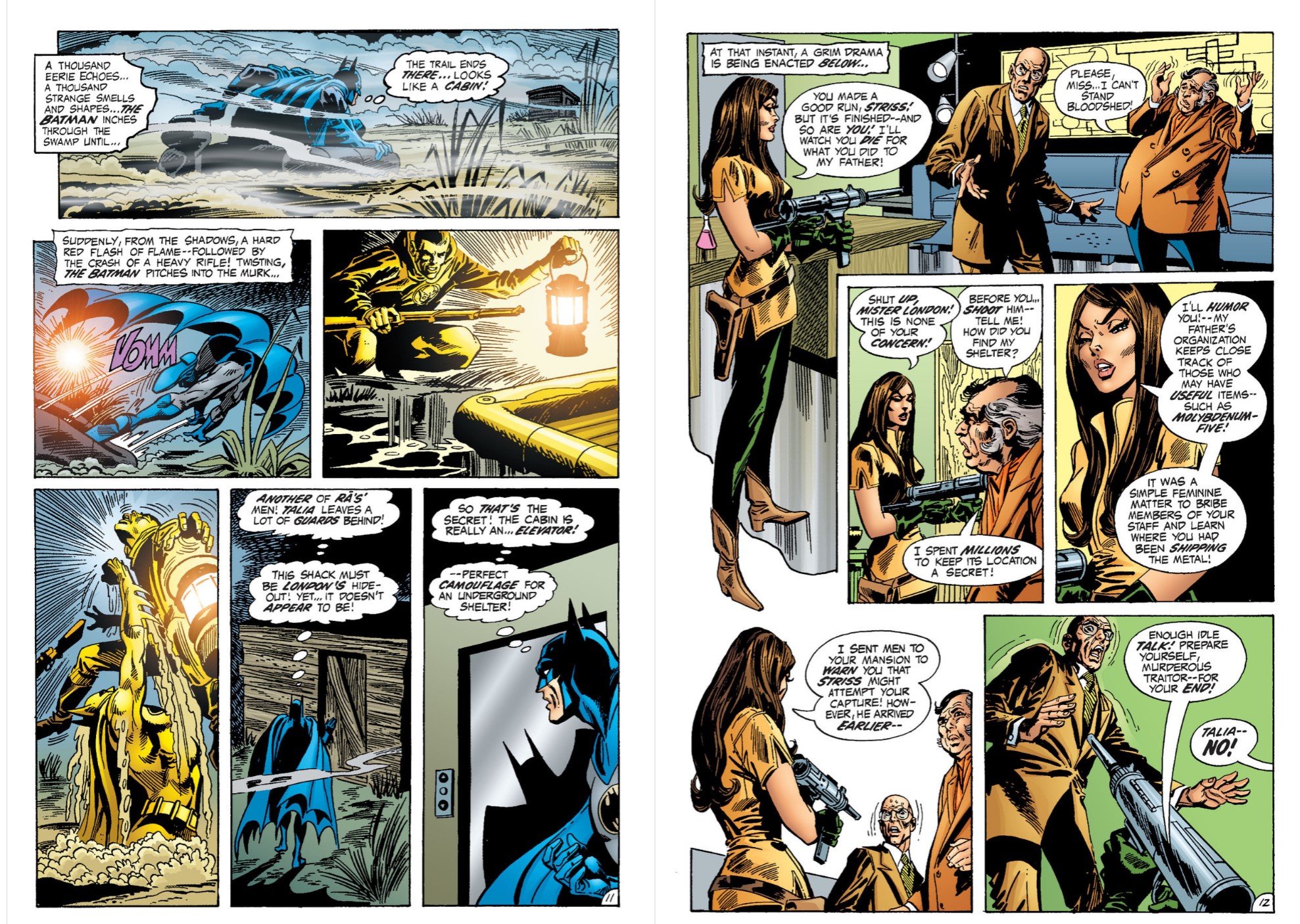
In DC #414, an aura of Film Noir redemption colours and flavours O’Neil & Novick’s ‘Legend of the Key Hook Lighthouse!’ when the dread detective tracks gunrunners to a haunted coastal bastion in Florida. However, only supernatural intervention enables him to save bystanders who, whilst not exactly innocent, certainly don’t deserve the fate psychotic banana republic despot General Ruizo planned for them. Then Batman #235’s ‘Swamp Sinister!’ (O’Neil & Novick) offers further insights into Talia’s true character and her ruthless sire’s agenda when the hero races to recover a bio-weapon stolen from “the Demon” before Detective #415 sees Robbins & Brown’s deliver the ‘Challenge of the Consumer Crusader’ as the Gotham Gangbuster uncover and dismantles an extortion ring inside the nation’s most respected product-testing organisation…
Detective Comics #400 had introduced a dark twisted doppelganger to Gotham’s Guardian after driven scientist Kirk Langstrom created a serum to make him superior to Batman – and paid a heavy price. Over two further tales Langstrom and his fiancée Francine endured his monstrous transformations until Batman found a cure. Now that trilogy expanded in DC #416 as Robbins illustrated his own script in ‘Man-Bat Madness!’ Here Kirk seemingly slips back into his mutative madness. Luckily, Batman has the faith to look beyond appearances and discerns a hidden factor in the scientist’s inexplicable recidivism…
In Batman #236, Robbins & Novick merge mysticism with a solidly mundane murder-plot, cover-up and blistering action intervention with ‘Wail of the Ghost-Bride!’ after which a persistent but annoying journalist seeks to become ‘Batman for a Night’ (Detective #417, Robbins, Brown) but only succeeds after experiencing similar crime-created loss. The next issue then delivers a (temporary) finish to the short-lived career of Steve Ditko’s outsider hero The Creeper. Concocted by O’Neil & Novick, ‘…And Be a Villain!’ pits the Gotham Guardian against a former hero being simultaneously killed and driven crazy by his own powers. At the heart of the problem is a criminal scientist forcing The Creeper to steal in return for a promised cure, but that’s no help for Batman who must defeat a deranged foe faster, stronger, more agile and far scarier than he…
O’Neil, Adams & Giordano reunited for Batman #237’s ‘Night of the Reaper!’ Regarded as another of the era’s most revered tales:, this harrowing Halloween epic finds Robin working with his former mentor to solve a string of barbarous killings, only to uncover atrocity leading back to Nazi Germany and a pitifully deranged perpetrator as much sinned-against as sinner.
Following the Adams/Giordano cover of all-reprint 100-Page Super-Spectacular Batman #238 (plus the key to all the heroes depicted there), in Detective #419 a corpse weighed down with Batman figurines leads our hero into an underworld imbroglio brimming with shameful family freaks, a ruthless master smuggler and the pitiful ‘Secret of the Slaying Statues!’ (O’Neil & Novick) before contemporary Christmas classic ‘Silent Night, Deadly Night!’ by the same creators over in Batman #239 sees the masked manhunter strive to save a desperate, poverty-struck single parent from making the worst decision of his life…
The evocative redemption saga sees him triumph – with some seasonal help from a Jolly higher power.
As the company’s flagship title increasingly dug back into its roots and pursued nominative determinism on all levels in its anthological pages, Robbins flew solo again in Detective Comics #420’s lead strip ‘Forecast for Tonight… Murder!’ Here a radioactive dead man stalks one of Gotham’s greatest philanthropists, outwitting Batman’s every preventative measure. It only gets tougher when the hero discovers he might be safeguarding the wrong injured party…
The long-brewing war between Batman and Ra’s Al Ghul went to Def Con 3 in Batman #240 (March 1972) as O’Neil, Novick & Giordano set the scene for the groundbreaking “series-within-a-series” soon to follow. When Batman uncovers one of his austere opponent’s less worthy and far more grisly projects, he clashes with diabolical rogue brain-surgeon Dr. Moon and must compromise his principles to deliver ‘Vengeance for a Dead Man!’ The end result is to be open conflict between Batman and the Demon’s Head…
First though, and for the best of reasons, the hero has to break a blackmailer who knows all Gotham’s dirty secrets out of prison during a full-scale riot in ‘Blind Justice… Blind Fear!’ (another all-Robbins affair from DC #421) whilst in the following issue O’Neil and Brown have the Dark Knight crush a cunning hijacking ring using radical methodology for corporate reasons in ‘Highway to Nowhere!’ Another sociopathic killer debuted in Batman #241 as the hero ferrets out freelance spy Colonel Sulphur, whose extortion scheme revolves around his threat to kill a Pentagon officer’s wife. O’Neil & Novick’s ‘At Dawn Dies Mary McGuffin!’ sees Batman scouring Gotham in a tense race against the clock in direct counterpoint to DC#423’s ‘The Most Dangerous Twenty Miles in Gotham City’ (Robbins, Brown) wherein the masked manhunter’s cognitive skills are tested trying to slip a Russian agent past a gang of US ultra-patriots. The killers don’t care that he’s being exchanged for a captive American, they just want to kill a commie and send a message…
Batman #242-244 (plus a 15-page epilogue in #245) comprised a single extended saga, unfolding outside normal DC continuity. It promised the final confrontation between two opposing ideals. O’Neil, Novick & Giordano opened the campaign in #242 with ‘Bruce Wayne – Rest in Peace!’ as, with his civilian identity taken off the board (to prevent The Demon exposing it), Batman gathers a small team of specialist allies. These comprise criminal alternate-identity Matches Malone, scientific advisor Dr. Harris Blaine and Ra’s’ top assassin Ling all coerced and sworn to destroy Ra’s Al Ghul forever.
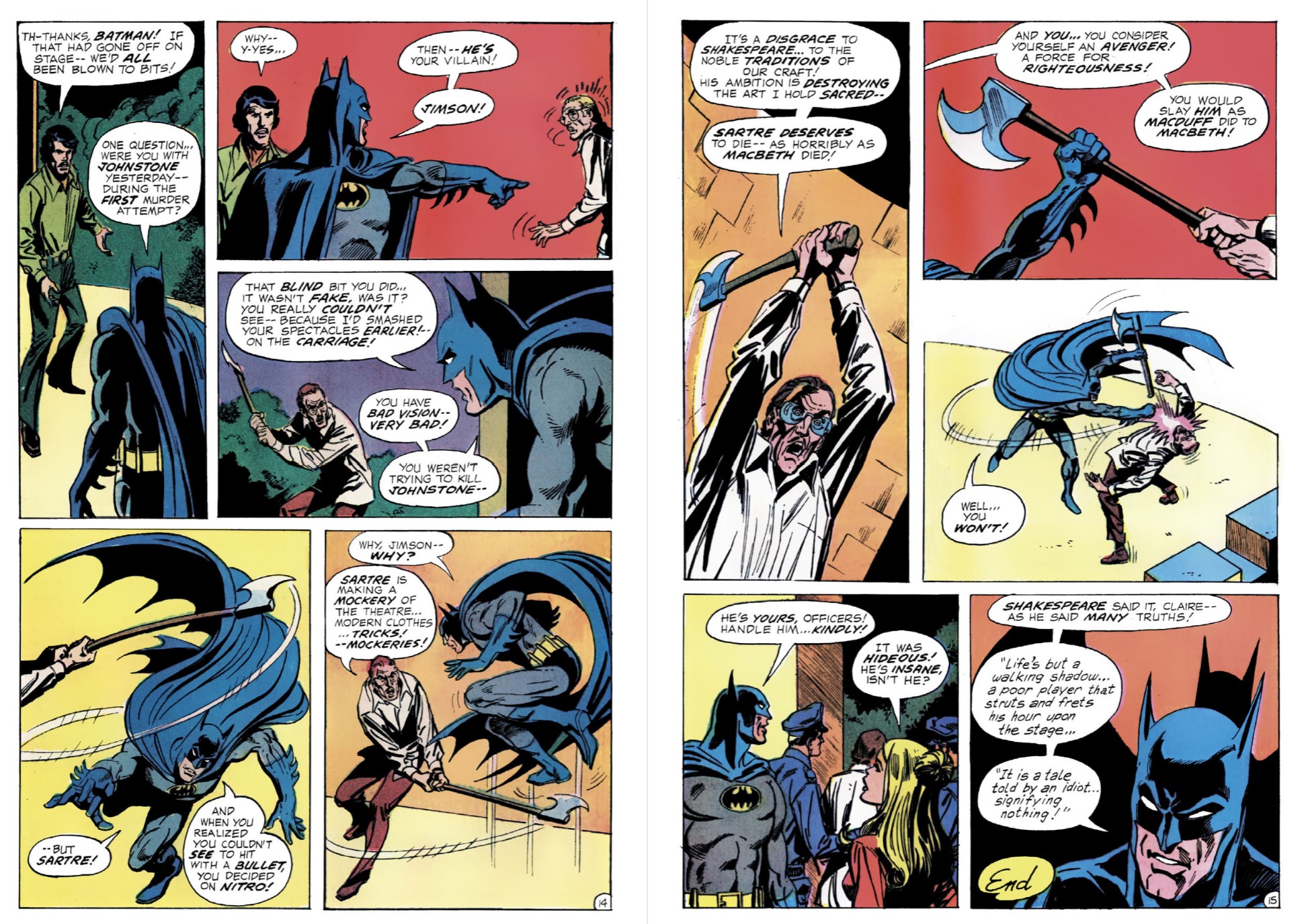
Meanwhile back in regulation continuity, it was business as usual in Detective #424 where Robbins & Brown’s ‘Double-Cross-Fire!’ played out an astoundingly cunning murder plot with Batman challenging Commissioner Gordon (and us readers) to spot a telltale clue giving the game away. One issue later O’Neil & Novick got all Shakespearean when ‘The Stage is Set… for Murder!’ and Batman carefully seeks to glean which thespian is plotting a big, bloody finish before the curtain comes down forever…
O’Neil, Adams & Giordano resumed operations with the second chapter of their landmark epic in Batman #243 as the team – plus latecomer Molly Post – bombastically invaded Ra’s’ Swiss citadel moments after their intended target passes away. Nobody suspects the ageless villain’s resources include ‘The Lazarus Pit’ which can revive the dead…
In Detective #426, a spate of inexplicable suicides amongst the wealthy leads Batman to suave gambler Conway Treach: a man who just can’t lose. Soon, however, the huckster learns his grim opponent has his own system for winning ‘Killer’s Roulette!’ in another suspenseful all-Robbins gem leading chronologically and conclusively to Batman #244 and the fateful finale wherein ‘The Demon Lives Again!’ Sadly, despite all his supernal gifts and forces, Ra’s cannot escape the climactic vengeance of his implacable foe in dream-team O’Neil, Adams & Giordano’s compulsive climax.
In DC #427, Robbins & Novick detail ‘A Small Case of Murder!’ as, long after arresting the admitted killer – an automated ventriloquist’s doll – the Gotham Gangbuster finally takes down the mastermind who really pulled the trigger. With the job done, an addendum in Batman #245 resolves ‘The Bruce Wayne Murder Case!’, restoring the billionaire to his rightful place in Gotham’s social whirl by catching a devious desperado who had opportunistically pinned the non-murder on a business rival…
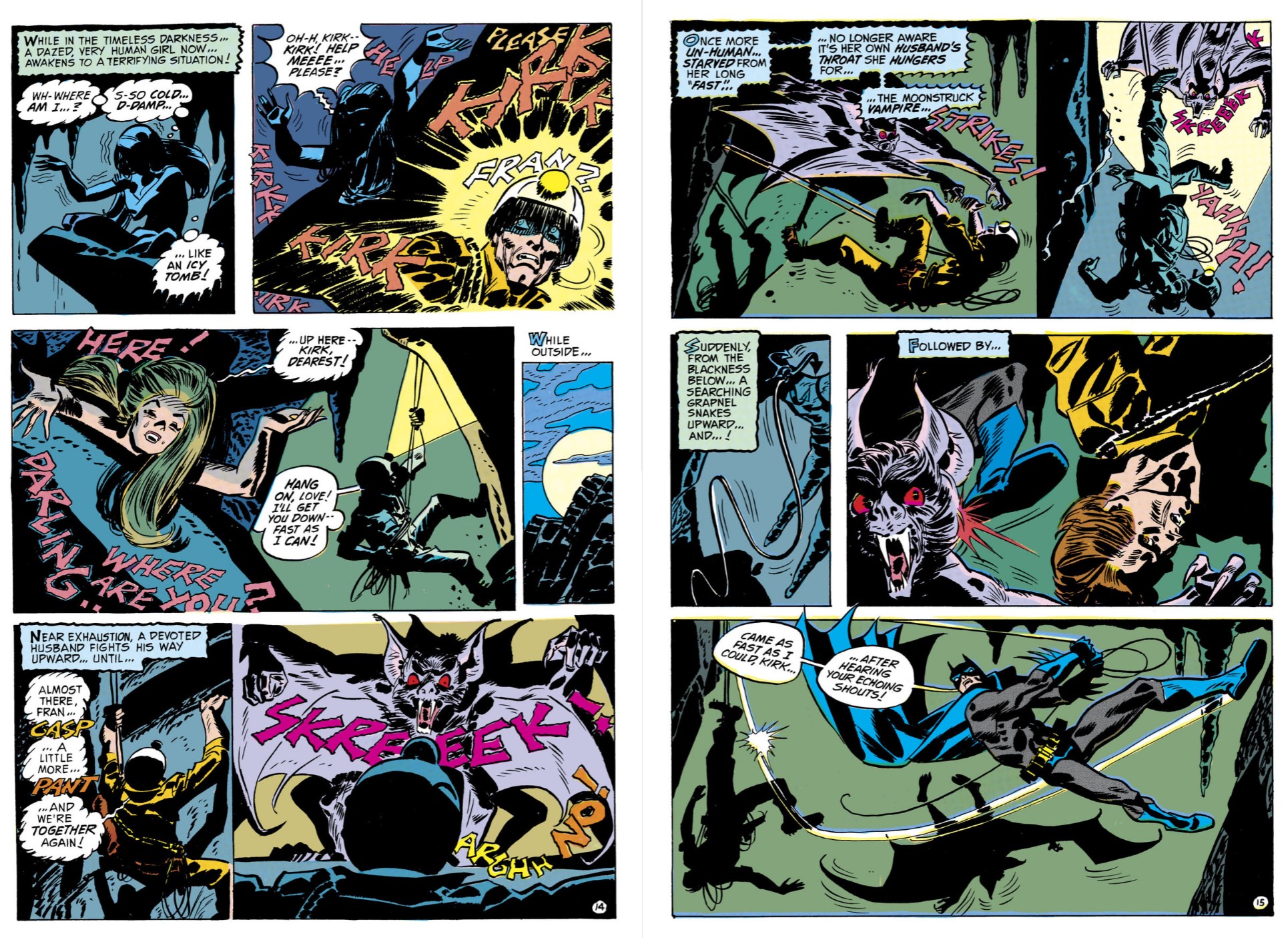
In Detective #428, Robbins, Brown & Giordano channel movie blockbuster The French Connection and debut by-the-book maverick cop Steve “Shotgun” Smith as the masked manhunter clashes with an obsessive equal in ‘The Batman vs the Toughest Cop in Gotham!’ Despite initial friction, the heroes bond once Batman proves shotgun isn’t a corrupt, bribe-taking killer, after which Robbins does it all again in closing inclusion ‘Man-Bat Over Vegas!’ from Detective #429 (November 1972). This was an epilogue to the triptych of tales which introduced tragic Kirk Langstrom, whose experiments doomed him to life as a monstrous winged mutant. Although here and now Batman assumed the scientist was cured, after a nuclear test led to a rash of vampire attacks in Nevada the Caped Crusader rushed west to investigate and discovered nothing was what it seemed.
Adding even more value to this print-only paragon of passion and peril, also included are Adams & Sol Harrison’s iconic wraparound cover to 1977’s tabloid compilation Limited Collectors’ Edition #C-51 and the wrapround covers to 1988 reprint series The Saga of Ra’s Al Ghul #1-4 by Jerry Bingham, Adams, Giordano and Rudy Nebres…
With the game-changing classics in this volume, Batman finally and fully returned to the commercial and critical top flight he had enjoyed in the 1940s, reviving and expanding upon his original conception as a remorseless, relentless avenger of injustice. The next few years would see the hero rise to unparalleled heights of quality so stay tuned… the very best is just around the corner . That dark, dark corner….
© 1971, 1972, 1977, 1988, 2026 DC Comics. All rights reserved.