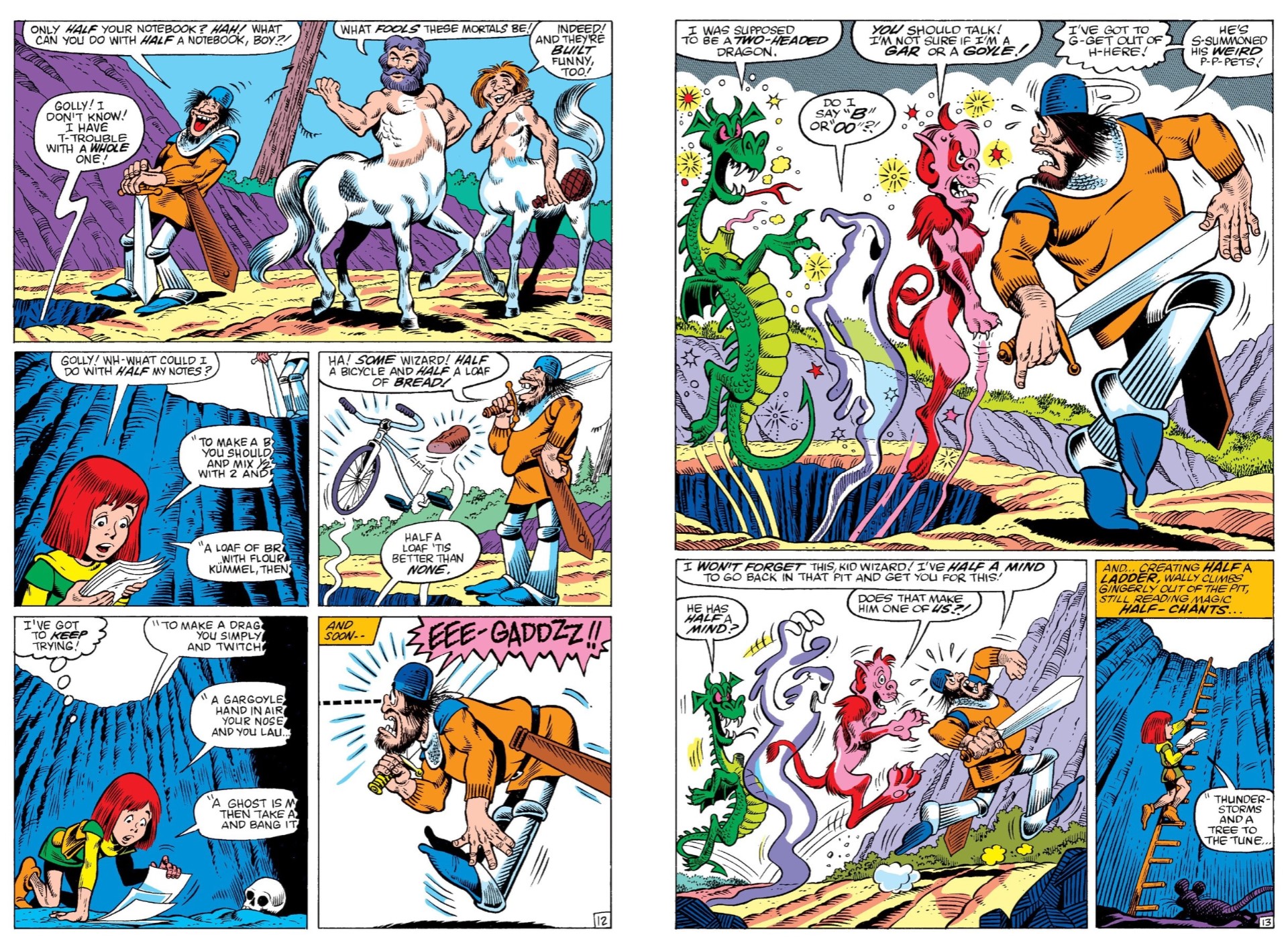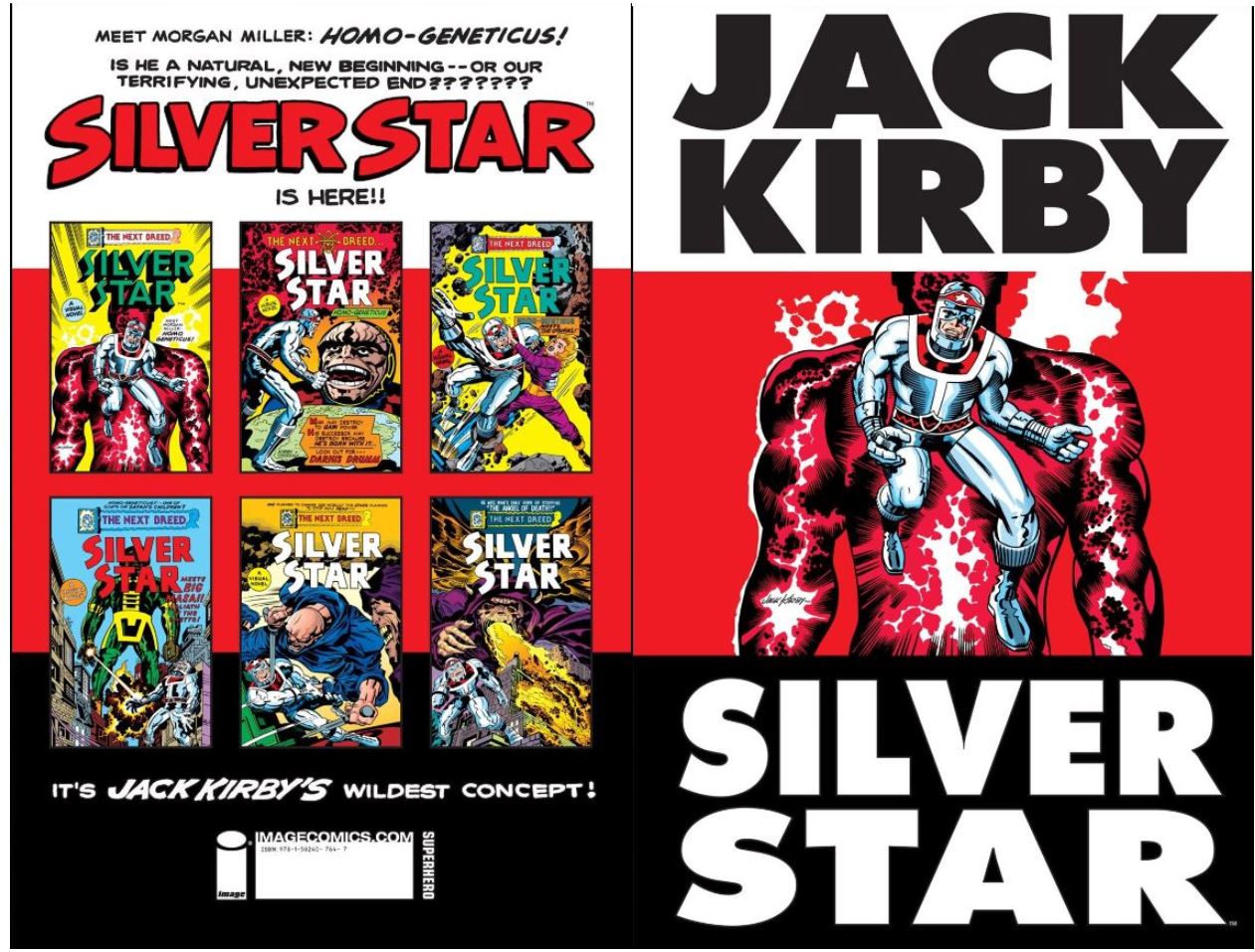
Jack Kirby’s Silver Star


By Jack Kirby, with Mike Royer, D. Bruce Berry, Janice Cohen, Erik Larsen & Eric Stephenson, Jim Lee, Joe Sinnott & various (Image)
ISBN: 978-1-58240-764-7 (HB/Digital edition)

Jack Kirby was – and remains – the most important single influence in the history of US comics. There are millions of words about what the man has done and meant, and you should read those if you are at all interested in our medium. Kirby was a man of vast imagination who translated big concepts into astoundingly potent and accessible symbols for generations of fantasy fans. If you were exposed to Kirby as an impressionable kid you were his for life. To be honest, the same probably applies whatever age you jump aboard the “Kirby Express”…

For those of us who grew up with Jack, his are the designs and images furnishing our interior mindsets. Close your eyes and think “robot” and the first thing that pops up is a Kirby creation. Every fantastic, futuristic city in our heads is crammed with his chunky, towering spires. Because of Jack, we all know what the bodies beneath those stony-head statues on Easter Island look like, we are all viscerally aware that you can never trust great big aliens parading around in their underpants and, most importantly, we know how cavemen dressed and carnosaurs clashed. His creations are magical; they inspire successive generations of creators to pick up the ball and keep running with it…

In the late 1930s, it took a remarkably short time for Kirby and creative partner Joe Simon to become the wonderkid dream team of the newborn comic book industry. Together they produced a year’s worth of pioneering influential monthly Blue Bolt; dashed off Captain Marvel Adventures (#1) for overstretched Fawcett and, after Martin Goodman appointed Simon editor at Timely Comics, co-created a host of iconic characters like Red Raven, the original Marvel Boy, Mercury, Hurricane, The Vision, Young Allies and million-selling mega-hit Captain America.

When Goodman failed to make good on his financial obligations, Simon & Kirby were snapped up by National/DC, who welcomed them with open arms and a fat chequebook. Bursting with ideas that cautious company were never really comfortable with, the Dynamism Duo were initially an uneasy fit, and were given two moribund strips to play with until they found their creative feet. They turned both Sandman and Manhunter around virtually overnight and, once established and left to their own devices, switched to the “Kid Gang” genre they had pioneered at Timely. Joe & Jack created wartime sales sensation Boy Commandos and Homefront iteration The Newsboy Legion before being called up to serve in the war they had been fighting on comic book pages since 1940. Once safely back and demobbed, they returned to a very different funnybook business and soon left National to create their own little empire.

Simon & Kirby heralded and ushered in the first American age of mature comics – not just by inventing the Romance comics genre, but with all manner of challenging modern material about real people in extraordinary situations – before seeing it all disappear again in less than eight years. Their small stable of magazines – generated for the association of companies known as Prize, Crestwood, Pines, Essenkay and/or Mainline Comics – blossomed and as quickly wilted when the industry abruptly contracted throughout the 1950s. After years of working for others, Simon & Kirby established their own publishing house, producing comics for a far more sophisticated audience, only to find themselves in a sales downturn and awash in public hysteria generated by an anti-comic book pogrom.

Hysterical censorship-fever spearheaded by US Senator Estes Kefauver and opportunistic pop psychologist Dr. Frederic Wertham led to witch-hunting Senate hearings. Caving in, publishers adopted a castrating straitjacket of draconian self-regulatory rules. Horror titles produced under the aegis and emblem of the Comics Code Authority were sanitised and anodyne affairs in terms of Shock and Gore, even though the market’s appetite for suspense and the uncanny was still high. Crime comics vanished and mature themes challenging an increasingly stratified and oppressive society were suppressed…

Simon quit comics for advertising, but Jack soldiered on, taking his skills and ideas to a many safer, if less experimental, companies. As the panic abated, Kirby returned briefly to DC where he worked on mystery tales and Green Arrow (at that time a back-up page-filler in Adventure Comics and World’s Finest Comics) whilst concentrating on his long-dreamed-of newspaper strip please link to Sky Masters of the Space Force: The Complete Dailies August 6th 2023. During that period Kirby also re-packaged an original superteam concept that had been kicking around in his head since he and Simon had closed their innovative, ill-timed ventures. At the end of 1956 Showcase #6 premiered the groundbreaking Challengers of the Unknown. After three further test issues the “Challs” won their own title with Kirby in command for the first eight issues. Then a legal dispute with Editor Jack Schiff exploded and the King was gone…

He found fresh fields and an equally hungry-for-change new partner in Stan Lee at ailing Atlas Comics (which had once been mighty Timely). There they created a revolution in superhero comics storytelling…

After just over a decade of never-ending innovation and wonderment, Kirby felt increasingly stifled. His efforts had transformed the dying publisher into industry-pioneer Marvel but now he felt trapped in a rut. Thus, he gambled on a move back to DC for another burst of sheer imagination and pure invention. Jack always understood the fundamentals of pleasing his audience and strived diligently to combat the appalling prejudice against the comics medium – especially from industry insiders and professionals who despised the “kiddies’ world” they were timidly trapped in. After his controversial, grandiose Fourth World titles were cancelled, Kirby looked for other concepts which would stimulate his own vast creativity and still appeal to a market growing evermore fickle. Follow-ups included science fiction themed heroes Kamandi and OMAC, supernatural star The Demon, war stories starring The Losers, and even a new Sandman co-created with Joe Simon. However, although ideas kept coming (Atlas, Kobra, Dingbats of Danger Street, and proposed adult titles In the Days of The Mob, Spirit World and True-Life Divorce) yet again editorial disputes ended up with him leaving for promises of more creative freedom elsewhere…

Kirby’s return to Marvel in 1976 was much hyped at the time but again turned out to be controversial. His new creations (2001: A Space Odyssey, The Eternals, Devil Dinosaur, Machine Man) found friends rapidly, but his return to earlier creations Captain America and Black Panther divided an increasingly voluble and transient fanbase. Jack was never slavishly wedded to tight continuity, and preferred to treat his stints on titles as another “Day One”: a policy increasingly at odds with close-continuity demanded by a strident faction of the readership…

They were apparently blind to the unfettered, joyous freedom of imagination run wild, the majesty of pulse-pounding thrills and galvanising BIG ART channelling BIG IDEAS! The end of the 1970s saw Kirby move back into animation: designing characters and scenarios for shows like Turbo-Teen, Thundarr the Barbarian and even The New Fantastic Four. His comics efforts included Original Graphic Novel The Hunger Dogs and miniseries Super Powers for DC, and an adaptation of movie The Black Hole for syndicated strip Walt Disney’s Treasury of Classic Tales.

However, his most memorable move was to validate the newly-minted Independent Comics and Direct Sale Market sectors where he launched bombastic sci fi shocker Captain Victory and the Galactic Rangers for distributor-turned-publisher Pacific Comics. For Eclipse, he co-created with Steve Gerber industry-excoriating symbol of creative rebellion Destroyer Duck (part of a grass-roots campaign that ultimately vanquished an iniquitous work-for-hire business model that had made creators little more than indentured servants since the business began). Also for Pacific at that time, Kirby crafted a 6-issue miniseries revisiting his cherished themes of human advancement and perfection. The lure of these projects was that after decades of toil and unleashed genius, now he owned his stuff, with complete editorial control.

That’s paid off in this dynamic yarn celebrating the sheer power and exuberance of The King’s gifts. Kirby never threw away a notion or design, and from his copious “Maybe Later/Maybe One Day” file in 1983, he crafted this frenzied, frenetic superhero-espionage doomsday thriller based on an unsuccessful screenplay he and then-assistant Steve Sherman had put together in the 1970s. Accompanied by an early concept drawing, the origins and impact of the original Silver Star miniseries – which ran from February 1983 to January 1984 – are discussed by Pacific’s editorial director Dave Scroggy in his Introduction before we meet Morgan Miller: Homo Geneticus! in premiere outing ‘Silver Star is here!!’
Via a communal psychic network, the next stage in human evolution reveals his secrets, disclosing that Morgan’s incredible powers come from prenatal genetic tampering by his father Dr. Bradford Miller. He was seeking to offset repercussions of prospective atomic war, and the son is apparently not the only one of this “Next Breed”.

He soon might be though, since earlier prototype Darius Drumm is methodically and ruthlessly exterminating them whenever he tracks them down…
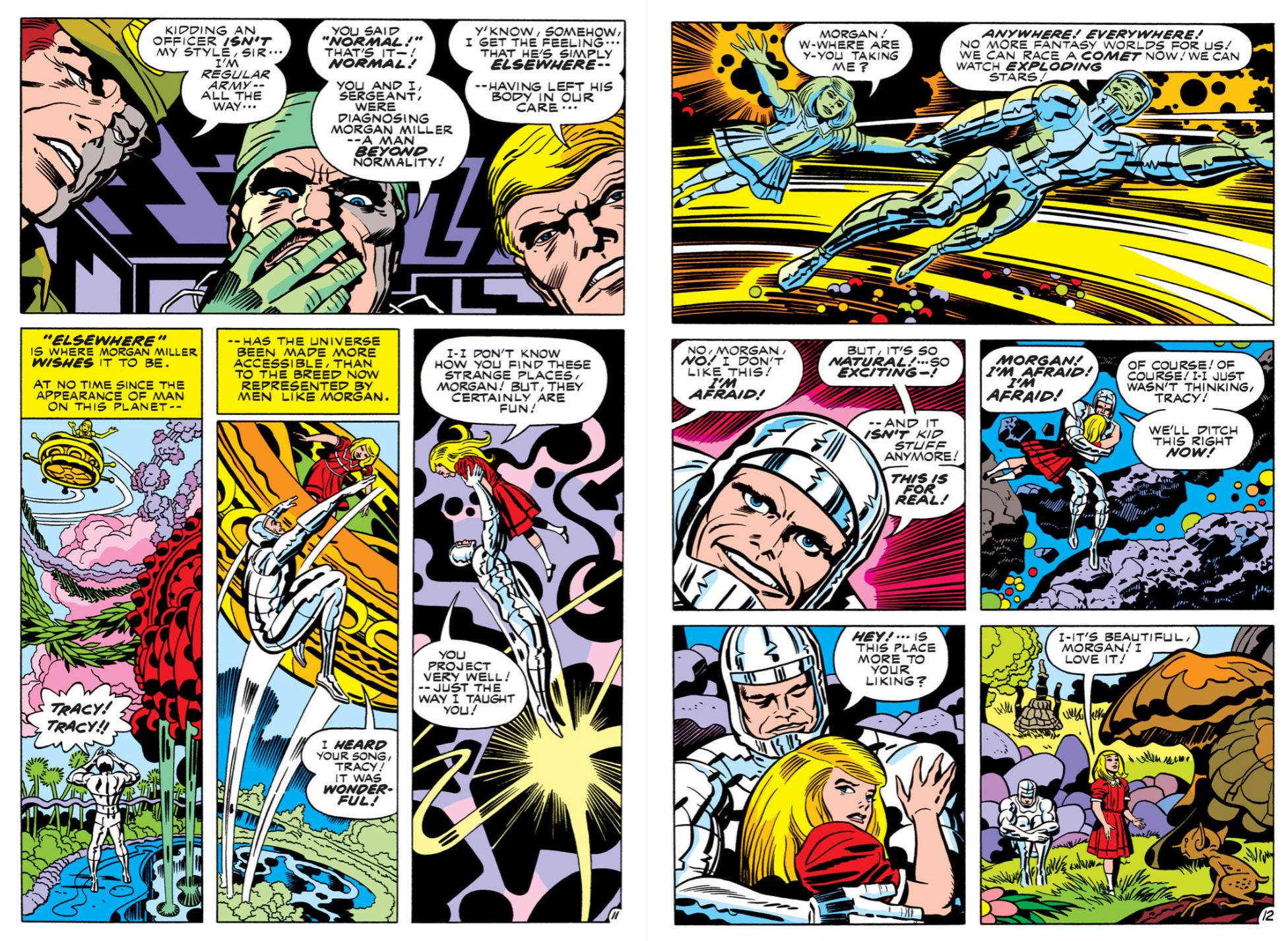
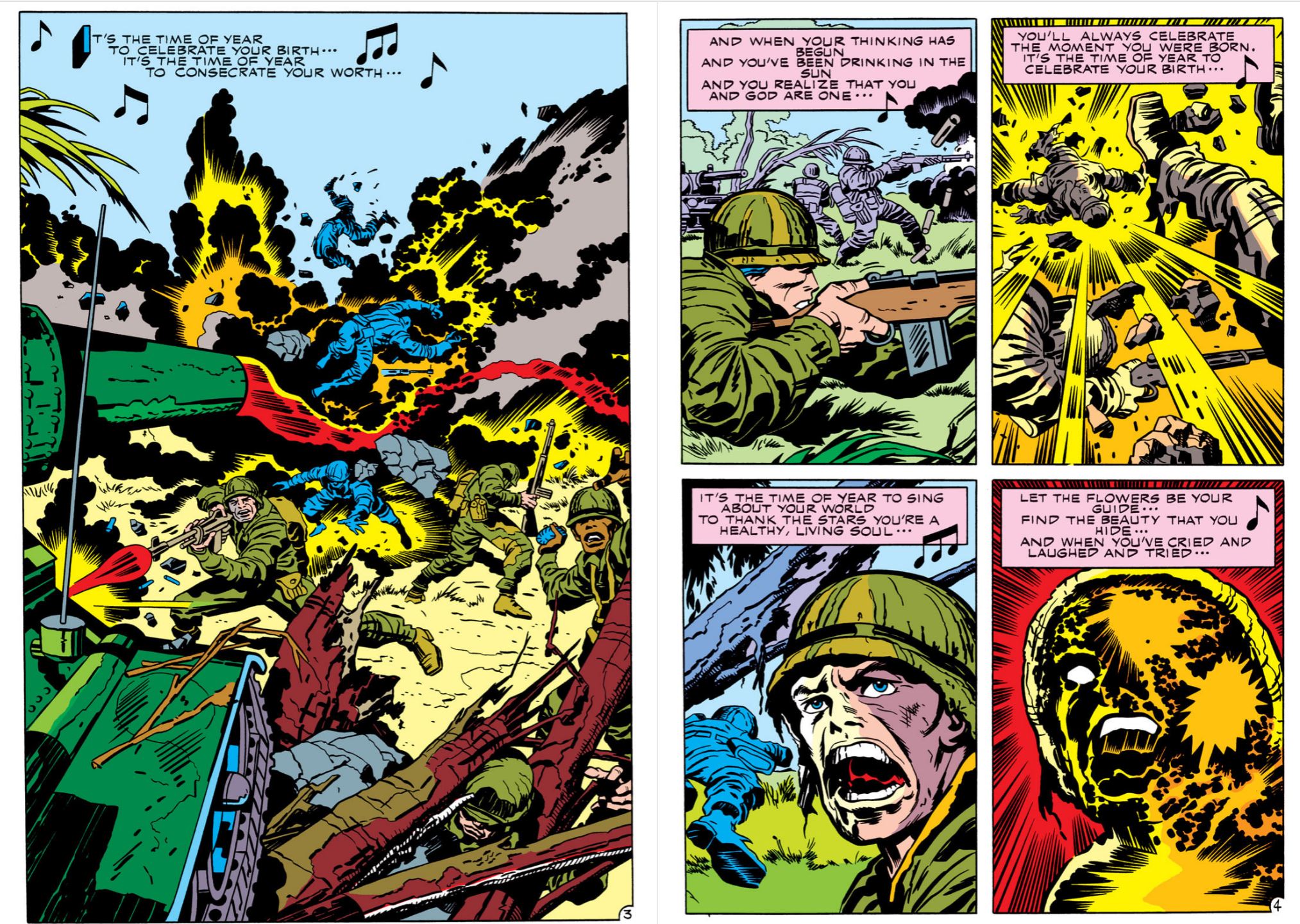
Morgan’s powers manifest when he comes under heavy fire as a good soldier fighting in another US overseas war. After an extremely public debut, he’s quickly co-opted by Secret Service agent Floyd Custer to protect The Land of the Free, even though Drumm’s campaign of terror against ‘The Others’ continues, not just with uncanny powers in the all-too-frail physical world, but also in torment-fuelled sorties into a communal astral plane where Morgan seeks to preserve the life and sanity of mysterious gamin Tracy Coleman…
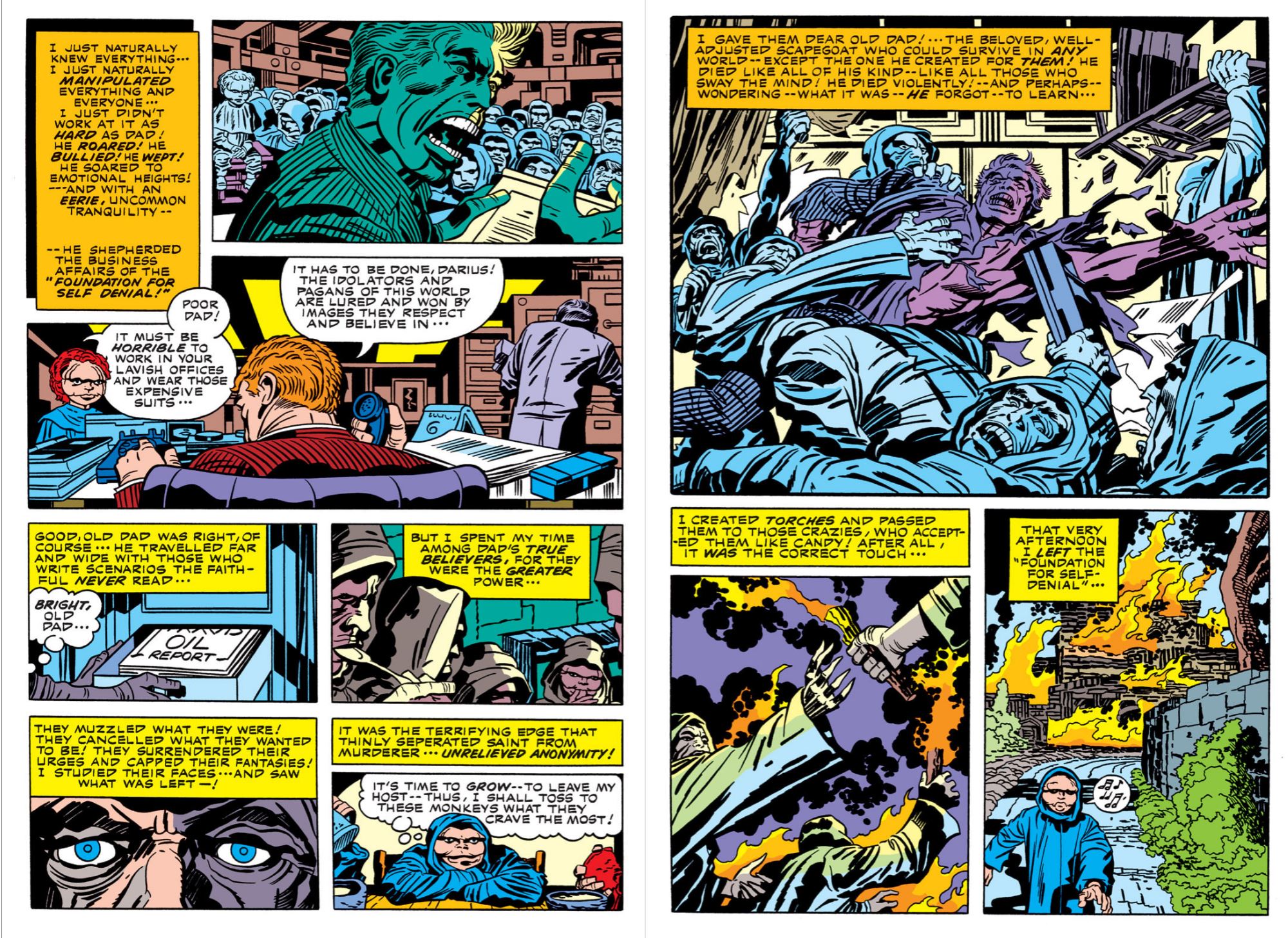
Sadly, the hero’s success rate is pretty abysmal, and Drumm’s twisted religious mania gives him an advantage in the war, as seen in ‘The Super-Normals: Are they God’s or Satan’s Children?’ It seems the tireless demagogue is also charismatic leader of a vast, anti-happiness and wellbeing cult…
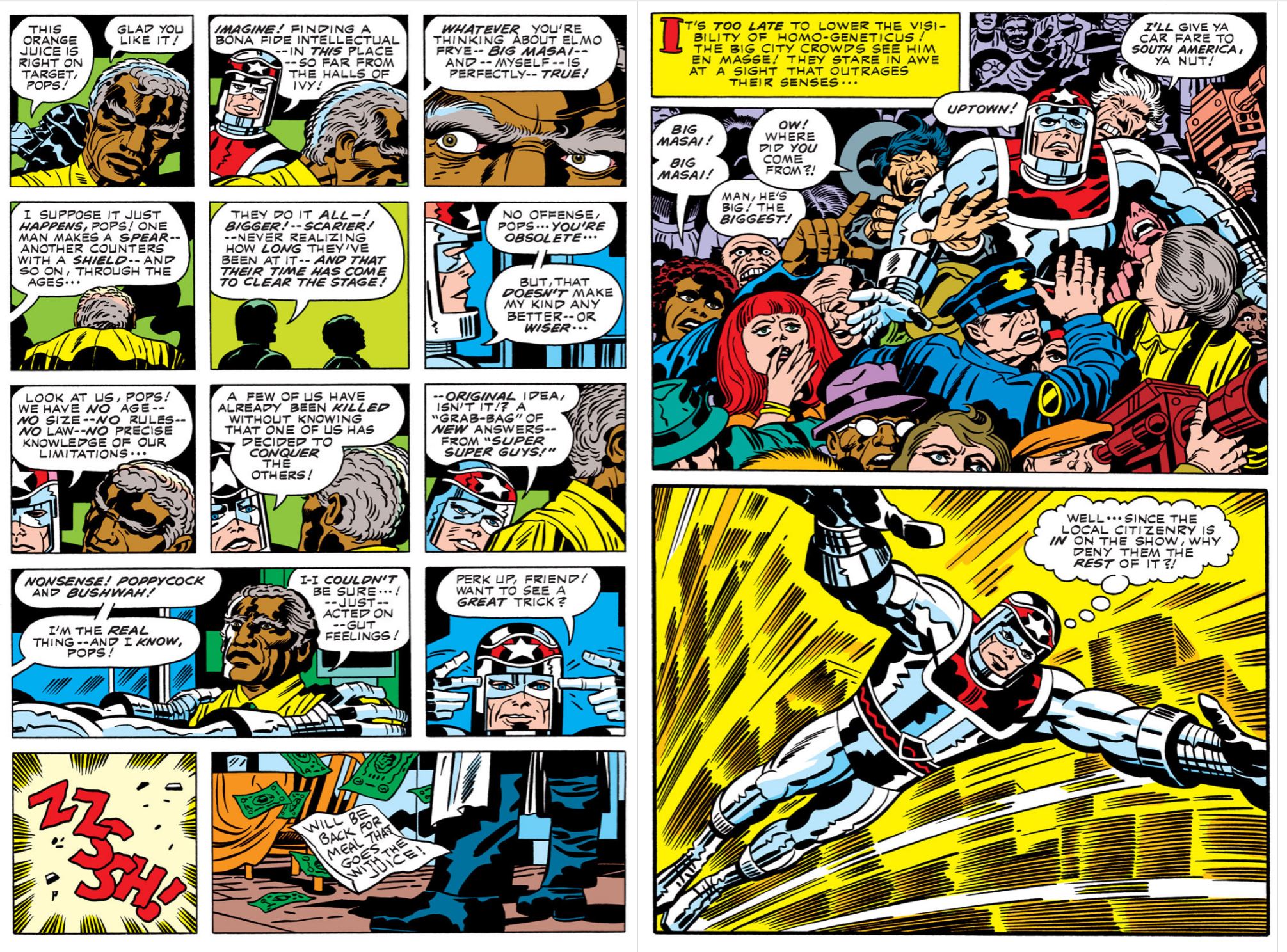
The first four issues were inked & lettered by Mike Royer with colours from Janice Cohen, but the remaining two chapters – which coincided in the 1980s with Pacific moving to more experimental print processes and paper stock (with a noticeable loss of reproduction quality) – are graced by the pens & brushes of D. Bruce Berry. They’re re-coloured for this edition by Erik Larsen & Eric Stephenson, who usher in a climactic showdown and moment of global revelation as ‘The World According to Drumm!’ sees hard-pressed hero Silver Star and his surviving species-mates zeroing in on the killer. Their foe, however, has expanded his remit to encompass all of Earth, forcing the hero to battle a science-spawned ‘Angel of Death!’…
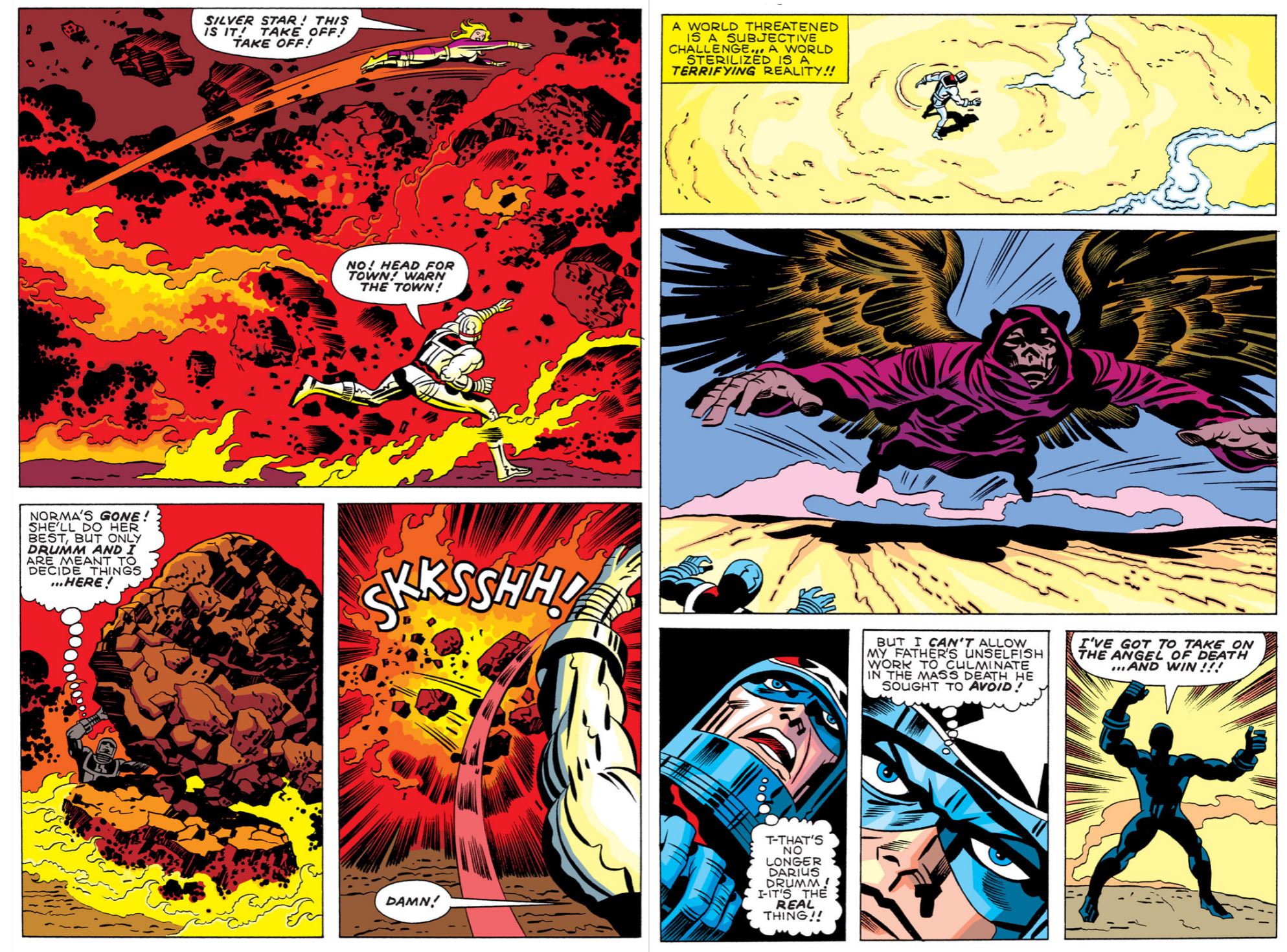
Peppered throughout with concept and developmental sketches, unused artwork, covers, pinups and designs inked by the likes of Jim Lee & Joe Sinnott, Kirby’s self-described and long-awaited Visual Novel also offers a lavishly illustrated look at his & Steve Sherman’s Silver Star Original Screenplay.

Kirby’s commitment to wholesome adventure, breakneck action and breathless wonderment combined with an absolute mastery of the comic page and unceasing quest for the Next Big Thrill always made for a captivating read. His comics should be compulsory for all and found in every home…
© 2007 the Jack Kirby Estate. All rights reserved.

Born today in 1929 was real life Wonder Woman Marie Severin (EC comics, Hulk, Doctor Strange, Sub-Mariner, Kull the Conqueror, Not Brand Echh, Superman Adventures); sharing festivities with Gary Friedrich (Monster of Frankenstein, Captain Atom, Hulk, Captain Britain, Captain America, Ghost Rider, Sgt. Fury, Capt. Savage and His Leatherneck Raiders, Hell-Rider) in 1943 and Spanish artist Juan José Ryp (Wolverine, Frank Miller’s Robocop, Clone) in 1971.

In 1984 we lost distributor and founder of comic conventions Phil Seuling, and on this day in 1993 British tabloid weekly The Topper closed its oversized doors for good after a sterling and mostly manic run that began on January 21st 1956.
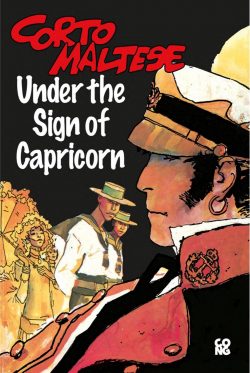
Corto Maltese: Under the Sign of Capricorn (A Corto Maltese USA Graphic Novel)


By Hugo Pratt, translated by Dean Mullaney & Simone Castaldi (CONG SA)
ISBN: 978-2-940552-42-9 (Digital edition), ASIN: B0BZ4YY5BK

This book include Discriminatory Content included for dramatic effect.

Born in Rimini on June 15th 1927, Ugo Eugenio Prat, AKA Hugo Pratt, wandered the world in his early life, and became one of its paramount comics creators. His enthralling pictorial inventions since Ace of Spades (whilst still a student at the Venice Academy of Fine Arts in 1945) were many and varied. His signature character – based in large part on his own exotic formative years – is mercurial soldier (perhaps sailor is more accurate) of fortune Corto Maltese who will be celebrating 60 inglorious years of disservice in July 2027.

Pratt was a consummate storyteller with a unique voice and starkly refined graphic style that should not work, but so wonderfully does. Usually and preferably viewed in stark monochrome, his tales blended pared-down, relentlessly modernistic narrative stylism with complex and memorable characters, often bordering on pure archetypes.

By placing a modern, morally ambivalent antihero in an era where his actions and responses to old-world duties and attitudes should make him a scoundrel and villain, yet keeping him true to an utterly personal, ironclad yet chimerical ethical integrity that went beyond considerations of race, class or gender, Pratt created an adventurer yardstick against which we cannot help but measure all other heroes. There and then, as empires faded and colonies fell, itinerant Corto Maltese dealt with and was moved by people, not money, national concepts and institutions or traditions. He was ever a whimsical man of action and a faithful humanist with a gift for being in the wrong place at the right time. We’ll return to him momentarily…

After working in both Argentinean and, from 1959, on English comics and true blue characters like Battler Briton, Hugo Pratt made a name for himself. In the UK he produced weekly serial fare and especially complete stories for our (extremely popular) digest graphic novel lines including Super Picture Library, Air Ace Picture Library, Action Picture Library and Thriller Picture Library. These were half-sized, 64-page monochrome booklets with glossy soft-paper painted covers presenting complete stories in 1-4 panels per page. This was a luxury of layout and page design he would return to in his later years. Particularly suited to combat titles, Pratt worked on exotic jungle yarns for War Picture Library, Battle Picture Library, War at Sea Picture Library and more. In the mid-1960s Pratt resettled in Italy and (in 1967) produced with Florenzo Ivaldi a number of features for monthly comic anthology Sgt. Kirk. In addition to the titular Western star, Pratt created pirate strip Capitan Cormorand; detective Lucky Star O’Hara, and a moody South Seas saga called Una Ballata del Mare Salato (A Ballad of the Salty Sea) and now regarded as the first official adventure of the insalubrious mariner. When the anthology folded in 1970, Pratt moved to France and took Una Ballata’s breakout character to French weekly Pif Gadget before eventually settling in at legendary Belgian periodical Le Journal de Tintin. Corto Maltese proved as much a Wild Rover in reality as in his historic and eventful career…

The sailor was soon seen all over Europe, filling a dozen multi-translated albums. His peripatetic exploits (both short-form tales and extended sagas in black-&-white yarns) were shared in no particular order and spanned 1967 to 1989, covering the old rogue’s wanderings between the turn of the 20th century and the 1930s. Corto won international awards and his own eponymous title, running between October 1983 and July 1993. Hugo Pratt died on August 20th 1995.

In 2014, current rights owner CONG SA regenerated the dormant property with new Corto albums created by writer Juan Díaz Canales (Blacksad) & illustrator Rubén Pellejero (El silencio de Malka) generating 5 new albums thus far. A year later, US publisher IDW began releasing English language translations (repaginated & “colorized”) of prime Pratt to mixed reviews, and in 2022 Spanish parent company CONG: Hugo Pratt Art Properties started a line of curated collections as eBooks, of which Under the Sign of Capricorn is the first. It’s still in color – but sensitively done – so if you’re a graphic purist who can’t abide the hues, you might prefer to track down the mid-1980s Corto Maltese volumes from NBM that we covered way back in 2007…

Chronologically, Under the Sign of Capricorn was the third captain’s log of salty seadog sagas. It’s 1916 – one year after the events of Ballad of the Salty Sea – as we open with ‘The Secret of Tristram Bantam’ wherein Corto broods, smokes, drinks and ponders at the Java Inn, Paramaribo, in the debilitating heat of Dutch Guyana. A magnet for trouble and sucker for sob stories, despite his hostess’s warnings he adopts drunken wretch and target of bullies Professor Jeremiah Steiner and is simultaneously sought out by a runaway English schoolboy beset with dreams and premonitions…

Current possessor of certain valuable papers indicating the location of the fabled lost kingdom of Mû, young Tristram’s father was an “associate” of worldly knife-throwing Madame Java and has sought her out as a possible means of meeting his disreputable half-sister Miss Morganna Dias do Santos Bantam of San Salvador de Bahia. All this has made Tristan the unwitting subject of nefarious scrutiny from his own lawyer Milner in London, the firm’s Javanese representative Kerster, locals like voodoo queen Ogun Ferraille and assorted murderous thugs. This results in a succession of murder attempts and the sinking of Maltese’s beloved boat…

Captain Maltese has heard many ridiculous and unprofitable fables in his time but is compelled in this instance by just how many rogues and killers are trying to take the papers from his new pint-sized admirer, and with Steiner and the kid in tow sets off to solve the mystery and find Mu…

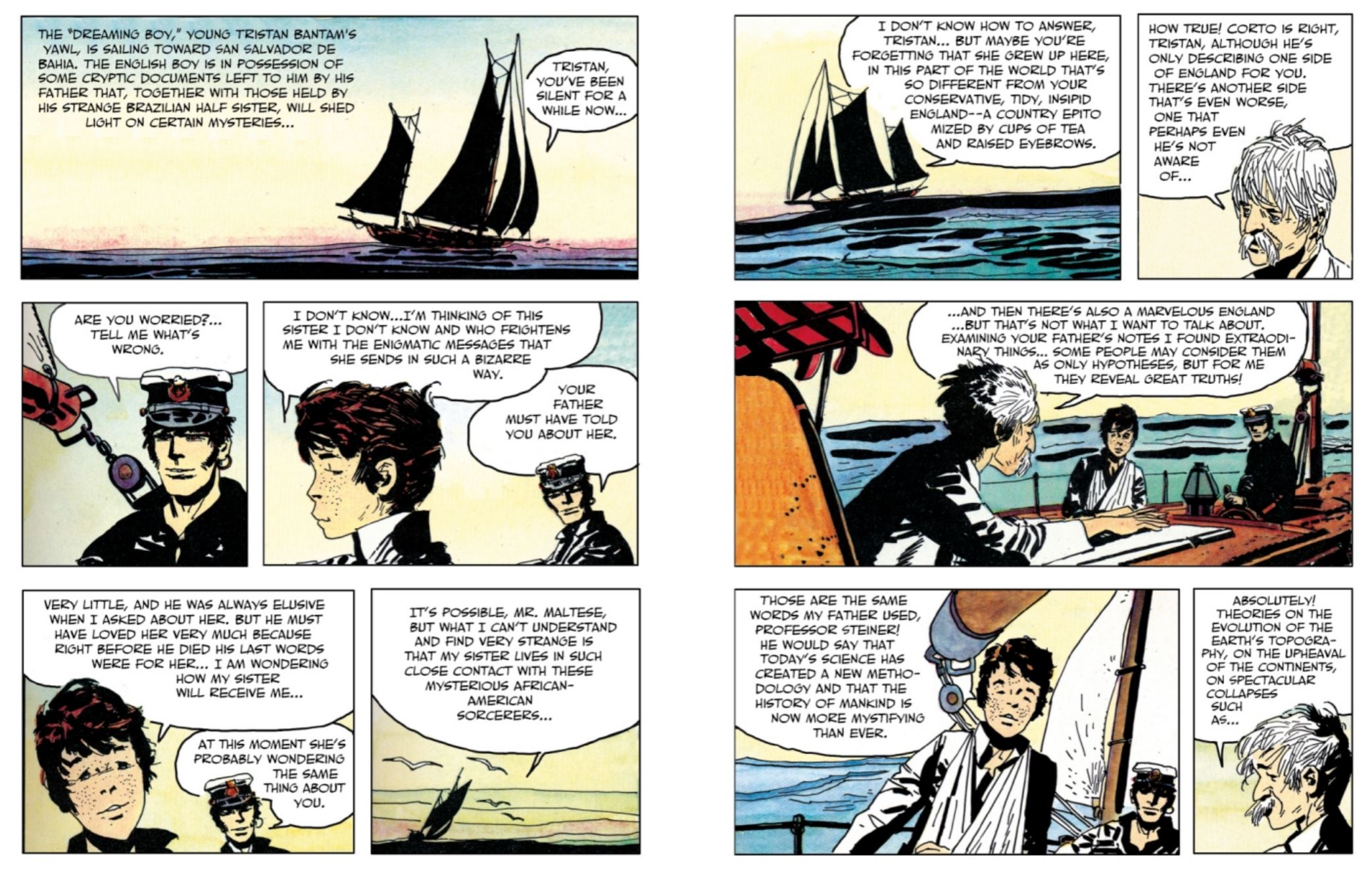
The mystery deepens in ‘Rendez-Vous in Bahia’ as Bantam’s yawl The Dreaming Boy sails for Bahia to find Morgana. She has their father’s notes about the lost continent, documents Tristan has only tantalisingly glimpsed in dreams, These are getting more compelling and engrossing as the voyagers arrive meet a native shaman and accidentally expose a convict trafficking scheme. Recently arrived big boss Milner tries to save himself by killing Tristan but instead loses his own life thanks to Corto’s skill with cards and weapons, leaving the trail apparently clear sailing from now on…

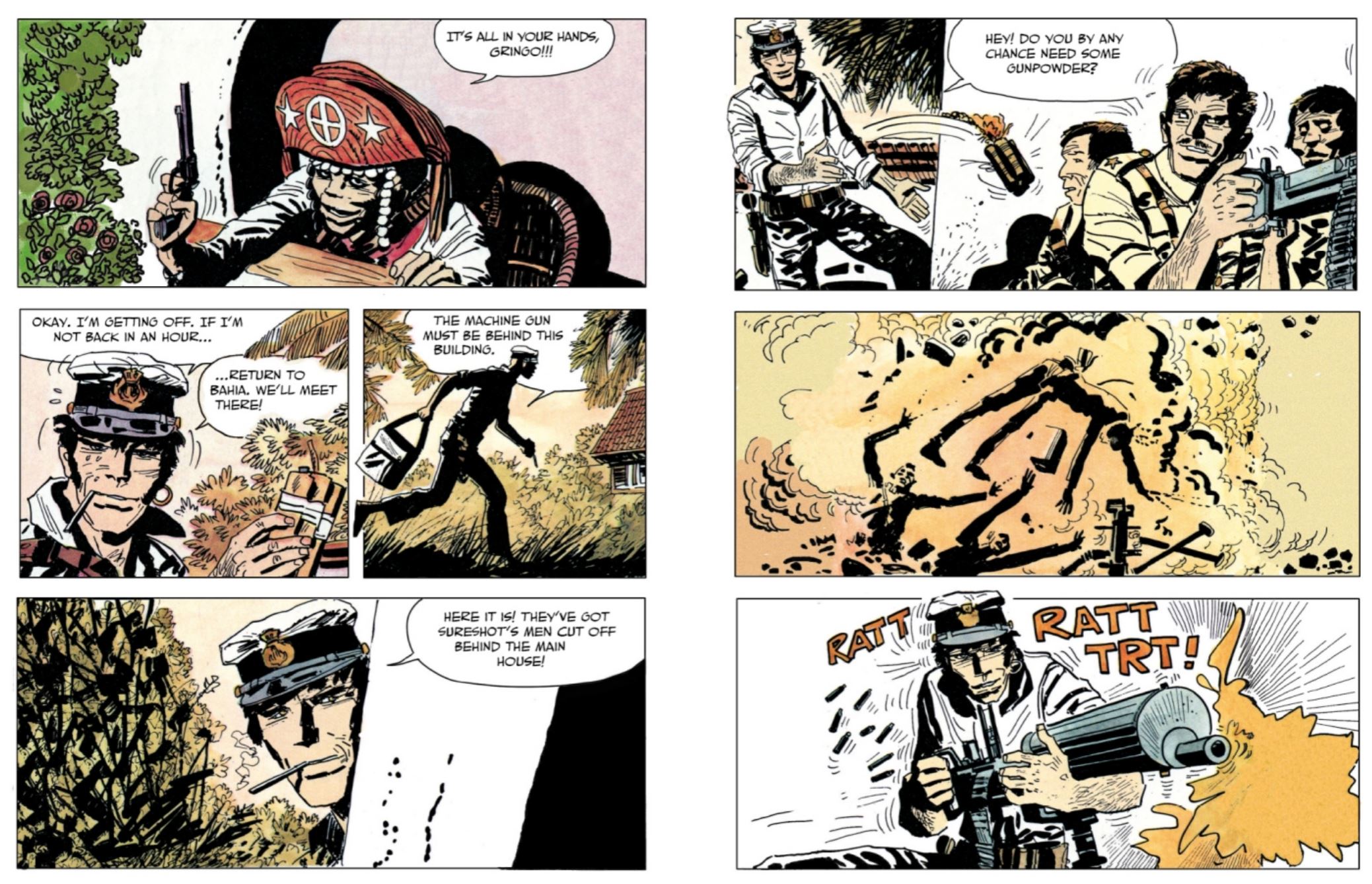
‘Chapter Three: Sureshot Samba’ sees the seekers reach Itapoa, where Corto, Tristan and Steiner meet Bocca Dorata AKA Gold Mouth: a great sorceress who raised Morgana and taught her black and white magic. The enigmatic sage somehow knows far too much about Corto’s past and origins for comfort, but nevertheless he accepts her proposal to ferry weapons and cash to Cangaceiros. There, rebel natives led by local legend Sureshot fight in the Brazilian Sertão against landholding European tycoons, murderous mercenaries, corrupted Federal Colonel Gonçalves and his requisitioned river gunboat. After all, £1000 is not to sneezed at…

Corto deals with his opponents and competes his mission with startling violences and efficiency and assures a swift brutal change in political fortunes…

Still houseguests of Gold Mouth, in ‘The Basilian Eagle’ reluctant slave liberators/freedom fighters Corto, Tristan & Steiner are caught in the backwash of the Great War. As they sail the coast seeking a wrecked Spanish galleon loaded with gold – it supposedly foundered near Marajò Island, at the mouth of the Amazon – they are trapped by global politics and international intrigue as colonial powers Great Britain and Germany square off in Brazil. Wallowing in innocent avarice, our derelict adventurers become unwitting competitors with a German Baron and apparent naval “deserters”. Enfolded in the byzantine scheme hatched by Bocca Dorata, Corto’s fate comes down to actions of rogue operatives, a double/triple agent dubbed “Jawbreaker”, overwhelming greed and gunboat diplomacy…

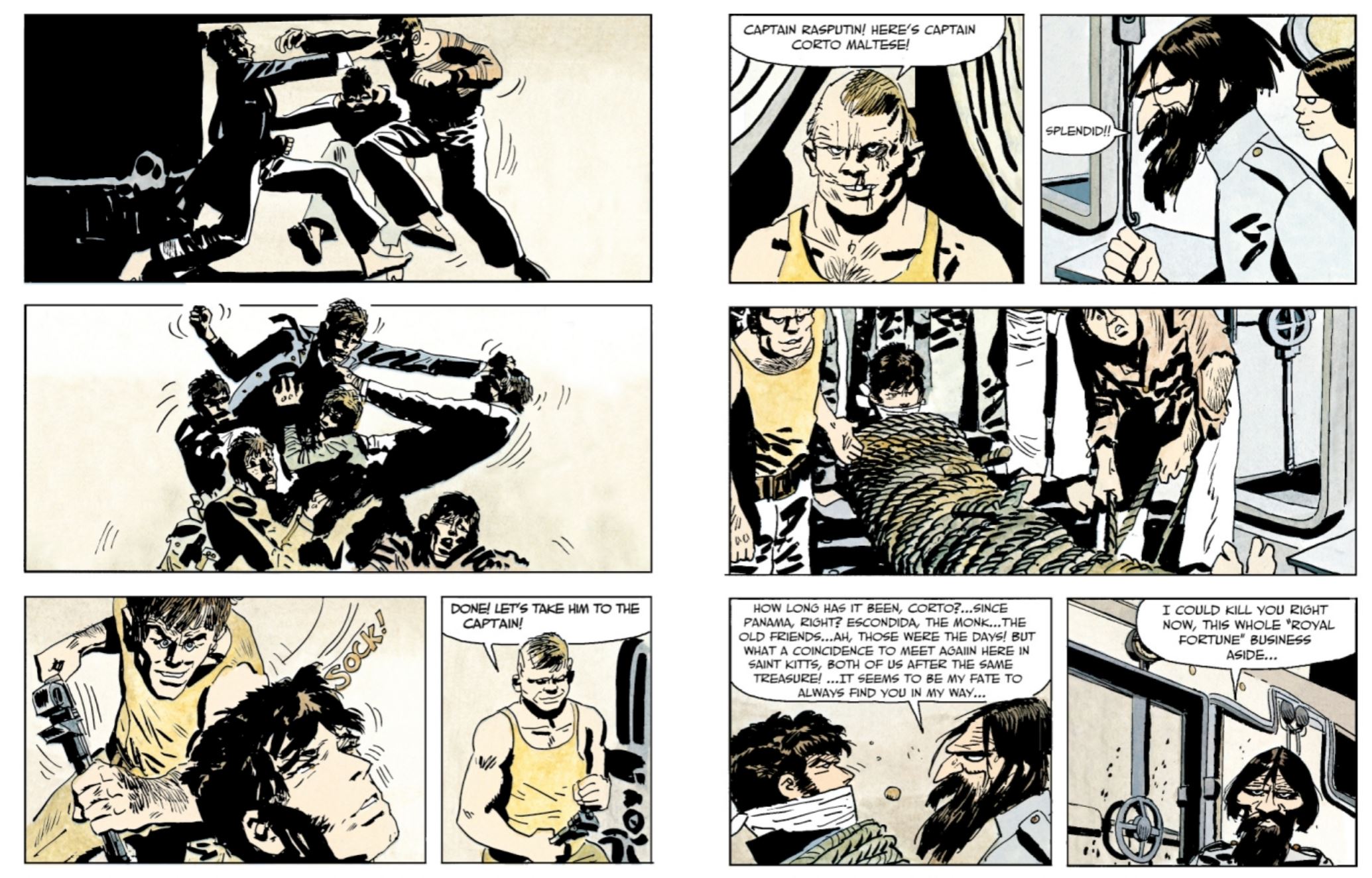
In earlier-set tales, Corto Maltese visited Russia and made an enemy for life of wild rogue/ spiritual anthesis Rasputin (no relation). Now that ferocious frenemy shows up in ‘So Much for Gentlemen of Fortune’ in an adventure centred on the search for fabulous pirate treasure, set in Saint Kitts in the Antilles. Still reading and rereading those papers brought by Tristam, Corto & Steiner happen upon a singular grave and a clue leading to confrontations and untenable alliances with contemporary freebooters Rasputin and Ambiguity di Poincy, all similarly in search of the amalgamated hoard of creole corsair Prying Barracuda, Calico Rackman, Agonia La Bella of Rochelle and Blackbeard Teach…

The game of double dealing leads to vast wealth and huge surprises, but in the end such friendships are doomed and savage bloodletting leaves everyone dead broke or both and Corto counting the cost of what and who he’s lost…

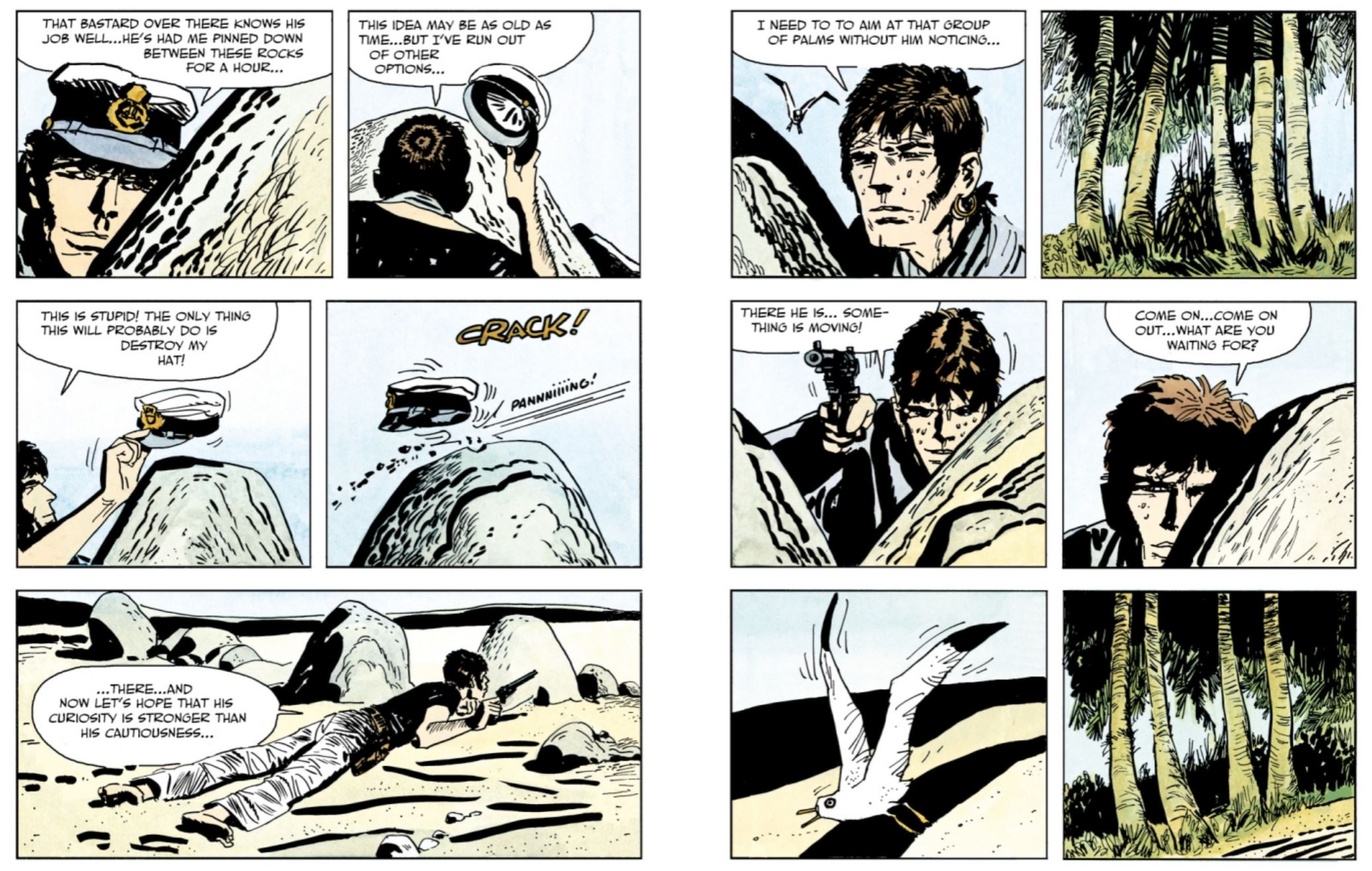
Concluding episode ‘The Seagull’s Fault’ lays the groundwork for more tales in a bizarre murder-mystery set on an island near British Honduras. Wounded and amnesiac, our Not-a-Hero reels on a bloody beach as his life ebbs away. As he blankly watches his totem animal fly, peck and probe, “John Smith’s” memories lie just beyond reach. Maybe it wouldn’t be so bad if the stranger he can’t see would stop shooting at him…

It gets no clearer when lovely angel Soledad and her brutish Caribi minder arrive, as their tender ministrations in the gothic pile they call home soon prove to be barbed and double edged. If only he could remember what all this has to do with legendary pirate and merciless “Evangelist” Judas Lokäarth. Surely, though, that long-missing maniac is dead and gone?

Compelling, enticing and invitingly addictive, these bleak but witty, darkly romantic, captivatingly cosmopolitan stories will grip you and never let go. These are treasures you must unearth and cherish forever.
© 1971 Cong S.A., Switzerland. Corto Maltese® and Hugo Pratt™ © Cong S.A. Translation © 2019 Dean Mullaney and Simone Castaldi, All rights reserved.

Today in 1915 artist, inker, letterer & colourist George Roussos (Batman, Johnny Quick, Airwave, Vigilante, Superman, Starman, CrimeSuspensStories, Flash Gordon, The Phantom, Sgt Fury, Fantastic Four, Avengers et al) was born, followed in 1930 by cartoonist Bill Rechin (Out of Bounds, Crock), and in 1968 artist Jeff Johnson (Wonder Man, Amazing Spider-Man, Way of the Rat, Weapon X, Greem Lantern) and writer/filmmaker Greg Pak (City Boy, John Wick, Eternal Warrior, World War Hulk, Incredible Hercules, Firefly, Agents of Atlas).

This day marks the passing of three giants: inventor of comic books Max Gaines in 1947; British legend Dudley. D. Watkins in 1969 and Hugo Pratt in 1995.

Sgt. Fury and his Howling Commandos Epic Collection: Volume 1 (1963-1965): The Howling Commandos


By Stan Lee, Jack Kirby & Dick Ayers, with George Roussos, Steve Ditko, Frank Giacoia, Vince Colletta, Chic Stone & various (MARVEL)
ISBN: 978-1-3029-1657-2 (TPB)  978-1-3025-1036-7 (Digital edition

This book includes Discriminatory Content produced in less enlightened times.

On August 28th 1917 in New York’s Lower East Side, Jacob Kurtzberg was born to Jewish-Austrian parents. He grew up to be one of the most influential and recognisable artists in world history. We’ll be celebrating his legacy of 99 years and counting over the next few weeks and rest of the year, but let’s start with the title all budding Marvelites rated least when he and Stan Lee first began changing comics together…

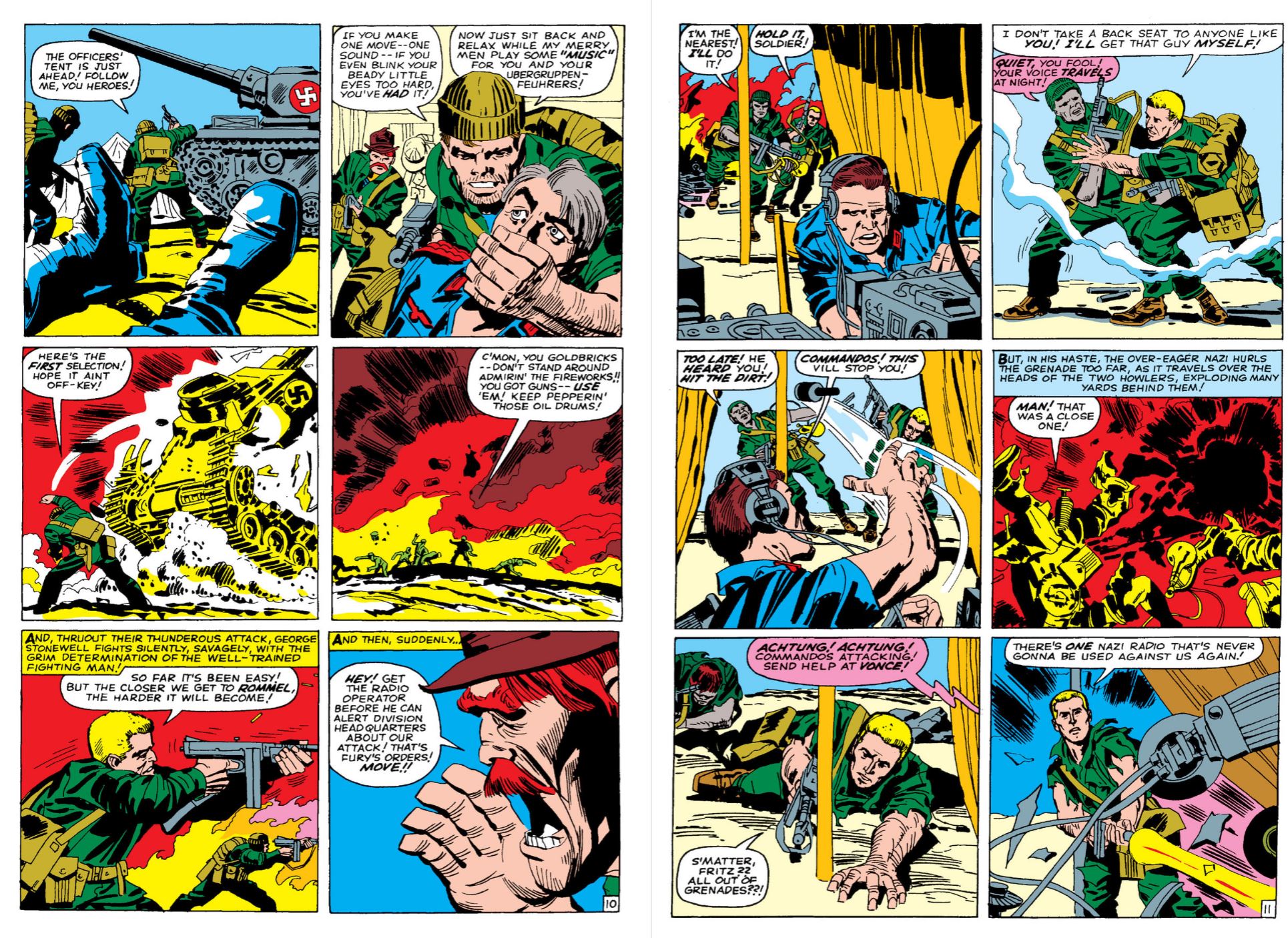
Sgt. Fury and his Howling Commandos began as an improbable, raucously over-the-top WWII combat comics series similar in tone to ensemble action movies like The Magnificent Seven, and such later offerings as The Wild Bunch and The Dirty Dozen. Our surly squad of sorry reprobates premiered in May 1963; one of three teams specifically concocted by men-on-fire Jack Kirby & Stan Lee to cover their genre bases whilst securing fledgling Marvel’s growing position as the publisher to watch.

Two years on, Fury’s post-war self was retooled as the big-name star of a second series (beginning with Strange Tales #135, August 1965) when espionage shows like The Man from U.N.C.L.E. and 007 film franchise were becoming international sensations. Nick Fury, Agent of S.H.I.E.L.D. combined Cold War tensions with sinister schemes of global domination by subversive, all-encompassing hidden enemy organisations with captivating super-science gadgetry and iconic imagineering from Jack Kirby and latterly Jim Steranko.

For all that time however, the original wartime version soldiered on (puns are my cool gadget of choice), blending a uniquely flamboyant house-bravado style, often ludicrous, implausible, historically inaccurate, all-action bombast with moments of genuine heartbreak, unbridled passion and seething emotion. Sgt. Fury started out as a pure Kirby creation. As with all his various war comics, The King (a seasoned WWII veteran who had served under Patton) made everything look harsh and real and appalling: the people and places are all grimy and tired, battered yet indomitable. Jack had survived some of the worst battles of the conflict and never forgot the horrific and heroic things he saw – as more graphically expressed in his comics (such as Foxhole) at different companies during the 1950s genre boom. However, even at kid-friendly, Comics Code-sanitised Marvel, those experiences perpetually leaked through onto his powerfully gripping pages.

Kirby was, sadly, far too valuable a resource to squander on a simple war comic (or indeed the X-Men or Avengers, the other series launched in that tripartite blitz on kids’ spending money) and was quickly reassigned, leaving redoubtable fellow veteran Dick Ayers to illuminate later stories, which he did for almost its entire run (95 issues plus Annuals) until transition to a reprint title with #121 (July 1974). The title then carried on until its ultimate demise in December 1981 with #167.

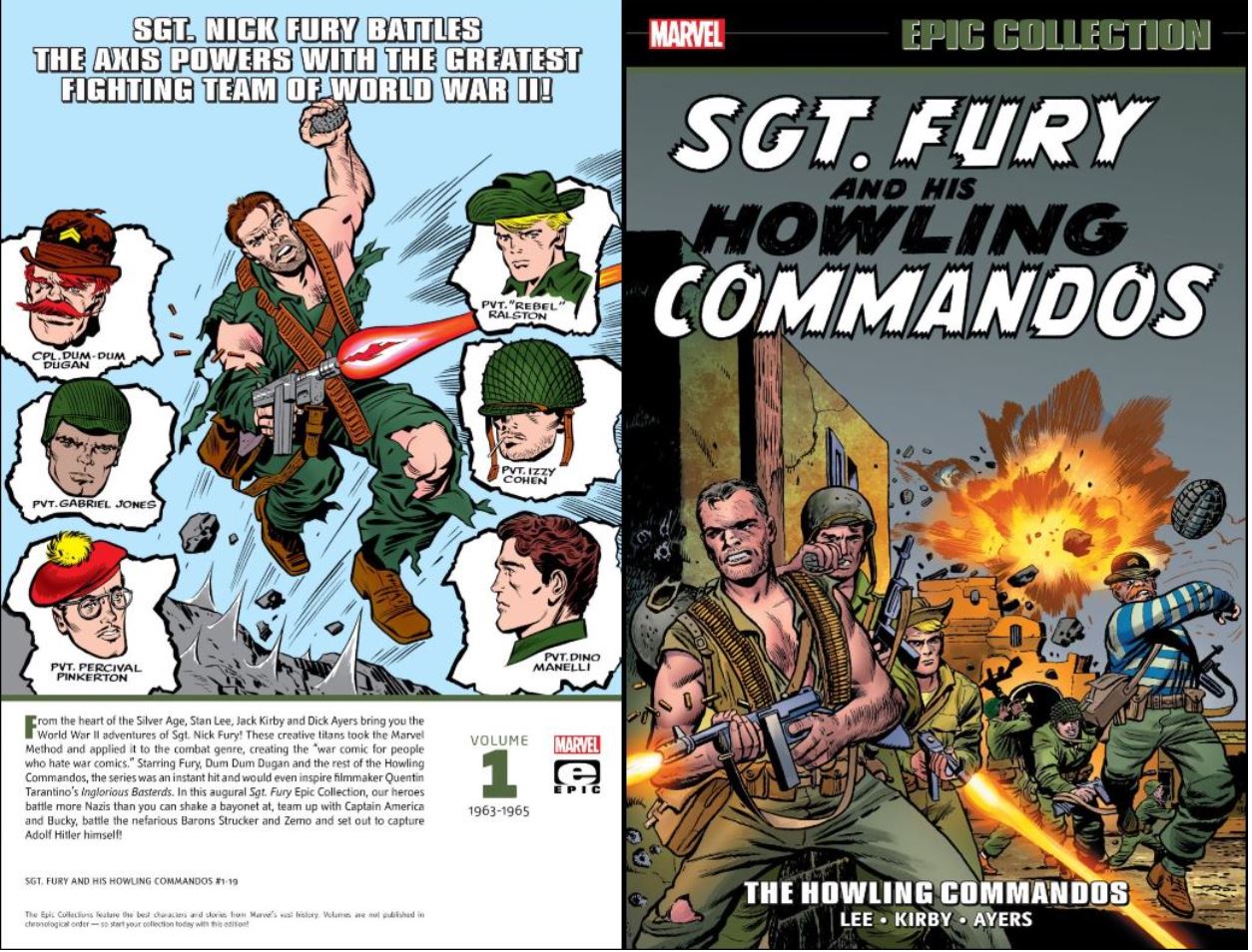
This initial compendium collects the contents of Sgt. Fury and his Howling Commandos #1-19 (spanning May 1963 – June 1965) and opens just as you’d expect with blistering premier ‘Sgt. Fury, and his Howling Commandoes’ (that’s how they spelleleled it in the storree-title – altho knot ennyware else).

Crafted by Lee, Kirby and inker Dick Ayers, the rip-snorting yarn is bursting with full page panels interrupted by ‘Meet the Howling Commandos’ – a double-page spread starring the seven members of First Attack Squad; Able Company. This comprised Fury himself, former circus strongman/Corporal “Dum-Dum” Dugan and Privates Robert “Rebel” Ralston (a Kentucky jockey), college student Jonathan “Junior” Juniper, jazz trumpeter Gabriel Jones, mechanic Izzy Cohen and glamorous movie heartthrob Dino Manelli. Controversially – even in the 1960s – this combat Rat Pack was an integrated unit with Jewish and black members as well as Catholics, Southern Baptists and New York Irish white guys all merrily serving together. The Howling Commandos pushed envelopes and busted taboos from the very start.

The first mission was a nonstop action romp pitting ‘Seven Against the Nazis!’ putting the squad through their unique paces as a ragged band of indomitable warriors took on hordes of square-necked Nazis to save D-Day and rescue a French resistance fighter with vital plans of the invasion. They even bring back a high-ranking “kraut” prisoner and leave room for a Kirby fact-page comparing and contrasting six different side-arms of the period in ancillary feature ‘Weapons of War’…

SF&HC #2 found ‘7 Doomed Men!’ up to their torn shirts in Germans as they first infiltrate a French coastal town to blow up a U-Boat base and get back to England just in time to be sent on another suicide mission. This time it’s to destroy a secret facility at Heinemund in the heart of the Fatherland, where Nazi scientists are doing something sinister and nefarious with “hard water”. These overblown fustian thrillers always played fast and loose with history and logic, so if you crave veracity above all, I’d steer clear, but if you can swallow a heaping helping of creative anachronism there’s always great fun to be had here – especially since nobody drew atomic explosions like Kirby. This drama is capped with fact pages as ‘The Enemy That Was!’ explores the capabilities of ‘The German Infantryman’ whilst ‘Weapons of War: “Chatter Guns” of World War II’ details all you need to know about submachine guns.

Rough-&-ready gallows humour and broad comedy became increasingly important to the series from SF&HC #3 onwards, with home base rivalries and comradely sparring leavening the outrageous nonstop carnage of the missions. ‘Midnight on Massacre Mountain!’ sees the septet explosively invading Italy to rescue a US army division caught in a Nazi trap. Along the way they meet a brilliant OSS officer training partisan troops, and Fury especially believes that young Reed Richards will go far…

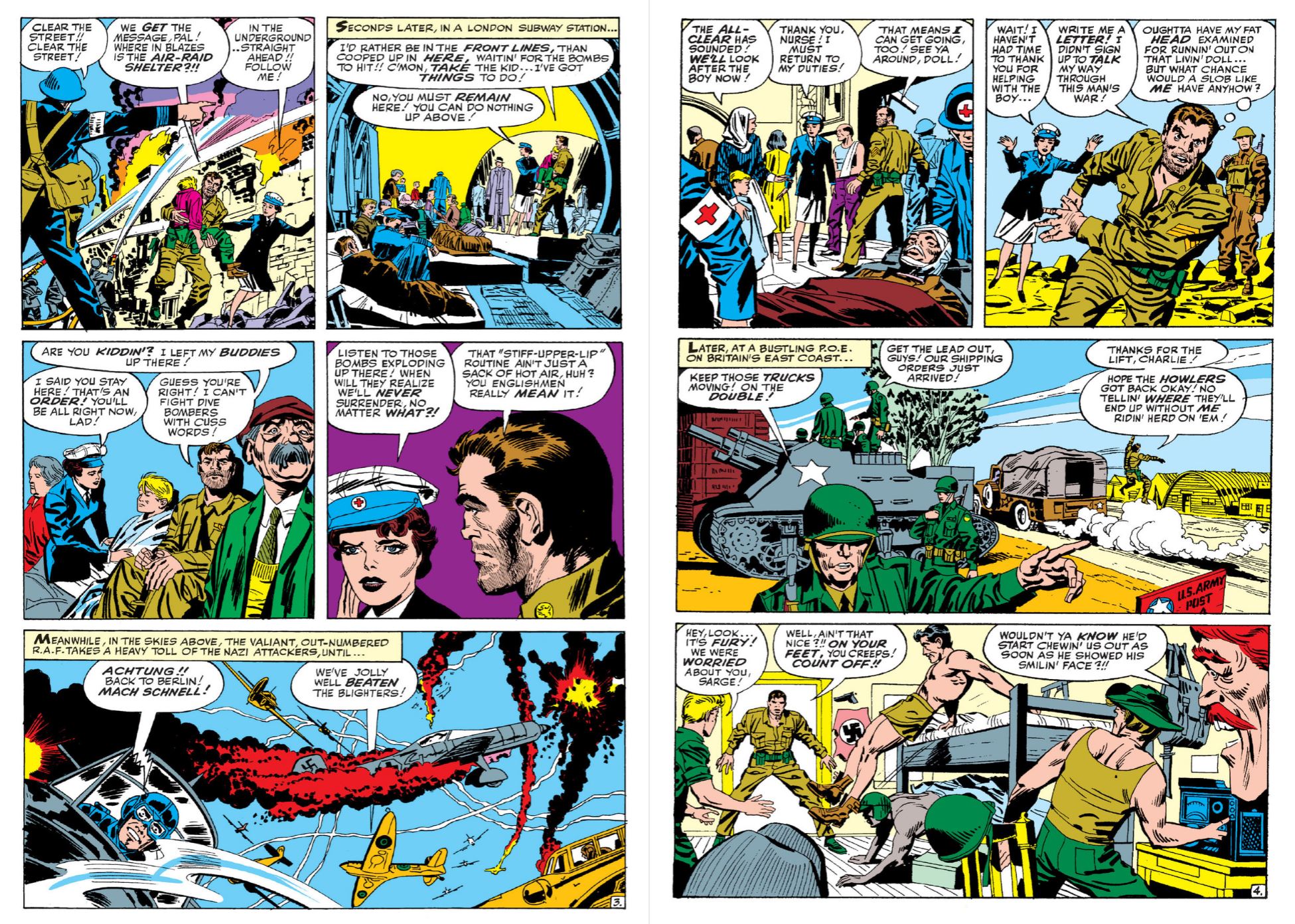
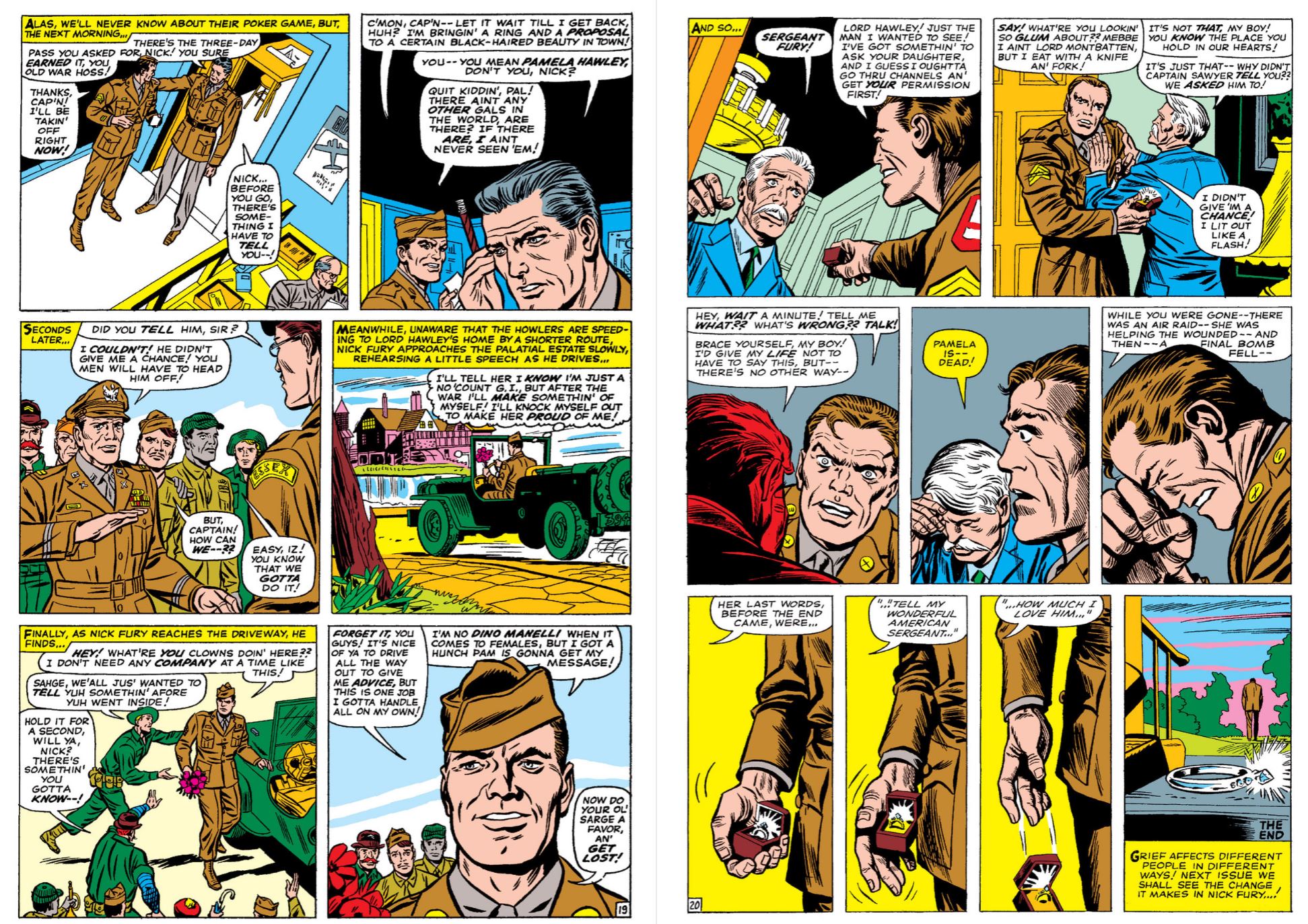
Supplementing this exploit is a fascinating feature revealing what ordnance and hardware cost in ‘America’s World War II Shopping List!’ before, in #4, ‘Lord Ha-Ha’s Last Laugh!’ began an inking tour of duty for “George Bell” (Kirby’s 1950s studio-mate George “Inky” Roussos) and introduced a love interest for the Sarge, after he meets aristocratic Red Cross volunteer Lady Pamela Hawley during a London air raid. How cruel and tragic was fate then, that the Howlers’ very next mission takes them to Berlin to kidnap a young British nobleman with the same name, now acting as a crucial propaganda mouthpiece for the Wehrmacht…

The mission is a double disaster. Not only does Pamela’s ignoble brother perish, but the debacle also costs the life of a Howler. Bonus feature ‘Weapons of War: Combat Rifles of World War II’ follows this shocking, surprisingly grim and low-key melodrama…

Fury’s key appearance as a CIA agent in FF #21 (not included here) was released between that issue and #5, but no mention is made of it as the dark and cunning yarn introduces one of Marvel’s vilest, greatest villains. ‘At the Mercy of Baron Strucker’ sees Fury humiliated and defeated in personal combat against an Aryan nobleman who uses candid filmed footage as a propaganda tool of the Nazis. Only too late does dashing Dino point out how the nonplussed noncom has fallen for the oldest trick in Hollywood’s archvillain playbook…

A riotous rematch goes rather better after which ‘Weapons of War: Light Machine Guns of World War II’ ends matters in a graphically educational manner, before ‘The Fangs of the Desert Fox!’ in #6 dumps the Squad in the desert to confront the massed forces of General Erwin Rommel in a mission foredoomed to fail. ‘The Court-Martial of Sergeant Fury’ provides a glimpse into the hard-bitten hero’s past and offers insights into his tempestuous relationship with immediate superior Captain Samuel “Happy Sam” Sawyer. Of course, to get that information we must watch Fury endure a dramatic trial after seemingly sabotaging a mission and striking a commanding officer…

Although continuing to draw the magnificent, eye-catching covers, Kirby left the title with this issue. His astounding abilities were more profitably employed in superhero titles, even as Lee began consolidating the ever-expanding Marvel Universe by utilising more WWII iterations of contemporary characters. In #8 ‘The Death Ray of Baron Zemo!’ pits Howlers against a Captain America villain recently debuted in The Avengers. Ayers & Roussos capably depict the squad’s attempts to capture a Nazi super-scientist and a weapon which could shape the outcome of the entire war. The tale introduced Junior Juniper’s replacement: a rather fruity caricature of a British soldier named Percival Pinkerton, resplendent in horn-rimmed specs, pencil moustache, fuchsia beret and impossibly utilitarian umbrella…

In #9 implausibly audacious ‘Mission: Capture Adolf Hitler!’ goes awry after the Howlers’ latest incursion into Berlin brings Fury face-to-face with Wolfgang von Strucker; leading to his temporary capture and an astounding escape, after which ‘On to Okinawa!’ in #10 sees the squad achieve far greater success when despatched to the Pacific to rescue a captured US colonel from the Japanese. This exploit also saw the debut of a bearded bombastic submarine commander who would become a series regular before eventually winning his own title (Captain Savage and his Leatherneck Raiders) in 1967.

Post-Kirby, the pace visibly slowed and melodramatic subplots increased. In #11, ‘The Crackdown of Capt. Flint!’ depicted Happy Sam briefly replaced by a spit-&-polish officer who soon learns the limitations of his ways, after which in #12, a raid on a V1 factory in the heart of Europe seemingly prompts Dino to join the Nazis ‘When a Howler Turns Traitor!’ It was just a pre-arranged ploy of course, but sadly nobody told the US commander, who latterly stuck the star in front of a firing squad…

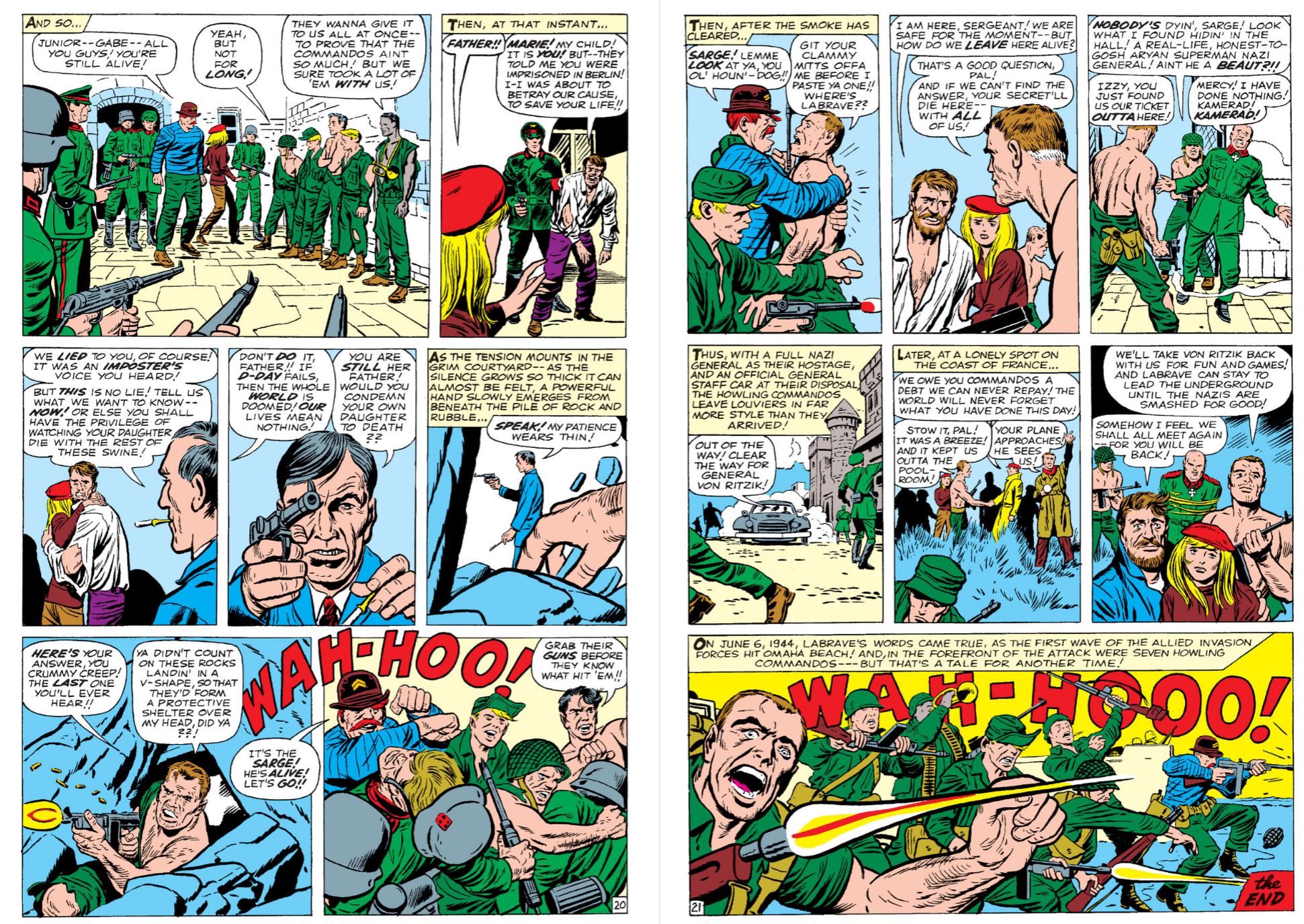
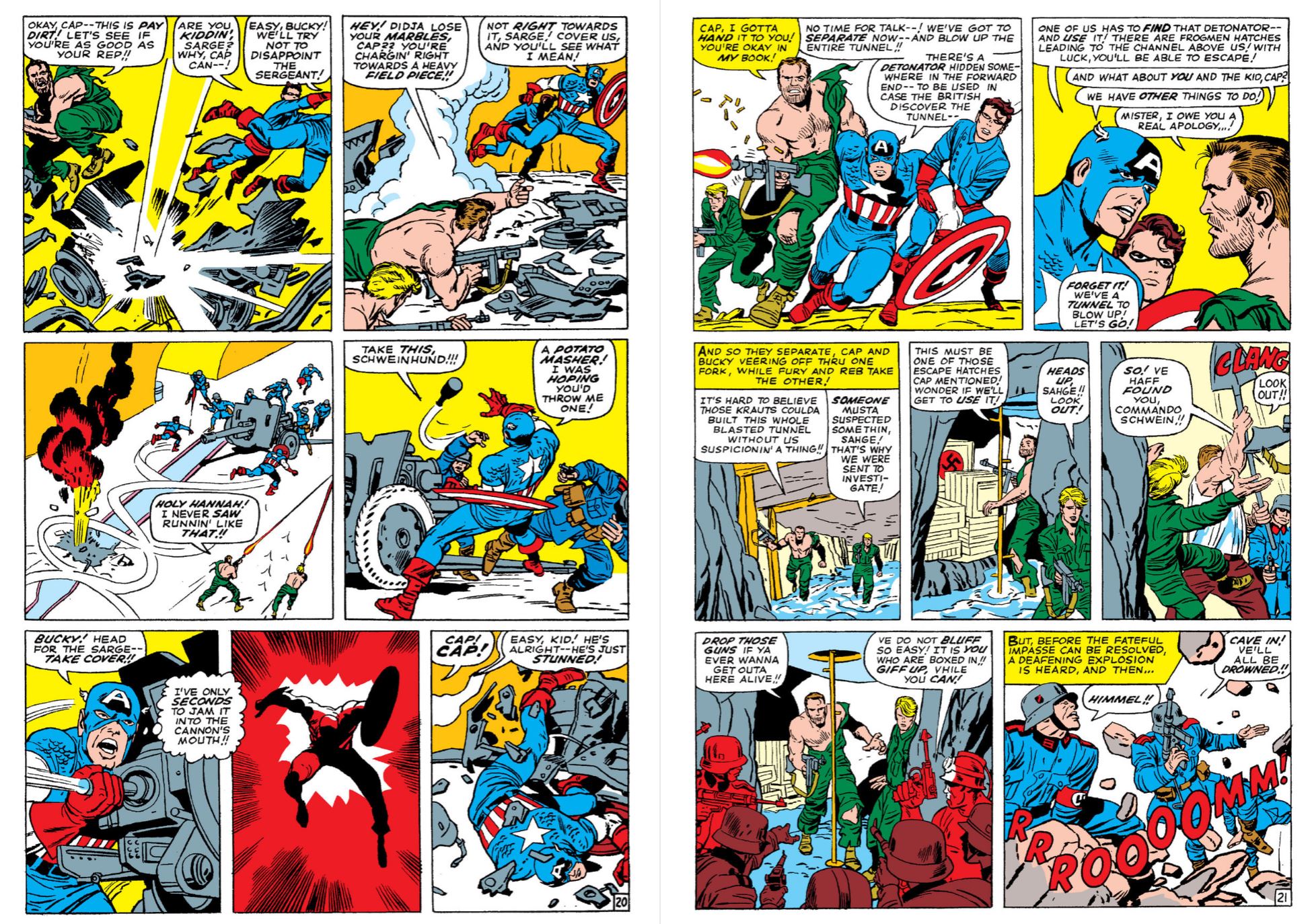
This issue also included a Marvel Masterwork Pin-up of Fury by Ayers, before Sgt. Fury and his Howling Commandos #13 offered arguably the best issue of the entire 167 issue run. The title said it all: ‘Fighting Side-by-Side with… Captain America and Bucky!’ reunited Lee, Kirby & Ayers in a blistering battle yarn wherein the Howlers cross paths with the masked Sentinels of Liberty after both teams stumble across a top-secret Nazi operation to build an invasion tunnel under the channel to England. To resort to the vernaculars of those times: “Wah-Hoo!”…

Ayers was back pencilling in #14, with Lee scripting and Roussos inking a minor milestone as harassed Adolf Hitler decrees the creation of a Nazi answer to Fury’s elite attack force. All ‘The Blitzkrieg Squad of Baron Strucker!’ had to do was lure the Howlers to a V2 rocket base and spring their trap…Yeah, that’s all…

Irregular supplemental feature Weapons of War provides the gen on the ‘B-26 Martin Marauder’ to inform and entertain in equal amounts before Steve Ditko stepped in to ink Ayers in issue #15 as ‘Too Small to Fight, Too Young to Die’ relates an ill-fated mission in Holland to destroy the dykes and flood the occupation forces. It all goes drastically awry and the Howlers “flee” back to Blighty with nothing but broken-hearted boy Hans Rooten… who has no idea that his despised quisling father is in fact now the Allies’ top spy in the region…

Hans is adopted as the Howlers’ plucky mascot but can’t accompany them when the squad is despatched to Africa in #16 to eradicate yet more Nazi super-weapons in ‘A Fortress in the Desert Stands!’ (pseudonymously inked by Frank Giacoia as Frankie Ray). From there it’s only a short camel-ride south until the ragtag rovers encounter spear-wielding natives and nasty Nazis engaged in a battle of Hearts & Minds ‘While the Jungle Sleeps!’ with Lee & Ayers supported by inker Vince Colletta.

All this time the chalk-&-cheese romantic relationship between Nick and Lady Pamela Hawley had been slowly developing to the point where the Yankee lout was ready to propose. That all ended in Chic Stone inked #18 when, as the unit is busy sinking a German battleship in a Norwegian port, Hawley is ‘Killed in Action!’ Crushed and crazy, Fury goes AWOL in the final tale of this collection, remorselessly hunting down the leader of the bomber flight which had targeted the hospital where she worked and extracting ‘An Eye for an Eye!’ in a satisfyingly shocking Lee story sensitively rendered by Ayers & Giacoia. The Howlers go along for the ride, but whether to help their leader or hold him back is unclear…

Gilding this bellicose lily, the book signs off with a wealth of stunning original art pages from Kirby, Ayers, Ditko, Giacoia, Stone & Roussos; contemporary house ads, and previous collection covers. Whereas close rival DC increasingly abandoned the Death or Glory bombast at this time in favour of humanistic, anti-war explorations of war and soldiering, Marvel’s take always favoured action-entertainment and fantasy over soul-searching for ultimate truths. On that level at least, once Kirby had moved on, these early epics are stunningly effective and galvanically powerful exhibitions of the comics combat genre.

Just don’t use them for history homework.
© 1963, 1964, 1965, 2019 Marvel All rights reserved.

Born yesterday in 1908, Argentinian cartoonist turned Golden Age comics artist Louis Cazaneuve (Quique, el Niño Pirata , Blue Beetle, Red Raven, Captain Savage, Sea Rover, Aquaman) shares the day with Filipino cartoonist Lauro “Larry” Zarate Alcala (Siopawman, Slice of Life, Mang Ambo, Kalabog en Bosyo) in 1926; Italian shock artist Stefano Tamburini (RanXerox, Fuzzy Rat, Snake Agent) in 1955; US comic book star Ron Garney (Captain America, Hulk, JLA, Daredevil, Silver Surfer, BRZRKR) in 1962, and in 1967 writers Brian Michael Bendis (Jinx, Torso, Secret Invasion, Ultimate Spider-Man, Alias) & Pete Tomasi (Batman and Robin, Brightest Day, Green Lantern Corps) and artist Eddy Barrows (52, Birds of Prey, Teen Titans, Superman), with latecomer Nathan Fairbairn (Lake of Fire, Scott Pilgrim, Wonder Woman, Batman Incorporated) arriving in 1976.

Today also saw the passing of Portuguese satirist and political cartoonist Carlos Botelho in 1982; Underground cartoonist Rick Griffin (Zap Comix) in 1991 and Spanish legend Afonso Azpiri Mejía (Black Hawk, Reflections, Mot, Chang, Lorna, Bethlehem Steele) and Italian Diabolik and Tex Willer contributor Sergio Zaniboni in 2017.

Today in 1903, radio writer and comics strip scripter Fran Striker was born, creator of an undying dynasty of pulp heroes that included The Lone Ranger, Green Hornet & Sgt. Preston of the Yukon. In 1932 French auteur Jacques Lob (Superdupont, Ténébrax, Blanche Épiphanie) arrived, sharing the natal day with Underground Commix pioneer Skip Williamson (Snappy Sammy Smoot, Bijou Funnies, Steal This Book) in 1944; Herb and Jamaal creator Stephen R. Bentley a decade later and comics artist/animator Chuck Patton (Justice League of America, The Creeper, Green Lantern) in 1956. Later comics related natal events include Jim Calafiore (Exiles, Aquaman, Secret Six, Deadpool) and all-rounder Brian Haberlin (Witchblade, Spawn) in 1963; Italian artist Stefano Gaudiano (Kafka, Batman, Catwoman, Walking Dead) in 1966; Gene Ha (The Adventures of Cyclops & Phoenix, Top Ten, Wonder Woman: Historia, Mae) in 1969 and Chynna Clugston (Blue Monday, Hopeless Savages, Queen Bee, Legion of Super Heroes in the 31st Century, Lumberjanes/Gotham Academy) in 1975.
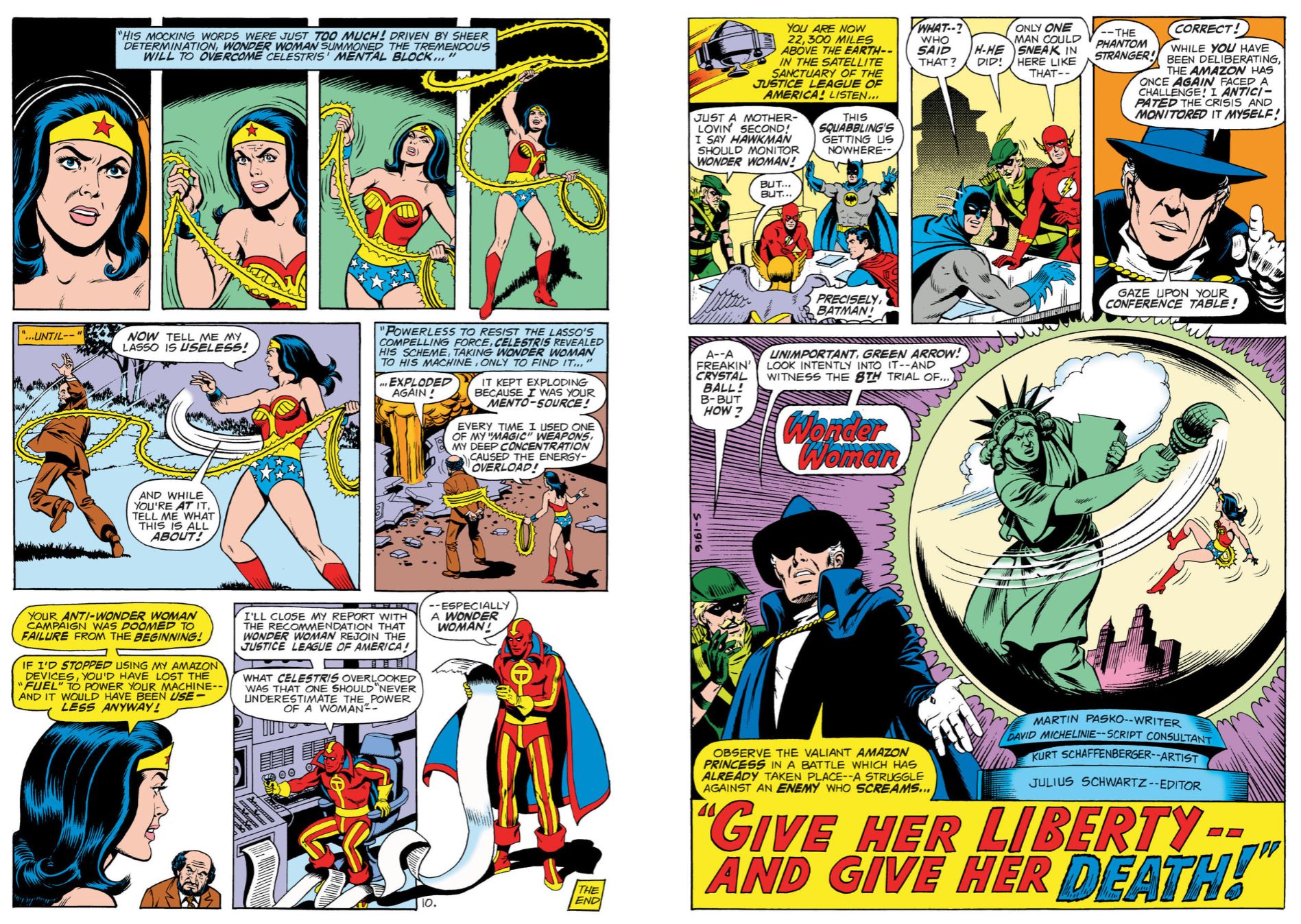
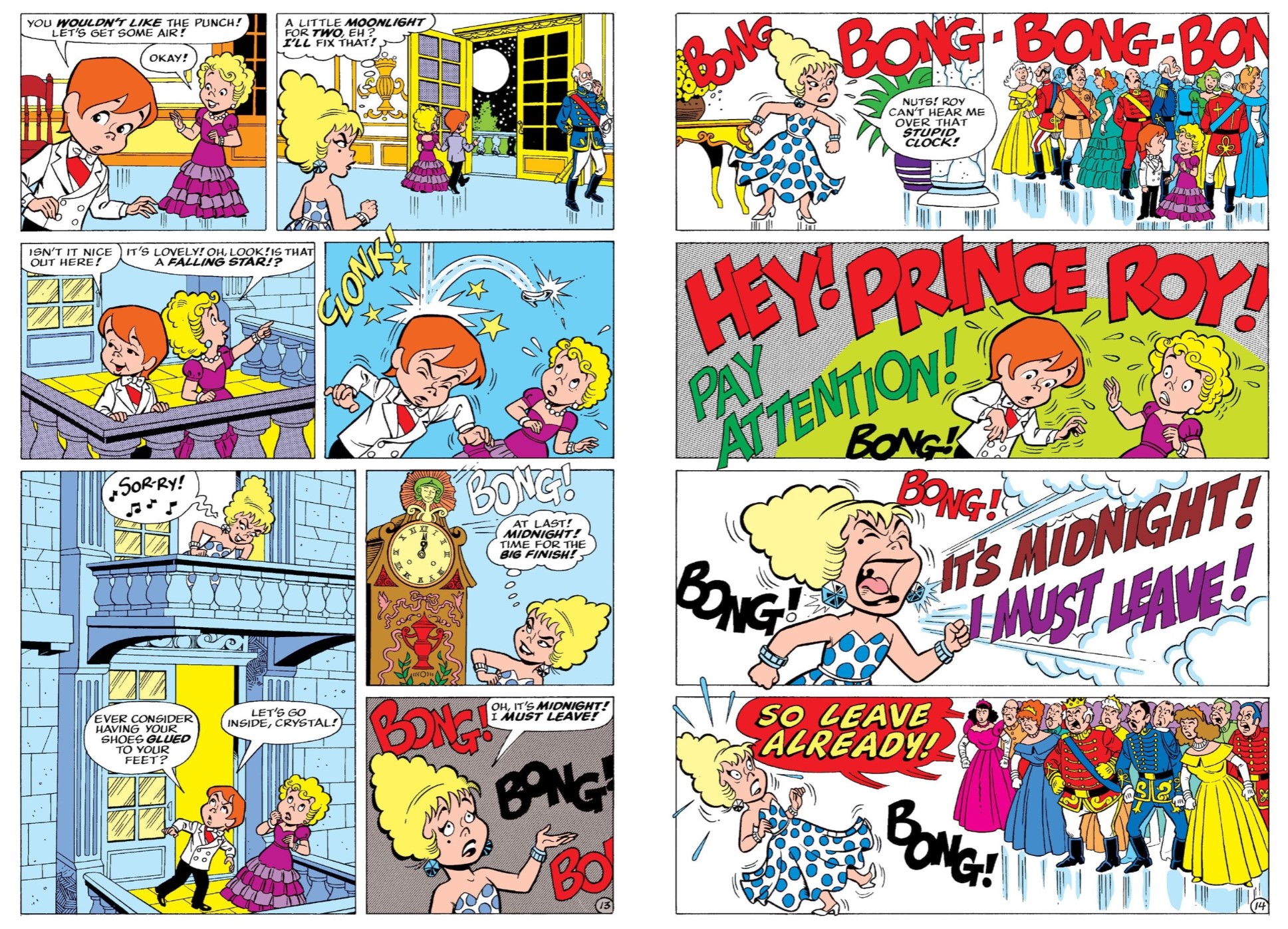
This day in 1984 artist Don Newton (The Phantom, Aquaman, The Avengers, New Gods, Batman, Captain Marvel/Shazam!) died. On this date in 2006 The Beano began running Hunt Emerson’s anarchic strip Ratz.

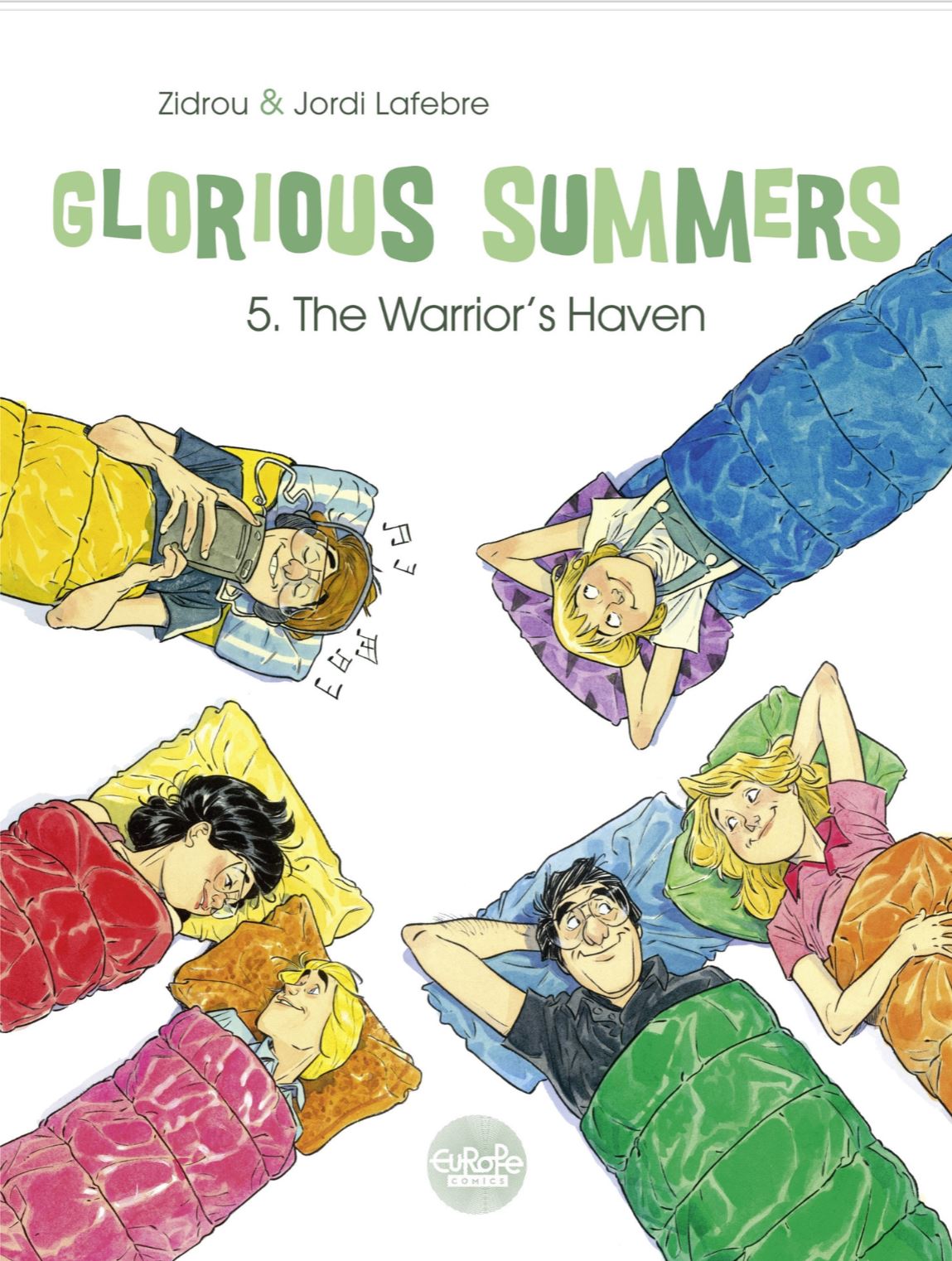
Glorious Summers volume 5: The Warrior’s Haven (1980)


By Zidrou & Jordi Lafebre, with additional colour by Mado Peña, translated by Lara Vergnaud (Europe Comics)
No ISBN: Digital edition only

I’ve had this ready for weeks but couldn’t face running it as so many locations mentioned are smoking ruins at the moment. However, as has been pointed out to me, this is a beautiful, sublimely respectful evocation of places and people and so, in anticipation of regrowth and better times that must surely come, here it is. Just squint your eyes a bit, engage your imaginations and please have hope…

Until comparatively recently, comics in the English-speaking world mostly countenanced comedic or numerous adventure sub-genres (crime, superhero, horror, sci fi), with only a small but vital niche of “mundane world” ventures, usually depicted via graphic biographies and autobiographies like They Called Us Enemy, Love on the Isle of Dogs, Wage Slaves or Sour Pickles offering a different feel and flavour. Even historical sagas were treated as extraordinary moments with larger-than-life characters whenever possible.

What we have never had – and still largely don’t -is a comics equivalent to general fiction, drama and melodrama. That’s not so in Japan, South Korea or Europe, where a literal “anything goes” attitude has always accommodated and nurtured human-scaled slice-of-life tales depicting ordinary people in as many quiet as extraordinary moments. Surely it can’t be that hard to tell engaging stories in pedestrian, recognisably ordinary settings? Medical traumas, love stories, school tales and family tragedies about common folk seem to play well on various-sized screens around the world, so why not in English language comics? The closest we seem to get are comedies like John Allison’s superb Giant Days (which I really must review soon) which all operate on the immortal closing line of every pub drawn out conversation or failed dinner party anecdote “well, maybe you had to be there…”

People being people is more than enough for Europeans. There apparently is an insatiable appetite for everyday events aimed at properly “mature readers”, joyfully sans vampires, aliens or men in tights. These even have sub-genres of their own. For example, there’s the wealth of superb comics just about going on holiday. So, since our own Government-in-Absurdia have ensured that it’s now all-but-impossible for any UK-based citizens to pop across and have une petite vacances in Europe, let’s stare & glare covetously at them having a good time. After all, over there holidays are an inalienable right, and they have some simply fabulous tales about a simple break. This one is probably amongst the best you’ll ever see…

An absolute exemplar of fantasy vacations made real, Glorious Summers: Southbound! (1973) was a nostalgia-drenched confection by Zidrou and regular collaborator Jordi Lafebre: a sublime example of idyllic group memory made into graphic sorcery in an everyday account utterly unafraid to temper humorous sweetness and light with real-world tragedy and suspense.

Perhaps some context is in order. Summer holidays – “Midi” – are a big deal in France and Belgium. The French divide into two tribes over the annual rest & recuperation period, which generally lasts an entire month. Juilletistes only vacation in July, wielding dogmatic facts like rapiers to prove why it’s the only way to take a break. They are eternally opposed, heart, soul, and suntan lotion, by majority faction the Aoûtiens, who recharge their batteries in August whilst fully reciprocating the suspicion, disdain and baffled scorn of the early-leavers. Many European sociologists claim the greatest social division today is not race, religion, gender, political affiliation or whether to open boiled eggs from the top or the bottom, but when summer holidays begin and end.

Les Beaux Étés 1: Cap au Sud! was the first in a string of family visits that began in 2015 courtesy of scripter Benoît “Zidrou” Drousie and Spanish illustrator Jordi Lafebre. Drousie is Belgian, Brussels-born in 1962 and was a school teacher prior to quitting marking books in 1990 to instead make them. His main successes include school dunce series L’Elève Ducobu, Petit Dagobert, Scott Zombi, La Ribambelle, Le Montreur d’histoires, the revival of Ric Hochet, African Trilogy, Léonardo, Shi and many more. His most celebrated and beloved stories are this memorable sequence and 2010’s Lydie, both illustrated by Lafebre.

That gifted, empathically sensitive illustrator and art teacher was born in Barcelona in 1979 and has created comics professionally since 2001, first for magazines like Mister K, where he limned Toni Font’s El Mundo de Judy. He found regular work at Le Journal de Spirou, creating the romance Always Never and collaborated with Zidrou on La vieille dame qui n’avait jamais joué au tennis et autres nouvelles qui font du bien, Lydie, and La Mondaine.

A combination of feel-good fable and powerful comedy drama, Glorious Summers depicts cherished memories of an aging couple recalling their grandest family moments, beginning with a momentous vacation in 1973 where their four kids nearly lost their parents….

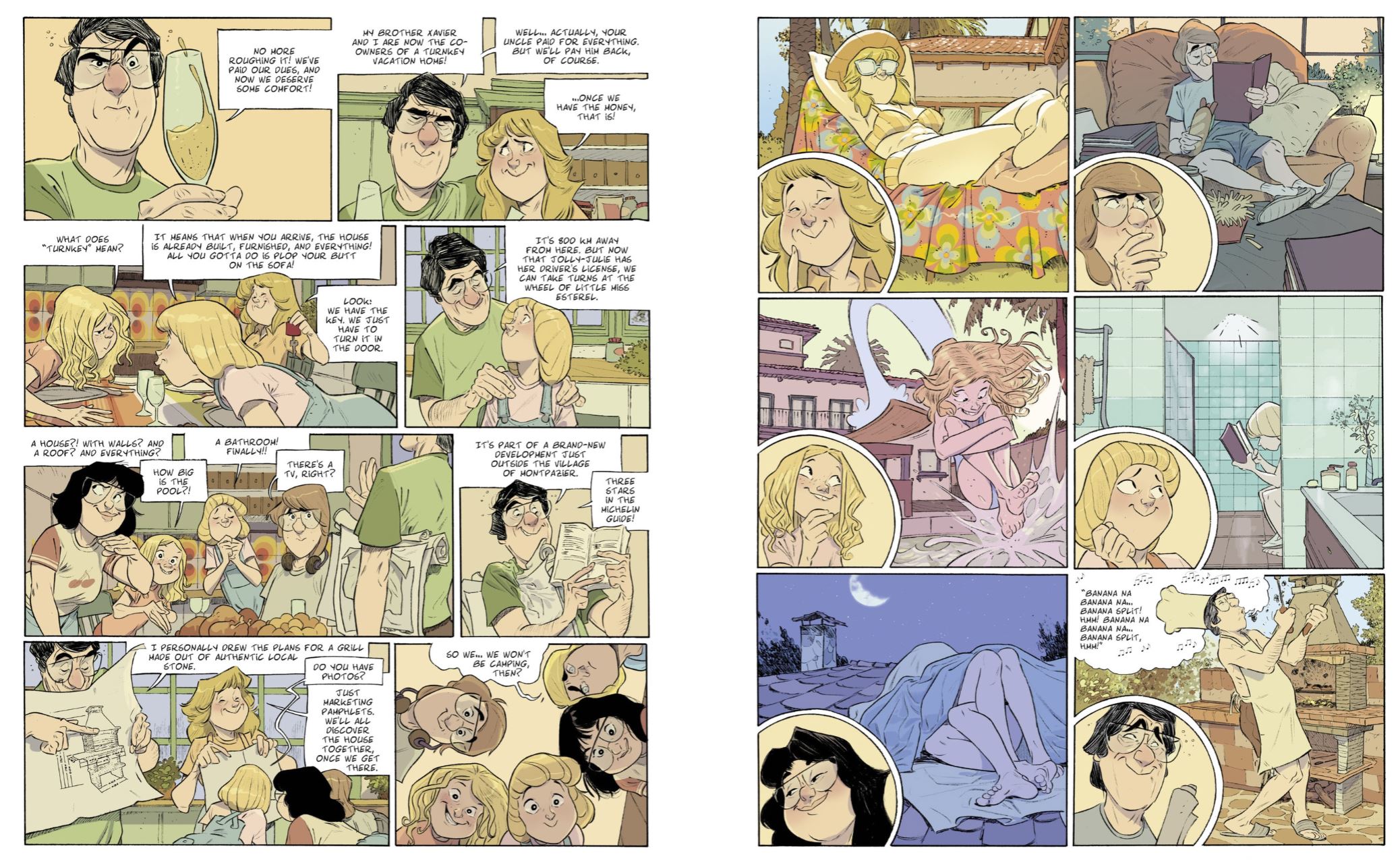
Here, however, final Anglicized volume (so far) The Warrior’s Haven – continentally Les Beaux Étés tome 4: Le Repos du Guerrier – focuses on the close of July 1980, as – just for once – infinitely patient Maddie Faldérault is not waiting for her comic illustrator hubby to finish a late assignment before the brood can head off on holiday! Pierre even has time to complete a little side project and give some life/career advice to studio junior Benoit who has come to the house to pick up the completed pages of latest hit-in-waiting G.I. Girl! (finished almost nine hours ahead of schedule!) and not at all to see oldest daughter Jolie-Julie…

This time the necessary angst and drama are all the preserve of rebellious. acting-out, chain-smoking seventeen year old Nicole who has convinced her folks to bring along her nervous, wealthy, spoiled boyfriend Jean-Emmanuel. All too soon though the parents stop reacting to the horny brats snogging at every opportunity. Now the annual escape from gloomy Brussels for a month in sun-drenched France can start. Even sixteen year old sole Faldérault son Louis is packed and prepared with his books, art supplies and music, and still-precocious nine-year-old wild child Paulette (AKA Peaches) can finally embrace the adventure to come…

And this year offers the beginning of a whole new era and way of life for family Faldérault, as Pierre and his brother Xavier are now proud co-owners of a brand-new, purpose built timeshare house. A fully fitted “turnkey vacation home” is waiting for them in the south of France: clean, fresh, stocked with everything needed and ready for occupation and memory making. No more roughing it in tents and hostels or hotels stuffed with strangers. Now it’s indoor plumbing, a personalised kitchen, a barbeque pit, comfortable sofas and proper beds… a place where they can relax and be themselves. They know exactly what it will be like because Maman picked it all out and designed it from the catalogue and sales brochures. Proud Pierre has already packed the handcrafted shingle for his “Warrior’s Haven”…

As the apparently-expanding family discuss the prospect over one last meal before setting off, the inevitable hammer falls. Pierre’s publisher thinks G.I. Girl! will be a monster hit and has tripled the print run in advance of release! Of course, that will mean the brilliant DILIGENT artist simply must add a giant poster for the promised TV ads, but it shouldn’t take more than a few days if he works flat-out…

The result is Papa stays and faithful transport Mam’zelle Estérel (translated here as Little Miss Esterel) is jam-packed with everybody else for the southbound trek to the sun. Even with Julie now designated driver, the raucous clan rituals (stupid jokes, constant awful singing and barbed off-colour remarks) are in full flow. Not even Nicole and “Jean-Manu”’s constant revolting actions in the backseat – which Louis dubs “vacuum-cleaning faces” – can stop them…

Still in Belgium, having accepted a now staggered vacation start, Pierre sets to and ponders joining them later before suddenly being struck by inspiration. Instead of imparting fatherly advice to impromptu assistant/courier/would-be son-in-law Benoit, he offers ingratiating responsibility to the gifted lad. He can get his big break by finishing the poster for father Faldérault! Crucial decision made, Pierre is soon hurtling south by train…

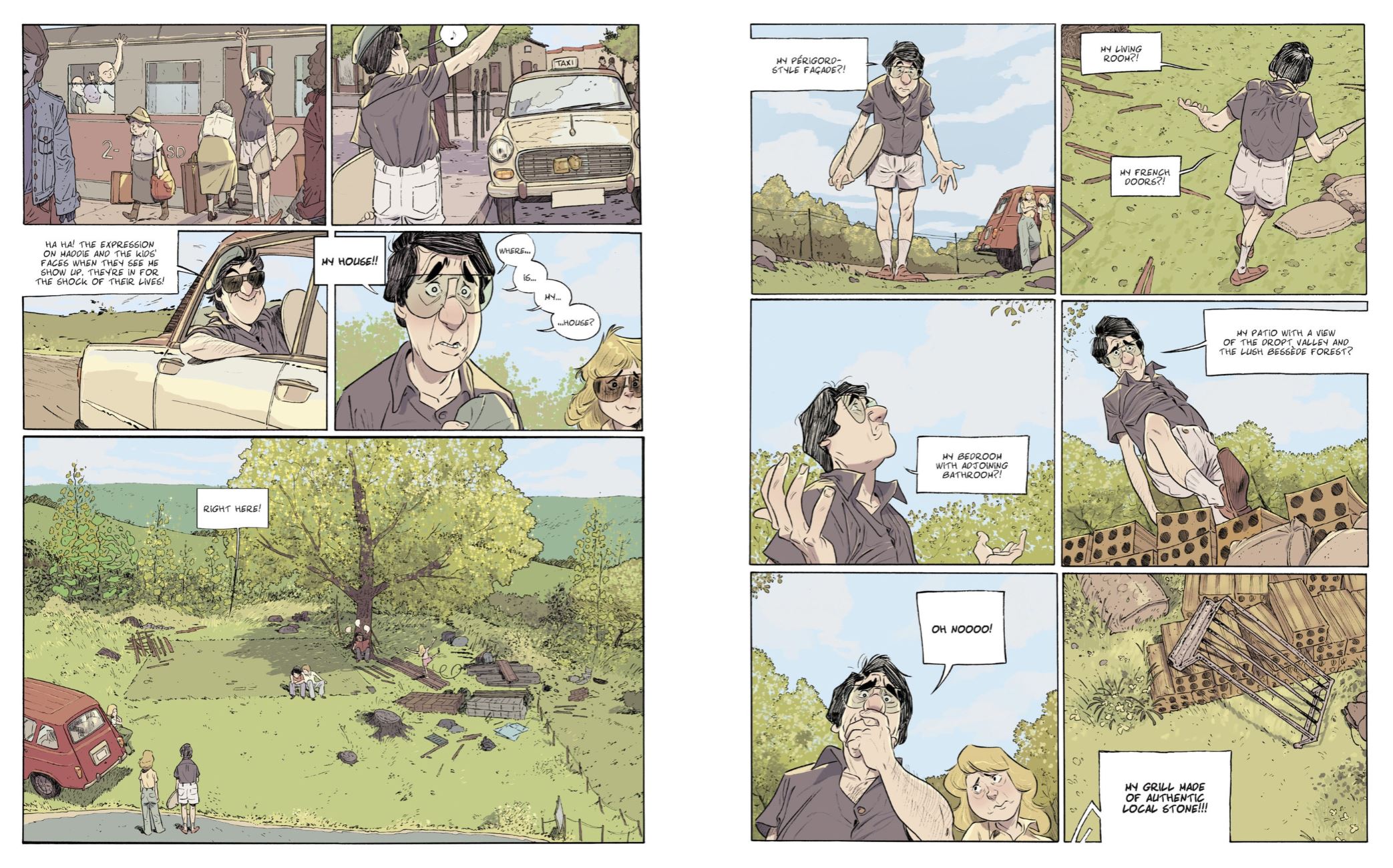
Near the scenic village of Monpazier, road trek and rail journey fortuitously converge, allowing them all to be reunited on their own doorstep – or at least it would have if they hadn’t been the latest victims of a huge property scam. Sitting under a tree in the vacant lot that should be their second home, the family reel in shock. Gradually, they meet other hopefuls of the utterly fictitious Oasis Turnkey Villas Holiday Complex.

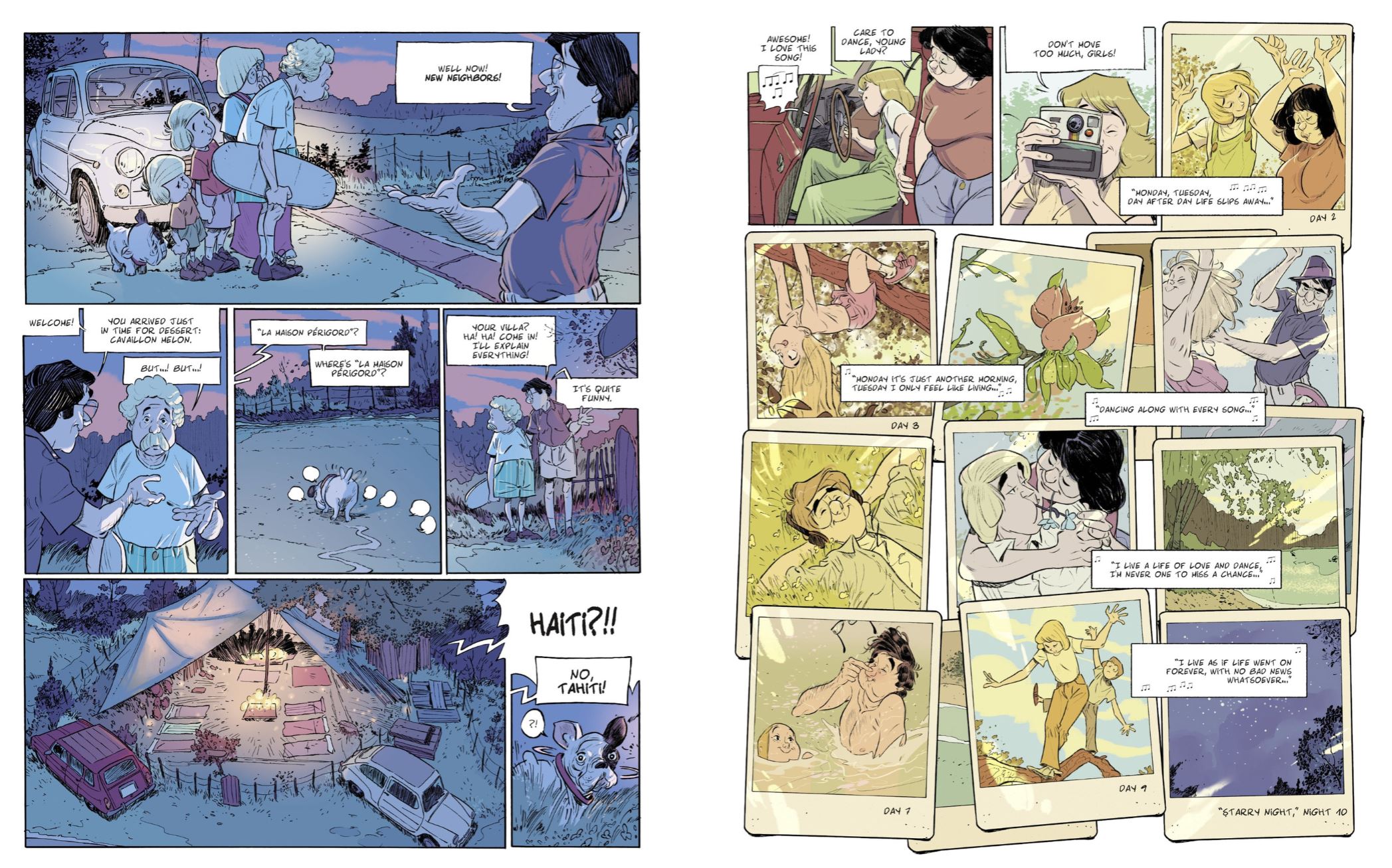
They all bought a dream sight unseen, and soon the sadder, wiser vacationers have banded together. As steps begin to track down the fraudsters and the entrepreneur idiot-brother Xavier recommended, the old warrior spirits return. As they all make the best of it, united with their new notionally-homeless neighbours in not letting bad people take their holiday as well as their money more memories are made…

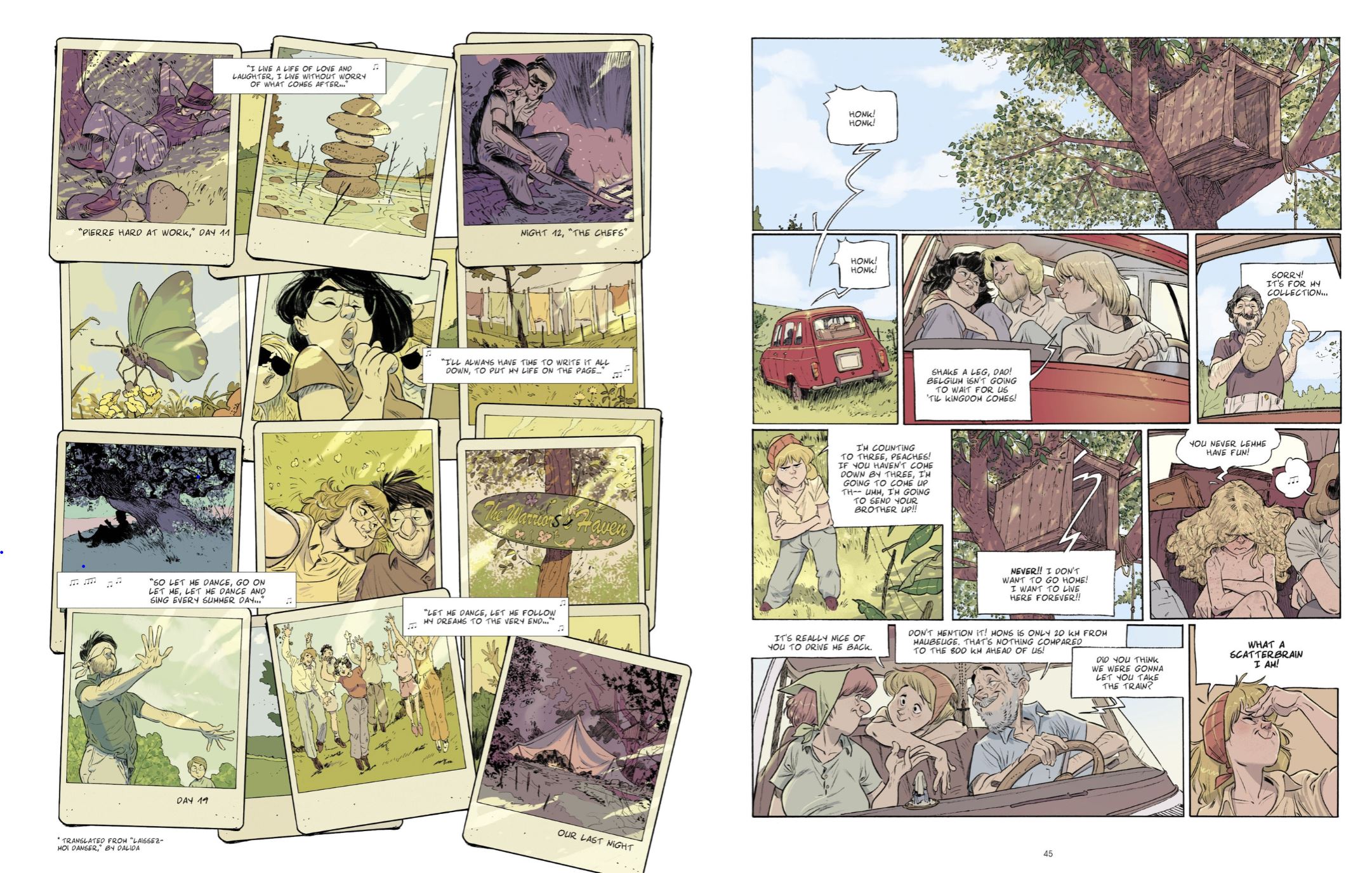
Of course the youngsters are initially crushed, embarrassed, petulant and indignant, but rich-boy Jean-Manu – who has stayed in penthouses all over the world but never, ever been camping – unexpectedly proffers some wisdom, solace and a little enhanced perspective. Moreover, although the cops might be less than helpful, the local villagers are all sympathetic and kind. With immense grace and no pretensions, they quietly chip in to make the victimised visitors feel welcome and less stupid. When fresh suckers turn up they too are comforted by all, and embraced as another community family forms. Days go by, unforgettable moments are enjoyed and life goes on…

Even return to the real world is graced by warmth, friendships and beloved customs and rituals that serve to reinforce the past and welcome what the future offers. What follows is timeless weeks of wonder and unforgettable explorations on endlessly sunny days, with local villagers and distressed wanderers forgetting woes and overcoming the worst the world can offer: a welcoming lesson in humanity at its best…

This tale is another beautifully rendered, enticingly realised album of happy days stitched seamlessly together. It’s funny, sweet and charming whilst delivering painful blows you never see coming. There aren’t any spectacular events and shocking crises and that’s the whole point…

If you’re British – and old enough – this series (six translated albums thus far, plus a French omnibus edition) will echo revered family sitcoms like Bless This House or Butterflies and generational ads starring the “Oxo Family”. (If that description doesn’t fit you, I pity your browsing history if you look up any of that). The rest of you in need of an opening (but unfair) comparator could break out the Calvin and Hobbes collections and re-examine the bits with his embattled parents when the kid’s out of the picture…

Lyrical, laconic, engagingly demure, and debilitatingly nostalgic, this holiday romance (blessed at the end with Jordi Lafebre’s glorious gallery of pencil sketches) is sheer visual perfection wrapped in sharp dialogue and a superbly anarchic sense of mischief. Vacations and downtimes are built of moments and might-have-beens, such as packaged here in compelling clips to make the mundane marvellous.
© 2019 – DARGAUD BENELUX (Dargaud-Lombard s.a.) – ZIDROU & LEFEBRE, LLC. All rights reserved.

Today in 1932, French artist Jean-Jacques Sempé (Le petit Nicholas, The New Yorker) was born, sharing a birthday with pioneering cartoonist, scholar, feminist and comics historian Trina Robbins (It Ain’t Me, Babe, The Silver Metal Lover, Wimmin’s Commix, Wonder Woman, Friends of Lulu, Dope, Women and the Comics) in 1938; writer Rachel Pollack (Doom Patrol, New Gods, Unquenchable Fire), in1945; artist Alex Saviuk (The Flash, Green Lantern, The Amazing Spider-Man: Parallel Lives OGN,  numerous Spider-Man series) in 1952; comic book royalty John Romita Jr. (Superman, Daredevil, Spider-Man, The Eternals, Iron Man, Kick-Ass, Uncanny X-Men, Incredible Hulk) in 1956 and writer/editor Andy Helfer (Justice League of America, The Shadow, Judge Dredd, Justice Inc.) in 1958.

Hal Foster’s Prince Valiant volume 15: 1965-1966


By Hal Foster (Fantagraphics Books)
ISBN: 978-1-68396-025-6 (HB)

These books include Discriminatory Content included for dramatic effect

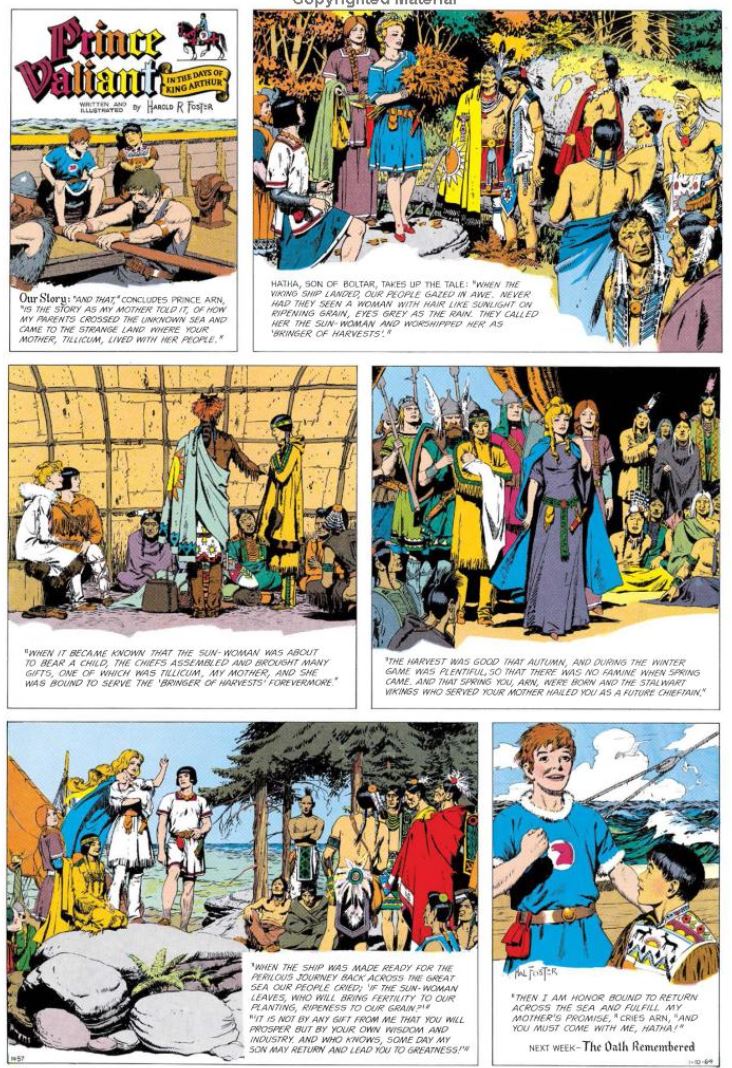
Prince Valiant in the Days of King Arthur premiered on Sunday February 13th 1937: a fabulous rainbow-hued weekly peek into a world where history met myth to produce something greater than both. Canadian illustrator-turned pioneering comics creator Harold “Hal” Foster developed the feature after a groundbreaking and astoundingly popular run on the Tarzan of the Apes comic strip, seeking something that could be his personal domain.

Prince Valiant offered action, adventure, exoticism, romance and a surprisingly high quota of laughs in its engrossing depiction of noble knights, scheming kings and wicked barbarians played out against a glamorised, dramatized Dark Ages backdrop. The never-ending story traces the eventful life a refugee lad of royal blood, driven from an ancestral Scandinavian homeland – Thule – and who grows up to roam the world, attaining a paramount position amongst the fabled heroes of Camelot.

Foster wove his generational epic romance over decades, tracing the progress of a feral wild boy who became a paragon of chivalric virtue: knight, warrior, saviour, secret agent, avenger and ultimately family patriarch through a constant storm of wild, robust and joyously witty wonderment. The restless champion visited many far-flung lands, siring a dynasty of equally puissant heroes whilst enchanting generations of readers and thousands of creative types in all the arts.

The glorious strip saga spawned films, animated series, comic books and all manner of toys, games, books and collections. Prince Valiant was – and remains – one of the few adventure strips to have run continuously from the thunderous 1930s to the present day (well north of 4000 episodes and still going strong) – and, even here at the end-times of newspaper strips as an art form, it continues in hundreds of papers and via the internet.

Foster soloed on the feature until 1971 when John Cullen Murphy (Big Ben Bolt) succeeded him as illustrator and the originator continued as writer and designer. That ended in 1980, when Foster fully and finally retired. Cullen Murphy’s daughter Mairead took over colouring and lettering whilst her brother John assumed the writer’s role, and in 2004 the senior Cullen Murphy also retired, since when the strip has soldiered on under the aegis of other extremely talented artists such as Gary Gianni, Scott Roberts and latterly Thomas Yeates & Mark Schultz.

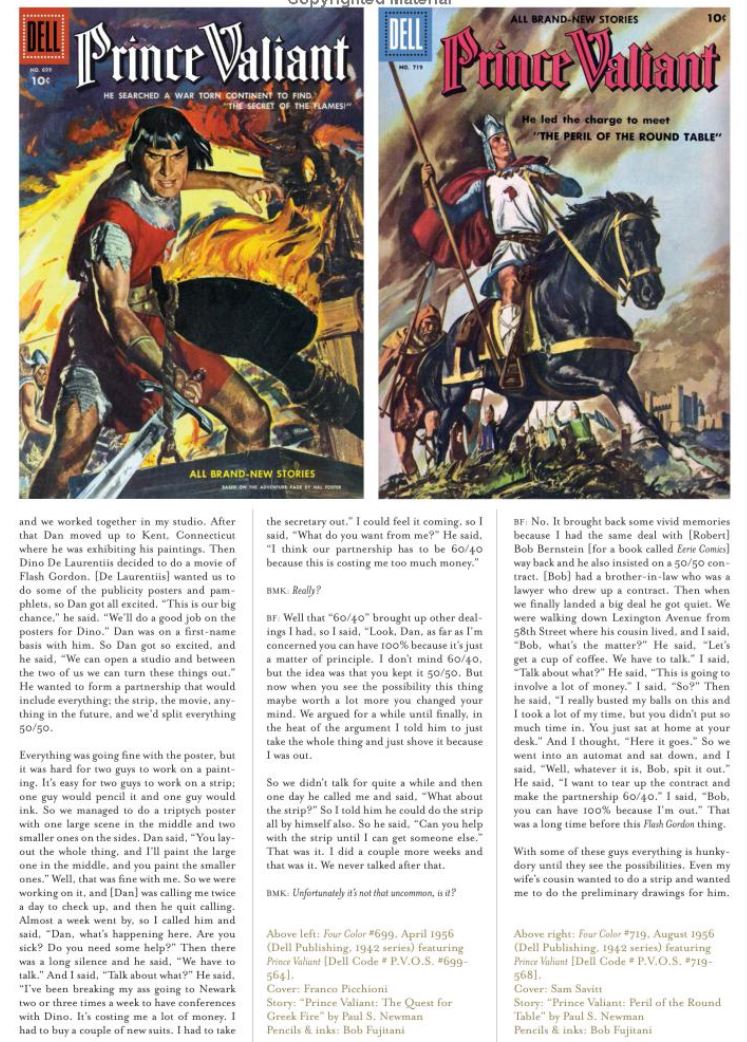
This luxuriously oversized (362 x 264 mm) full-colour hardback (tragically, the series is still unavailable digitally) re-presents pages spanning January 3rd 1965 to December 25th 1966, (individual Strips #1456 to 1559) and comes with all the regular bonus trimmings. Preceding two years’ worth of graphic narrative wonderment, historian/editor Brian M. Kane conducts an interview with a veteran comic book artist/comics strips illustrator. Heavily illustrated, the Foreword ‘Sir Robert of Dell: the Prince Valiant Art of Bob (Rip Kirby; Flash Gordon; Doctor Solar, Man of the Atom; Turok, Son of Stone; Lassie) Fujitani’ shares many secrets at the front, and the titanic tome ends with a flurry of illustrated essays and the rear.

These include fabulous King Features promotional material and inducements to newspapers plus Kane’s critical appraisal and discussion of the strip in other media. ‘Not Just For Sundays: Prince Valiant’s Adventures Beyond the Fourth Estate’ details collected editions from around the world; spin-offs and edited collections for the children’s book trade; novelisations (mainly by Max Trell); Hal Foster’s other books and curated compendia that fuelled the global demand for the apparently inexorable knight extant. Heavily illustrated with a wealth of book and comics covers (by Foster, John Cullen Murphy or Mike Grell) and candid photos, the reprint round-up also includes a gallery of covers by Michael Wm. Kaluta that graced the all-new sagas published by Marvel in 1994 (as written by Charles Vess & Elaine Lee and illustrated by the deeply underrated John Ridgway).

What Has Gone Before: valued vassal and infallible secret asset of King Arthur of Britain, Prince Valiant has travelled the world carrying out missions for his liege lord, embattled Christendom, honour and decency. His greatest comrades are stalwart Knights like Sir Gawain, Sir Kay and Sir Launcelot and barbarous Viking pirate Baltar. Val’s life of duty and action won him a glorious, implacable and equally incomparable wife in Mediterranean monarch Queen Aleta of the Misty Isles. Their first son Arn was born on an unknown continent and since has thrived on a life of constant peril. He stands on the brink of manhood and his own path of Royal service.

Val’s offspring currently number four: Arn, precocious twin girls Karen & Valeta and recent addition Galan, arriving during Aleta’s last peril-packed stay in her Misty Isles homeland. Arn rapidly advanced from Court Page to Novice and began official combat training. He swiftly became a Batchelor-at-Arms and constantly excels. Some battles are purely personal as when vindictive Mordred attempted to traduce Aleta’s honour by orchestrating a vicious scandal involving her and Lancelot, but the plot was foiled by clear thinking and valiant action…

In combination with his father, Arn’s gifts proved invaluable in repelling invasion by Saxon hordes and foiling rebellions in Scotland, Cornwall and Wales, as well as an international insurrection when savage Skogul Oderson united disparate Nordic tribes into a united force to ravage his grandfather’s kingdom of Thule. In the aftermath of that triumph, Valiant’s large family wintered in those chilly climes. While taking their ease, Arn and Boltar’s son Hatha talked much of the lost lands of Arn’s birth, recalling the prophecy that Valiant’s heir (deemed “son of the Sun Woman and the Bringer of Harvests”) would one day return to Vinland (the Americas) and his Niagara birthplace to do great deeds…

It should be noted that Hatha’s mother Tillicum is a princess of the Algonquin folk the Vikings befriended 15 years previously. She accompanied the Sun Woman on her return north and east, becoming Aleta’s bondswoman, royal nursemaid and confidante…

Now, as the year reaches mid-point Arn yearns to fulfil his mother’s promise of his return, not only to prove his manhood, but also to make good his family honour, forge trade alliances, and do mighty deeds. The most import of these goals is the first… receiving his father’s approval and mother’s grudging acquiescence. As winter approaches, Arn and Hatha must ready a ship – the province of Valiant’s old friend and ingenious shipwright Gundar Harl – and recruit a competent crew who can survive the perilous voyage and handle anything they might meet on the other side…

Arn further prepares by learning the Algonquin language from Tillicum and discovers her gift for strategic planning. He is delighted when she invites herself along for the trip – a gesture that convinces many holdouts that mayhap the callow youth might make them all rich after all…

Preparations are geared to a spring embarkation and Arn spends every moment seeking to anticipate problems and solve them. Disbelief and dwindling confidence in his proposed crew is offset by Arn undertaking a perilous midwinter sortie to the chilly home of his grandfather Aguar and convincing the hard-headed businessman to back the venture. That gained, Arn almost dies on the return trip, but survives to recruit even more men from local lads who would rather fight than farm…

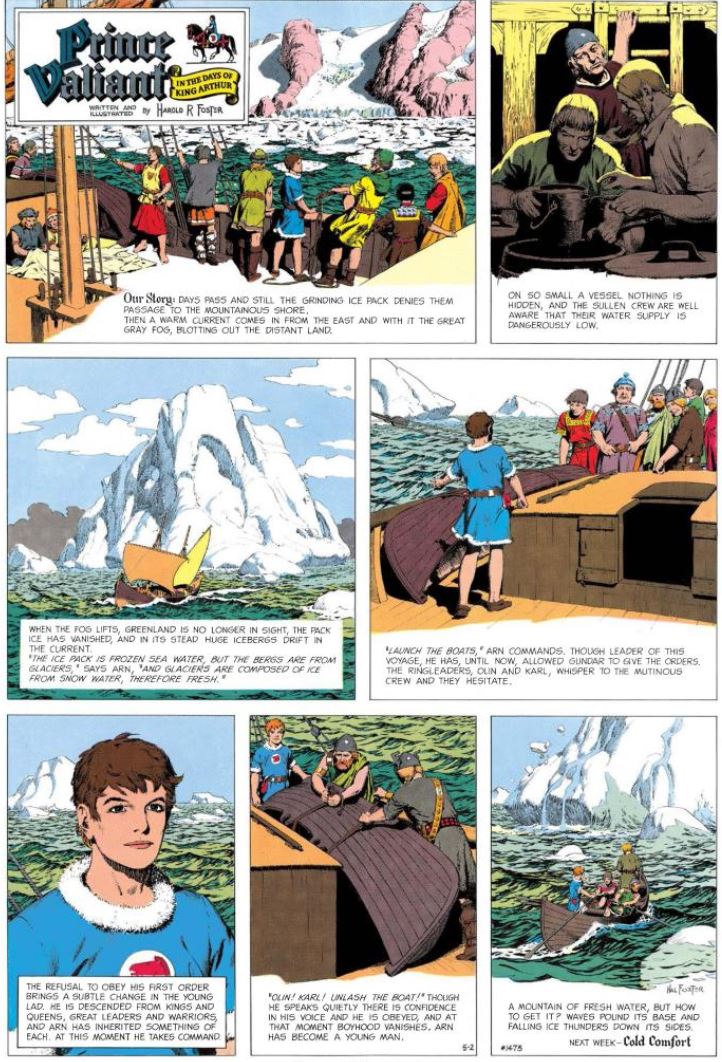
Arn’s relentless proselytising (he even recruits a skald to visit outlying homesteads singing of the glorious exploit to come in hopes of boosting support and manpower) pays dividends and the voyage begins with the Prince, Hatha, Tillicum and Gundar leading an untried crew across largely unknown waters. Early upsets are all deftly dealt with by Arn and his nursemaid: pirates, rebellious crewmen, deadly winds, dire doldrums, pack ice and resource shortages, before they make landfall in the chilly climes of Vinland…

Here the real adventure begins as the explorers make their way down from the far north to the more hospitable shores of what will be New England a thousand years hence. Arn manipulates the understandably anxious tribes and stage-manages a charm offensive that sees him accepted as the supernatural “Bringer of Harvests” promised by the Sun Woman, as he introduces new weapons and tactics, farming implements, fresh food production methods, new ways to fight and fish, permanent sustainable dwellings and a staggering haul of trade goods. In the course of an epic exploration of the region via the St Lawrence river and overland, Arn learns the art of ruling and that physical wealth means nothing. Hatha narrowly escapes marriage, Tillicum reunites with her long-abandoned father and Viking knowhow saves the Algonquin from eradication by tribal nemeses the Iroquois, and apparently unkillable (chainmail-clad) Arn raises their status with the so-far neutral Ottowa and Huron. In the aftermath of a colossal tribal war, preparations begin for the return to Thule with their trade items (amber, seeds, furs, pemmican and precious minerals) being constantly computed and weighed against sufficient provisions to sustain them for the entire trip home. However, even readying themselves to leave generates tension and clashes with Mohawk and Mohegan enclaves before Gundar declares his modified dragonship refitted and ready to go…

During this rite of passage and voyage of bloody discovery life continued to present challenges in civilised Thule. As their children endured the return trip, both Valiant and Boltar were at the end of their patience and the Prince unwisely organised a tournament to amuse the warriors and himself. Sadly, unlike Arthur’s knights rowdy reivers have no understanding of ritual combat and the event was called off; barely before the competitors killed each other…

Soon after the debacle their boys triumphantly return, but their exploits and triumphs are not celebrated for long, as a ship from Camelot follows, bidding Valiant back into service. Beyond Hadrian’s Wall, life-long foes the Picts and Caledonians have somehow buried past grievances and are massing to attack England together. Arthur needs his greatest operative to find out how the miracle occurred and how best to counter it. Disguised as a vagabond sell-sword Val infiltrates the alliance and discovers Mordred is the unifying force, and embarks on a rapid but brutal solution. There is no love lost between the factions and less trust even now, so it only takes a few covert – and rather macabre – dirty tricks to set clan against clan. Sadly, Mordred sees his old enemy’s hand in the affair and determines to be revenged…

Arn would have joined the undercover mission, but as the latest Man of the House his job was to escort Aleta and the family back to Arthur’s court. By the time they arrive, Mordred and his half-brothers Agravaine and Gaheris have enacted a scheme to targeting Valiant’s loved one, but which is humiliating foiled by playful romance-obsessed Karen & Valeta and their burly handmaiden Katwin. Upon his return to Court, Valiant seeks out Mordred and lays down the law…

The year and the book close on lighter notes as skinny-dipping Aleta accidentally starts a mermaid panic after taking up bathing in Britain’s chilly seas, before her husband is called upon to apply his diplomatic skills to end a succession crisis. A staunch supporter of Arthur, King Bedwin of Dimore had trained his son Prince Harwick to carry on his wise reign and peaceful policies. Now though, as death approaches the aged monarch, Harwick has vanished and Bedwin’s brothers make ready for civil war should the son not be available to take over. When Val traces the absent heir apparent, he finds an obnoxious layabout dedicated only to fishing and carousing, but still smart enough to trick an oath of non-interference out of Arthur’s agent…

As war clouds gather, Valiant seems utterly stifled by his own honour and beliefs..

To Be Continued…

A mesmerising non-stop panorama of visual passion and precision, Prince Valiant is a tremendous procession of boisterous action, exotic adventure and grand romance; blending epic fantasy with dry wit and broad humour, and soap opera melodrama with dark vividly authentic violence. Lush, lavish and captivatingly lovely, it is an indisputable landmark of comics fiction and something no true fan should miss.
All comics © 2017 King Features Syndicate. All other content and properties © 2016 their respective creators or holders. This edition © 2015 Fantagraphics Books. All rights reserved.

Today in 1892 cartoonist and animator Otto Messmer (Fun, Feline Follies, Felix the Cat) was born, sharing the natal celebrations with fellow cartoon gamechanger Hal Foster (Tarzan, Prince Valiant). In 1916 Golden Age art star Paul Gustavson (The Angel, The Human Bomb, A-Man, Alias the Spider, Quicksilver) was born; as was British writer Dick Foreman (Black Orchid, Hellblazer) in 1952; illustrator Brian Stelfreeze (Black Panther, CyCops, Shadow of the Bat, Gun Candy) in 1962 and Italian artist Enrico Marini (Batman: Dark Prince Charming, Gipsy, The Scorpion) in 1969.

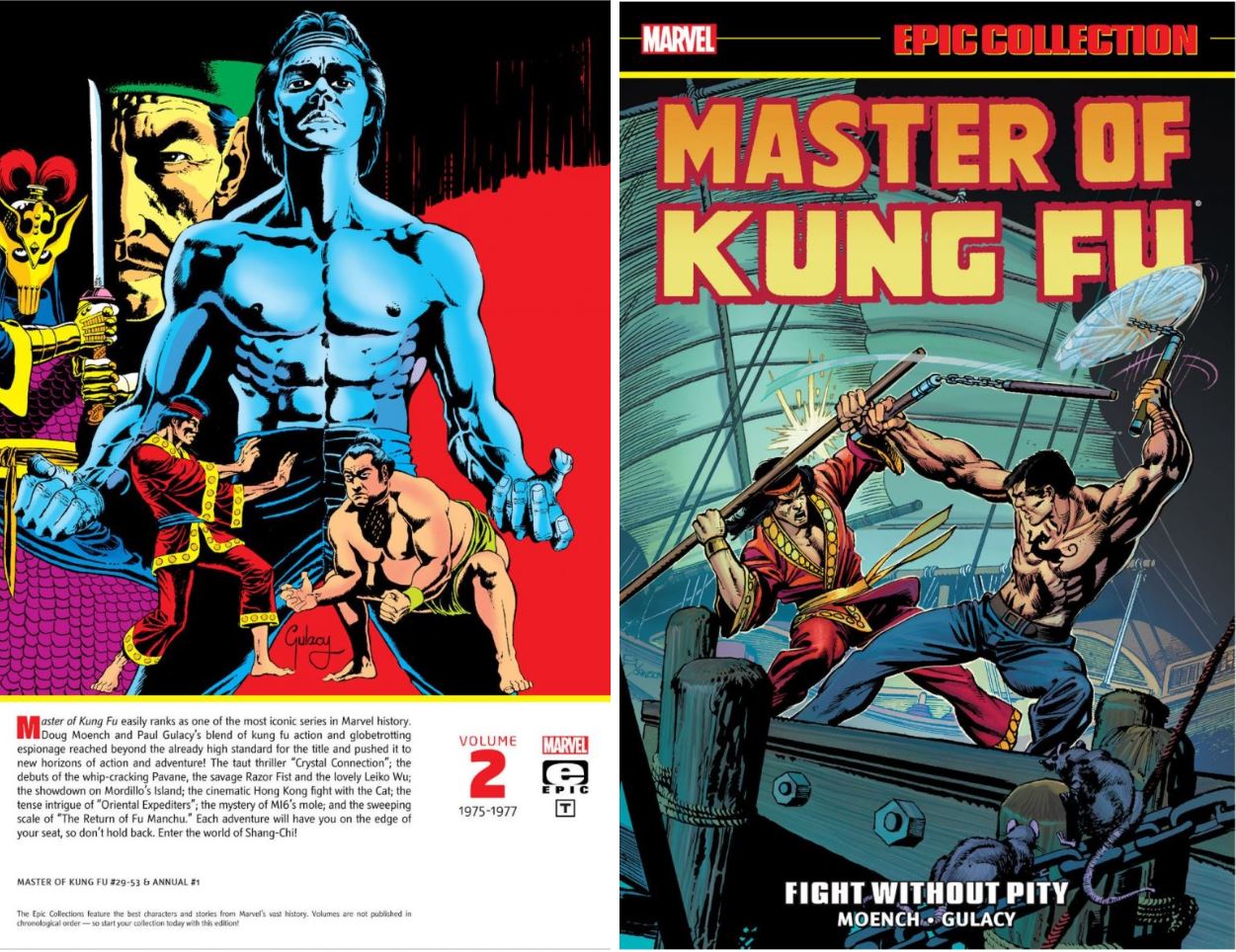
Master of Kung Fu Epic Collection volume 2: Fight Without Pity


By Doug Moench, Paul Gulacy, Sal Buscema, Keith Pollard, Jim Craig, Dan Adkins, Jack Abel, Pablo Marcos, Mike Esposito, Sal Trapani, John Tartaglione, Duffy Vohland, Tom Sutton & various (MARVEL)
ISBN: 978-1-3029-0135-6 (TPB/Digital edition)

This book includes Discriminatory Content produced in less enlightened times Comic books have always operated within outworld popular trends and fashions – just look at what got published whenever westerns or science fiction dominated on TV – so when the ancient philosophy and discipline of Kung Fu made its mark on western entertainment, it wasn’t long before all those kicks and punches found their way onto four-colour pages of America’s periodicals. Early starter Charlton Comics added Yang and House of Yang to their pioneering Judo Joe title and Frank McLaughlin’s Judomaster; DC debuted Richard Dragon and rebooted Karate Kid; Atlas/Seaboard opened (and as quickly closed again) The Hands of the Dragon and Marvel converted an already in-development proposed literary adaptation into an ongoing saga about a villain’s son…

A month after it launched, a second orient-inspired hero debuted with Iron Fist: combining combat philosophy, high fantasy and magical forces with a proper superhero mask and costume…

Although largely retrofitted for modern times, inspirational Master of Kung Fu star Shang-Chi originated with lots of tricky baggage. He kicked off in the autumn of 1973, cashing in on the contemporary West’s craze for Eastern philosophy and martial arts action that had already generated an avalanche of “Chop Sockey” movies and a controversial TV sensation entitled Kung Fu. You may recall that the lead in that cowboy-set saga was a half-Chinese Shaolin monk, played – after much publicised legal and industry agitation – by a white actor…

At Marvel, no one at that time particularly griped about the fact that Shang-Chi was designed by editor Roy Thomas and artisans Steve Englehart, Jim Starlin & Al Milgrom as a naive innocent (also half Chinese, with an American mother) thrown into tumultuous modern society as a rebellious yet involved counterpoint to his father: an insidious scheming fiend intent on global domination. Back then, securing rights to a major literary property and wrapping new comics in it was an established practise. It had worked spectacularly with Conan the Barbarian and horror stars Dracula and The Monster of Frankenstein. The same process also brilliantly informed seminal science fiction icon Killraven in War of the Worlds and plenty more…

These days we comics apologists keep saying “it was a different era”, but I genuinely don’t think anyone in the editorial office paused for a moment of second thoughts when their new Kung Fu book secured the use of one of literature’s greatest villains as a major player. Special Marvel Edition #15 (cover-dated December 1973) launched to great success, with Fu Manchu an overarching villain already a global personification of infamy.

Arthur Henry Sarsfield Ward AKA Sax Rohmer’s ultimate embodiment of patronising mistrust and racist suspicion had been hugely popular since 1913’s The Mystery of Dr. Fu-Manchu. The prime archetype for mad scientists and remorseless “Yellow Peril” threatening civilization, the character spread to stage, screen, airwaves and comics (even appropriating the cover of Detective Comics #1, heralding an interior series that ran until #28), but most importantly, became the visual affirmation and conceptual basis for countless evil “Asiatics”, “Orientals” and “Celestials” dominating popular fiction ever since. In recent years we’ve all (well, mostly all) acknowledged past iniquities and Shang-Chi has been fully reimagined, with that paternal link downplayed and ultimately abandoned – as much for licensing laws as social justice. And cultural respect, naturally…

Like most comics companies, Marvel employed plenty of “Yellow Peril” knock-offs and personifications – including Wong Chu; Plan Tzu (AKA the Yellow and latterly Golden, Claw); Huang Zhu; Silver Samurai; Doctor Sun, ad infinitum: all birds of another colour that are still nastily pejorative shades of saffron. Perhaps this is just my white guilt and fanboy shame talking. These stories, crafted by Marvel’s employees were – and remain – some of the best action comics you’ll ever encounter, but never forget what they’re actually about -distrust of the “other”. Without making excuses, I should also state that despite the casual racism suggested by legions of outrageously exotic, inscrutable lemon-hued bad guys haunting this series at every level, Master of Kung Fu did sensitively address issues of race and honestly attempt to share non-Christian philosophies and thought whilst – most importantly – offering potently powerful role models to kids of Asian origins. So at least there’s that…

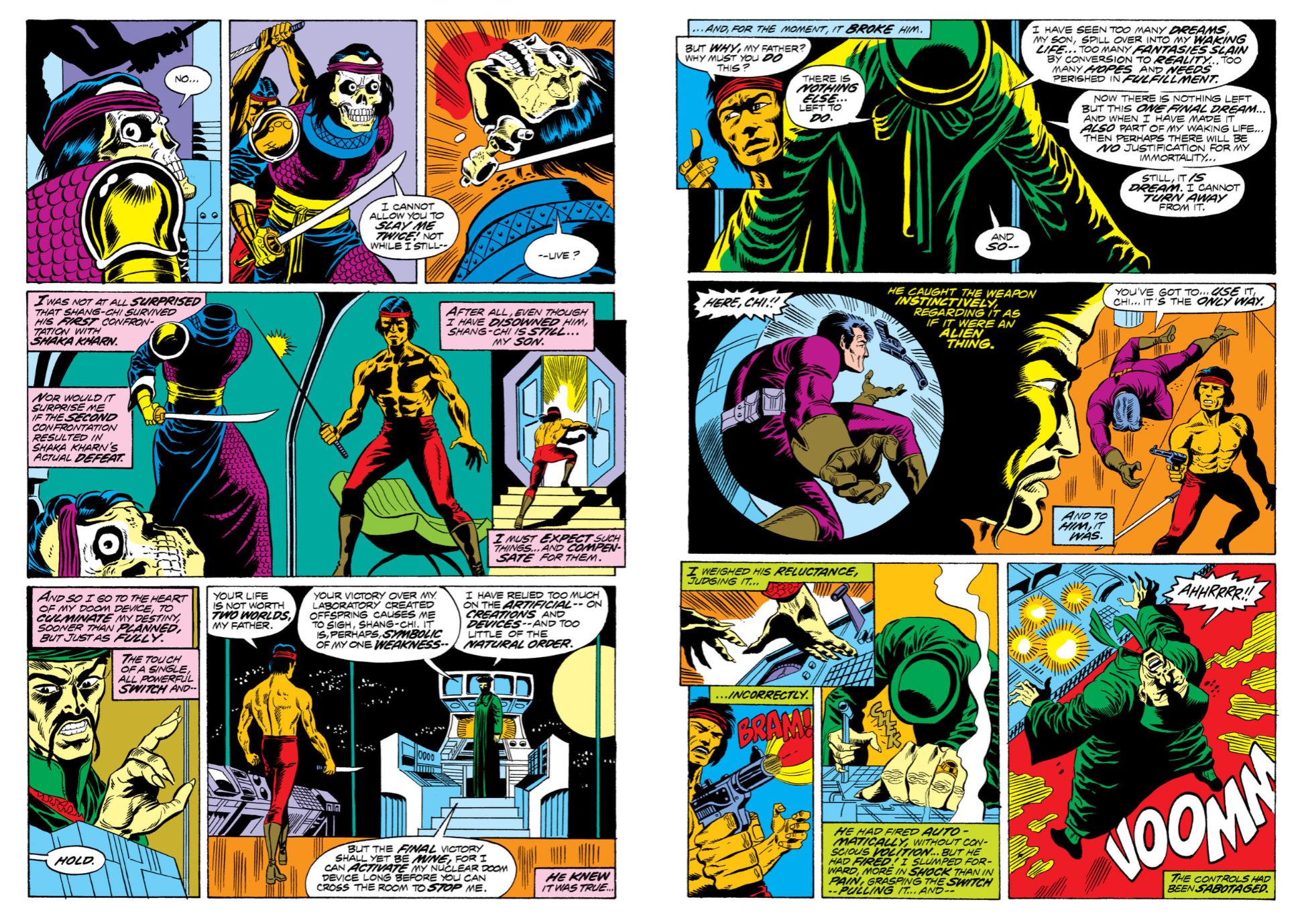
Packed with stunning exotic adventure and compellingly convincing drama, this collection gathers Master of Kung Fu #29-53 and Master of Kung Fu Annual #1 (spanning June 1975 to August 1977). Written entirely by Doug Moench and primarily showcasing the developing graphic realism of Paul Gulacy, surrendering to his love of spy fiction it opens without a preamble in the middle of a mighty struggle…

Previously: the series inauspiciously launched in bimonthly reprint title Special Marvel Edition as The Hands of Shang Chi: Master of Kung Fu, but by the third issue (April 1974) became exclusively his. The origin episode introduced a vibrant, brilliant young man raised in utter isolation in the style and manner of imperial China. Reared by monks and savants, the boy was the result of a match between a physically perfect American woman and “misunderstood patriot” Fu Manchu. The boy was raised to accept that his sire was a noble hero unfairly hunted and slandered by corrupt western governments and the communist usurpers now blasphemously controlling the world’s greatest empire.

Fu’s son was schooled to respect and obey his father, trained to perfection in martial arts and designed as the ultimate warrior servant: the doctor’s devoted personal weapon against lifelong enemies Sir Dennis Nayland Smith and Doctor Petrie.

On reaching maturity, Shang – whose name means “the rising and advancing of a spirit” – was despatched to execute Petrie. However, after the obedient weapon completed his mission, he subsequently questions his entire life and the worldly benefit of killing an elderly, frail, already dying man. An emotional confrontation with Nayland Smith (who endured daily agonies from being maimed at the Devil Doctor’s command) further rattled the boy’s resolve and eventually Shang’s sublime education demanded he reassess everything his father had taught him…

After invading the villain’s New York citadel and crushing an army of freaks and monsters, Shang Chi faced his father and rejected all he stood for. The battle lines of an epic family struggle had been drawn. Banished from his cloistered childhood home and environs, the philosophically minded innocent adapted rapidly to the constant violence of the modern world. eventually accepting shelter with Nayland Smith in return for (espionage) services rendered…

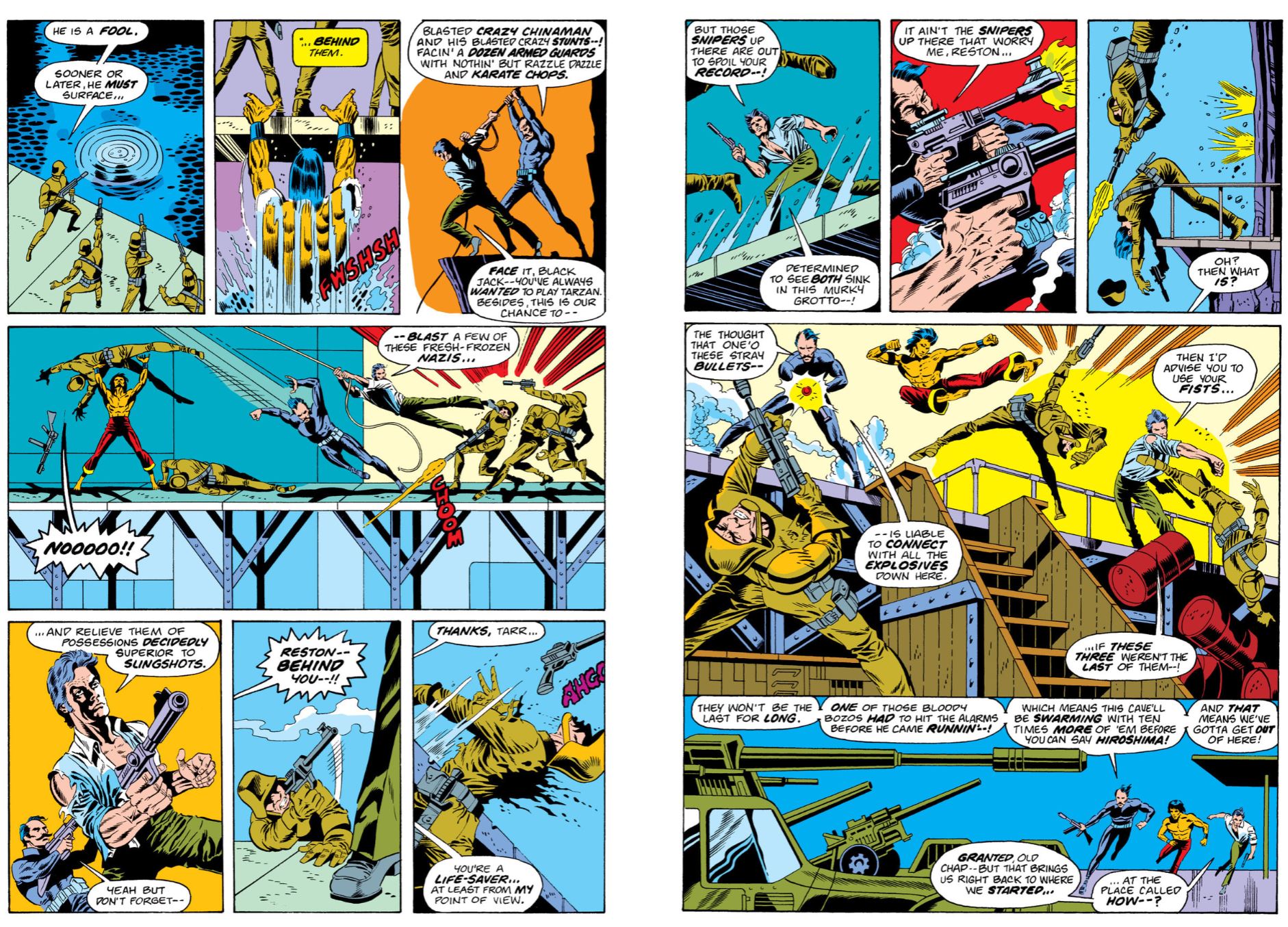
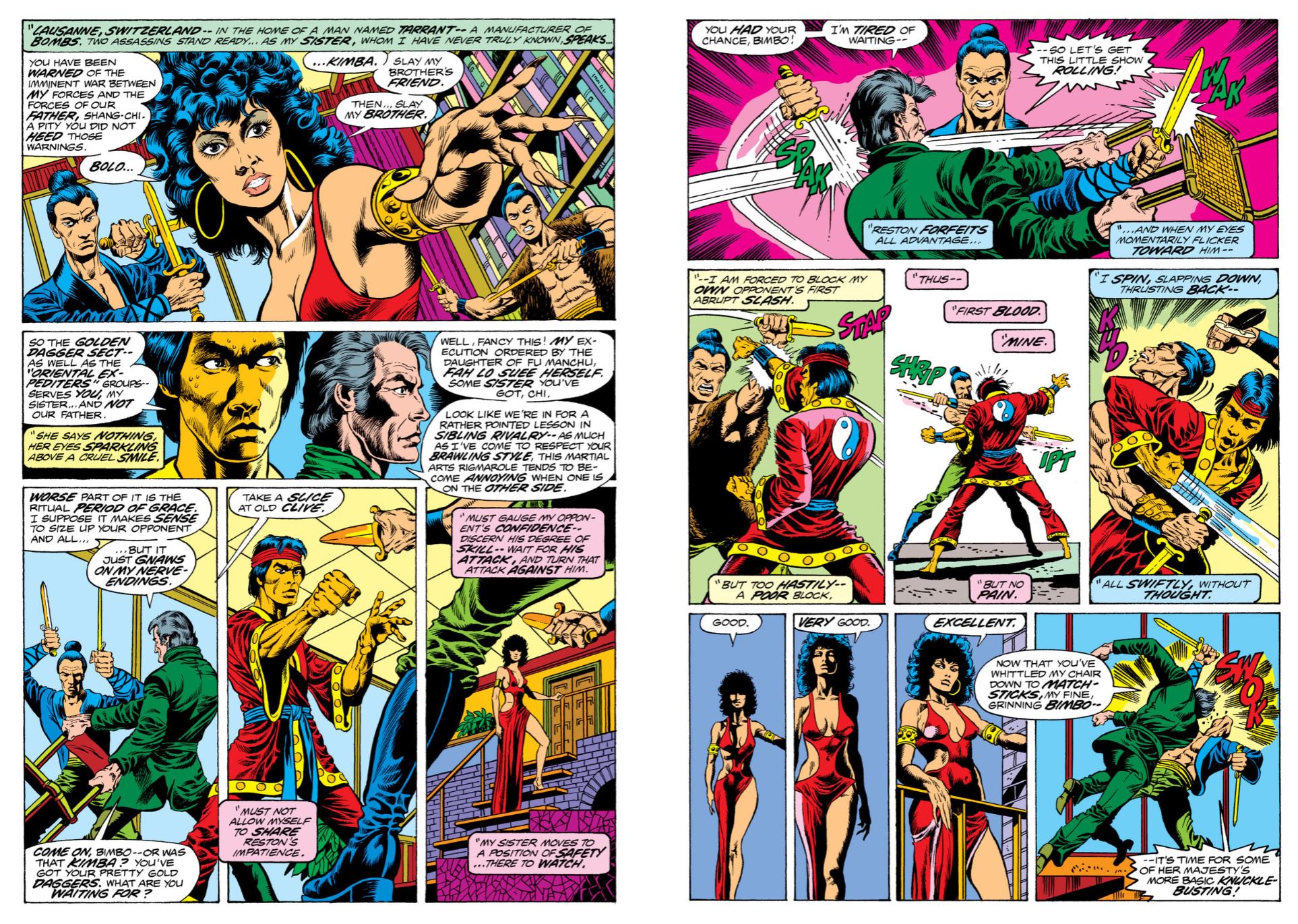
Now, a turning point in his rising and advancement comes in MOKF #29 as Shang finds reason to abandon his pacifistic aspirations and get involved in western affairs after seeing firsthand the harm drugs cause, joining Nayland Smith’s team to cripple the drug trade. The unwelcome allies include veteran heavy Blackjack Tarr, and Petrie – not dead at Shang’s hand after all and subsequently rescued from his father’s clutches – working with British agent Clive Reston. He is, by his own account, a descendent of a famed “Consulting Detective” and a Double-0 operative “on Her Majesty’s Secret Service”)

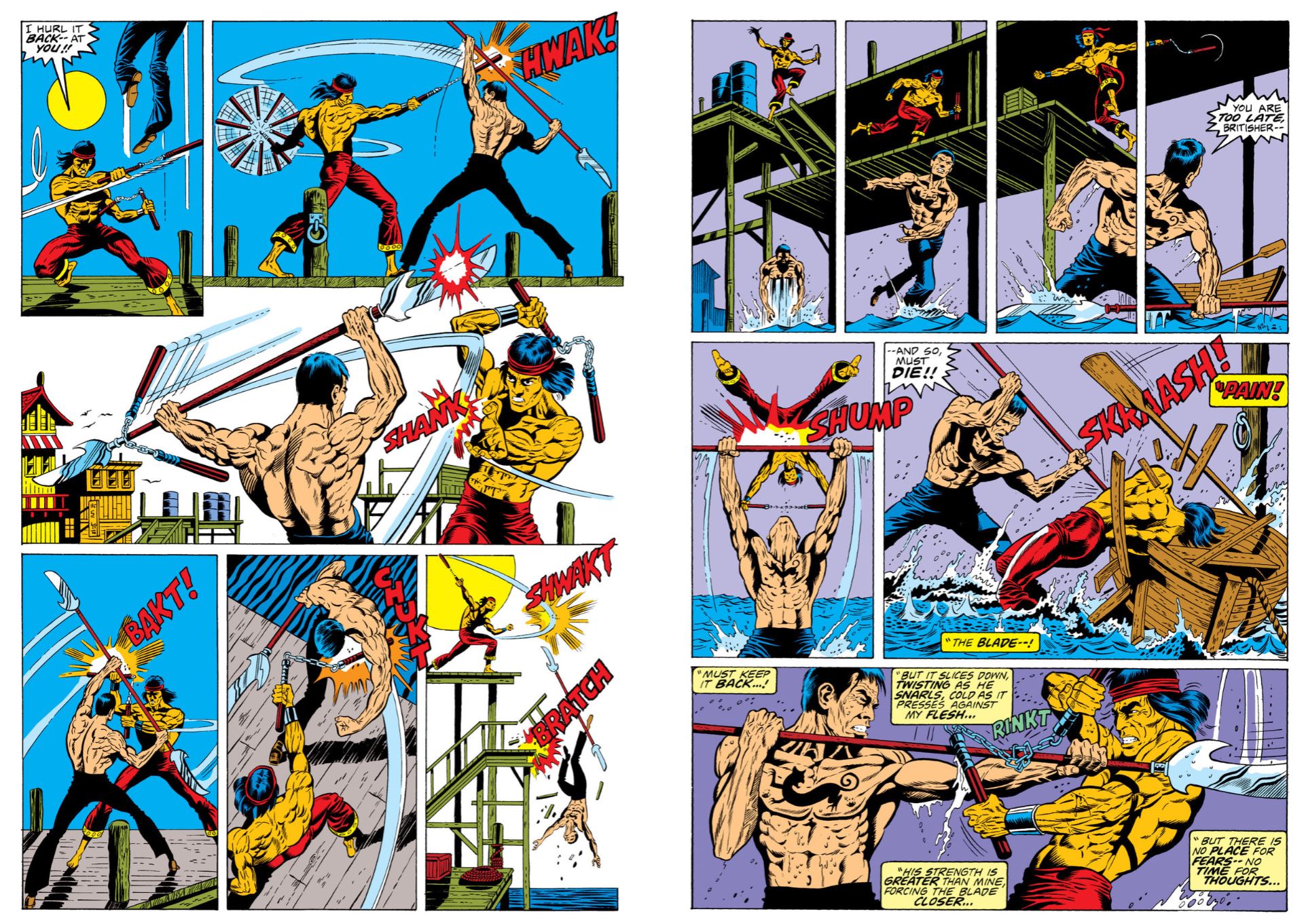
The entire series was slowly morphing into a James Bond pastiche and with this mission to end effetely urbane drug dealer turned nuclear terrorist Carlton Velcro, illustrator Gulacy began a ballistic visual progression that would make him one of most watched and admired artists of the era as he referenced movie star and set pieces throughout the saga.

‘The Crystal Connection’ begins with Reston undercover at Velcro’s French coast fortress, playing heroin buyer Mr Blue until Shang & Tarr can infiltrate and secure the dope stocks. No one expected such massive defences; an army of killers led by deadly assassin Razor-Fist and a nuclear arsenal hidden below ‘A Gulf of Lions’ (#30, inked by Dan Adkins), with the pitched battle ranging far and wide as Razor Fist’s defeat leads to Shang clashing with whip-wielding panther woman Pavane before a truly explosive conclusion in ‘Snowbuster’…

‘Assault on an Angry Sea!’ was a hasty fill-in illustrated by Sal Buscema & Mike Esposito as Shang returns to London by ship and is drawn into the hunt for an undercover courier who is unaware that counteragents intend to intercept and end them. In this traditional mystery yarn, Chi finds too many suspects and can’t tell friend from foe from target, but triumphs nonetheless, before MOKF #33 resumes the Moench/Gulacy filmic fun-fest with ‘Wicked Messenger of Madness!’ This introduces seductive, conflicted agent Leiko Wu as both romantic interest and wedge between Shang Chi and his colleagues, and sees a robotic mannequin fail to assassinate Nayland Smith thanks to martial arts mastery but opens the door to a complex web of lies, double-dealing, insane artificial intelligences and a doomsday weapon.

The robot was a literal tool of missing agent Simon Bretnor, revealed far too late as narcissistic hired killer and would-be world conqueror Mordillo, who wants a space weapon using the ozone layer and sunlight to ravage sites on Earth. The plans for it are encoded in Wu’s brain, but by the time she realises her current boyfriend Bretnor is the bad guy, Leiko’s his prisoner on a manically murderous version of Fantasy Island…

As Shang & Reston race to the madly modified atoll-turned-playground-of-peril, Wu attempts to reason with the crazed Mordillo, but gets more sense from his Pinocchio-like AI robot sidekick Brynocki, who is trying to mediate a ‘Cyclone at the Center of a Madman’s Crown!’ She does, however, learn that her captor had a connection to Pavane and Velcro and now holds Chi responsible for a huge loss of face and fortune. Another spectacular conclusion comes when maniac and martial artist clash in the skies above the island as the villain briefly unleashes his stolen Solar Chute to rain destruction down on the island in ‘Death-Hand and the Sun of Mordillo’…

What feels like a reformatted leftover from the Giant-Size Master of Kung Fu era follows in #36 & 37 (January & February 1976, by Moench, Keith Pollard & Sal Trapani) with Shang entering a magical maze of mystery. He seeks to defend from ninjas and their leader Darkstrider a carnival of hapless freaks voluntarily living in ‘Cages of Myth, Menagerie of Mirrors!’ but is initially hard-pressed saving anyone from the villain who subtly weaves a ‘Web of Dark Death!’ Moench, Pollard, John Tartaglione & Duffy Vohland continue fantasy themes in Master of Kung Fu Annual #1 during a team-up with fellow transplanted warrior Iron Fist. Here Danny Rand and Shang are tricked into entering another dimension to invade ‘The Fortress of S’ahra Sharn!’ The culprit is trickster wizard Quan-St’ar, whose true goal is the destruction of immortal city K’un-Lun, but he makes one huge mistake…

At their creative peak Moench & Gulacy started an epic, ambitious, truly sophisticated and industry-changing run in MOKF #38 (March 1976). Here Shang Chi reluctantly accepts a rescue mission to extract an agent from Hong Kong, meeting lies, passion, disinformation and deadly love in ‘Cat’. Nayland Smith has again orchestrated events to satisfy his own agenda and saving Julia leads Chi into a ‘Fight Without Pity’ against an opponent who might well be his superior in combat ability… and also holds the moral high ground.

The landmark clash is simply prologue to an extended, character driven serial that opens at ‘The Murder Agency’ (#40 with Gulacy inking himself) as on-fire creators pioneer storytelling techniques later seen in Christopher Nolan’s Memento. A traitor in British Intelligence is murdering agents and the information Nayland Smith wanted from Julia should have given them vital advantage. However, as Shang again quits all “games of death and deceit” he, Tarr & Leiko Wu are attacked by (apparent) Chinese agents masquerading as “Oriental Expediters”.

After helping to defeat the attackers, Wu leaves on a similar extraction mission and suggests that the embattled operatives re-enlist disgraced former agent/current drunken sot James Larner. When they try, he’s got a new pal also boozing himself to death: lovelorn abandoned Clive Reston. That’s when another heavily-armed gang burst in guns blazing, laying down their lives simply to bait a trap the agents can’t afford to avoid…

With the spy saga solidly underway, everything suddenly screeched to a halt as a deadline crunch necessitated another fill-in moment, with Moench, Sal B & Esposito revealing a childhood moment in ‘Slain in Secrecy, and by Illusion!’ Here Shang recalls reluctant clashes with childhood companion M’nai – AKA Si Fan super-assassin Midnight – to prove Fu Manchu’s hallowed home harboured a thief and traitor…

Inked by Tom Sutton, the main event resumes in #42 in a welter of flashbacks, crosscuts and flash forwards as ‘The Clock of Shattered Time’ introduces a mechanically augmented, electrically-enhanced martial arts assassin who almost kills Chi. Shock-Wave has a strong but top-secret connection to Nayland Smith and nearly succeeds in blowing up the spy chief too…

As the MI5 mole and Shock-Wave set more bombs, MOKF #43 sees a changed and vengeful Shang win a rematch with the amplified assassin in ‘A Flash of Purple Sparks’. As Wu escorted her own living package across Europe with the Oriental Expediters chasing them all the way to an MI5 safehouse in Switzerland, Shang was waiting, but his triumph was short-lived as Leiko’s charge revealed who was behind all the deaths – and the Oriental Expediter organisation – and that, in London. another of his allies had fallen…

The drama kicked into overdrive with a long-anticipated event. Cover-dated September 1976, #44 heralded ‘The Return of Fu Manchu, Prelude: “Golden Daggers (A Death Run)”’ with the scattered British agents heading for home under a hail of gunfire and assorted ambushes. Crucially revealed now is how the Devil Doctor’s recalcitrant first-born Fah Lo Suee is at war with their father for control of his empire…

She originally debuted in third novel The Si-Fan Mysteries /The Hand of Fu-Manchu in 1917 (or fourth outing The Daughter of Fu-Manchu in 1931, depending on who you ask) and became a minor character here in Master of Kung Fu #26, but now steps into the full spotlight after Nayland Smith is finally downed… by his most trusted ally! On the back foot and losing, Fah Lo Suee seeks alliances and her brother’s aid in ‘Part One (Shang Chi): “The Death Seed!”’ while Fu Manchu is occupied with resurrecting his founding ancestor to be his new – loyal – son/enforcer.

In London, Larner saves Nayland Smith even as Reston, Shang & Wu reunite and rebuff the “daughter of the Devil”… and that’s when Clive makes a big mistake and is taken by Fah Lo Suee. Inked by Pablo Marcos, ‘Part Two (Clive Reston): “The Spider Spell!”’ splits attention between the British agent’s trial and eventual triumph and Fu resurrecting legendary warlord Shaka Kharn, before ‘Part Three (Leiko Wu): “Phantom Sand”’ details how she & Shang infiltrate a fantastic city at the north pole in advance of what’s left of the team joining them to destroy the citadel. Before that, though, the final clash between father and daughter again confirms the total mastery of the malevolent mandarin…

The true appalling scope of the Devil Doctor’s ambitions are exposed in ‘Part Four (Black Jack Tarr): “City in the Top of the World”’ as the schemer prepares to leave Earth and cull its population by 90%! Meanwhile Shang duels revived revenant Shaka Kharn, and battles his way aboard his sire’s space shuttle even as his companions destroy the base at the cost of another valiant soul in ‘Part Five (Sir Dennis Nayland Smith): “The Affair of the Agent Who Died!”’ The astounding saga – and Gulacy’s interior involvement – ends with #50 as the villain speaks for himself with his plans and perhaps his over-extended life ended for real in ‘Part Six (Fu Manchu): “The Dreamslayer!”’

Master of Kung Fu #51 saw Jim Craig join Moench & Marcos, taking over pencil duties for ‘Epilogue: “Brass and Blackness!” (A Death Move!!)’ infilling details of interments and getting back to Earth where our unhappy reluctant warrior again quits the spy world. The final tale here (#52, May 1977) is one more fill-in as Moench & Pollard reintroduce Groucho Marx knock-off Rufus T. Hackstabber who invites our baffled battler to ‘A Night at the 1001 Nights!’ in search of family (such as reprobate/WC Fields analogue Quigley J. Warmflash); riches and safety from mercenaries led by Si-Fan general Tiger-Claw.

Ernie Chan’s cover to MOKF #53 (which reprinted #20) leads into an bonus section including Gil Kane & Adkins’ covers to Savage Fists of Kung Fu tabloid collector’s edition; house ads: 10 pages of original art plus unused and modified covers. The published ones throughout were crafted by Kane, Adkins, Sal Buscema, Rich Buckler, Dave Cockrum, Marie Severin, Chan, Gulacy, John Romita Jr., Ron Wilson & Jack Abel, Al Milgrom, Esposito, Joe Sinnott, Frank Giacoia and Klaus Janson.

In recent years, Shang Chi’s backstory has been adapted and altered. His dad was understandably reinvented as Zheng Zu, Mr. Han, Chang Hu, Wang Yu-Seng and The Devil Doctor, so, depending on your attitude, you have the ultimate choice and sanction of not buying or reading this material. If you do – with eyes wide open and fully acknowledging that the past is another place that we can and should now consign to history – your comics appreciation faculties will see some amazing stories incredibly well illustrated: ranking amongst the most exciting, visually beguiling and enjoyable in Marvel’s canon.
© 2018 MARVEL.

Today in 1987 the final issue of British toddlers weekly Playhour was published, ending a 1700+ run that had commenced on 16th October 1954, whilst on this day back in 1982 cartoonist and master of minimalism Ernie Bushmiller (Mac the Manager, Fritzi Ritz, Nancy) died.

The day saw the birth of Golden Age Superman artist Ed Dobrotka in 1917; Indian cartoonist Pran Kumar Sharma (Billoo, Chacha Chaudhary) in 1938; realist action artist Paul Gulacy (Sabre: Slow Fade of an Endangered Species, Master of Kung Fu, Batman: Prey, Black Widow, Slash Maraud, Six From Sirius, Sci-Spy, James Bond 007) in 1953; writer/Conspiracy historian Lamar Waldron (Lightrunner, M.I.C.R.A.: Mind Controlled Remote Automaton) in 1954; artist Terry Shoemaker (X-Men, Spellbound, Legion of Super-Heroes) in 1960 and “Bad Grrrl” artist Jim Balent (Catwoman, Purgatori, Vampirella, Tarot: Witch of the Black Rose) in 1963. Also blowing out candles today are Iron Man, XO Manowar, Elektra & Wolverine artist Sean Chen and quite rude Norwegian cartoonist Frode Øverli (Pondus, Riskhospitalet, Rutetid, Deep Shit Junkies) – both in 1968, and artists David Nakayama (City of Heroes, Big Hero Six, Proximity) in 1978 and Clay Mann (Magneto: Not a Hero, X-Men: Legacy, XO Manowar, Gambit, Heroes in Crisis) in 1990.

Wonder Woman: The Twelve Labors


By Martin Pasko, Elliot S! Maggin, Cary Bates, Len Wein, Curt Swan, John Rosenberger, Irv Novick, Dick Dillin, Kurt Schaffenberger, Dick Giordano, José Delbo, Tex Blaisdell, Phil Zupa, Vince Colletta, & various (DC Comics)
ISBN: 978-1-4012-3494-2 (PB/Digital edition)

This book includes Discriminatory Content produced in less enlightened times.

The Princess of Paradise Island originally debuted as a special promotional feature in All Star Comics #8 (cover dated December 1941/January 1942 and on sale from October 21st 1941). Happy 85th birthday Princess Diana!

Officially, she was conceived by psychologist/polygraph pioneer William Moulton Marston and realised and nigh-exclusively illustrated by Harry G. Peter, in their calculated attempt to offer girls a positive and forceful role model and, on forward-thinking Editor M.C. Gaines’ part, to sell more funnybooks to girls. Later research has since disclosed much of her genesis was thanks to Moulton’s wife – attorney turned psychologist Sarah Elizabeth Marston (née Holloway) who had worked with him to create the systolic lie detector process – with further input provided by their live-in partner Olive Byrne.

Wonder Woman catapulted into her own series and the cover-spot of new anthology Sensation Comics a month later. An instant hit, the Amazing Amazon won her own eponymous supplemental title a few months later, cover-dated Summer 1942.

Once upon a time on a hidden island of immortal superwomen, US aviator Steve Trevor of US Army Intelligence crashed to Earth. Near death, he was nursed back to health by young, impressionable Princess Diana. Fearful of her besotted child’s growing obsession with the creature from a long-forgotten and madly violent world, Diana’s mother Queen Hippolyte revealed the hidden history of the Amazons: how they were seduced and betrayed by men but rescued by the goddess Aphrodite on condition that they forever isolated themselves from the mortal world and devoted their eternal lives to becoming ideal, perfect creatures.

However, with the planet in crisis, goddesses Athena and Aphrodite instructed Hippolyte to send an Amazon back with the American to fight for global freedom and liberty. She would be chosen by triumphing over all her sisters in a grand tournament. Although forbidden to compete, Diana clandestinely overcame all other candidates to become their emissary. On arriving in the Land of the Free, she purchased the identity and credentials of lovelorn Army nurse Diana Prince, elegantly allowing the Amazing Amazon to stay close to Steve whilst enabling the heartsick but poverty-stricken care-worker to join her own finance in South America. Diana gained a position with Army Intelligence as secretary to General Darnell, ensuring she would always be able to watch over her beloved. She little suspected that, although the painfully shallow Steve only had eyes for the dazzling Amazon superwoman, the General had fallen for the mousy yet supremely competent and capable Lieutenant Prince…

That set up set the Star-Spangled Siren to weather the vicissitudes of the notoriously transient comic book marketplace and survive the end of the Golden Age of costumed heroes along with Superman, Batman and the few lucky second-stringers who inhabited the backs of their titles. She soldiered on until the end of the Silver Age revival, mostly under the auspices of Robert Kanigher, Ross Andru & Mike Esposito, but by 1968 superhero comics were in decline again and publishers sought new ways to keep audiences interested as tastes – US society – changed. Back then, the entire industry depended on newsstand sales and if you weren’t popular, you died. Editor Jack Miller & Mike Sekowsky stepped up with a radical proposal and made a little bit of comic book history with the only female superhero to still have her own title in that turbulent marketplace.

The superbly eccentric art of Sekowsky had been a DC mainstay for nearly two decades, and he had also scored big with fans at Gold Key with Man from Uncle and Tower Comics in T.H.U.N.D.E.R. Agents and war title Fight the Enemy! His unique take on the Justice League of America had cemented its overwhelming success, and in 1968 he began stretching himself further with a number of experimental, young-adult oriented projects. Tapping into the teen zeitgeist with Easy Rider style drama Jason’s Quest and resurgent sci fi and western genres in Manhunter 2070 proved ultimately unsuccessful, but with the Metal Men and the hopelessly outdated and moribund Wonder Woman he had much greater impact. Sekowsky would subsequently work the same magic with equally stalled icon Supergirl…

The big change came when the Amazons were compelled to leave our dimension, taking with them all their magic – including Wonder Woman’s powers and all her mystic weaponry. Now no more or less than human, she opted to stay on Earth permanently, assuming her own secret identity of Diana Prince, dedicated to fighting injustice as a mortal, very much in the manner of TV’s Emma Peel, Honey West and crimebusting comics siren Modesty Blaise…

Blind Buddhist monk I Ching rather rapidly trained her as a martial artist, and she soon became embroiled in the schemes of would-be world-conqueror Doctor Cyber. Most shockingly, her beloved Steve was branded a traitor and murdered! Sekowsky’s root & branch overhaul offered a whole new kind of Wonder Woman, but as I’ve already said fashion ruled and, in a few years, without fanfare or warning, everything that had happened since Diana lost her powers was unwritten. Her mythical origins were revised and re-established as she returned to a world of immortals, gods, mythical monster and super-villains with a new nemesis… an African (or perhaps Hellenic?) American half-sister named. Nubia. It took decades for her to find her place in the modern DC but that’s a tale for another day and review…

Such abrupt reversal had tongues wagging and heads spinning in fan circles. Had the series offended some shady “higher-ups” who didn’t want controversy or a shake-up of the status quo?

Probably not. Sales were never great even on the Sekowsky run and the most logical reason is probably Television. The Amazon had been optioned as a series since the days of the Batman TV show in 1967, and by this time (1973) production work had begun on the original 1974 pilot featuring Cathy Lee Crosby. An abrupt return to the character most viewers would be familiar with from their own childhoods seems perfectly logical to me…

By the time Lynda Carter made the concept work in 1975, Wonder Woman was once again “Stronger than Hercules, swifter than Mercury and more beautiful than Aphrodite”, but as Diana returned to mainstream DC continuity, readers and fans expected her to fully reintegrate, leading to this early and impressive example of a comics miniseries which ran in Wonder Woman #212 through 222 (cover-dates July 1974 to March 1976), detailing how the Amazing Amazon reclaimed her confidence and rejoined the JLA.

Scripter Len Wein and artists Curt Swan & Tex Blaisdell got the ball rolling with ‘The Man Who Mastered Women!’ wherein the Hellenic Hellion thwarts a terrorist attack at New York’s United Nations building… where Diana Prince now works as a translator. In the aftermath she surprisingly meets old friend Clark Kent. Over the course of a conversation she suddenly realises that her memories have been tampered with and understands why her JLA colleagues haven’t called her to any meetings. She had resigned years ago…

Although her former comrades beg her to re-enlist, Diana declines, fearing her memory lapse might endanger the team and the world. After much insistent pleading, she relents enough to suggest the League must covertly monitor her next dozen major cases – in the manner of Hercules’ twelve legendary tests – until she proves herself competent and worthy, for her own peace of mind, if not the JLA’s.

Once they grudgingly agree, she leaves and Superman begins surveillance, observing her flying to Paradise Island in her Invisible Plane. Correctly deducing she has been subjected to Amazonian selective memory manipulation, Diana confronts her mother and learns of her time as a mere mortal and of Steve’s death. Although the past has been excised by her well-meaning Amazon sisters, Diana now demands every recollection removed be returned…

Back in “Man’s World”, a crisis is already brewing as chauvinist costumed crazy The Cavalier exerts his uncanny influence over women to control female Heads of State. Ultimately, however, his powers prove ineffectual over the Amazing Amazon. As a result of that case, Diana Prince changes jobs, going to work as a troubleshooter for dashing Morgan Tracy at the UN Crisis Bureau, and her first mission isn’t long in coming…

Crafted by Cary Bates, Irv Novick & Blaisdell, Wonder Woman #213 details how an alien robot removes all aggression from humanity in one stroke. As The Flash helplessly observes, however, ‘The War-No-More Machine!’ also quashes all bravery, determination, confidence and capability. The species faces imminent – if long and drawn out – extinction. Happily, Diana, a teenaged girl and a murderous criminal are all somehow immune to the invader’s influence. Elliot S! Maggin, Swan & Phil Zupa then share Green Lantern Hal Jordan‘s undercover observations after a lost Amazon gem in unwitting, unscrupulous hands almost triggers World War III with the Princess of Power barely averting nuclear holocaust spawned by a ‘Wish Upon a Star!’

Inked by Vince Colletta, the superb and vastly undervalued John Rosenberger pencilled Bates’ tale of the ‘Amazon Attack Against Atlantis’ as Aquaman watches Wonder Woman unravel a baroque and barbaric plot by Mars, God of War to set Earth’s two most advanced nations at each other’s throats, after which #216 boasts Black Canary uncovering the Amazon Sisterhood’s greatest secret in ‘Paradise in Peril!’ (Maggin, Rosenberger & Colletta). The tale concerns an obsessed multi-millionaire risking everything… including the collapse of civilisation… to uncover exactly what would happen if a man set foot upon the Amazons long-hidden Island.

One of Diana’s oldest foes resurfaces in ‘The Day Time Broke Loose!’ (Maggin, Dick Dillin & Colletta) and Green Arrow is caught in the crossfire as the Duke of Deception attacks the UN, with temporally torturous images and hallucinations designed to generate madness and death on a global scale.

Produced by Martin Pasko & Kurt Schaffenberger, WW #218 offers two short complete tales. Firstly Red Tornado reports on the ‘Revolt of the Wonder Weapons’ as an astrologer with influential political clout uses mind-control techniques to gain power and accidentally undermine Diana’s arsenal, after which The Phantom Stranger stealthily surveys her foiling a mystic plot by sorcerer Felix Faust to animate and enrage the Statue of Liberty in ‘Give Her Liberty – and Give Her Death!’

This was a time when feminism was finally making inroads into American culture and Pasko, Swan & Colletta slyly tipped their hats to the burgeoning movement in a wry and fanciful sci-fi thriller. Thus, #219 sees Diana preventing a vile incursion by the dominating males of Xro, a ‘World of Enslaved Women!’, with stretchable sleuth Elongated Man covertly traversing the parallel dimensions in Wonder Woman’s wake.

With the epic endeavour almost ended, scripter Pasko added a patina of mystery to the affair as The Atom watched Diana tackle ‘The Man Who Wiped Out Time!’ Illustrated by Dick Giordano, WW #220 found temporal bandit Chronos eradicating New York’s ability to discern time and time pieces: a plot foiled with style and brilliance by the on-form, in-time Power Princess. The only problem was that during that entire exacting episode Hawkman was simultaneously watching Diana tackle another potential disaster hundreds of miles away.

The Feathered Fury’s report (illustrated by Swan & Colletta) shows how Crisis Bureau operative Diana Prince was targeted by Dr. Cyber & Professor Moon – old enemies from her powerless period – who combined their craving for vengeance with a plan to steal a UN-controlled chemical weapon in ‘The Fiend with the Face of Glass’

How she could be in two places simultaneously was revealed by Batman, who wraps up the twelve trials in ‘Will the Real Wonder Woman Please… Stand Up Drop Dead!’ (illustrated by José Delbo & Blaisdell), detailing how a beloved children’s entertainment icon was subverted into a monster feeding off people whilst replacing them with perfect duplicates.

Even this was not enough to deter Diana who triumphed again before taking up her leading role in the World’s Greatest Superheroes again…

With covers by Bob Oksner, Nick Cardy, Mike Grell, Dick Giordano & Ernie Chan, this is a spectacular slice of pure, uncomplicated, all ages superhero action/adventure starring one of comics’ true all stars.

Stuffed with stunning art and witty, beguiling stories, here is Wonder Woman at her most welcoming in a timeless, pivotal classic of our medium: one that still provides astounding amounts of fun and thrills for anyone interested in a grand old time.
© 1974, 1975, 1976, 2012 DC Comics. All Rights Reserved.

Today in 1867 primal and insalubrious British Comics icon Ally Sloper first appeared in the magazine Judy. Coincidentally on the same day in 1932, Frederick Burr Opper’s descendant strip itinerant Happy Hooligan made his final bow.

Real people sharing the day include Golden & Silver Age Bill Draut (genre anthologies, The Fly, Teen Titans, Phantom Stranger, Weird War Tales) born in 1921; impossibly prolific French Shakespeare René Goscinny in 1926; artist letterer John Costanza (Tales of the Green Berets, Swamp Thing, The Dark Knight Returns, everything!) arriving in 1943’ master mangaka Jiro Taniguchi (A Distant Neighborhood, The Summit of the Gods, A Journal of My Father, K, Guardians of the Louvre) in 1947; cartoonist Gary Larson (The Far Side) in 1950; British musician/cartoonist Peter Blegvad (Leviathan) in 1951 and writer/inker Jimmy Palmiotti (Ash, Painkiller Jane, Daredevil, Jonah Hex, Supergirl, Harley Quinn) in 1961.

Star Comics All-Star Collection volume 1


By Lennie Herman, Sid Jacobson, Stan Kay, Bob Bolling, Warren Kremer, Howard Post, Vince Colletta, Jon D’Agostino, Jacqueline Roettcher & various (Marvel)
ISBN: 978-0-7851-4291-1 (TPB), 978-1-3025-0691-9 (Digital edition)

This book includes Discriminatory Content and especially outdated gender roles produced in less enlightened times.

Once upon a time the US comic book industry aimed at younger readers was utterly dominated by Dell/Gold Key with their TV & Disney licenses, and Harvey Comics who had largely switched from a variety of genres to a wholesome, kid-friendly pantheon by the end of the 1950s. Despite valiant and consistent efforts from DC, Charlton and Marvel to compete, this Big Two owned the pre-school sector until declining morals, television cartoon saturation and rising print costs finally forced them to bow out.

The Wester Publishing companies suffered a slow erosion, gradually losing valuable prime properties like Popeye, Star Trek, assorted Hanna-Barbera and Warner Brothers cartoon stars, plus sundry other treasures until the parent company called it a day in 1984. Harvey had already shut up shop in 1982 when company founder Alfred Harvey retired.

The latter’s vast archived artwork store was sold off and, with properties and rights up for grabs, Marvel Comics (who had already secured those lost Star Trek and Hanna-Barbera titles) was frontrunner for licensing the family firm’s iconic characters. These included Richie Rich, Casper the Friendly Ghost, Sad Sack, Hot Stuff – the Little Devil, Wendy the Good Little Witch and so many others. That bid ultimately foundered, but business savvy Editor-in-Chief Jim Shooter, recognised a huge gap in the market, and subsequently launched a cloned imprint of the Harvey stable which would also encompass new TV/toy properties like Jim Henson’s Muppet Babies & Fraggle Rock; Alf; Madballs; Strawberry Shortcake, Care Bears; Thundercats; Ewoks and every Saturday Morning TV sensation still to come. He resolved to devise and deliver the next generation of worthily wholesome, entry-level comics for entertainment-hungry young minds and their concerned parents…

Marvel’s Star Comics line launched in 1985, edited by ex-Harvey head-honcho Sid Jacobson, with familiar-looking titles sporting an incontestably similar look and feel, which was achieved primarily by hiring former Harvey stalwarts like Jacobson, Lennie Herman, Warren Kremer, Howard Post, Ernie Colon and others.

Millionaire prince and all-around good kid Royal Roy especially invoked the ire of the Harvey heirs who sued for copyright infringement of their astonishingly prolific Richie Rich: a glittering prize who had shone in over 55 separate titles between his debut in 1953 and the bust of 1982. Roy was cancelled after 6 issues – as were many Star series – in a brutal “Survival of the Funnest” policy – and the suit was quietly dropped. None of which affects the fact that those Eighties child stars were, in their own right, superb examples of all-ages fun, excitement and adventure joyously revisited in this collection first released in from 2009: gathering that first wave of titles and latterly expanded on in a coordinated curated kids comics book sequence (remember now: “gotta get ‘em all!”).

Re-presenting Planet Terry #1-2, Top Dog #1-3, Royal Roy #1-2 & Wally the Wizard #1-2 in a veritable nova of bubbly contagious thrills and frolics, the eccentric escapades open with a star who was just a little lost boy in space…

Planet Terry was created by Lennie Herman (who died just before the big Star Comics launch) and the merely magnificent Warren Kremer, whose animation-based art style became the defining look of Harvey Comics during its happy heyday, and starred a young lad searching the universe for the parents he had never known. Introduced in ‘The Search’ (Herman, Kremer & Vince Colletta), little Terry was something of a nuisance, periodically landing on alien worlds, pestering the inhabitants and asking “Has anyone seen my mother and father?”

Found wandering in a life-pod which raised and educated him, the only clues PT had to his past are a name bracelet and an empty picture frame. However, this time when he returns to the obnoxious planet Bznko, Terry accidentally drives off a menace which bores folks to death with bad jokes, so the inhabitants give him a junked lady robot as a reward. This proves to be a blessing in disguise as Robota inadvertently leads the lonely lad to ‘A Clue’ when they later crashland on a mining asteroid and meet aged Enoch Diggs who recognises the lifepod the infant Terry was originally found in…

‘Some Answers’ are forthcoming as the dithery prospector reveals he once worked on Confederation Cosmos Cruiser Space Warp, where the captain’s wife was going to have a baby. Needing a sterile environment for the newborn infant, the crew placed him in the emergency lifeboat, but his jubilant father accidentally triggered it whilst celebrating his son’s birth and the infant was rocketed into deep space. Although they searched everywhere, the heartbroken spacemen never located the pod and assumed baby Terry was lost forever…

Although Enoch can’t remember the names of Terry’s parents, he suggests another old shipmate might, and the re-energised searchers rush to another asteroid to find him. Sadly, they instead encounter ‘The Malt Shop Menace’, before recruiting another voyager when Robota saves a brutish monster…

Omnus gratefully joins their decidedly odd and growing family. Little do they know that a sinister conspiracy is at work to keep the whereabouts and secret of the Space Warp lost forever…

In #2 (by Herman, Kremer & Jon D’Agostino) the quest continues as the outcasts encounter sabotage and opposition before landing their freshly repaired ship on the lost world of the Gorkels where the trio clumsily fulfil an ancient prophecy in ‘The Saga of Princess Ugly’. In return for repairing Terry’s downed vessel, he, Robota and Omnus must rescue an abducted Princess by battling hostile jungles, shapeshifting beasts, killer vines, a whirlpool and a volcano all controlled by archvillain Vermin the Vile in ‘Too Close (enough) for Comfort’ before saving the girl from ‘The Doom of the Domed City’ and uncovering the final resting place of the elusive Space Warp…

Also by Herman, Kremer & D’Agostino, Royal Roy debuted on his birthday in ‘The Mystery of the Missing Crown’, wherein the Prince of wealthy Ruritanian Cashalot discovers that the traditional, venerable Royal Highness Crown has gone missing on the very day of his investiture. Whilst King Regal and Queen Regalia understandably panic, super suave, ultra cool bodyguard Ascot diligently investigates as assorted resplendent relatives dither and interfere, so Roy and his pet crocodile Gummy keep their heads and maintain their poise by ‘Picking up the Scent’. They soon expose a supernatural agency at work after ‘A Midnight Visit’ by ghostly ancestor William the Warhorse…

Topping off that opening issue was a snappy, snazzy short fun yarn starring reptilian Gummy in ‘Crocadog’ prior to #2 hosting ‘The Grand Ball’. Scripted by Stan Kay, it occupied most of Roy’s attention as the underage but still eligible Prince took a fancy to simple commoner Crystal Clear whilst ambitious – and mean – social climber Lorna Loot spent all her time – and considerable cash – unsuccessfully attempting to beguile the boy by turning herself into a contemporary Cinderella in ‘A Strange Stranger’…

‘Maneuvers!’ then sees Roy fulfil his hereditary duties by joining Cashalot’s army on dawn exercises. As ruler-in-waiting of a rich but peaceful nation, the plucky lad isn’t too surprised to find that the entire armed forces consists of one reluctant prince and a keen but aging general…

Top Dog featured a far more modern and mundane situation, depicting the lives of average American boy Joey Jordan and a mutt he brought home one day. Herman, Kremer & Jacqueline Roettcher’s ‘The Dog-Gone Beginning’ revealed how, whilst looking for his lost baseball, the kid had accidentally spotted a dog reading the newspaper and talking to himself. Exposed, the canny canine begged the boy to keep his secret else all the four-footed wonder could expect was a short and painful life being poked, prodded and probed by scientists…

Once the lad swore to keep his secret, Top Dog agreed to come live with Joey in ‘House About a Dog, Mom?’ Whilst the boy tries to teach the pooch to bark – one of the few languages he can’t speak! – Joey’s accommodating family gradually get used to the seemingly normal dog and his boy.

However, when Mervin Megabucks (the richest, meanest kid in town) overhears them playing and chatting, the spoiled brat refuses to believe Joey is a ventriloquist and when the junior Jordan refuses to sell, Mervin steals Top Dog as the perfect addition to his palatial high-tech house. However, even torture won’t make the purloined pooch speak again, and when Joey stages ‘The Big Breakout’, Mervin’s mega-robots prove no match for dogged determination leaving the peewee plutocrat brat baffled, bamboozled and dog-less…

Top Dog #2 exposes ‘Spies!’ after the restless dog of a thousand talents seems to harbour a dark side. Going out on nightly jaunts, the marvellous mutt apparently leads a double life as a security guard at a Defence Plant, triple-crossing everybody by photographing military secrets for a foreign power. It’s actually a diminutive enemy agent in a dog costume but Vladimir’s handlers hadn’t reckoned on a real dog looking (and speaking) just like their hairy infiltrator. Thus they accidentally give the purloined plans to the chatty all-American canine.

After spectacularly trapping the sinister spies without revealing his own astounding intellect, Top Dog is framed in #3 by Joey’s best friend Larry who’s been feeling neglected and rejected since the brilliant bow-wow moved in. With a feral hound dubbed ‘The Mad Biter’ on the prowl and attacking people, it’s simple to send our perspicacious pup to the Pound, where he encounters lots of bad dogs who probably deserve to be ‘Caged’.

Faithful Joey never gives up and after bailing his canine comrade out, they convince the guilt-ridden perjurer to see the light by via an impromptu midnight ‘Ghost Story’. Even with Larry recanting his lies, neighbourhood families don’t trust Top Dog, but that all changes once the maligned mutt tracks down the real Biter and engages him in ‘A Fight to the Finish’…

The final initial entry was written and illustrated by Archie Comics veteran Bob Bolling who concocted a fabulous medieval wonderland for Wally the Wizard to play in. In #1’s ‘A Plague of Locusts’, mystical Merlin’s older, smarter brother Marlin is having trouble with a stubbornly inquisitive apprentice. Wally wants to know everything NOW, has no discipline and is full of foolish ideas and misconceptions. As a serious scientist, Marlin has no time for silly superstitions, so after the lad accidentally releases a time-travelling demon from an age-old prison, the mage refuses to believe him.

Gorg however swears faithfully to repay the favour before disappearing…

Despatched to deliver a potion to King Kodger, Wally also helps a dragon save his hatchling from a deep well, only just reaches the sovereign in time and has a feed on the Royal Barge where he once again fails to impress beauteous Princess Penelope…

Meanwhile in Bloodmire Castle, wicked plotters Vastar the Vile, his sister Sybilious the Bilious and wicked warlock Erasmo conspire to conquer the kingdom by unleashing a huge metal locust to consume all in its path. Noble knights led by invincible Sir Flauntaroy are helpless before the brazen beast and Wally realises only Marlin can save them. Sadly, the boy gets lost on route to fetch him, but happily for everybody, the dragon and demon the rationalist sorcerer refuses to believe in are ready to pay their debts to the apprentice…

Sid Jacobson, Howard Post & D’Agostino handled the second issue wherein Wally enters the annual apprentice’s games, with Marlin now suddenly transformed into a traditional magic-making mage. In fact, Marlin, as a three-time champion of ‘The Magic-a-Thon!’ is secretly regretful that Wally is too inexperienced to compete… a fact his disciple discerns and tries to fix. Desperately cramming for a week and eventually (with the coaching of his proud master) Wally sets off to compete but a lovelorn barbarian accidentally cleaves the kid’s crib notes in twain, leaving him able to create only half-spells and conjure up mere semi-monsters…

Undaunted, Wally continues and perseveres, even after a huge storm deprives him of the demi-directions and his back-up pouch of herbs and potions. He is determined to win using nothing but his wits, guts and unflagging optimism…

This clutch of classic children’s tales also includes the enchanting covers and the original house-ads which introduced the characters to the Kids in America and four decades later is still a fabulous blast of intoxicating wonder and entertainment readers of all ages cannot fail to love. With children’s comics back in force again after too long a fallow period, it’s apt, sensible and fun to acknowledge the timeless classics we used to draw upon and which drew kids in. Historical compilations like this one belong on the shelves of every funnybook-loving parent and even those lonely couples with only a vague twinkle in their eyes…
© 1985 and 2009 Marvel Characters, Inc. All rights reserved.

Today in 1928 Lyman Young’s strip epic Tim Tyler’s Luck launched, followed by Al Capp’s Li’l Abner in 1934.

This day in 1919 prolific illustrator and inker Jim Mooney (Tommy Tomorrow, Supergirl, Omega the Unknown, Robin, Batman, Pussycat, Man-Thing, Spider-Man, Thundercats, Elvira, Mistress of the Dark) was born, as were artist/inker Gene Day (Star*Reach, Star Wars, Master of Kung Fu) in 1951; all-rounder Donna Barr (Desert Peach, Stinz) in1952; UK artist Rob Davis (Judge Dredd, Doctor Who, Nelson) in 1954; artist Bret Blevins (New Mutants, Sleepwalker, Bozz Chronicles) in 1960; both Billy Tucci (Shi, Sgt. Rock: The Lost Battalion) and cartoonist Shannon Wheeler (Too Much Coffee Man, Postage Stamp Funnies) in 1966 and Malaysian artist Billy Tan Mung Khoy AKA Billy Tan (Uncanny X-Men, Green Lantern, Tomb Raider) in 1970.

Passing on this day were Jack Cole (Plastic Man, Betsy and Me) in 1958; British editor creator John Geering (Sparky, The Topper, Cracker, Plug, Nutty, The Beano, The Dandy on Puss ‘n’ Boots, Smudge, Bananaman, DangerMouse, Count Duckula) in 1999 and Tintin colour artist Josette Baujot in 2009.

Lucky Luke volume 29: The Bounty Hunter


By Morris & Goscinny, translated by Erica Jeffrey (Cinebook)
ISBN: 978-1-84918-083-2 (Album PB) 978-1-84918-819-7 (Digital edition)

This book includes Discriminatory Content produced in less enlightened times. This book also includes Discriminatory Content added for comedic effect.

Time for another Anniversary announcement, non?

Created by Belgian animator, illustrator and cartoonist “Morris” (AKA Maurice de Bévère), Lucky Luke debuted in the summer of 1946, initially riding out in Le Journal de Spirou in mid-summer sans title or banner, and only in the French-language edition of the multinational comic. The Lone Rider’s official launch came in (Christmas Annual) L’Almanach Spirou 1947, before beginning his first official serial – ‘Arizona 1880’ – in 1946’s all-regional, multilingual weekly edition for December 7th.

Doughty, dashing, dependable cowboy “good guy” Lucky is a rangy, implacably placid do-gooder able to “draw faster than his own shadow”. He amiably ambles around the mythic Old West, having light-hearted adventures on his petulant and rather sarcastic wonder-horse Jolly Jumper. For 80 years his exploits have made Lucky a top-ranking global comic icon, packing more than 90 individual albums and spin-off series like Kid Lucky & Ran-Tan-Plan, with sales well north of 300 million copies in 30 languages. That renown translates into a merch mountain of toys, games, animated cartoons, TV shows and live-action movies and even commemorative exhibitions. No theme park yet, but you never know…

After a relatively slow start for such a fast gun, Lucky’s global dominance came via a decades-long collaboration with superstar scripter René Goscinny. The official partnership spanned Des rails sur la Prairie/Rails on the Prairie (starting August 25th 1955) to La Ballade des Dalton et autres histoires/The Ballad Of The Daltons And Other Stories in 1986, during which time the sixgun straight-shooter switched teams, transferring to Goscinny’s own magazine Pilote with La Diligenc/The Stagecoach in 1967. Goscinny crafed 45 albums with Morris before his death, after which the artist continued both singly and with other literary pardners, before recruiting a posse of legacy creators including Lo Hartog van Banda, Achdé & Laurent Gerra, Xavier Fauche, Benacquista & Pennac, Jean Léturgie, Jacques Pessis and more, all taking their own shots at the venerable vigilante. Morris continued until his own death in 2001, having drawn fully 70 adventures, plus numerous sidebar and spin-off sagebrush sagas.

His grande idée draws on western history less than movie mythology, but – as here(ish) – our hero regularly met historical figures as well as fictional folk in tales drawn from key themes of classic cowboy lore, lensed through uniquely European notions and interpretations – as also seen here. Our sixgun star is not averse to being a figure of political change and Weapon of Mass Satire, as well as spoofing his own antecedents whilst wallowing in movie schtick to trigger delicious drives down memory lane in the eternal game of cowboys and imbeciles…

In the ‘50’s Goscinny began scripting Lucky uncredited. Morris had spent almost a decade filling nine albums with affectionate sagebrush parody, action and Lucky Laughs, but when Goscinny was fully deputised as lead wordsmith, Luke popped up more often and rapidly attained dizzying heights of super swift superstardom. Moreover, the hits just kept coming. The 40th European album Le Grand Duc was first seen serially in weekly Pilote from January 25th to May 24th 1973 (issues #690 to 707). In 2011, as The Grand Duke, it became Cinebook’s 29th English-language tome of scathing sagebrush satire and horsefeather hijinks.

Morris drew from a deep shared well of visual and cinematic motifs, gilded with historical veracity as Goscinny’s rip-roaring yarn borrowed heavily from an actual Diplomatic “Jolly” enjoyed between 1871 – 1872 by Grand Duke Alexei Alexandrovich, the son of Russian Emperor Alexander II. As the new ambassador to the United States, and alongside living legend Buffalo Bill Cody, Alexei felt it vital that he visit the fabled plains and unfolding frontier, sneering at natives and peasants whilst slaughtering any beast crossing his gunsights…

Here, however, it begins with Lucky once more summoned to Washington DC – this time by the Secretary of State, a big man in need of a little favour. Visiting Russian dignitary Grand Duke Leonid is an enthusiastic fan of James Fenimore Cooper and other modern American authors, and wishes to experience all the grandeur and wildness (such as bandits, cattle-towns, owlhoots, prairies, stage robbers, gold rushes, gunslingers, bar room brawls, ghost towns, varmints, prospectors, Indian attacks and all the rest) of the west, as described in his hobby reads. Despite his often fanciful studies he is not particularly eloquent and most of his communication comes via interpreter/attaché/aide-de-camp His Excellency Colonel Fedor Mikhailovich Boulenkov of His Majety the Czar’s Guard. What they really need is an experienced guide who can inconspicuously double as bodyguard and babysitter. A vital trade treaty depends on our hero keeping the visiting VIP safe and sweet, and of course they will all be utterly incognito…

Impatient Leonid demands an immediate start, so they are all aboard a train heading to desperado-plagued cow-town Abilene within the hour, which is bad news for the Russian anarchist/bomber dogging their heels and blowing up all the wrong coaches and vehicles they should have been in…

The tourists have a rather uneventful journey west, but only because they don’t notice Lucky quietly dealing with train robbers, the bomber and even cardsharps set to fleece the coffers of a foreign government. Instead, the Duke in mufti teaches them a game of chance from his homeland… Russian Roulette…

By the time they get to Kansas – on horseback! Not comfortable rail carriage – the voyagers are ready to sample all the hedonistic delights of the bustling flesh exchange (animal and otherwise). Having Americanised his name to “Bob” and still guided by his reading, Grand Duke Leonid is open to all the town offers and heads for the saloon where lovely – albeit rather hardboiled – chanteuse Laura Legs beguiles and breaks hearts. The aristocrat is unaware that Lucky has already vigorously discouraged all the cowboy patrons from taking advantage or making fun of the foreign tenderfoot about to arrive through those swing doors…

Sadly, Laura’s boss, saloon owner Jackson, reads Eastern newspapers and recognises The Duke. He thinks he’s going to be very rich very soon but hasn’t accounted for his target’s low boredom threshold. Finding this Abilene too sedate, Bob insists on a stagecoach ride further into the west, hoping that it might be held up by desperate gunmen. The ever-close anarchist also lays plans and more bombs, but again Luke is anticipating problems and finding solutions. Before anything can happen, the travellers ditch the coach and alter destination, heading off again on horseback and missing anything even remotely resembling action, adventure or attempted assassination…

Cunningly steering his charges to sedate enclave Bellow Springs, Lucky hopes for peace, quiet and a nice bath but is frustrated when Bob finds a newspaper trumpeting a manhunt for deadly desperado Texas Ripper and wants to join the posse combing nearby Sioux Hills. With no way out, Luke leads the trio into the brush where they soon meet the monster… with astonishing results….

Then, after subverting the press in Grassy Junction, Luke believes a faux newspaper will lead Bob to a dull, dead ghost town. Ironically, even fake news spreads fast and soon Nugget Town is born again in the heat of another rumour-fuelled gold rush. Sadly the bored Duke has already moved on. Bob is ready to call it a day and heads back to dreary Bellow Springs… where the anarchist is waiting. It’s again in vain as the Duke changes his mind and demands to experience an Indian war before finally retreating east. Sadly, with no natives – outraged or otherwise – to hand, Lucky must requisition the local US cavalry contingent to play the furious feathered aggressors… and as usual nothing goes as it should…

It would have been so much easier if someone had ridden to the next fort and spread the word of the imaginary “uprising” but as always, when the unnecessary reinforcements arrive Lucky thinks as fast as he draws and saves the day, the jaunt and that treaty…

A cunning conception and sly amalgam of deception and surreal slapstick, The Grand Duke is a rowdy romp and raucous antidote to dark realpolitik dramas and mirthless mood-driven melodramas of the mesas. This engaging comedy thriller is ideal for kids tall-to-small with a smidgen of historical perspective and social understanding The action and set pieces – even the Russian Roulette running gag – are no more contentious than any Laurel and Hardy film (understandable as Morris was a huge fan of the duo) and genuinely hilarious. Such foolish forays are a grand old hoot in the tradition of Destry Rides Again or Cat Ballou, superbly executed by master storytellers and a perfect introduction to a unique genre for anyone who might well have missed the romantic allure of the Wild West that never was.
© Dargaud Editeur Paris 1973 by Goscinny and Morris. © Lucky Comics. English translation © 2011 Cinebook Ltd.

Today in 1911 writer/artist Kin Platt (Doc Strange, Happy, The Mask, Captain Future, Mr. & Mrs.) was born, sharing birthdays with British artist Staz Johnson (Catwoman, Rogue Trooper, Robin, Action Force) in 1965; writer Gregg Hurwitz (Foolkiller) in 1973; writer Al Ewing (Judge Dredd, Loki: Agent of Asgard, Ultimates, The Immortal Hulk) in 1977 and editor Alanna Smith in 1990.

Today in 1996 we lost writer/editor Mark Gruenwald (the Omniverse, Captain America, Hawkeye, Squadron Supreme) with Mike Wieringo (Amazing Spider-Man, Impulse, Flash, Tellos, Fantastic Four) passing in 2007 and the irreplaceable Joe Kubert (Sgt Rock, Enemy Ace, Hawkman, Flash, Tarzan, Fax from Sarajevo) in 2012.

The Count Binface Comic Book


By Nick Abadzis, Krent Able, Steven Appleby, Andrew Attwell, Rachael Ball, Becky Barnicoat, Henny Beaumont, Hannah Berry, Abbigayle Bircham & Bobby Joseph, Paul Ashley Brown, Grazia Caleo & Louis Netter, Darryl Cunningham & Jonathan Edwards, Dix, Kate Evans, Babak Ganjei, Fraser Geesin, ILYA, JAKe Detonator, Rich Johnston, Rebecca K. Jones, Jonesy, Dave McKean, Peter Morey, Rob Murray, Woodrow Phoenix, Anna Readman, Scarlett & Sophie Rickard, Martin Rowson, Mark Stafford, Bryan Talbot, Edward Taylor, Myfanwy Tristram & various (SelfMadeHero)

ISBN: 978-1-914224-58-4 (TPB)

Hey ordinary upstanding voters! Oi, honourable members and professional politicians! Cartoonists are laughing at you, How do you like it?

With entire galaxies to dominate, unruly constellations to effectively administer and all that accumulated rubbish to face, it seems gracious in the extreme for an extraterrestrial overlord to consider the welfare of backward minor satrapies like Clack-Ton and the heilarious (MJ – not a typo) maze-running of human political relations. A benevolent “Greater Galactic” no less puissant than Tharg the Mighty, Count Binface is Britain’s most beloved Recyclon, a staunch defender of common sense and tireless champion of the Lovejoy box set (an entertainment item not an unspecified, unelected elite group).

He is always ready to play a straight game and reap the non-existent rewards of bossing earthlings about and will attempt to cater to their inexpressible usually contradictory whims. Thus, unafraid of hard questions and daft policies and utterly unaware of what five million quid even looks like, he competes in every UK by-election. However, none could stop a bunch of scribblers who think they’re so-ooo funny from compiling this no-holds-barred cartoon expose/briefing dossier, which digs behind the bin – as much as possible – and shows us what there is to know of the only ma humanoid prepared to tell it like it should be.

For expediency’s sake our irrepressible leader in waiting who – as mild-mannered comedian Jon Harvey – was rocketed to Earth from Sigma IX to show us a better way to live – pledges to keep it simple with manifesto promises including “a 99 pence cap on all 99 Flake ice creams (just common sense); to abolish auto-renew on Subscriptions (pure evil and a tax on forgetfulness!) and to build at least one affordable home (just to prove we can!).” If the impact studies are favourable, he would also “nationalise the singer Adele”…

Because pictures am clear & simple to understand, The Count Binface Comic Book is already seditiously at large in some comic shops, even though not officially published until Polling Day/August 13th 2026 (and how come no big shot foreign director has used that title for a summer blockbuster of negligible sense and questionable messaging?). Also, 10% of every sale is donated to British housing charity Shelter via Work for Good. Moreover, each copy reaching human hands will burn like fire as it explodes the pomposity and miscreancy of those weaselly incumbents who think humans will believe any old-beer/milk shake-sodden tosh, just as long as it makes strangers and foreigners look like monsters, flouts maritime law and ignores basic arithmetic…

A cross between good-natured political statement and another display of the British inability to take important stuff seriously, this hot-off-the-presses strip collection rides a local (one bit of one count in one country on one planet!) zeitgeist with a wealth of our best and brightest cartoonists and satirists deconstructing the myth whilst providing The Sun and Daily Telegraph with potential scoops and banner headlines for months to come as it shares (possibly inaccurate) accounts of what else Count Binface does when no one is looking…

Encompassing everything from fashion to prognostication, prophecy and revelation to cosmic combat and the fate of universes – and even a history of activism and election “joke candidates” – this timely tome is a thematic sequel to SelfMadeHero’s 2017 grand political experiment The Corbyn Comic Book and was rush-released out: compacting into 72 pages a barking mad bombardment of cogent crazy cartoon commentary by and from some of Earth’s most exciting comics creators.

These include Nick Abadzis, Krent Able, Steven Appleby, Andrew Attwell, Rachael Ball, Becky Barnicoat, Henny Beaumont, Hannah Berry, Abbigayle Bircham & Bobby Joseph, Paul Ashley Brown, Grazia Caleo & Louis Netter, Darryl Cunningham & Jonathan Edwards, JAKe Detonator, Dix, Kate Evans, Babak Ganjei, Fraser Geesin, ILYA, Rich Johnston, Rebecca K. Jones, Jonesy, Dave McKean, Peter Morey, Rob Murray, Woodrow Phoenix, Anna Readman, Scarlett & Sophie Rickard, Martin Rowson, Mark Stafford, Bryan Talbot, Edward Taylor, Myfanwy Tristram and others.

You can stand up and be counted just by sitting down and scoping out the wonders contained herein, and every sale will remind those who matter that it’s not aliens we worry about, but homegrown spivs, exploitative rabblerousers, greedy rich bastards and unthinking bigots…

WARNING! UNOFFICIAL, UNAUTHORIZED SATIRICAL ANTHOLOGY

This publication has not been prepared, approved, authorized, or licensed by Count Binface or any related entity. The Count Binface Comic Book is available at GOSH (London) from 6th August & on sale at other good bookshops and online in the week leading up to the August 13th by-election.

Today in 1902 saw the arrival of illustrator, cartoonist and comic book pioneer Jack Binder (Daredevil, If…?, The Destroyer, Bulletman, Mary Marvel, Fighting Yank, Ibis the Invincible, Mister Scarlet and Pinky, Captain Battle, Black Owl, Doc Savage, The Shadow), joined by It Never Fails and Mickey Finn artist Morris Weiss in 1915; cartoonist Dik Browne (The Tracy Twins, Hi and Lois, Hägar the Horrible) in 1917 and Swedish creator Rune Andréasson (Bamse, Teddy, Habibu, Brum, Pellefant) in1925. In 1948 horrorist T. Casey Brennan (Eerie, Creepy, Vampirella) was born, sharing the day with Brian Azzarello (100 Bullets, Batman, Loveless, Hellblazer) in 1962; Jim Lee (X-Men, WildC.A.T.s. DC New 52) and letterer Pat Brosseau in in 1964; artist/ghost inker Ryan Winn (Hiding in Time) in 1976 and illustrator Joseph A. Quiñones Jr. (Firefly, Wonder Woman, Teen Titans Go!, Superman/Batman, Thunderbolts) in 1982.

This day in 1959 saw the passing of breakthrough African American artist Matt Baker (Phantom Lady, It Rhymes with Lust, Sheena, Queen of the Jungle, Canteen Kate, Sky Girl, Charlton and Atlas mystery/horror, westerns and romance anthologies).