
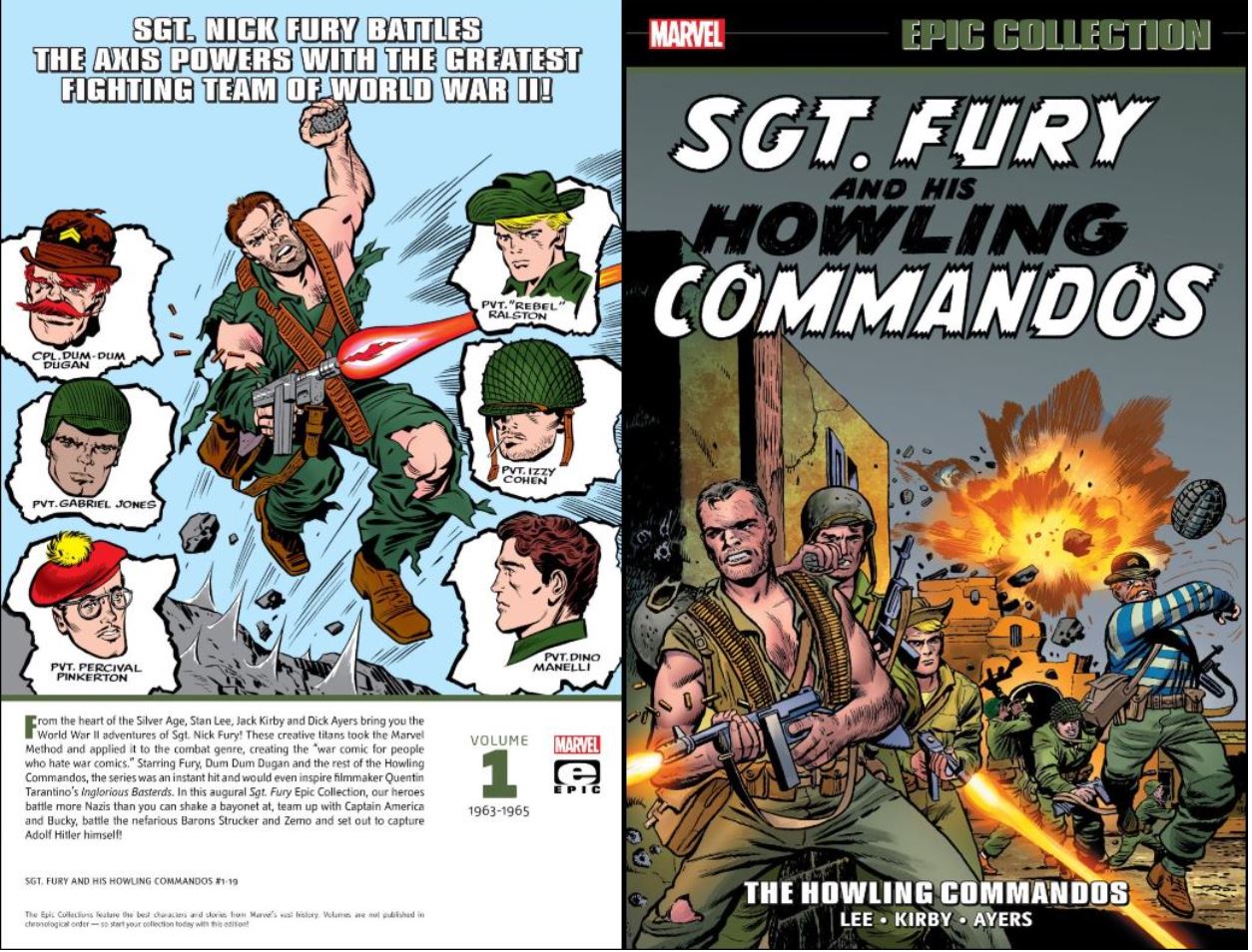
By Stan Lee, Jack Kirby & Dick Ayers, with George Roussos, Steve Ditko, Frank Giacoia, Vince Colletta, Chic Stone & various (MARVEL)
ISBN: 978-1-3029-1657-2 (TPB) 978-1-3025-1036-7 (Digital edition
This book includes Discriminatory Content produced in less enlightened times.
On August 28th 1917 in New York’s Lower East Side, Jacob Kurtzberg was born to Jewish-Austrian parents. He grew up to be one of the most influential and recognisable artists in world history. We’ll be celebrating his legacy of 99 years and counting over the next few weeks and rest of the year, but let’s start with the title all budding Marvelites rated least when he and Stan Lee first began changing comics together…
Sgt. Fury and his Howling Commandos began as an improbable, raucously over-the-top WWII combat comics series similar in tone to ensemble action movies like The Magnificent Seven, and such later offerings as The Wild Bunch and The Dirty Dozen. Our surly squad of sorry reprobates premiered in May 1963; one of three teams specifically concocted by men-on-fire Jack Kirby & Stan Lee to cover their genre bases whilst securing fledgling Marvel’s growing position as the publisher to watch.
Two years on, Fury’s post-war self was retooled as the big-name star of a second series (beginning with Strange Tales #135, August 1965) when espionage shows like The Man from U.N.C.L.E. and 007 film franchise were becoming international sensations. Nick Fury, Agent of S.H.I.E.L.D. combined Cold War tensions with sinister schemes of global domination by subversive, all-encompassing hidden enemy organisations with captivating super-science gadgetry and iconic imagineering from Jack Kirby and latterly Jim Steranko.
For all that time however, the original wartime version soldiered on (puns are my cool gadget of choice), blending a uniquely flamboyant house-bravado style, often ludicrous, implausible, historically inaccurate, all-action bombast with moments of genuine heartbreak, unbridled passion and seething emotion. Sgt. Fury started out as a pure Kirby creation. As with all his various war comics, The King (a seasoned WWII veteran who had served under Patton) made everything look harsh and real and appalling: the people and places are all grimy and tired, battered yet indomitable. Jack had survived some of the worst battles of the conflict and never forgot the horrific and heroic things he saw – as more graphically expressed in his comics (such as Foxhole) at different companies during the 1950s genre boom. However, even at kid-friendly, Comics Code-sanitised Marvel, those experiences perpetually leaked through onto his powerfully gripping pages.
Kirby was, sadly, far too valuable a resource to squander on a simple war comic (or indeed the X-Men or Avengers, the other series launched in that tripartite blitz on kids’ spending money) and was quickly reassigned, leaving redoubtable fellow veteran Dick Ayers to illuminate later stories, which he did for almost its entire run (95 issues plus Annuals) until transition to a reprint title with #121 (July 1974). The title then carried on until its ultimate demise in December 1981 with #167.
This initial compendium collects the contents of Sgt. Fury and his Howling Commandos #1-19 (spanning May 1963 – June 1965) and opens just as you’d expect with blistering premier ‘Sgt. Fury, and his Howling Commandoes’ (that’s how they spelleleled it in the storree-title – altho knot ennyware else).
Crafted by Lee, Kirby and inker Dick Ayers, the rip-snorting yarn is bursting with full page panels interrupted by ‘Meet the Howling Commandos’ – a double-page spread starring the seven members of First Attack Squad; Able Company. This comprised Fury himself, former circus strongman/Corporal “Dum-Dum” Dugan and Privates Robert “Rebel” Ralston (a Kentucky jockey), college student Jonathan “Junior” Juniper, jazz trumpeter Gabriel Jones, mechanic Izzy Cohen and glamorous movie heartthrob Dino Manelli. Controversially – even in the 1960s – this combat Rat Pack was an integrated unit with Jewish and black members as well as Catholics, Southern Baptists and New York Irish white guys all merrily serving together. The Howling Commandos pushed envelopes and busted taboos from the very start.
The first mission was a nonstop action romp pitting ‘Seven Against the Nazis!’ putting the squad through their unique paces as a ragged band of indomitable warriors took on hordes of square-necked Nazis to save D-Day and rescue a French resistance fighter with vital plans of the invasion. They even bring back a high-ranking “kraut” prisoner and leave room for a Kirby fact-page comparing and contrasting six different side-arms of the period in ancillary feature ‘Weapons of War’…
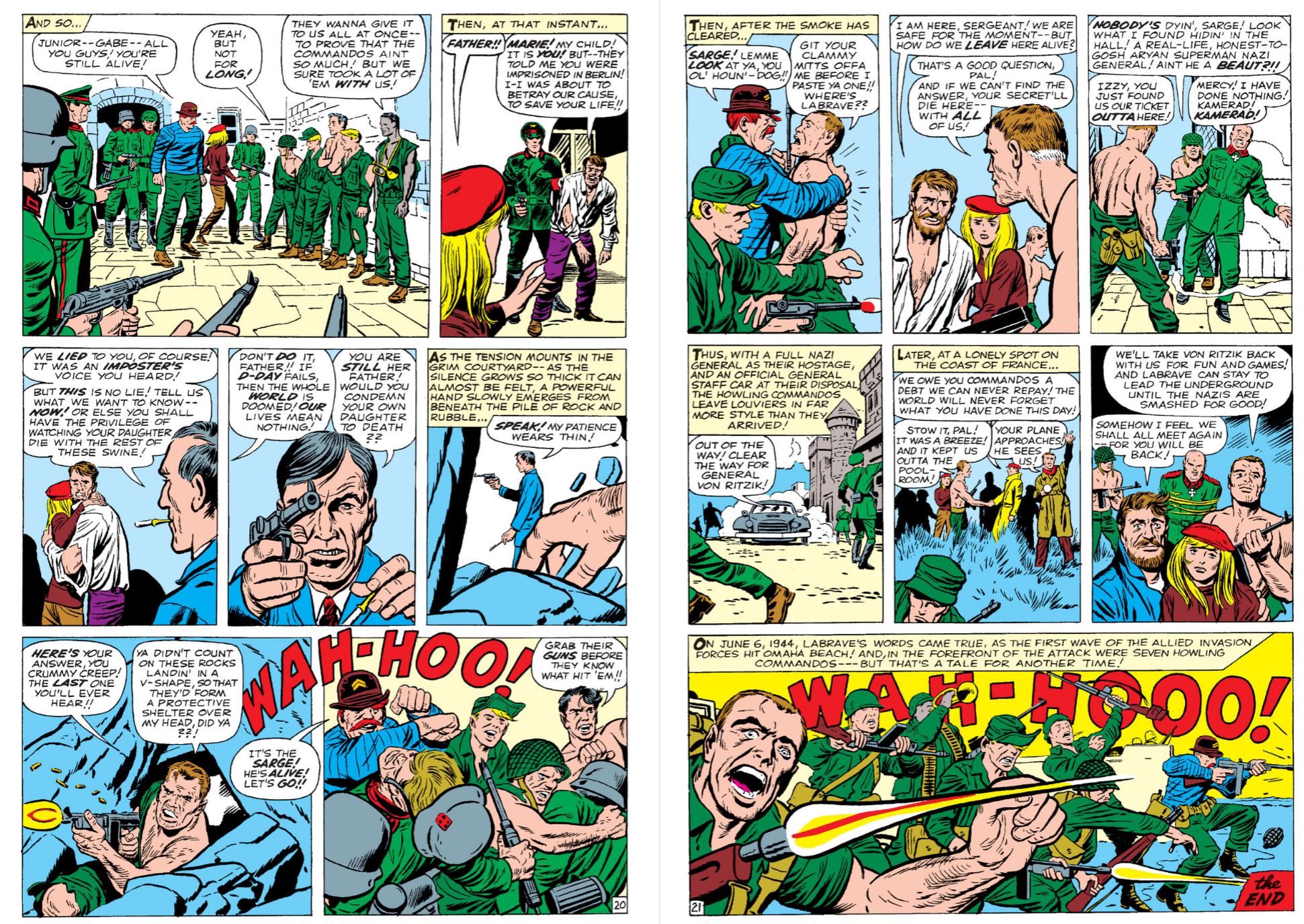
SF&HC #2 found ‘7 Doomed Men!’ up to their torn shirts in Germans as they first infiltrate a French coastal town to blow up a U-Boat base and get back to England just in time to be sent on another suicide mission. This time it’s to destroy a secret facility at Heinemund in the heart of the Fatherland, where Nazi scientists are doing something sinister and nefarious with “hard water”. These overblown fustian thrillers always played fast and loose with history and logic, so if you crave veracity above all, I’d steer clear, but if you can swallow a heaping helping of creative anachronism there’s always great fun to be had here – especially since nobody drew atomic explosions like Kirby. This drama is capped with fact pages as ‘The Enemy That Was!’ explores the capabilities of ‘The German Infantryman’ whilst ‘Weapons of War: “Chatter Guns” of World War II’ details all you need to know about submachine guns.
Rough-&-ready gallows humour and broad comedy became increasingly important to the series from SF&HC #3 onwards, with home base rivalries and comradely sparring leavening the outrageous nonstop carnage of the missions. ‘Midnight on Massacre Mountain!’ sees the septet explosively invading Italy to rescue a US army division caught in a Nazi trap. Along the way they meet a brilliant OSS officer training partisan troops, and Fury especially believes that young Reed Richards will go far…
Supplementing this exploit is a fascinating feature revealing what ordnance and hardware cost in ‘America’s World War II Shopping List!’ before, in #4, ‘Lord Ha-Ha’s Last Laugh!’ began an inking tour of duty for “George Bell” (Kirby’s 1950s studio-mate George “Inky” Roussos) and introduced a love interest for the Sarge, after he meets aristocratic Red Cross volunteer Lady Pamela Hawley during a London air raid. How cruel and tragic was fate then, that the Howlers’ very next mission takes them to Berlin to kidnap a young British nobleman with the same name, now acting as a crucial propaganda mouthpiece for the Wehrmacht…
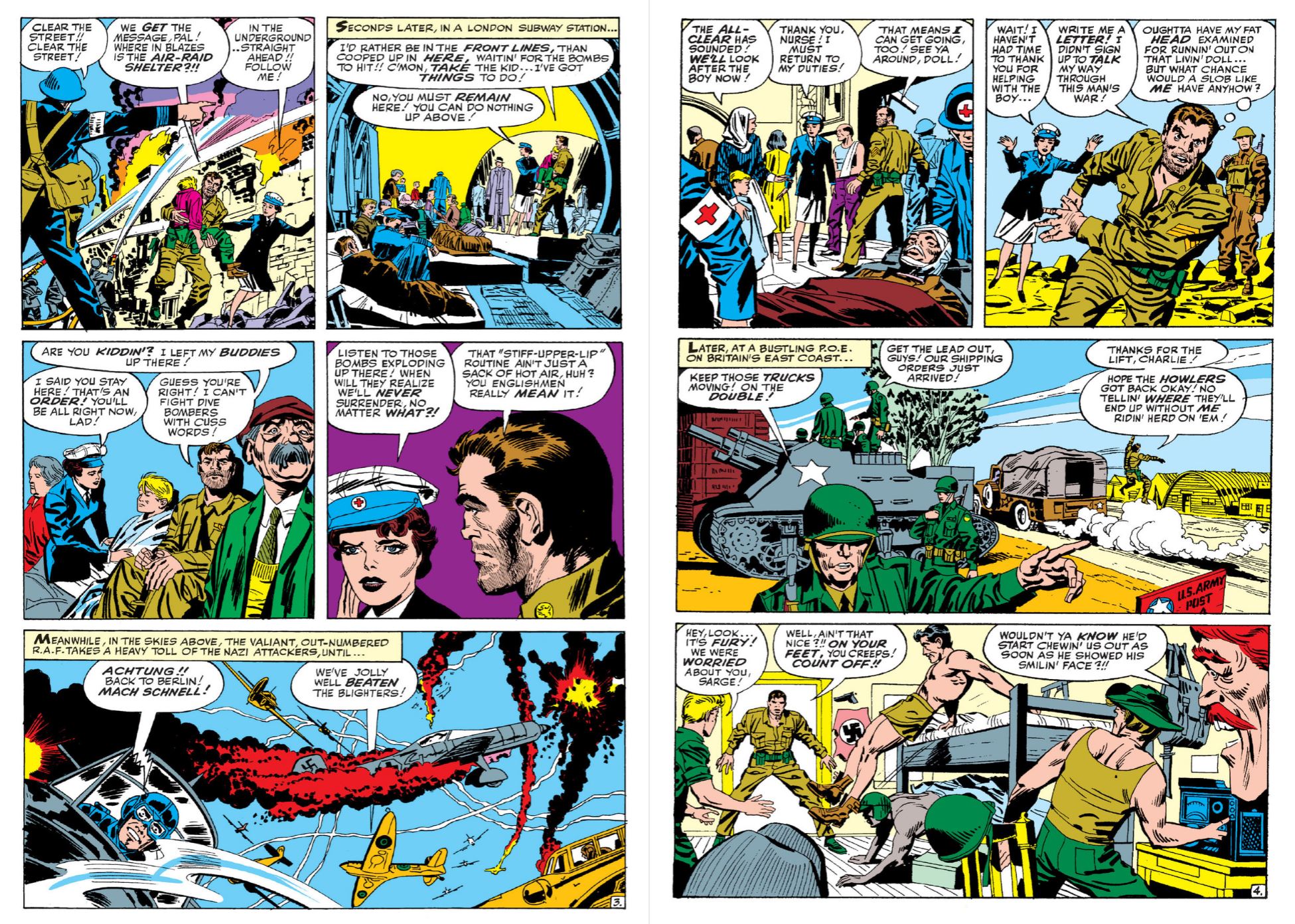
The mission is a double disaster. Not only does Pamela’s ignoble brother perish, but the debacle also costs the life of a Howler. Bonus feature ‘Weapons of War: Combat Rifles of World War II’ follows this shocking, surprisingly grim and low-key melodrama…
Fury’s key appearance as a CIA agent in FF #21 (not included here) was released between that issue and #5, but no mention is made of it as the dark and cunning yarn introduces one of Marvel’s vilest, greatest villains. ‘At the Mercy of Baron Strucker’ sees Fury humiliated and defeated in personal combat against an Aryan nobleman who uses candid filmed footage as a propaganda tool of the Nazis. Only too late does dashing Dino point out how the nonplussed noncom has fallen for the oldest trick in Hollywood’s archvillain playbook…
A riotous rematch goes rather better after which ‘Weapons of War: Light Machine Guns of World War II’ ends matters in a graphically educational manner, before ‘The Fangs of the Desert Fox!’ in #6 dumps the Squad in the desert to confront the massed forces of General Erwin Rommel in a mission foredoomed to fail. ‘The Court-Martial of Sergeant Fury’ provides a glimpse into the hard-bitten hero’s past and offers insights into his tempestuous relationship with immediate superior Captain Samuel “Happy Sam” Sawyer. Of course, to get that information we must watch Fury endure a dramatic trial after seemingly sabotaging a mission and striking a commanding officer…
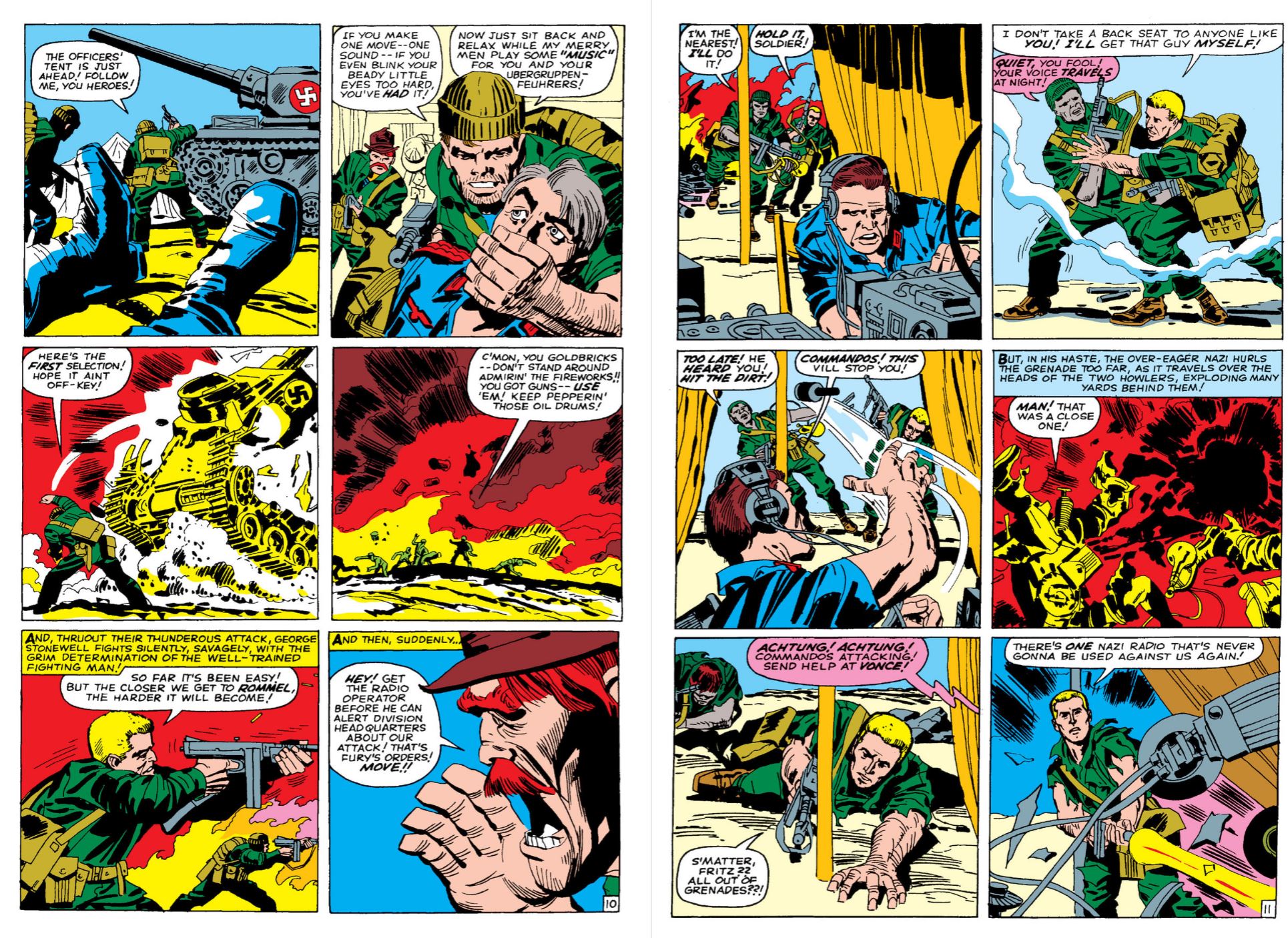
Although continuing to draw the magnificent, eye-catching covers, Kirby left the title with this issue. His astounding abilities were more profitably employed in superhero titles, even as Lee began consolidating the ever-expanding Marvel Universe by utilising more WWII iterations of contemporary characters. In #8 ‘The Death Ray of Baron Zemo!’ pits Howlers against a Captain America villain recently debuted in The Avengers. Ayers & Roussos capably depict the squad’s attempts to capture a Nazi super-scientist and a weapon which could shape the outcome of the entire war. The tale introduced Junior Juniper’s replacement: a rather fruity caricature of a British soldier named Percival Pinkerton, resplendent in horn-rimmed specs, pencil moustache, fuchsia beret and impossibly utilitarian umbrella…
In #9 implausibly audacious ‘Mission: Capture Adolf Hitler!’ goes awry after the Howlers’ latest incursion into Berlin brings Fury face-to-face with Wolfgang von Strucker; leading to his temporary capture and an astounding escape, after which ‘On to Okinawa!’ in #10 sees the squad achieve far greater success when despatched to the Pacific to rescue a captured US colonel from the Japanese. This exploit also saw the debut of a bearded bombastic submarine commander who would become a series regular before eventually winning his own title (Captain Savage and his Leatherneck Raiders) in 1967.
Post-Kirby, the pace visibly slowed and melodramatic subplots increased. In #11, ‘The Crackdown of Capt. Flint!’ depicted Happy Sam briefly replaced by a spit-&-polish officer who soon learns the limitations of his ways, after which in #12, a raid on a V1 factory in the heart of Europe seemingly prompts Dino to join the Nazis ‘When a Howler Turns Traitor!’ It was just a pre-arranged ploy of course, but sadly nobody told the US commander, who latterly stuck the star in front of a firing squad…
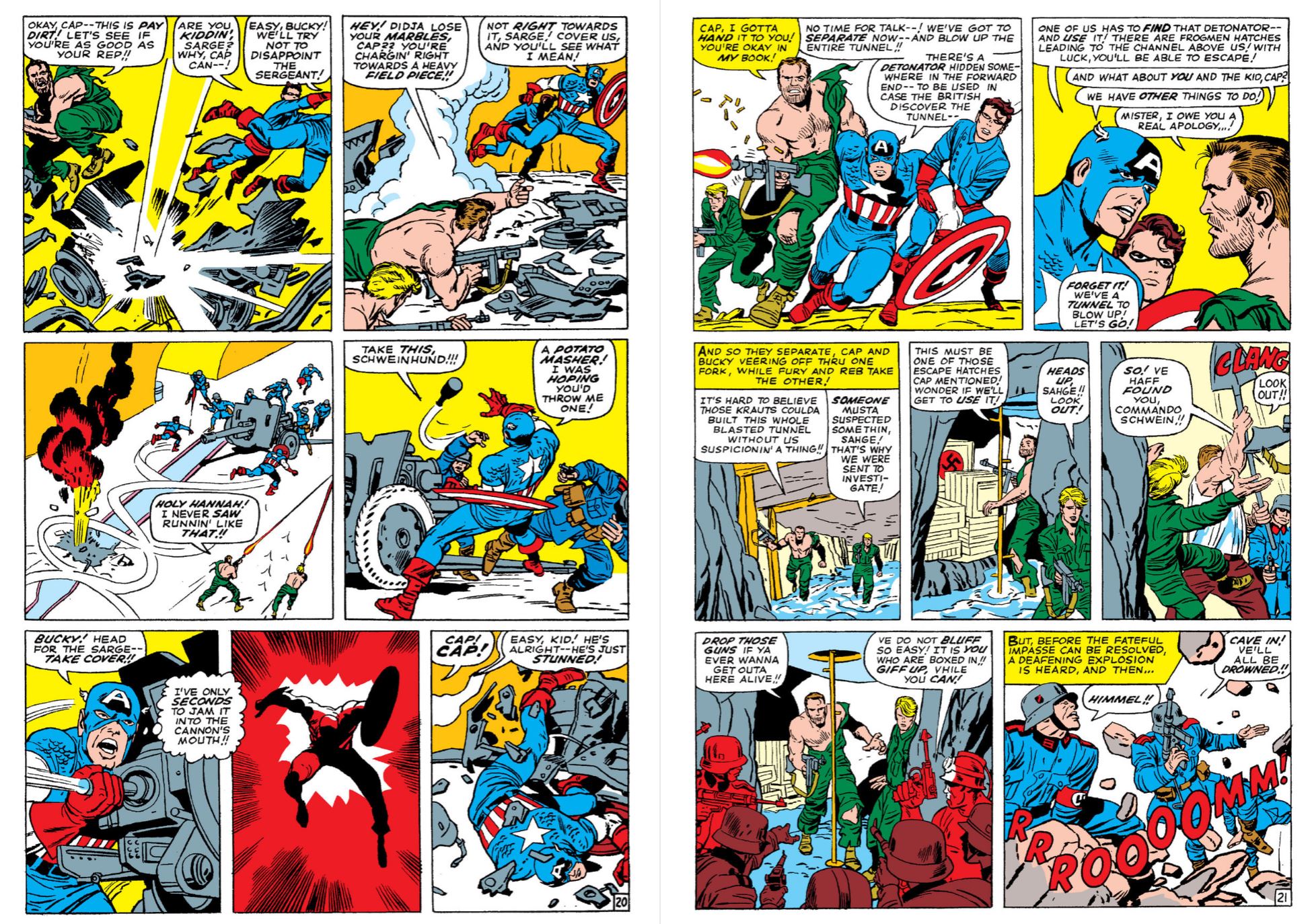
This issue also included a Marvel Masterwork Pin-up of Fury by Ayers, before Sgt. Fury and his Howling Commandos #13 offered arguably the best issue of the entire 167 issue run. The title said it all: ‘Fighting Side-by-Side with… Captain America and Bucky!’ reunited Lee, Kirby & Ayers in a blistering battle yarn wherein the Howlers cross paths with the masked Sentinels of Liberty after both teams stumble across a top-secret Nazi operation to build an invasion tunnel under the channel to England. To resort to the vernaculars of those times: “Wah-Hoo!”…
Ayers was back pencilling in #14, with Lee scripting and Roussos inking a minor milestone as harassed Adolf Hitler decrees the creation of a Nazi answer to Fury’s elite attack force. All ‘The Blitzkrieg Squad of Baron Strucker!’ had to do was lure the Howlers to a V2 rocket base and spring their trap…Yeah, that’s all…
Irregular supplemental feature Weapons of War provides the gen on the ‘B-26 Martin Marauder’ to inform and entertain in equal amounts before Steve Ditko stepped in to ink Ayers in issue #15 as ‘Too Small to Fight, Too Young to Die’ relates an ill-fated mission in Holland to destroy the dykes and flood the occupation forces. It all goes drastically awry and the Howlers “flee” back to Blighty with nothing but broken-hearted boy Hans Rooten… who has no idea that his despised quisling father is in fact now the Allies’ top spy in the region…
Hans is adopted as the Howlers’ plucky mascot but can’t accompany them when the squad is despatched to Africa in #16 to eradicate yet more Nazi super-weapons in ‘A Fortress in the Desert Stands!’ (pseudonymously inked by Frank Giacoia as Frankie Ray). From there it’s only a short camel-ride south until the ragtag rovers encounter spear-wielding natives and nasty Nazis engaged in a battle of Hearts & Minds ‘While the Jungle Sleeps!’ with Lee & Ayers supported by inker Vince Colletta.
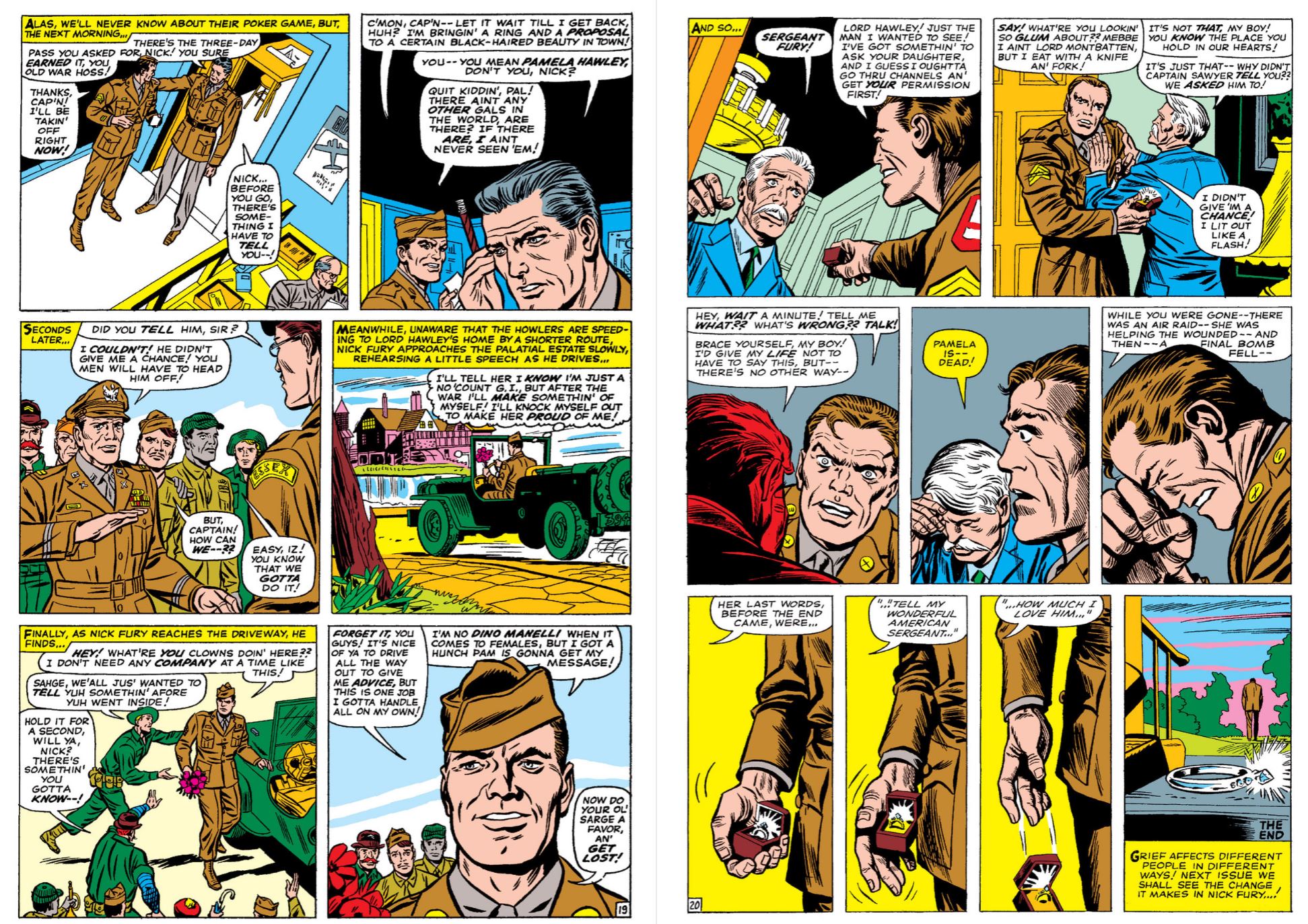
All this time the chalk-&-cheese romantic relationship between Nick and Lady Pamela Hawley had been slowly developing to the point where the Yankee lout was ready to propose. That all ended in Chic Stone inked #18 when, as the unit is busy sinking a German battleship in a Norwegian port, Hawley is ‘Killed in Action!’ Crushed and crazy, Fury goes AWOL in the final tale of this collection, remorselessly hunting down the leader of the bomber flight which had targeted the hospital where she worked and extracting ‘An Eye for an Eye!’ in a satisfyingly shocking Lee story sensitively rendered by Ayers & Giacoia. The Howlers go along for the ride, but whether to help their leader or hold him back is unclear…
Gilding this bellicose lily, the book signs off with a wealth of stunning original art pages from Kirby, Ayers, Ditko, Giacoia, Stone & Roussos; contemporary house ads, and previous collection covers. Whereas close rival DC increasingly abandoned the Death or Glory bombast at this time in favour of humanistic, anti-war explorations of war and soldiering, Marvel’s take always favoured action-entertainment and fantasy over soul-searching for ultimate truths. On that level at least, once Kirby had moved on, these early epics are stunningly effective and galvanically powerful exhibitions of the comics combat genre.
Just don’t use them for history homework.
© 1963, 1964, 1965, 2019 Marvel All rights reserved.
Born yesterday in 1908, Argentinian cartoonist turned Golden Age comics artist Louis Cazaneuve (Quique, el Niño Pirata , Blue Beetle, Red Raven, Captain Savage, Sea Rover, Aquaman) shares the day with Filipino cartoonist Lauro “Larry” Zarate Alcala (Siopawman, Slice of Life, Mang Ambo, Kalabog en Bosyo) in 1926; Italian shock artist Stefano Tamburini (RanXerox, Fuzzy Rat, Snake Agent) in 1955; US comic book star Ron Garney (Captain America, Hulk, JLA, Daredevil, Silver Surfer, BRZRKR) in 1962, and in 1967 writers Brian Michael Bendis (Jinx, Torso, Secret Invasion, Ultimate Spider-Man, Alias) & Pete Tomasi (Batman and Robin, Brightest Day, Green Lantern Corps) and artist Eddy Barrows (52, Birds of Prey, Teen Titans, Superman), with latecomer Nathan Fairbairn (Lake of Fire, Scott Pilgrim, Wonder Woman, Batman Incorporated) arriving in 1976.
Today also saw the passing of Portuguese satirist and political cartoonist Carlos Botelho in 1982; Underground cartoonist Rick Griffin (Zap Comix) in 1991 and Spanish legend Afonso Azpiri Mejía (Black Hawk, Reflections, Mot, Chang, Lorna, Bethlehem Steele) and Italian Diabolik and Tex Willer contributor Sergio Zaniboni in 2017.
Today in 1903, radio writer and comics strip scripter Fran Striker was born, creator of an undying dynasty of pulp heroes that included The Lone Ranger, Green Hornet & Sgt. Preston of the Yukon. In 1932 French auteur Jacques Lob (Superdupont, Ténébrax, Blanche Épiphanie) arrived, sharing the natal day with Underground Commix pioneer Skip Williamson (Snappy Sammy Smoot, Bijou Funnies, Steal This Book) in 1944; Herb and Jamaal creator Stephen R. Bentley a decade later and comics artist/animator Chuck Patton (Justice League of America, The Creeper, Green Lantern) in 1956. Later comics related natal events include Jim Calafiore (Exiles, Aquaman, Secret Six, Deadpool) and all-rounder Brian Haberlin (Witchblade, Spawn) in 1963; Italian artist Stefano Gaudiano (Kafka, Batman, Catwoman, Walking Dead) in 1966; Gene Ha (The Adventures of Cyclops & Phoenix, Top Ten, Wonder Woman: Historia, Mae) in 1969 and Chynna Clugston (Blue Monday, Hopeless Savages, Queen Bee, Legion of Super Heroes in the 31st Century, Lumberjanes/Gotham Academy) in 1975.
This day in 1984 artist Don Newton (The Phantom, Aquaman, The Avengers, New Gods, Batman, Captain Marvel/Shazam!) died. On this date in 2006 The Beano began running Hunt Emerson’s anarchic strip Ratz.