
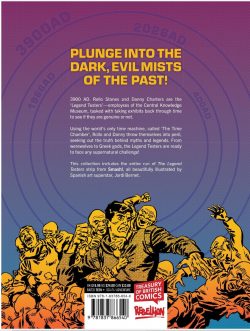
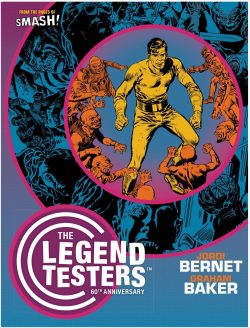
By Graham Baker, Jordi Bernet, with Alf Wallace & various (Rebellon Studios/ treasury of British Comics)
ISBN: 978-1-83786-654-0 (TPB/Digital edition), 978-1-83786-681-6 (Webshop edition)
This book includes Discriminatory Content produced in less enlightened times.
British comics always enjoyed an extended love affair with what can only be described as “unconventional” (for which substitute “bizarre” or “creepy”) stars. So many notional role models we grew up reading were outrageous or just plain “off”: self-righteous voyeur / vigilantes like Jason Hyde, sinister foreign masterminds like The Dwarf or Black Max, affable criminals such as Charley Peace, arrogant ex-criminals like The Spider or outright racist Overmen like manic white ideologue Captain Hurricane…
Prior to game changers Action, 2000AD and Misty, our comics fell into fairly ironclad categories. Back then, you had genial and/or fantastic preschool fantasy; many, many licensed entertainment properties; action; adventure; war (especially ones “We” were in or had started); school dramas; sports; and straight comedy strands. Closer examination could confirm that there was always a subversive merging, mixing undertone, especially anarchic antiheroes like Dennis the Menace or our rather strained interpretation of costumed crime-busters. Just check out Phantom Viking, Kelly’s Eye or early Steel Claw stories…
Over and again British oddness would combine with or react to long-standing familiarity with soft oppression, leading to sagas of overwhelming, imminent conquest and worse. With our benighted shores existentially threatened, entertainment sources responded with a procession of doughty resistors facing down doom from the deepest depths of perfidy and menace… especially as churned up by the scary results of foolish modern SCIENCE!
That’s not to say we didn’t appreciate less outrageous adventurers as with this notional precursor (or synchronistic zeitgeist?) to TV’s Time Tunnel, with a brace of straightlaced but tough-as-nails He-Men heroes Rollo Stones and Danny Charters who dared the unknown weekly in the name of SCIENCE! – and history of course…
Cover-dated February 5th 1966, Smash! launched as just another standard Odhams anthology weekly until abruptly re-badged as a “Power Comic” at the end of the year. It combined homegrown funnies and British originated thrillers with resized US strips to capitalise on the superhero bubble created by the Batman TV series. Power Comics was a sub-brand used by Odhams to differentiate those periodicals which contained reprinted American superhero material from the company’s regular blend of sports, war, western, adventure and funny strips – like Buster, Valiant, Lion or Tiger. During the Swinging Sixties, Power weeklies did much to popularise budding Marvel Universe characters in this country, which were still poorly served by distribution of the original US imports.
The increasingly expensive American reprints were dropped in 1969 and Smash! was radically retooled with the traditional mix of action, sport and humour strips. Undergoing a full redesign, it was relaunched on March 15th 1969 with all-UK material (mostly drawn by overseas artists) and finally disappeared into Valiant in April 1971 after 257 issues. Seasonal specials remained a draw until October 1975 when Smash Annual 1976 properly ended the era. From then on, the new Fleetway brand had no room for the old guard – except as re-conditioned reprints in cooler, more modern books…
Thanks to economic vagaries and spiralling costs in publishing, the mid 1960s and early 1970s were particularly wild and desperate for comics: inspiring a wave of innovation most fondly remembered for more of those aforementioned darkly off-kilter heroes, beguiling monsters and charismatic villains.
Gathering serialised episodes from Smash! 2nd April 1966 to 8th July 1967, this complete compilation delivers fantastic threats and menaces in a traditional weekly manner, as a pair of dedicated and competent white blokes diligently push back the boundaries of ignorance. As was usual for these times, what was popular on screens large & small affected what arrived on the picture-packed pages Probably committee created with majority input from supervising editor Alf Wallace (Missing Link, Johnny Future) and sub-editor/scripter Graham Baker with new kid Jordi Bernet involved from the get-go, this series is one of many lost delights crafted by world stars in waiting and the observant will see Bernet improving and pushing himself on every page…
Jordi Bernet Cussó was born in Barcelona in 1944, son of a prominent, successful humour cartoonist. When his dad died suddenly 15-year-old Jordi took over his strip Doña Urraca (Mrs. Magpie). A huge fan of Alex Raymond, Hal Foster and especially Milton Caniff, Jordi yearned for less restrictive horizons and left Spain in the early 1960s and moved into dramatic storytelling.
He worked for Belgium’s Le Journal de Spirou, and Germany’s Pip and Primo, before finding a home in British weeklies. Bernet worked for UK publishers between 1964 and 1967, and as well as Odhams/Fleetway/IPC anthologies Smash!, Tiger and War Picture Library, produced superb pages for DC Thomson’s Victor and Hornet. He even illustrated a Gardner Fox horror short for Marvel’s Vampire Tales #1 (1973), but mainstream America was generally denied his mastery (other than translated Torpedo volumes and a Batman short story) until the 21st century reincarnation of Jonah Hex… which he truly made his own.
His most famous strips include thrillers Dan Lacombe (written by his uncle Miguel Cussó), Paul Foran (scripted by José Larraz) the saucy Wat 69 plus spectacular post-apocalyptic barbarian epic Andrax (both with uncle Cussó again). When fascist dictator Franco died, Bernet returned to Spain and began working for Cimoc, Creepy and Metropol, collaborating with Antonio Segura on adult fantasy Sarvan and dystopian SF black comedy Kraken, as well as with Enrique Sánchez Abuli on the gangster and adult themed tales that made him one of the world’s most honoured artists. These culminated with the incredibly successful crime saga Torpedo 1936.
For now though and way back then, following a heartwarming reminiscence and proud career resume from the series illustrator himself, we launch at full pelt with inaugural serial ‘Death Castle’ which ran from 2nd April (Smash! #9) to 25th June 1966.
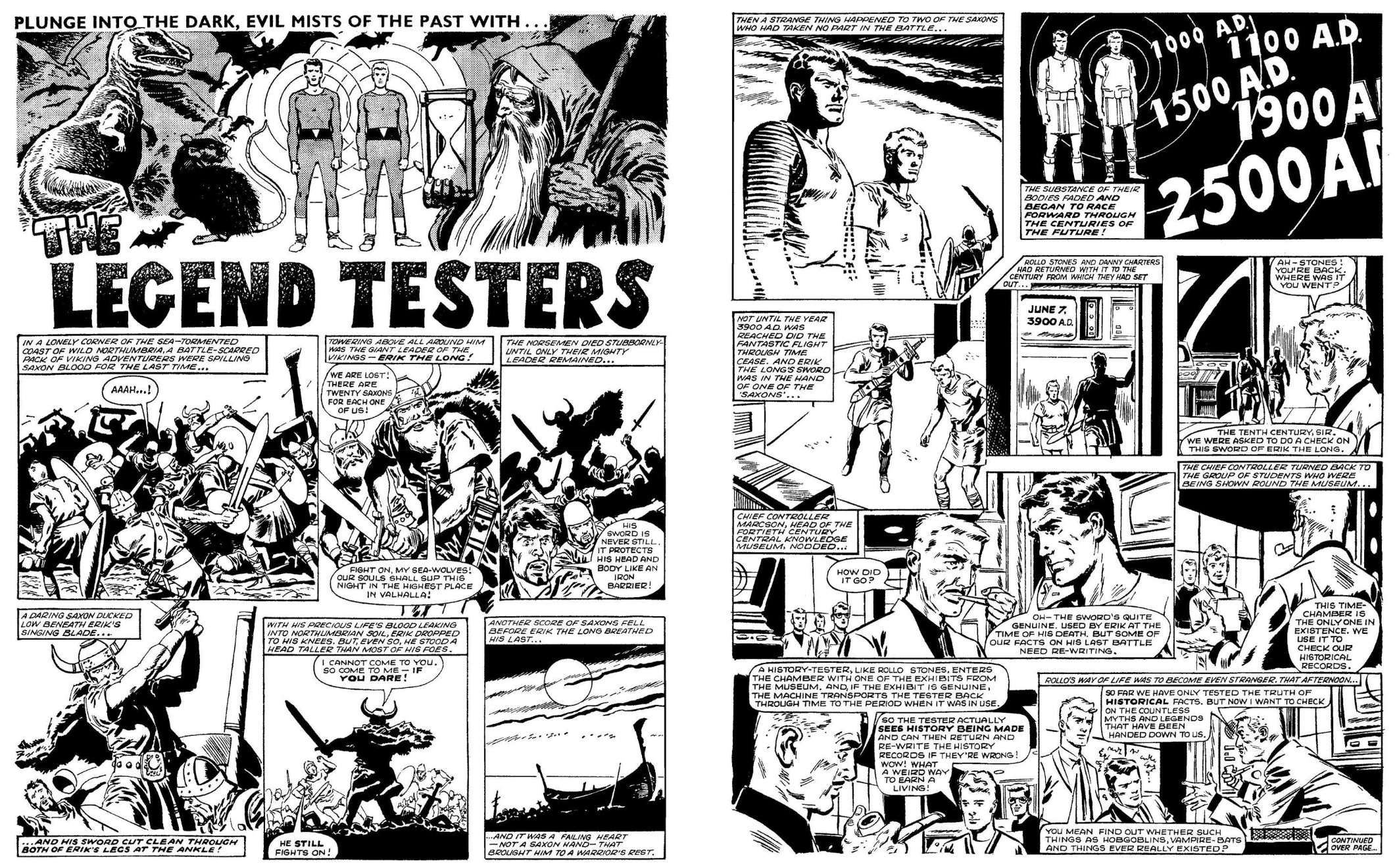
In that wild innovative era, the creators were looking to be fresh and new so here logos and layout and even the narrative tone changed from week to week as the storytellers shuffled to make something fresh instantly compelling out of old themes and plots. That even included on-again, off-again individual chapter titles like ‘Man into Monster’ and ‘The 5 Faces of Evil!’ before settling down and just opting to tell tense, gripping yarns…
The premise is simple: in the 40th century the Central Knowledge Museum is a vast research and storage repository of all things historical. Now top investigators Rollo Stones and Danny Charters have used its time machine to confirm the veracity of the last artefact and corrected (by first person observation) the mistaken data that has come down with it, their boss Marcson has a new mission for them. It’s June 7th 3900 AD and with no more history mysteries, he asks them to start testing the large collection of unknown and myth-based items in their cupboard.
Apart from the potential death and danger, it’s practically foolproof. The machine only works if the objects the newly-appointed Legend Testers are holding are in some way authentic, as with the supposed werewolf skull that catapults them both back to feudal Europe and an encounter with a magical coalition of diabolical monsters.
In short order Rollo & Danny survive on wits and fists against a citadel of devils comprising sorcerer Necro, vampire Draca, sadistic torturer/inventor Love, Balbin, Prince of Trolls. bodyguard brute Happy (the werewolf in question) and notional leader Count Cadavo. Each in turns tries to break the strangers with their personalised hordes of monster minions but in the end the myths are confirmed at the cost of the vile villains’ unlives…
One of the most complex and trippy exploits of the era, ‘Eterno’ ran in issues between 2nd July and 20th August. This time the suspect object pulled our investigators back beyond humankind to a previous civilisation that was destroyed by a vampiric alien that consumed their planetary life energies. Millions of years later, humankind evolved and developed a very similar existence which drew Eterna back to Earth and the Testers on his heels to that time and place. As the monster and his robots began preparing to absorb a second course of earthlings Rollo & Danny were in the right place and time to end the terror forever…
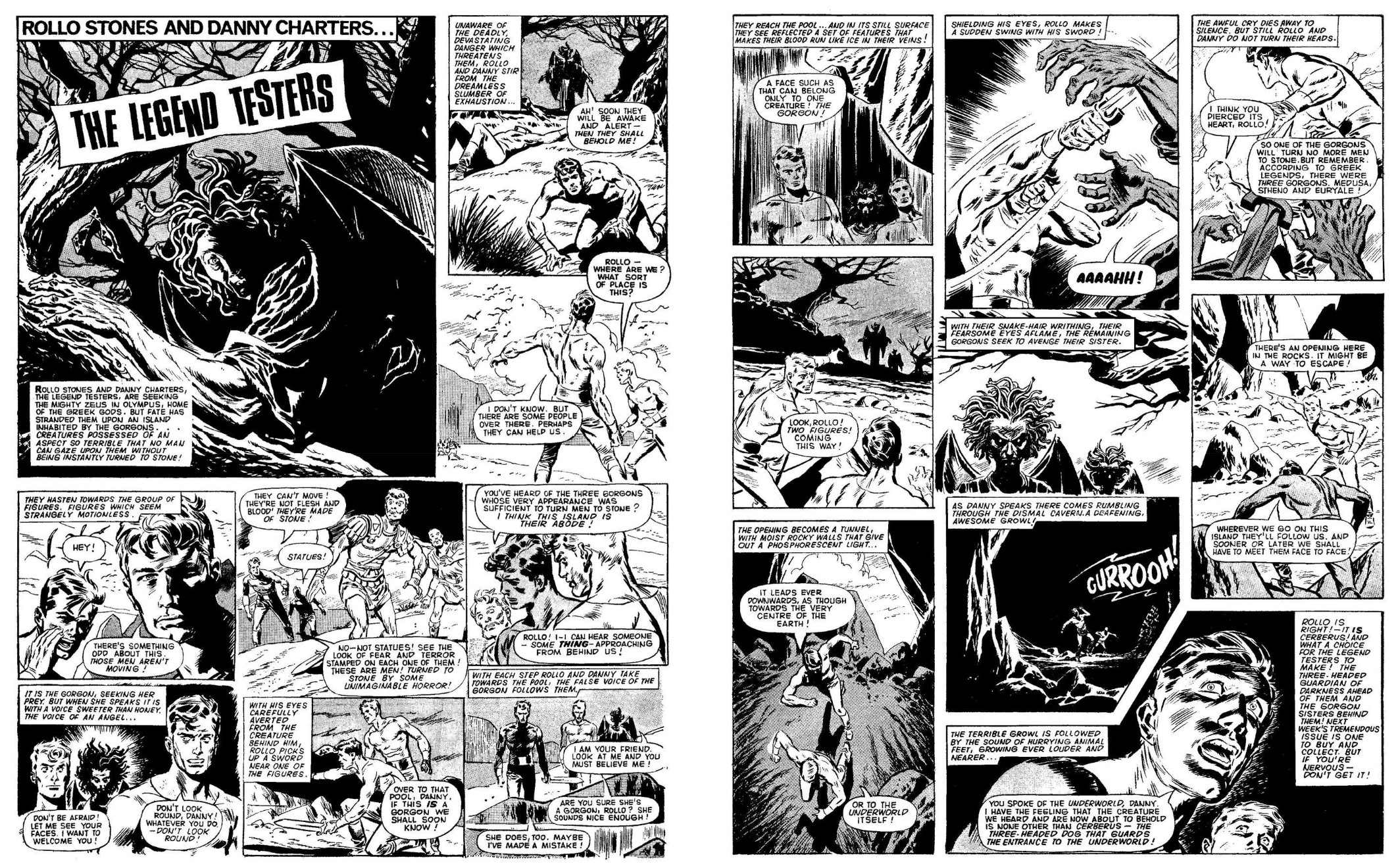
Channelling the contemporary cinematic trend for Grecian myths and heroes, the boys spend half a year authenticating ‘The Crown of Zeus’ (27th August – 24th December), enduring an avalanche of peril and near-death escapes to categorically verify their chunk of diadem – and by extension the ancient lives of gods and monsters. After facing cyclopes, centaurs, gorgons, Cerberus, the Minotaur, Lernaean ghosts and hydras, man-eating horses, Pegasus, Poseidon, Proteus, Janus, sky-propping Atlas, petty-minded Bacchus, satyrs and earth-shaking Titans the lads learn just how the gods died…
At least demi-gods Hercules and Hermes (AKA “Quicksilver”) were on their side until it was all over and the time machine called them home…
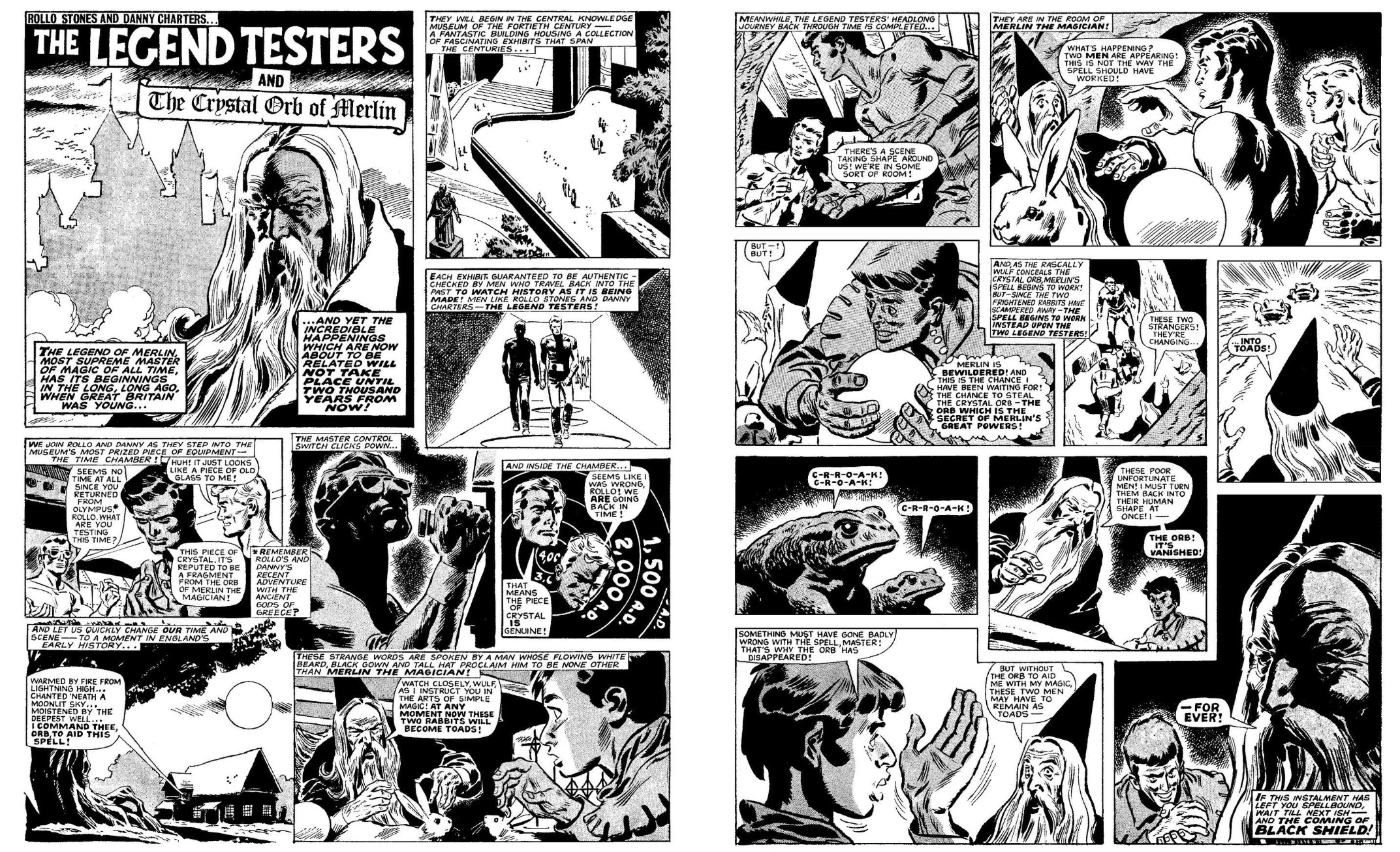
The days of Camelot called when the Testers touched fragments of ‘The Crystal Orb of Merlin’ (December 31st 1966 to 4th March 1967) but sparked chronal catastrophe as the wise wizard’s talisman was stolen by anti-Arthurian despot Black Shield, who used it to arm his troops with 20th century weapons from pistols and hand grenades to tanks and an atomic bomb. The conclusion left everyone gasping and still does today…
Published from 11th March to 15th April, ‘The King of the Beasts’ saw Rollo & Danny divine how an idyllic land of talking animals living in harmony and seclusion was destroyed by greed and ambition, after which aliens are the order of the day when Marcson hands the investigators a piece of metal not of this Earth. A simple touch then takes them to 12th century Europe where ‘The Metal Men’ (22nd April – 3rd June) are seeking to strip-mine the world for life-generating minerals. The Testers’ interference only results in their rendition to embattled, civil war-torn planet Meturn, but too late to do any good as the metalloids descend into mutually assured destruction. Thankfully, the confusion allows the boys to frantically steal the last space bus out of town…
The temporal turbulence terminates rather timidly with ‘The Crown of Kebi’ (10th June to 8th July 1967) as Marcson sends his gone-to guys to an utterly unknown destination where again greed and ambition trigger the end of a fabulous civilisation. Rollo & Danny’s very conspicuous arrival makes them unwitting tools of shady priest Walu on the island kingdom of Kebi, but their scruples mean he soon prefers them dead to alive. After tricking them into a voyage into “the underworld” beneath a mountain, the boys battle beastly apes, demon dwarves and worse, but their refusal to be suitably sainted and sent to heaven ultimately stymies the witch doctor and sinks the island nation…
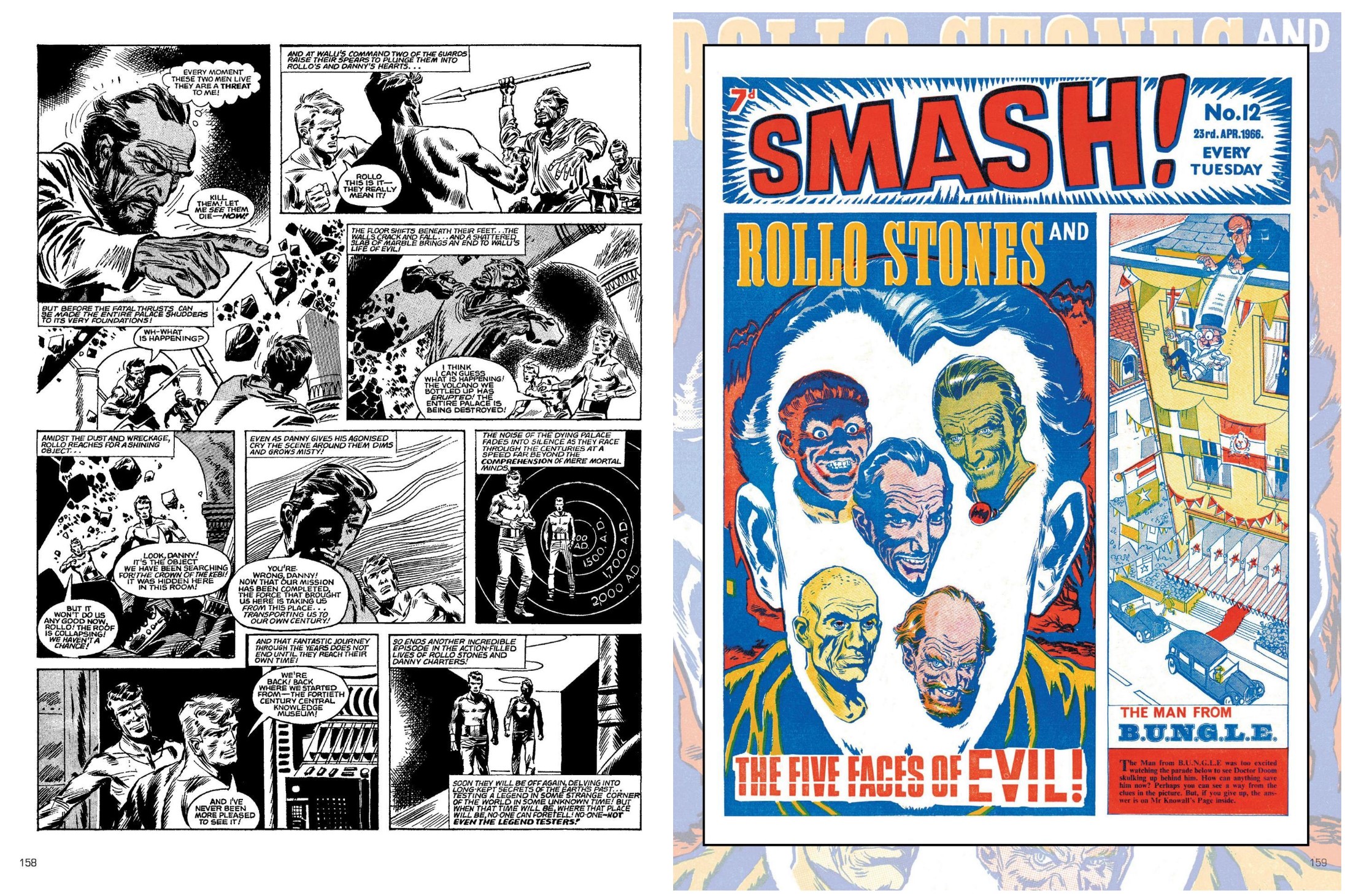
Closing this epic outing of spookily spectacular saga is a compelling ‘Covers gallery’ of thrilling (albeit limited-colour) clashes courtesy of Bernet and the editorial paste up squad, plus the now traditional creator briefings.
For British, Commonwealth and European readers of a certain age and prone to debilitating nostalgia, the comic works gathered in this titanic tribute gig are an exciting, engaging, done-in-one delight that’s undemanding and rewarding; and a rare treat these days.
If that appeals, go hit this book, it’s how history – and SCIENCE! – should be made.
© 1966, 1967, & 2026 Rebellion Publishing IP Ltd. All Rights reserved.
Today in 1883, French artist, printmaker, illustrator, painter, caricaturist, sculptor and comic dabbler Gustave Doré died. However, one year later comics strip genius George (Jiggs & Maggie, Bringing Up Father) McManus was born. In 1952 Klaus (Daredevil, Batman) Janson joined the party, but probably missed the 1930 debut of Hergé’s Quick & Flupke in Le Petit Vingtième and launch of UK weekly Sparky in 1965.
In 1988, UK icon Battle Picture Weekly shut up shop and in 2001 Makoto Yukimura’s manga masterpiece Planetes began.