
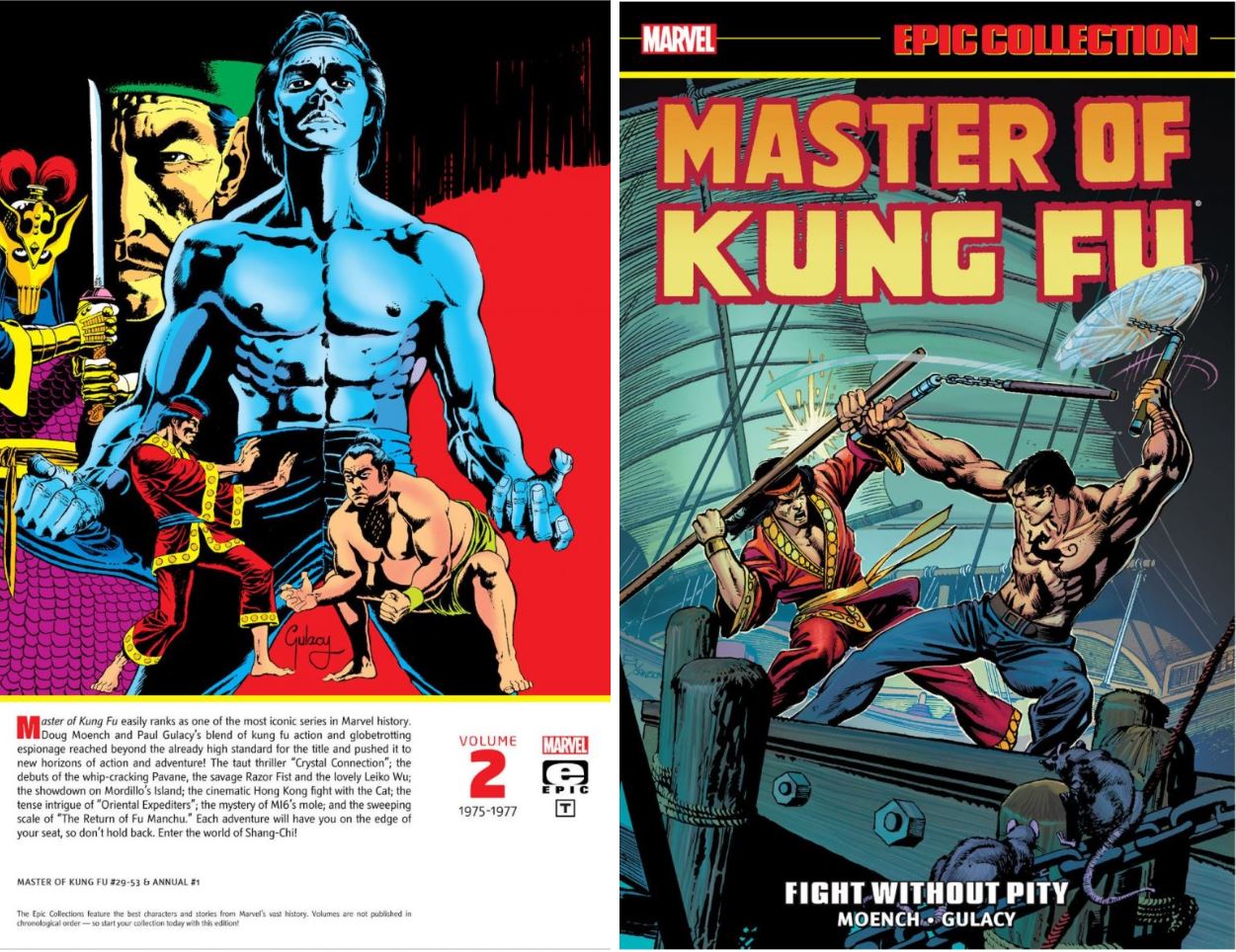
By Doug Moench, Paul Gulacy, Sal Buscema, Keith Pollard, Jim Craig, Dan Adkins, Jack Abel, Pablo Marcos, Mike Esposito, Sal Trapani, John Tartaglione, Duffy Vohland, Tom Sutton & various (MARVEL)
ISBN: 978-1-3029-0135-6 (TPB/Digital edition)
This book includes Discriminatory Content produced in less enlightened times Comic books have always operated within outworld popular trends and fashions – just look at what got published whenever westerns or science fiction dominated on TV – so when the ancient philosophy and discipline of Kung Fu made its mark on western entertainment, it wasn’t long before all those kicks and punches found their way onto four-colour pages of America’s periodicals. Early starter Charlton Comics added Yang and House of Yang to their pioneering Judo Joe title and Frank McLaughlin’s Judomaster; DC debuted Richard Dragon and rebooted Karate Kid; Atlas/Seaboard opened (and as quickly closed again) The Hands of the Dragon and Marvel converted an already in-development proposed literary adaptation into an ongoing saga about a villain’s son…
A month after it launched, a second orient-inspired hero debuted with Iron Fist: combining combat philosophy, high fantasy and magical forces with a proper superhero mask and costume…
Although largely retrofitted for modern times, inspirational Master of Kung Fu star Shang-Chi originated with lots of tricky baggage. He kicked off in the autumn of 1973, cashing in on the contemporary West’s craze for Eastern philosophy and martial arts action that had already generated an avalanche of “Chop Sockey” movies and a controversial TV sensation entitled Kung Fu. You may recall that the lead in that cowboy-set saga was a half-Chinese Shaolin monk, played – after much publicised legal and industry agitation – by a white actor…
At Marvel, no one at that time particularly griped about the fact that Shang-Chi was designed by editor Roy Thomas and artisans Steve Englehart, Jim Starlin & Al Milgrom as a naive innocent (also half Chinese, with an American mother) thrown into tumultuous modern society as a rebellious yet involved counterpoint to his father: an insidious scheming fiend intent on global domination. Back then, securing rights to a major literary property and wrapping new comics in it was an established practise. It had worked spectacularly with Conan the Barbarian and horror stars Dracula and The Monster of Frankenstein. The same process also brilliantly informed seminal science fiction icon Killraven in War of the Worlds and plenty more…
These days we comics apologists keep saying “it was a different era”, but I genuinely don’t think anyone in the editorial office paused for a moment of second thoughts when their new Kung Fu book secured the use of one of literature’s greatest villains as a major player. Special Marvel Edition #15 (cover-dated December 1973) launched to great success, with Fu Manchu an overarching villain already a global personification of infamy.
Arthur Henry Sarsfield Ward AKA Sax Rohmer’s ultimate embodiment of patronising mistrust and racist suspicion had been hugely popular since 1913’s The Mystery of Dr. Fu-Manchu. The prime archetype for mad scientists and remorseless “Yellow Peril” threatening civilization, the character spread to stage, screen, airwaves and comics (even appropriating the cover of Detective Comics #1, heralding an interior series that ran until #28), but most importantly, became the visual affirmation and conceptual basis for countless evil “Asiatics”, “Orientals” and “Celestials” dominating popular fiction ever since. In recent years we’ve all (well, mostly all) acknowledged past iniquities and Shang-Chi has been fully reimagined, with that paternal link downplayed and ultimately abandoned – as much for licensing laws as social justice. And cultural respect, naturally…
Like most comics companies, Marvel employed plenty of “Yellow Peril” knock-offs and personifications – including Wong Chu; Plan Tzu (AKA the Yellow and latterly Golden, Claw); Huang Zhu; Silver Samurai; Doctor Sun, ad infinitum: all birds of another colour that are still nastily pejorative shades of saffron. Perhaps this is just my white guilt and fanboy shame talking. These stories, crafted by Marvel’s employees were – and remain – some of the best action comics you’ll ever encounter, but never forget what they’re actually about -distrust of the “other”. Without making excuses, I should also state that despite the casual racism suggested by legions of outrageously exotic, inscrutable lemon-hued bad guys haunting this series at every level, Master of Kung Fu did sensitively address issues of race and honestly attempt to share non-Christian philosophies and thought whilst – most importantly – offering potently powerful role models to kids of Asian origins. So at least there’s that…
Packed with stunning exotic adventure and compellingly convincing drama, this collection gathers Master of Kung Fu #29-53 and Master of Kung Fu Annual #1 (spanning June 1975 to August 1977). Written entirely by Doug Moench and primarily showcasing the developing graphic realism of Paul Gulacy, surrendering to his love of spy fiction it opens without a preamble in the middle of a mighty struggle…
Previously: the series inauspiciously launched in bimonthly reprint title Special Marvel Edition as The Hands of Shang Chi: Master of Kung Fu, but by the third issue (April 1974) became exclusively his. The origin episode introduced a vibrant, brilliant young man raised in utter isolation in the style and manner of imperial China. Reared by monks and savants, the boy was the result of a match between a physically perfect American woman and “misunderstood patriot” Fu Manchu. The boy was raised to accept that his sire was a noble hero unfairly hunted and slandered by corrupt western governments and the communist usurpers now blasphemously controlling the world’s greatest empire.
Fu’s son was schooled to respect and obey his father, trained to perfection in martial arts and designed as the ultimate warrior servant: the doctor’s devoted personal weapon against lifelong enemies Sir Dennis Nayland Smith and Doctor Petrie.
On reaching maturity, Shang – whose name means “the rising and advancing of a spirit” – was despatched to execute Petrie. However, after the obedient weapon completed his mission, he subsequently questions his entire life and the worldly benefit of killing an elderly, frail, already dying man. An emotional confrontation with Nayland Smith (who endured daily agonies from being maimed at the Devil Doctor’s command) further rattled the boy’s resolve and eventually Shang’s sublime education demanded he reassess everything his father had taught him…
After invading the villain’s New York citadel and crushing an army of freaks and monsters, Shang Chi faced his father and rejected all he stood for. The battle lines of an epic family struggle had been drawn. Banished from his cloistered childhood home and environs, the philosophically minded innocent adapted rapidly to the constant violence of the modern world. eventually accepting shelter with Nayland Smith in return for (espionage) services rendered…
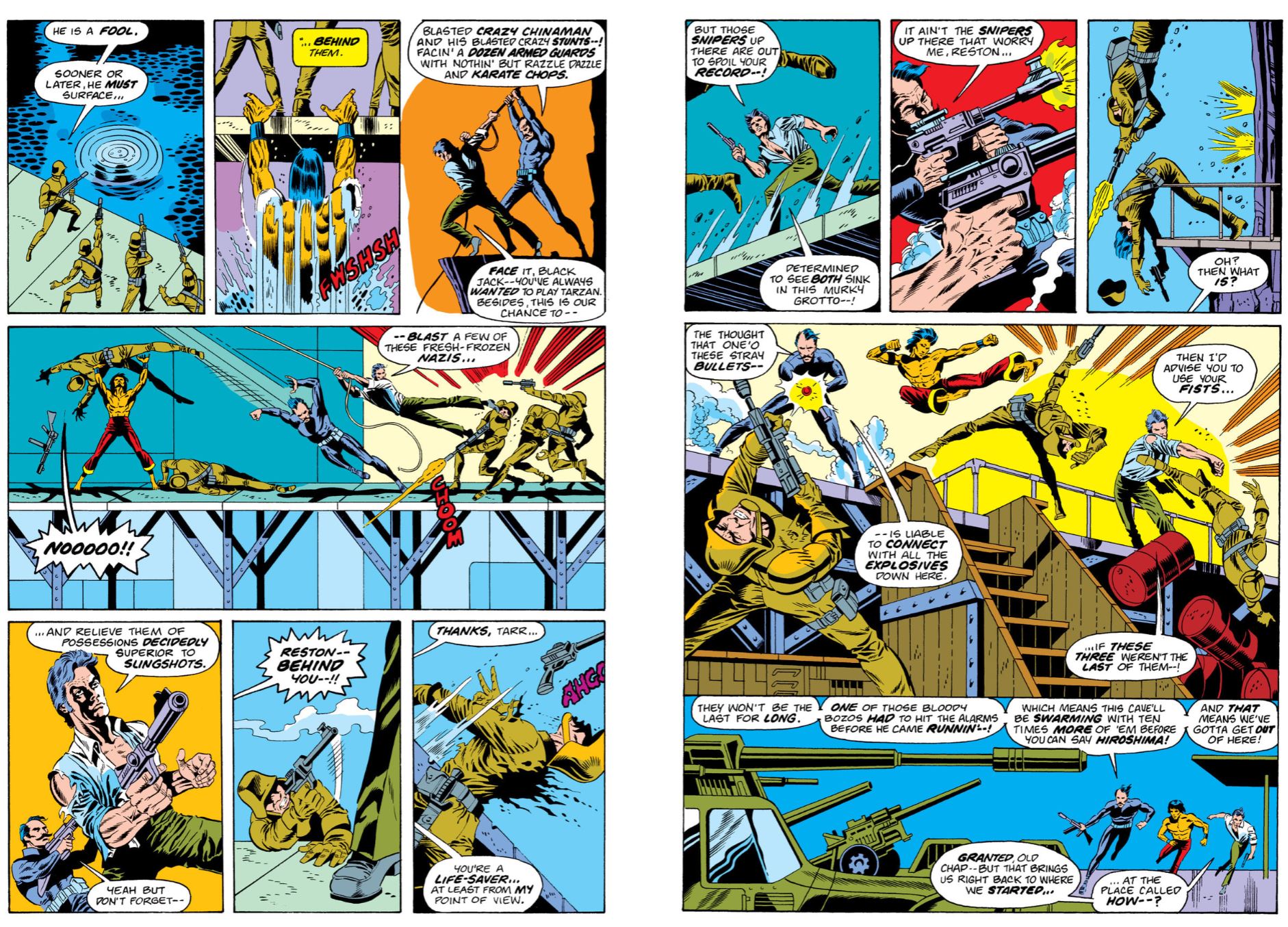
Now, a turning point in his rising and advancement comes in MOKF #29 as Shang finds reason to abandon his pacifistic aspirations and get involved in western affairs after seeing firsthand the harm drugs cause, joining Nayland Smith’s team to cripple the drug trade. The unwelcome allies include veteran heavy Blackjack Tarr, and Petrie – not dead at Shang’s hand after all and subsequently rescued from his father’s clutches – working with British agent Clive Reston. He is, by his own account, a descendent of a famed “Consulting Detective” and a Double-0 operative “on Her Majesty’s Secret Service”)
The entire series was slowly morphing into a James Bond pastiche and with this mission to end effetely urbane drug dealer turned nuclear terrorist Carlton Velcro, illustrator Gulacy began a ballistic visual progression that would make him one of most watched and admired artists of the era as he referenced movie star and set pieces throughout the saga.
‘The Crystal Connection’ begins with Reston undercover at Velcro’s French coast fortress, playing heroin buyer Mr Blue until Shang & Tarr can infiltrate and secure the dope stocks. No one expected such massive defences; an army of killers led by deadly assassin Razor-Fist and a nuclear arsenal hidden below ‘A Gulf of Lions’ (#30, inked by Dan Adkins), with the pitched battle ranging far and wide as Razor Fist’s defeat leads to Shang clashing with whip-wielding panther woman Pavane before a truly explosive conclusion in ‘Snowbuster’…
‘Assault on an Angry Sea!’ was a hasty fill-in illustrated by Sal Buscema & Mike Esposito as Shang returns to London by ship and is drawn into the hunt for an undercover courier who is unaware that counteragents intend to intercept and end them. In this traditional mystery yarn, Chi finds too many suspects and can’t tell friend from foe from target, but triumphs nonetheless, before MOKF #33 resumes the Moench/Gulacy filmic fun-fest with ‘Wicked Messenger of Madness!’ This introduces seductive, conflicted agent Leiko Wu as both romantic interest and wedge between Shang Chi and his colleagues, and sees a robotic mannequin fail to assassinate Nayland Smith thanks to martial arts mastery but opens the door to a complex web of lies, double-dealing, insane artificial intelligences and a doomsday weapon.
The robot was a literal tool of missing agent Simon Bretnor, revealed far too late as narcissistic hired killer and would-be world conqueror Mordillo, who wants a space weapon using the ozone layer and sunlight to ravage sites on Earth. The plans for it are encoded in Wu’s brain, but by the time she realises her current boyfriend Bretnor is the bad guy, Leiko’s his prisoner on a manically murderous version of Fantasy Island…
As Shang & Reston race to the madly modified atoll-turned-playground-of-peril, Wu attempts to reason with the crazed Mordillo, but gets more sense from his Pinocchio-like AI robot sidekick Brynocki, who is trying to mediate a ‘Cyclone at the Center of a Madman’s Crown!’ She does, however, learn that her captor had a connection to Pavane and Velcro and now holds Chi responsible for a huge loss of face and fortune. Another spectacular conclusion comes when maniac and martial artist clash in the skies above the island as the villain briefly unleashes his stolen Solar Chute to rain destruction down on the island in ‘Death-Hand and the Sun of Mordillo’…
What feels like a reformatted leftover from the Giant-Size Master of Kung Fu era follows in #36 & 37 (January & February 1976, by Moench, Keith Pollard & Sal Trapani) with Shang entering a magical maze of mystery. He seeks to defend from ninjas and their leader Darkstrider a carnival of hapless freaks voluntarily living in ‘Cages of Myth, Menagerie of Mirrors!’ but is initially hard-pressed saving anyone from the villain who subtly weaves a ‘Web of Dark Death!’ Moench, Pollard, John Tartaglione & Duffy Vohland continue fantasy themes in Master of Kung Fu Annual #1 during a team-up with fellow transplanted warrior Iron Fist. Here Danny Rand and Shang are tricked into entering another dimension to invade ‘The Fortress of S’ahra Sharn!’ The culprit is trickster wizard Quan-St’ar, whose true goal is the destruction of immortal city K’un-Lun, but he makes one huge mistake…
At their creative peak Moench & Gulacy started an epic, ambitious, truly sophisticated and industry-changing run in MOKF #38 (March 1976). Here Shang Chi reluctantly accepts a rescue mission to extract an agent from Hong Kong, meeting lies, passion, disinformation and deadly love in ‘Cat’. Nayland Smith has again orchestrated events to satisfy his own agenda and saving Julia leads Chi into a ‘Fight Without Pity’ against an opponent who might well be his superior in combat ability… and also holds the moral high ground.
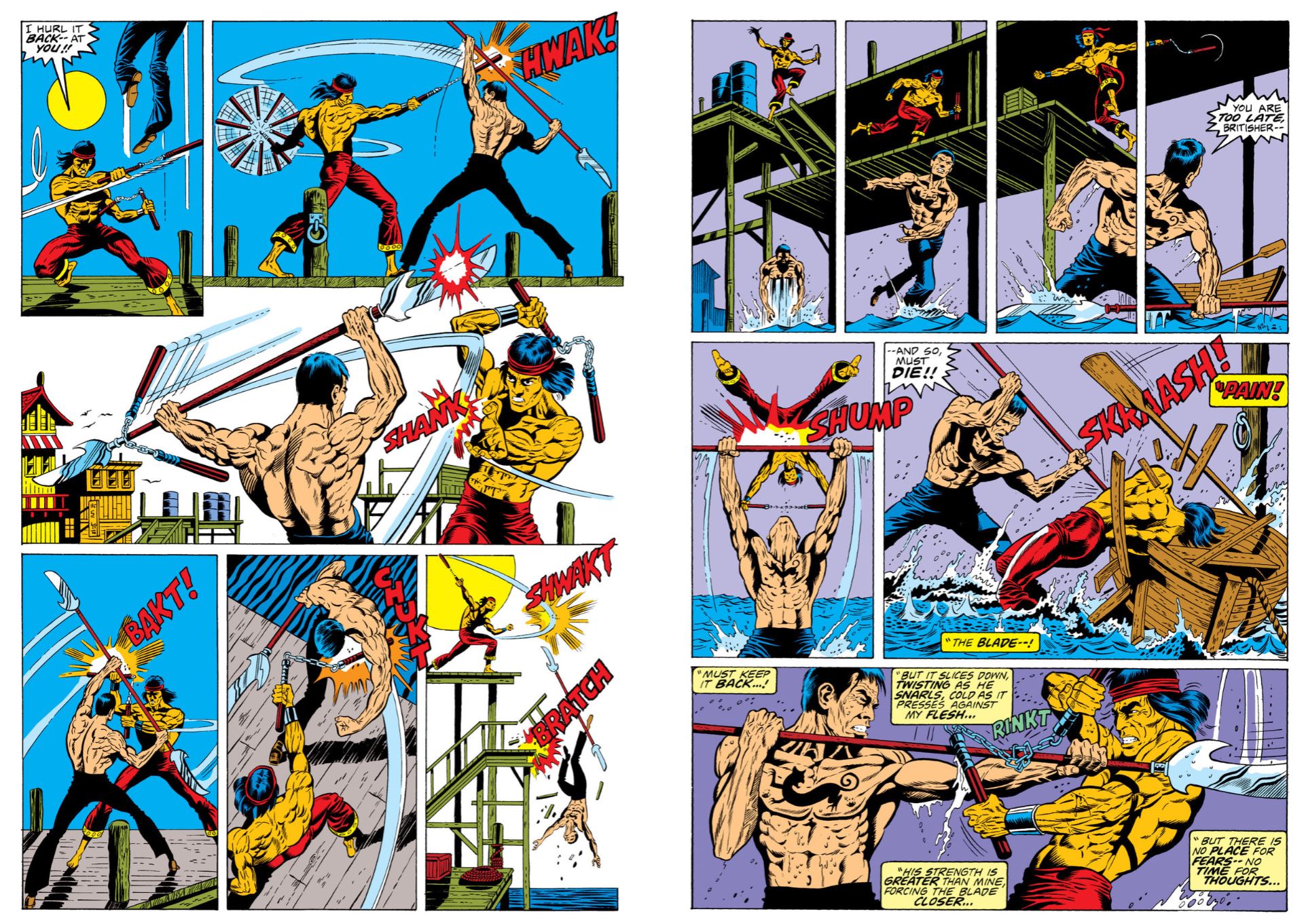
The landmark clash is simply prologue to an extended, character driven serial that opens at ‘The Murder Agency’ (#40 with Gulacy inking himself) as on-fire creators pioneer storytelling techniques later seen in Christopher Nolan’s Memento. A traitor in British Intelligence is murdering agents and the information Nayland Smith wanted from Julia should have given them vital advantage. However, as Shang again quits all “games of death and deceit” he, Tarr & Leiko Wu are attacked by (apparent) Chinese agents masquerading as “Oriental Expediters”.
After helping to defeat the attackers, Wu leaves on a similar extraction mission and suggests that the embattled operatives re-enlist disgraced former agent/current drunken sot James Larner. When they try, he’s got a new pal also boozing himself to death: lovelorn abandoned Clive Reston. That’s when another heavily-armed gang burst in guns blazing, laying down their lives simply to bait a trap the agents can’t afford to avoid…
With the spy saga solidly underway, everything suddenly screeched to a halt as a deadline crunch necessitated another fill-in moment, with Moench, Sal B & Esposito revealing a childhood moment in ‘Slain in Secrecy, and by Illusion!’ Here Shang recalls reluctant clashes with childhood companion M’nai – AKA Si Fan super-assassin Midnight – to prove Fu Manchu’s hallowed home harboured a thief and traitor…
Inked by Tom Sutton, the main event resumes in #42 in a welter of flashbacks, crosscuts and flash forwards as ‘The Clock of Shattered Time’ introduces a mechanically augmented, electrically-enhanced martial arts assassin who almost kills Chi. Shock-Wave has a strong but top-secret connection to Nayland Smith and nearly succeeds in blowing up the spy chief too…
As the MI5 mole and Shock-Wave set more bombs, MOKF #43 sees a changed and vengeful Shang win a rematch with the amplified assassin in ‘A Flash of Purple Sparks’. As Wu escorted her own living package across Europe with the Oriental Expediters chasing them all the way to an MI5 safehouse in Switzerland, Shang was waiting, but his triumph was short-lived as Leiko’s charge revealed who was behind all the deaths – and the Oriental Expediter organisation – and that, in London. another of his allies had fallen…
The drama kicked into overdrive with a long-anticipated event. Cover-dated September 1976, #44 heralded ‘The Return of Fu Manchu, Prelude: “Golden Daggers (A Death Run)”’ with the scattered British agents heading for home under a hail of gunfire and assorted ambushes. Crucially revealed now is how the Devil Doctor’s recalcitrant first-born Fah Lo Suee is at war with their father for control of his empire…
She originally debuted in third novel The Si-Fan Mysteries /The Hand of Fu-Manchu in 1917 (or fourth outing The Daughter of Fu-Manchu in 1931, depending on who you ask) and became a minor character here in Master of Kung Fu #26, but now steps into the full spotlight after Nayland Smith is finally downed… by his most trusted ally! On the back foot and losing, Fah Lo Suee seeks alliances and her brother’s aid in ‘Part One (Shang Chi): “The Death Seed!”’ while Fu Manchu is occupied with resurrecting his founding ancestor to be his new – loyal – son/enforcer.
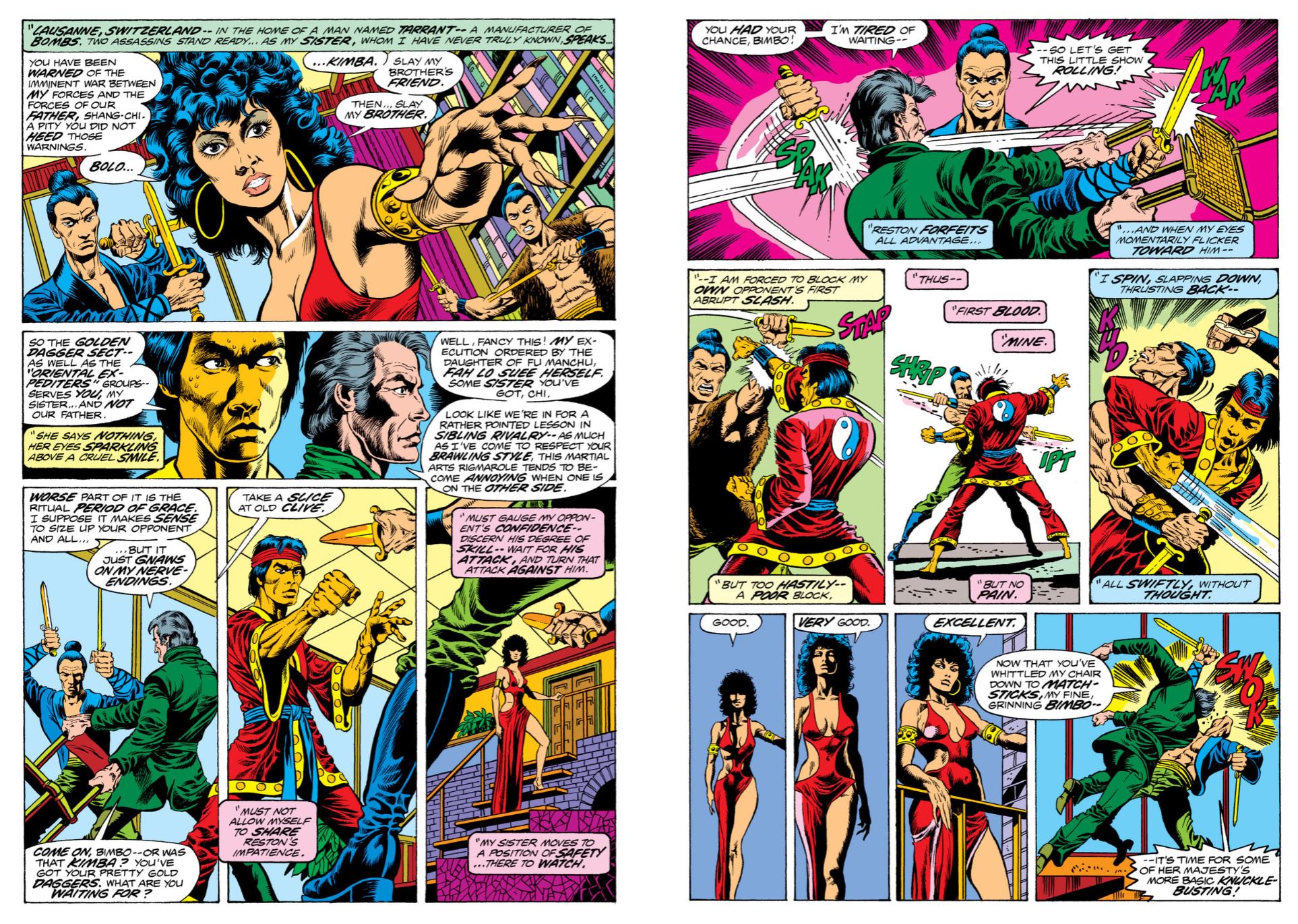
In London, Larner saves Nayland Smith even as Reston, Shang & Wu reunite and rebuff the “daughter of the Devil”… and that’s when Clive makes a big mistake and is taken by Fah Lo Suee. Inked by Pablo Marcos, ‘Part Two (Clive Reston): “The Spider Spell!”’ splits attention between the British agent’s trial and eventual triumph and Fu resurrecting legendary warlord Shaka Kharn, before ‘Part Three (Leiko Wu): “Phantom Sand”’ details how she & Shang infiltrate a fantastic city at the north pole in advance of what’s left of the team joining them to destroy the citadel. Before that, though, the final clash between father and daughter again confirms the total mastery of the malevolent mandarin…
The true appalling scope of the Devil Doctor’s ambitions are exposed in ‘Part Four (Black Jack Tarr): “City in the Top of the World”’ as the schemer prepares to leave Earth and cull its population by 90%! Meanwhile Shang duels revived revenant Shaka Kharn, and battles his way aboard his sire’s space shuttle even as his companions destroy the base at the cost of another valiant soul in ‘Part Five (Sir Dennis Nayland Smith): “The Affair of the Agent Who Died!”’ The astounding saga – and Gulacy’s interior involvement – ends with #50 as the villain speaks for himself with his plans and perhaps his over-extended life ended for real in ‘Part Six (Fu Manchu): “The Dreamslayer!”’
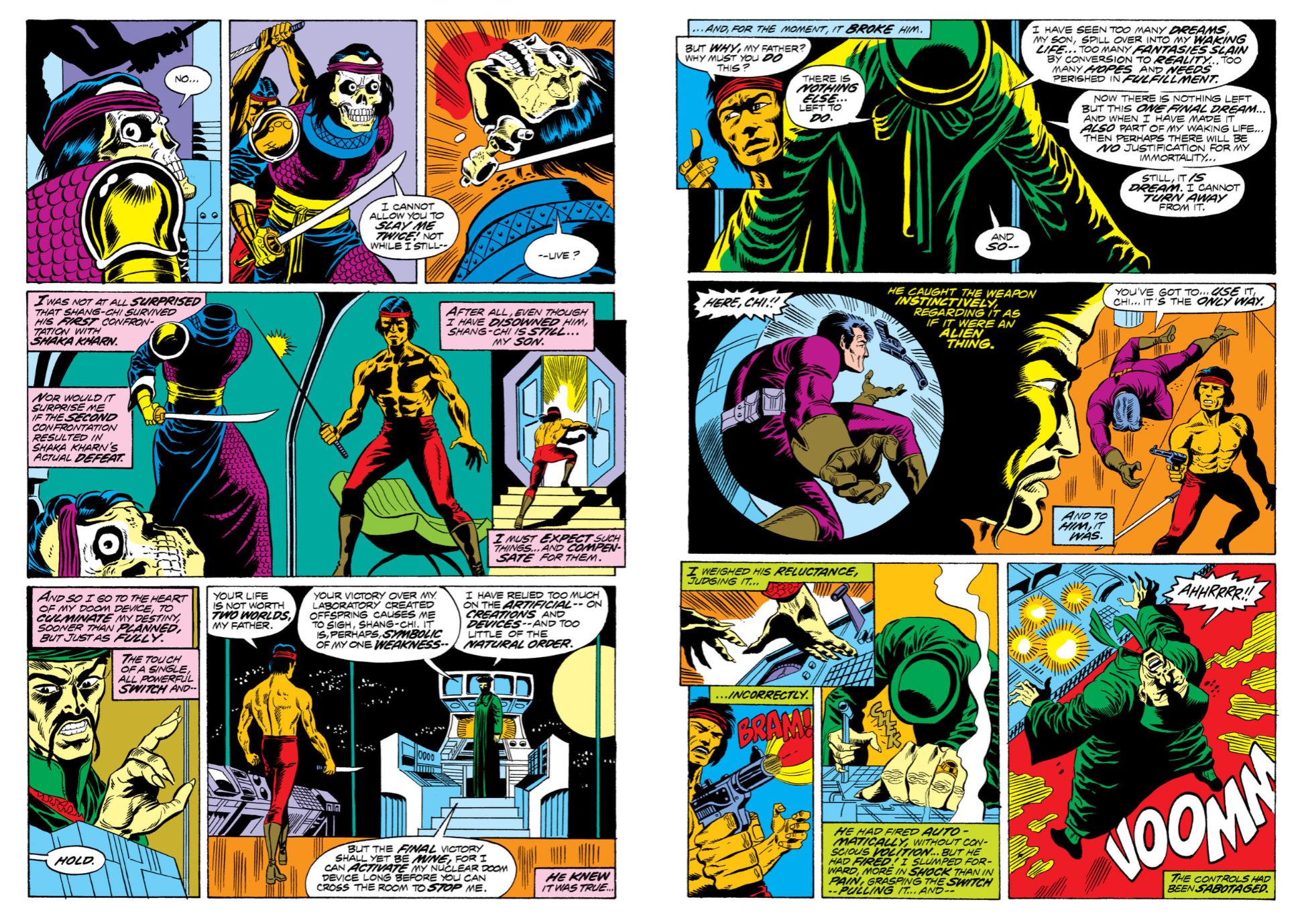
Master of Kung Fu #51 saw Jim Craig join Moench & Marcos, taking over pencil duties for ‘Epilogue: “Brass and Blackness!” (A Death Move!!)’ infilling details of interments and getting back to Earth where our unhappy reluctant warrior again quits the spy world. The final tale here (#52, May 1977) is one more fill-in as Moench & Pollard reintroduce Groucho Marx knock-off Rufus T. Hackstabber who invites our baffled battler to ‘A Night at the 1001 Nights!’ in search of family (such as reprobate/WC Fields analogue Quigley J. Warmflash); riches and safety from mercenaries led by Si-Fan general Tiger-Claw.
Ernie Chan’s cover to MOKF #53 (which reprinted #20) leads into an bonus section including Gil Kane & Adkins’ covers to Savage Fists of Kung Fu tabloid collector’s edition; house ads: 10 pages of original art plus unused and modified covers. The published ones throughout were crafted by Kane, Adkins, Sal Buscema, Rich Buckler, Dave Cockrum, Marie Severin, Chan, Gulacy, John Romita Jr., Ron Wilson & Jack Abel, Al Milgrom, Esposito, Joe Sinnott, Frank Giacoia and Klaus Janson.
In recent years, Shang Chi’s backstory has been adapted and altered. His dad was understandably reinvented as Zheng Zu, Mr. Han, Chang Hu, Wang Yu-Seng and The Devil Doctor, so, depending on your attitude, you have the ultimate choice and sanction of not buying or reading this material. If you do – with eyes wide open and fully acknowledging that the past is another place that we can and should now consign to history – your comics appreciation faculties will see some amazing stories incredibly well illustrated: ranking amongst the most exciting, visually beguiling and enjoyable in Marvel’s canon.
© 2018 MARVEL.
Today in 1987 the final issue of British toddlers weekly Playhour was published, ending a 1700+ run that had commenced on 16th October 1954, whilst on this day back in 1982 cartoonist and master of minimalism Ernie Bushmiller (Mac the Manager, Fritzi Ritz, Nancy) died.
The day saw the birth of Golden Age Superman artist Ed Dobrotka in 1917; Indian cartoonist Pran Kumar Sharma (Billoo, Chacha Chaudhary) in 1938; realist action artist Paul Gulacy (Sabre: Slow Fade of an Endangered Species, Master of Kung Fu, Batman: Prey, Black Widow, Slash Maraud, Six From Sirius, Sci-Spy, James Bond 007) in 1953; writer/Conspiracy historian Lamar Waldron (Lightrunner, M.I.C.R.A.: Mind Controlled Remote Automaton) in 1954; artist Terry Shoemaker (X-Men, Spellbound, Legion of Super-Heroes) in 1960 and “Bad Grrrl” artist Jim Balent (Catwoman, Purgatori, Vampirella, Tarot: Witch of the Black Rose) in 1963. Also blowing out candles today are Iron Man, XO Manowar, Elektra & Wolverine artist Sean Chen and quite rude Norwegian cartoonist Frode Øverli (Pondus, Riskhospitalet, Rutetid, Deep Shit Junkies) – both in 1968, and artists David Nakayama (City of Heroes, Big Hero Six, Proximity) in 1978 and Clay Mann (Magneto: Not a Hero, X-Men: Legacy, XO Manowar, Gambit, Heroes in Crisis) in 1990.