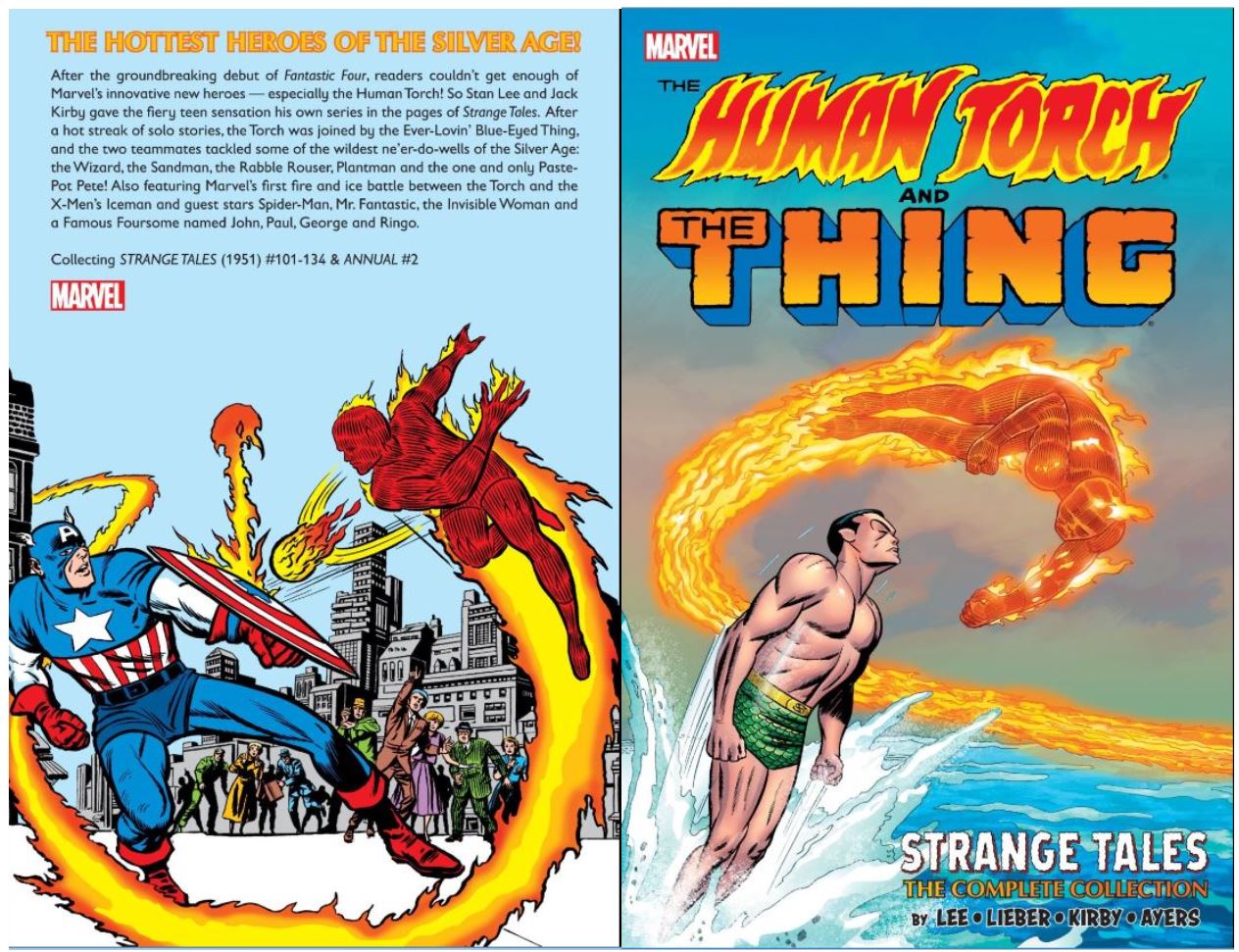
By Stan Lee, Kirby, Larry Lieber, Robert Bernstein, Ernie Hart, Jerry Siegel, Larry Ivie, Jack Dick Ayers, Bob Powell, Steve Ditko, Carl Burgos, George Roussos, Paul Reinman, Frank Giacoia, Chic Stone, Mike Esposito, Wallace Wood, John Romita Sr., Joe Sinnott, Ron Wilson, Gil Kane, Al Milgrom, Vince Colletta & various (MARVEL)
ISBN: 978-1-3029-1334-2 (TPB), 978-1302505455 (Digital edition)
This book includes Discriminatory Content produced in less enlightened times.
Monolithic modern megamedia Marvel truly began with eccentric monster ‘n’ alien filled adventures of a compact superteam as much squabbling family as coolly capable costumed champions. All that Modern Marvel is, company and brand, stems from that quirky quartet and the inspired, inspirational, groundbreaking efforts of Stan Lee & Jack Kirby…
Cautiously bi-monthly and cover-dated November 1961 (Happy 65th Birthday!) Fantastic Four #1 was raw and crude even by its ailing publisher’s straitened standards. However, it seethed with rough, passionate, uncontrolled excitement, and thrill-hungry kids pounced on its dynamic storytelling. The series caught a wave of change beginning to build in America, and every succeeding issue changed comics a little bit more… and forever.
Revealed in that premier, maverick scientist Reed Richards, fiancée Sue Storm, close friend Ben Grimm and Sue’s bratty teenaged brother survived an ill-starred private spaceshot after cosmic rays penetrated their ship’s inadequate shielding. Permanently mutated, Richards’ body became elastic, diffident Sue became (even more) invisible, Johnny Storm burst into living flame and tragic Ben shockingly devolved into a shambling, rocky freak. After the initial revulsion and trauma passed, they solemnly agreed to use their abilities to benefit mankind. Thus was born The Fantastic Four – you can add your own fanfare and timpani here if you wish…
Hot on the heels of the runaway success of Fantastic Four, Stan Lee & Jack Kirby spun the most colourful and youngest member of the team into his own series, hoping to recapture the glory of the 1940s when the Human Torch was one of the company’s “Big Three” superstars. This captivatingly esoteric and economical collection of pure 1960s superhero shenanigans gathers those eclectic yet crucial yarns (no less than five major Marvel villains debuted in blistering battle against the Flaming Kid as seen in Strange Tales #101 – 134). Also included here is the lead story from Strange Tales Annual #2, with it all spanning October 1962 to July 1965.
Festooned and filled with fabulous classics of old school Marvel Fights ‘n’ Tights mayhem and mirth, this compendium also finally acknowledges that for a large part of that run Johnny’s rocky companion and elder gadfly Ben Grimm was an equal player and partner in crime-busting.
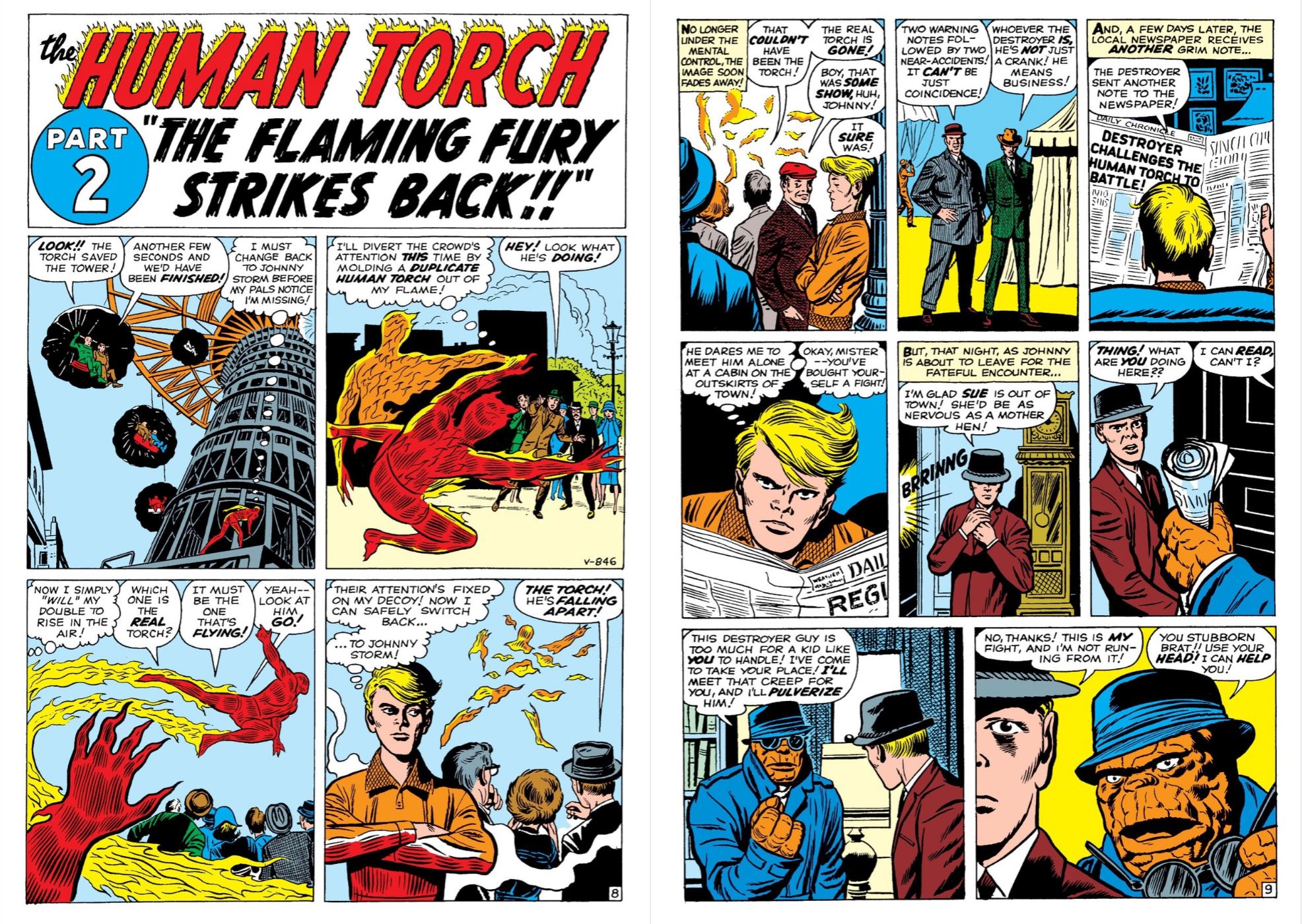
Within a year of FF #1, former magic-&-monsters anthology Strange Tales was home for the hot-headed hero who started his ancillary solo career in eponymous epic ‘The Human Torch’. Scripted by Larry Lieber (over a plot by his brother Stan Lee) and sublimely illustrated by Kirby & Dick Ayers, here the plucky lad investigates sabotage at a new seaside amusement park and promptly discovers Commie-conniving thanks to a Red spy called the Destroyer. Kirby would pencil the first few adventures before moving on, after which inker Ayers would assume control of the series’ look for most of its run – although The King would generate some of the best covers of his Marvel career throughout the Torch’s tenure in Strange Tales.
An odd inconsistency or, more likely, tension- and drama-inducing gimmick did crop up here. Although public figures in the FF, Johnny and his sister Sue lived part-time in Long Island hamlet Glenville and, despite the townsfolk being fully aware of her as the glamorous and heroic Invisible Girl, they seem oblivious to the fact that her baby brother is the equally famous Torch. Many daft-but-ingenious pages of Johnny protecting his secret identity would ensue before the situation was brilliantly resolved…
Although something of a hit-or-miss proposition in itself, above the strip was the origin point for many of Marvel’s greatest villains. The first of these appeared in the very next issue. ‘Prisoner of the Wizard’ (Lee, Lieber, Kirby & Ayers) sees a spiteful and publicity-hungry intellectual giant determined to crush the Torch to prove his superiority to the callow kid who steals all the newspaper headlines…
The same creative team produced captivating classic ‘Prisoner of the 5th Dimension’, as Johnny defeats an imminent invasion and frees a captive populace from tyranny before easily trashing adhesive-toting adversary ‘Paste-Pot Pete!’ (later revamped as the Trapster), before teaming with sister Sue to tackle the perilous ‘Return of the Wizard’. When Kirby moved on to engineer and design a host of new characters and concepts (occasionally returning as necessity or special events warranted), Ayers assumed full art duties beginning with Strange Tales #106 (March 1963). This Lee & Lieber yarn was notable in that it revealed that the entire town of Glenville had always known the Torch’s secret identity but were just playing along to keep him happy! In ‘The Threat of the Torrid Twosome’, when Acrobat Carl Zante knocks on Johnny’s door to offer him a better-paying gig, the kid’s head is swelled and swayed, but he soon learns he’s been played by a master conman and diabolical bandit…
This first hint of tongue-in-cheek whimsy presaged an increasing lightness of touch which would come to characterise the Marvel style as much as the infighting between team-mates. The villainous Zante would return for another milestone in issue #114…
ST #107 was officially Lieber’s last as Ayers drew a potent punch-up with ‘Sub-Mariner’ – a tale reminiscent of the spectacular and immensely popular Golden Age battles of their publishing forebears. Veteran writer Robert “Berns” Bernstein scripted the next two – frankly daft – sagas over Lee’s plots, but the saving grace of both ‘The Painter of a Thousand Perils!’ (empowered by an alien art kit which brought illustrations to life in ST #108) and ‘The Sorcerer and Pandora’s Box’ (#109, with monstrous demons attacking humanity) was the brief return of Kirby to the pencilling.
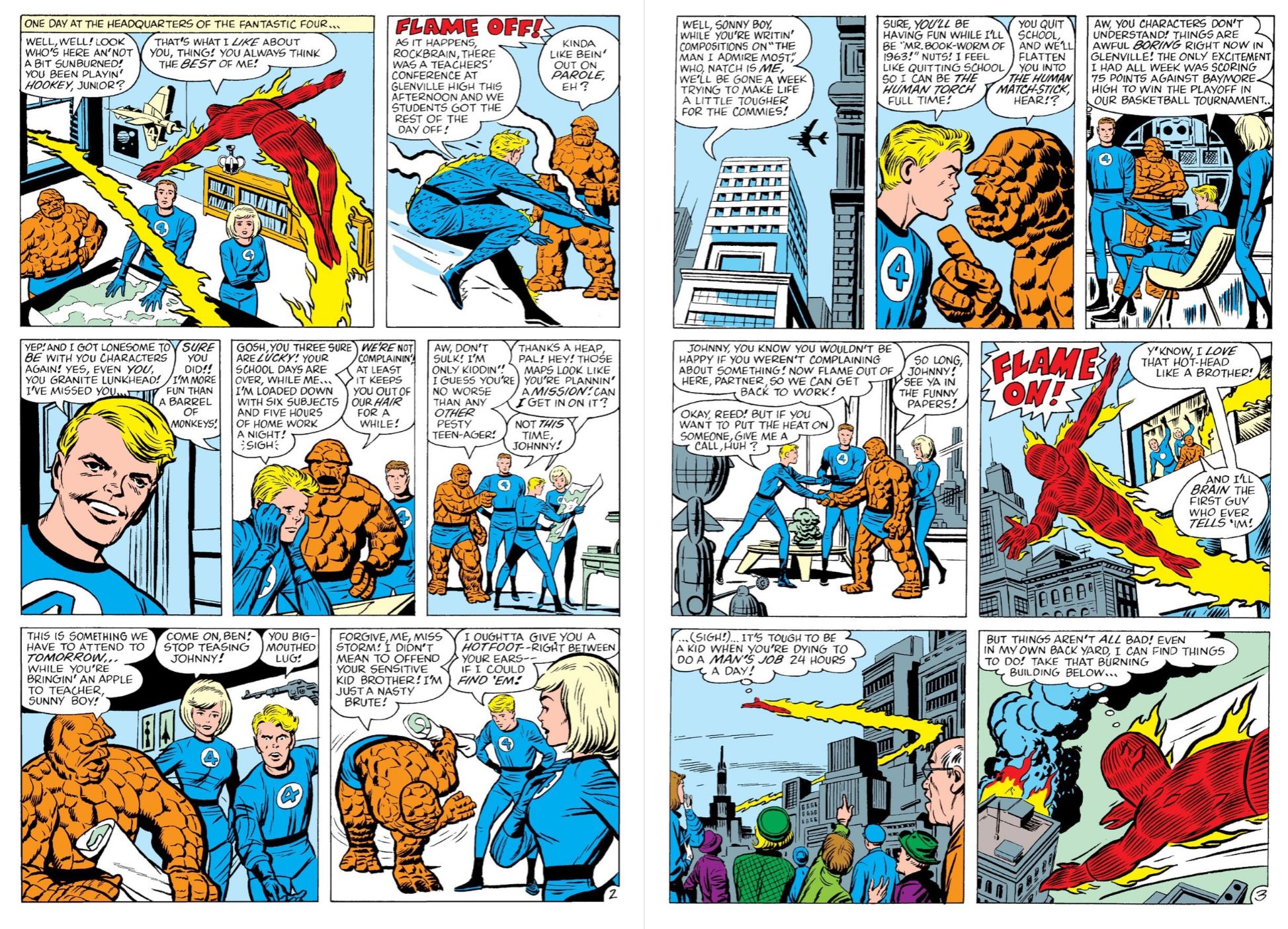
H.E. Huntley (Ernie Hart) typed the words for Ayers to illumine in ‘The Human Torch vs. the Wizard and Paste-Pot Pete!’: a cunning clash presaging the villains’ eventual evolution into FF’s evil counterparts the Frightful Four whilst one issue later, the Torch made short work of ‘Fighting to the Death with the Asbestos Man!’ – yet another demented scientist experiencing the travails and tragedies of simpler times.
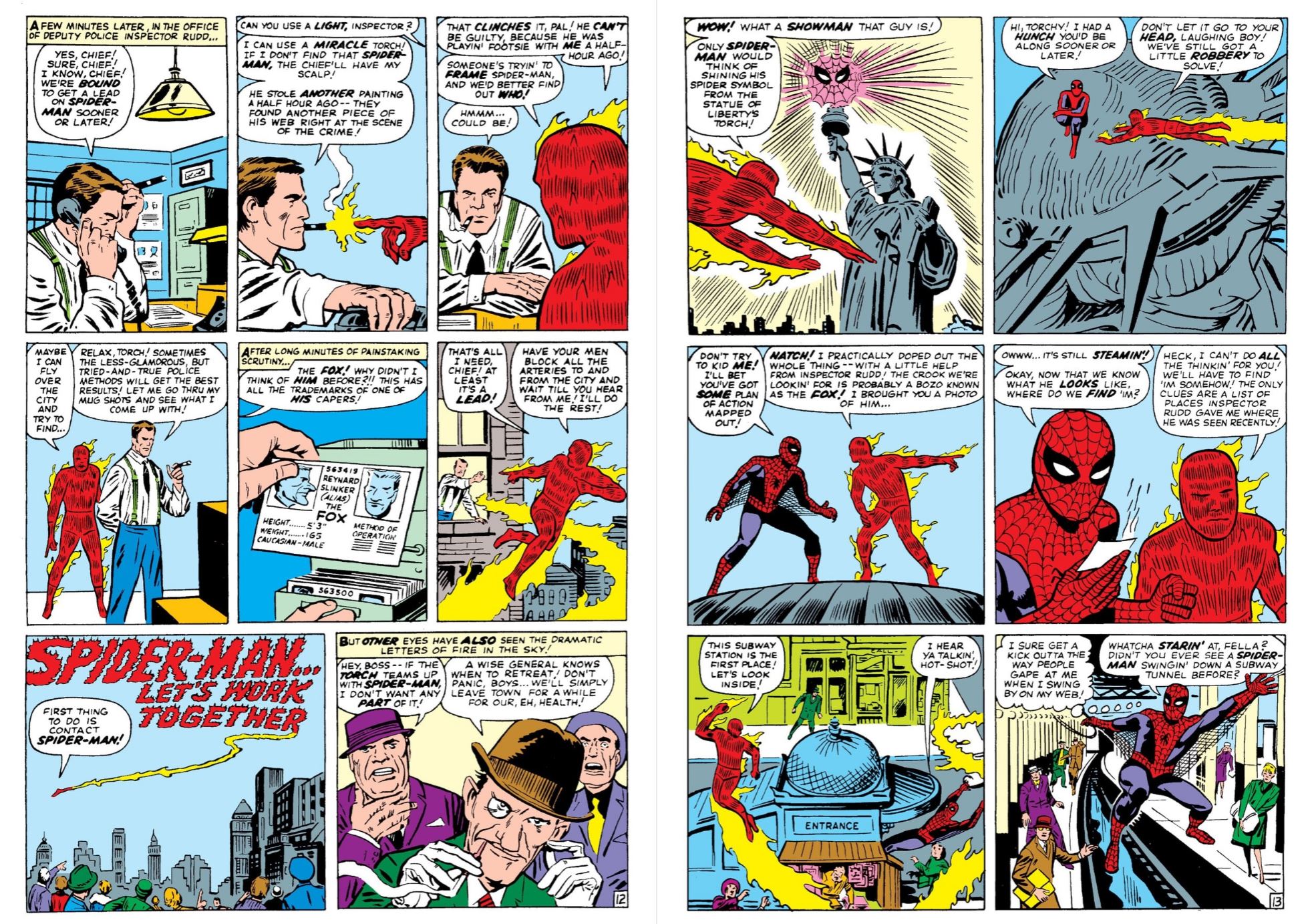
Scripted by Jerry Siegel under penname Joe Carter, Strange Tales #112 debuted murderous electrical marauder the Eel, who accidentally swiped and activated a miniature A-bomb in tense, multifaceted thriller ‘The Human Torch Faces the Threat of the Living Bomb!’, after which 1963’s Strange Tales Annual #2 featured ‘The Human Torch on the Trail of the Amazing Spider-Man!’ This terrific romp by Lee, Kirby & Steve Ditko details how the wallcrawler is framed by international art thief The Fox…
In regular comic book Strange Tales #113, “Carter” created another long-term always-employed baddie in ‘The Coming of the Plantman!’ before November’s Strange Tales #114 changed the face of the Marvel Firmament forever. Written by Lee and illustrated by Kirby & Ayers, it featured the return of the third of Timely Comics’ Big Three – or at least an impersonation of him by the insidious Acrobat – in a blockbusting battle entitled ‘The Human Torch meets… Captain America!’
Here’s a quote from the last panel…
“You guessed it! This story was really a test! To see if you too would like Captain America to Return! As usual, your letters will give us the answer!” I wonder how that all turned out?
Lee took over as scripter with ST #115’s ‘The Sandman Strikes!’ as Johnny impersonates Spider-Man to defeat granular gangster Flint Marko, after which the Torrid Teen and team-mate Ben Grimm battle each other while ‘In the Clutches of the Puppet Master!’ (#116, with Ayers inked by George Roussos in his own secret identity of George Bell).
‘The Return of the Eel! proved far more of a challenge in #117, after which The Wizard has another go as ‘The Man Who Became the Torch!’, consequently nearly killing Thing and Reed Richards besides. A first brush with Marvel’s soon-to-be core readership came in #119. ‘The Torch Goes Wild!’ details how Commie Agent the Rabble Rouser mesmerises decent citizens, making them surly and rebellious, after which Kirby stepped back in for #120 as ‘The Torch Meets Iceman!’: a terrific action-extravaganza that pretty much ended the glory days of this strip.
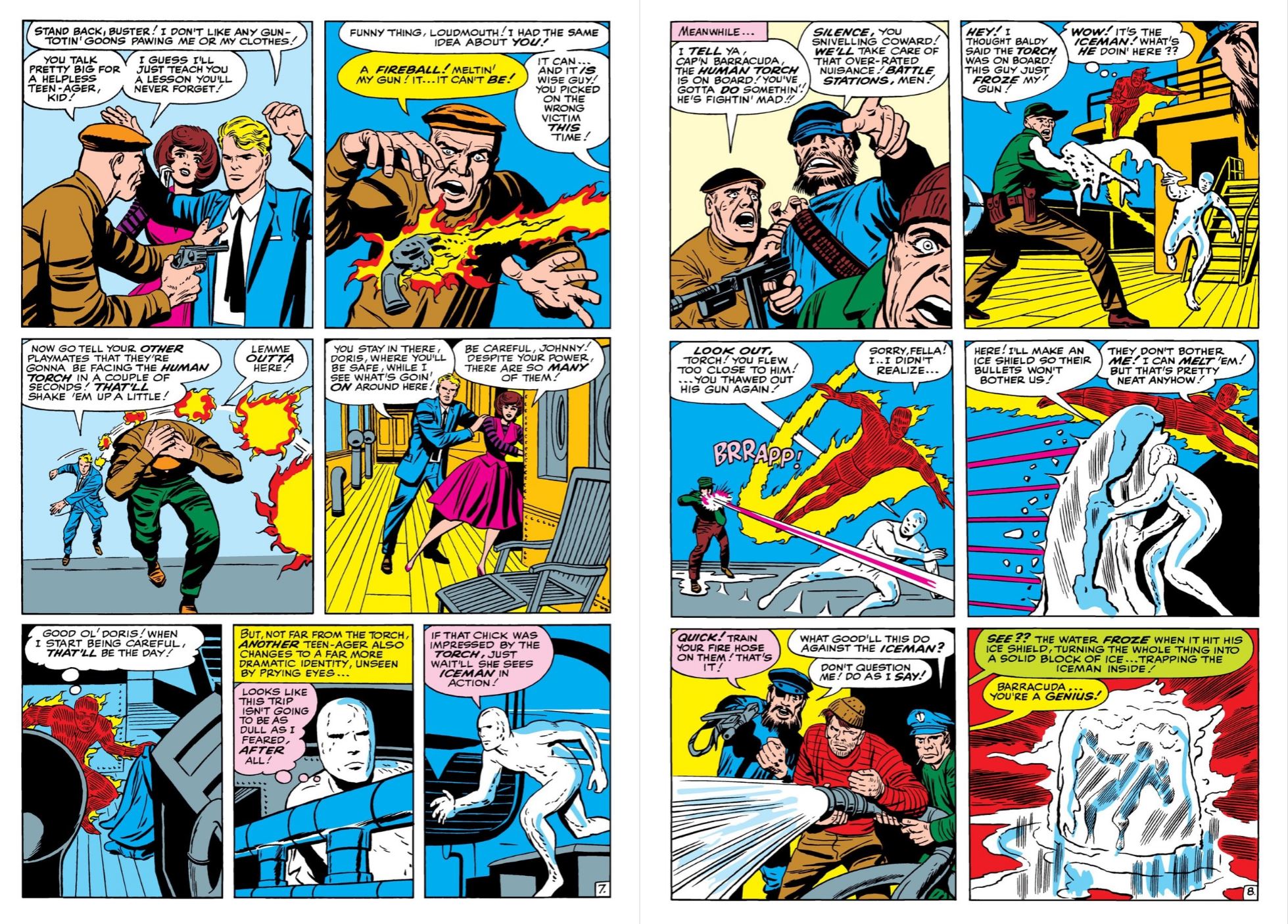
From then on, despite every gimmick and occasional burst of pure inspiration the Bullpen could muster, a slow decline set in as quirky back-up strip Doctor Strange grew in popularity – and cover space. ST #121 saw Johnny as ‘Prisoner of the Plantman!’ (Lee & Ayers) and #122 found a thug, a conman and a yogi all augmented by Dr. Doom mustered as the woefully lame Terrible Trio, ordered to launch an ill-conceived attack in ‘3 Against the Torch!’ whereas #123 details a creepy inventor building himself an impressive insectoid exo-suit to get rich the easy way. Crucially, in an effort to boost ratings The Thing now became a permanent fixture in ‘The Birth of the Beetle!’ This so-so saga was most notable for the pencil job by Golden Age Torch creator Carl Burgos, after which Johnny & Ben tackle a re-designed ‘Paste-Pot Pete’ (inked by Paul Reinman) before going after another old adversary in ‘The Sub-Mariner Must Be Stopped!’
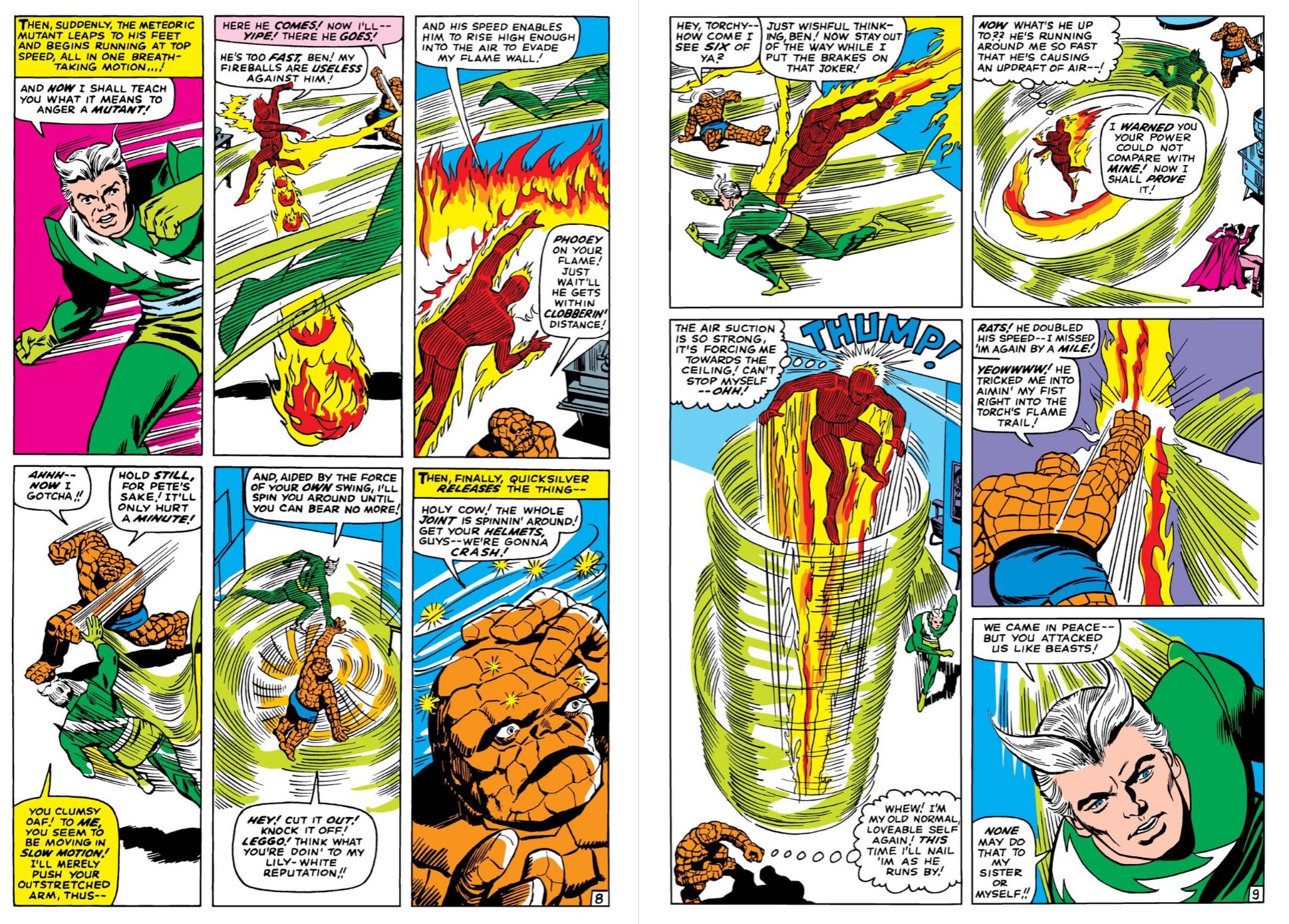
‘Pawns of the Deadly Duo!’ sees Puppet Master return, allied to the Mad Thinker in a clever but shallow yarn before #127 pits Ben & Johnny against a bizarre puzzle and ‘The Mystery Villain!’ Then, following a stunning Kirby Thing pin-up, the Fantastic Two then unwillingly battle ‘Quicksilver and the Scarlet Witch’ in #128 (this one inked by Frankie Ray, AKA Frank Giacoia), as the Homo Superior siblings make an abortive first attempt to quit Magneto’s Brotherhood of Evil Mutants, prior to ‘The Terrible Trio!’ once more failing to impress or assassinate our heroes…
Pop culture reeled and staggered in #130 with ‘Meet the Beatles’ (not villains, but actually some sort of popular musical combo of the era, and they actually didn’t meet them at all), although brilliant Golden Age artist Bob Powell (inked by Chic Stone) did take over the art chores for the comedy of errors/crime caper. Ayers returned to ink #131, the frankly dire ‘Bouncing Ball of Doom!’ with Mad Thinker siccing a cybernetic bowling bowl on the duo, before Larry Ivie delivers a capable Space Race thriller in ‘The Sinister Space Trap!’ (inked by Mike Esposito under his Mickey DeMeo alias).
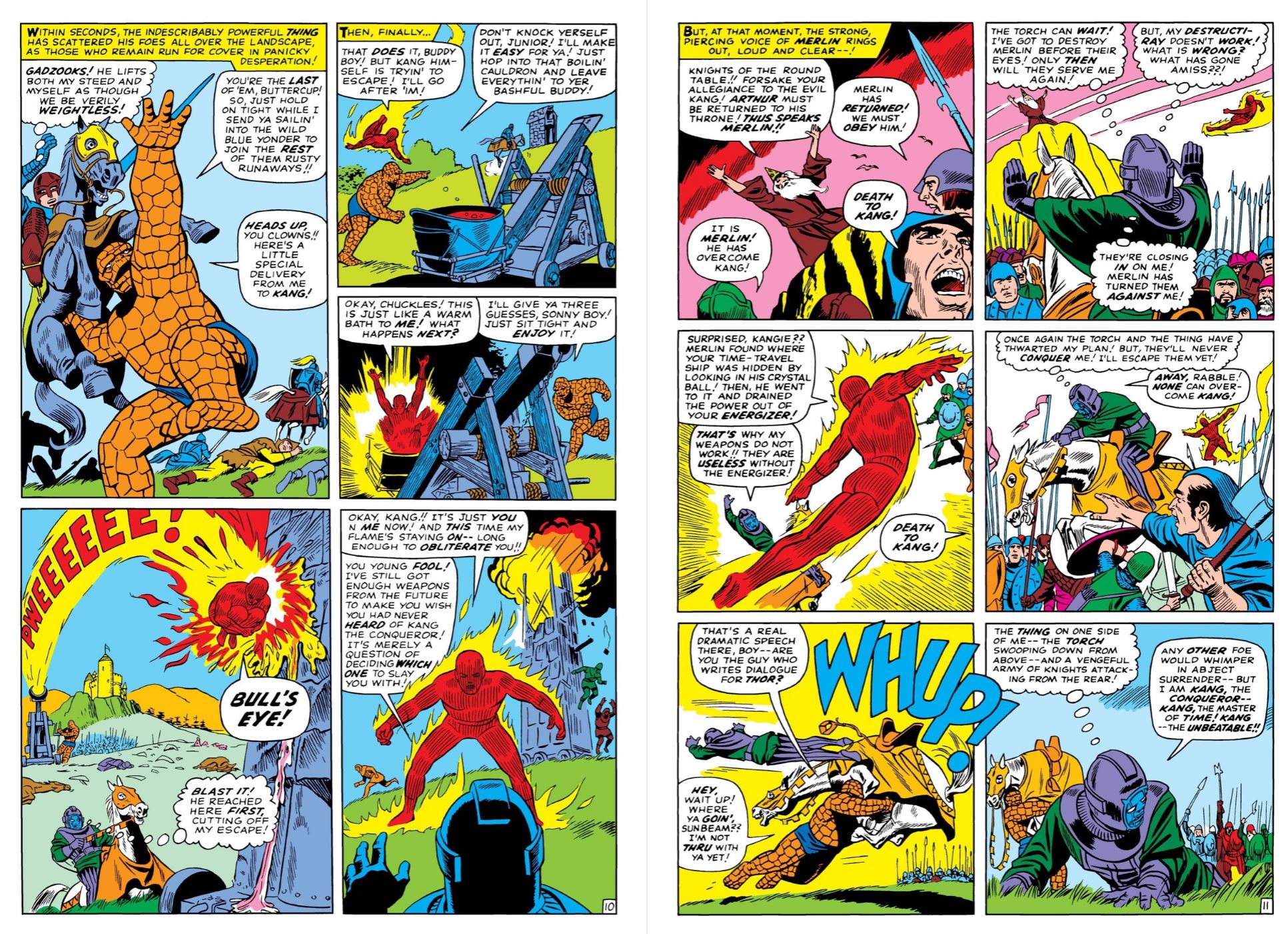
Stan Lee returned for the last two tales in ST #133 & #134; ‘The Terrible Toys’ wherein Puppet Master seeks a new modus operandi and ‘The Challenge of… The Watcher!’ (inked by the majestic Wallace Wood) wherein Torch & Thing are transported back to legendary Camelot to battle time-reaver Kang the Conqueror, but it was clear the writer’s mind was elsewhere, most likely with the new Nick Fury, Agent of S.H.I.E.L.D. strip that would replace the FF pair beginning with Strange Tales #135.
Wrapping up this memory lane meander are a marvellous melange of original art pages by Kirby and/or Ayers; nostalgia-invoking House Ads and a cover gallery from the 1974-75 reprint series of Golden/Silver Age Torch Tales, rendered by John Romita, Joe Sinnott, Larry Lieber, Ron Wilson, Frank Giacoia, Gil Kane, Al Milgrom & Vince Colletta, plus the Kirby/Richard Isanove paint cover from Marvel Masterworks: The Human Torch #1.
It’s interesting to note that as the parent Fantastic Four title grew in scope and quality, the Torch’s own series diminished. Perhaps there’s something to concentrating one’s efforts or not overexposing your stars. What was originally a spin-off for a younger audience faded as Marvel found its voice and marketplace, although there would be periodic efforts to relight the Torch.
Sadly, historic value often supersedes the quality of these strange tales, but there’s still a good deal that’s great about this series, and Costumed Drama devotees with a sense of tradition and love of fun will find this book irresistible and unmissable: still filled with the right kind of fireworks.
© 1962, 1963, 1964, 1965, 2018 Marvel Characters, Inc. All rights reserved.