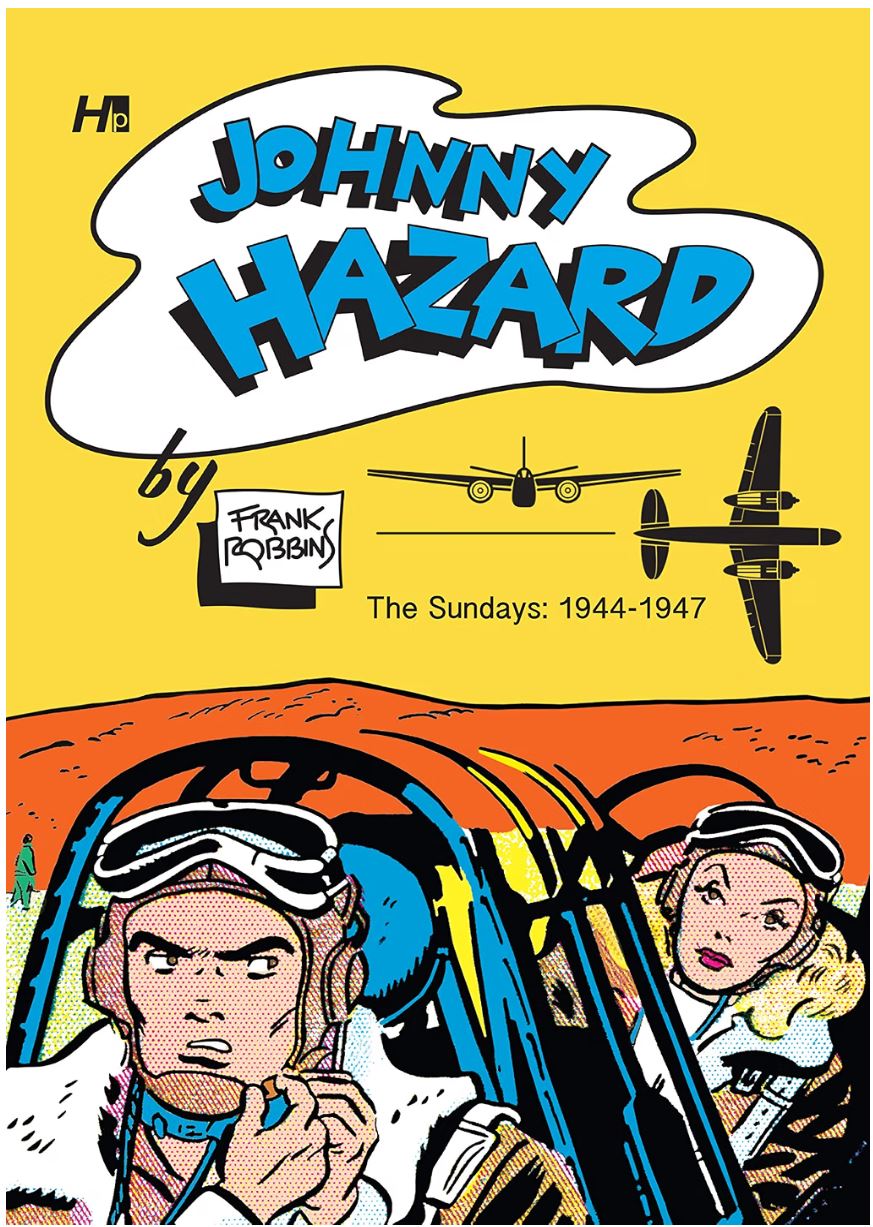
By Frank Robbins with Roy Thomas, Howard Chaykin, Daniel Herman, E.S. Herman & various (Hermes Press)
ISBN: 978-1-613451-23-6 (HB/Digital edition)
This book includes Discriminatory Content produced in less enlightened times.
Win’s Christmas Gift Recommendation: An Immortal Star to Faithfully Follow… 9/10
Johnny Hazard was a newspaper strip created in the style and manner of Terry and the Pirates, but in many ways this steely-eyed hero most accurately resembles – and indeed predates – Milton Caniff’s second masterwork Steve Canyon. Unbelievably, until 2011 this stunningly impressive, enthralling fantasy-adventure strip had never been comprehensively collected in archival volumes – at least not in English (or even America’s version of it) although selected highlights had appeared in magazines including Pioneer Comics, Dragon Lady Press Presents and the Pacific Comic Club.
Boston born, Franklin Robbins (9th September 1917 – 28th November 1994) was an artistic prodigy who shone from early on. At age nine he was awarded a scholarship to the Boston Museum of Fine Arts and at 15, moved to New York City to attend the National Academy of Design on a Rockefeller grant. Skilled, inventive and prolific as both painter and graphic artist, he freelanced continually, even working with Edward Trumbull on the legendary murals for the NBC building and Radio City Music Hall.
Robbins created graphics for RKO Pictures, worked in advertising and magazine illustrations but never stopped painting, with work shown at the Whitney Museum of American Art, Metropolitan Museum of Art, The Corcoran Gallery of Art and Walker Art Gallery, although he found his perfect medium of expression when invited to take over a top comic strip…
Even whilst relentlessly creating a full seven days of newspaper strips, he exhibited work at the Whitney Museum of American Art’s Annual show and – after ending his comics career – retired to Mexico to end his days with a brush in his hand. The truth is that comics changed Robbins’ life. He was a brilliant natural cartoonist whose unique artistic and lettering styles lent themselves equally to adventure, comedy and super-heroic tales, whilst his expansive raconteur’s gifts made him one of the best writers over three generations.
He first found popular fame in 1939 by taking over aviation strip Scorchy Smith from Bert (The Sandman) Christman, who had left the US to fight with the Flying Tigers in China. Robbins thrived on the job and created a Sunday page for the strip in 1940. The landmark, groundbreaking feature had been originated by John Terry before astounding Noel Sickles replaced him: revolutionising it and – with Milton Caniff – inventing a new impressionistic style of narrative art to reshape the way comics were drawn and perceived. Robbins remained until 1944 when he was offered high-profile hit Secret Agent X-9. Instead, he devised his own lantern-jawed, steely-eyed man of action.
Tireless and prolific, even whilst producing daily and Sunday Hazards (with a separate storyline for each), Robbins continued freelancing as an illustrator for The Saturday Evening Post, Look, Life and a host of other mainstream magazines. He also tried comic books for the first time when Johnny Hazard won his own title in 1948-1949, just as superheroes began being supplanted by mobsters, monsters and laconic macho-men…
Robbins tried again in 1968: becoming a key contributor as both artist and writer on The Flash, Superboy, and The Atom, as well as a regular contributor to surreal humour mag Plop! and DC’s mystery and war anthologies. He particularly shone on Batman, Batgirl and Detective Comics where, with Neal Adams, he created Man-Bat before following Michael Kaluta as artist on The Shadow.
Moving to Marvel in the 1970s, Robbins concentrated on drawing a variety of titles including Captain America, Daredevil, Ghost Rider, Morbius, The Man from Atlantis, Human Fly, Power Man and The Invaders – which he co-created with Roy Thomas.
When Johnny Hazard launched on Monday June 5th 1944, he was a POW and aviator in the US Army Air Corps. After hostilities ceased, he briefly became a freelance charter pilot and spy before settling into the of a globe-girdling, troubleshooting mystery-solver: a modern day Knight Errant. The feature ended in 1977: another casualty of diminishing panel-sizes and a move towards simplified, thrill-free, family-friendly gag-a-day graphic fodder to frame small-ads. In its time it was syndicated in nine different languages in thousands of newspapers across the world, and even scored a residency in 1950s British weekly Rocket.
This fabulous hardcover/digital tome – reproduced from original King Features proofs – re-presents the definitive magnum opus in fitting form: a big book of colourful characters and cases and in a formal archival collection resurrecting the skyborne two-fisted troubleshooter for avid followers whilst hopefully finding new fans.
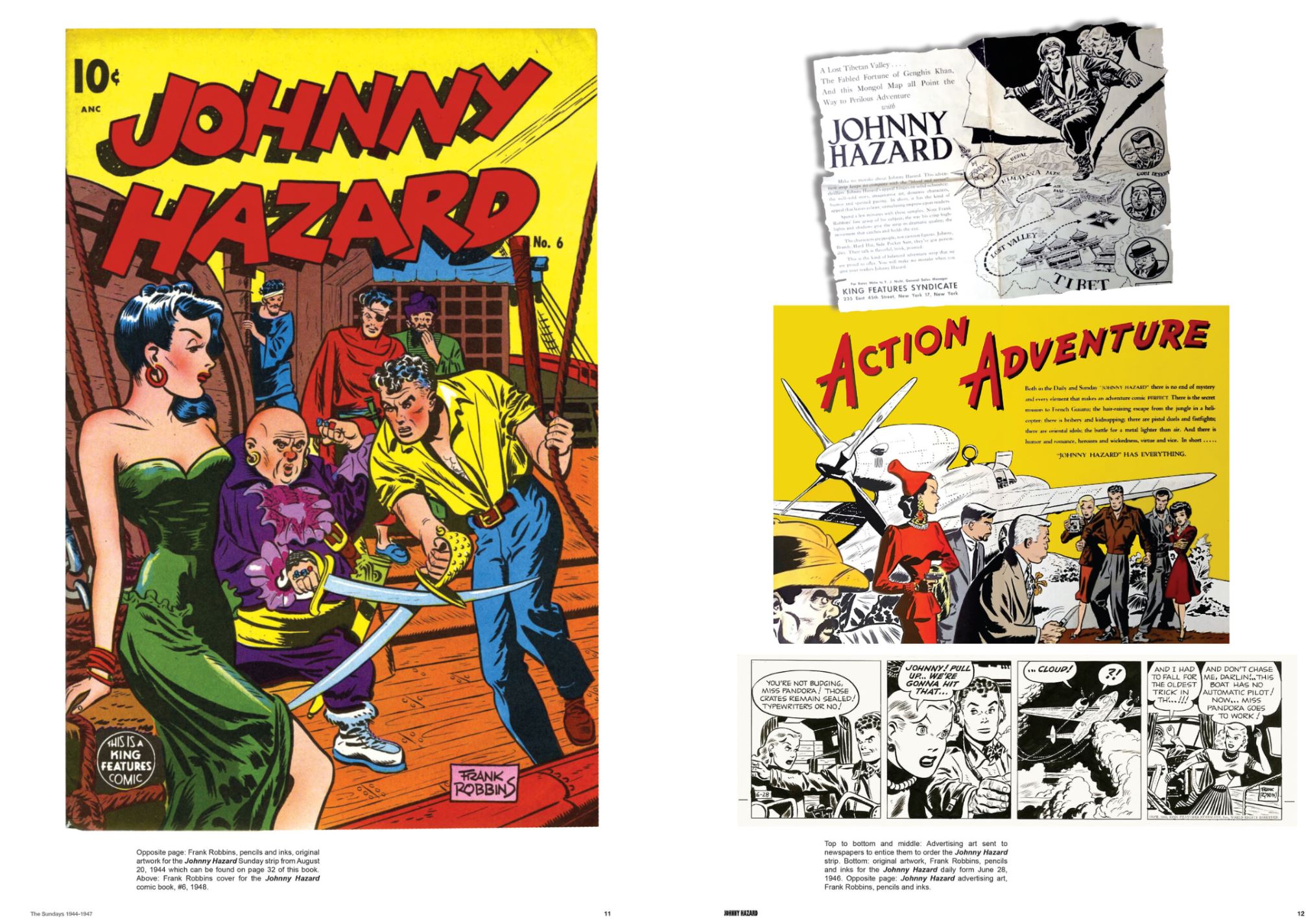
Before we take off, Howard Chaykin’s Foreword ‘One of the Greats’ precedes Daniel Herman’s informative Introduction ‘Looking Back at Frank Robbins’ whilst E.S. Herman reviews ‘Frank Robbins at D.C. Comics’ and former collaborator Roy Thomas details the later years in ‘Frank Robbins at the House of Ideas’ …all appropriately gussied-up with photos, original art pages, covers & sketches and promotional materials.
In 1944 When Robbins launched the Sunday feature he followed the example of Roy Crane on Wash Tubbs (and latterly Buz Sawyer), opting for episodic, broadly comedic, done-in-one vignettes starring Johnny, embedded journalist/love interest Brandy and other players from the weekly serials. Here (covering 2nd August 1944 – 6th June 1945) these are grouped together and categorised as ‘Just Another Day in the Air Force’. Incorporating inclusive added attractions such as how to identify aircraft silhouettes, these full page, full colour episodes mix breathtaking patriotic sorties against the enemy (Germany, then Japan) with a Man’s Life on an airbase: seeing officers razzed and ridiculed, gossiping, re-training, making ludicrous gaffes, facing food foul-ups, illegally fraternising with local civilians, pranking pals and ogling, pestering or generally “appreciating” any visiting women in the loud raucous ways our male ancestors preferred…
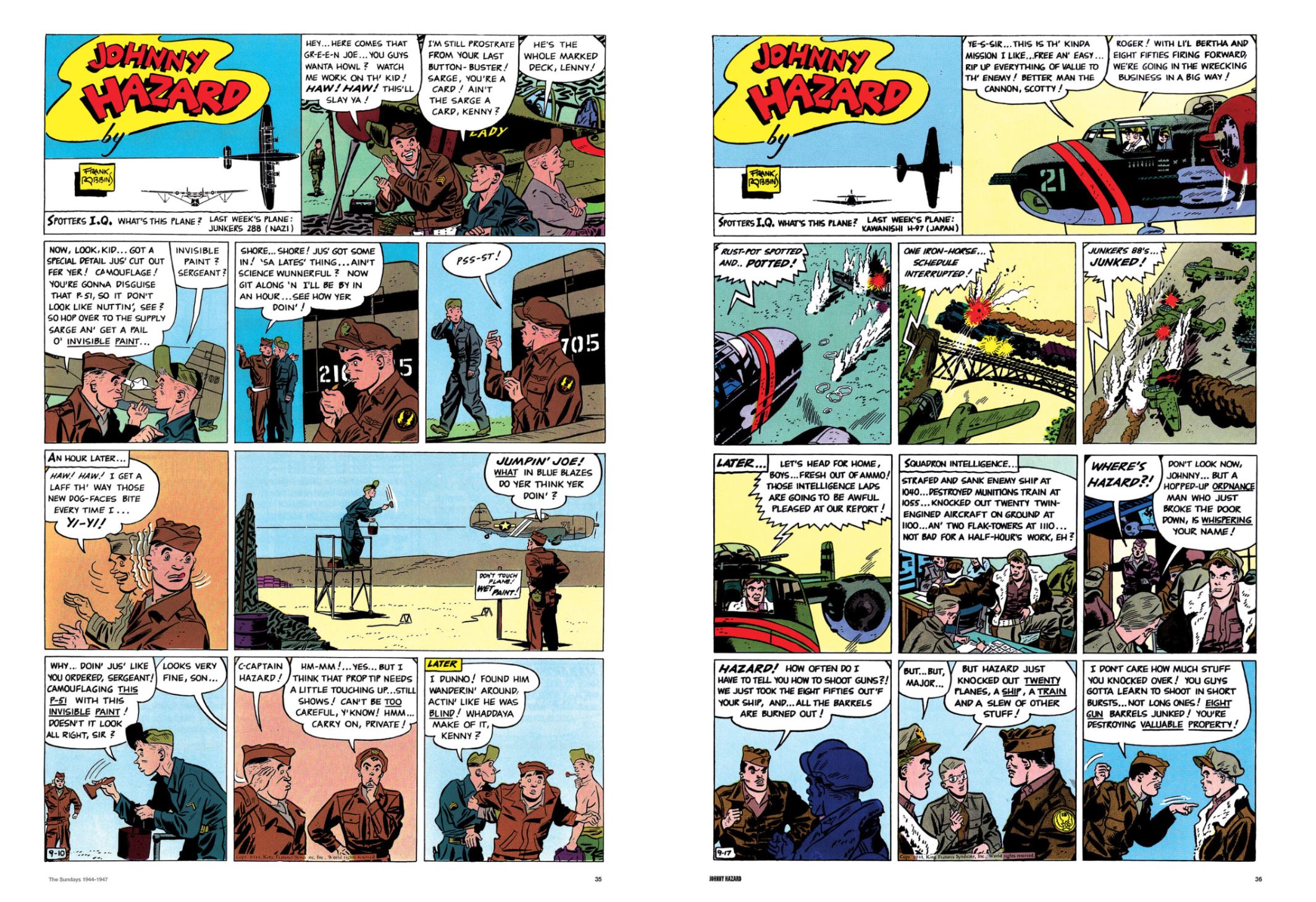
The strip never could keep up with actual events after D-Day. In the real world the Allies invaded “Fortress Europa” the day after Johnny Hazard debuted, and the auteur quickly learned to keep his own timetable as much as possible. By the time of the third daily serial arc – opening on September 11th 1944 – the hero’s squadron had been transferred to the Pacific Theatre of Operations to reinforce the battle against Japan. Brandy had craftily had herself transferred too, and stuck with the newly-promoted newsworthy Captain Hazard…
With the daily saga beginning on January 31st 1945, Hazard set up shop on an embattled army air base under constant assault by Japanese forces on the front line of occupied China. This move introduced a new sidekick: ace wingman Captain “The Admiral” Slocum and last in an unbroken line of valiant patriotic mariners. Sadly he was reduced to defending his country in the skies since his debilitating sea sickness prevented him from serving afloat like a true warrior…
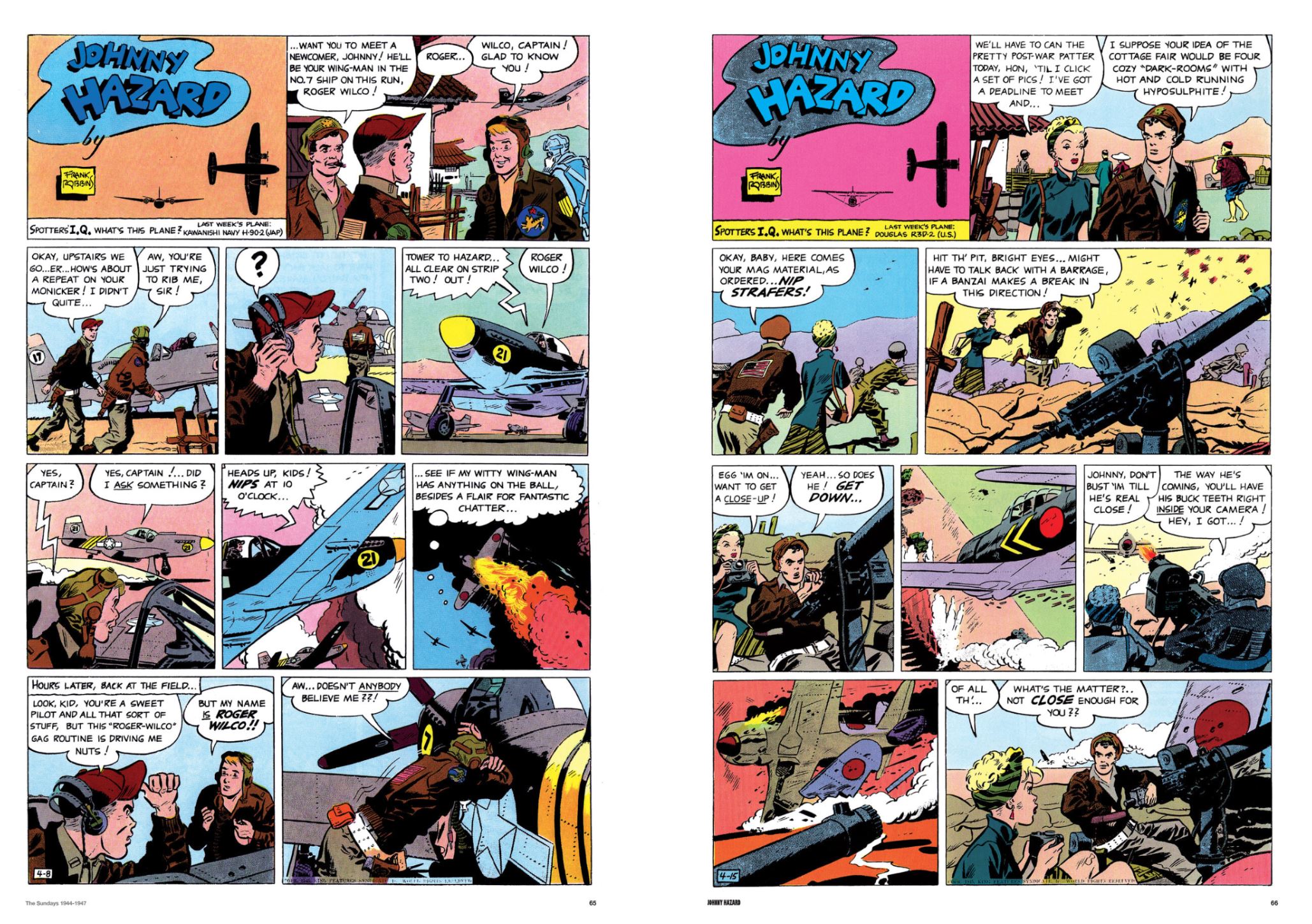
The parochially Yankee Admiral moved into the Sundays from February 18th 1945 and was the star of many a gag page ranging from Manchuria to India, with Hazard and Brandy as alternating straight men, but as the conflict neared its conclusion, settings gradually switched from war-footing to anticipated demobilisation and post-war civilian life. In response, Robbins initiated longer, continued serials beginning with ‘Searching for Brandy’ (13th May to 18th November 1945) which intriguingly detailed how she, Johnny and The Admiral found a crashed Nazi plane in Mongolia. After inspecting their find the airmen took off again. utterly unaware that Brandy had stayed behind and become the hostage of the surviving Nazi war criminals who had seen what lay ahead for Germany and cut and run early…
Scoop-hungry Brandy thought she could have escaped at any time, but after the lads realised where she was and set off to rescue her, the Fuhrer’s fugitives were in complete control. Dragging her far, far away prompted chases across trackless wastes and battles with locals already incensed by the murderous acts of the panicking Übermensch. Luckily, the American pursuers found gregarious widely-travelled Mongolian merchant Gid-Jee to act as guide, translator – and latterly combat comrade – once all the opposing forces converged on a lonely desert oasis…
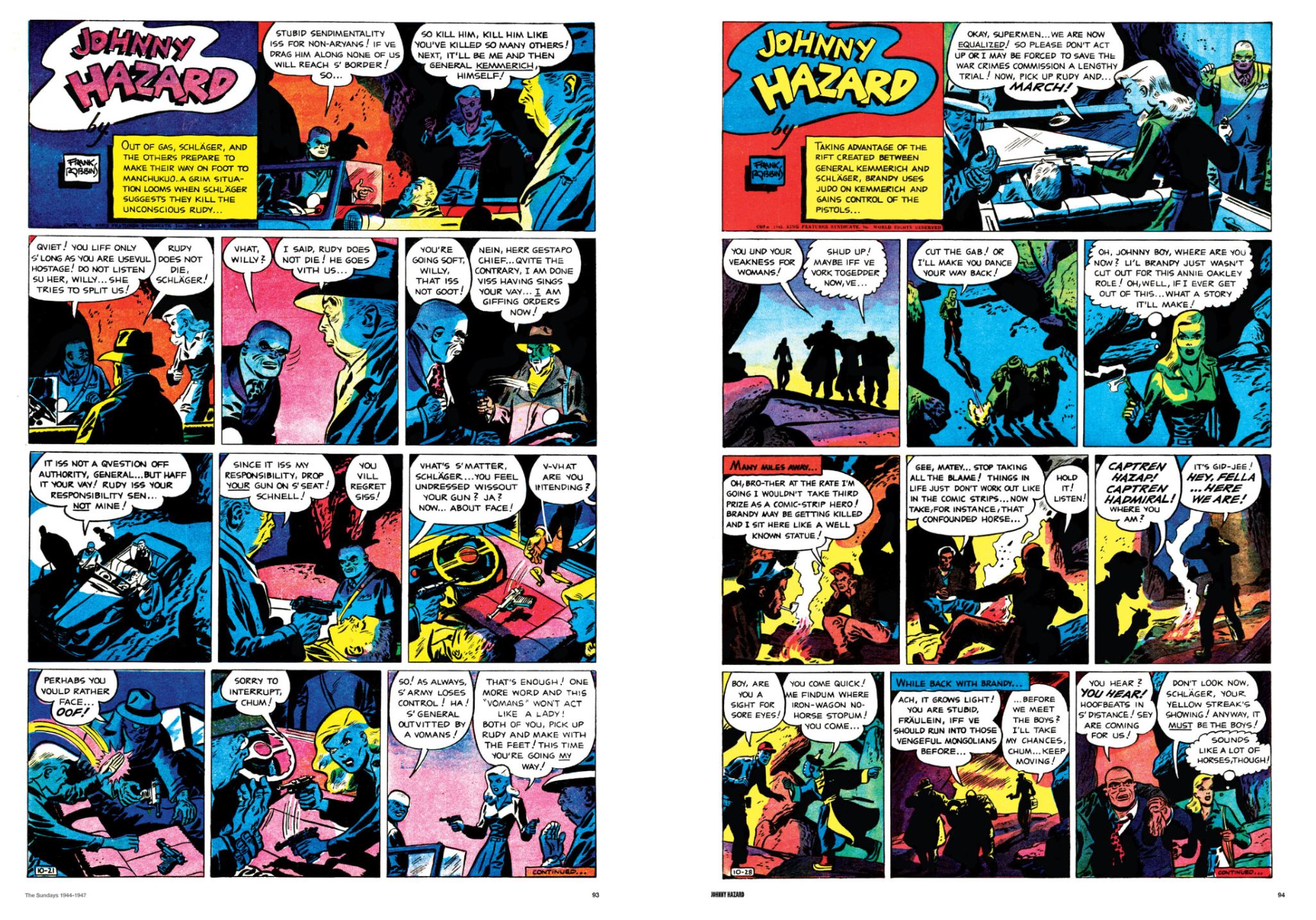
That last official military manoeuvre led into the bewildering imbroglio ‘Balinese Dancing Idol’ (25th November 1945 – 21st April 1946). As the wanderers gradually transition back to civilian life and fly home, they pause their crossing of the China Sea and are hired by enigmatic Mr. Gootch to babysit a mysterious box he is transporting. The odd duck is actually fleeing former partners Sable and Orchid, but when he apparently dies, his naive dupes are stuck with it.
Opening the package Hazard, Brandy & The Admiral Slocum discover an ordinary-seeming dancing doll worth far less than the thousands of dollars Gootch paid them. Relentlessly pursued, the Americans part ways. Thinking Brandy safe, the aviators eventually fall into Sable’s hands and learn that the figurine is the most valuable object on Earth. They have no idea that Brandy is spying on them…
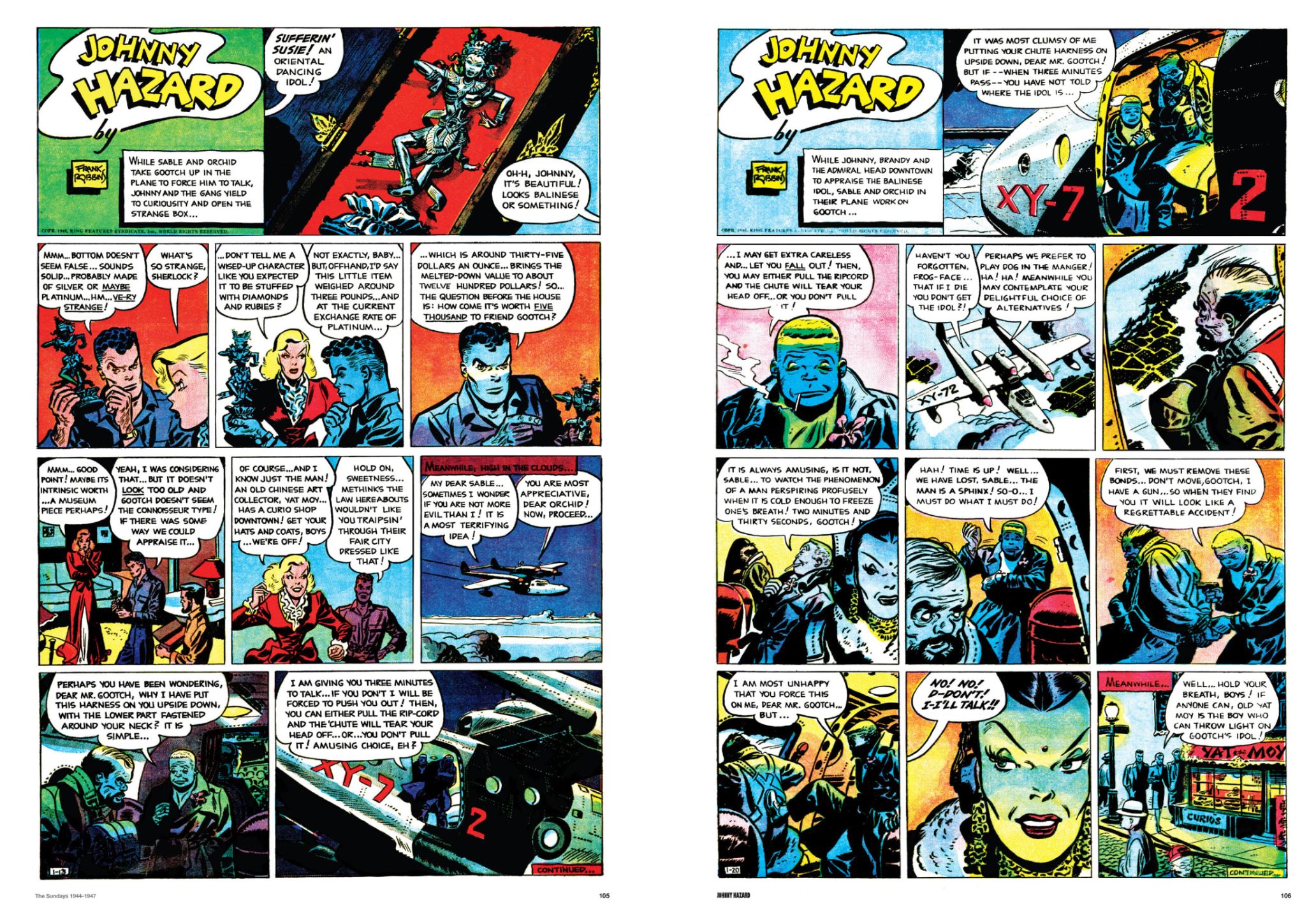
The doll is actually an example of an ancient anti-gravity element and Sable is desperate to find the lost island it originated from. Moments from being murdered, fast-talking Johnny and the Admiral convince the femme fatale that they can to find the “lost island of Legon” and commandeer the source and all remaining specimens of the miracle element. With Brandy as stowaway, the expedition ‘Searching for the Metal Lighter Than Air’ (28th April – 29th September 1946) switches gears from crime thriller to sci fi romp as the crew and a strangely alive again Gootch raid the hidden land of the Dancing Goddess Legon and find treasure beyond price and deadly danger too great to survive.
Thankfully, at the most propitiously perilous moment, the hordes of rampaging affronted aborigines, legions of dancers and terrible temple guards are distracted by covert comrade Brandy who looks remarkably like their long-gone goddess…
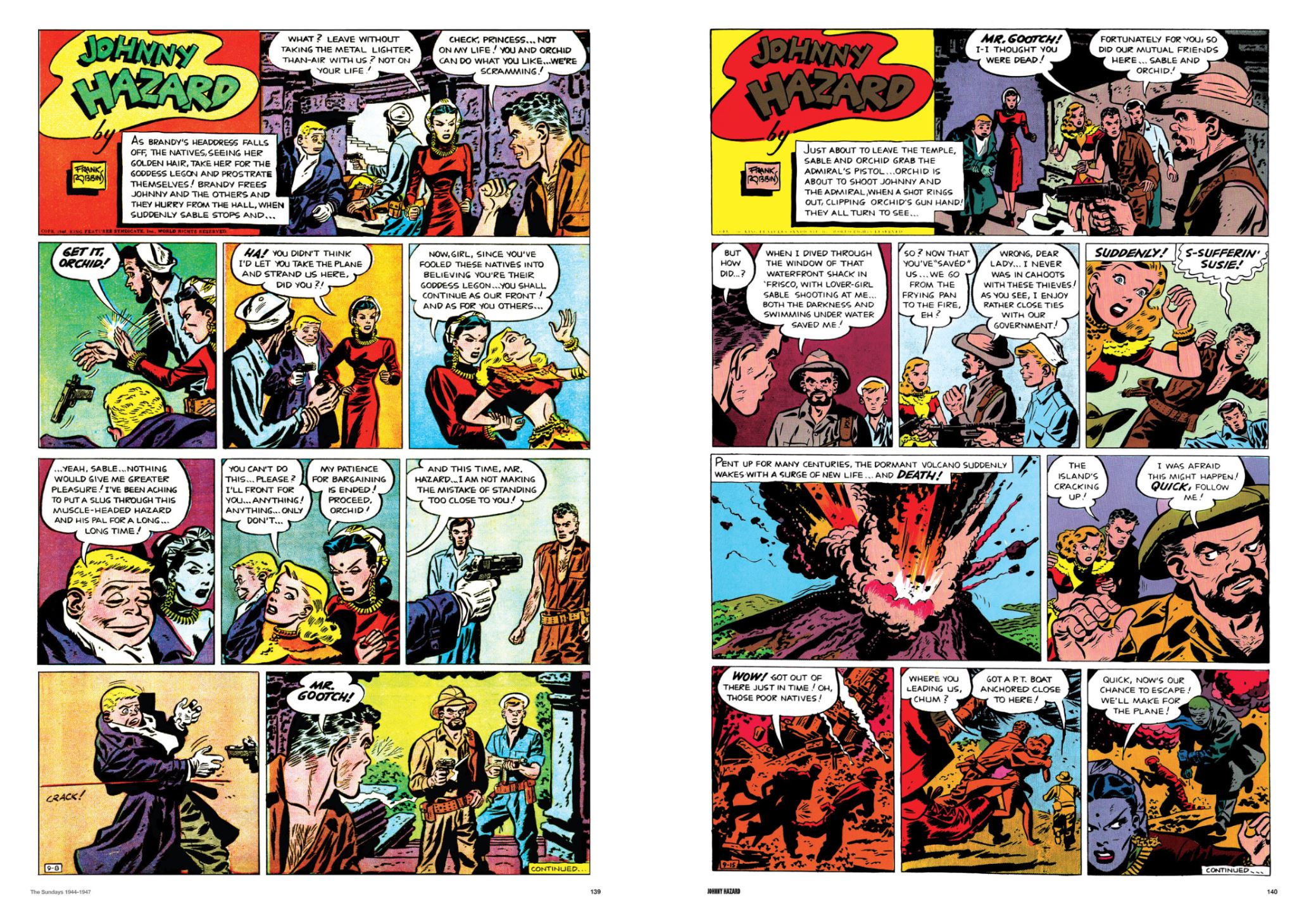
What might have been the dawn of a new age ends abruptly when the shenanigans – and moving tons of the miracle metal that have held up the atoll for ages – trigger a vast volcanic detonation…
In the course of fleeing for their lives, Gootch had been revealed as a Government agent and, as he arranges for Johnny, Brandy & Slocum to complete their trip back to the USA, a fresh crisis develops when their Navy vessel is attacked by ‘The Java Sea Pirate’ (6th October 1946 – 12th January 1947). This marine marauder has his own submarine and uses a pervasive fog to create unconsciousness before commencing his plundering. However, when “Baron DeBris. Pirate extraordinaire” snatches sleeping Brandy as a prize and hostage he invites the wrath of a furious boyfriend who just happens to be one of the greatest bomber pilots of all time…
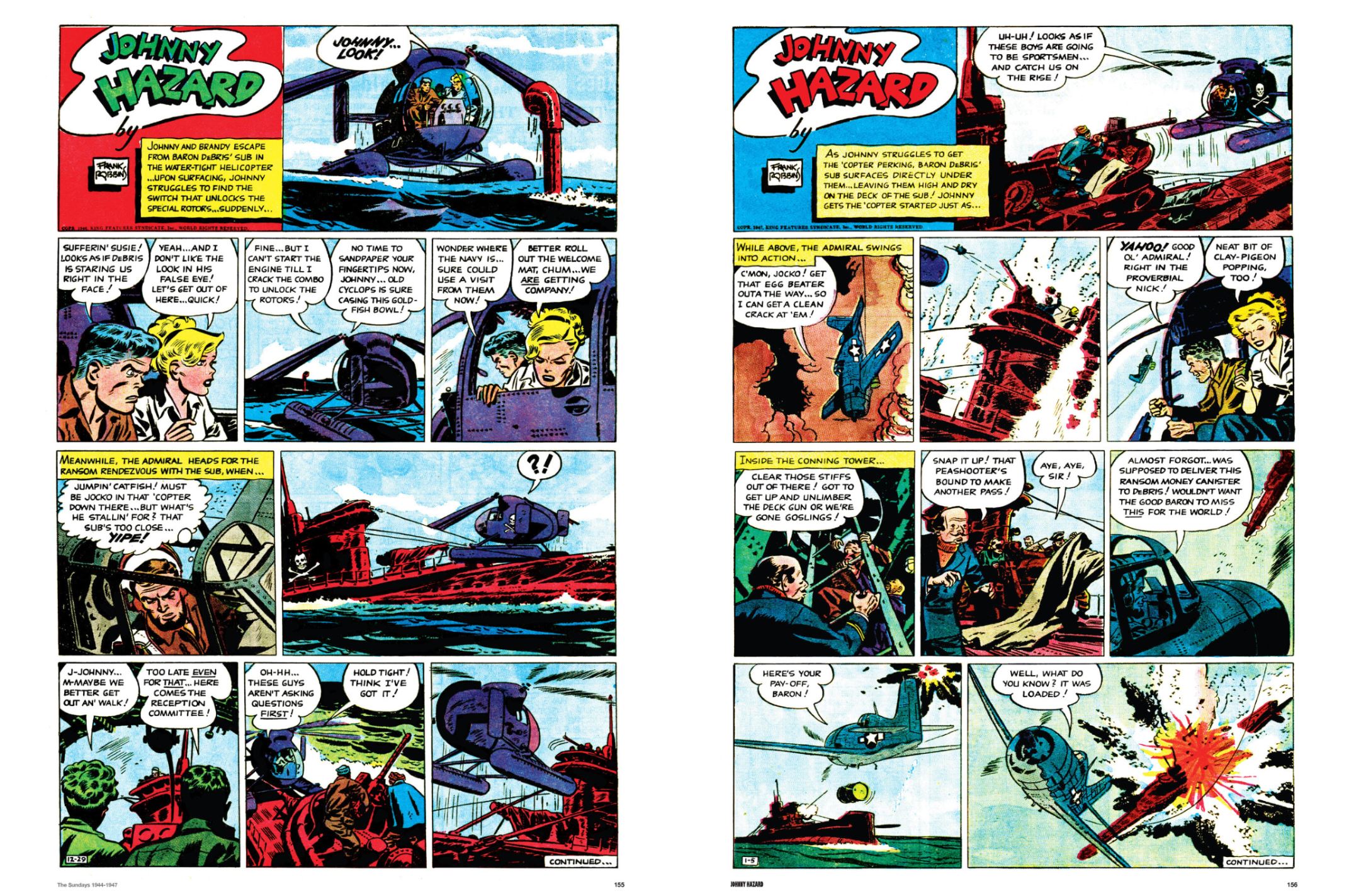
As some of the greatest comic strips in history, sharp, snappy, devilishly funny repartee in the style of movies like Howard Hawks’ His Girl Friday and Frank Capra’s It Happened One Night was a hallmark of these yarns, but that can present problems for modern readers. Contemporary attitudes to sexuality, gender and particularly race are far from what we find acceptable – or should even tolerate – today. The situation is further compounded by an understandably fervent patriotic tone, equal parts pure jingoism and government-sponsored morale boosting.
Every feature of the era participated in the war effort by shaping its content accordingly, and terms like “Jap”, “Nip”, “Kraut” and different forms of “othering” were common parlance in both movies and comics – the two main forms of popular entertainment. These slurs became character-defining shorthand, used without consideration and thus an indelible facet of national speech and behaviour for decades to follow. We know better now – at least most of us do – but must accept and understand that hurtful and unjust as such terms are, they did exist and we’re doing history and our society a huge and dangerous disservice by ignoring, downplaying or worst of all self-censoring those terms and the attitudes that fed them.
Johnny Hazard was far less egregious than most. Robbins took pains to show the Japanese army (who had committed many verified real world atrocities) did not unnecessarily suffer from the worst propagandist nonsense used by the Allies to bolster a united war spirit. Other ethnicities – like Chinese, Iranian, Tibetans and Italians – were treated with the full dignity of different but equal cultures and depicted as competent comrades in arms, not ignorant primitives in need of a white man’s saving graces. However, arch comedian Robbins couldn’t resist playing mischievous games with accents, names and speech patterns, so if you don’t think you’re capable of being historically detached, best forgo these delights.
To be continued…
The tome terminates with a gallery of Original Artwork: starring Kitty Hawkes, Sabina Eden, Pixie and Johnny mirroring similar shots of pilot Hazard and strip sirens Vava Lavoum, Baroness Flame and Sequin, used to introduce the opening editorial section and all taken from the artist’s promotional materials to plug the strip to potential new syndicate papers…
These exotic all-action intrigues and romances perfectly capture the mood and magic of a distant yet incredibly familiar time; with cool heroes, hot dames and exceedingly intemperate bad-guys encountering exotic locales and stunning scenarios, all peppered with blistering tension, slyly mature humour and vivid, visceral excitement. Johnny Hazard is a brilliant two-fisted thriller-strip too long forgotten, and you should grab at the chance to fix that.
© 2019 King Features Syndicate, Inc. ® Hearst Holdings Inc.; reprinted with permission. All rights reserved. Foreword © 2019 Howard Chaykin; Introduction © 2019 Daniel Herman; Focus © 2019 E.S. Herman; and Close-up © 2019 Roy Thomas.